Effective
Strategic Marketing Planning
Nigel S Jones
BEng MSc MIDM MCIM FInstSMM
1
• Provide and overview of the Strategic Marketing
Planning Process
• Introduce some key planning tools / technique
2
Objectives
Definition of Marketing
3
The management process responsible for identifying,
anticipating and satisfying customer requirements
profitably.
Definition of Marketing
4
Purpose of Strategic Marketing Planning
5
Strategy is the way in which an organisation achieves its goals
Principle focus Marketing Planning:
• Identification and creation of a competitive advantage
• Identify and capitalise on opportunities
Where
are we
now?
Where do
we want
to be?
How are
we going
to get
there?
How will
we know
when we
are there?
The Planning Process
6
4 Key Phases
Phase 1 - Goal Setting
Phase 2 - Situation Analysis
Phase 3 - Strategy Formation
Phase 4 - Resource Allocation / Implementation
7
4 Key Phases
1. Vision / Mission
Phase 1
Goal Setting
Phase 2
Situation Analysis
Phase 3
Strategy Formation
Phase 4
Resource Allocation /
Implementation
2. Corporate Objectives
4. SWOT Analysis
5. Issues to be addressed
3. Marketing Audit
6. Marketing Objectives
7. Marketing Strategies
9. Budget
10. 1st Year Implementation Plan
8
Measurement
and Review
Phase 1 - Goal Setting
9
Vision Statement
10
Where your organisation wants to go
What it wants to be
Should be a source of inspiration
Example:
To become the most successful premium
manufacturer in the car industry
Mission Statement
11
Fundamental purpose of organisation
What it does to achieve vision
Defines critical processes
Vision Statement
12
Example:
To be the worldwide leader in sharing delicious
tastes and creating joyful memories
Mission Statement
13
Example:
Krispy Kreme seeks to maintain its loyal customer base and attract
new customers in both current and developing markets with its
commitment to quality and consistency in its doughnuts, other
baked goods, and beverages .
Krispy Kreme will lead the industry via a commitment to
innovation, service, growth, and quality . Its channel system and
franchise system ensure profitability for retailers and franchisees
while providing convenient access for customers. Krispy Kreme
desires to instill the belief that the company is a set of capabilities,
not just a product or brand .
Corporate Mission & Objectives
14
• Statement of the organisation’s role
• Business Definition – distinctive competences
• Indication of the future market performance
• Summary of financial performance
• Typically 3 – 5 year planning period
15
Phase 2 - Situation Analysis
Example - The ABC Motor Company
Established 16 November 2010
Sports Coupe´
Family Hybrid 4 x 4
Small Hatchback
16
Market Segments
17
Group of customers with same or similar requirements
Each has own critical success factors – address to
succeed
Affects marketing / promotional mix
Market Segments
18
Types of Segmentation
• Geographic Segmentation
• Demographic Segmentation – age, socio, gender
• Psychographic – lifestyle, behavioral
http://www.strategicbusinessinsights.com/vals/presurvey.shtml
Example - The ABC Motor Company
Established 16 November 2010
Sports Coupe´
Family Hybrid 4 x 4
Small Hatchback
19
Segment: Young Drivers - C1C2D
Limited disposable income
Segment: Families - BC1C2
Moderate disposable income
Segment: Executive – ABC1
Large disposable income
CSF: Cheap to insure!
CSF: Safe and economical
CSF: Indicate status – excite!
SWOT Analysis
Example - ABC Motor Company
Two areas of analysis:
Internal – Strengths and Weaknesses
External – Opportunities and Threats
20
Internal Analysis
21
Strengths
• Very strong loyal UK following
• Low insurance grouping for hatchback and family model
• Recent addition of hybrid family car
• Excellent Research and Development (R&D) Resources
22
SWOT - Internal Analysis
Example - ABC Motor Company
Weaknesses
• Marketing / Brand Development – small department
• Customer Relations / Database
• Not a strong brand yet – perception of coupe as exec model
• Product Reliability Issues
• Sports Coupe – very heavy on fuel and high emissions
• Hatchback now a bit long in the tooth – spec falling behind
competition
23
SWOT - Internal Analysis
Example - ABC Motor Company
External Analysis
24
Considers Opportunities and Threats
PEST or PESTLE Model:
25
External Analysis
Political
Economic
Social
Technology
Legal
Environmental
SWOT Analysis ABC Motor Company
Political
• Potential increased taxation 4 x 4 – not hybrids
26
Opportunities
Economic
• Escalating fuel prices – selling point for hybrids
Social
• UK designed and produced vehicles – strong selling feature
in UK market
Technology
• Digital / Social media – inexpensive marketing tools
SWOT Analysis ABC Motor Company
Political
• VAT to reach 20% for 2011 will impact sales for at least 1st two
quarters
27
Threats
Economic
• Escalating fuel prices
• Sales of new cars still low
Social
• Increasing environmental awareness – impact on performance
cars
Technology
• Development of battery technology – competition from electric
cars
• Strength of brand - poor
• Customer Relations / Database - limited
• Product Reliability Issues
• Sports Coupe – very heavy on fuel and high emissions
• Hatchback now a bit long in the tooth – spec falling
behind competition
28
Issues to be Addressed from Analysis
Example - ABC Motor Company
29
Phase 3
Strategy Formation
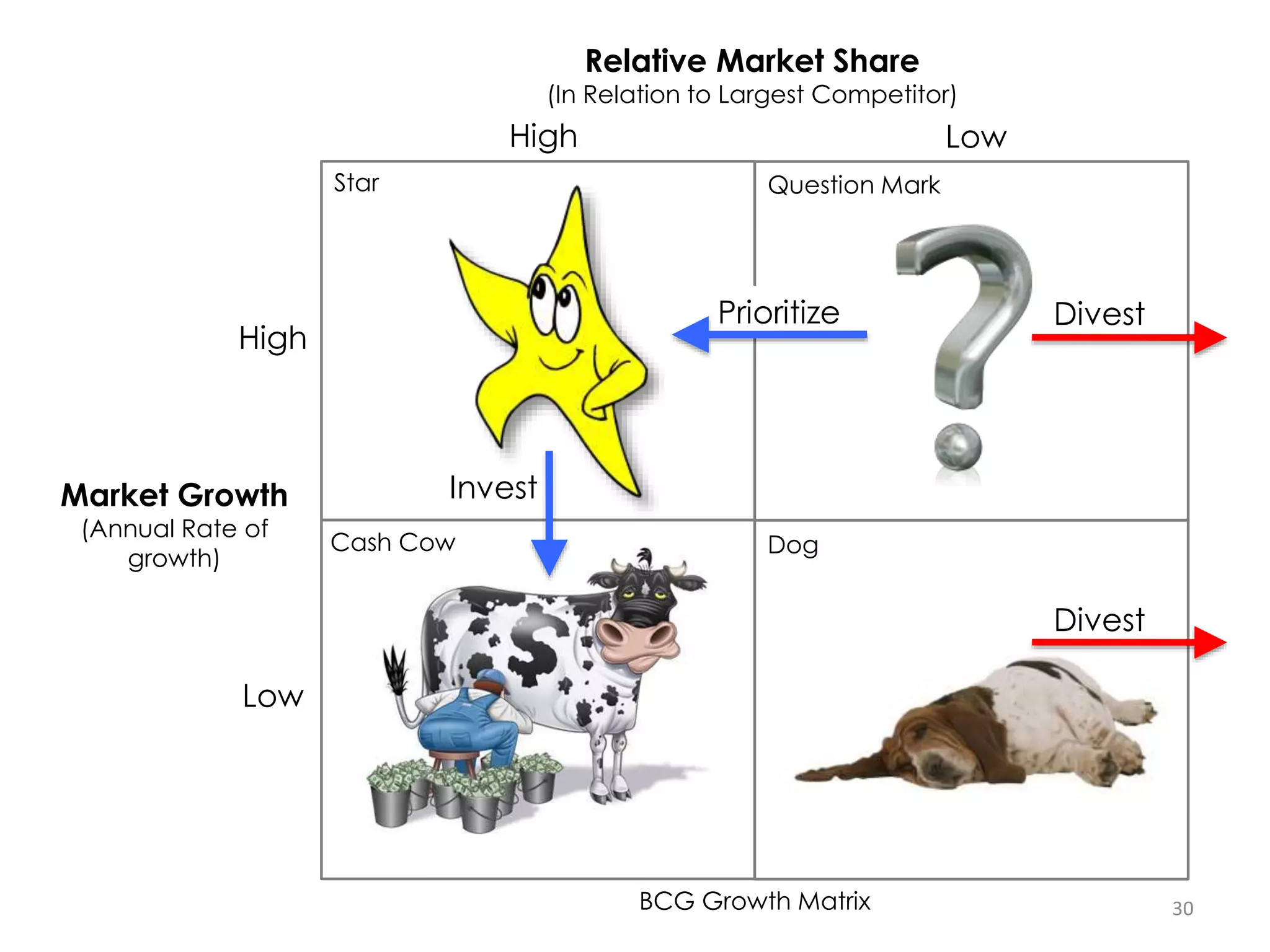
High Low
Relative Market Share
(In Relation to Largest Competitor)
BCG Growth Matrix
High
Low
Market Growth
(Annual Rate of
growth)
Divest
Divest
Prioritize
Invest
Star
Cash Cow
Question Mark
Dog
30
Sports Coupe´Family Hybrid 4 x 4
Small Hatchback
The ABC Motor Company
High Low
Relative Market Share
(In Relation to Largest Competitor)
BCG Growth Matrix
High
Low
Market Growth
(Annual Rate of
growth)
Star
Cash Cow
Question Mark
Dog
31
• Develop ABC Motor Company Brand
• Develop Customer Relations / Marketing Database
• Resolve Product Reliability Issues
• Focused marketing for Sports Coupe to increase
market share
• Re-design of Hatchback – to gain larger market share
• Increased marketing on Family Hybrid – Cash Cow
32
Marketing Objectives (From Issues)
Fundamental Questions
1. Why should customers come to you?
2. Do you deliver what you promise and more?
3. Are your customers delighted?
Or just satisfied?
33
Planning Reality Check
Roger Staubach
• Emphasizes superiority of brand based upon unique
features and benefits
• Differentiates company from competitors
• Reinforces customers decision to purchase
34
Unique Selling Proposition (USP)
(Rosser Reeves, USA)
Approach to identifying USP: -
1. Identify you 3 biggest benefits
2. Be unique & specific
3. Solve and industry Performance Gap
• Current issues in the market
• What do you do that your competitors don’t do
4. Condense into one single concise sentence
35
Unique Selling Proposition (USP)
USP Example
“When it absolutely, positively
has to be there overnight”
36
Marketing Strategies
Actions taken to achieve objectives
Develop strengths and counter weaknesses
Strategy in terms of: -
• Product
• Price
• Place
• Promotion
Marketing Strategies
Product
Policies regarding: -
• Product lines
• Modifications
• Specifications to suit segments
• Product additions / deletions
• Design
• Branding
e.g. Re-design of Hatchback
specification
Marketing Strategies
Price
Pricing Policies regarding: -
• Pricing objectives – e.g. max revenue, profit, survival,
market share
• Strategies – Skimming, Penetration, loss leaders etc
• Loyalty discounts
• Pricing for different products
• Pricing for different segments
e.g. reduce price of Coupe to increase market share
and move into “cash cow”
Marketing Strategies
Place
Policies regarding: -
• Distribution channels / retailers
• Agents, resellers, franchises
• Customer services levels
e.g. direct marketing
Promotion
Marketing Strategies
Promotion
Policies regarding the promotional mix: -
• Advertising
• Sales promotion
• Public Relations
• Personal selling
• Direct Marketing
e.g. sales promotions for end of line Hatchback before
re-spec
Marketing Strategies
Promotion – 5M’s
• Mission - Objectives
• Money – Cost Implications
• Message – to suit market segment
• Media – Appropriate media
• Measurement – how can the result be measured?
Ladder of Engagement
45
Phase 4 - Resource Allocation / Implementation
Implementation
Budget / Resources
Strategies and tactics must be aligned with available
resources
Both financial an physical
Implementation – e.g. Promotion
Action Jan Feb Mar April May June July Aug Sept Oct Nov Dec
Advertising
Sales
Promotion
Public
Relations
Personal
Selling
Direct
Marketing
Measurement ROI (Metrics)
• Increase in turnover
• Advertising – impressions from view listener volumes
• Consumer surveys
• Sales promotions – return of coupons / loyalty cards
• Wide range of methods to measure digital marketing
• Analytics
• Number of conversations regarding your product
• Number of tweets / retweets
• Number of followers
• Number impressions
• Number of views (video / slides)
• Etc etc.
Measurement ROI (Metrics)
Financial Analysis
• Cost per enquiry (CPE) / Response (CPR)
• Response%
• Conversion Ratios
• Cost per order (CPO)
• Return on investment
• Lifetime Value
Further Reading
50
herdmanjones
Strategic Marketing Consultants
info@herdmanjones.co.uk
www.herdmanjones.co.uk
51
NigelSJones
Nigel S Jones
Herdman Jones Associates Ltd

Strategic Marketing Planning

  • 1.
    Effective Strategic Marketing Planning NigelS Jones BEng MSc MIDM MCIM FInstSMM 1
  • 2.
    • Provide andoverview of the Strategic Marketing Planning Process • Introduce some key planning tools / technique 2 Objectives
  • 3.
    Definition of Marketing 3 Themanagement process responsible for identifying, anticipating and satisfying customer requirements profitably.
  • 4.
  • 5.
    Purpose of StrategicMarketing Planning 5 Strategy is the way in which an organisation achieves its goals Principle focus Marketing Planning: • Identification and creation of a competitive advantage • Identify and capitalise on opportunities
  • 6.
    Where are we now? Where do wewant to be? How are we going to get there? How will we know when we are there? The Planning Process 6
  • 7.
    4 Key Phases Phase1 - Goal Setting Phase 2 - Situation Analysis Phase 3 - Strategy Formation Phase 4 - Resource Allocation / Implementation 7
  • 8.
    4 Key Phases 1.Vision / Mission Phase 1 Goal Setting Phase 2 Situation Analysis Phase 3 Strategy Formation Phase 4 Resource Allocation / Implementation 2. Corporate Objectives 4. SWOT Analysis 5. Issues to be addressed 3. Marketing Audit 6. Marketing Objectives 7. Marketing Strategies 9. Budget 10. 1st Year Implementation Plan 8 Measurement and Review
  • 9.
    Phase 1 -Goal Setting 9
  • 10.
    Vision Statement 10 Where yourorganisation wants to go What it wants to be Should be a source of inspiration Example: To become the most successful premium manufacturer in the car industry
  • 11.
    Mission Statement 11 Fundamental purposeof organisation What it does to achieve vision Defines critical processes
  • 12.
    Vision Statement 12 Example: To bethe worldwide leader in sharing delicious tastes and creating joyful memories
  • 13.
    Mission Statement 13 Example: Krispy Kremeseeks to maintain its loyal customer base and attract new customers in both current and developing markets with its commitment to quality and consistency in its doughnuts, other baked goods, and beverages . Krispy Kreme will lead the industry via a commitment to innovation, service, growth, and quality . Its channel system and franchise system ensure profitability for retailers and franchisees while providing convenient access for customers. Krispy Kreme desires to instill the belief that the company is a set of capabilities, not just a product or brand .
  • 14.
    Corporate Mission &Objectives 14 • Statement of the organisation’s role • Business Definition – distinctive competences • Indication of the future market performance • Summary of financial performance • Typically 3 – 5 year planning period
  • 15.
    15 Phase 2 -Situation Analysis
  • 16.
    Example - TheABC Motor Company Established 16 November 2010 Sports Coupe´ Family Hybrid 4 x 4 Small Hatchback 16
  • 17.
    Market Segments 17 Group ofcustomers with same or similar requirements Each has own critical success factors – address to succeed Affects marketing / promotional mix
  • 18.
    Market Segments 18 Types ofSegmentation • Geographic Segmentation • Demographic Segmentation – age, socio, gender • Psychographic – lifestyle, behavioral http://www.strategicbusinessinsights.com/vals/presurvey.shtml
  • 19.
    Example - TheABC Motor Company Established 16 November 2010 Sports Coupe´ Family Hybrid 4 x 4 Small Hatchback 19 Segment: Young Drivers - C1C2D Limited disposable income Segment: Families - BC1C2 Moderate disposable income Segment: Executive – ABC1 Large disposable income CSF: Cheap to insure! CSF: Safe and economical CSF: Indicate status – excite!
  • 20.
    SWOT Analysis Example -ABC Motor Company Two areas of analysis: Internal – Strengths and Weaknesses External – Opportunities and Threats 20
  • 21.
  • 22.
    Strengths • Very strongloyal UK following • Low insurance grouping for hatchback and family model • Recent addition of hybrid family car • Excellent Research and Development (R&D) Resources 22 SWOT - Internal Analysis Example - ABC Motor Company
  • 23.
    Weaknesses • Marketing /Brand Development – small department • Customer Relations / Database • Not a strong brand yet – perception of coupe as exec model • Product Reliability Issues • Sports Coupe – very heavy on fuel and high emissions • Hatchback now a bit long in the tooth – spec falling behind competition 23 SWOT - Internal Analysis Example - ABC Motor Company
  • 24.
  • 25.
    Considers Opportunities andThreats PEST or PESTLE Model: 25 External Analysis Political Economic Social Technology Legal Environmental
  • 26.
    SWOT Analysis ABCMotor Company Political • Potential increased taxation 4 x 4 – not hybrids 26 Opportunities Economic • Escalating fuel prices – selling point for hybrids Social • UK designed and produced vehicles – strong selling feature in UK market Technology • Digital / Social media – inexpensive marketing tools
  • 27.
    SWOT Analysis ABCMotor Company Political • VAT to reach 20% for 2011 will impact sales for at least 1st two quarters 27 Threats Economic • Escalating fuel prices • Sales of new cars still low Social • Increasing environmental awareness – impact on performance cars Technology • Development of battery technology – competition from electric cars
  • 28.
    • Strength ofbrand - poor • Customer Relations / Database - limited • Product Reliability Issues • Sports Coupe – very heavy on fuel and high emissions • Hatchback now a bit long in the tooth – spec falling behind competition 28 Issues to be Addressed from Analysis Example - ABC Motor Company
  • 29.
  • 30.
    High Low Relative MarketShare (In Relation to Largest Competitor) BCG Growth Matrix High Low Market Growth (Annual Rate of growth) Divest Divest Prioritize Invest Star Cash Cow Question Mark Dog 30
  • 31.
    Sports Coupe´Family Hybrid4 x 4 Small Hatchback The ABC Motor Company High Low Relative Market Share (In Relation to Largest Competitor) BCG Growth Matrix High Low Market Growth (Annual Rate of growth) Star Cash Cow Question Mark Dog 31
  • 32.
    • Develop ABCMotor Company Brand • Develop Customer Relations / Marketing Database • Resolve Product Reliability Issues • Focused marketing for Sports Coupe to increase market share • Re-design of Hatchback – to gain larger market share • Increased marketing on Family Hybrid – Cash Cow 32 Marketing Objectives (From Issues)
  • 33.
    Fundamental Questions 1. Whyshould customers come to you? 2. Do you deliver what you promise and more? 3. Are your customers delighted? Or just satisfied? 33 Planning Reality Check Roger Staubach
  • 34.
    • Emphasizes superiorityof brand based upon unique features and benefits • Differentiates company from competitors • Reinforces customers decision to purchase 34 Unique Selling Proposition (USP) (Rosser Reeves, USA)
  • 35.
    Approach to identifyingUSP: - 1. Identify you 3 biggest benefits 2. Be unique & specific 3. Solve and industry Performance Gap • Current issues in the market • What do you do that your competitors don’t do 4. Condense into one single concise sentence 35 Unique Selling Proposition (USP)
  • 36.
    USP Example “When itabsolutely, positively has to be there overnight” 36
  • 37.
    Marketing Strategies Actions takento achieve objectives Develop strengths and counter weaknesses Strategy in terms of: - • Product • Price • Place • Promotion
  • 38.
    Marketing Strategies Product Policies regarding:- • Product lines • Modifications • Specifications to suit segments • Product additions / deletions • Design • Branding e.g. Re-design of Hatchback specification
  • 39.
    Marketing Strategies Price Pricing Policiesregarding: - • Pricing objectives – e.g. max revenue, profit, survival, market share • Strategies – Skimming, Penetration, loss leaders etc • Loyalty discounts • Pricing for different products • Pricing for different segments e.g. reduce price of Coupe to increase market share and move into “cash cow”
  • 40.
    Marketing Strategies Place Policies regarding:- • Distribution channels / retailers • Agents, resellers, franchises • Customer services levels e.g. direct marketing
  • 41.
  • 42.
    Marketing Strategies Promotion Policies regardingthe promotional mix: - • Advertising • Sales promotion • Public Relations • Personal selling • Direct Marketing e.g. sales promotions for end of line Hatchback before re-spec
  • 43.
    Marketing Strategies Promotion –5M’s • Mission - Objectives • Money – Cost Implications • Message – to suit market segment • Media – Appropriate media • Measurement – how can the result be measured?
  • 44.
  • 45.
    45 Phase 4 -Resource Allocation / Implementation
  • 46.
    Implementation Budget / Resources Strategiesand tactics must be aligned with available resources Both financial an physical
  • 47.
    Implementation – e.g.Promotion Action Jan Feb Mar April May June July Aug Sept Oct Nov Dec Advertising Sales Promotion Public Relations Personal Selling Direct Marketing
  • 48.
    Measurement ROI (Metrics) •Increase in turnover • Advertising – impressions from view listener volumes • Consumer surveys • Sales promotions – return of coupons / loyalty cards • Wide range of methods to measure digital marketing • Analytics • Number of conversations regarding your product • Number of tweets / retweets • Number of followers • Number impressions • Number of views (video / slides) • Etc etc.
  • 49.
    Measurement ROI (Metrics) FinancialAnalysis • Cost per enquiry (CPE) / Response (CPR) • Response% • Conversion Ratios • Cost per order (CPO) • Return on investment • Lifetime Value
  • 50.
  • 51.

Editor's Notes

  • #12 Mission statement is an internal statement Not written for customers (although can be used) Communicated to all staff Driven and inspired by vision statement
  • #20 CSF start to provide strategic focus – on product spec and also marketing message!
  • #29 Note, not all issues are marketing – Could be resource / systems procedures etc
  • #33 Note, not all issues are marketing – Could be resource / systems procedures etc
  • #34 Note, not all issues are marketing – Could be resource / systems procedures etc
  • #35 Note, not all issues are marketing – Could be resource / systems procedures etc
  • #36 Note, not all issues are marketing – Could be resource / systems procedures etc
  • #37 Note, not all issues are marketing – Could be resource / systems procedures etc
  • #40 Skimming - high prices – reduce as sales slow down Penetration pricing – low to encourage purchases
  • #41 Skimming - high prices – reduce as sales slow down Penetration pricing – low to encourage purchases
  • #42 Skimming - high prices – reduce as sales slow down Penetration pricing – low to encourage purchases
  • #48 Only Showing Promotional mix elements