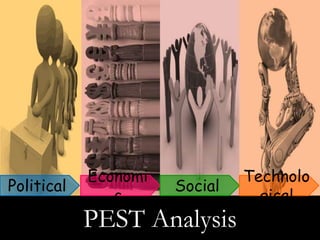
PEST Analysis
Political
Economi
c
Social
Technolo
gical
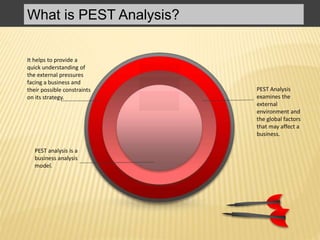
What is PEST Analysis?
It helps to provide a
quick understanding of
the external pressures
facing a business and
their possible constraints
on its strategy.
PEST Analysis
examines the
external
environment and
the global factors
that may affect a
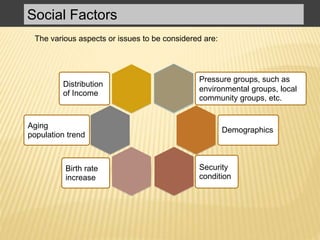
business.
PEST analysis is a
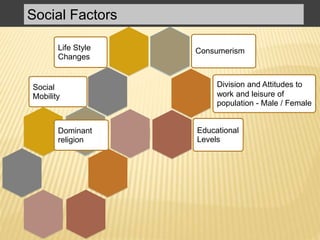
business analysis
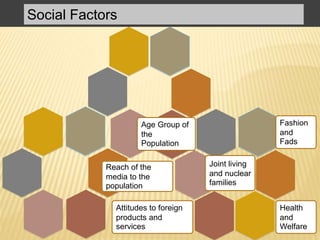
model.
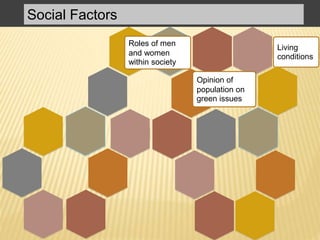
What is PEST Analysis?
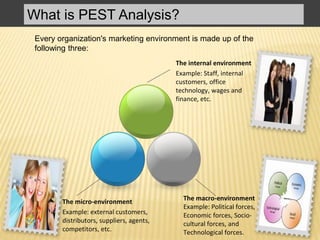
Every organization's marketing environment is made up of the
following three:
The internal environment
Example: Staff, internal
customers, office
technology, wages and
finance, etc.
The micro-environment
Example: external customers,
distributors, suppliers, agents,
competitors, etc.
The macro-environment
Example: Political forces,
Economic forces, Socio-
cultural forces, and
Technological forces.
What is PEST Analysis?
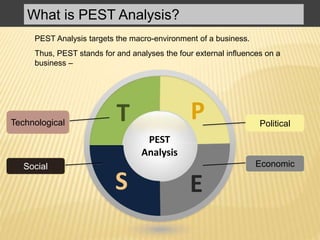
PEST Analysis targets the macro-environment of a business.
Thus, PEST stands for and analyses the four external influences on a
business –
PEST
Analysis
PT
S E
Political
EconomicSocial
Technological
What is PEST Analysis?
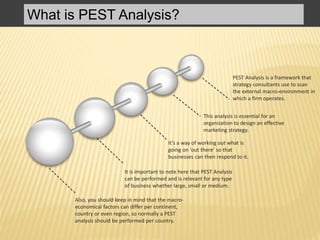
PEST Analysis is a framework that
strategy consultants use to scan
the external macro-environment in
which a firm operates.
This analysis is essential for an
organization to design an effective
marketing strategy.
It’s a way of working out what is
going on ‘out there’ so that
businesses can then respond to it.
It is important to note here that PEST Analysis
can be performed and is relevant for any type
of business whether large, small or medium.
Also, you should keep in mind that the macro-
economical factors can differ per continent,
country or even region, so normally a PEST
analysis should be performed per country.
Importance of PEST Analysis
PEST Analysis is crucial in designing a
marketing strategy for the business. PEST
Analysis helps:
• In the value creation opportunities of a
strategy.
• To assess the market including
competitors from the stand point of a
particular business.
• To evaluate the impact of the external
environment on a firm’s objectives and
strategy.
• To make contingency plans for threats.
• To prepare business and strategic
plans.
• To understand market growth or decline,
business position, potential and
direction for operations.
Importance of PEST Analysis
PEST Analysis is crucial in designing a
marketing strategy for the business. PEST
Analysis helps:
• To align company’s performance
positively with the powerful forces of
change that are affecting business
environment.
• To successfully launch business
operations into new markets and new
countries.
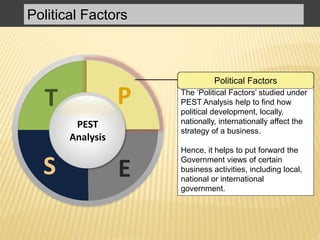
The ‘Political Factors’ studied under
PEST Analysis help to find how
political development, locally,
nationally, internationally affect the
strategy of a business.
Hence, it helps to put forward the
Government views of certain
business activities, including local,
national or international
government.
Political Factors
PT
S E
P
PEST
Analysis
Political Factors
Political Factors
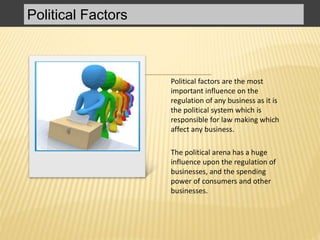
Political factors are the most
important influence on the
regulation of any business as it is
the political system which is
responsible for law making which
affect any business.
The political arena has a huge
influence upon the regulation of
businesses, and the spending
power of consumers and other
businesses.
Political Factors
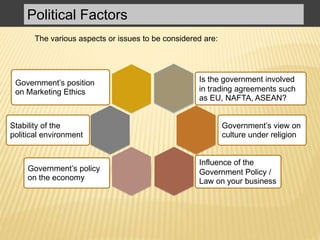
Stability of the
political environment
Government’s policy
on the economy
Influence of the
Government Policy /
Law on your business
Government’s view on
culture under religion
Is the government involved
in trading agreements such
as EU, NAFTA, ASEAN?
Government’s position
on Marketing Ethics
The various aspects or issues to be considered are:
Political Factors
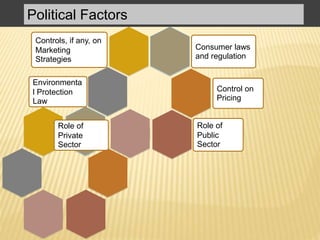
Environmenta
l Protection
Law
Controls, if any, on
Marketing
Strategies
Consumer laws
and regulation
Control on
Pricing
Role of
Public
Sector
Role of
Private
Sector
Political Factors
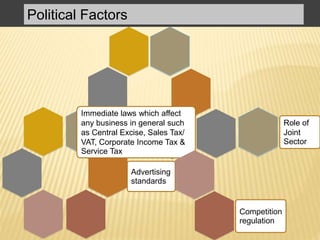
Advertising
standards
Competition
regulation
Role of
Joint
Sector
Immediate laws which affect
any business in general such
as Central Excise, Sales Tax/
VAT, Corporate Income Tax &
Service Tax
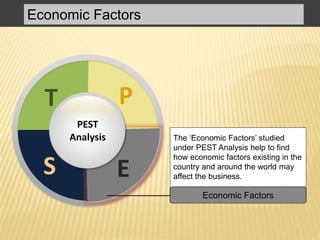
The ‘Economic Factors’ studied
under PEST Analysis help to find
how economic factors existing in the
country and around the world may
affect the business.
Economic Factors
PT
S EE
PEST
Analysis
Economic Factors
Economic Factors
It is crucial to consider the short
term as well as long term state of
economy especially in case of
planning for international
marketing.
Therefore, marketers need to
consider the state of a trading
economy in the short and long-
terms.
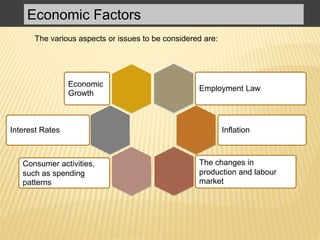
Economic Factors
Interest Rates
Consumer activities,
such as spending
patterns
The changes in
production and labour
market
Inflation
Employment Law
Economic
Growth
The various aspects or issues to be considered are:
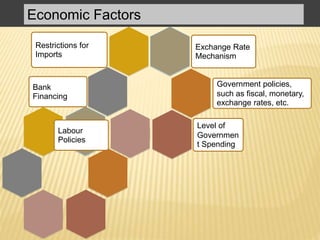
Economic Factors
Bank
Financing
Restrictions for
Imports
Exchange Rate
Mechanism
Government policies,
such as fiscal, monetary,
exchange rates, etc.
Level of
Governmen
t Spending
Labour
Policies
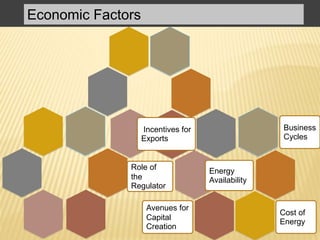
Economic Factors
Role of
the
Regulator
Avenues for
Capital
Creation
Business
Cycles
Incentives for
Exports
Cost of
Energy
Energy
Availability
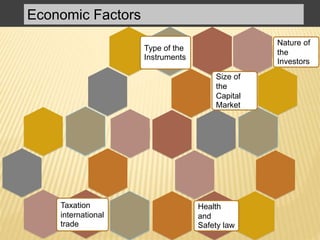
Economic Factors
Type of the
Instruments
Nature of
the
Investors
Size of
the
Capital
Market
Health
and
Safety law
Taxation
international
trade
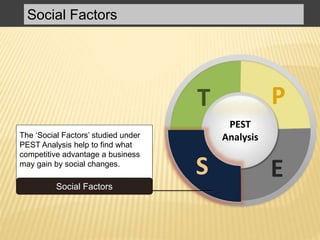
The ‘Social Factors’ studied under
PEST Analysis help to find what
competitive advantage a business
may gain by social changes.
Social Factors
PT
S E
PEST
Analysis
S
Social Factors
Social Factors
The social and cultural influences
on business vary from country to
country.
It is very important that such
factors are considered to
understand the socio-cultural
environment of the country in
which the business has to
prosper.
Social Factors
Aging
population trend
Birth rate
increase
Security
condition
Demographics
Pressure groups, such as
environmental groups, local
community groups, etc.
Distribution
of Income
The various aspects or issues to be considered are:
Social Factors
Social
Mobility
Life Style
Changes
Consumerism
Division and Attitudes to
work and leisure of
population - Male / Female
Educational
Levels
Dominant
religion
Social Factors
Reach of the
media to the
population
Attitudes to foreign
products and
services
Fashion
and
Fads
Age Group of
the
Population
Health
and
Welfare
Joint living
and nuclear
families
Social Factors
Roles of men
and women
within society
Living
conditions
Opinion of
population on
green issues
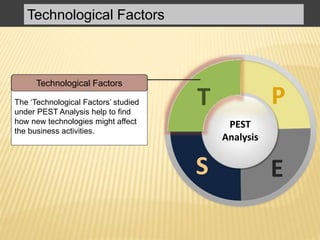
The ‘Technological Factors’ studied
under PEST Analysis help to find
how new technologies might affect
the business activities.
Technological Factors
PT
S E
PEST
Analysis
T
Technological Factors
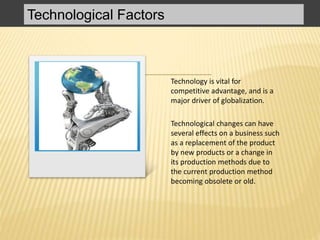
Technology is vital for
competitive advantage, and is a
major driver of globalization.
Technological changes can have
several effects on a business such
as a replacement of the product
by new products or a change in
its production methods due to
the current production method
becoming obsolete or old.
Technological Factors
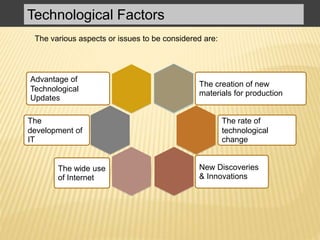
The
development of
IT
The wide use
of Internet
New Discoveries
& Innovations
The rate of
technological
change
The creation of new
materials for production
Advantage of
Technological
Updates
The various aspects or issues to be considered are:
Technological Factors
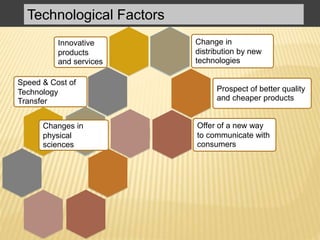
Speed & Cost of
Technology
Transfer
Innovative
products
and services
Change in
distribution by new
technologies
Prospect of better quality
and cheaper products
Offer of a new way
to communicate with
consumers
Changes in
physical
sciences
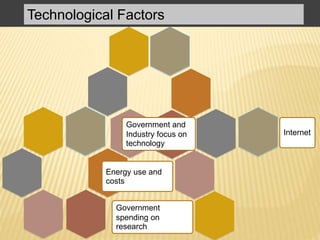
Technological Factors
Energy use and
costs
Government
spending on
research
Internet
Government and
Industry focus on
technology
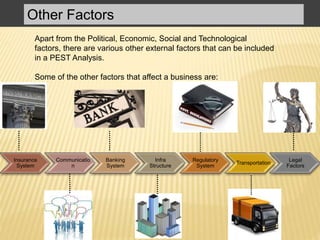
Other Factors
Apart from the Political, Economic, Social and Technological
factors, there are various other external factors that can be included
in a PEST Analysis.
Some of the other factors that affect a business are:
Insurance
System
Communicatio
n
Banking
System
Infra
Structure
Regulatory
System
Transportation
Legal
Factors
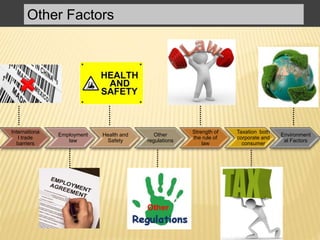
Other Factors
Internationa
l trade
barriers
Employment
law
Health and
Safety
Other
regulations
Strength of
the rule of
law
Taxation both
corporate and
consumer
Environment
al Factors
Other
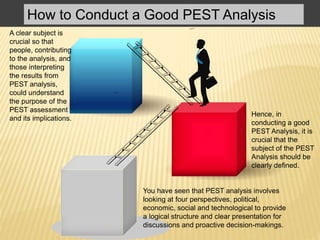
How to Conduct a Good PEST Analysis
You have seen that PEST analysis involves
looking at four perspectives, political,
economic, social and technological to provide
a logical structure and clear presentation for
discussions and proactive decision-makings.
Hence, in
conducting a good
PEST Analysis, it is
crucial that the
subject of the PEST
Analysis should be
clearly defined.
A clear subject is
crucial so that
people, contributing
to the analysis, and
those interpreting
the results from
PEST analysis,
could understand
the purpose of the
PEST assessment
and its implications.
How to Conduct a Good PEST Analysis
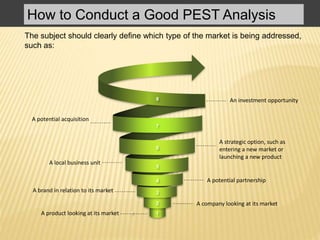
The subject should clearly define which type of the market is being addressed,
such as:
A brand in relation to its market
A company looking at its market
1
2
3
4
5
6
7
8
A product looking at its market
A potential partnership
A local business unit
A strategic option, such as
entering a new market or
launching a new product
A potential acquisition
An investment opportunity
1
How to Conduct a Good PEST Analysis
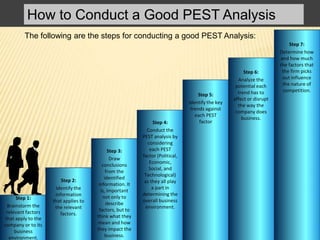
Step 1:
Brainstorm the
relevant factors
that apply to the
company or to its
business
environment.
Step 2:
Identify the
information
that applies to
the relevant
factors.
Step 3:
Draw
conclusions
from the
identified
information. It
is, important
not only to
describe
factors, but to
think what they
mean and how
they impact the
business.
Step 4:
Conduct the
PEST analysis by
considering
each PEST
factor (Political,
Economic,
Social, and
Technological)
as they all play
a part in
determining the
overall business
environment.
Step 5:
Identify the key
trends against
each PEST
factor
Step 6:
Analyze the
potential each
trend has to
affect or disrupt
the way the
company does
business.
Step 7:
Determine how
and how much
the factors that
the firm picks
out influence
the nature of
competition.
The following are the steps for conducting a good PEST Analysis:
Finding Information for PEST Analysis
To conduct a good PEST Analysis, it
is important to understand what kind
of environment the company may
compete in the near future. Thus, it
requires understanding of the forces
that will shape the change.
Information for PEST analysis can be
collected from various secondary
data source of current events and
projected future trends.
Finding Information for PEST Analysis
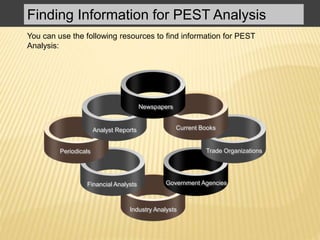
You can use the following resources to find information for PEST
Analysis:
Industry Analysts
Financial Analysts
Periodicals
Analyst Reports
Government Agencies
Trade Organizations
Current Books
Newspapers
Key Points to Remember for PEST
Analysis
Some of the key points to keep in mind while conducting a PEST
Analysis are:
• Avoid trying to conduct a single analysis that tries to cover
the entire history of a firm and an industry.
• Keep the analysis of past developments separate from that
of the present situation and future trends.
• While analyzing PEST factors in the present, make it clear
why the present is different from the past, and how the
industry may need to change.
• Do not worry a lot about whether a particular item is
political, economic, social and technological in nature.
• Keep in mind that many important factors go past the
simple PEST categories.
• It is allowed to leave some categories empty while using a
checklist in PEST rather than trying to find factors that do
not exist.
• Remember that the factors that influence a business the
most depends upon the type of business. Hence, for some
manufacturing and service businesses the most powerful
force will be customers; for others it may be competition.
Summary
In this module you learnt that:
PEST analysis is a business analysis model.
PEST Analysis examines the external environment and the global factors that may
affect a business. It helps to provide a quick understanding of the external pressures
facing a business and their possible constraints on its strategy.
PEST analysis is also known as: STEP, PESTEL, PESTLE, PESTE, PESTLIED, SLEPT,
STEEPLE, STEEPLED, LE PEST C and LEPEST analysis.
PEST stands for and analyses the four external influences on a business:
• Political Factors
• Economic Factors
• Social Factors
• Technological Factors
PEST Analysis can be performed and is relevant for any type of business whether
large, small or medium.

Marketing Management - PEST Analysis

  • 1.
  • 2.
    What is PESTAnalysis? It helps to provide a quick understanding of the external pressures facing a business and their possible constraints on its strategy. PEST Analysis examines the external environment and the global factors that may affect a business. PEST analysis is a business analysis model.
  • 3.
    What is PESTAnalysis? Every organization's marketing environment is made up of the following three: The internal environment Example: Staff, internal customers, office technology, wages and finance, etc. The micro-environment Example: external customers, distributors, suppliers, agents, competitors, etc. The macro-environment Example: Political forces, Economic forces, Socio- cultural forces, and Technological forces.
  • 4.
    What is PESTAnalysis? PEST Analysis targets the macro-environment of a business. Thus, PEST stands for and analyses the four external influences on a business – PEST Analysis PT S E Political EconomicSocial Technological
  • 5.
    What is PESTAnalysis? PEST Analysis is a framework that strategy consultants use to scan the external macro-environment in which a firm operates. This analysis is essential for an organization to design an effective marketing strategy. It’s a way of working out what is going on ‘out there’ so that businesses can then respond to it. It is important to note here that PEST Analysis can be performed and is relevant for any type of business whether large, small or medium. Also, you should keep in mind that the macro- economical factors can differ per continent, country or even region, so normally a PEST analysis should be performed per country.
  • 6.
    Importance of PESTAnalysis PEST Analysis is crucial in designing a marketing strategy for the business. PEST Analysis helps: • In the value creation opportunities of a strategy. • To assess the market including competitors from the stand point of a particular business. • To evaluate the impact of the external environment on a firm’s objectives and strategy. • To make contingency plans for threats. • To prepare business and strategic plans. • To understand market growth or decline, business position, potential and direction for operations.
  • 7.
    Importance of PESTAnalysis PEST Analysis is crucial in designing a marketing strategy for the business. PEST Analysis helps: • To align company’s performance positively with the powerful forces of change that are affecting business environment. • To successfully launch business operations into new markets and new countries.
  • 8.
    The ‘Political Factors’studied under PEST Analysis help to find how political development, locally, nationally, internationally affect the strategy of a business. Hence, it helps to put forward the Government views of certain business activities, including local, national or international government. Political Factors PT S E P PEST Analysis Political Factors
  • 9.
    Political Factors Political factorsare the most important influence on the regulation of any business as it is the political system which is responsible for law making which affect any business. The political arena has a huge influence upon the regulation of businesses, and the spending power of consumers and other businesses.
  • 10.
    Political Factors Stability ofthe political environment Government’s policy on the economy Influence of the Government Policy / Law on your business Government’s view on culture under religion Is the government involved in trading agreements such as EU, NAFTA, ASEAN? Government’s position on Marketing Ethics The various aspects or issues to be considered are:
  • 11.
    Political Factors Environmenta l Protection Law Controls,if any, on Marketing Strategies Consumer laws and regulation Control on Pricing Role of Public Sector Role of Private Sector
  • 12.
    Political Factors Advertising standards Competition regulation Role of Joint Sector Immediatelaws which affect any business in general such as Central Excise, Sales Tax/ VAT, Corporate Income Tax & Service Tax
  • 13.
    The ‘Economic Factors’studied under PEST Analysis help to find how economic factors existing in the country and around the world may affect the business. Economic Factors PT S EE PEST Analysis Economic Factors
  • 14.
    Economic Factors It iscrucial to consider the short term as well as long term state of economy especially in case of planning for international marketing. Therefore, marketers need to consider the state of a trading economy in the short and long- terms.
  • 15.
    Economic Factors Interest Rates Consumeractivities, such as spending patterns The changes in production and labour market Inflation Employment Law Economic Growth The various aspects or issues to be considered are:
  • 16.
    Economic Factors Bank Financing Restrictions for Imports ExchangeRate Mechanism Government policies, such as fiscal, monetary, exchange rates, etc. Level of Governmen t Spending Labour Policies
  • 17.
    Economic Factors Role of the Regulator Avenuesfor Capital Creation Business Cycles Incentives for Exports Cost of Energy Energy Availability
  • 18.
    Economic Factors Type ofthe Instruments Nature of the Investors Size of the Capital Market Health and Safety law Taxation international trade
  • 19.
    The ‘Social Factors’studied under PEST Analysis help to find what competitive advantage a business may gain by social changes. Social Factors PT S E PEST Analysis S Social Factors
  • 20.
    Social Factors The socialand cultural influences on business vary from country to country. It is very important that such factors are considered to understand the socio-cultural environment of the country in which the business has to prosper.
  • 21.
    Social Factors Aging population trend Birthrate increase Security condition Demographics Pressure groups, such as environmental groups, local community groups, etc. Distribution of Income The various aspects or issues to be considered are:
  • 22.
    Social Factors Social Mobility Life Style Changes Consumerism Divisionand Attitudes to work and leisure of population - Male / Female Educational Levels Dominant religion
  • 23.
    Social Factors Reach ofthe media to the population Attitudes to foreign products and services Fashion and Fads Age Group of the Population Health and Welfare Joint living and nuclear families
  • 24.
    Social Factors Roles ofmen and women within society Living conditions Opinion of population on green issues
  • 25.
    The ‘Technological Factors’studied under PEST Analysis help to find how new technologies might affect the business activities. Technological Factors PT S E PEST Analysis T Technological Factors
  • 26.
    Technological Factors Technology isvital for competitive advantage, and is a major driver of globalization. Technological changes can have several effects on a business such as a replacement of the product by new products or a change in its production methods due to the current production method becoming obsolete or old.
  • 27.
    Technological Factors The development of IT Thewide use of Internet New Discoveries & Innovations The rate of technological change The creation of new materials for production Advantage of Technological Updates The various aspects or issues to be considered are:
  • 28.
    Technological Factors Speed &Cost of Technology Transfer Innovative products and services Change in distribution by new technologies Prospect of better quality and cheaper products Offer of a new way to communicate with consumers Changes in physical sciences
  • 29.
    Technological Factors Energy useand costs Government spending on research Internet Government and Industry focus on technology
  • 30.
    Other Factors Apart fromthe Political, Economic, Social and Technological factors, there are various other external factors that can be included in a PEST Analysis. Some of the other factors that affect a business are: Insurance System Communicatio n Banking System Infra Structure Regulatory System Transportation Legal Factors
  • 31.
    Other Factors Internationa l trade barriers Employment law Healthand Safety Other regulations Strength of the rule of law Taxation both corporate and consumer Environment al Factors Other
  • 32.
    How to Conducta Good PEST Analysis You have seen that PEST analysis involves looking at four perspectives, political, economic, social and technological to provide a logical structure and clear presentation for discussions and proactive decision-makings. Hence, in conducting a good PEST Analysis, it is crucial that the subject of the PEST Analysis should be clearly defined. A clear subject is crucial so that people, contributing to the analysis, and those interpreting the results from PEST analysis, could understand the purpose of the PEST assessment and its implications.
  • 33.
    How to Conducta Good PEST Analysis The subject should clearly define which type of the market is being addressed, such as: A brand in relation to its market A company looking at its market 1 2 3 4 5 6 7 8 A product looking at its market A potential partnership A local business unit A strategic option, such as entering a new market or launching a new product A potential acquisition An investment opportunity 1
  • 34.
    How to Conducta Good PEST Analysis Step 1: Brainstorm the relevant factors that apply to the company or to its business environment. Step 2: Identify the information that applies to the relevant factors. Step 3: Draw conclusions from the identified information. It is, important not only to describe factors, but to think what they mean and how they impact the business. Step 4: Conduct the PEST analysis by considering each PEST factor (Political, Economic, Social, and Technological) as they all play a part in determining the overall business environment. Step 5: Identify the key trends against each PEST factor Step 6: Analyze the potential each trend has to affect or disrupt the way the company does business. Step 7: Determine how and how much the factors that the firm picks out influence the nature of competition. The following are the steps for conducting a good PEST Analysis:
  • 35.
    Finding Information forPEST Analysis To conduct a good PEST Analysis, it is important to understand what kind of environment the company may compete in the near future. Thus, it requires understanding of the forces that will shape the change. Information for PEST analysis can be collected from various secondary data source of current events and projected future trends.
  • 36.
    Finding Information forPEST Analysis You can use the following resources to find information for PEST Analysis: Industry Analysts Financial Analysts Periodicals Analyst Reports Government Agencies Trade Organizations Current Books Newspapers
  • 37.
    Key Points toRemember for PEST Analysis Some of the key points to keep in mind while conducting a PEST Analysis are: • Avoid trying to conduct a single analysis that tries to cover the entire history of a firm and an industry. • Keep the analysis of past developments separate from that of the present situation and future trends. • While analyzing PEST factors in the present, make it clear why the present is different from the past, and how the industry may need to change. • Do not worry a lot about whether a particular item is political, economic, social and technological in nature. • Keep in mind that many important factors go past the simple PEST categories. • It is allowed to leave some categories empty while using a checklist in PEST rather than trying to find factors that do not exist. • Remember that the factors that influence a business the most depends upon the type of business. Hence, for some manufacturing and service businesses the most powerful force will be customers; for others it may be competition.
  • 38.
    Summary In this moduleyou learnt that: PEST analysis is a business analysis model. PEST Analysis examines the external environment and the global factors that may affect a business. It helps to provide a quick understanding of the external pressures facing a business and their possible constraints on its strategy. PEST analysis is also known as: STEP, PESTEL, PESTLE, PESTE, PESTLIED, SLEPT, STEEPLE, STEEPLED, LE PEST C and LEPEST analysis. PEST stands for and analyses the four external influences on a business: • Political Factors • Economic Factors • Social Factors • Technological Factors PEST Analysis can be performed and is relevant for any type of business whether large, small or medium.