COMPETIT
OR
ANALYSIS
PREPARED & PRESENTED BY,
ASHOK.M
DEFINITION
Competitor analysis is an assessment of
the strengths and weaknesses of current and
potential competitors. This analysis provides
both an offensive and defensive strategic
context to identify opportunities and threats.
COMPETITOR ARRAY













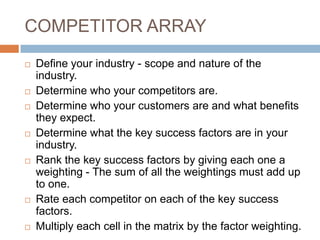
Define your industry - scope and nature of the
industry.
Determine who your competitors are.
Determine who your customers are and what benefits
they expect.
Determine what the key success factors are in your
industry.
Rank the key success factors by giving each one a
weighting - The sum of all the weightings must add up
to one.
Rate each competitor on each of the key success
factors.
Multiply each cell in the matrix by the factor weighting.
EXAMPLE
Key
Industry
Success
Factors

Weighting

Competito
r
#1 rating

Competito
r
#1
weighted

Competito
r
#2 rating

Competito
r
#2
weighted

1Extensive
distribution

.4

6

2.4

3

1.2

2Customer
focus

.3

4

1.2

5

1.5

3Economies
of scale

.2

3

.6

3

.6

4 - Product
innovation

.1

7

.7

4

.4

Totals

1.0

20

4.9

15

3.7
COMPETITOR PROFILING









Background
Financials
Products
Marketing
Facilities
Personnel
Corporate strategies
BACKGROUND





Location of offices and plants.
History - key personalities, dates, events, and
trends.
Ownership, corporate governance, and
organizational structure.
FINANCIALS




P-E ratios, dividend policy, and profitability.
Various financial ratios, liquidity, and cash flow.
Profit growth profile.
PRODUCTS







Products offered and product portfolio balance.
New products developed, new product
success rate and R&D strengths.
Brands, brand loyalty and brand awareness.
Patents and licenses.
Quality control conformance.
MARKETING








Segments served, market shares, customer
base and growth rate.
Promotional mix, promotional budgets,
advertising themes, ad agency used, sales
force success rate and online promotional
strategy.
Distribution channels used and geographical
coverage.
Pricing, discounts and allowances.
FACILITIES




Plant capacity, capacity utilization rate, age of
plant, plant efficiency and capital investment.
Location and shipping logistics.
PERSONNEL





Number of employees and skill sets.
Strength of management and management
style.
Compensation, benefits, employee morale and
retention rates.
CORPORATE STRATEGIES
•

Objectives, mission statement, growth plans,
acquisitions, and divestitures
ANALYSIS OF NEW
COMPETITOR









Companies competing in a related
product/market.
Companies using related technologies.
Companies already targeting your prime
market segment but with unrelated products.
Companies from other geographical areas and
with similar products.
New start-up companies organized by former
employees and/or managers of existing
companies.
THANK YOU

Competitor Analysis