(Professional Business Analyst Training organisation)
PESTLE Analysis
What is PESTLE Analysis?
There are many companies in the world who
conducts PESTLE analysis on their brands in
order to ascertain strategies for the future or to
understand the market before launching their
products.
It is a fundamental tool used for market
planning and strategizing that must be carried
out to comprehend market trends and the
systematic risks involved in the market.
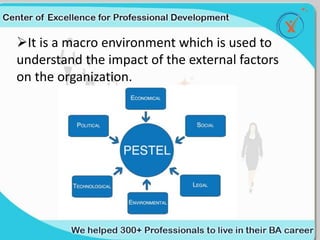
It is a macro environment which is used to
understand the impact of the external factors
on the organization.
PESTLE stands for:
1) Political
2) Economical
3) Social
4) Technological
5) Legal
6) Environmental
 Political:
1) Political stability
2) Tax policy
3) Employment labor law
4) Environmental
regulations
5) Trade restrictions
6) Tariffs etc.
Traditional BA (Waterfall) Agile BA
Requirements are documented in Use
Cases,Business Requirements, Functional
requirements, UI Specifications, Business Rules.
Requirements are documented in Epics, User
Stories and optionally Business (or Essential) Use
cases.
Focuses on completeness of requirement and
spends time in ensuring the requirement is
unambiguous and has all the details.
Focuses on understanding the problem and being
the domain expert so that s/he can answer
questions from the development team swiftly and
decisively.
Focuses on getting a ‘sign off’ on the requirements.
Focuses on ensuring the requirements meet the
currentbusiness needs, even if it requires
updating them.
Often there is a wall between the BA/Business and
the Development team.
Agile BA (Often called as Product Owner) is part of
the team.
Tends to dictate solutions.
Has to remain in the problem domain, leaving the
development team ‘space’ to explore different
solutions.
Long turnaround. Quick turnaround.
Focus on what the requirements document said. In
other words, output (Artifact) is a well written
thorough requirements document.
Focus on the functionality of the developed
software. In other words, output (Artifact) is the
software that meets thebusiness needs.
Economical
It affects the decision making process of the
organization.
A global player must examine the economic
issues in the world and find opportunities with
such conditions for business growth.
Example:
1) Economic growth
2) Interest rates
3) Inflation rate
Social
It represents the culture of the society that
an organization operates within.
 It includes demographics, age distribution,
population growth rates etc.
Example:
1) Age distribution
2) Population growth rate
3) Emphasis on safety
4) Career attitudes
Technological
It is related to new inventions and
development.
Affect the cost and quality of the outputs.
Example:
1) Automation
2) Technology incentives
3) Rate of technological change
4) R&D activity
Legal
It consists of both external and internal sides.
There are certain laws that affect both sides of
the business environment.
Example:
1) Consumer law
2) Antitrust law
3) Employment law
4) Discrimination law
5) Health and safety law
Environmental:
It refers to ecological and environmental
aspects such as climate, weather and
climate change.
Mostly it is useful for the certain
industries like tourism, farming, agriculture
etc.
Pestle analysis

Pestle analysis

  • 1.
    (Professional Business AnalystTraining organisation) PESTLE Analysis
  • 2.
    What is PESTLEAnalysis? There are many companies in the world who conducts PESTLE analysis on their brands in order to ascertain strategies for the future or to understand the market before launching their products. It is a fundamental tool used for market planning and strategizing that must be carried out to comprehend market trends and the systematic risks involved in the market.
  • 3.
    It is amacro environment which is used to understand the impact of the external factors on the organization.
  • 4.
    PESTLE stands for: 1)Political 2) Economical 3) Social 4) Technological 5) Legal 6) Environmental  Political: 1) Political stability 2) Tax policy 3) Employment labor law 4) Environmental regulations 5) Trade restrictions 6) Tariffs etc.
  • 5.
    Traditional BA (Waterfall)Agile BA Requirements are documented in Use Cases,Business Requirements, Functional requirements, UI Specifications, Business Rules. Requirements are documented in Epics, User Stories and optionally Business (or Essential) Use cases. Focuses on completeness of requirement and spends time in ensuring the requirement is unambiguous and has all the details. Focuses on understanding the problem and being the domain expert so that s/he can answer questions from the development team swiftly and decisively. Focuses on getting a ‘sign off’ on the requirements. Focuses on ensuring the requirements meet the currentbusiness needs, even if it requires updating them. Often there is a wall between the BA/Business and the Development team. Agile BA (Often called as Product Owner) is part of the team. Tends to dictate solutions. Has to remain in the problem domain, leaving the development team ‘space’ to explore different solutions. Long turnaround. Quick turnaround. Focus on what the requirements document said. In other words, output (Artifact) is a well written thorough requirements document. Focus on the functionality of the developed software. In other words, output (Artifact) is the software that meets thebusiness needs. Economical It affects the decision making process of the organization. A global player must examine the economic issues in the world and find opportunities with such conditions for business growth. Example: 1) Economic growth 2) Interest rates 3) Inflation rate
  • 6.
    Social It represents theculture of the society that an organization operates within.  It includes demographics, age distribution, population growth rates etc. Example: 1) Age distribution 2) Population growth rate 3) Emphasis on safety 4) Career attitudes
  • 7.
    Technological It is relatedto new inventions and development. Affect the cost and quality of the outputs. Example: 1) Automation 2) Technology incentives 3) Rate of technological change 4) R&D activity
  • 8.
    Legal It consists ofboth external and internal sides. There are certain laws that affect both sides of the business environment. Example: 1) Consumer law 2) Antitrust law 3) Employment law 4) Discrimination law 5) Health and safety law
  • 9.
    Environmental: It refers toecological and environmental aspects such as climate, weather and climate change. Mostly it is useful for the certain industries like tourism, farming, agriculture etc.