Marketing Management (5565)-2018
ENVIRONMENTAL ANALYSIS IN MARKETING
AND ITS RELATIONSHIP WITH SWOT ANALYSIS
INTRODUCTION
Companies use many types of analyses as indicators of business progress. Some reveal how the company
can utilize cash flow in best way, while others indicate how the cost of inputs may be twofold in the
coming months. An environmental analysis and a SWOT analysis are tools utilized by associations
though both give businesses insight into potential barriers and shortcomings, these reports differ in
distinct ways.
Environmental Analysis
An environmental analysis surveys the business landscape to determine how external variables
will affect its decision-making. Robert Grant, author of the book, “Contemporary Strategy
Analysis,” categorizes environmental influences as either source or proximity.
Grant explains that sources include political, economic, social and technological factors; these
factors form what’s known as a PEST or PESTLE analysis. The business is not always in a
position to control these variables; it can only plan for them and make decisions accordingly.
Companies use an environmental analysis to prepare for a variety of potential scenarios. For
instance, an organization may prepare for a downturn in the economy by drafting several
production schedules that are contingent on different levels of consumer demand. (Capozzi, n.d.).
SWOT Analysis
A SWOT analysis reviews the business’s strengths, weaknesses, opportunities and threats. As is
the case with an environmental analysis, a SWOT analysis also surveys external circumstances.
However, this type of analysis also takes into consideration internal components. Within the
strengths and weaknesses section of the SWOT analysis, the company assesses factors unique to
the organization. Examples of these components may include the business’s leadership abilities,
patents and intellectual property, technology available within the company and the strength of its
brand name. The company can control these factors, so it attempts to strengthen its best assets and
improve its apparent weaknesses. (Capozzi, n.d.).
ENVIRONMENTAL ANALYSIS
Environmental analysis is a strategic tool. It is a process to identify all the external and internal
elements, which can affect the organization’s performance. The analysis entails assessing the level of
threat or opportunity the factors might present. These evaluations are later translated into the decision-
making process. The analysis helps align strategies with the firm’s environment.
Markets are facing changes every day. Many new things develop over time and the whole scenario can
alter in only a few seconds. Some factors are beyond the marketer’s control, but marketer can control a lot
of these things. Businesses are greatly influenced by their environment. All the situational factors which
determine day to day circumstances impact firms. So, businesses must constantly analyze the trade
environment and the market.
Marketing Management (5565)-2018
There are many strategic analysis tools that a firm can use, but some are more common. The most used
detailed analysis of the environment is the PESTLE analysis. This is a bird’s eye view of the business
conduct. Managers and strategy builders use this analysis to find where their market currently. It also
helps foresee where the organization will be in the future. PESTLE analysis consists of various factors
that affect the business environment. Each letter in the acronym signifies a set of factors. These factors
can affect every industry directly or indirectly.
PESTLE analysis consists of various factors that affect the business environment. Each letter in the
acronym signifies a set of factors. These factors can affect every industry directly or indirectly.
The letters in PESTLE, also called PESTEL, denote the following things:
 Political factors
 Economic factors
 Social factors
 Technological factors
 Legal factors
 Environmental factor
Often, managers choose to learn about political, economic, social and technological factors only. In that
case, they conduct the PEST analysis. It is a shorter version of PESTLE analysis. STEP, STEEP,
STEEPLE, STEEPLED, STEPJE and LEPEST: All of these are acronyms for the same set of factors.
Some of them gauge additional factors like ethical and demographical factors.
Following are six most commonly assessed factors in environmental analysis.
 P for Political factors
The political factors take the country’s current political situation. It also reads the global political
condition’s effect on the country and business. When conducting this step, ask questions like
“What kind of government leadership is impacting decisions of the firm?” Some political factors
that you can study are:
 Government policies
 Taxes laws and tariff
 Stability of government
 Entry mode regulations
 E for Economic factors
Economic factors involves all the determinants of the economy and its state. These are factors
that can conclude the direction in which the economy might move. So, businesses analyze this
factor based on the environment. It helps to set up strategies in line with changes.
I have listed some determinants you can assess to know how economic factors are affecting your
business below:
 The inflation rate
 The interest rate
 Disposable income of buyers
 Credit accessibility
 Unemployment rates
 The monetary or fiscal policies
 The foreign exchange rate
 S for Social factors
Countries vary from each other. Every country has a distinctive mindset. These attitudes have an
impact on the businesses. The social factors might ultimately affect the sales of products and
services. Some of the social factors you should study are:
Marketing Management (5565)-2018
 The cultural
 implications
 The gender and connected
demographics
 The social lifestyles
 The domestic structures
 Educational levels
 Distribution of Wealth
 T for Technological factors
Technology is advancing continuously. The advancement is greatly influencing businesses.
Performing environmental analysis on these factors will help you stay up to date with the
changes. Technology alters every minute. This is why companies must stay connected all the
time. Firms should integrate when needed. Technological factors will help you know how the
consumers react to various trends. Firms can use these factors for their benefit:
 New discoveries
 Rate of technological
obsolescence
 Rate of technological advances
 Innovative technological platforms
 L for Legal factors
Legislative changes take place from time to time. Many of these changes affect the business
environment. If a regulatory body sets up a regulation for industries, for example, that law would
impact industries and business in that economy. So, businesses should also analyze the legal
developments in respective environments. Some legal factors are:
 Product regulations
 Employment regulations
 Competitive regulations
 Patent infringements
 Health and safety regulations
 E for Environmental factors
The location influences business trades. Changes in climatic changes can affect the trade. The
consumer reactions to particular offering can also be an issue. This most often affects agri-
businesses. Some environmental factors are:
 Geographical location
 The climate and weather
 Waste disposal laws
 Energy consumption regulation
 People’s attitude towards the environment
There are 5 simple steps for environmental analysis:
1. Understand all the environmental factors before moving to the next step.
2. Collect all the relevant information.
3. Identify the opportunities for your organization.
4. Recognize the threats your company faces.
5. The final step is to take action.
Environmental analysis is essential to determine what role certain factors play in your business.
PEST or PESTLE analysis allows businesses to take a look at the external factors. Many organizations
use these tools to project the growth of their company effectively. The analyses provide a good look at
factors like revenue, profitability, and corporate success. If you want to take the right decisions for your
Marketing Management (5565)-2018
firm, employ environmental analysis. The analysis you should conduct depends on the nature of your
company.
A PEST analysis prepares the business for handling external factors. It helps the business be proactive
with market trends. Instead of reacting to market forces, it gives the business the tools to prepare for
potential risks. For instance, this type of analysis may disclose that government legislation will increase
the cost of raw materials by 20 percent. If the business can preempt this as a possibility, it can switch
vendors, stock up on raw materials or find cheaper alternatives. Such preparation ultimately saves the
company money and in turn gives it a competitive advantage.
PESTLE Analysis Example
The following PESTLE analysis example will clarify how the six external factors work and what type of
information you should include in your analysis. The example of overseas sale of a product.
Category Political Economic Social Technological Legal Environment
Possible
factors
eg international
trading tariffs,
restrictions, visa
requirements, price
control, etc
eg current UK
economical
situation, currency
inflation, interest
rates, taxation
level, etc
eg cultural norms,
attitudes to
product, consumer
preferences, age
and gender
distribution, etc
eg emergence of
innovative
technologies
affecting the
production,
marketing or sale
of product,
automation of
processes, etc
eg legislative
issues, such as
consumer
protection laws,
health and safety
laws, licensing
regulations, etc;
eg sustainability,
waste management
rules and
regulations, green
practices etc
Business
impact
eg - possible trade
barriers to protect
domestic suppliers
eg - strength of
overseas
economies versus
UK may affect
price/profitability
eg - will product be
accepted overseas?
eg - can intellectual
property rights be
protected overseas?
eg - will the
product comply or
be allowed into the
market?
eg - pollution
implications of
transportation
Time
frame
unknown
6-12 months
(possibly longer)
6-12 months 0-6 months 0-6 months n/a
Type of
impact
negative unknown unknown negative negative possibly negative
Rate of
impact
increasing
unknown -
dependent on the
economy, and other
countries'
economies
unknown unchanged unchanged unknown
Importance unknown important critical important critical unknown
Advantages of PESTLE analysis:
By helping you to understand how external factors affect your businesses, PESTLE can help you:
 determine their long-term effect on the performance and activities of your business
 review any strategies you have in place
 work out a new direction, product or plan for your business
 identify solutions to problems
Marketing Management (5565)-2018
 gain strategic advantage on competitors
 evaluate the risks associated with markets you're interested in
 PESTLE is an extended version of PEST analysis. It is often used in collaboration with other
analytical business tools like the SWOT analysis and Porter's Five Forces to give a clear
understanding of a situation and related internal and external factors.
(Strategic planning for …).
SWOT ANALYSIS
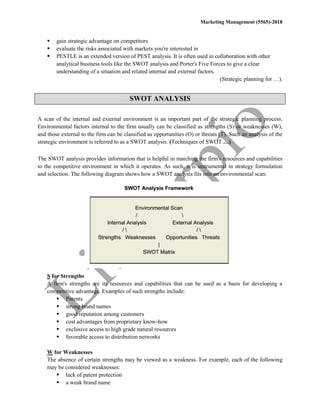
A scan of the internal and external environment is an important part of the strategic planning process.
Environmental factors internal to the firm usually can be classified as strengths (S) or weaknesses (W),
and those external to the firm can be classified as opportunities (O) or threats (T). Such an analysis of the
strategic environment is referred to as a SWOT analysis. (Techniques of SWOT …)
The SWOT analysis provides information that is helpful in matching the firm's resources and capabilities
to the competitive environment in which it operates. As such, it is instrumental in strategy formulation
and selection. The following diagram shows how a SWOT analysis fits into an environmental scan:
S for Strengths
A firm's strengths are its resources and capabilities that can be used as a basis for developing a
competitive advantage. Examples of such strengths include:
 Patents
 strong brand names
 good reputation among customers
 cost advantages from proprietary know-how
 exclusive access to high grade natural resources
 favorable access to distribution networks
W for Weaknesses
The absence of certain strengths may be viewed as a weakness. For example, each of the following
may be considered weaknesses:
 lack of patent protection
 a weak brand name
Marketing Management (5565)-2018
 poor reputation among customers
 high cost structure
 lack of access to the best natural resources
 lack of access to key distribution channels
In some cases, a weakness may be the flip side of a strength. Take the case in which a firm has a large
amount of manufacturing capacity. While this capacity may be considered a strength that competitors
do not share, it also may be a considered a weakness if the large investment in manufacturing
capacity prevents the firm from reacting quickly to changes in the strategic environment.
O for Opportunities
The external environmental analysis may reveal certain new opportunities for profit and growth.
Some examples of such opportunities include:
 an unfulfilled customer need
 arrival of new technologies
 loosening of regulations
 removal of international trade barriers
T for Threats
Changes in the external environmental also may present threats to the firm. Some examples of such
threats include:
 shifts in consumer tastes away from the firm's products
 emergence of substitute products
 new regulations
 increased trade barriers
(Techniques of SWOT …)
Marketing Management (5565)-2018
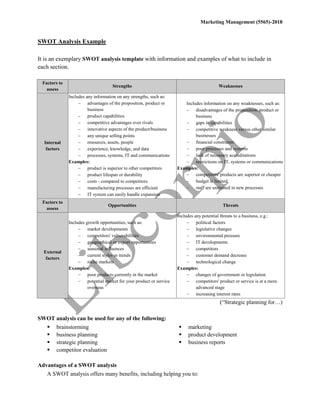
SWOT Analysis Example
It is an exemplary SWOT analysis template with information and examples of what to include in
each section.
Factors to
assess
Strengths Weaknesses
Internal
factors
Includes any information on any strengths, such as:
 advantages of the proposition, product or
business
 product capabilities
 competitive advantages over rivals
 innovative aspects of the product/business
 any unique selling points
 resources, assets, people
 experience, knowledge, and data
 processes, systems, IT and communications
Examples:
 product is superior to other competitors
 product lifespan or durability
 costs - compared to competitors
 manufacturing processes are efficient
 IT system can easily handle expansion
Includes information on any weaknesses, such as:
 disadvantages of the proposition, product or
business
 gaps in capabilities
 competitive weakness versus other similar
businesses
 financial constraints
 poor processes and systems
 lack of necessary accreditations
 restrictions on IT, systems or communications
Examples:
 competitors' products are superior or cheaper
 budget is limited
 staff are untrained in new processes
Factors to
assess
Opportunities Threats
External
factors
Includes growth opportunities, such as:
 market developments
 competitors' vulnerabilities
 geographical or export opportunities
 seasonal influences
 current styles or trends
 niche markets
Examples:
 poor products currently in the market
 potential market for your product or service
overseas
Includes any potential threats to a business, e.g.:
 political factors
 legislative changes
 environmental pressure
 IT developments
 competitors
 customer demand decrease
 technological change
Examples:
 changes of government or legislation
 competitors' product or service is at a more
advanced stage
 increasing interest rates
(“Strategic planning for…)
SWOT analysis can be used for any of the following:
 brainstorming
 business planning
 strategic planning
 competitor evaluation
 marketing
 product development
 business reports
Advantages of a SWOT analysis
A SWOT analysis offers many benefits, including helping you to:
Marketing Management (5565)-2018
 understand the key issues affecting your business
 spot and deal with weaknesses
 minimize risks and deter threats
 capitalize on opportunities
 take advantage of your strengths
 develop business goals
 identify strategies for achieving your goals
 A SWOT analysis is typically also low- or no cost, and relatively quick and simple to carry
out.
CONCLUSION
PESTLE and SWOT are closely related approaches to business analysis. ... SWOT is a situational
analysis tool for company leaders/ marketers that involves assessing strengths, weaknesses, opportunities
and threats. PEST correlates strongly with the threats component of SWOT, but also has relevance to the
opportunities assessment.
PESTLE can be rightly called a thorough view on the external environment in which an organization is
operating in. On the contrary though, SWOT analysis is the analysis on the internal environment of the
company based on its products etc. SWOT tends to be more product/service specific as an individual or
an entity conducts this analysis based on that product/service.
REFERENCES
Capozzi, C. (n.d.). What Is the Difference Between an Environmental Analysis & a SWOT Analysis? Small Business - Chron.com. Retrieved
from http://smallbusiness.chron.com/difference-between-environmental-analysis-swot-analysis-20684.html
Kotler, P. & Kotler, K. (2012). Marketing management. 14th
ed. Boston: Prentice Hall.
Strategic planning for business growth. nibusinessinfo.co.uk. Retrieved from https://www.nibusinessinfo.co.uk/content/strategic-planning-
business-growth
Techniques of SWOT analysis. Planning Tank. Retrieved from https://planningtank.com/planning-techniques/swot-analysis

ENVIRONMENTAL ‎ANALYSIS & SWOT ‎ANALYSIS

  • 1.
    Marketing Management (5565)-2018 ENVIRONMENTALANALYSIS IN MARKETING AND ITS RELATIONSHIP WITH SWOT ANALYSIS INTRODUCTION Companies use many types of analyses as indicators of business progress. Some reveal how the company can utilize cash flow in best way, while others indicate how the cost of inputs may be twofold in the coming months. An environmental analysis and a SWOT analysis are tools utilized by associations though both give businesses insight into potential barriers and shortcomings, these reports differ in distinct ways. Environmental Analysis An environmental analysis surveys the business landscape to determine how external variables will affect its decision-making. Robert Grant, author of the book, “Contemporary Strategy Analysis,” categorizes environmental influences as either source or proximity. Grant explains that sources include political, economic, social and technological factors; these factors form what’s known as a PEST or PESTLE analysis. The business is not always in a position to control these variables; it can only plan for them and make decisions accordingly. Companies use an environmental analysis to prepare for a variety of potential scenarios. For instance, an organization may prepare for a downturn in the economy by drafting several production schedules that are contingent on different levels of consumer demand. (Capozzi, n.d.). SWOT Analysis A SWOT analysis reviews the business’s strengths, weaknesses, opportunities and threats. As is the case with an environmental analysis, a SWOT analysis also surveys external circumstances. However, this type of analysis also takes into consideration internal components. Within the strengths and weaknesses section of the SWOT analysis, the company assesses factors unique to the organization. Examples of these components may include the business’s leadership abilities, patents and intellectual property, technology available within the company and the strength of its brand name. The company can control these factors, so it attempts to strengthen its best assets and improve its apparent weaknesses. (Capozzi, n.d.). ENVIRONMENTAL ANALYSIS Environmental analysis is a strategic tool. It is a process to identify all the external and internal elements, which can affect the organization’s performance. The analysis entails assessing the level of threat or opportunity the factors might present. These evaluations are later translated into the decision- making process. The analysis helps align strategies with the firm’s environment. Markets are facing changes every day. Many new things develop over time and the whole scenario can alter in only a few seconds. Some factors are beyond the marketer’s control, but marketer can control a lot of these things. Businesses are greatly influenced by their environment. All the situational factors which determine day to day circumstances impact firms. So, businesses must constantly analyze the trade environment and the market.
  • 2.
    Marketing Management (5565)-2018 Thereare many strategic analysis tools that a firm can use, but some are more common. The most used detailed analysis of the environment is the PESTLE analysis. This is a bird’s eye view of the business conduct. Managers and strategy builders use this analysis to find where their market currently. It also helps foresee where the organization will be in the future. PESTLE analysis consists of various factors that affect the business environment. Each letter in the acronym signifies a set of factors. These factors can affect every industry directly or indirectly. PESTLE analysis consists of various factors that affect the business environment. Each letter in the acronym signifies a set of factors. These factors can affect every industry directly or indirectly. The letters in PESTLE, also called PESTEL, denote the following things:  Political factors  Economic factors  Social factors  Technological factors  Legal factors  Environmental factor Often, managers choose to learn about political, economic, social and technological factors only. In that case, they conduct the PEST analysis. It is a shorter version of PESTLE analysis. STEP, STEEP, STEEPLE, STEEPLED, STEPJE and LEPEST: All of these are acronyms for the same set of factors. Some of them gauge additional factors like ethical and demographical factors. Following are six most commonly assessed factors in environmental analysis.  P for Political factors The political factors take the country’s current political situation. It also reads the global political condition’s effect on the country and business. When conducting this step, ask questions like “What kind of government leadership is impacting decisions of the firm?” Some political factors that you can study are:  Government policies  Taxes laws and tariff  Stability of government  Entry mode regulations  E for Economic factors Economic factors involves all the determinants of the economy and its state. These are factors that can conclude the direction in which the economy might move. So, businesses analyze this factor based on the environment. It helps to set up strategies in line with changes. I have listed some determinants you can assess to know how economic factors are affecting your business below:  The inflation rate  The interest rate  Disposable income of buyers  Credit accessibility  Unemployment rates  The monetary or fiscal policies  The foreign exchange rate  S for Social factors Countries vary from each other. Every country has a distinctive mindset. These attitudes have an impact on the businesses. The social factors might ultimately affect the sales of products and services. Some of the social factors you should study are:
  • 3.
    Marketing Management (5565)-2018 The cultural  implications  The gender and connected demographics  The social lifestyles  The domestic structures  Educational levels  Distribution of Wealth  T for Technological factors Technology is advancing continuously. The advancement is greatly influencing businesses. Performing environmental analysis on these factors will help you stay up to date with the changes. Technology alters every minute. This is why companies must stay connected all the time. Firms should integrate when needed. Technological factors will help you know how the consumers react to various trends. Firms can use these factors for their benefit:  New discoveries  Rate of technological obsolescence  Rate of technological advances  Innovative technological platforms  L for Legal factors Legislative changes take place from time to time. Many of these changes affect the business environment. If a regulatory body sets up a regulation for industries, for example, that law would impact industries and business in that economy. So, businesses should also analyze the legal developments in respective environments. Some legal factors are:  Product regulations  Employment regulations  Competitive regulations  Patent infringements  Health and safety regulations  E for Environmental factors The location influences business trades. Changes in climatic changes can affect the trade. The consumer reactions to particular offering can also be an issue. This most often affects agri- businesses. Some environmental factors are:  Geographical location  The climate and weather  Waste disposal laws  Energy consumption regulation  People’s attitude towards the environment There are 5 simple steps for environmental analysis: 1. Understand all the environmental factors before moving to the next step. 2. Collect all the relevant information. 3. Identify the opportunities for your organization. 4. Recognize the threats your company faces. 5. The final step is to take action. Environmental analysis is essential to determine what role certain factors play in your business. PEST or PESTLE analysis allows businesses to take a look at the external factors. Many organizations use these tools to project the growth of their company effectively. The analyses provide a good look at factors like revenue, profitability, and corporate success. If you want to take the right decisions for your
  • 4.
    Marketing Management (5565)-2018 firm,employ environmental analysis. The analysis you should conduct depends on the nature of your company. A PEST analysis prepares the business for handling external factors. It helps the business be proactive with market trends. Instead of reacting to market forces, it gives the business the tools to prepare for potential risks. For instance, this type of analysis may disclose that government legislation will increase the cost of raw materials by 20 percent. If the business can preempt this as a possibility, it can switch vendors, stock up on raw materials or find cheaper alternatives. Such preparation ultimately saves the company money and in turn gives it a competitive advantage. PESTLE Analysis Example The following PESTLE analysis example will clarify how the six external factors work and what type of information you should include in your analysis. The example of overseas sale of a product. Category Political Economic Social Technological Legal Environment Possible factors eg international trading tariffs, restrictions, visa requirements, price control, etc eg current UK economical situation, currency inflation, interest rates, taxation level, etc eg cultural norms, attitudes to product, consumer preferences, age and gender distribution, etc eg emergence of innovative technologies affecting the production, marketing or sale of product, automation of processes, etc eg legislative issues, such as consumer protection laws, health and safety laws, licensing regulations, etc; eg sustainability, waste management rules and regulations, green practices etc Business impact eg - possible trade barriers to protect domestic suppliers eg - strength of overseas economies versus UK may affect price/profitability eg - will product be accepted overseas? eg - can intellectual property rights be protected overseas? eg - will the product comply or be allowed into the market? eg - pollution implications of transportation Time frame unknown 6-12 months (possibly longer) 6-12 months 0-6 months 0-6 months n/a Type of impact negative unknown unknown negative negative possibly negative Rate of impact increasing unknown - dependent on the economy, and other countries' economies unknown unchanged unchanged unknown Importance unknown important critical important critical unknown Advantages of PESTLE analysis: By helping you to understand how external factors affect your businesses, PESTLE can help you:  determine their long-term effect on the performance and activities of your business  review any strategies you have in place  work out a new direction, product or plan for your business  identify solutions to problems
  • 5.
    Marketing Management (5565)-2018 gain strategic advantage on competitors  evaluate the risks associated with markets you're interested in  PESTLE is an extended version of PEST analysis. It is often used in collaboration with other analytical business tools like the SWOT analysis and Porter's Five Forces to give a clear understanding of a situation and related internal and external factors. (Strategic planning for …). SWOT ANALYSIS A scan of the internal and external environment is an important part of the strategic planning process. Environmental factors internal to the firm usually can be classified as strengths (S) or weaknesses (W), and those external to the firm can be classified as opportunities (O) or threats (T). Such an analysis of the strategic environment is referred to as a SWOT analysis. (Techniques of SWOT …) The SWOT analysis provides information that is helpful in matching the firm's resources and capabilities to the competitive environment in which it operates. As such, it is instrumental in strategy formulation and selection. The following diagram shows how a SWOT analysis fits into an environmental scan: S for Strengths A firm's strengths are its resources and capabilities that can be used as a basis for developing a competitive advantage. Examples of such strengths include:  Patents  strong brand names  good reputation among customers  cost advantages from proprietary know-how  exclusive access to high grade natural resources  favorable access to distribution networks W for Weaknesses The absence of certain strengths may be viewed as a weakness. For example, each of the following may be considered weaknesses:  lack of patent protection  a weak brand name
  • 6.
    Marketing Management (5565)-2018 poor reputation among customers  high cost structure  lack of access to the best natural resources  lack of access to key distribution channels In some cases, a weakness may be the flip side of a strength. Take the case in which a firm has a large amount of manufacturing capacity. While this capacity may be considered a strength that competitors do not share, it also may be a considered a weakness if the large investment in manufacturing capacity prevents the firm from reacting quickly to changes in the strategic environment. O for Opportunities The external environmental analysis may reveal certain new opportunities for profit and growth. Some examples of such opportunities include:  an unfulfilled customer need  arrival of new technologies  loosening of regulations  removal of international trade barriers T for Threats Changes in the external environmental also may present threats to the firm. Some examples of such threats include:  shifts in consumer tastes away from the firm's products  emergence of substitute products  new regulations  increased trade barriers (Techniques of SWOT …)
  • 7.
    Marketing Management (5565)-2018 SWOTAnalysis Example It is an exemplary SWOT analysis template with information and examples of what to include in each section. Factors to assess Strengths Weaknesses Internal factors Includes any information on any strengths, such as:  advantages of the proposition, product or business  product capabilities  competitive advantages over rivals  innovative aspects of the product/business  any unique selling points  resources, assets, people  experience, knowledge, and data  processes, systems, IT and communications Examples:  product is superior to other competitors  product lifespan or durability  costs - compared to competitors  manufacturing processes are efficient  IT system can easily handle expansion Includes information on any weaknesses, such as:  disadvantages of the proposition, product or business  gaps in capabilities  competitive weakness versus other similar businesses  financial constraints  poor processes and systems  lack of necessary accreditations  restrictions on IT, systems or communications Examples:  competitors' products are superior or cheaper  budget is limited  staff are untrained in new processes Factors to assess Opportunities Threats External factors Includes growth opportunities, such as:  market developments  competitors' vulnerabilities  geographical or export opportunities  seasonal influences  current styles or trends  niche markets Examples:  poor products currently in the market  potential market for your product or service overseas Includes any potential threats to a business, e.g.:  political factors  legislative changes  environmental pressure  IT developments  competitors  customer demand decrease  technological change Examples:  changes of government or legislation  competitors' product or service is at a more advanced stage  increasing interest rates (“Strategic planning for…) SWOT analysis can be used for any of the following:  brainstorming  business planning  strategic planning  competitor evaluation  marketing  product development  business reports Advantages of a SWOT analysis A SWOT analysis offers many benefits, including helping you to:
  • 8.
    Marketing Management (5565)-2018 understand the key issues affecting your business  spot and deal with weaknesses  minimize risks and deter threats  capitalize on opportunities  take advantage of your strengths  develop business goals  identify strategies for achieving your goals  A SWOT analysis is typically also low- or no cost, and relatively quick and simple to carry out. CONCLUSION PESTLE and SWOT are closely related approaches to business analysis. ... SWOT is a situational analysis tool for company leaders/ marketers that involves assessing strengths, weaknesses, opportunities and threats. PEST correlates strongly with the threats component of SWOT, but also has relevance to the opportunities assessment. PESTLE can be rightly called a thorough view on the external environment in which an organization is operating in. On the contrary though, SWOT analysis is the analysis on the internal environment of the company based on its products etc. SWOT tends to be more product/service specific as an individual or an entity conducts this analysis based on that product/service. REFERENCES Capozzi, C. (n.d.). What Is the Difference Between an Environmental Analysis & a SWOT Analysis? Small Business - Chron.com. Retrieved from http://smallbusiness.chron.com/difference-between-environmental-analysis-swot-analysis-20684.html Kotler, P. & Kotler, K. (2012). Marketing management. 14th ed. Boston: Prentice Hall. Strategic planning for business growth. nibusinessinfo.co.uk. Retrieved from https://www.nibusinessinfo.co.uk/content/strategic-planning- business-growth Techniques of SWOT analysis. Planning Tank. Retrieved from https://planningtank.com/planning-techniques/swot-analysis