What is a pest ?
• A pest is any living organism which
competes with human, domestic animals
or desirable plants for food or water.
• At the same time they spread diseases to
mankind & harms the environment .
Why to control pests?
1. For clean environment.
2. Disease free environment.
3. To stop the rapid growth of pests.
How it is done ?
Pest Management
System
What are the goals of PMS?
1. Prevention.
2. Suppression.
3. Eradication.
Apart from this
Natural Control
Biological control
Types of pests
• Insects
• Arthopods ( eight legged)
• Microbial organism
• Weeds
• mollusks
• Cockroach, termites,
beetles& fleas
• Spiders
• Bacteria
• Any plant growing where
they are unwanted
• snails , slugs & ship
worms
COCKROACH
• These are found in kitchens &
restaurant.
• Do not require human food &
can feed on white wash, hair &
books.
• Prevention can be done by
hygienic disposal of food &
waste & overall cleanliness of
the area,
• Eradication :
Chlorodecone.(Insecticide)
• Life span : 4 months or more.
RAT & MICE
• They are found in
kitchen & dining
areas.
• Can be controlled by
hygienic storage &
disposal of food &
waste.
• Destruction : Baits,
Fumigation &
Trapping.
SILVERFISH
SILVERFISH ERADICATION
• Its silver grey insect that looks like
minute fish without fins
• A dispersion of borax or Boric acid
and sugar is a reliable bait to kill.
silverfish).
• Adults can be killed by freezing,
but it is difficult to kill the eggs.
• To capture silverfish, sprinkle
plaster on a wet, white cotton
cloth, put it in a corner overnight,
near the silverfish's hideout.
• By far the most effective way to be
rid of Silverfish for sure is to keep
an area or room tidy, limiting the
possible number of breeding
grounds they have.
HOUSE FLY
• It breeds on human &
animal extracts,
decaying &
fermenting
vegetables.
• It cannot breed in dry
materials.
• Controlling measures:
Keeping area clean &
installing
Electrocutors.
FLEAS
• They bite their hosts
causing irritation. In
humans red itching
spots appear on the
skin.
• Found in unhygienic
conditions & entry to
clean places is
entirely accidental.
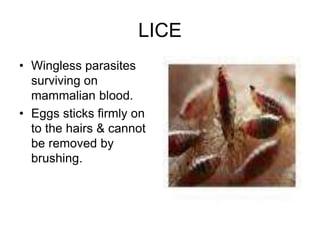
LICE
• Wingless parasites
surviving on
mammalian blood.
• Eggs sticks firmly on
to the hairs & cannot
be removed by
brushing.
BED BUGS
• Prefer human blood & can
survive for months without
food.
• Gammexane, D.D.T.
Dichloro-Diphenyl-
Trichloroethane is one of
the best known synthetic
pesticides), or kerosene oil
containing pyrethrum may be
sprayed.
• Hydrocyanic acid gives very
good result.
MOSQUITOES
• Prefer dark areas.
• Live on blood.
(females)
• Presence of water is
essential for their
existence.
CARPET BEETLE
• Major textile pest.
• Larvae damages
fabric.
• Can be controlled by
frequent vacuum
cleaning & spraying of
insecticide between
floor boards under
carpets, under felts &
in the crevices.
WOOD BORING BEETLE
• They attack unpolished &
unpainted wooden
surfaces.
• Causes weakening of the
wood & may take 2-3
years to destroy it.
• Controlled by spraying
Rentokil, cuprinol etc.
• Heat & fumigation.
• Badly infested pieces are
burnt.
EFFECTS DUE TO INFESTATION
MOTHS
• Pest only in the larvae
stage.
• Control measures:
• Naphthalene balls &
camphor tablets.
• Keeping area clean.
CLOTH MOTH & ITS LARVAE
DRY ROT
• Lives on wood.
• Gives offensive smell.
• Prefers dampness.
• Effected area cut
away & burnt.
• Sterilized by using
blow lamp.
WET ROT
• Decay in timber in
damp conditions.
• Causes darkening of
wood & breaking into
small pieces,
• Badly decayed wood
to be cut out.
INSECTICIDES
• An insecticide is a pesticide used against
insects in all developmental forms.
• Insecticides are used in agriculture, medicine,
industry and the household.
• Some insecticides have been banned due to the
fact that they are persistent toxins which have
adverse effects on animals and/or humans. An
oft-quoted case is that of DDT( Dichloro-
Diphenyl-Trichloroethane) .
•
Control measures:
• Proper drainage --
• No stagnant water ---
• Screening of buildings --
• Mosquito nets — (Repellants formula:
kerosene oil – 1 part, coconut oil – 2 parts, Carbolic acid –
1%, Citronella oil – 1 part)
Fumigation
• Fumigation -- is a method of pest
control that completely fills an area with
gaseous pesticides to suffocate or poison
the pests.
• Pci– Pest Control of India
• Rentokil pvt ltd ( UK based company)
DESINGED BY
Sunil Kumar
Research Scholar/ Food Production Faculty
Institute of Hotel and Tourism Management,
MAHARSHI DAYANAND UNIVERSITY, ROHTAK
Haryana- 124001 INDIA Ph. No. 09996000499
email: skihm86@yahoo.com , balhara86@gmail.com
linkedin:- in.linkedin.com/in/ihmsunilkumar
facebook: www.facebook.com/ihmsunilkumar
webpage: chefsunilkumar.tripod.com

Pest control

  • 1.
    What is apest ? • A pest is any living organism which competes with human, domestic animals or desirable plants for food or water. • At the same time they spread diseases to mankind & harms the environment .
  • 2.
    Why to controlpests? 1. For clean environment. 2. Disease free environment. 3. To stop the rapid growth of pests.
  • 3.
    How it isdone ? Pest Management System
  • 4.
    What are thegoals of PMS? 1. Prevention. 2. Suppression. 3. Eradication.
  • 5.
    Apart from this NaturalControl Biological control
  • 6.
    Types of pests •Insects • Arthopods ( eight legged) • Microbial organism • Weeds • mollusks • Cockroach, termites, beetles& fleas • Spiders • Bacteria • Any plant growing where they are unwanted • snails , slugs & ship worms
  • 7.
    COCKROACH • These arefound in kitchens & restaurant. • Do not require human food & can feed on white wash, hair & books. • Prevention can be done by hygienic disposal of food & waste & overall cleanliness of the area, • Eradication : Chlorodecone.(Insecticide) • Life span : 4 months or more.
  • 8.
    RAT & MICE •They are found in kitchen & dining areas. • Can be controlled by hygienic storage & disposal of food & waste. • Destruction : Baits, Fumigation & Trapping.
  • 9.
  • 10.
    SILVERFISH ERADICATION • Itssilver grey insect that looks like minute fish without fins • A dispersion of borax or Boric acid and sugar is a reliable bait to kill. silverfish). • Adults can be killed by freezing, but it is difficult to kill the eggs. • To capture silverfish, sprinkle plaster on a wet, white cotton cloth, put it in a corner overnight, near the silverfish's hideout. • By far the most effective way to be rid of Silverfish for sure is to keep an area or room tidy, limiting the possible number of breeding grounds they have.
  • 11.
    HOUSE FLY • Itbreeds on human & animal extracts, decaying & fermenting vegetables. • It cannot breed in dry materials. • Controlling measures: Keeping area clean & installing Electrocutors.
  • 12.
    FLEAS • They bitetheir hosts causing irritation. In humans red itching spots appear on the skin. • Found in unhygienic conditions & entry to clean places is entirely accidental.
  • 13.
    LICE • Wingless parasites survivingon mammalian blood. • Eggs sticks firmly on to the hairs & cannot be removed by brushing.
  • 14.
    BED BUGS • Preferhuman blood & can survive for months without food. • Gammexane, D.D.T. Dichloro-Diphenyl- Trichloroethane is one of the best known synthetic pesticides), or kerosene oil containing pyrethrum may be sprayed. • Hydrocyanic acid gives very good result.
  • 15.
    MOSQUITOES • Prefer darkareas. • Live on blood. (females) • Presence of water is essential for their existence.
  • 16.
    CARPET BEETLE • Majortextile pest. • Larvae damages fabric. • Can be controlled by frequent vacuum cleaning & spraying of insecticide between floor boards under carpets, under felts & in the crevices.
  • 17.
    WOOD BORING BEETLE •They attack unpolished & unpainted wooden surfaces. • Causes weakening of the wood & may take 2-3 years to destroy it. • Controlled by spraying Rentokil, cuprinol etc. • Heat & fumigation. • Badly infested pieces are burnt.
  • 18.
    EFFECTS DUE TOINFESTATION
  • 19.
    MOTHS • Pest onlyin the larvae stage. • Control measures: • Naphthalene balls & camphor tablets. • Keeping area clean.
  • 20.
    CLOTH MOTH &ITS LARVAE
  • 21.
    DRY ROT • Liveson wood. • Gives offensive smell. • Prefers dampness. • Effected area cut away & burnt. • Sterilized by using blow lamp.
  • 22.
    WET ROT • Decayin timber in damp conditions. • Causes darkening of wood & breaking into small pieces, • Badly decayed wood to be cut out.
  • 23.
    INSECTICIDES • An insecticideis a pesticide used against insects in all developmental forms. • Insecticides are used in agriculture, medicine, industry and the household. • Some insecticides have been banned due to the fact that they are persistent toxins which have adverse effects on animals and/or humans. An oft-quoted case is that of DDT( Dichloro- Diphenyl-Trichloroethane) . •
  • 24.
    Control measures: • Properdrainage -- • No stagnant water --- • Screening of buildings -- • Mosquito nets — (Repellants formula: kerosene oil – 1 part, coconut oil – 2 parts, Carbolic acid – 1%, Citronella oil – 1 part)
  • 25.
    Fumigation • Fumigation --is a method of pest control that completely fills an area with gaseous pesticides to suffocate or poison the pests.
  • 26.
    • Pci– PestControl of India • Rentokil pvt ltd ( UK based company) DESINGED BY Sunil Kumar Research Scholar/ Food Production Faculty Institute of Hotel and Tourism Management, MAHARSHI DAYANAND UNIVERSITY, ROHTAK Haryana- 124001 INDIA Ph. No. 09996000499 email: skihm86@yahoo.com , balhara86@gmail.com linkedin:- in.linkedin.com/in/ihmsunilkumar facebook: www.facebook.com/ihmsunilkumar webpage: chefsunilkumar.tripod.com