Food Safety
Definition
Food safety is a scientific discipline describing:
 Handling
 Preparation
 Storage
 Serving
Of food in ways that prevent food borne illness.
This Includes a number of routines that should be followed
to avoid potentially severe health hazards
By JP Lawand
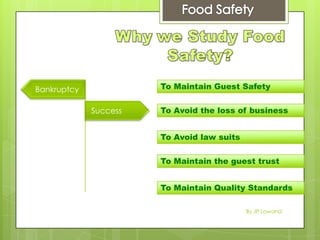
To Maintain Guest Safety
To Maintain Quality Standards
To Avoid the loss of business
To Avoid law suits
To Maintain the guest trust
Bankruptcy
Success
By JP Lawand
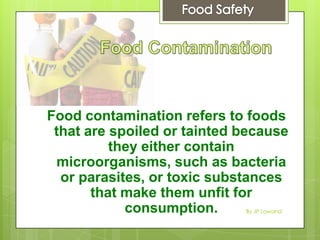
Food contamination refers to foods
that are spoiled or tainted because
they either contain
microorganisms, such as bacteria
or parasites, or toxic substances
that make them unfit for
consumption. By JP Lawand
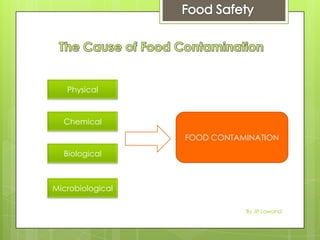
Physical
Microbiological
Chemical
Biological
FOOD CONTAMINATION
By JP Lawand
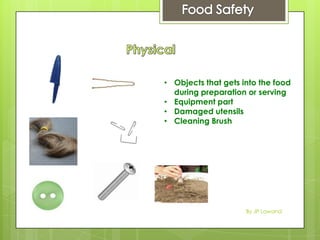
• Objects that gets into the food
during preparation or serving
• Equipment part
• Damaged utensils
• Cleaning Brush
By JP Lawand
• Hair restraint using suitable cap or hair net
• Long sleeve uniform
• Jacket’s pocket always empty
• Clean environment, closed windows and doors to avoid
dust coming from outside
• Equipment well maintained (check the screws, the
plastic accessories…)
• Avoid the usage of deteriorated utensils
• Ceiling and walls well maintained
By JP Lawand
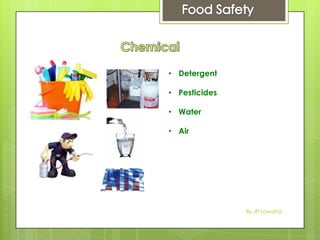
• Detergent
• Pesticides
• Water
• Air
By JP Lawand
• Designate a suitable area away from food to store the detergent
• Label the detergent with name and usage
• Rinse with water utensils and equipment after using detergents
(White vinegar is ideally to remove the detergent)
• Do not mix between food containers and cleaning containers
• Always check the water you are using, regularly check the filtering
system.
• Regularly check the ventilation system
• Cover the food when you are using the pesticides, sanitize
everything afterward
By JP Lawand
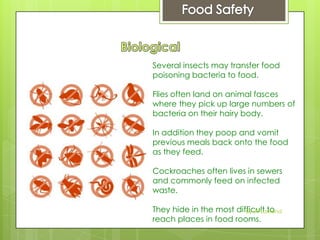
Several insects may transfer food
poisoning bacteria to food.
Flies often land on animal fasces
where they pick up large numbers of
bacteria on their hairy body.
In addition they poop and vomit
previous meals back onto the food
as they feed.
Cockroaches often lives in sewers
and commonly feed on infected
waste.
They hide in the most difficult to
reach places in food rooms.
By JP Lawand
• Clean and sanitize the working area
• Clean the unreachable places (Corners…)
• Maintain walls, ceiling and floor to be free from holes
• Make sure that grain, sugar, flour are free from any sort of pest
• Regular pest control check
• Efficient air curtains on doors
• Fly killers machine
• Cover food
By JP Lawand
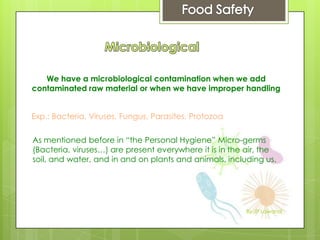
We have a microbiological contamination when we add
contaminated raw material or when we have improper handling
Exp.: Bacteria, Viruses, Fungus, Parasites, Protozoa
As mentioned before in “the Personal Hygiene” Micro-germs
(Bacteria, viruses…) are present everywhere it is in the air, the
soil, and water, and in and on plants and animals, including us.
By JP Lawand
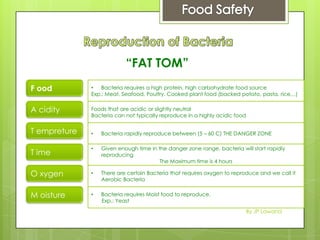
“FAT TOM”
F ood
A cidity
T empreture
O xygen
T ime
M oisture
• Bacteria requires a high protein, high carbohydrate food source
Exp.: Meat, Seafood, Poultry, Cooked plant food (backed potato, pasta, rice…)
Foods that are acidic or slightly neutral
Bacteria can not typically reproduce in a highly acidic food
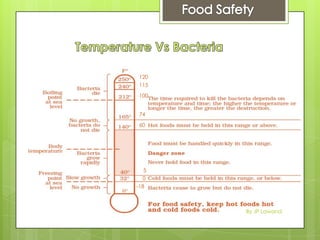
• Bacteria rapidly reproduce between (5 – 60 C) THE DANGER ZONE
• Given enough time in the danger zone range, bacteria will start rapidly
reproducing
The Maximum time is 4 hours
• There are certain Bacteria that requires oxygen to reproduce and we call it
Aerobic Bacteria
• Bacteria requires Moist food to reproduce.
Exp.: Yeast
By JP Lawand
-18
5
0
60
74
100
115
120
By JP Lawand
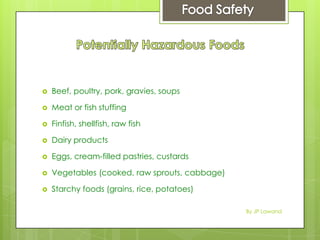
 Beef, poultry, pork, gravies, soups
 Meat or fish stuffing
 Finfish, shellfish, raw fish
 Dairy products
 Eggs, cream-filled pastries, custards
 Vegetables (cooked, raw sprouts, cabbage)
 Starchy foods (grains, rice, potatoes)
By JP Lawand
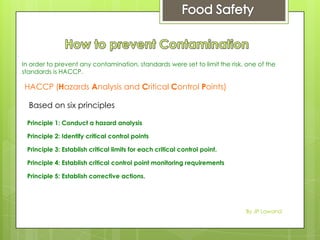
In order to prevent any contamination, standards were set to limit the risk, one of the
standards is HACCP.
HACCP (Hazards Analysis and Critical Control Points)
Based on six principles
Principle 1: Conduct a hazard analysis
Principle 2: Identify critical control points
Principle 3: Establish critical limits for each critical control point.
Principle 4: Establish critical control point monitoring requirements
Principle 5: Establish corrective actions.
By JP Lawand
 Purchasing
 Receiving
 Storing
 Preparing
 Cooking
 Serving and holding
 Cooling
 Reheating
By JP Lawand
 Evaluate suppliers
 Compliance with food safety standards(HACCP, ISO 22000…)
 Trained employees
 Safe/sanitary packaging
 Delivery during “slow” times
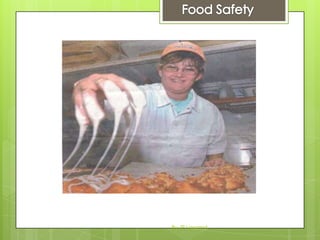
 Supplier facility(Specially for Meat, poultry and fish)
 Transportation and temperature controlled delivery
 Place your orders according to your consumption taking into
consideration the products shelf life
By JP Lawand
 Check supplies upon receipt for:
 signs of spoilage
 color, odor, texture, slime, mold, dirt, insects
 swollen, pierced, rusted, wet containers
 Quality, temperature, general condition
 Arrange delivery for off-peak hours
 Plan ahead to ensure sufficient storage space
 Transfer to proper storage promptly
 Clean transport carts
 Date food (arrival or “use by” date)(exp.: Vegetables)
 Remove the external packaging (carton or dirty crates) and
place the products in clean crates. (for vegetables after
cleaning and sanitizing)
By JP Lawand
By JP Lawand
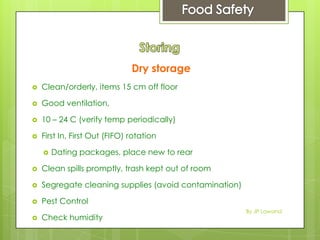
Dry storage
 Clean/orderly, items 15 cm off floor
 Good ventilation,
 10 – 24 C (verify temp periodically)
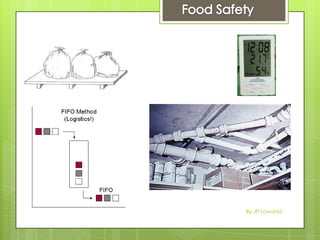
 First In, First Out (FIFO) rotation
 Dating packages, place new to rear
 Clean spills promptly, trash kept out of room
 Segregate cleaning supplies (avoid contamination)
 Pest Control
 Check humidity
By JP Lawand
By JP Lawand
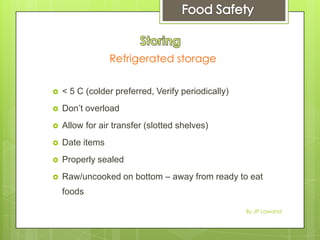
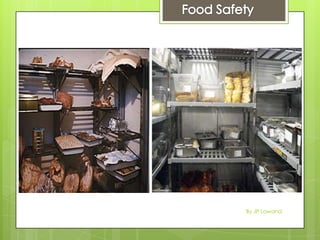
Refrigerated storage
 < 5 C (colder preferred, Verify periodically)
 Don’t overload
 Allow for air transfer (slotted shelves)
 Date items
 Properly sealed
 Raw/uncooked on bottom – away from ready to eat
foods
By JP Lawand
By JP Lawand
Freezer
 - 18 C, store foods immediately for foods that are
frozen upon receipt
 Slotted shelves (circulation)
 Use moisture proof containers/wrappings
 Avoid multiple entries
 Segregate large warm “container” into smaller ones
By JP Lawand
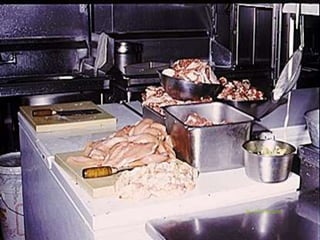
Cross contamination:
is one of the most common causes of food poisoning. It
happens when harmful germs are spread onto food from
other food, surfaces, hands or equipment.
By JP Lawand
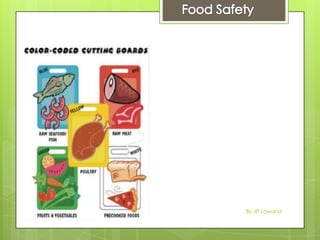
 Don't let raw meat, poultry or unwashed raw vegetables touch other
foods.
 Never prepare ready-to-eat food using a chopping board, utensil or
knife that you have used to prepare raw meat, poultry or unwashed raw
vegetables unless they have been washed and disinfected thoroughly
first.
 Clean worktops and utensils with hot water and detergent and
remember to disinfect those surfaces that have come in contact with
raw meat, poultry and unwashed raw vegetables. You can disinfect
equipment and utensils using boiling water, a chemical such as an
antibacterial leaner or in a dishwasher.
 Always wash your hands thoroughly after touching raw meat, poultry
and unwashed raw vegetables, and before you touch anything else.
 Always cover raw meat and store it on the bottom shelf of the fridge
where it can't touch or drip onto other foods.
 Root vegetables such as potatoes, leeks and carrots often have traces
of soil on them which can contain harmful bacteria, so wash them
thoroughly before use. Don't forget to wash other fruit and vegetables
too, especially if they are going to be eaten raw.
 Keep dishcloths clean and change them regularly.
 Avoid preparing food for yourself or others if you are ill, especially with
vomiting and/or diarrhea.
By JP Lawand
By JP Lawand
 Thawing and Marinating
 Keep foods out of temperature danger zone
 5 C< Danger < 60 C
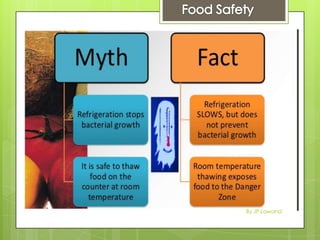
 Never thaw on counter or non-refrigerated area
 Use refrigerator – in pan on bottom shelf
 Under running water (21 C) < 2 hours
 Marinate meats/fish in refrigerator
By JP Lawand
By JP Lawand
By JP Lawand
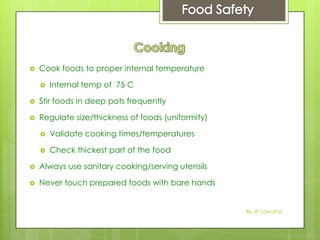
 Cook foods to proper internal temperature
 Internal temp of 75 C
 Stir foods in deep pots frequently
 Regulate size/thickness of foods (uniformity)
 Validate cooking times/temperatures
 Check thickest part of the food
 Always use sanitary cooking/serving utensils
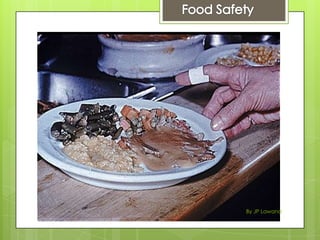
 Never touch prepared foods with bare hands
By JP Lawand
By JP Lawand
 Keep hot food above 60 C
 Steam tables, keep food covered
 Stir foods to ensure even heating
 Keep cold food below 5 C
 Refrigeration unit/ice
 Check temperature periodically
 Sanitize thermometer after each use
 Discard food held in danger zone (4 hours)
 Never add “fresh” food to food already out for serving
By JP Lawand
 Wash hands before serving food
 Clean/sanitary long handled ladles and spoons for
serving
 Never touch parts of cups/plates that will have contact
w/food
 Cover cuts w/ bandages and cover with gloves
 Change gloves after contact with contaminated
surface
 Sneeze guards
 Avoid Cross Contamination
 Pre-wrap food as much as possible
 Watch customer behavior – remove contaminated
food.
By JP Lawand
By JP Lawand
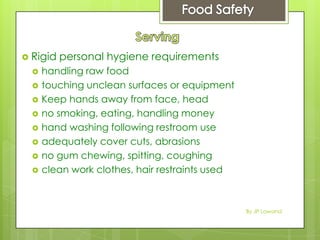
 Rigid personal hygiene requirements
 handling raw food
 touching unclean surfaces or equipment
 Keep hands away from face, head
 no smoking, eating, handling money
 hand washing following restroom use
 adequately cover cuts, abrasions
 no gum chewing, spitting, coughing
 clean work clothes, hair restraints used
By JP Lawand
 Don’t wear jewelry
 Use utensils for serving
 Don’t taste food with finger
 Report any illness to management, avoid handling food
 Healthy workers, hair washing, bathing, with frequent hand washing
By JP Lawand
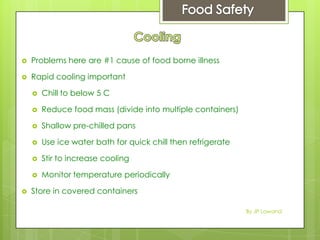
 Problems here are #1 cause of food borne illness
 Rapid cooling important
 Chill to below 5 C
 Reduce food mass (divide into multiple containers)
 Shallow pre-chilled pans
 Use ice water bath for quick chill then refrigerate
 Stir to increase cooling
 Monitor temperature periodically
 Store in covered containers
By JP Lawand
 Boil/heat to > 75 C within 2 hours of removal from
refrigeration
 Never reheat more than once
 Never mix leftover and fresh food
 Discard leftovers refrigerated for more than a week from
preparation date
By JP Lawand
 Fridges & Freezers Temperature log sheet
 Labeling
 Opening and Closing checklists
 Cleaning Checklist
 Controlling the temperature using suitable and clean
thermometer
By JP Lawand
By JP Lawand
http://www.youtube.com/watch?v=XkL5Ac8HzF0

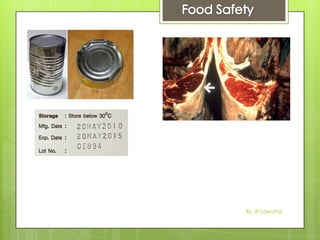
Food safety

  • 1.
  • 2.
    Definition Food safety isa scientific discipline describing:  Handling  Preparation  Storage  Serving Of food in ways that prevent food borne illness. This Includes a number of routines that should be followed to avoid potentially severe health hazards By JP Lawand
  • 3.
    To Maintain GuestSafety To Maintain Quality Standards To Avoid the loss of business To Avoid law suits To Maintain the guest trust Bankruptcy Success By JP Lawand
  • 4.
    Food contamination refersto foods that are spoiled or tainted because they either contain microorganisms, such as bacteria or parasites, or toxic substances that make them unfit for consumption. By JP Lawand
  • 5.
  • 6.
    • Objects thatgets into the food during preparation or serving • Equipment part • Damaged utensils • Cleaning Brush By JP Lawand
  • 7.
    • Hair restraintusing suitable cap or hair net • Long sleeve uniform • Jacket’s pocket always empty • Clean environment, closed windows and doors to avoid dust coming from outside • Equipment well maintained (check the screws, the plastic accessories…) • Avoid the usage of deteriorated utensils • Ceiling and walls well maintained By JP Lawand
  • 8.
    • Detergent • Pesticides •Water • Air By JP Lawand
  • 9.
    • Designate asuitable area away from food to store the detergent • Label the detergent with name and usage • Rinse with water utensils and equipment after using detergents (White vinegar is ideally to remove the detergent) • Do not mix between food containers and cleaning containers • Always check the water you are using, regularly check the filtering system. • Regularly check the ventilation system • Cover the food when you are using the pesticides, sanitize everything afterward By JP Lawand
  • 10.
    Several insects maytransfer food poisoning bacteria to food. Flies often land on animal fasces where they pick up large numbers of bacteria on their hairy body. In addition they poop and vomit previous meals back onto the food as they feed. Cockroaches often lives in sewers and commonly feed on infected waste. They hide in the most difficult to reach places in food rooms. By JP Lawand
  • 11.
    • Clean andsanitize the working area • Clean the unreachable places (Corners…) • Maintain walls, ceiling and floor to be free from holes • Make sure that grain, sugar, flour are free from any sort of pest • Regular pest control check • Efficient air curtains on doors • Fly killers machine • Cover food By JP Lawand
  • 12.
    We have amicrobiological contamination when we add contaminated raw material or when we have improper handling Exp.: Bacteria, Viruses, Fungus, Parasites, Protozoa As mentioned before in “the Personal Hygiene” Micro-germs (Bacteria, viruses…) are present everywhere it is in the air, the soil, and water, and in and on plants and animals, including us. By JP Lawand
  • 13.
    “FAT TOM” F ood Acidity T empreture O xygen T ime M oisture • Bacteria requires a high protein, high carbohydrate food source Exp.: Meat, Seafood, Poultry, Cooked plant food (backed potato, pasta, rice…) Foods that are acidic or slightly neutral Bacteria can not typically reproduce in a highly acidic food • Bacteria rapidly reproduce between (5 – 60 C) THE DANGER ZONE • Given enough time in the danger zone range, bacteria will start rapidly reproducing The Maximum time is 4 hours • There are certain Bacteria that requires oxygen to reproduce and we call it Aerobic Bacteria • Bacteria requires Moist food to reproduce. Exp.: Yeast By JP Lawand
  • 14.
  • 15.
     Beef, poultry,pork, gravies, soups  Meat or fish stuffing  Finfish, shellfish, raw fish  Dairy products  Eggs, cream-filled pastries, custards  Vegetables (cooked, raw sprouts, cabbage)  Starchy foods (grains, rice, potatoes) By JP Lawand
  • 16.
    In order toprevent any contamination, standards were set to limit the risk, one of the standards is HACCP. HACCP (Hazards Analysis and Critical Control Points) Based on six principles Principle 1: Conduct a hazard analysis Principle 2: Identify critical control points Principle 3: Establish critical limits for each critical control point. Principle 4: Establish critical control point monitoring requirements Principle 5: Establish corrective actions. By JP Lawand
  • 17.
     Purchasing  Receiving Storing  Preparing  Cooking  Serving and holding  Cooling  Reheating By JP Lawand
  • 18.
     Evaluate suppliers Compliance with food safety standards(HACCP, ISO 22000…)  Trained employees  Safe/sanitary packaging  Delivery during “slow” times  Supplier facility(Specially for Meat, poultry and fish)  Transportation and temperature controlled delivery  Place your orders according to your consumption taking into consideration the products shelf life By JP Lawand
  • 19.
     Check suppliesupon receipt for:  signs of spoilage  color, odor, texture, slime, mold, dirt, insects  swollen, pierced, rusted, wet containers  Quality, temperature, general condition  Arrange delivery for off-peak hours  Plan ahead to ensure sufficient storage space  Transfer to proper storage promptly  Clean transport carts  Date food (arrival or “use by” date)(exp.: Vegetables)  Remove the external packaging (carton or dirty crates) and place the products in clean crates. (for vegetables after cleaning and sanitizing) By JP Lawand
  • 20.
  • 21.
    Dry storage  Clean/orderly,items 15 cm off floor  Good ventilation,  10 – 24 C (verify temp periodically)  First In, First Out (FIFO) rotation  Dating packages, place new to rear  Clean spills promptly, trash kept out of room  Segregate cleaning supplies (avoid contamination)  Pest Control  Check humidity By JP Lawand
  • 22.
  • 23.
    Refrigerated storage  <5 C (colder preferred, Verify periodically)  Don’t overload  Allow for air transfer (slotted shelves)  Date items  Properly sealed  Raw/uncooked on bottom – away from ready to eat foods By JP Lawand
  • 24.
  • 25.
    Freezer  - 18C, store foods immediately for foods that are frozen upon receipt  Slotted shelves (circulation)  Use moisture proof containers/wrappings  Avoid multiple entries  Segregate large warm “container” into smaller ones By JP Lawand
  • 26.
    Cross contamination: is oneof the most common causes of food poisoning. It happens when harmful germs are spread onto food from other food, surfaces, hands or equipment. By JP Lawand
  • 27.
     Don't letraw meat, poultry or unwashed raw vegetables touch other foods.  Never prepare ready-to-eat food using a chopping board, utensil or knife that you have used to prepare raw meat, poultry or unwashed raw vegetables unless they have been washed and disinfected thoroughly first.  Clean worktops and utensils with hot water and detergent and remember to disinfect those surfaces that have come in contact with raw meat, poultry and unwashed raw vegetables. You can disinfect equipment and utensils using boiling water, a chemical such as an antibacterial leaner or in a dishwasher.  Always wash your hands thoroughly after touching raw meat, poultry and unwashed raw vegetables, and before you touch anything else.  Always cover raw meat and store it on the bottom shelf of the fridge where it can't touch or drip onto other foods.  Root vegetables such as potatoes, leeks and carrots often have traces of soil on them which can contain harmful bacteria, so wash them thoroughly before use. Don't forget to wash other fruit and vegetables too, especially if they are going to be eaten raw.  Keep dishcloths clean and change them regularly.  Avoid preparing food for yourself or others if you are ill, especially with vomiting and/or diarrhea. By JP Lawand
  • 28.
  • 29.
     Thawing andMarinating  Keep foods out of temperature danger zone  5 C< Danger < 60 C  Never thaw on counter or non-refrigerated area  Use refrigerator – in pan on bottom shelf  Under running water (21 C) < 2 hours  Marinate meats/fish in refrigerator By JP Lawand
  • 30.
  • 31.
  • 32.
     Cook foodsto proper internal temperature  Internal temp of 75 C  Stir foods in deep pots frequently  Regulate size/thickness of foods (uniformity)  Validate cooking times/temperatures  Check thickest part of the food  Always use sanitary cooking/serving utensils  Never touch prepared foods with bare hands By JP Lawand
  • 33.
  • 34.
     Keep hotfood above 60 C  Steam tables, keep food covered  Stir foods to ensure even heating  Keep cold food below 5 C  Refrigeration unit/ice  Check temperature periodically  Sanitize thermometer after each use  Discard food held in danger zone (4 hours)  Never add “fresh” food to food already out for serving By JP Lawand
  • 35.
     Wash handsbefore serving food  Clean/sanitary long handled ladles and spoons for serving  Never touch parts of cups/plates that will have contact w/food  Cover cuts w/ bandages and cover with gloves  Change gloves after contact with contaminated surface  Sneeze guards  Avoid Cross Contamination  Pre-wrap food as much as possible  Watch customer behavior – remove contaminated food. By JP Lawand
  • 36.
  • 37.
     Rigid personalhygiene requirements  handling raw food  touching unclean surfaces or equipment  Keep hands away from face, head  no smoking, eating, handling money  hand washing following restroom use  adequately cover cuts, abrasions  no gum chewing, spitting, coughing  clean work clothes, hair restraints used By JP Lawand
  • 38.
     Don’t wearjewelry  Use utensils for serving  Don’t taste food with finger  Report any illness to management, avoid handling food  Healthy workers, hair washing, bathing, with frequent hand washing By JP Lawand
  • 39.
     Problems hereare #1 cause of food borne illness  Rapid cooling important  Chill to below 5 C  Reduce food mass (divide into multiple containers)  Shallow pre-chilled pans  Use ice water bath for quick chill then refrigerate  Stir to increase cooling  Monitor temperature periodically  Store in covered containers By JP Lawand
  • 40.
     Boil/heat to> 75 C within 2 hours of removal from refrigeration  Never reheat more than once  Never mix leftover and fresh food  Discard leftovers refrigerated for more than a week from preparation date By JP Lawand
  • 41.
     Fridges &Freezers Temperature log sheet  Labeling  Opening and Closing checklists  Cleaning Checklist  Controlling the temperature using suitable and clean thermometer By JP Lawand
  • 42.

Editor's Notes

  • #2 What does it mean Food Safety?Why we study food Safety?Why it’s important?
  • #5 What does it mean contamination?
  • #6 Food may be contaminated before or during delivery or may become contaminated as a result of poor hygiene practices.There are 4 contamination hazards:ChemicalPhysicalBiologicalMicrobiological
  • #7 The food may be contaminated with chemicals such as pesticides or detergent.Cleaning material should be separated from the foodCleaning and pest control must never expose food to risk Cleaning chemicals must never be transferred to unmark bottles, or food containers (I see the cleaners sometimes using food containers or utensils to clean exp: knives…)Only food-grade packaging should be used. (food- grade paper, bags…)
  • #8 Physical hazards include things like:Glass, wood, nails, stones, hair, medicines, jewelry, Metal, cleaning material such as the bristles, bits of clouthCigarette ends, blades, buttons, pen top…DirtControl : equipment checkup, no glass policy, suitable uniform.