This presentation is from the course “Sanitation” of the FAO Good
Hygiene Practices (GHP) Toolbox.
Readers are encouraged to visit the online resource for a full
learning experience.
Sanitation in food premises
Sanitation in food premises: Presentation Objectives
The objectives of the presentation are:
– To provide an overview of the topic “Sanitation in food
premises” as covered in the FAO GHP Toolbox.
– To make users aware of the importance of cleaning and
disinfection programmes as the basis of the production
of safe, high quality foods;
– To introduce the basic theory of cleaning and
disinfection so trainers can better advise their
audiences on how to clean and, if necessary, disinfect
premises and equipment;
– To enable trainers to develop cleaning and disinfection
programmes adapted to the technical level of a specific
food business;
Sanitation: Training Outline Overview
1. Understanding the importance of sanitation
2. Removing soils by cleaning
3. Eliminating microorganisms by disinfecting
4. Developing a sanitation programme
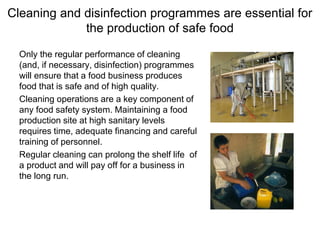
Cleaning and disinfection programmes are essential for
the production of safe food
Only the regular performance of cleaning
(and, if necessary, disinfection) programmes
will ensure that a food business produces
food that is safe and of high quality.
Cleaning operations are a key component of
any food safety system. Maintaining a food
production site at high sanitary levels
requires time, adequate financing and careful
training of personnel.
Regular cleaning can prolong the shelf life of
a product and will pay off for a business in
the long run.
Cleaning and disinfection steps have separate goals
Cleaning removes
– soils (e.g. food
and mineral
residues)
– dust
– dirt/waste
Disinfection is only
done after soils have
been removed in
order to inactivate
remaining
microorganisms!
Note that the term “sanitation” is used by different organisations/publications to
describe a number of actions such as providing clean facilities, maintaining
hygienic conditions, and procedures of disinfection.
Sanitation: Training Outline Overview
1. Understanding the importance of sanitation
2. Removing soils by cleaning
3. Eliminating microorganisms by disinfecting
4. Developing a sanitation programme
Soils have to be regularly removed
Cleaning is an essential part of any food production.
Correctly carried out, cleaning operations
– prevent the build-up of dirt and soils that stick to surfaces and
thus reduce the time necessary for each cleaning step;
– remove food and hiding spaces for pests and reduce the
bacterial load and thus improve levels of hygiene;
– protect surfaces from corrosion through soils, food and
detergent/disinfectant residues;
– prevent contamination of foods with allergens;
Start by removing gross debris
Always
– start by removing gross debris
(i.e. constant removal of used
packaging and food waste)
and then only
– tackle the “small” dirt (e.g.
cleaning sticky surfaces).
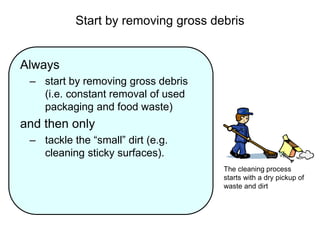
The cleaning process
starts with a dry pickup of
waste and dirt
Effectively removing soils is a challenge
Depending on which type of soil is to be removed
from which type of surface a different cleaning
approach is used.
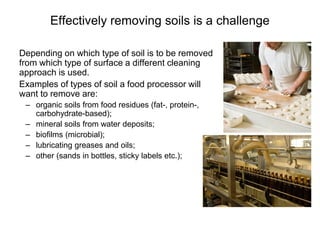
Examples of types of soil a food processor will
want to remove are:
– organic soils from food residues (fat-, protein-,
carbohydrate-based);
– mineral soils from water deposits;
– biofilms (microbial);
– lubricating greases and oils;
– other (sands in bottles, sticky labels etc.);
Removing soils without using water
Dry cleaning methods are used for
low‐moisture foods, and in particular
with foods that are hygroscopic.
Examples are: Bakery goods, nuts and
seeds, candy, grains, snack foods,
dried foods (milk powder, etc.)
Dry cleaning essentially consists of the
mechanical removal of soils using
sweeping, brushing, wiping and
vacuuming with the aim to minimise
the spread of ‘dust’ from one area to
another.
Disinfection following dry cleaning is
done by applying 70% ethanol and
allowing it to dry off before equipment
is reassembled.
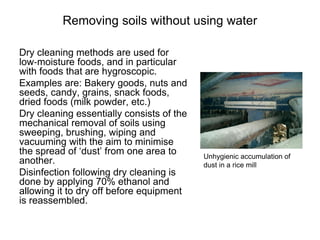
Unhygienic accumulation of
dust in a rice mill
Cleaning with water
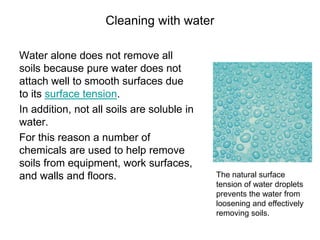
Water alone does not remove all
soils because pure water does not
attach well to smooth surfaces due
to its surface tension.
In addition, not all soils are soluble in
water.
For this reason a number of
chemicals are used to help remove
soils from equipment, work surfaces,
and walls and floors. The natural surface
tension of water droplets
prevents the water from
loosening and effectively
removing soils.
Improving wet cleaning with the help of chemicals
There is no single chemical that effectively removes all types of soils.
The selection of suitable chemicals for cleaning requires special
knowledge and therefore cleaning chemicals should be bought from
specialised suppliers who provide professional support on how to use
their products.
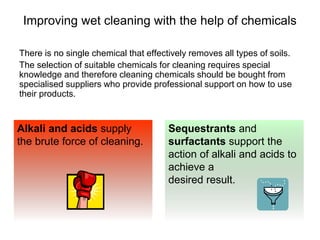
Sequestrants and
surfactants support the
action of alkali and acids to
achieve a
desired result.
Alkali and acids supply
the brute force of cleaning.
Surfactants improve the cleaning effect of water
Surfactants (often referred to as detergents) are
neutral cleaners and are used in hand washing
soaps.
The presence of surfactants enables cleaning
chemicals to reach the soil through
• wetting (reduction of surface tension);
• foaming (e.g. improved adherence to walls);
• spreading (e.g. entering small gaps);
• emulsification (e.g. making fats soluble in
water);
Sequestrants prevent the build up of mineral deposits
The quality of water (i.e. hardness, pH, impurities such as
minerals etc.) influences the effect of detergents.
Sequestrants bind metals and thus can remove mineral
hardness from water and make it softer for improved
cleaning.
EDTA (ethylene diamine tetra acetic acid) and
polyphosphates are known examples of widely used
sequestrants. It should be noted that these chemicals
have been overused and are now considered
environmental pollutants.
Depending on the level of water hardness in a plant the
use of sequestrants could be reduced if they have not
been included by default in commercially available
detergents.
Different soils are soluble at different pH
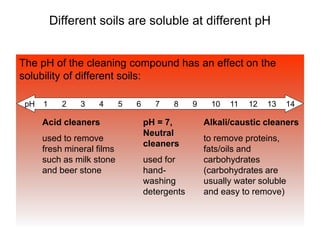
The pH of the cleaning compound has an effect on the
solubility of different soils:
pH 1 2 3 4 5 6 7 8 9 10 11 12 13 14
Acid cleaners
used to remove
fresh mineral films
such as milk stone
and beer stone
Alkali/caustic cleaners
to remove proteins,
fats/oils and
carbohydrates
(carbohydrates are
usually water soluble
and easy to remove)
pH = 7,
Neutral
cleaners
used for
hand-
washing
detergents
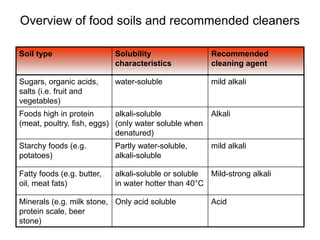
Overview of food soils and recommended cleaners
Soil type Solubility
characteristics
Recommended
cleaning agent
Sugars, organic acids,
salts (i.e. fruit and
vegetables)
water-soluble mild alkali
Foods high in protein
(meat, poultry, fish, eggs)
alkali-soluble
(only water soluble when
denatured)
Alkali
Starchy foods (e.g.
potatoes)
Partly water-soluble,
alkali-soluble
mild alkali
Fatty foods (e.g. butter,
oil, meat fats)
alkali-soluble or soluble
in water hotter than 40°C
Mild-strong alkali
Minerals (e.g. milk stone,
protein scale, beer
stone)
Only acid soluble Acid
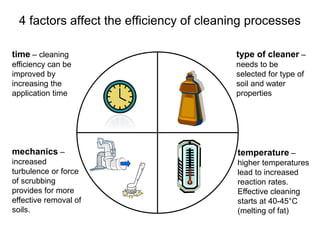
4 factors affect the efficiency of cleaning processes
time – cleaning
efficiency can be
improved by
increasing the
application time
temperature –
higher temperatures
lead to increased
reaction rates.
Effective cleaning
starts at 40-45°C
(melting of fat)
type of cleaner –
needs to be
selected for type of
soil and water
properties
mechanics –
increased
turbulence or force
of scrubbing
provides for more
effective removal of
soils.
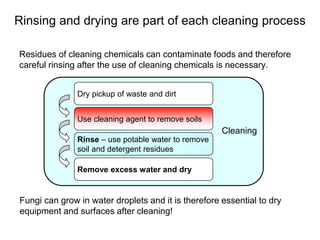
Rinsing and drying are part of each cleaning process
Dry pickup of waste and dirt
Use cleaning agent to remove soils
Rinse – use potable water to remove
soil and detergent residues
Remove excess water and dry
Cleaning
Residues of cleaning chemicals can contaminate foods and therefore
careful rinsing after the use of cleaning chemicals is necessary.
Fungi can grow in water droplets and it is therefore essential to dry
equipment and surfaces after cleaning!
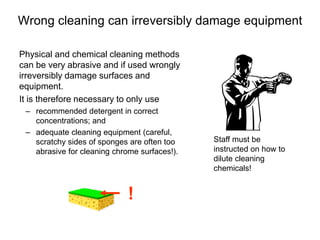
Wrong cleaning can irreversibly damage equipment
Physical and chemical cleaning methods
can be very abrasive and if used wrongly
irreversibly damage surfaces and
equipment.
It is therefore necessary to only use
– recommended detergent in correct
concentrations; and
– adequate cleaning equipment (careful,
scratchy sides of sponges are often too
abrasive for cleaning chrome surfaces!).
Staff must be
instructed on how to
dilute cleaning
chemicals!
!
Sanitation: Training Outline Overview
1. Understanding the importance of sanitation
2. Removing soils by cleaning
3. Eliminating microorganisms by disinfecting
4. Developing a sanitation programme
Disinfection is the step that comes after cleaning
Disinfection inactivates microorganisms only if soils
have first been removed.
Two main methods of disinfection exist:
– physical (e.g. heating, applying pressure, using UV); and
– chemical (e.g. chlorine, ethanol, ozone).
Disinfection in the food industry is a complex topic. This
section only provides a general overview of
disinfectants and illustrates their use through two
examples of disinfection methods commonly used in
food industry.
Remember, many viruses are resistant to disinfection methods and
disinfectant concentrations commonly used in food industry!
Evaluation of most effective method of disinfection
Often, disinfectants in use do not target the
microorganisms of concern or then are applied wrongly and
have no effect.
Deciding on the appropriate disinfectant and/or disinfection
method for a specific food production facility needs careful
evaluation.
Prior to deciding on which disinfectant to use a food
business should consult with more than one supplier and
carefully check the promises made by sales people.
The following slides provide insight into different methods
of disinfection and types of disinfectants used.
An example of a physical disinfection method
Disinfection with steam or hot water in closed
production processes is widely used in food
production.
Steam and/or boiling water are effective
disinfectants as:
– they penetrate into corners and small
spaces;
– leave no residues:
– Attack all types of microorganisms;
Careful: if water hardness exceeds 60 mg/l, water scale is deposited
and needs to be removed!
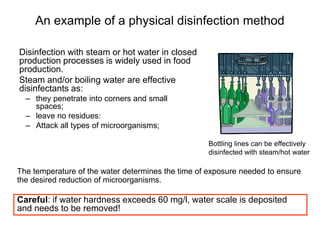
Bottling lines can be effectively
disinfected with steam/hot water
The temperature of the water determines the time of exposure needed to ensure
the desired reduction of microorganisms.
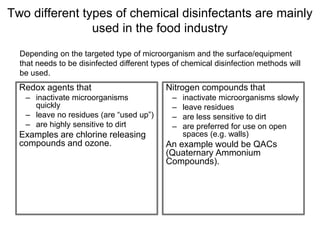
Two different types of chemical disinfectants are mainly
used in the food industry
Redox agents that
– inactivate microorganisms
quickly
– leave no residues (are “used up”)
– are highly sensitive to dirt
Examples are chlorine releasing
compounds and ozone.
Nitrogen compounds that
– inactivate microorganisms slowly
– leave residues
– are less sensitive to dirt
– are preferred for use on open
spaces (e.g. walls)
An example would be QACs
(Quaternary Ammonium
Compounds).
Depending on the targeted type of microorganism and the surface/equipment
that needs to be disinfected different types of chemical disinfection methods will
be used.
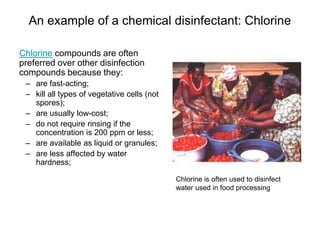
An example of a chemical disinfectant: Chlorine
Chlorine compounds are often
preferred over other disinfection
compounds because they:
– are fast-acting;
– kill all types of vegetative cells (not
spores);
– are usually low-cost;
– do not require rinsing if the
concentration is 200 ppm or less;
– are available as liquid or granules;
– are less affected by water
hardness;
Chlorine is often used to disinfect
water used in food processing
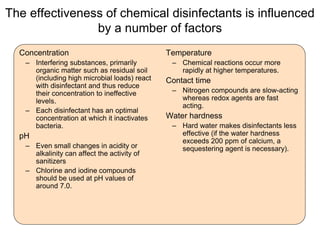
The effectiveness of chemical disinfectants is influenced
by a number of factors
Concentration
– Interfering substances, primarily
organic matter such as residual soil
(including high microbial loads) react
with disinfectant and thus reduce
their concentration to ineffective
levels.
– Each disinfectant has an optimal
concentration at which it inactivates
bacteria.
pH
– Even small changes in acidity or
alkalinity can affect the activity of
sanitizers
– Chlorine and iodine compounds
should be used at pH values of
around 7.0.
Temperature
– Chemical reactions occur more
rapidly at higher temperatures.
Contact time
– Nitrogen compounds are slow-acting
whereas redox agents are fast
acting.
Water hardness
– Hard water makes disinfectants less
effective (if the water hardness
exceeds 200 ppm of calcium, a
sequestering agent is necessary).
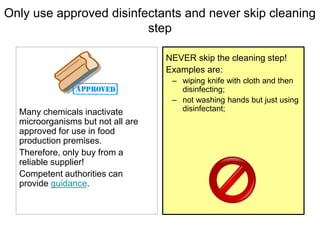
Only use approved disinfectants and never skip cleaning
step
Many chemicals inactivate
microorganisms but not all are
approved for use in food
production premises.
Therefore, only buy from a
reliable supplier!
Competent authorities can
provide guidance.
NEVER skip the cleaning step!
Examples are:
– wiping knife with cloth and then
disinfecting;
– not washing hands but just using
disinfectant;
Sanitation: Training Outline Overview
1. Understanding the importance of sanitation
2. Removing soils by cleaning
3. Eliminating microorganisms by disinfecting
4. Developing a sanitation programme
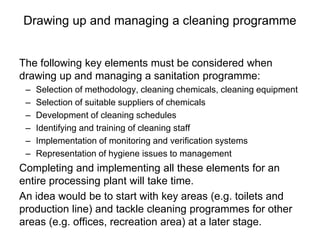
Drawing up and managing a cleaning programme
The following key elements must be considered when
drawing up and managing a sanitation programme:
– Selection of methodology, cleaning chemicals, cleaning equipment
– Selection of suitable suppliers of chemicals
– Development of cleaning schedules
– Identifying and training of cleaning staff
– Implementation of monitoring and verification systems
– Representation of hygiene issues to management
Completing and implementing all these elements for an
entire processing plant will take time.
An idea would be to start with key areas (e.g. toilets and
production line) and tackle cleaning programmes for other
areas (e.g. offices, recreation area) at a later stage.
Organizing sanitation operations
Sanitation operations should follow a logical
sequence to prevent contamination of foods
and/or clean rooms and equipment.
A sanitation sequence determines the order in
which the product contact surfaces of equipment
and environmental surfaces (walls, floors, drains,
etc.) are cleaned and disinfected.
The sequence must be performed at a ‘room’
level so that all environmental surfaces and
equipment in the area are cleaned at the same
time.
Do not forget to dry environmental surfaces and
all equipment. Aerate rooms (with clean air!),
and dry surfaces/equipment with clean clothes.
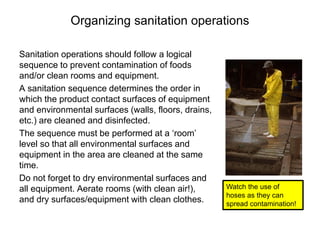
Watch the use of
hoses as they can
spread contamination!
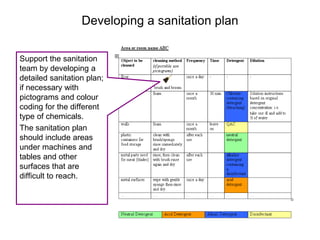
Developing a sanitation plan
Support the sanitation
team by developing a
detailed sanitation plan;
if necessary with
pictograms and colour
coding for the different
type of chemicals.
The sanitation plan
should include areas
under machines and
tables and other
surfaces that are
difficult to reach.
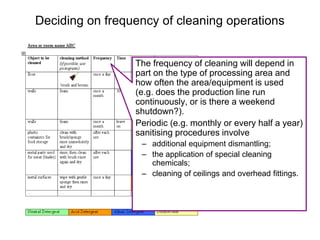
Deciding on frequency of cleaning operations
The frequency of cleaning will depend in
part on the type of processing area and
how often the area/equipment is used
(e.g. does the production line run
continuously, or is there a weekend
shutdown?).
Periodic (e.g. monthly or every half a year)
sanitising procedures involve
– additional equipment dismantling;
– the application of special cleaning
chemicals;
– cleaning of ceilings and overhead fittings.
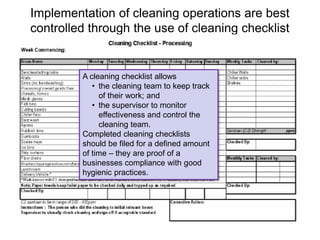
Implementation of cleaning operations are best
controlled through the use of cleaning checklist
A cleaning checklist allows
• the cleaning team to keep track
of their work; and
• the supervisor to monitor
effectiveness and control the
cleaning team.
Completed cleaning checklists
should be filed for a defined amount
of time – they are proof of a
businesses compliance with good
hygienic practices.
The safety of workers needs to be ensured
Cleaning operations may
involve the use of
aggressive chemicals, hot
water and steam.
Appropriate precautions
need to be taken to ensure
the safety of workers.
Therefore, workers
responsible for cleaning and
disinfecting operations must
be properly trained
– in the preparation and use of
the cleaning chemicals, and
– with regard to safety
requirements.
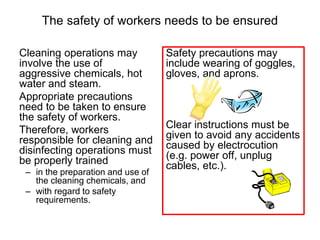
Safety precautions may
include wearing of goggles,
gloves, and aprons.
Clear instructions must be
given to avoid any accidents
caused by electrocution
(e.g. power off, unplug
cables, etc.).
Provide adequate cleaning equipment and storage
space
Cleaning and disinfecting operations
can only be effective if the
equipment is adequate.
Cleaning equipment should be
– of good quality
– cleaned regularly and, if necessary,
disinfected
– regularly replaced
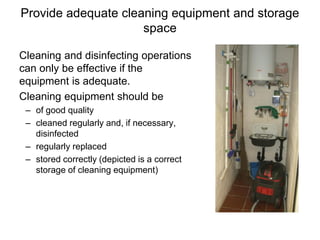
– stored correctly (depicted is a correct
storage of cleaning equipment)
Monitoring effectiveness
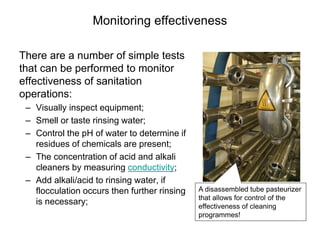
There are a number of simple tests
that can be performed to monitor
effectiveness of sanitation
operations:
– Visually inspect equipment;
– Smell or taste rinsing water;
– Control the pH of water to determine if
residues of chemicals are present;
– The concentration of acid and alkali
cleaners by measuring conductivity;
– Add alkali/acid to rinsing water, if
flocculation occurs then further rinsing
is necessary;
A disassembled tube pasteurizer
that allows for control of the
effectiveness of cleaning
programmes!
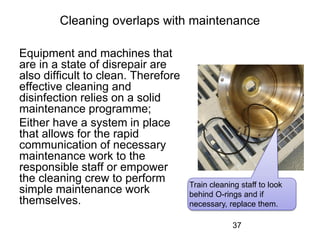
Cleaning overlaps with maintenance
Equipment and machines that
are in a state of disrepair are
also difficult to clean. Therefore
effective cleaning and
disinfection relies on a solid
maintenance programme;
Either have a system in place
that allows for the rapid
communication of necessary
maintenance work to the
responsible staff or empower
the cleaning crew to perform
simple maintenance work
themselves.
37
Train cleaning staff to look
behind O-rings and if
necessary, replace them.
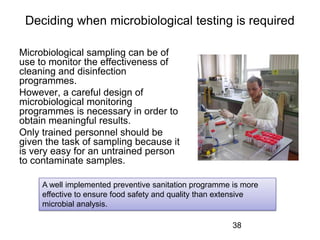
Deciding when microbiological testing is required
Microbiological sampling can be of
use to monitor the effectiveness of
cleaning and disinfection
programmes.
However, a careful design of
microbiological monitoring
programmes is necessary in order to
obtain meaningful results.
Only trained personnel should be
given the task of sampling because it
is very easy for an untrained person
to contaminate samples.
38
A well implemented preventive sanitation programme is more
effective to ensure food safety and quality than extensive
microbial analysis.
Cleaning and Disinfecting: Conclusions
Cleaning and disinfection programmes are part of a sanitation
system and are essential for the production of safe and high
quality food.
Different soils and surfaces need a different cleaning approach
and a number of chemicals are used to help remove different
types of soils and to improve the cleaning efficiency of water.
Disinfection operations are used to reduce the level of
microorganisms after soils have been removed. Both physical
and chemical methods of disinfection are used in food industry.
Sanitation operations should be organised to prevent the
contamination of foods and/or clean rooms and equipment.
A sanitation plan helps the staff responsible for cleaning carry
out cleaning and disinfection steps correctly.
The effectiveness of cleaning operations must be regularly
controlled.
You have reached the end of the presentation
Sanitation.
This presentation is from the course “Sanitation” of the FAO Good
Hygiene Practices (GHP) Toolbox.
Readers are encouraged to visit the online resource for a full
learning experience.

Sanitation in food premises

  • 1.
    This presentation isfrom the course “Sanitation” of the FAO Good Hygiene Practices (GHP) Toolbox. Readers are encouraged to visit the online resource for a full learning experience. Sanitation in food premises
  • 2.
    Sanitation in foodpremises: Presentation Objectives The objectives of the presentation are: – To provide an overview of the topic “Sanitation in food premises” as covered in the FAO GHP Toolbox. – To make users aware of the importance of cleaning and disinfection programmes as the basis of the production of safe, high quality foods; – To introduce the basic theory of cleaning and disinfection so trainers can better advise their audiences on how to clean and, if necessary, disinfect premises and equipment; – To enable trainers to develop cleaning and disinfection programmes adapted to the technical level of a specific food business;
  • 3.
    Sanitation: Training OutlineOverview 1. Understanding the importance of sanitation 2. Removing soils by cleaning 3. Eliminating microorganisms by disinfecting 4. Developing a sanitation programme
  • 4.
    Cleaning and disinfectionprogrammes are essential for the production of safe food Only the regular performance of cleaning (and, if necessary, disinfection) programmes will ensure that a food business produces food that is safe and of high quality. Cleaning operations are a key component of any food safety system. Maintaining a food production site at high sanitary levels requires time, adequate financing and careful training of personnel. Regular cleaning can prolong the shelf life of a product and will pay off for a business in the long run.
  • 5.
    Cleaning and disinfectionsteps have separate goals Cleaning removes – soils (e.g. food and mineral residues) – dust – dirt/waste Disinfection is only done after soils have been removed in order to inactivate remaining microorganisms! Note that the term “sanitation” is used by different organisations/publications to describe a number of actions such as providing clean facilities, maintaining hygienic conditions, and procedures of disinfection.
  • 6.
    Sanitation: Training OutlineOverview 1. Understanding the importance of sanitation 2. Removing soils by cleaning 3. Eliminating microorganisms by disinfecting 4. Developing a sanitation programme
  • 7.
    Soils have tobe regularly removed Cleaning is an essential part of any food production. Correctly carried out, cleaning operations – prevent the build-up of dirt and soils that stick to surfaces and thus reduce the time necessary for each cleaning step; – remove food and hiding spaces for pests and reduce the bacterial load and thus improve levels of hygiene; – protect surfaces from corrosion through soils, food and detergent/disinfectant residues; – prevent contamination of foods with allergens;
  • 8.
    Start by removinggross debris Always – start by removing gross debris (i.e. constant removal of used packaging and food waste) and then only – tackle the “small” dirt (e.g. cleaning sticky surfaces). The cleaning process starts with a dry pickup of waste and dirt
  • 9.
    Effectively removing soilsis a challenge Depending on which type of soil is to be removed from which type of surface a different cleaning approach is used. Examples of types of soil a food processor will want to remove are: – organic soils from food residues (fat-, protein-, carbohydrate-based); – mineral soils from water deposits; – biofilms (microbial); – lubricating greases and oils; – other (sands in bottles, sticky labels etc.);
  • 10.
    Removing soils withoutusing water Dry cleaning methods are used for low‐moisture foods, and in particular with foods that are hygroscopic. Examples are: Bakery goods, nuts and seeds, candy, grains, snack foods, dried foods (milk powder, etc.) Dry cleaning essentially consists of the mechanical removal of soils using sweeping, brushing, wiping and vacuuming with the aim to minimise the spread of ‘dust’ from one area to another. Disinfection following dry cleaning is done by applying 70% ethanol and allowing it to dry off before equipment is reassembled. Unhygienic accumulation of dust in a rice mill
  • 11.
    Cleaning with water Wateralone does not remove all soils because pure water does not attach well to smooth surfaces due to its surface tension. In addition, not all soils are soluble in water. For this reason a number of chemicals are used to help remove soils from equipment, work surfaces, and walls and floors. The natural surface tension of water droplets prevents the water from loosening and effectively removing soils.
  • 12.
    Improving wet cleaningwith the help of chemicals There is no single chemical that effectively removes all types of soils. The selection of suitable chemicals for cleaning requires special knowledge and therefore cleaning chemicals should be bought from specialised suppliers who provide professional support on how to use their products. Sequestrants and surfactants support the action of alkali and acids to achieve a desired result. Alkali and acids supply the brute force of cleaning.
  • 13.
    Surfactants improve thecleaning effect of water Surfactants (often referred to as detergents) are neutral cleaners and are used in hand washing soaps. The presence of surfactants enables cleaning chemicals to reach the soil through • wetting (reduction of surface tension); • foaming (e.g. improved adherence to walls); • spreading (e.g. entering small gaps); • emulsification (e.g. making fats soluble in water);
  • 14.
    Sequestrants prevent thebuild up of mineral deposits The quality of water (i.e. hardness, pH, impurities such as minerals etc.) influences the effect of detergents. Sequestrants bind metals and thus can remove mineral hardness from water and make it softer for improved cleaning. EDTA (ethylene diamine tetra acetic acid) and polyphosphates are known examples of widely used sequestrants. It should be noted that these chemicals have been overused and are now considered environmental pollutants. Depending on the level of water hardness in a plant the use of sequestrants could be reduced if they have not been included by default in commercially available detergents.
  • 15.
    Different soils aresoluble at different pH The pH of the cleaning compound has an effect on the solubility of different soils: pH 1 2 3 4 5 6 7 8 9 10 11 12 13 14 Acid cleaners used to remove fresh mineral films such as milk stone and beer stone Alkali/caustic cleaners to remove proteins, fats/oils and carbohydrates (carbohydrates are usually water soluble and easy to remove) pH = 7, Neutral cleaners used for hand- washing detergents
  • 16.
    Overview of foodsoils and recommended cleaners Soil type Solubility characteristics Recommended cleaning agent Sugars, organic acids, salts (i.e. fruit and vegetables) water-soluble mild alkali Foods high in protein (meat, poultry, fish, eggs) alkali-soluble (only water soluble when denatured) Alkali Starchy foods (e.g. potatoes) Partly water-soluble, alkali-soluble mild alkali Fatty foods (e.g. butter, oil, meat fats) alkali-soluble or soluble in water hotter than 40°C Mild-strong alkali Minerals (e.g. milk stone, protein scale, beer stone) Only acid soluble Acid
  • 17.
    4 factors affectthe efficiency of cleaning processes time – cleaning efficiency can be improved by increasing the application time temperature – higher temperatures lead to increased reaction rates. Effective cleaning starts at 40-45°C (melting of fat) type of cleaner – needs to be selected for type of soil and water properties mechanics – increased turbulence or force of scrubbing provides for more effective removal of soils.
  • 18.
    Rinsing and dryingare part of each cleaning process Dry pickup of waste and dirt Use cleaning agent to remove soils Rinse – use potable water to remove soil and detergent residues Remove excess water and dry Cleaning Residues of cleaning chemicals can contaminate foods and therefore careful rinsing after the use of cleaning chemicals is necessary. Fungi can grow in water droplets and it is therefore essential to dry equipment and surfaces after cleaning!
  • 19.
    Wrong cleaning canirreversibly damage equipment Physical and chemical cleaning methods can be very abrasive and if used wrongly irreversibly damage surfaces and equipment. It is therefore necessary to only use – recommended detergent in correct concentrations; and – adequate cleaning equipment (careful, scratchy sides of sponges are often too abrasive for cleaning chrome surfaces!). Staff must be instructed on how to dilute cleaning chemicals! !
  • 20.
    Sanitation: Training OutlineOverview 1. Understanding the importance of sanitation 2. Removing soils by cleaning 3. Eliminating microorganisms by disinfecting 4. Developing a sanitation programme
  • 21.
    Disinfection is thestep that comes after cleaning Disinfection inactivates microorganisms only if soils have first been removed. Two main methods of disinfection exist: – physical (e.g. heating, applying pressure, using UV); and – chemical (e.g. chlorine, ethanol, ozone). Disinfection in the food industry is a complex topic. This section only provides a general overview of disinfectants and illustrates their use through two examples of disinfection methods commonly used in food industry. Remember, many viruses are resistant to disinfection methods and disinfectant concentrations commonly used in food industry!
  • 22.
    Evaluation of mosteffective method of disinfection Often, disinfectants in use do not target the microorganisms of concern or then are applied wrongly and have no effect. Deciding on the appropriate disinfectant and/or disinfection method for a specific food production facility needs careful evaluation. Prior to deciding on which disinfectant to use a food business should consult with more than one supplier and carefully check the promises made by sales people. The following slides provide insight into different methods of disinfection and types of disinfectants used.
  • 23.
    An example ofa physical disinfection method Disinfection with steam or hot water in closed production processes is widely used in food production. Steam and/or boiling water are effective disinfectants as: – they penetrate into corners and small spaces; – leave no residues: – Attack all types of microorganisms; Careful: if water hardness exceeds 60 mg/l, water scale is deposited and needs to be removed! Bottling lines can be effectively disinfected with steam/hot water The temperature of the water determines the time of exposure needed to ensure the desired reduction of microorganisms.
  • 24.
    Two different typesof chemical disinfectants are mainly used in the food industry Redox agents that – inactivate microorganisms quickly – leave no residues (are “used up”) – are highly sensitive to dirt Examples are chlorine releasing compounds and ozone. Nitrogen compounds that – inactivate microorganisms slowly – leave residues – are less sensitive to dirt – are preferred for use on open spaces (e.g. walls) An example would be QACs (Quaternary Ammonium Compounds). Depending on the targeted type of microorganism and the surface/equipment that needs to be disinfected different types of chemical disinfection methods will be used.
  • 25.
    An example ofa chemical disinfectant: Chlorine Chlorine compounds are often preferred over other disinfection compounds because they: – are fast-acting; – kill all types of vegetative cells (not spores); – are usually low-cost; – do not require rinsing if the concentration is 200 ppm or less; – are available as liquid or granules; – are less affected by water hardness; Chlorine is often used to disinfect water used in food processing
  • 26.
    The effectiveness ofchemical disinfectants is influenced by a number of factors Concentration – Interfering substances, primarily organic matter such as residual soil (including high microbial loads) react with disinfectant and thus reduce their concentration to ineffective levels. – Each disinfectant has an optimal concentration at which it inactivates bacteria. pH – Even small changes in acidity or alkalinity can affect the activity of sanitizers – Chlorine and iodine compounds should be used at pH values of around 7.0. Temperature – Chemical reactions occur more rapidly at higher temperatures. Contact time – Nitrogen compounds are slow-acting whereas redox agents are fast acting. Water hardness – Hard water makes disinfectants less effective (if the water hardness exceeds 200 ppm of calcium, a sequestering agent is necessary).
  • 27.
    Only use approveddisinfectants and never skip cleaning step Many chemicals inactivate microorganisms but not all are approved for use in food production premises. Therefore, only buy from a reliable supplier! Competent authorities can provide guidance. NEVER skip the cleaning step! Examples are: – wiping knife with cloth and then disinfecting; – not washing hands but just using disinfectant;
  • 28.
    Sanitation: Training OutlineOverview 1. Understanding the importance of sanitation 2. Removing soils by cleaning 3. Eliminating microorganisms by disinfecting 4. Developing a sanitation programme
  • 29.
    Drawing up andmanaging a cleaning programme The following key elements must be considered when drawing up and managing a sanitation programme: – Selection of methodology, cleaning chemicals, cleaning equipment – Selection of suitable suppliers of chemicals – Development of cleaning schedules – Identifying and training of cleaning staff – Implementation of monitoring and verification systems – Representation of hygiene issues to management Completing and implementing all these elements for an entire processing plant will take time. An idea would be to start with key areas (e.g. toilets and production line) and tackle cleaning programmes for other areas (e.g. offices, recreation area) at a later stage.
  • 30.
    Organizing sanitation operations Sanitationoperations should follow a logical sequence to prevent contamination of foods and/or clean rooms and equipment. A sanitation sequence determines the order in which the product contact surfaces of equipment and environmental surfaces (walls, floors, drains, etc.) are cleaned and disinfected. The sequence must be performed at a ‘room’ level so that all environmental surfaces and equipment in the area are cleaned at the same time. Do not forget to dry environmental surfaces and all equipment. Aerate rooms (with clean air!), and dry surfaces/equipment with clean clothes. Watch the use of hoses as they can spread contamination!
  • 31.
    Developing a sanitationplan Support the sanitation team by developing a detailed sanitation plan; if necessary with pictograms and colour coding for the different type of chemicals. The sanitation plan should include areas under machines and tables and other surfaces that are difficult to reach.
  • 32.
    Deciding on frequencyof cleaning operations The frequency of cleaning will depend in part on the type of processing area and how often the area/equipment is used (e.g. does the production line run continuously, or is there a weekend shutdown?). Periodic (e.g. monthly or every half a year) sanitising procedures involve – additional equipment dismantling; – the application of special cleaning chemicals; – cleaning of ceilings and overhead fittings.
  • 33.
    Implementation of cleaningoperations are best controlled through the use of cleaning checklist A cleaning checklist allows • the cleaning team to keep track of their work; and • the supervisor to monitor effectiveness and control the cleaning team. Completed cleaning checklists should be filed for a defined amount of time – they are proof of a businesses compliance with good hygienic practices.
  • 34.
    The safety ofworkers needs to be ensured Cleaning operations may involve the use of aggressive chemicals, hot water and steam. Appropriate precautions need to be taken to ensure the safety of workers. Therefore, workers responsible for cleaning and disinfecting operations must be properly trained – in the preparation and use of the cleaning chemicals, and – with regard to safety requirements. Safety precautions may include wearing of goggles, gloves, and aprons. Clear instructions must be given to avoid any accidents caused by electrocution (e.g. power off, unplug cables, etc.).
  • 35.
    Provide adequate cleaningequipment and storage space Cleaning and disinfecting operations can only be effective if the equipment is adequate. Cleaning equipment should be – of good quality – cleaned regularly and, if necessary, disinfected – regularly replaced – stored correctly (depicted is a correct storage of cleaning equipment)
  • 36.
    Monitoring effectiveness There area number of simple tests that can be performed to monitor effectiveness of sanitation operations: – Visually inspect equipment; – Smell or taste rinsing water; – Control the pH of water to determine if residues of chemicals are present; – The concentration of acid and alkali cleaners by measuring conductivity; – Add alkali/acid to rinsing water, if flocculation occurs then further rinsing is necessary; A disassembled tube pasteurizer that allows for control of the effectiveness of cleaning programmes!
  • 37.
    Cleaning overlaps withmaintenance Equipment and machines that are in a state of disrepair are also difficult to clean. Therefore effective cleaning and disinfection relies on a solid maintenance programme; Either have a system in place that allows for the rapid communication of necessary maintenance work to the responsible staff or empower the cleaning crew to perform simple maintenance work themselves. 37 Train cleaning staff to look behind O-rings and if necessary, replace them.
  • 38.
    Deciding when microbiologicaltesting is required Microbiological sampling can be of use to monitor the effectiveness of cleaning and disinfection programmes. However, a careful design of microbiological monitoring programmes is necessary in order to obtain meaningful results. Only trained personnel should be given the task of sampling because it is very easy for an untrained person to contaminate samples. 38 A well implemented preventive sanitation programme is more effective to ensure food safety and quality than extensive microbial analysis.
  • 39.
    Cleaning and Disinfecting:Conclusions Cleaning and disinfection programmes are part of a sanitation system and are essential for the production of safe and high quality food. Different soils and surfaces need a different cleaning approach and a number of chemicals are used to help remove different types of soils and to improve the cleaning efficiency of water. Disinfection operations are used to reduce the level of microorganisms after soils have been removed. Both physical and chemical methods of disinfection are used in food industry. Sanitation operations should be organised to prevent the contamination of foods and/or clean rooms and equipment. A sanitation plan helps the staff responsible for cleaning carry out cleaning and disinfection steps correctly. The effectiveness of cleaning operations must be regularly controlled.
  • 40.
    You have reachedthe end of the presentation Sanitation. This presentation is from the course “Sanitation” of the FAO Good Hygiene Practices (GHP) Toolbox. Readers are encouraged to visit the online resource for a full learning experience.