Hazzard Analysis Critical Control Point
…the Food Safety System
HACCP
Watch Out
… there is a germ about
- The Food Safety tool
• Hazard – food contamination / spoilage
• Analysis – finding out the source
• Critical – the level of danger
• Control – the remedial actions
• Point – the stage for corrective action
HACCP
- Definition
HACCP is a systematic approach to
identify, evaluate and control food safety
hazards that are caused by biological,
chemical or physical agents. These
agents can cause illness if not controlled.
HACCP
… its objective
• To ensure that the food served to the guest is
safe for human consumption.
• Awareness to food handling techniques.
• Understanding the faults and taking corrective
action.
• Better knowledge to food handlers for longer
shelf life of cooked and raw food.
• This methods also has other benefits of
maintaining food quality and managing food
cost.
HACCP
• A forerunner of HACCP was developed during
the World War II.
• Jointly developed by the Pilsbury Company,
and the National Aeronautics and Space
Administration (NASA), to prevents
astronauts from getting food poisoning.
Their goal was to produce 100% safe food.
HACCP – the beginning
• All food handlers – proper
implementation of food safety
standards.
• Only achieved by proper
training and constant
demonstration.
• Commitment to food safety
standards are required.
HACCP – who’s responsibility?
1. Conduct a hazard analysis – identify hazards
2. Determine the Critical Control Point – the step or
procedure at which control can be applied.
3. Establish Critical limits – maximum or minimum
value to reduce hazard to an acceptable level
(7°C - 63°C).
4. Establish a system to monitor control of the
CCP - Visual check, temperature recording etc.
HACCP – The 7 Principles
5. Establish corrective actions to be taken when
monitoring – any deviation should be rectified.
6. Establish procedures for verification to confirm
that the HACCP system is working effectively –
record keeping and documentation.
7. Ensuring the procedure – periodical checks
to ensure that the system is working as
intended.
HACCP – The 7 Principles
Menu
HACCP – The Critical Control Points
Purchase
Receiving Storage Thawing
Preparation
Practicing HACCP
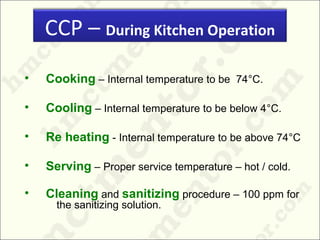
• Cooking – Internal temperature to be 74°C.
• Cooling – Internal temperature to be below 4°C.
• Re heating - Internal temperature to be above 74°C
• Serving – Proper service temperature – hot / cold.
• Cleaning and sanitizing procedure – 100 ppm for
the sanitizing solution.
CCP – During Kitchen Operation
• Personal Hygiene
– Uniform
– Nails
– Hair
– Bruises
– Diseases
Practicing HACCP
Practicing HACCP
• Work Practices
- Tools of trade
- Dusters
- Sanitary wipes
• 3 sink system
– Wash
– Rinse
– Sanitize
Practicing HACCP
Practicing HACCP
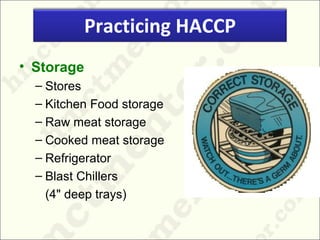
• Storage
– Stores
– Kitchen Food storage
– Raw meat storage
– Cooked meat storage
– Refrigerator
– Blast Chillers
(4" deep trays)
Practicing HACCP
• Handling Food correctly
– Hot & Cold
• Complete thawing
• Complete cooking
Practicing HACCP
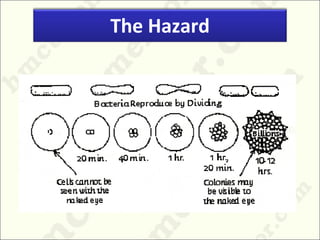
The Hazard
Step Hazard Preventive
measures
CCP What When Corrective
Action
Record
Cooking
Meat
Insufficient
cooking
allows
food
poisoning
Follow
personal
hygiene
standards
&
Cooking
principles
Yes Measure
internal temp
by using
sanitized
thermometer
Each
batch
Continue
cooking until
meat dish
reaches an
internal
minimum
temp of
74°C for
minimum
15 seconds
Cook / chill
temp
monitoring
record.
HACCP Monitoring Sheet
FAQ’S
• What is HACCP?
Hazard Analysis and Critical Control Point is a
process control system designed to identify
and prevent microbial and other hazards in
food production.
FAQ
• How do you implement HACCP in your
organisation?
It includes steps designed to prevent problems
before they occur and to correct deviations as
soon as they are detected.
FAQ
FAQ
• What is the HACCP rule for internal
temperatures of cooked meat which is served hot?
The internal temperature must be 74°C for at least
15 seconds
• What is the danger zone for bacterial growth in
hot food?
4°C to 60°C
WHEN ???
• The last best time to implement a food
safety program was 20 years ago!
• The next best time is NOW!!
THANK YOU
an
Anish Banerjee
initiative

Haccp

  • 1.
    Hazzard Analysis CriticalControl Point …the Food Safety System HACCP
  • 2.
    Watch Out … thereis a germ about
  • 3.
    - The FoodSafety tool • Hazard – food contamination / spoilage • Analysis – finding out the source • Critical – the level of danger • Control – the remedial actions • Point – the stage for corrective action HACCP
  • 4.
    - Definition HACCP isa systematic approach to identify, evaluate and control food safety hazards that are caused by biological, chemical or physical agents. These agents can cause illness if not controlled. HACCP
  • 5.
    … its objective •To ensure that the food served to the guest is safe for human consumption. • Awareness to food handling techniques. • Understanding the faults and taking corrective action. • Better knowledge to food handlers for longer shelf life of cooked and raw food. • This methods also has other benefits of maintaining food quality and managing food cost. HACCP
  • 6.
    • A forerunnerof HACCP was developed during the World War II. • Jointly developed by the Pilsbury Company, and the National Aeronautics and Space Administration (NASA), to prevents astronauts from getting food poisoning. Their goal was to produce 100% safe food. HACCP – the beginning
  • 7.
    • All foodhandlers – proper implementation of food safety standards. • Only achieved by proper training and constant demonstration. • Commitment to food safety standards are required. HACCP – who’s responsibility?
  • 8.
    1. Conduct ahazard analysis – identify hazards 2. Determine the Critical Control Point – the step or procedure at which control can be applied. 3. Establish Critical limits – maximum or minimum value to reduce hazard to an acceptable level (7°C - 63°C). 4. Establish a system to monitor control of the CCP - Visual check, temperature recording etc. HACCP – The 7 Principles
  • 9.
    5. Establish correctiveactions to be taken when monitoring – any deviation should be rectified. 6. Establish procedures for verification to confirm that the HACCP system is working effectively – record keeping and documentation. 7. Ensuring the procedure – periodical checks to ensure that the system is working as intended. HACCP – The 7 Principles
  • 10.
    Menu HACCP – TheCritical Control Points Purchase Receiving Storage Thawing Preparation
  • 11.
  • 12.
    • Cooking –Internal temperature to be 74°C. • Cooling – Internal temperature to be below 4°C. • Re heating - Internal temperature to be above 74°C • Serving – Proper service temperature – hot / cold. • Cleaning and sanitizing procedure – 100 ppm for the sanitizing solution. CCP – During Kitchen Operation
  • 13.
    • Personal Hygiene –Uniform – Nails – Hair – Bruises – Diseases Practicing HACCP
  • 14.
  • 15.
    • Work Practices -Tools of trade - Dusters - Sanitary wipes • 3 sink system – Wash – Rinse – Sanitize Practicing HACCP
  • 16.
  • 17.
    • Storage – Stores –Kitchen Food storage – Raw meat storage – Cooked meat storage – Refrigerator – Blast Chillers (4" deep trays) Practicing HACCP
  • 18.
    • Handling Foodcorrectly – Hot & Cold • Complete thawing • Complete cooking Practicing HACCP
  • 19.
  • 20.
    Step Hazard Preventive measures CCPWhat When Corrective Action Record Cooking Meat Insufficient cooking allows food poisoning Follow personal hygiene standards & Cooking principles Yes Measure internal temp by using sanitized thermometer Each batch Continue cooking until meat dish reaches an internal minimum temp of 74°C for minimum 15 seconds Cook / chill temp monitoring record. HACCP Monitoring Sheet
  • 21.
  • 22.
    • What isHACCP? Hazard Analysis and Critical Control Point is a process control system designed to identify and prevent microbial and other hazards in food production. FAQ
  • 23.
    • How doyou implement HACCP in your organisation? It includes steps designed to prevent problems before they occur and to correct deviations as soon as they are detected. FAQ
  • 24.
    FAQ • What isthe HACCP rule for internal temperatures of cooked meat which is served hot? The internal temperature must be 74°C for at least 15 seconds • What is the danger zone for bacterial growth in hot food? 4°C to 60°C
  • 25.
    WHEN ??? • Thelast best time to implement a food safety program was 20 years ago! • The next best time is NOW!!
  • 26.