Pertussis


   Pediatric Home Service
Infection Control Committee
      December 9, 2010
Mode of Transmission
• Bacteria is found in fluids from the mouth and
  nose.
• Bacteria can be spread by coughing, sneezing, or
  having it on your hands and rubbing your eyes,
  nose, or mouth.
• Greatest risk comes from being within three feet
  of someone with pertussis for at least 10 hours
  per week (close contact).
Pertussis in Minnesota
• Pertussis is endemic in Minnesota
• Occurs year round, peaking in the later part of
  the year
• Annual incidence peaks every 3-5 years
• Adults and adolescents are half of all cases
  nationally
• Waning immunity leads to a substantial
  number of older children and adults
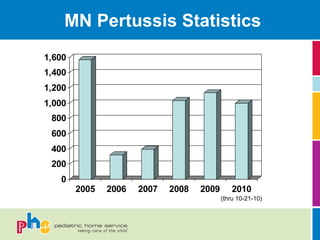
MN Pertussis Statistics
1,600
1,400
1,200
1,000
 800
 600
 400
 200
   0
        2005   2006   2007   2008   2009       2010
                                           (thru 10-21-10)
Clinical Features
• Common incubation period of 7-10 days with a
  range of 4-21 days
• Severe rapid, violent cough
• Bursts of coughing resulting in shortness of
  breath
• After a coughing spell, the person breathes in
  deeply and the breathing pattern often makes a
  whooping sound followed by the next coughing
  spell
Treatment
• Can be treated with antibiotics
• Antibiotic treatment may not cure the
  symptoms
• Will reduce the spread of disease to others
• Antibiotics lessen the symptoms if given in
  the early stage of the illness
Fatal Cases
• Pertussis in infants is often severe
• Infants are more likely than older children and
  adults to develop complications
  – Most common complication is bacterial pneumonia
  – Rare complications include seizures, inflammation of
    the brain, and death
Pertussis Vaccination
• Two types of pertussis vaccination
  – DTaP for infants and children
  – Tdap for adolescents and adults
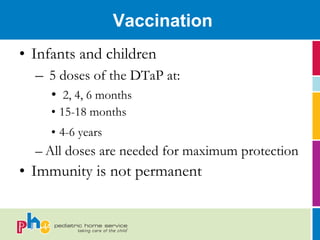
Vaccination
• Infants and children
   – 5 doses of the DTaP at:
     • 2, 4, 6 months
     • 15-18 months
     • 4-6 years
  – All doses are needed for maximum protection
• Immunity is not permanent
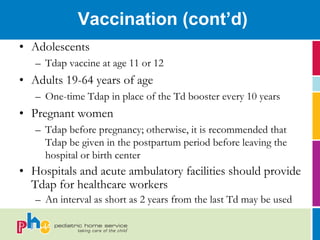
Vaccination (cont’d)
• Adolescents
   – Tdap vaccine at age 11 or 12
• Adults 19-64 years of age
   – One-time Tdap in place of the Td booster every 10 years
• Pregnant women
   – Tdap before pregnancy; otherwise, it is recommended that
     Tdap be given in the postpartum period before leaving the
     hospital or birth center
• Hospitals and acute ambulatory facilities should provide
  Tdap for healthcare workers
   – An interval as short as 2 years from the last Td may be used
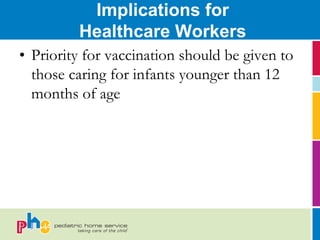
Implications for
         Healthcare Workers
• Priority for vaccination should be given to
  those caring for infants younger than 12
  months of age
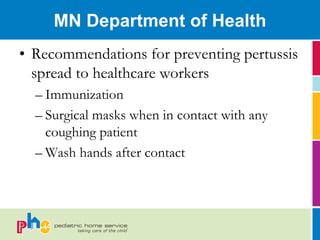
MN Department of Health
• Recommendations for preventing pertussis
  spread to healthcare workers
  – Immunization
  – Surgical masks when in contact with any
    coughing patient
  – Wash hands after contact
Additional Precautions
• At PHS, employees may be performing close contact
  procedures (suctioning with possible coughing
  resulting)
• The MN Department of Health recommends the use of
  eye and face protection, in addition to masks when
  performing procedures, such as close suctioning for all
  patients, not just those with pertussis
• What to Do After an Exposure to a Patient with
  Pertussis?
   – If you were wearing a mask during the exposure, antibiotic
     prophylaxis is not recommended
   – If you were not wearing a mask and had close face-face
     contact, preventive antibiotics would be recommended
What to Do After an Exposure to
   a Patient with Pertussis?
• If you were wearing a mask during the exposure,
  antibiotic prophylaxis is not recommended
• If you were not wearing a mask and had close
  face-face contact, preventive antibiotics would
  be recommended
References
• Center for Disease Control and Prevention. (2010, August).
  Pertussis: Clinical features. Retrieved from
  www.cdc.gov/pertussis/clinical/features.html
• Center for Disease Control and Prevention. (2010, August).
  Pertussis: Outbreaks-questions and answers. Retrieved from
  www.cdc.gov/pertussis/outbreaks-faqs.html
• Minnesota Department of Health. (2010, August). Pertussis: school
  and activities exclusion recommendations. Retrieved from
  www.health.state.mn.us/immunize
• Minnesota Department of Health. (2010, August). Pertussis: Fact
  sheet for EMS, public safety and first responders. Retrieved from
  www.health.state.mn.us/divs/idepc/dtopics/infectioncontrol/ps
  /pertussis.pdf

Pertussis Overview

  • 1.
    Pertussis Pediatric Home Service Infection Control Committee December 9, 2010
  • 2.
    Mode of Transmission •Bacteria is found in fluids from the mouth and nose. • Bacteria can be spread by coughing, sneezing, or having it on your hands and rubbing your eyes, nose, or mouth. • Greatest risk comes from being within three feet of someone with pertussis for at least 10 hours per week (close contact).
  • 3.
    Pertussis in Minnesota •Pertussis is endemic in Minnesota • Occurs year round, peaking in the later part of the year • Annual incidence peaks every 3-5 years • Adults and adolescents are half of all cases nationally • Waning immunity leads to a substantial number of older children and adults
  • 4.
    MN Pertussis Statistics 1,600 1,400 1,200 1,000 800 600 400 200 0 2005 2006 2007 2008 2009 2010 (thru 10-21-10)
  • 5.
    Clinical Features • Commonincubation period of 7-10 days with a range of 4-21 days • Severe rapid, violent cough • Bursts of coughing resulting in shortness of breath • After a coughing spell, the person breathes in deeply and the breathing pattern often makes a whooping sound followed by the next coughing spell
  • 6.
    Treatment • Can betreated with antibiotics • Antibiotic treatment may not cure the symptoms • Will reduce the spread of disease to others • Antibiotics lessen the symptoms if given in the early stage of the illness
  • 7.
    Fatal Cases • Pertussisin infants is often severe • Infants are more likely than older children and adults to develop complications – Most common complication is bacterial pneumonia – Rare complications include seizures, inflammation of the brain, and death
  • 8.
    Pertussis Vaccination • Twotypes of pertussis vaccination – DTaP for infants and children – Tdap for adolescents and adults
  • 9.
    Vaccination • Infants andchildren – 5 doses of the DTaP at: • 2, 4, 6 months • 15-18 months • 4-6 years – All doses are needed for maximum protection • Immunity is not permanent
  • 10.
    Vaccination (cont’d) • Adolescents – Tdap vaccine at age 11 or 12 • Adults 19-64 years of age – One-time Tdap in place of the Td booster every 10 years • Pregnant women – Tdap before pregnancy; otherwise, it is recommended that Tdap be given in the postpartum period before leaving the hospital or birth center • Hospitals and acute ambulatory facilities should provide Tdap for healthcare workers – An interval as short as 2 years from the last Td may be used
  • 11.
    Implications for Healthcare Workers • Priority for vaccination should be given to those caring for infants younger than 12 months of age
  • 12.
    MN Department ofHealth • Recommendations for preventing pertussis spread to healthcare workers – Immunization – Surgical masks when in contact with any coughing patient – Wash hands after contact
  • 13.
    Additional Precautions • AtPHS, employees may be performing close contact procedures (suctioning with possible coughing resulting) • The MN Department of Health recommends the use of eye and face protection, in addition to masks when performing procedures, such as close suctioning for all patients, not just those with pertussis • What to Do After an Exposure to a Patient with Pertussis? – If you were wearing a mask during the exposure, antibiotic prophylaxis is not recommended – If you were not wearing a mask and had close face-face contact, preventive antibiotics would be recommended
  • 14.
    What to DoAfter an Exposure to a Patient with Pertussis? • If you were wearing a mask during the exposure, antibiotic prophylaxis is not recommended • If you were not wearing a mask and had close face-face contact, preventive antibiotics would be recommended
  • 15.
    References • Center forDisease Control and Prevention. (2010, August). Pertussis: Clinical features. Retrieved from www.cdc.gov/pertussis/clinical/features.html • Center for Disease Control and Prevention. (2010, August). Pertussis: Outbreaks-questions and answers. Retrieved from www.cdc.gov/pertussis/outbreaks-faqs.html • Minnesota Department of Health. (2010, August). Pertussis: school and activities exclusion recommendations. Retrieved from www.health.state.mn.us/immunize • Minnesota Department of Health. (2010, August). Pertussis: Fact sheet for EMS, public safety and first responders. Retrieved from www.health.state.mn.us/divs/idepc/dtopics/infectioncontrol/ps /pertussis.pdf