Dysautonomia and POTS
Presented by Dr. Roy Maynard
October 2, 2013
Objectives
• Understand basics related to the
autonomic nervous system
• Describe normal orthostatic response in
transitioning from supine to upright
position
• Identify symptoms associated with POTS
• Name the most common form of
orthostatic intolerance
2 of 36
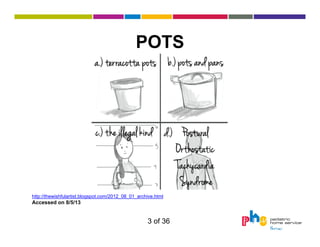
POTS

http://thewishfulartist.blogspot.com/2012_08_01_archive.html

Accessed on 8/5/13

3 of 36
Definitions
• Dysautonomia:- malfunction of the
autonomic nervous system
• POTS:- Postural Orthostatic Tachycardia
Syndrome

4 of 36
Autonomic Nervous System
• Two Components
– Sympathetic
• Fight or flight

– Parasympathetic
• Rest or digest

5 of 36
Autonomic Nervous System
• Anatomy
– Lower brainstem
• Sympathetic T1- L3
• Parasympathetic S2-S4, Cranial Nerves 3, 7, 9, 10

• Function
–
–
–
–

Subconscious level
Visceral functions
Heart rate, respiration, blood pressure
Digestion, micturation, perspiration, salivation,
pupillary dilatation
– Dilatation and constriction of blood vessels (arteries
and veins)
6 of 36
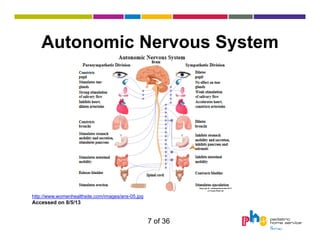
Autonomic Nervous System

http://www.womenhealthsite.com/images/ans-05.jpg

Accessed on 8/5/13

7 of 36
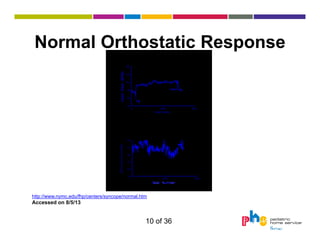
Normal Orthostatic Response
• Standing transfers more than 17 ounces of
blood into the abdomen and legs
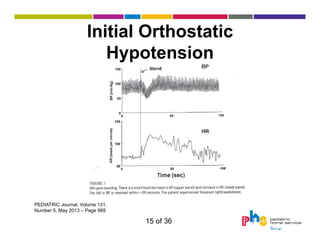
• Initial period of instability (initial orthostatic
hypotension) ensues and blood pressure
may decrease by 30% for 10 to 20
seconds after standing
• Reflex tachycardia happens
• Blood pressure restored within 30 to 60
seconds
8 of 36
Normal Orthostatic Response
• Mechanisms to restore hemodynamics
– Arterial vasoconstriction
– Elastic recoil of venous blood in dependent
veins
– Active venoconstriction in splanchnic veins

9 of 36
Normal Orthostatic Response

http://www.nymc.edu/fhp/centers/syncope/normal.htm

Accessed on 8/5/13

10 of 36
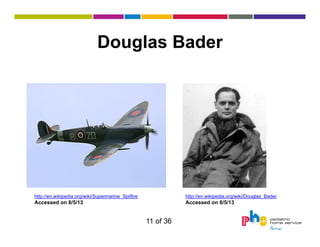
Douglas Bader

http://en.wikipedia.org/wiki/Supermarine_Spitfire

http://en.wikipedia.org/wiki/Douglas_Bader

Accessed on 8/5/13

Accessed on 8/5/13

11 of 36
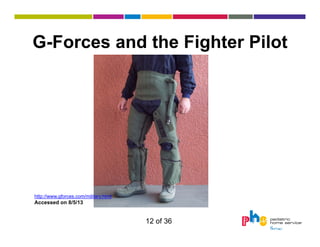
G-Forces and the Fighter Pilot

http://www.gforces.com/military.html

Accessed on 8/5/13

12 of 36
Types of Orthostatic
Hypotension
• Initial Orthostatic Hypotension
• Orthostatic Hypotension
– Nonneurogenic orthostatic hypotension
– Neurogenic orthostatic hypotension

• POTS
– Neuropathic POTS
– Hyperadrenergic POTS

• Vasovagal Syncope (VVS)
13 of 36
diagnosis
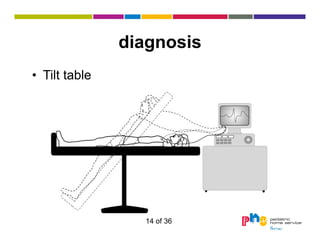
• Tilt table

14 of 36
Initial Orthostatic
Hypotension

PEDIATRIC Journal, Volume 131,
Number 5, May 2013 – Page 969

15 of 36
Types of Orthostatic
Hypotension
• Initial Orthostatic Hypotension
• Orthostatic Hypotension
– Non-neurogenic orthostatic hypotension
– Neurogenic orthostatic hypotension

• POTS
– Neuropathic POTS
– Hyperadrenergic POTS

• Postural Vasovagal syncope
16 of 36
Orthostatic Hypotension
• Non-neurogenic orthostatic hypotension
– Common in young
– Cause – drugs, dehydration, hemorrhage
– Mechanism- incomplete autonomic nervous
system compensation for stressors
– Treatment- stop medication, prevent
dehydration

17 of 36
Orthostatic Hypotension
• Neurogenic orthostatic hypotension
– Rare in young people, no increase in heart
rate
– Associated with diabetes, amyloidosis,
Parkinson’s disease
– Cause- autonomic vasoconstrictor failure
– Treatment- physical counter-maneuvers,
• Medications- IV saline, corticosteroids, midodrine,
droxidopa
18 of 36
Types of Orthostatic
Hypotension
• Initial Orthostatic Hypotension
• Orthostatic Hypotension
– Non-neurogenic orthostatic hypotension
– Neurogenic orthostatic hypotension

• POTS
– Neuropathic POTS
– Hyperadrenergic POTS

• Postural Vasovagal syncope
19 of 36
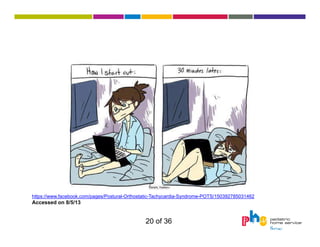
https://www.facebook.com/pages/Postural-Orthostatic-Tachycardia-Syndrome-POTS/150392785031462

Accessed on 8/5/13

20 of 36
Postural Orthostatic Tachycardia
Syndrome
• Definition: chronic day-to-day symptoms of
orthostatic intolerance plus excessive
increase in heart rate when upright
– HR>30 from baseline
or >120 after 10 minutes during tilt test in adults
– HR>40 from baseline in children and teens
– Blood pressure usually not low

• Cause: alterations in autonomic nervous
system
21 of 36
Postural Orthostatic Tachycardia
Syndrome
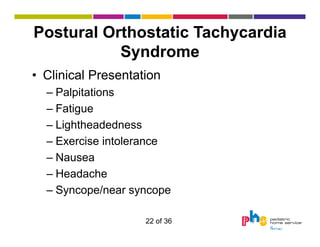
• Clinical Presentation
– Palpitations
– Fatigue
– Lightheadedness
– Exercise intolerance
– Nausea
– Headache
– Syncope/near syncope
22 of 36
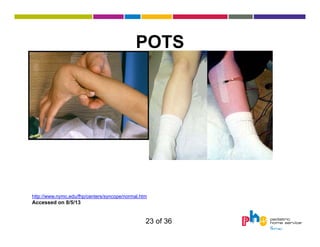
POTS

http://www.nymc.edu/fhp/centers/syncope/normal.htm

Accessed on 8/5/13

23 of 36
Epidemiology
• Females > Males 3:1 to 5:1; > 500,000 in 1999
• Triggers: Onset often follows flulike illness, selflimited autoimmune disease, surgery or injury,
pregnancy, rapid growth spurt
• May be associated with joint hypermobility
syndromes
• Young women may be underweight; need to
differentiate from eating disorders
• Hot weather or hot showers worsens symptoms
• Cognitive function may be affected
24 of 36
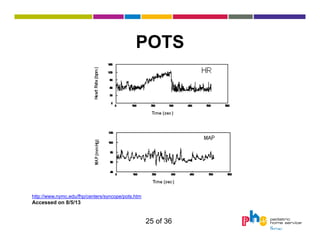
POTS

http://www.nymc.edu/fhp/centers/syncope/pots.htm

Accessed on 8/5/13

25 of 36
POTS
• Neuropathic POTS
– Cause- loss of regional vasoconstrictive ability
– Blood pooling in lower extremities
– Heart rate increases to compensate for
decreased circulating blood volume now
pooling in lower extremities

26 of 36
Treatment
• Neuropathic POTS- defect is loss of
regional vasoconstrictive ability
– Physical counter-manuevers
– Salt and water loading
– Midodrine
– Mestinon
– Exercise
– Rapid water ingestion
27 of 36
POTS
• Hyperadrenergic POTS
– Increased circulating norepinephrine
– May have increased orthostatic blood
pressure
– Less common than neuropathic form
– Symptoms attributed- anxiety, tremor, cold
sweaty extremities

28 of 36
Treatment
• Hyperadrenergic POTS:- Defect adrenergic
potentiation
– Physical counter-manuevers
– Beta-blockers
– Angiotension receptor blocker
– Fludrocortisone

29 of 36
OUTCOME for patients with
POTS
• Adolescent-onset: 80% recover by mid
20’s
• Adult-onset: large percentage recover
within 2-5 years
• Some patients will suffer from long term
disability associated with POTS

30 of 36
Types of Orthostatic
Hypotension
• Initial Orthostatic Hypotension
• Orthostatic Hypotension
– Non-neurogenic orthostatic hypotension
– Neurogenic orthostatic hypotension

• POTS
– Neuropathic POTS
– Hyperadrenergic POTS

• Postural Vasovagal syncope
31 of 36
Postural Vasovagal Syncope
• Most common form of orthostatic
intolerance
• Onset age 15, 2/3 are female
• 40% of the population has had at least one
episode in their lifetime

32 of 36
Treatment
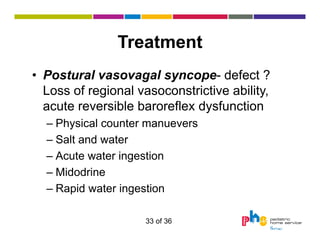
• Postural vasovagal syncope- defect ?
Loss of regional vasoconstrictive ability,
acute reversible baroreflex dysfunction
– Physical counter manuevers
– Salt and water
– Acute water ingestion
– Midodrine
– Rapid water ingestion
33 of 36
Summary
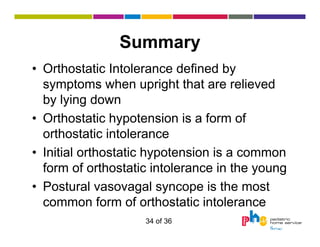
• Orthostatic Intolerance defined by
symptoms when upright that are relieved
by lying down
• Orthostatic hypotension is a form of
orthostatic intolerance
• Initial orthostatic hypotension is a common
form of orthostatic intolerance in the young
• Postural vasovagal syncope is the most
common form of orthostatic intolerance
34 of 36
Summary
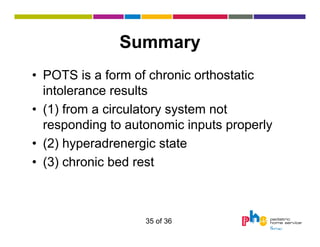
• POTS is a form of chronic orthostatic
intolerance results
• (1) from a circulatory system not
responding to autonomic inputs properly
• (2) hyperadrenergic state
• (3) chronic bed rest

35 of 36
The End
• Thanks for coming.
• Questions?

36 of 36

Dysautonomia and pots