Emerging and Re-Emerging
Infections: Spotlight on pertussis
By
Dr Magdy Shafik
pediatric consultant
PhD pediatric
Outlines
• Why does Pertussis continue to cause concern?
• Epidemiology & disease burden
• Pertussis clinical characteristics,Diagnosis and
complication
• Prévention Strate gy
• Why vaccinate pregnant woman against pertussis?
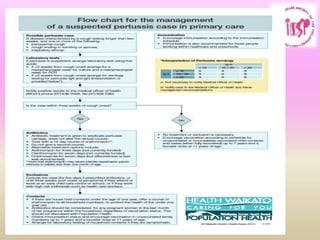
• Mangement of suspected cases
• Conclusions
Why does Pertussis continue to
cause concern?
Very young (under 6 months)
•Babies are born with maternal antibodies however this does not give adequate
protection
•Antibodies transferred to the baby through breast milk will not provide adequate
protection either
1.Poorly protected until received 3 doses of vaccine
2.Increased risk of severe disease / death
3.Efficacy of childhood DTPa vaccination is 89%.
Adults
•Waning immunity from immunization or natural infection
•Pass on the disease to the very young
»at least 50% of infants contract the disease from an adult contact
•Can cause significant morbidity in older aged
»cerebral hemorrhages, rib fractures, hernia, incontinence
• There is a lot of pertussis around at the
moment and babies who are too young to
start their vaccinations are at greater risk
The incidence of pertussis increased
dramatically as part of a national outbreak in
2012 and 2013 and still remains well above pre
outbreak levels
• During 2014 there were 504 laboratory
confirmed cases of pertussis, which remains
well above the historic levels
In 2011 and 2010 there had been 119 and 82
confirmed cases respectively
2010 California Pertussis
Outbreak
• 7,824 confirmed, probable and suspect cases of
pertussis with onset from January 1 through
December 15, 2010 (20.0 cases/100,000)
• Previous record: 1947 (63 years ago) 9,394 cases;
26.0 cases/100,000 in 1958
• Highest rates in children under three to six months of
age
• Younger infants also had the highest rates of
hospitalization and the most deaths, which increased
to 10
What is Pertussis?
• Pertussis is an acute bacterial infection
caused by Bordetella pertussis
• It is highly contagious and can be passed
from person to person though droplets from
the nose and throat of infected individuals
when coughing and sneezing
• Infants and young children are the most
vulnerable group, with the highest rates of
complications and mortality
Incubation period
• The incubation period is on average 7-10 days
(range 5-21 days)
Infectious period
• Patients with pertussis are most infectious in
the initial catarrhal stage and during first
three weeks after the onset of cough
Clinical Manifestations of
Pertussis
• Usually affect children before vaccine available
• Clinical illness in 3 stages
– Catarrhal phase
• Cold-like (coryza, conjunctival irritation, occasionally a slight
cough)
• 7-10 days
– Paroxysmal phase
• Long duration (2-6 weeks); No fever
• a series of rapid, forced expirations, followed by gasping
inhalation the typical whooping sound
• Post-tussive vomiting common
• Very young infants may present with apnea or cyanosis
in the absence of cough
– Convalescent phase
VIDEOS
• In young infants the typical ‘whoop’ may never
develop and coughing spasms can be followed
by difficulty breathing (apnoea).
• Young children may also seem to choke or
become blue in the face (cyanosis) when they
have a bout of coughing.
• The rate of hospitalisation and complications
for pertussis is much higher in young infants
than it is for older children and adults.
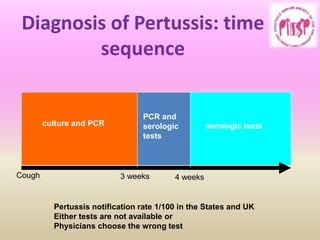
Diagnosis of Pertussis: time
sequence
Cough 3 weeks 4 weeks
culture and PCR
PCR and
serologic
tests
serologic tests
Pertussis notification rate 1/100 in the States and UK
Either tests are not available or
Physicians choose the wrong test
Pertussis- possible complications in infants
and young children
most severely affected and more likely to develop severe
complications such as:
•Pneumonia
•Weight loss due to excessive vomiting
•Seizures or brain damage
•Encephalitis (an acute inflammation of the
brain)
•Low blood pressure, requiring medication
•Kidney failure, requiring temporary dialysis
In severe cases pertussis can be fatal in infants and young
children
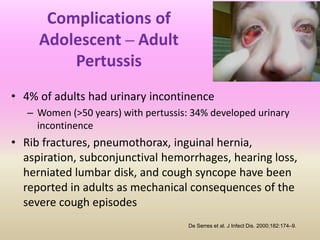
Complications of
Adolescent – Adult
Pertussis
• 4% of adults had urinary incontinence
– Women (>50 years) with pertussis: 34% developed urinary
incontinence
• Rib fractures, pneumothorax, inguinal hernia,
aspiration, subconjunctival hemorrhages, hearing loss,
herniated lumbar disk, and cough syncope have been
reported in adults as mechanical consequences of the
severe cough episodes
De Serres et al. J Infect Dis. 2000;182:174–9.
Cardiogenic Shock caused by Pertussis
• 3 infants with pulmonary hypertension, right-sided heart failure and
cardiogenic shock who responded favorably to whole blood exchange
therapy
– All had rapid cardiovascular and respiratory collapse in relation to cardiogenic
shock, progressive hypoxia and increased WBC counts (45,000 cells/L, 78,800
cells/L and 106,000 cells/L)
– The echocardiogram showed severe pulmonary hypertension
– Double-volume exchange transfusion was performed and the WBC counts
decreased, the cardiopulmonary condition improved and the patients survived
• Hyperleukocytosis (white blood cell WBC > 50,000 cells/L) is a critical
element and occasionally present in patients with pertussis
• Outcome poor if patients develop refractory pulmonary hypertension
• Mechanism: occlusion of the pulmonary vessels by the increased mass of
leukocytes (pulmonary leukostasis), possibly due to enhanced pertussis
toxin production
Donoso AF et al, PIDJ 2006: 846
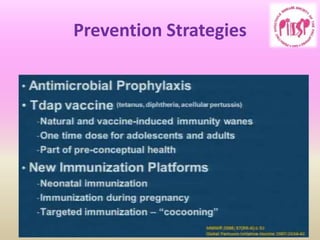
Prevention Strategies
Immunity against pertussis
Vaccination against pertussis does not give
life-long immunity
• Individuals who have had pertussis can
become re-infected and spread infection
to others
• This spread of infection is important
particularly in children too young to be
vaccinated
Combination vaccines with acellular pertussis[
DTaP and Tdap are both combined vaccines against
diphtheria, tetanus, and pertussis. The difference is in the
dosage, with the upper case letters meaning higher quantity
DTaP (also DTPa and TDaP) is a combined vaccine against
diphtheria, tetanus, and pertussis, in which the component with
lower case 'a' is acellular. This is in contrast to whole-cell,
inactivated DTP (aka DTwP). The acellular vaccine uses
selected antigens of the pertussis pathogen to induce
immunity. Because it uses fewer antigens than the whole cell
vaccines, it is considered safer, but it is also more expensive.
Recent research suggests that the DTP vaccine is more
effective than DTaP in conferring immunity; this is because
DTaP's narrower antigen base is less effective against current
pathogen strains
Cocooning Immunization Strategy
• Selective immunization of
– New mothers
– Family members
– Close contacts of un-immunized or incompletely
immunized young infants
• Selective immunization of
– Health care workers
– Child care workers
Pertussis Vaccines
ACIP Recommendations 2010
• Adolescents who have not received a dose of Tdap or whose
vaccine history is unknown should be immunized with Tdap
as soon as feasible
• Children 7-10 years of age who are not fully vaccinated with
pertussis (not receive 5 doses Dtap/DTP) should receive 1
dose of Tdap
• Children 7-10 years who have never been vaccinated should
receive 1 tdap, a second dose of td and a 3rd dose of td
Pertussis Vaccines
ACIP Recommendations 2010
• Adult 65+:
– general recommendation for Tdap for those 65+ who
have contact with infants under 1 year of age (in
place of a Td vaccine)
– permissive recommendation for Tdap in place of Td
for all other adults 65+
• All of these recommendations are off-label use
for both licensed Tdap vaccines
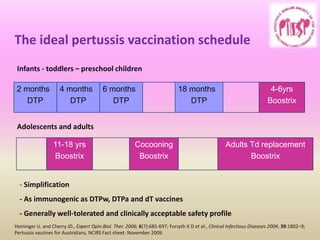
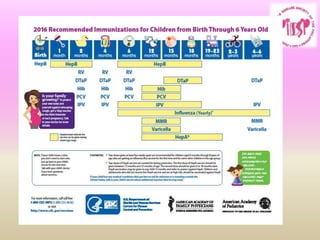
The ideal pertussis vaccination schedule
2 months
DTP
4 months
DTP
6 months
DTP
18 months
DTP
4-6yrs
Boostrix
11-18 yrs
Boostrix
Cocooning
Boostrix
Adults Td replacement
Boostrix
- Simplification
- As immunogenic as DTPw, DTPa and dT vaccines
- Generally well-tolerated and clinically acceptable safety profile
Infants - toddlers – preschool children
Adolescents and adults
Heininger U. and Cherry JD., Expert Opin.Biol. Ther. 2006; 6(7):685-697; Forsyth K D et al., Clinical Infectious Diseases 2004; 39:1802–9;
Pertussis vaccines for Australians, NCIRS Fact sheet: November 2009.
Vaccination now recommended from 16 weeks
of pregnancy
An update for registered healthcare
practitioners – April 2016
Vaccination of pregnant women
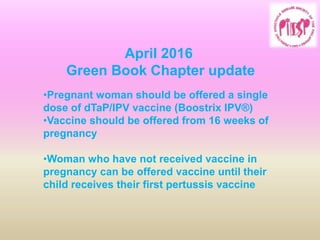
April 2016
Green Book Chapter update
•Pregnant woman should be offered a single
dose of dTaP/IPV vaccine (Boostrix IPV®)
•Vaccine should be offered from 16 weeks of
pregnancy
•Woman who have not received vaccine in
pregnancy can be offered vaccine until their
child receives their first pertussis vaccine
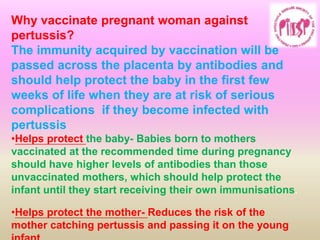
Why vaccinate pregnant woman against
pertussis?
The immunity acquired by vaccination will be
passed across the placenta by antibodies and
should help protect the baby in the first few
weeks of life when they are at risk of serious
complications if they become infected with
pertussis
•Helps protect the baby- Babies born to mothers
vaccinated at the recommended time during pregnancy
should have higher levels of antibodies than those
unvaccinated mothers, which should help protect the
infant until they start receiving their own immunisations.
•Helps protect the mother- Reduces the risk of the
mother catching pertussis and passing it on the young
Conclusions
• Pertussis has become a disease of older
subjects and is more common than we
realized
• Further booster of pertussis vaccine from
adolescence is recommended and may be
very helpful
• Large scale pertussis epidemic still occurred
• A better vaccine to reduce disease and
colonization is highly desired
THANK YOU

Pertussis

  • 1.
    Emerging and Re-Emerging Infections:Spotlight on pertussis By Dr Magdy Shafik pediatric consultant PhD pediatric
  • 2.
    Outlines • Why doesPertussis continue to cause concern? • Epidemiology & disease burden • Pertussis clinical characteristics,Diagnosis and complication • Prévention Strate gy • Why vaccinate pregnant woman against pertussis? • Mangement of suspected cases • Conclusions
  • 3.
    Why does Pertussiscontinue to cause concern? Very young (under 6 months) •Babies are born with maternal antibodies however this does not give adequate protection •Antibodies transferred to the baby through breast milk will not provide adequate protection either 1.Poorly protected until received 3 doses of vaccine 2.Increased risk of severe disease / death 3.Efficacy of childhood DTPa vaccination is 89%. Adults •Waning immunity from immunization or natural infection •Pass on the disease to the very young »at least 50% of infants contract the disease from an adult contact •Can cause significant morbidity in older aged »cerebral hemorrhages, rib fractures, hernia, incontinence
  • 4.
    • There isa lot of pertussis around at the moment and babies who are too young to start their vaccinations are at greater risk The incidence of pertussis increased dramatically as part of a national outbreak in 2012 and 2013 and still remains well above pre outbreak levels • During 2014 there were 504 laboratory confirmed cases of pertussis, which remains well above the historic levels In 2011 and 2010 there had been 119 and 82 confirmed cases respectively
  • 5.
    2010 California Pertussis Outbreak •7,824 confirmed, probable and suspect cases of pertussis with onset from January 1 through December 15, 2010 (20.0 cases/100,000) • Previous record: 1947 (63 years ago) 9,394 cases; 26.0 cases/100,000 in 1958 • Highest rates in children under three to six months of age • Younger infants also had the highest rates of hospitalization and the most deaths, which increased to 10
  • 6.
    What is Pertussis? •Pertussis is an acute bacterial infection caused by Bordetella pertussis • It is highly contagious and can be passed from person to person though droplets from the nose and throat of infected individuals when coughing and sneezing • Infants and young children are the most vulnerable group, with the highest rates of complications and mortality
  • 7.
    Incubation period • Theincubation period is on average 7-10 days (range 5-21 days) Infectious period • Patients with pertussis are most infectious in the initial catarrhal stage and during first three weeks after the onset of cough
  • 8.
    Clinical Manifestations of Pertussis •Usually affect children before vaccine available • Clinical illness in 3 stages – Catarrhal phase • Cold-like (coryza, conjunctival irritation, occasionally a slight cough) • 7-10 days – Paroxysmal phase • Long duration (2-6 weeks); No fever • a series of rapid, forced expirations, followed by gasping inhalation the typical whooping sound • Post-tussive vomiting common • Very young infants may present with apnea or cyanosis in the absence of cough – Convalescent phase
  • 9.
  • 10.
    • In younginfants the typical ‘whoop’ may never develop and coughing spasms can be followed by difficulty breathing (apnoea). • Young children may also seem to choke or become blue in the face (cyanosis) when they have a bout of coughing. • The rate of hospitalisation and complications for pertussis is much higher in young infants than it is for older children and adults.
  • 11.
    Diagnosis of Pertussis:time sequence Cough 3 weeks 4 weeks culture and PCR PCR and serologic tests serologic tests Pertussis notification rate 1/100 in the States and UK Either tests are not available or Physicians choose the wrong test
  • 12.
    Pertussis- possible complicationsin infants and young children most severely affected and more likely to develop severe complications such as: •Pneumonia •Weight loss due to excessive vomiting •Seizures or brain damage •Encephalitis (an acute inflammation of the brain) •Low blood pressure, requiring medication •Kidney failure, requiring temporary dialysis In severe cases pertussis can be fatal in infants and young children
  • 13.
    Complications of Adolescent –Adult Pertussis • 4% of adults had urinary incontinence – Women (>50 years) with pertussis: 34% developed urinary incontinence • Rib fractures, pneumothorax, inguinal hernia, aspiration, subconjunctival hemorrhages, hearing loss, herniated lumbar disk, and cough syncope have been reported in adults as mechanical consequences of the severe cough episodes De Serres et al. J Infect Dis. 2000;182:174–9.
  • 14.
    Cardiogenic Shock causedby Pertussis • 3 infants with pulmonary hypertension, right-sided heart failure and cardiogenic shock who responded favorably to whole blood exchange therapy – All had rapid cardiovascular and respiratory collapse in relation to cardiogenic shock, progressive hypoxia and increased WBC counts (45,000 cells/L, 78,800 cells/L and 106,000 cells/L) – The echocardiogram showed severe pulmonary hypertension – Double-volume exchange transfusion was performed and the WBC counts decreased, the cardiopulmonary condition improved and the patients survived • Hyperleukocytosis (white blood cell WBC > 50,000 cells/L) is a critical element and occasionally present in patients with pertussis • Outcome poor if patients develop refractory pulmonary hypertension • Mechanism: occlusion of the pulmonary vessels by the increased mass of leukocytes (pulmonary leukostasis), possibly due to enhanced pertussis toxin production Donoso AF et al, PIDJ 2006: 846
  • 15.
  • 16.
    Immunity against pertussis Vaccinationagainst pertussis does not give life-long immunity • Individuals who have had pertussis can become re-infected and spread infection to others • This spread of infection is important particularly in children too young to be vaccinated
  • 17.
    Combination vaccines withacellular pertussis[ DTaP and Tdap are both combined vaccines against diphtheria, tetanus, and pertussis. The difference is in the dosage, with the upper case letters meaning higher quantity DTaP (also DTPa and TDaP) is a combined vaccine against diphtheria, tetanus, and pertussis, in which the component with lower case 'a' is acellular. This is in contrast to whole-cell, inactivated DTP (aka DTwP). The acellular vaccine uses selected antigens of the pertussis pathogen to induce immunity. Because it uses fewer antigens than the whole cell vaccines, it is considered safer, but it is also more expensive. Recent research suggests that the DTP vaccine is more effective than DTaP in conferring immunity; this is because DTaP's narrower antigen base is less effective against current pathogen strains
  • 18.
    Cocooning Immunization Strategy •Selective immunization of – New mothers – Family members – Close contacts of un-immunized or incompletely immunized young infants • Selective immunization of – Health care workers – Child care workers
  • 19.
    Pertussis Vaccines ACIP Recommendations2010 • Adolescents who have not received a dose of Tdap or whose vaccine history is unknown should be immunized with Tdap as soon as feasible • Children 7-10 years of age who are not fully vaccinated with pertussis (not receive 5 doses Dtap/DTP) should receive 1 dose of Tdap • Children 7-10 years who have never been vaccinated should receive 1 tdap, a second dose of td and a 3rd dose of td
  • 20.
    Pertussis Vaccines ACIP Recommendations2010 • Adult 65+: – general recommendation for Tdap for those 65+ who have contact with infants under 1 year of age (in place of a Td vaccine) – permissive recommendation for Tdap in place of Td for all other adults 65+ • All of these recommendations are off-label use for both licensed Tdap vaccines
  • 21.
    The ideal pertussisvaccination schedule 2 months DTP 4 months DTP 6 months DTP 18 months DTP 4-6yrs Boostrix 11-18 yrs Boostrix Cocooning Boostrix Adults Td replacement Boostrix - Simplification - As immunogenic as DTPw, DTPa and dT vaccines - Generally well-tolerated and clinically acceptable safety profile Infants - toddlers – preschool children Adolescents and adults Heininger U. and Cherry JD., Expert Opin.Biol. Ther. 2006; 6(7):685-697; Forsyth K D et al., Clinical Infectious Diseases 2004; 39:1802–9; Pertussis vaccines for Australians, NCIRS Fact sheet: November 2009.
  • 22.
    Vaccination now recommendedfrom 16 weeks of pregnancy An update for registered healthcare practitioners – April 2016 Vaccination of pregnant women
  • 23.
    April 2016 Green BookChapter update •Pregnant woman should be offered a single dose of dTaP/IPV vaccine (Boostrix IPV®) •Vaccine should be offered from 16 weeks of pregnancy •Woman who have not received vaccine in pregnancy can be offered vaccine until their child receives their first pertussis vaccine
  • 24.
    Why vaccinate pregnantwoman against pertussis? The immunity acquired by vaccination will be passed across the placenta by antibodies and should help protect the baby in the first few weeks of life when they are at risk of serious complications if they become infected with pertussis •Helps protect the baby- Babies born to mothers vaccinated at the recommended time during pregnancy should have higher levels of antibodies than those unvaccinated mothers, which should help protect the infant until they start receiving their own immunisations. •Helps protect the mother- Reduces the risk of the mother catching pertussis and passing it on the young
  • 27.
    Conclusions • Pertussis hasbecome a disease of older subjects and is more common than we realized • Further booster of pertussis vaccine from adolescence is recommended and may be very helpful • Large scale pertussis epidemic still occurred • A better vaccine to reduce disease and colonization is highly desired
  • 28.