PLENARY 3
              In CPH


―Communicable Diseases‖

         (Pertussis)


   Submitted by: Solidum Diore M.

           BSMD 2Y2-5

         (January 21, 2013)
PERTUSSIS

BRIEF DESCRIPTION

        Pertussis is an acute infection of the respiratory tract.
        It begins as an ordinary cold, which in a typical case becomes increasingly severe, and after the
        second week is attended by paroxysms of cough ending in a characteristic whoop as the breath
        is drawn in.
        Vomiting may follow spasm.
        Cough may last for several weeks and occasionally 2-3 months.


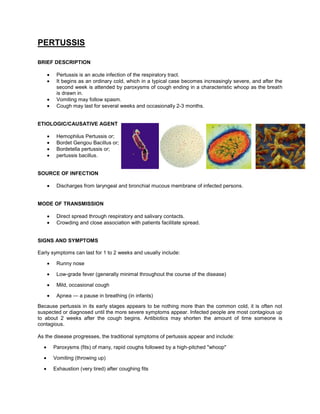
ETIOLOGIC/CAUSATIVE AGENT

        Hemophilus Pertussis or;
        Bordet Gengou Bacillus or;
        Bordetella pertussis or;
        pertussis bacillus.


SOURCE OF INFECTION

        Discharges from laryngeal and bronchial mucous membrane of infected persons.


MODE OF TRANSMISSION

        Direct spread through respiratory and salivary contacts.
        Crowding and close association with patients facilitate spread.


SIGNS AND SYMPTOMS

Early symptoms can last for 1 to 2 weeks and usually include:

        Runny nose

        Low-grade fever (generally minimal throughout the course of the disease)

        Mild, occasional cough

        Apnea — a pause in breathing (in infants)

Because pertussis in its early stages appears to be nothing more than the common cold, it is often not
suspected or diagnosed until the more severe symptoms appear. Infected people are most contagious up
to about 2 weeks after the cough begins. Antibiotics may shorten the amount of time someone is
contagious.

As the disease progresses, the traditional symptoms of pertussis appear and include:

      Paroxysms (fits) of many, rapid coughs followed by a high-pitched "whoop"

      Vomiting (throwing up)

      Exhaustion (very tired) after coughing fits
PERIOD OF COMMUNICABILITY

     In early catarrhal stage, paroxysmal cough confirms provisional clinical diagnosis 7 days after
     exposure to 3 weeks after onset of paroxysms.
     The incubation period of pertussis is commonly 7–10 days, with a range of 4–21 days, and
     rarely may be as long as 42 days.


SUSCEPTIBILITY, RESISTANCE, AND OCCURRANCE

     Susceptibility is general, predominantly a childhood disease.
     The incidence being highest under 7 years of age and mortality highest in infants, particularly
     under 6 months of age.
     One attack confers definite and prolonged immunity.
     Second attack occasionally occurs.
     A very prevalent and common disease among children everywhere regardless of race, climate or
     geographic location.


METHODS OF PREVENTION AND CONTROL

     Routine DPT (Diphtheria Pertussis Tetanus) immunization of all infants which can be started at 1
     ½ months of life and given at monthly intervals in 3 consecutive months. This constitutes the
     primary infections.
     Booster dose is to be given at the age of 2 years and again at 4 to 5 years of age.
     The patient should be segregated until after 3 weeks from the appearance of paroxysmal cough.
     If started early enough, antibiotics such as erythromycin can make the symptoms go away more
     quickly. Unfortunately, most patients are diagnosed too late, when antibiotics
     aren't very effective. However, the medicines can help reduce the patient's
     ability to spread the disease to others.

     Infants younger than 18 months need constant supervision because their
     breathing may temporarily stop during coughing spells. Infants with severe
     cases should be hospitalized.

     An oxygen tent with high humidity may be used.

     Fluids may be given through a vein if coughing spells are severe enough to
     prevent the person from drinking enough fluids.

     Sedatives (medicines to make you sleepy) may be prescribed for young
     children.

     Cough mixtures, expectorants, and suppressants are usually not helpful and
     should NOT be used.
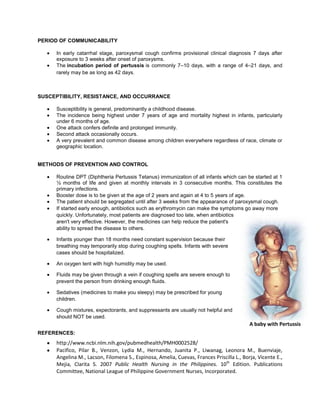
                                                                                          A baby with Pertussis
REFERENCES:
     http://www.ncbi.nlm.nih.gov/pubmedhealth/PMH0002528/
     Pacifico, Pilar B., Venzon, Lydia M., Hernando, Juanita P., Liwanag, Leonora M., Buenviaje,
     Angelina M., Lacson, Filomena S., Espinosa, Amelia, Cuevas, Frances Priscilla L., Borja, Vicente E.,
     Mejia, Clarita S. 2007 Public Health Nursing in the Philippines. 10th Edition. Publications
     Committee, National League of Philippine Government Nurses, Incorporated.
Pertussis

Pertussis

  • 1.
    PLENARY 3 In CPH ―Communicable Diseases‖ (Pertussis) Submitted by: Solidum Diore M. BSMD 2Y2-5 (January 21, 2013)
  • 2.
    PERTUSSIS BRIEF DESCRIPTION Pertussis is an acute infection of the respiratory tract. It begins as an ordinary cold, which in a typical case becomes increasingly severe, and after the second week is attended by paroxysms of cough ending in a characteristic whoop as the breath is drawn in. Vomiting may follow spasm. Cough may last for several weeks and occasionally 2-3 months. ETIOLOGIC/CAUSATIVE AGENT Hemophilus Pertussis or; Bordet Gengou Bacillus or; Bordetella pertussis or; pertussis bacillus. SOURCE OF INFECTION Discharges from laryngeal and bronchial mucous membrane of infected persons. MODE OF TRANSMISSION Direct spread through respiratory and salivary contacts. Crowding and close association with patients facilitate spread. SIGNS AND SYMPTOMS Early symptoms can last for 1 to 2 weeks and usually include: Runny nose Low-grade fever (generally minimal throughout the course of the disease) Mild, occasional cough Apnea — a pause in breathing (in infants) Because pertussis in its early stages appears to be nothing more than the common cold, it is often not suspected or diagnosed until the more severe symptoms appear. Infected people are most contagious up to about 2 weeks after the cough begins. Antibiotics may shorten the amount of time someone is contagious. As the disease progresses, the traditional symptoms of pertussis appear and include: Paroxysms (fits) of many, rapid coughs followed by a high-pitched "whoop" Vomiting (throwing up) Exhaustion (very tired) after coughing fits
  • 3.
    PERIOD OF COMMUNICABILITY In early catarrhal stage, paroxysmal cough confirms provisional clinical diagnosis 7 days after exposure to 3 weeks after onset of paroxysms. The incubation period of pertussis is commonly 7–10 days, with a range of 4–21 days, and rarely may be as long as 42 days. SUSCEPTIBILITY, RESISTANCE, AND OCCURRANCE Susceptibility is general, predominantly a childhood disease. The incidence being highest under 7 years of age and mortality highest in infants, particularly under 6 months of age. One attack confers definite and prolonged immunity. Second attack occasionally occurs. A very prevalent and common disease among children everywhere regardless of race, climate or geographic location. METHODS OF PREVENTION AND CONTROL Routine DPT (Diphtheria Pertussis Tetanus) immunization of all infants which can be started at 1 ½ months of life and given at monthly intervals in 3 consecutive months. This constitutes the primary infections. Booster dose is to be given at the age of 2 years and again at 4 to 5 years of age. The patient should be segregated until after 3 weeks from the appearance of paroxysmal cough. If started early enough, antibiotics such as erythromycin can make the symptoms go away more quickly. Unfortunately, most patients are diagnosed too late, when antibiotics aren't very effective. However, the medicines can help reduce the patient's ability to spread the disease to others. Infants younger than 18 months need constant supervision because their breathing may temporarily stop during coughing spells. Infants with severe cases should be hospitalized. An oxygen tent with high humidity may be used. Fluids may be given through a vein if coughing spells are severe enough to prevent the person from drinking enough fluids. Sedatives (medicines to make you sleepy) may be prescribed for young children. Cough mixtures, expectorants, and suppressants are usually not helpful and should NOT be used. A baby with Pertussis REFERENCES: http://www.ncbi.nlm.nih.gov/pubmedhealth/PMH0002528/ Pacifico, Pilar B., Venzon, Lydia M., Hernando, Juanita P., Liwanag, Leonora M., Buenviaje, Angelina M., Lacson, Filomena S., Espinosa, Amelia, Cuevas, Frances Priscilla L., Borja, Vicente E., Mejia, Clarita S. 2007 Public Health Nursing in the Philippines. 10th Edition. Publications Committee, National League of Philippine Government Nurses, Incorporated.