Transient ligand-based C-H
activation at sp2 center
Presented by:
Ankita Nishad
MC/2021-2/022
Medicinal Chemistry
NIPER Guwahati
1
CONTENT
• C-H activation
• Directing groups
• Limitations of directing group
• Transient directing group
• Comparison between directing group based C-H activation versus transient ligand-based activation
• Important criteria for the design of a transient DG
• C–H activation by transient phosphite DG
• C–H activation by transient imine DG
• Conclusion
• Reference
2
C-H Activation
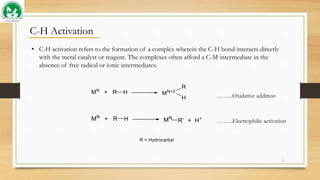
• C-H activation refers to the formation of a complex wherein the C-H bond interacts directly
with the metal catalyst or reagent. The complexes often afford a C-M intermediate in the
absence of free radical or ionic intermediates.
……..Oxidative addition
……..Electrophilic activation
3
It is a catalytic reaction of transition metal complexes with the unreactive C―H bonds of alkenes, arenes, or alkyl
chains to form products containing new metal-carbon bonds.
Conventional Cross-Coupling Reaction And Its Drawbacks
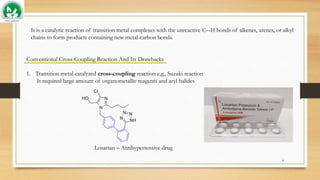
1. Transition metal-catalyzed cross-coupling reaction e.g., Suzuki reaction
It required large amount of organometallic reagents and aryl halides
Losartan – Antihypertensive drug
4
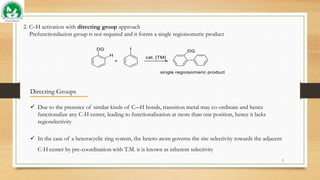
2. C–H activation with directing group approach
Prefunctionilazion group is not required and it forms a single regioisomeric product
Directing Groups
 Due to the presence of similar kinds of C―H bonds, transition metal may co-ordinate and hence
functionalize any C-H center, leading to functionalization at more than one position, hence it lacks
regioselectivity
 In the case of a heterocyclic ring system, the hetero atom governs the site selectivity towards the adjacent
C-H center by pre-coordination with T.M. it is known as inherent selectivity
5
 In case of simple aromatic or aliphatic system, governing regioselectivity is difficult in such a system DG comes
to play, leading to regioselective C-H bond activation
Limitations Of Directing Group
1. Directing group, if incorporated into a molecule, should be removable. Otherwise, it remains in the
final molecule
2. Also, incorporation and removal of DG require extra two steps; hence step economy will be effected
3. Most of the directing groups allow functionalization only at the ortho position; therefore its limits the
scope of the final product formed
6
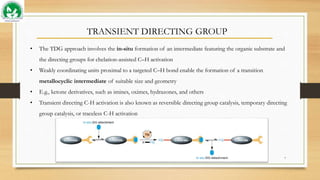
TRANSIENT DIRECTING GROUP
• The TDG approach involves the in-situ formation of an intermediate featuring the organic substrate and
the directing groups for chelation-assisted C–H activation
• Weakly coordinating units proximal to a targeted C–H bond enable the formation of a transition
metallocyclic intermediate of suitable size and geometry
• E.g., ketone derivatives, such as imines, oximes, hydrazones, and others
• Transient directing C-H activation is also known as reversible directing group catalysis, temporary directing
group catalysis, or traceless C-H activation
7
8
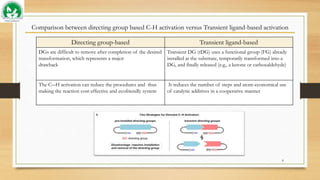
Comparison between directing group based C-H activation versus Transient ligand-based activation
Directing group-based Transient ligand-based
DGs are difficult to remove after completion of the desired
transformation, which represents a major
drawback
Transient DG (tDG) uses a functional group (FG) already
installed at the substrate, temporarily transformed into a
DG, and finally released (e.g., a ketone or carboxaldehyde)
The C―H activation can reduce the procedures and thus
making the reaction cost-effective and ecofriendly system
It reduces the number of steps and atom-economical use
of catalytic additives in a cooperative manner
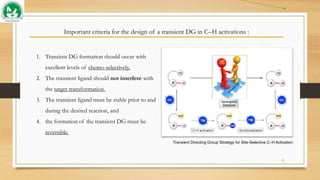
Important criteria for the design of a transient DG in C–H activations :
9
1. Transient DG formation should occur with
excellent levels of chemo-selectively,
2. The transient ligand should not interfere with
the target transformation,
3. The transient ligand must be stable prior to and
during the desired reaction, and
4. the formation of the transient DG must be
reversible.
Transient Directing Group Strategy for Site-Selective C–H Activation
10
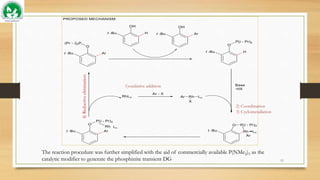
C–H Activation by Transient Phosphite DG
The catalytic cycle was proposed to proceed by
1. oxidative addition of aryl bromides to rhodium(I),
2. coordination of the phosphinite co-catalyst to rhodium(III) species, and
3. subsequent cyclometallation followed by
4. reductive elimination to deliver the ortho-arylated phosphinite,
which generates the co-catalyst, and liberates the 2-arylated product by transesterification
ortho-C–H arylation of phenols with an aryl halide
[RhCl(PPh3)3] - Wilkinson’s catalyst
11
The reaction procedure was further simplified with the aid of commercially available P(NMe2)3 as the
catalytic modifier to generate the phosphinite transient DG
1)oxidative addition
2) Coordination
3) Cyclometallation
4)
Reductive
elimination
12
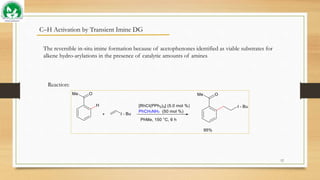
C–H Activation by Transient Imine DG
The reversible in-situ imine formation because of acetophenones identified as viable substrates for
alkene hydro-arylations in the presence of catalytic amounts of amines
Reaction:
13
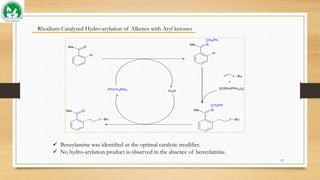
Rhodium-Catalyzed Hydro-arylation of Alkenes with Aryl ketones
 Benzylamine was identified as the optimal catalytic modifier.
 No hydro-arylation product is observed in the absence of benzylamine.
14
Conclusion
 C–H activation chemistry has emerged as a transformative platform for molecular syntheses and is
characterized by improved atom and step economy compared with traditional cross-couplings.
 The generation of strongly coordinating DG by synergistic catalysis by the action of an organocatalyst
and a transition-metal catalyst bears great potential for more sustainable syntheses.
 The transient DG approach enabled positional-selective C–H functionalization of substrates bearing
weakly coordinating functional groups with the aid of co-catalytic modifiers through the reversible
formation of phosphites or imines
15
References
(1) Gandeepan, P.; Ackermann, L. Transient Directing Groups for Transformative C–H
Activation by Synergistic Metal Catalysis. Chem. 2018, 4 (2), 199–222.
https://doi.org/10.1016/j.chempr.2017.11.002.
(2) Goswami, N.; Bhattacharya, T.; Maiti, D. Transient Directing Ligands for Selective
Metal-Catalysed C–H Activation. Nat. Rev. Chem. 2021, 5 (9), 646–659.
https://doi.org/10.1038/s41570-021-00311-3.
(3) Besset, T.; Zhao, Q.; Poisson, T.; Pannecoucke, X. The Transient Directing Group
Strategy: A New Trend in Transition-Metal-Catalyzed C–H Bond
Functionalization. Synthesis (Mass.) 2017, 49 (21), 4808–4826.
https://doi.org/10.1055/s-0036-1590878.
(4) Davies, H. M. L.; Morton, D. Recent Advances in C-H Functionalization. J. Org.
Chem. 2016, 81 (2), 343–350. https://doi.org/10.1021/acs.joc.5b02818.
(5) Bhattacharya, T.; Pimparkar, S.; Maiti, D. Combining Transition Metals and Transient
Directing Groups for C–H Functionalizations. RSC Adv. 2018, 8 (35), 19456–19464.
https://doi.org/10.1039/c8ra03230k.
16

Transient ligand-based C-H activation

  • 1.
    Transient ligand-based C-H activationat sp2 center Presented by: Ankita Nishad MC/2021-2/022 Medicinal Chemistry NIPER Guwahati 1
  • 2.
    CONTENT • C-H activation •Directing groups • Limitations of directing group • Transient directing group • Comparison between directing group based C-H activation versus transient ligand-based activation • Important criteria for the design of a transient DG • C–H activation by transient phosphite DG • C–H activation by transient imine DG • Conclusion • Reference 2
  • 3.
    C-H Activation • C-Hactivation refers to the formation of a complex wherein the C-H bond interacts directly with the metal catalyst or reagent. The complexes often afford a C-M intermediate in the absence of free radical or ionic intermediates. ……..Oxidative addition ……..Electrophilic activation 3
  • 4.
    It is acatalytic reaction of transition metal complexes with the unreactive C―H bonds of alkenes, arenes, or alkyl chains to form products containing new metal-carbon bonds. Conventional Cross-Coupling Reaction And Its Drawbacks 1. Transition metal-catalyzed cross-coupling reaction e.g., Suzuki reaction It required large amount of organometallic reagents and aryl halides Losartan – Antihypertensive drug 4
  • 5.
    2. C–H activationwith directing group approach Prefunctionilazion group is not required and it forms a single regioisomeric product Directing Groups  Due to the presence of similar kinds of C―H bonds, transition metal may co-ordinate and hence functionalize any C-H center, leading to functionalization at more than one position, hence it lacks regioselectivity  In the case of a heterocyclic ring system, the hetero atom governs the site selectivity towards the adjacent C-H center by pre-coordination with T.M. it is known as inherent selectivity 5
  • 6.
     In caseof simple aromatic or aliphatic system, governing regioselectivity is difficult in such a system DG comes to play, leading to regioselective C-H bond activation Limitations Of Directing Group 1. Directing group, if incorporated into a molecule, should be removable. Otherwise, it remains in the final molecule 2. Also, incorporation and removal of DG require extra two steps; hence step economy will be effected 3. Most of the directing groups allow functionalization only at the ortho position; therefore its limits the scope of the final product formed 6
  • 7.
    TRANSIENT DIRECTING GROUP •The TDG approach involves the in-situ formation of an intermediate featuring the organic substrate and the directing groups for chelation-assisted C–H activation • Weakly coordinating units proximal to a targeted C–H bond enable the formation of a transition metallocyclic intermediate of suitable size and geometry • E.g., ketone derivatives, such as imines, oximes, hydrazones, and others • Transient directing C-H activation is also known as reversible directing group catalysis, temporary directing group catalysis, or traceless C-H activation 7
  • 8.
    8 Comparison between directinggroup based C-H activation versus Transient ligand-based activation Directing group-based Transient ligand-based DGs are difficult to remove after completion of the desired transformation, which represents a major drawback Transient DG (tDG) uses a functional group (FG) already installed at the substrate, temporarily transformed into a DG, and finally released (e.g., a ketone or carboxaldehyde) The C―H activation can reduce the procedures and thus making the reaction cost-effective and ecofriendly system It reduces the number of steps and atom-economical use of catalytic additives in a cooperative manner
  • 9.
    Important criteria forthe design of a transient DG in C–H activations : 9 1. Transient DG formation should occur with excellent levels of chemo-selectively, 2. The transient ligand should not interfere with the target transformation, 3. The transient ligand must be stable prior to and during the desired reaction, and 4. the formation of the transient DG must be reversible. Transient Directing Group Strategy for Site-Selective C–H Activation
  • 10.
    10 C–H Activation byTransient Phosphite DG The catalytic cycle was proposed to proceed by 1. oxidative addition of aryl bromides to rhodium(I), 2. coordination of the phosphinite co-catalyst to rhodium(III) species, and 3. subsequent cyclometallation followed by 4. reductive elimination to deliver the ortho-arylated phosphinite, which generates the co-catalyst, and liberates the 2-arylated product by transesterification ortho-C–H arylation of phenols with an aryl halide [RhCl(PPh3)3] - Wilkinson’s catalyst
  • 11.
    11 The reaction procedurewas further simplified with the aid of commercially available P(NMe2)3 as the catalytic modifier to generate the phosphinite transient DG 1)oxidative addition 2) Coordination 3) Cyclometallation 4) Reductive elimination
  • 12.
    12 C–H Activation byTransient Imine DG The reversible in-situ imine formation because of acetophenones identified as viable substrates for alkene hydro-arylations in the presence of catalytic amounts of amines Reaction:
  • 13.
    13 Rhodium-Catalyzed Hydro-arylation ofAlkenes with Aryl ketones  Benzylamine was identified as the optimal catalytic modifier.  No hydro-arylation product is observed in the absence of benzylamine.
  • 14.
    14 Conclusion  C–H activationchemistry has emerged as a transformative platform for molecular syntheses and is characterized by improved atom and step economy compared with traditional cross-couplings.  The generation of strongly coordinating DG by synergistic catalysis by the action of an organocatalyst and a transition-metal catalyst bears great potential for more sustainable syntheses.  The transient DG approach enabled positional-selective C–H functionalization of substrates bearing weakly coordinating functional groups with the aid of co-catalytic modifiers through the reversible formation of phosphites or imines
  • 15.
    15 References (1) Gandeepan, P.;Ackermann, L. Transient Directing Groups for Transformative C–H Activation by Synergistic Metal Catalysis. Chem. 2018, 4 (2), 199–222. https://doi.org/10.1016/j.chempr.2017.11.002. (2) Goswami, N.; Bhattacharya, T.; Maiti, D. Transient Directing Ligands for Selective Metal-Catalysed C–H Activation. Nat. Rev. Chem. 2021, 5 (9), 646–659. https://doi.org/10.1038/s41570-021-00311-3. (3) Besset, T.; Zhao, Q.; Poisson, T.; Pannecoucke, X. The Transient Directing Group Strategy: A New Trend in Transition-Metal-Catalyzed C–H Bond Functionalization. Synthesis (Mass.) 2017, 49 (21), 4808–4826. https://doi.org/10.1055/s-0036-1590878. (4) Davies, H. M. L.; Morton, D. Recent Advances in C-H Functionalization. J. Org. Chem. 2016, 81 (2), 343–350. https://doi.org/10.1021/acs.joc.5b02818. (5) Bhattacharya, T.; Pimparkar, S.; Maiti, D. Combining Transition Metals and Transient Directing Groups for C–H Functionalizations. RSC Adv. 2018, 8 (35), 19456–19464. https://doi.org/10.1039/c8ra03230k.
  • 16.