RAVI KUMAR SINGH
Combination of inter related
activities
Executed in logical sequence
Accomplishment of a desired
objective
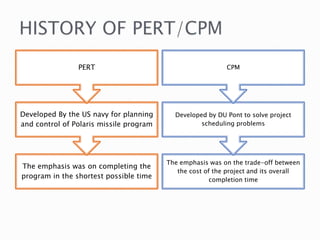
The emphasis was on completing the
program in the shortest possible time
Developed By the US navy for planning
and control of Polaris missile program
PERT
The emphasis was on the trade-off between
the cost of the project and its overall
completion time
Developed by DU Pont to solve project
scheduling problems
CPM
Uniform wide acceptance
Performance evaluation
External program review
Internal program review
Controlling resource allocation
Planning resource requirements
Prediction of deliverables
Construction of a Dam or Canal
Construction of a building or highway
Maintenance or Overhaul of aircrafts
Space Flights
Designing a Prototype of a Machine
Development of Supersonic Planes
1. PLANNING
2. SCHEDULING
3. ALLOCATION OF RESOURCES
4. CONTROLLING
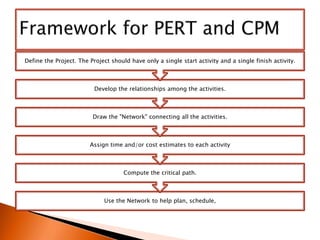
Use the Network to help plan, schedule,
Compute the critical path.
Assign time and/or cost estimates to each activity
Draw the "Network" connecting all the activities.
Develop the relationships among the activities.
Define the Project. The Project should have only a single start activity and a single finish activity.
Drafting the design of
Programme or Project
Project Evaluation of drafted
Programme or Project
Project Review of evaluated
Programme or Project
To analyze and represent the tasks
involved in completing a given project
Accommodates the variation in event
completion time
Event-oriented technique rather than
start- and completion-oriented
Commonly used in conjunction with the
critical path method
Activity
Event
Constraints
Network
Diagram
Critical Path
 Both are Quantitative Techniques of Network
Analysis
 Both are used as tools for Decision Making
 Both involve drawing & analysis of Network
Diagram on various scores
PERT
Probabilistic Model
Non-repetitive jobs like
planning scheduling of
programmes
Results calculated on basis of
Event
Related with activities of
uncertain time
CPM
Deterministic Model
Repetitive jobs like
residential construction
Results calculated on
basis of activities
Related with activities of
well known time
Reduction in
cost
Elimination of Risk
in Complex activity
Flexibility
Optimization of Resources
Reduction of Uncertainties
Network charts tend to be large
Lack of a timeframe on most PERT/CPM charts makes it
harder to show status
When PERT/CPM charts become unwieldy, they are no longer
used to manage the project
Planning & Implementation required
thanks
Cpm and pert - project management

Cpm and pert - project management

  • 1.
  • 2.
    Combination of interrelated activities Executed in logical sequence Accomplishment of a desired objective
  • 3.
    The emphasis wason completing the program in the shortest possible time Developed By the US navy for planning and control of Polaris missile program PERT The emphasis was on the trade-off between the cost of the project and its overall completion time Developed by DU Pont to solve project scheduling problems CPM
  • 4.
    Uniform wide acceptance Performanceevaluation External program review Internal program review Controlling resource allocation Planning resource requirements Prediction of deliverables
  • 5.
    Construction of aDam or Canal Construction of a building or highway Maintenance or Overhaul of aircrafts Space Flights Designing a Prototype of a Machine Development of Supersonic Planes
  • 6.
    1. PLANNING 2. SCHEDULING 3.ALLOCATION OF RESOURCES 4. CONTROLLING
  • 7.
    Use the Networkto help plan, schedule, Compute the critical path. Assign time and/or cost estimates to each activity Draw the "Network" connecting all the activities. Develop the relationships among the activities. Define the Project. The Project should have only a single start activity and a single finish activity.
  • 8.
    Drafting the designof Programme or Project Project Evaluation of drafted Programme or Project Project Review of evaluated Programme or Project
  • 9.
    To analyze andrepresent the tasks involved in completing a given project Accommodates the variation in event completion time Event-oriented technique rather than start- and completion-oriented Commonly used in conjunction with the critical path method
  • 10.
  • 12.
     Both areQuantitative Techniques of Network Analysis  Both are used as tools for Decision Making  Both involve drawing & analysis of Network Diagram on various scores
  • 13.
    PERT Probabilistic Model Non-repetitive jobslike planning scheduling of programmes Results calculated on basis of Event Related with activities of uncertain time CPM Deterministic Model Repetitive jobs like residential construction Results calculated on basis of activities Related with activities of well known time
  • 14.
    Reduction in cost Elimination ofRisk in Complex activity Flexibility Optimization of Resources Reduction of Uncertainties
  • 15.
    Network charts tendto be large Lack of a timeframe on most PERT/CPM charts makes it harder to show status When PERT/CPM charts become unwieldy, they are no longer used to manage the project Planning & Implementation required
  • 16.