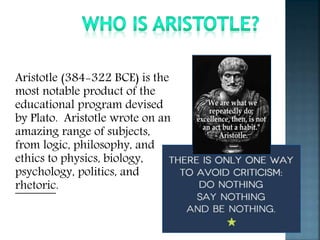
Aristotle (384-322 BCE) is the
most notable product of the
educational program devised
by Plato. Aristotle wrote on an
amazing range of subjects,
from logic, philosophy, and
ethics to physics, biology,
psychology, politics, and
rhetoric.
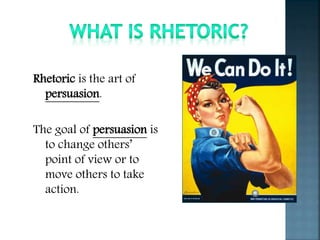
Rhetoric is the art of
persuasion.
The goal of persuasion is
to change others’
point of view or to
move others to take
action.
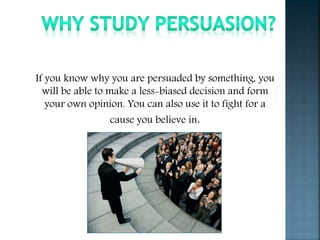
If you know why you are persuaded by something, you
will be able to make a less-biased decision and form
your own opinion. You can also use it to fight for a
cause you believe in.
Logos
Ethos
Pathos
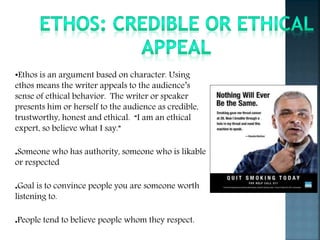
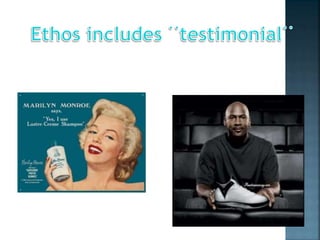
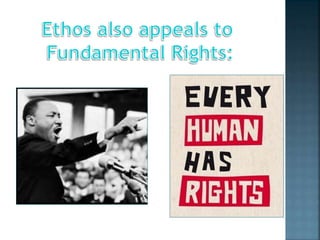
•Ethos is an argument based on character. Using
ethos means the writer appeals to the audience’s
sense of ethical behavior. The writer or speaker
presents him or herself to the audience as credible,
trustworthy, honest and ethical. “I am an ethical
expert, so believe what I say.”
●Someone who has authority, someone who is likable
or respected
●Goal is to convince people you are someone worth
listening to.
●People tend to believe people whom they respect.
In the following example, note how Nancy Mairs
establishes her credibility, trustworthiness, and
authority to write about this subject by being honest.
Mairs admits she is uncertain about her own motives
and shows she understands the discomfort others’
have with this subject.
People—crippled or not—wince
at the word “cripple,” as they
do not at “handicapped” or
“disabled.” Perhaps I want
them to wince. I want them
to see me as a tough
customer, one to whom the
fates/gods/viruses have not
been kind, but who can face
the brutal truth of her
existence squarely. As a
cripple, I swagger.
—Nancy Mairs, “On
Being a Cripple”
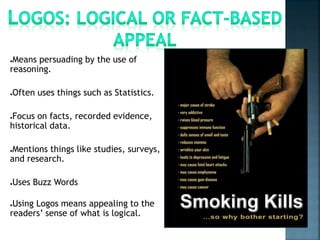
●Means persuading by the use of
reasoning.
●Often uses things such as Statistics.
●Focus on facts, recorded evidence,
historical data.
●Mentions things like studies, surveys,
and research.
●Uses Buzz Words
●Using Logos means appealing to the
readers’ sense of what is logical.
●Examples:
● “Pure”
● “Natural”
● “Freedom”
● “Tasty”
●Words that end in -er
● Better, Cleaner, Longer, Faster
● Technically not the best, but
better than it was!
In the following example, note how Ian Ayres uses
evidence from experience (her work environment,
Delta Airlines, the University of Chicago). This
evidence establishes the precedent that Ayres uses
to compare to the current situation that she argues
should be changed.
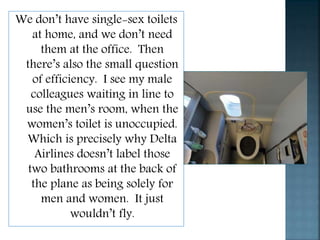
We don’t have single-sex toilets
at home, and we don’t need
them at the office. Then
there’s also the small question
of efficiency. I see my male
colleagues waiting in line to
use the men’s room, when the
women’s toilet is unoccupied.
Which is precisely why Delta
Airlines doesn’t label those
two bathrooms at the back of
the plane as being solely for
men and women. It just
wouldn’t fly.
● Using pathos means appealing to
readers’ emotions and feelings.
●Language choice affects the
audience's emotional response
● Can be positive
(Love, excitement)
● Can be negative (Jealousy,
hatred)
•Fear.
•Worry.
•Sadness.
•Nostalgia.
•Sense of Adventure.
•Horror.
•Affection.
In the following example from a speech by
Winston Churchill, note the use of anaphora
(repetition of a word or group of words at the
beginning of items in a series).
This repetition emphasizes the point and
expresses passion and emotion. Moreover, the
repetition affects the audience emotionally.
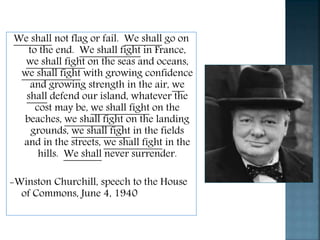
We shall not flag or fail. We shall go on
to the end. We shall fight in France,
we shall fight on the seas and oceans,
we shall fight with growing confidence
and growing strength in the air, we
shall defend our island, whatever the
cost may be, we shall fight on the
beaches, we shall fight on the landing
grounds, we shall fight in the fields
and in the streets, we shall fight in the
hills. We shall never surrender.
-Winston Churchill, speech to the House
of Commons, June 4, 1940
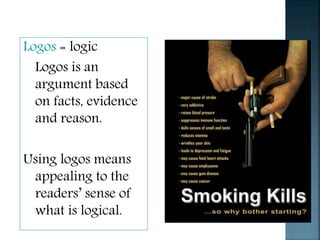
Logos = logic
Logos is an
argument based
on facts, evidence
and reason.
Using logos means
appealing to the
readers’ sense of
what is logical.
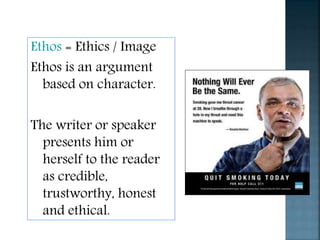
Ethos = Ethics / Image
Ethos is an argument
based on character.
The writer or speaker
presents him or
herself to the reader
as credible,
trustworthy, honest
and ethical.
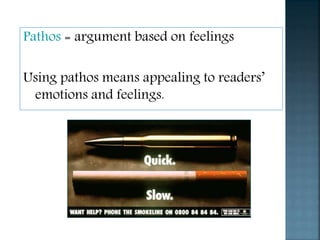
Pathos = argument based on feelings
Using pathos means appealing to readers’
emotions and feelings.
Using logos, ethos, and pathos will help you to master the
art of persuasion.
• Through language, you will be able to change the point of
view of others!
• Through language, you will be able to motivate others to
take action!
Persuasion in-writing

Persuasion in-writing

  • 2.
    Aristotle (384-322 BCE)is the most notable product of the educational program devised by Plato. Aristotle wrote on an amazing range of subjects, from logic, philosophy, and ethics to physics, biology, psychology, politics, and rhetoric.
  • 3.
    Rhetoric is theart of persuasion. The goal of persuasion is to change others’ point of view or to move others to take action.
  • 4.
    If you knowwhy you are persuaded by something, you will be able to make a less-biased decision and form your own opinion. You can also use it to fight for a cause you believe in.
  • 5.
  • 7.
    •Ethos is anargument based on character. Using ethos means the writer appeals to the audience’s sense of ethical behavior. The writer or speaker presents him or herself to the audience as credible, trustworthy, honest and ethical. “I am an ethical expert, so believe what I say.” ●Someone who has authority, someone who is likable or respected ●Goal is to convince people you are someone worth listening to. ●People tend to believe people whom they respect.
  • 10.
    In the followingexample, note how Nancy Mairs establishes her credibility, trustworthiness, and authority to write about this subject by being honest. Mairs admits she is uncertain about her own motives and shows she understands the discomfort others’ have with this subject.
  • 11.
    People—crippled or not—wince atthe word “cripple,” as they do not at “handicapped” or “disabled.” Perhaps I want them to wince. I want them to see me as a tough customer, one to whom the fates/gods/viruses have not been kind, but who can face the brutal truth of her existence squarely. As a cripple, I swagger. —Nancy Mairs, “On Being a Cripple”
  • 12.
    ●Means persuading bythe use of reasoning. ●Often uses things such as Statistics. ●Focus on facts, recorded evidence, historical data. ●Mentions things like studies, surveys, and research. ●Uses Buzz Words ●Using Logos means appealing to the readers’ sense of what is logical.
  • 13.
    ●Examples: ● “Pure” ● “Natural” ●“Freedom” ● “Tasty” ●Words that end in -er ● Better, Cleaner, Longer, Faster ● Technically not the best, but better than it was!
  • 14.
    In the followingexample, note how Ian Ayres uses evidence from experience (her work environment, Delta Airlines, the University of Chicago). This evidence establishes the precedent that Ayres uses to compare to the current situation that she argues should be changed.
  • 15.
    We don’t havesingle-sex toilets at home, and we don’t need them at the office. Then there’s also the small question of efficiency. I see my male colleagues waiting in line to use the men’s room, when the women’s toilet is unoccupied. Which is precisely why Delta Airlines doesn’t label those two bathrooms at the back of the plane as being solely for men and women. It just wouldn’t fly.
  • 16.
    ● Using pathosmeans appealing to readers’ emotions and feelings. ●Language choice affects the audience's emotional response ● Can be positive (Love, excitement) ● Can be negative (Jealousy, hatred)
  • 17.
  • 18.
    In the followingexample from a speech by Winston Churchill, note the use of anaphora (repetition of a word or group of words at the beginning of items in a series). This repetition emphasizes the point and expresses passion and emotion. Moreover, the repetition affects the audience emotionally.
  • 19.
    We shall notflag or fail. We shall go on to the end. We shall fight in France, we shall fight on the seas and oceans, we shall fight with growing confidence and growing strength in the air, we shall defend our island, whatever the cost may be, we shall fight on the beaches, we shall fight on the landing grounds, we shall fight in the fields and in the streets, we shall fight in the hills. We shall never surrender. -Winston Churchill, speech to the House of Commons, June 4, 1940
  • 21.
    Logos = logic Logosis an argument based on facts, evidence and reason. Using logos means appealing to the readers’ sense of what is logical.
  • 22.
    Ethos = Ethics/ Image Ethos is an argument based on character. The writer or speaker presents him or herself to the reader as credible, trustworthy, honest and ethical.
  • 23.
    Pathos = argumentbased on feelings Using pathos means appealing to readers’ emotions and feelings.
  • 24.
    Using logos, ethos,and pathos will help you to master the art of persuasion. • Through language, you will be able to change the point of view of others! • Through language, you will be able to motivate others to take action!