Good Afternoon.
Powers of
Persuasion: Ethos,
Pathos, Logos
Rhetorical strategies that all of us use … every single
day!
Argument and Persuasion: Warm-up
Think about a really persuasive
commercial.
How does that company get you to buy
what they’re selling?
If an advertisement or a commercial
succeeds in making a person buy
something, it has been PERSUASIVE.
Activity 2 - PERSUADE ME!
Instructions: For each of the following
scenarios, write your own persuasive
sentences.
Activity 2 - PERSUADE ME!
You are trying to persuade your brother to stop eating
chocolate.
You are trying to persuade members of your class to
volunteer to tutor underprivileged children.
You are trying to persuade your teacher not to give you
homework
Processing of activity:
How was the activity?
Is it easy to persuade/ convince someone?
Why?
What technique should be use for you to
convince more person?
PERSUASIVE
LANGUAGE
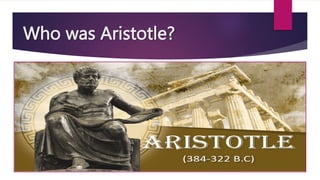
Who was Aristotle?
Who was Aristotle?
ARISTOTLE was a Greek philosopher who
lived in the 4th century BCE. He was an
influential thinker and wrote on many
subjects – from logic and ethics, to biology
and metaphysics.
Who was Aristotle?
One area, in which Aristotle was particularly
interested, was rhetoric. That is, the art of
persuasive speaking or writing. He even
wrote a whole book entitled ‘On Rhetoric’ in
which he explains his theories of persuasive
language and speech.
Who was Aristotle?
Most significantly, in this work he expounds on
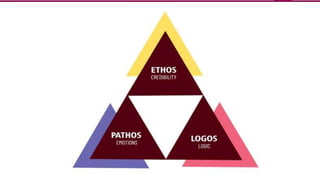
the concepts of ethos, logos and pathos, as tools
for persuasive language. A lot can be learned
about the art of persuasion from these three
concepts, and once understood, they can be easily
applied to our own persuasive speaking and
writing.
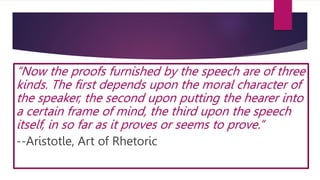
“Now the proofs furnished by the speech are of three
kinds. The first depends upon the moral character of
the speaker, the second upon putting the hearer into
a certain frame of mind, the third upon the speech
itself, in so far as it proves or seems to prove.”
--Aristotle, Art of Rhetoric
Ethos = Ethical or Moral
Ethos is a Greek word meaning
‘character’.
In terms of persuasive language, it is an
appeal to authority and credibility.
Ethos = Ethical or Moral
Ethos is a means of convincing an
audience of the reliable character or
credibility of the speaker/writer, or the
credibility of the argument.
Ethos = Ethical or Moral
It is an important tool of persuasion
because if you can get your audience to
see you (or your argument) as credible and
trustworthy, it will be much easier to
persuade them.
For example …
Pretend that you are sick, go to the doctor,
and she gives you a prescription for a pill
that would make you feel better, would you
take the pill?
… when a trusted doctor gives you advice,
you may not understand all the medical
reasoning behind the advice, but you follow
it any way because you believe the doctor
knows what s/he is talking about. You trust
him or her!
How would the situation change if you were
at the mall with your friends, felt sick, and
were offered a pill?
Pathos = Feeling
Pathos is a Greek word meaning ‘suffering’ or
‘experience’, and it is used in persuasive
speech as an appeal to the emotions of the
audience.
Pathos is the way of creating a persuasive
argument by evoking an emotional response
in the audience/reader.
Pathos = Feeling
You can use pathos when trying to
persuade, by appealing to an audience’s
hopes and dreams, playing on their fears
or worries, or appealing to their particular
beliefs or ideals.
Pathos = Feeling
You may be persuaded by fear, love,
patriotism, hatred, joy, humor, guilt.
The use of pathos can be extremely
effective and also manipulative.
Pathos = Feeling
Example:
If you don’t buy this insurance, you are
letting your family down.
Pathos = Feeling
Logos = Logic or Reason
Logos is a Greek word meaning ‘a word’ or
‘reason’.
In rhetoric, it is an appeal to logic and
reason. It is used to persuade an audience
by logical thought, fact and rationality.
Logos = Logic or Reason
Logos can be a useful tool of persuasion
because if you can ‘prove’ an argument
through logical and sound reasoning, your
audience is more likely to be persuaded.
Logos = Logic or Reason
Numbers, polls, facts, and statistics are also
examples of the persuasive use of logic.
Logos = Logic or Reason
Example:
It’s a fact that smoking causes cancer.
Therefore, if you don’t want cancer, you
shouldn’t smoke.
Logos = Logic or Reason
We Can Incorporate It!
Instructions: Using the same group earlier,
each group will be given different tasks.
We Can Incorporate It!
GROUP I
Directions: For the following scenarios, write
your own persuasive sentences using ethos.
SCENARIO: You are trying to persuade your
mother to let you get a tattoo.
We Can Incorporate It!
GROUP 2
Directions: For the following scenarios, write
your own persuasive sentences using pathos.
SCENARIO: You are attempting to convince a
friend to join your sports team.
We Can Incorporate It!
GROUP 3
Directions: For the following scenarios, write your
own persuasive sentences using logos.
SCENARIO: You are trying to persuade an audience
that they should exercise more often.
We Can Incorporate It!
CRITERIA FOR SCORING:
Originality - 10
Creativity - 10
Word Mechanics - 10
Total = 30
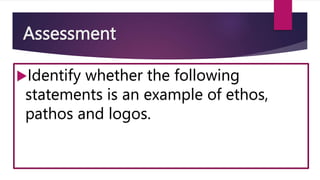
Assessment
Identify whether the following
statements is an example of ethos,
pathos and logos.
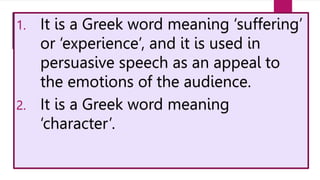
1. It is a Greek word meaning ‘suffering’
or ‘experience’, and it is used in
persuasive speech as an appeal to
the emotions of the audience.
2. It is a Greek word meaning
‘character’.
3. It is a Greek word meaning ‘a word’ or
‘reason’. It is a Greek word meaning
‘character’.
4. It is used to persuade an audience by
logical thought, fact and rationality.
5. It is the way of creating a persuasive
argument by evoking an emotional
response in the audience/reader.
6. In terms of persuasive language, it is
an appeal to authority and credibility.
7. It can be extremely effective and also
manipulative.
8. Numbers, polls, facts, and statistics are
also examples of the persuasive use of
logic.
9 It is the way of creating a persuasive
argument by evoking an emotional
response in the audience/reader.
10. You may be persuaded by fear, love,
patriotism, hatred, joy, humor, guilt.
11. “My three decades of experience in
public service, my tireless commitment
to the people of this community, and my
willingness to reach across the aisle and
cooperate with the opposition, make me
the ideal candidate for your mayor.”
12. They’ve worked against everything
we’ve worked so hard to build, and they
don’t care who gets hurt in the process.
Make no mistake, they’re the enemy and
they won’t stop until we’re destroyed.”
13. More than one hundred peer-
reviewed studies have been conducted
over the past decade, and none of them
suggests that this is an effective
treatment for hair loss.
14. “Don’t be the last person on the
block to have their lawn treated – you
don’t want to be the laughing stock of
your community!”
15. Better men than us have fought and
died to preserve this great nation. Now
is our turn to return the favor. For God
and country, gentleman!
16. You will never be satisfied in life if
you don’t seize this opportunity. Do you
want to live the rest of years yearning to
know what would have happened if you
just jumped when you had the chance?
17. He is a forensics and ballistics expert
for the federal government – if anyone’s
qualified to determine the murder
weapon, it’s him.
18. As doctor, I am qualified to tell you
that this course of treatment will likely
generate the best results.
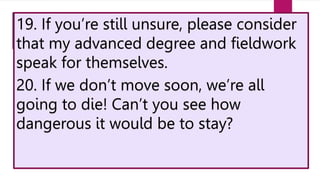
19. If you’re still unsure, please consider
that my advanced degree and fieldwork
speak for themselves.
20. If we don’t move soon, we’re all
going to die! Can’t you see how
dangerous it would be to stay?


Persuasive Techniques: logos, pathos, ethos [Recovered].pptx

  • 1.
  • 2.
    Powers of Persuasion: Ethos, Pathos,Logos Rhetorical strategies that all of us use … every single day!
  • 3.
    Argument and Persuasion:Warm-up Think about a really persuasive commercial. How does that company get you to buy what they’re selling?
  • 4.
    If an advertisementor a commercial succeeds in making a person buy something, it has been PERSUASIVE.
  • 5.
    Activity 2 -PERSUADE ME! Instructions: For each of the following scenarios, write your own persuasive sentences.
  • 6.
    Activity 2 -PERSUADE ME! You are trying to persuade your brother to stop eating chocolate. You are trying to persuade members of your class to volunteer to tutor underprivileged children. You are trying to persuade your teacher not to give you homework
  • 7.
    Processing of activity: Howwas the activity? Is it easy to persuade/ convince someone? Why? What technique should be use for you to convince more person?
  • 8.
  • 9.
  • 10.
    Who was Aristotle? ARISTOTLEwas a Greek philosopher who lived in the 4th century BCE. He was an influential thinker and wrote on many subjects – from logic and ethics, to biology and metaphysics.
  • 11.
    Who was Aristotle? Onearea, in which Aristotle was particularly interested, was rhetoric. That is, the art of persuasive speaking or writing. He even wrote a whole book entitled ‘On Rhetoric’ in which he explains his theories of persuasive language and speech.
  • 12.
    Who was Aristotle? Mostsignificantly, in this work he expounds on the concepts of ethos, logos and pathos, as tools for persuasive language. A lot can be learned about the art of persuasion from these three concepts, and once understood, they can be easily applied to our own persuasive speaking and writing.
  • 13.
    “Now the proofsfurnished by the speech are of three kinds. The first depends upon the moral character of the speaker, the second upon putting the hearer into a certain frame of mind, the third upon the speech itself, in so far as it proves or seems to prove.” --Aristotle, Art of Rhetoric
  • 15.
    Ethos = Ethicalor Moral Ethos is a Greek word meaning ‘character’. In terms of persuasive language, it is an appeal to authority and credibility.
  • 16.
    Ethos = Ethicalor Moral Ethos is a means of convincing an audience of the reliable character or credibility of the speaker/writer, or the credibility of the argument.
  • 17.
    Ethos = Ethicalor Moral It is an important tool of persuasion because if you can get your audience to see you (or your argument) as credible and trustworthy, it will be much easier to persuade them.
  • 18.
    For example … Pretendthat you are sick, go to the doctor, and she gives you a prescription for a pill that would make you feel better, would you take the pill?
  • 19.
    … when atrusted doctor gives you advice, you may not understand all the medical reasoning behind the advice, but you follow it any way because you believe the doctor knows what s/he is talking about. You trust him or her!
  • 20.
    How would thesituation change if you were at the mall with your friends, felt sick, and were offered a pill?
  • 22.
    Pathos = Feeling Pathosis a Greek word meaning ‘suffering’ or ‘experience’, and it is used in persuasive speech as an appeal to the emotions of the audience. Pathos is the way of creating a persuasive argument by evoking an emotional response in the audience/reader.
  • 23.
    Pathos = Feeling Youcan use pathos when trying to persuade, by appealing to an audience’s hopes and dreams, playing on their fears or worries, or appealing to their particular beliefs or ideals.
  • 24.
    Pathos = Feeling Youmay be persuaded by fear, love, patriotism, hatred, joy, humor, guilt. The use of pathos can be extremely effective and also manipulative.
  • 25.
    Pathos = Feeling Example: Ifyou don’t buy this insurance, you are letting your family down.
  • 26.
  • 27.
    Logos = Logicor Reason Logos is a Greek word meaning ‘a word’ or ‘reason’. In rhetoric, it is an appeal to logic and reason. It is used to persuade an audience by logical thought, fact and rationality.
  • 28.
    Logos = Logicor Reason Logos can be a useful tool of persuasion because if you can ‘prove’ an argument through logical and sound reasoning, your audience is more likely to be persuaded.
  • 29.
    Logos = Logicor Reason Numbers, polls, facts, and statistics are also examples of the persuasive use of logic.
  • 30.
    Logos = Logicor Reason Example: It’s a fact that smoking causes cancer. Therefore, if you don’t want cancer, you shouldn’t smoke.
  • 31.
    Logos = Logicor Reason
  • 32.
    We Can IncorporateIt! Instructions: Using the same group earlier, each group will be given different tasks.
  • 33.
    We Can IncorporateIt! GROUP I Directions: For the following scenarios, write your own persuasive sentences using ethos. SCENARIO: You are trying to persuade your mother to let you get a tattoo.
  • 34.
    We Can IncorporateIt! GROUP 2 Directions: For the following scenarios, write your own persuasive sentences using pathos. SCENARIO: You are attempting to convince a friend to join your sports team.
  • 35.
    We Can IncorporateIt! GROUP 3 Directions: For the following scenarios, write your own persuasive sentences using logos. SCENARIO: You are trying to persuade an audience that they should exercise more often.
  • 36.
    We Can IncorporateIt! CRITERIA FOR SCORING: Originality - 10 Creativity - 10 Word Mechanics - 10 Total = 30
  • 37.
    Assessment Identify whether thefollowing statements is an example of ethos, pathos and logos.
  • 38.
    1. It isa Greek word meaning ‘suffering’ or ‘experience’, and it is used in persuasive speech as an appeal to the emotions of the audience. 2. It is a Greek word meaning ‘character’.
  • 39.
    3. It isa Greek word meaning ‘a word’ or ‘reason’. It is a Greek word meaning ‘character’. 4. It is used to persuade an audience by logical thought, fact and rationality.
  • 40.
    5. It isthe way of creating a persuasive argument by evoking an emotional response in the audience/reader. 6. In terms of persuasive language, it is an appeal to authority and credibility.
  • 41.
    7. It canbe extremely effective and also manipulative. 8. Numbers, polls, facts, and statistics are also examples of the persuasive use of logic.
  • 42.
    9 It isthe way of creating a persuasive argument by evoking an emotional response in the audience/reader. 10. You may be persuaded by fear, love, patriotism, hatred, joy, humor, guilt.
  • 43.
    11. “My threedecades of experience in public service, my tireless commitment to the people of this community, and my willingness to reach across the aisle and cooperate with the opposition, make me the ideal candidate for your mayor.”
  • 44.
    12. They’ve workedagainst everything we’ve worked so hard to build, and they don’t care who gets hurt in the process. Make no mistake, they’re the enemy and they won’t stop until we’re destroyed.”
  • 45.
    13. More thanone hundred peer- reviewed studies have been conducted over the past decade, and none of them suggests that this is an effective treatment for hair loss.
  • 46.
    14. “Don’t bethe last person on the block to have their lawn treated – you don’t want to be the laughing stock of your community!”
  • 47.
    15. Better menthan us have fought and died to preserve this great nation. Now is our turn to return the favor. For God and country, gentleman!
  • 48.
    16. You willnever be satisfied in life if you don’t seize this opportunity. Do you want to live the rest of years yearning to know what would have happened if you just jumped when you had the chance?
  • 49.
    17. He isa forensics and ballistics expert for the federal government – if anyone’s qualified to determine the murder weapon, it’s him.
  • 50.
    18. As doctor,I am qualified to tell you that this course of treatment will likely generate the best results.
  • 51.
    19. If you’restill unsure, please consider that my advanced degree and fieldwork speak for themselves. 20. If we don’t move soon, we’re all going to die! Can’t you see how dangerous it would be to stay?