Ethos

 ―…style is the writer, and therefore what you
 are, rather than what you know, will at last
 determine your style.‖
 –E.B. White, The Elements of Style
3 skills a writer must learn
1.       Grammar- use language well
          Grammar and glamour
2.       Logic- think well
          Logos: the Word
3.       Rhetoric- manage language well to get
         jobs done in the world of affairs
Teaching writing
   Teachers usually teach the first 2, but not #3.
   Students often revise on basis of 1 only.
   Some teachers may push them to 2.
   But 3 (rhetoric) must also be taught.
   Reason we write.
   Just because something is true doesn’t mean
    people will believe it.
   Just because something is false doesn’t mean
    people won’t want to believe it.
336 B.C. Aristotle defined
three facets of persuasion

1. logos- sources of persuasion that
   reside in the text and words
2. pathos- not necessarily emotional.
     What exists in the audience that is being
      appealed to, adapted, manipulated.
336 B.C. Aristotle defined
three facets of persuasion
3. ethos- what resides in the writer as he
   becomes apparent through the text.
  ethos potentially most persuasive.
  Readers must consider you believable
   and want to attend to you—to pay
   attention to you.
  They use the words to decide whether
   to believe and attend or not.
Aspects of ethos

1.   Knowledge or sagacity (competence, not
     necessarily education but pertinent experience)
2.   High moral character
3.   Good will- no ulterior motive, no personal gain, just
     the best interests of the reader at heart. Not
     suspicious.
4.   Similarity with the reader
5.   Dynamism- particularly in American-style culture.
     Seen in sentence structure on up.
Ethos a key factor
   Application letter or essay
   Resume
   Politics
       First moments of debate, meeting
       ―Senator, you’re no Jack Kennedy.‖
       ―I will not exploit, for political gain, my
        opponent’s youth and inexperience.‖
   Advertising
Style: What you are, not what
you know
   Wandering opening paragraph:
       Lack of planning
       Unclear thinking
   Long-winded, vague statements
       Doesn’t have enough evidence
       Arrogant, doesn’t respect reader’s intelligence
   Grammar, spelling, punctuation
       Sloppy in small thingsMay be sloppy in big
        things
       Doesn’t care. Then why should I?
   Ex: asking for recommendation letters
Style: What you are, not what
you know
   Avoiding clichés
       Knows what has been done before.
       Original thinker.
   Attention to detail
       Cares to do a good job even when task is boring or
        unrewarded.
       Has internal standards, doesn’t rely on others for guidance
        and approval. Mature.
   Humor
       Is familiar enough with subject to play with it. Not still
        struggling to master subject.
       Is intelligent and enjoys life.
       Is fun to be around.
Syllogism
   May depend on enthymeme
    (from Greek ―I remember‖)
    1. All men are mortal (enthymeme)
    2. Socrates is a man
    3. Therefore, Socrates is mortal.
   Often wise to leave out one of three, using
    enthymeme as premise or basis, and let reader
    decide conclusion for himself.
   Ex:
    1. Networking is the path by which most people get jobs.
    2. My networking skills are underdeveloped.
    3. Hmmm…………
Enthymeme
   A kind of soft sell.
   Allow reader to make conclusion rather than
    beating reader over head with conclusion.
   ―We’ve chosen you to write the report
    because you always do such a professional
    job.‖
       ―And therefore we know that you’ll do a
        professional job this time as well.‖
   ―I know you. You’ve never been a quitter.‖
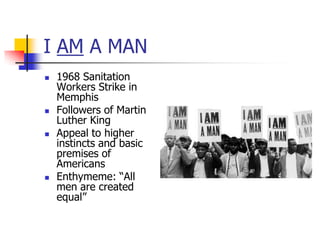
I AM A MAN
   1968 Sanitation
    Workers Strike in
    Memphis
   Followers of Martin
    Luther King
   Appeal to higher
    instincts and basic
    premises of
    Americans
   Enthymeme: ―All
    men are created
    equal‖
Logos, Pathos, Ethos in use
   Know your audience
   Know what they know (or believe they know)
       (must have decided on audience to do this).
   Use what they know to work syllogism, in
    some fashion.
   Base argument or desired result on that
    foundation.
   Not ―You know how frustrated you get when
    both your Jaguar and your Mercedes need
    repairs? That’s how I feel right now.‖
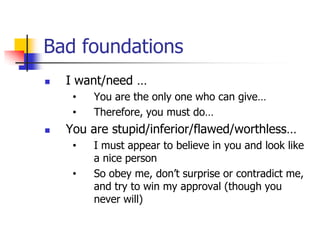
Bad foundations
   I want/need …
     •   You are the only one who can give…
     •   Therefore, you must do…
   You are stupid/inferior/flawed/worthless…
     •   I must appear to believe in you and look like
         a nice person
     •   So obey me, don’t surprise or contradict me,
         and try to win my approval (though you
         never will)
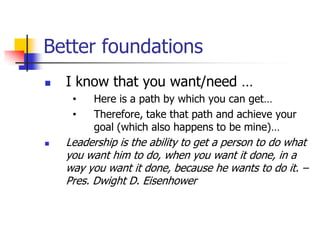
Better foundations
   I know that you want/need …
     •    Here is a path by which you can get…
     •    Therefore, take that path and achieve your
          goal (which also happens to be mine)…
   Leadership is the ability to get a person to do what
    you want him to do, when you want it done, in a
    way you want it done, because he wants to do it. –
    Pres. Dwight D. Eisenhower
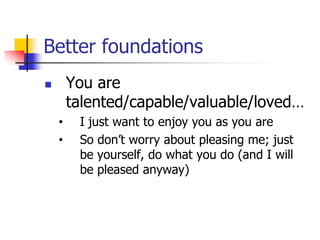
Better foundations
       You are
        talented/capable/valuable/loved…
    •    I just want to enjoy you as you are
    •    So don’t worry about pleasing me; just
         be yourself, do what you do (and I will
         be pleased anyway)
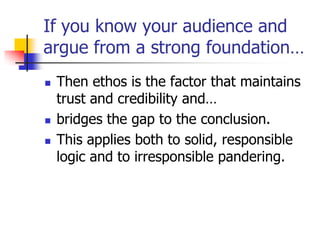
If you know your audience and
argue from a strong foundation…
   Then ethos is the factor that maintains
    trust and credibility and…
   bridges the gap to the conclusion.
   This applies both to solid, responsible
    logic and to irresponsible pandering.
If the logos and pathos are solid
(the enthymeme is well chosen)…
   Pandering:
   ―We all know liberals hate America. So when
    Ted Kennedy says…‖
   ―We all know Republicans only love rich,
    white people…So when Dick Cheney says…‖
   The enthymeme works for a certain, limited
    audience, but…
   it is a stereotype or false assumption, i.e. the
    foundation is shaky.
Ethos=trust
I trust him/her…
 Because she tells me what I like to hear
 Because he makes me feel good

 Because he gives me interesting challenges
 Because she helps me learn (things which
  improve my life)
 Because he is willing to take risks to stick to
  his beliefs, i.e. he inspires me
 Because she is an authority figure

   Because she won’t lie.
Aristotle’s 4 Primary drives
(cf. Maslow’s hierarchy of human imperatives)
1. To avoid the unpleasant
2. To supply one’s needs (hunger, other
   fulfillments)
3. To be sexually attractive
   Henry Kissinger: ―Power is an aphrodisiac.‖
4. To satisfy one’s ego (acceptance, being held
   in high regard or esteem)
   Excellent writing will appeal in some
   way to most or all of these drives.
Summary
   Decide: ―What evidence will have the most
    influence on this audience?‖
   Appeal to basic drives in your audience
   Project dimensions of ethos as you have
    them
       ―What about me will make the audience trust
        me?‖
   Use enthymemes to give your logical
    argument a solid foundation
Summary
   Decide: ―What evidence will have the most
    influence on this audience?‖
       Know your subject
   Appeal to basic drives in your audience
       Know your audience
   Project dimensions of ethos as you have them
       ―What about me will make the audience trust me?‖
       Know yourself
   Use enthymemes to give your logical
    argument a solid foundation
       Know how ideas and truths connect
Great persuaders are great
storytellers
   Story (illustration) often overlooked as form
    of support.
   One story can be a great essay, a great
    conveyer of an idea the writer wants to
    convince the reader of.
   Russell Conwell ―Acres of Diamonds‖
   1870’s to 1920’s. Made same speech 5000+
    times, made enough $ to endow Temple U.

Ethos

  • 1.
    Ethos ―…style isthe writer, and therefore what you are, rather than what you know, will at last determine your style.‖ –E.B. White, The Elements of Style
  • 2.
    3 skills awriter must learn 1. Grammar- use language well  Grammar and glamour 2. Logic- think well  Logos: the Word 3. Rhetoric- manage language well to get jobs done in the world of affairs
  • 3.
    Teaching writing  Teachers usually teach the first 2, but not #3.  Students often revise on basis of 1 only.  Some teachers may push them to 2.  But 3 (rhetoric) must also be taught.  Reason we write.  Just because something is true doesn’t mean people will believe it.  Just because something is false doesn’t mean people won’t want to believe it.
  • 4.
    336 B.C. Aristotledefined three facets of persuasion 1. logos- sources of persuasion that reside in the text and words 2. pathos- not necessarily emotional.  What exists in the audience that is being appealed to, adapted, manipulated.
  • 5.
    336 B.C. Aristotledefined three facets of persuasion 3. ethos- what resides in the writer as he becomes apparent through the text.  ethos potentially most persuasive.  Readers must consider you believable and want to attend to you—to pay attention to you.  They use the words to decide whether to believe and attend or not.
  • 6.
    Aspects of ethos 1. Knowledge or sagacity (competence, not necessarily education but pertinent experience) 2. High moral character 3. Good will- no ulterior motive, no personal gain, just the best interests of the reader at heart. Not suspicious. 4. Similarity with the reader 5. Dynamism- particularly in American-style culture. Seen in sentence structure on up.
  • 7.
    Ethos a keyfactor  Application letter or essay  Resume  Politics  First moments of debate, meeting  ―Senator, you’re no Jack Kennedy.‖  ―I will not exploit, for political gain, my opponent’s youth and inexperience.‖  Advertising
  • 8.
    Style: What youare, not what you know  Wandering opening paragraph:  Lack of planning  Unclear thinking  Long-winded, vague statements  Doesn’t have enough evidence  Arrogant, doesn’t respect reader’s intelligence  Grammar, spelling, punctuation  Sloppy in small thingsMay be sloppy in big things  Doesn’t care. Then why should I?  Ex: asking for recommendation letters
  • 9.
    Style: What youare, not what you know  Avoiding clichés  Knows what has been done before.  Original thinker.  Attention to detail  Cares to do a good job even when task is boring or unrewarded.  Has internal standards, doesn’t rely on others for guidance and approval. Mature.  Humor  Is familiar enough with subject to play with it. Not still struggling to master subject.  Is intelligent and enjoys life.  Is fun to be around.
  • 10.
    Syllogism  May depend on enthymeme (from Greek ―I remember‖) 1. All men are mortal (enthymeme) 2. Socrates is a man 3. Therefore, Socrates is mortal.  Often wise to leave out one of three, using enthymeme as premise or basis, and let reader decide conclusion for himself.  Ex: 1. Networking is the path by which most people get jobs. 2. My networking skills are underdeveloped. 3. Hmmm…………
  • 11.
    Enthymeme  A kind of soft sell.  Allow reader to make conclusion rather than beating reader over head with conclusion.  ―We’ve chosen you to write the report because you always do such a professional job.‖  ―And therefore we know that you’ll do a professional job this time as well.‖  ―I know you. You’ve never been a quitter.‖
  • 12.
    I AM AMAN  1968 Sanitation Workers Strike in Memphis  Followers of Martin Luther King  Appeal to higher instincts and basic premises of Americans  Enthymeme: ―All men are created equal‖
  • 13.
    Logos, Pathos, Ethosin use  Know your audience  Know what they know (or believe they know)  (must have decided on audience to do this).  Use what they know to work syllogism, in some fashion.  Base argument or desired result on that foundation.  Not ―You know how frustrated you get when both your Jaguar and your Mercedes need repairs? That’s how I feel right now.‖
  • 14.
    Bad foundations  I want/need … • You are the only one who can give… • Therefore, you must do…  You are stupid/inferior/flawed/worthless… • I must appear to believe in you and look like a nice person • So obey me, don’t surprise or contradict me, and try to win my approval (though you never will)
  • 15.
    Better foundations  I know that you want/need … • Here is a path by which you can get… • Therefore, take that path and achieve your goal (which also happens to be mine)…  Leadership is the ability to get a person to do what you want him to do, when you want it done, in a way you want it done, because he wants to do it. – Pres. Dwight D. Eisenhower
  • 16.
    Better foundations  You are talented/capable/valuable/loved… • I just want to enjoy you as you are • So don’t worry about pleasing me; just be yourself, do what you do (and I will be pleased anyway)
  • 17.
    If you knowyour audience and argue from a strong foundation…  Then ethos is the factor that maintains trust and credibility and…  bridges the gap to the conclusion.  This applies both to solid, responsible logic and to irresponsible pandering.
  • 18.
    If the logosand pathos are solid (the enthymeme is well chosen)…  Pandering:  ―We all know liberals hate America. So when Ted Kennedy says…‖  ―We all know Republicans only love rich, white people…So when Dick Cheney says…‖  The enthymeme works for a certain, limited audience, but…  it is a stereotype or false assumption, i.e. the foundation is shaky.
  • 19.
    Ethos=trust I trust him/her… Because she tells me what I like to hear  Because he makes me feel good  Because he gives me interesting challenges  Because she helps me learn (things which improve my life)  Because he is willing to take risks to stick to his beliefs, i.e. he inspires me  Because she is an authority figure  Because she won’t lie.
  • 20.
    Aristotle’s 4 Primarydrives (cf. Maslow’s hierarchy of human imperatives) 1. To avoid the unpleasant 2. To supply one’s needs (hunger, other fulfillments) 3. To be sexually attractive  Henry Kissinger: ―Power is an aphrodisiac.‖ 4. To satisfy one’s ego (acceptance, being held in high regard or esteem) Excellent writing will appeal in some way to most or all of these drives.
  • 21.
    Summary  Decide: ―What evidence will have the most influence on this audience?‖  Appeal to basic drives in your audience  Project dimensions of ethos as you have them  ―What about me will make the audience trust me?‖  Use enthymemes to give your logical argument a solid foundation
  • 22.
    Summary  Decide: ―What evidence will have the most influence on this audience?‖  Know your subject  Appeal to basic drives in your audience  Know your audience  Project dimensions of ethos as you have them  ―What about me will make the audience trust me?‖  Know yourself  Use enthymemes to give your logical argument a solid foundation  Know how ideas and truths connect
  • 23.
    Great persuaders aregreat storytellers  Story (illustration) often overlooked as form of support.  One story can be a great essay, a great conveyer of an idea the writer wants to convince the reader of.  Russell Conwell ―Acres of Diamonds‖  1870’s to 1920’s. Made same speech 5000+ times, made enough $ to endow Temple U.