Class 18
EWRT 1A
AGENDA
 Essay #4: Improving our readable plan

 In-Class Writing: Thesis/Speech

 "Presentation:
   Intro to Speech: Speeches: Ethos, Logos, and Pathos
   Martin Luther King Jr. “I have a Dream”

 Discussion: "I have a Dream.”
 Rhetorical Strategies
     Anaphora
     Theme words
     Quotations and Allusion
     Examples
     Metaphors
A Readable Plan

Because proposals present a complex, multipart argument—
to establish the seriousness of the problem, to convince
readers that the proposed solution is feasible, and to refute
objections and persuade readers that the proposed solution
is better than alternatives—writers try to make it easy for
readers to navigate the essay. Among the cueing strategies
writers use to orient readers are the use of transitional words
and phrases, and rhetorical Questions. Transitions or
connectives help readers understand the logical connection
between one paragraph or sentence and the one that
follows.
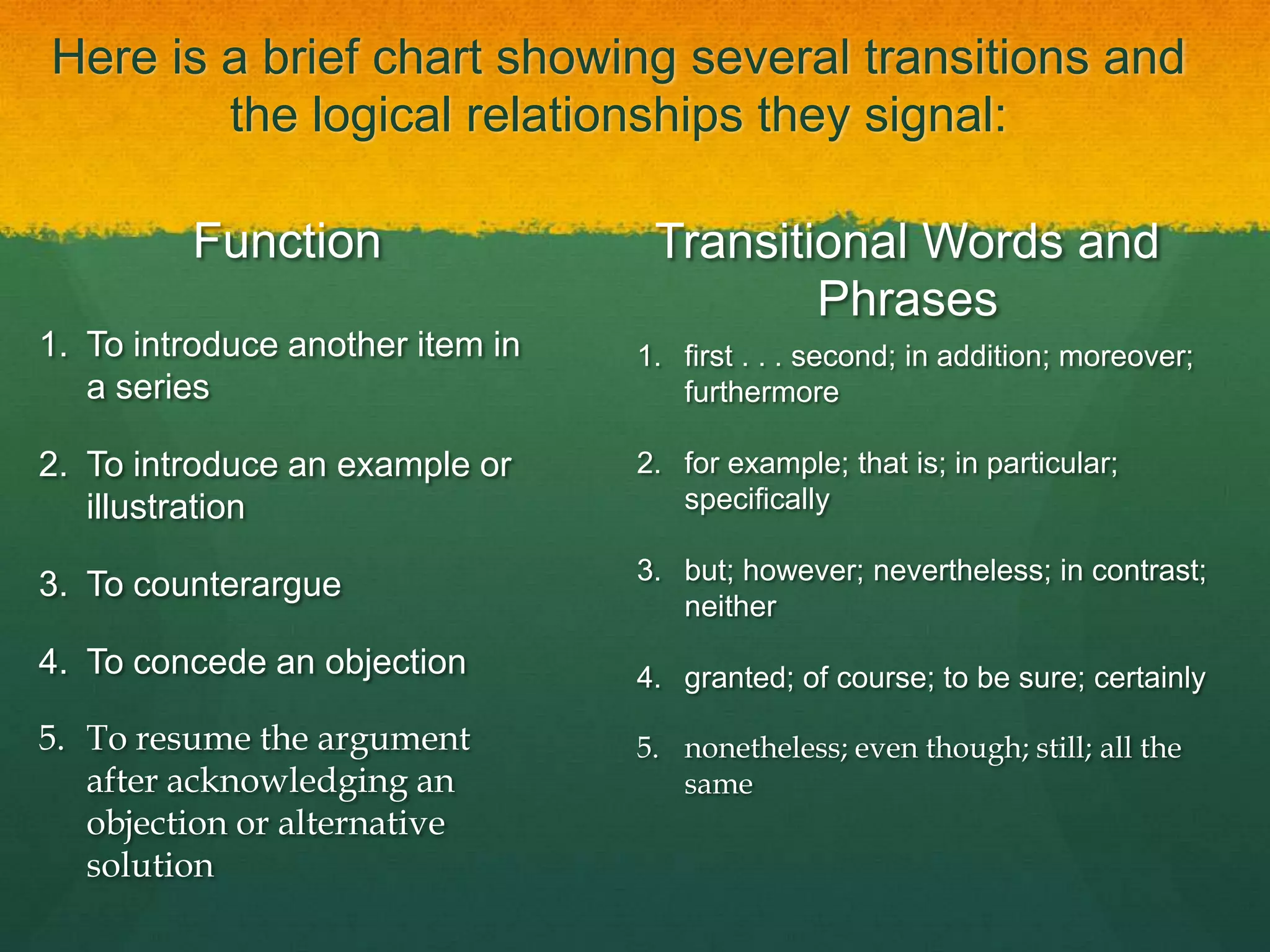
Here is a brief chart showing several transitions and
        the logical relationships they signal:

         Function                  Transitional Words and
                                           Phrases
1. To introduce another item in   1. first . . . second; in addition; moreover;
   a series                          furthermore

2. To introduce an example or     2. for example; that is; in particular;
   illustration                      specifically

                                  3. but; however; nevertheless; in contrast;
3. To counterargue
                                     neither
4. To concede an objection        4. granted; of course; to be sure; certainly

5. To resume the argument         5. nonetheless; even though; still; all the
   after acknowledging an            same
   objection or alternative
   solution
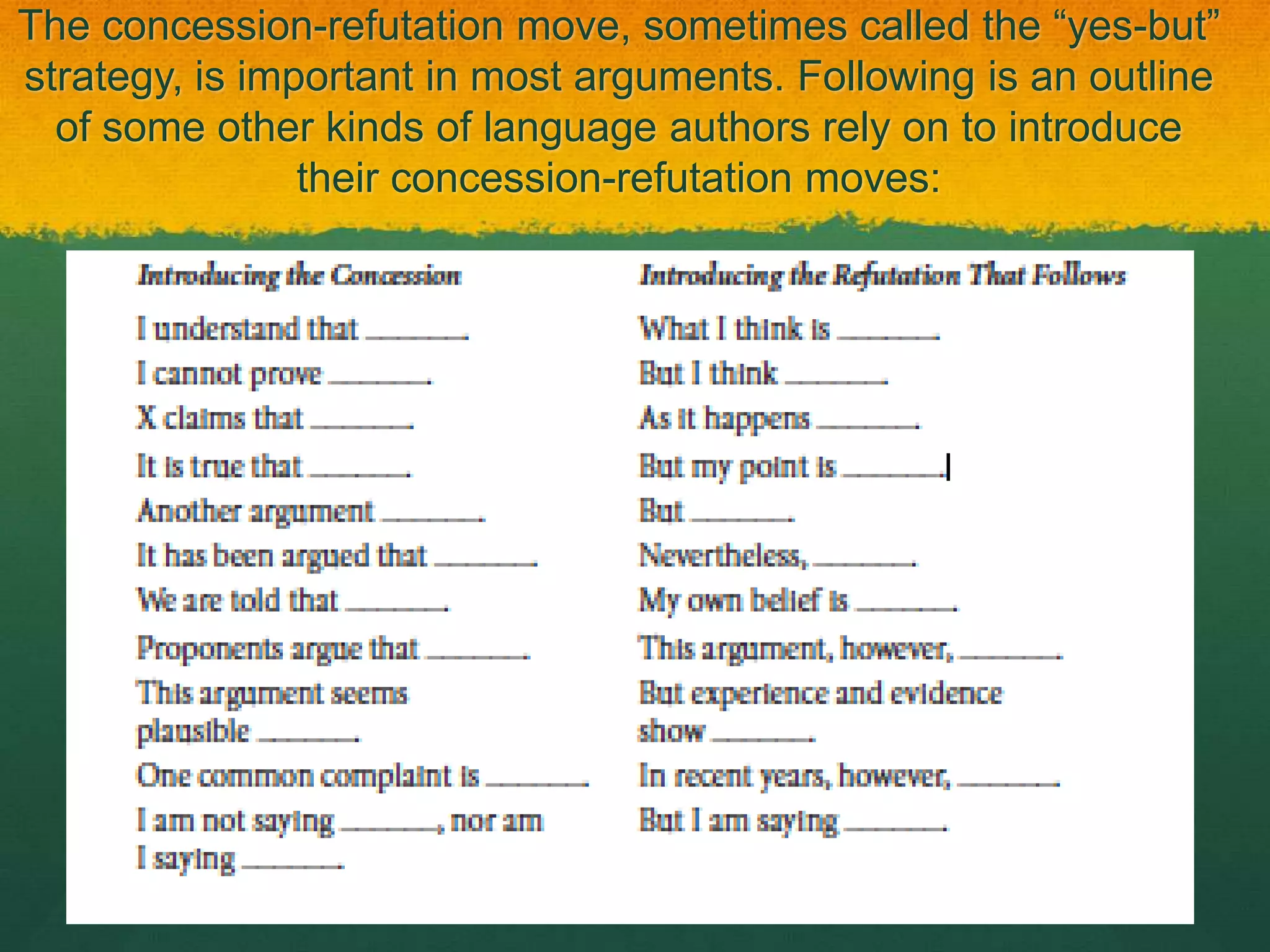
The concession-refutation move, sometimes called the “yes-but”
strategy, is important in most arguments. Following is an outline
  of some other kinds of language authors rely on to introduce
                their concession-refutation moves:
Motivational Appeals
        Aristotle
Introduction to Speech Writing:
  The Art of (Ethical)Persuasion

Three Crucial Motivational Appeals:
 Ethos: Establishing credibility; convincing
  through your character, credentials, or
  knowledge.
 Pathos: Appealing to emotions, values, and
  beliefs.
 Logos: Appealing to reason or logic.
Martin Luther King Jr. has now been
 dead longer than he lived. But what an
        extraordinary life it was.

 At 33, he was pressing the case of civil rights with
  President John Kennedy. At 34, he galvanized the
  nation with his "I Have a Dream" speech. At 35, he
  won the Nobel Peace Prize. At 39, he was
  assassinated, but he left a legacy of hope and
  inspiration that continues today.
 King's most famous speech, "I Have a Dream," was
  delivered in 1963 at the March on Washington, one
  of the largest political rallies for human rights in
  United States history; it called for civil and
  economic rights for African Americans.
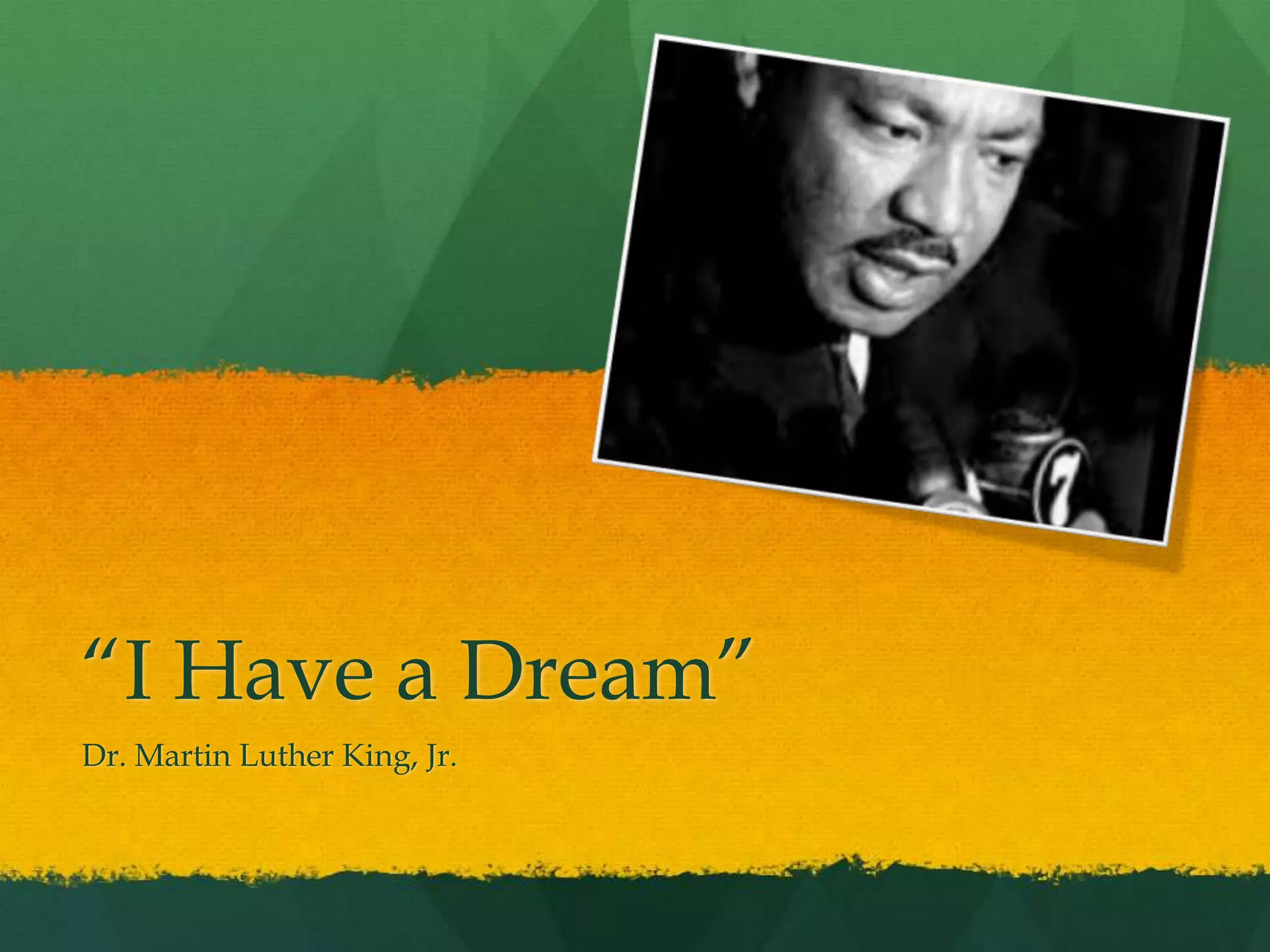
“I Have a Dream”
Dr. Martin Luther King, Jr.
Ethos
 Ethos means the character of the speaker in the eyes
  of the audience. King was born into a well-
  educated, successful family, graduated from
  Morehouse College, and, as the outstanding
  member of his senior class, from Crozer Theological
  Seminary. He received his Ph.D. in philosophy in
  1955, and served as minister of the Dexter Avenue
  Baptist Church from 1955 to 1968. His Nobel Peace
  Prize was received one year after this speech was
  given.
Pathos: King depends on his use of language
   to draw emotion from his listeners. Figures of
               speech predominate.

 Antithesis, or the setting of one clause or other member of a
  sentence against another to which it is opposed, is heavily used.
  “It came as a joyous daybreak to end their long night of
  captivity,” is the first of many examples of antithesis used in the
  speech.
 Simile is the comparison of two unlike things, connected with
  the words “like” or “as” such as “justice rolls down like waters
  and righteousness like a mighty stream.”
 Metaphor is a compressed simile (the “like” or “as” is
  eliminated) and they are abundant: “manacles of segregation,”
  “symphony of brotherhood.”
 Allusions, or references to literary, historical, and biblical
  events, occur often. One obvious example is “Five score years
  ago,” which refers to the Gettysburg Address.
 Personification: the attribution of a personal nature or character to
  inanimate objects or abstract notions: "Death lays his icy hand on
  kings”
 Hyperbole: obvious and intentional exaggeration: “to wait an
  eternity.”
 Contrast: To evince a difference that can distinguish meaning:
  “Voiced and voiceless”
 Colloquialisms: a word, phrase, or expression characteristic of
  ordinary or familiar conversation rather than formal speech or
  writing, as “She‟s out” for “She is not at home.”
 Repetition: repeated word aimed at stimulating thought on a
  recurring theme; used to create an 'auditory' stimulus.
 Anaphora: a poetic device and a repetition device where the same
  expression is repeated at the beginning of two or more
  lines, clauses, or sentences.
 Parallelism: occurs when a writer or speaker expresses ideas of
  equal worth with the same grammatical form: "Veni, vidi, vici," (I
  came, I saw, I conquered)
Find examples of Pathos
      through language use in King‟s
                 Speech
   Antithesis: the setting of one clause          Contrast: To evince a difference that
    against another to which it is opposed.         can distinguish meaning.

   Simile is the comparison of two unlike         Colloquialisms: a word, phrase, or
    things, connected with the words “like”         expression characteristic of ordinary
    or “as.”                                        or familiar conversation.
   Metaphor is a compressed simile (the           Repetition: repeated word aimed at
    “like” or “as” is eliminated).                  stimulating thought on a recurring
   Allusions: references to                        theme.
    literary, historical, and biblical events
                                                   Anaphora: a repetition device where
   Personification: the attribution of a           the same expression is repeated at
    personal nature or character to                 the beginning of two or more lines,
    inanimate objects or abstract notions.          clauses, or sentences.

   Hyperbole: obvious and intentional             Parallelism: a writer or speaker
    exaggeration.                                   expresses ideas of equal worth with
                                                    the same grammatical form
Logos: A persuasive
        strategy of logic
 In his “I Have a Dream” speech, King used
  mostly his own personal experience and
  observations to support his major
  arguments. His thesis (or purpose) statement
  is, “Now is the time to make justice a reality
  for all of God‟s children.”
Organizing your Speech
     A Method in Five Steps!
King followed Monroe‟s
             motivated sequence.

    The five steps of the Monroe motivated sequence are
    attention, need, satisfaction, visualization, and action.

 In the attention step, speakers call attention to the situation. King, speaking from the
  steps of the Lincoln Memorial, calls attention to Lincoln‟s signing of the
  Emancipation Proclamation, the situation of the Negro today (“One hundred years
  later, the Negro still is not free.”), and the fact that the words of the Constitution and
  Declaration of Independence granting all people the unalienable rights of
  life, liberty, and the pursuit of happiness have not been fulfilled.

 For the need step, speakers describe the
  difficulty, trouble, distress, crisis, emergency, or urgency. King says, “Instead of
  honoring this sacred obligation [what the Constitution and Declaration of
  Independence promise], America has given the Negro people a bad check, a check
  that has come back marked „insufficient funds.‟” And why have they come to
  Washington, D.C.? — to “remind America of the fierce urgency of now.”
attention, need, satisfaction, visualization
                        and action.


 In the satisfaction step, speakers tell listeners how to satisfy the need they
  establish. King says, “We must make the pledge that we shall always march
  ahead.” To march ahead, he said, “We can never be satisfied.” Then he tells
  listeners to go back home knowing their situation can and will be changed.
   For visualization, speakers offer listeners a vision of what life can be once their
   solution (offered in the satisfaction step) is adopted. This is where King offers
   listeners his dream: “I have a dream” offered along with five different
   descriptions of what life can and will be like in
   Georgia, Mississippi, Alabama, in communities, and around the world.
   The final stage is the action step when speakers offer listeners a specific course
   of action to follow. King‟s action step occurs when he asks his audience to “Let
   freedom ring,” and he uses the phrase at the end of the speech focusing on
   eight states symbolizing the whole nation.


            Courtesy of Richard L. Weaver II
Homework
 Find several examples of Pathos through language use in “I
  Have a Dream. ” Post them.

 Use the list of strategies to generate several ideas for your own
  speech. Post a few ideas.

 Rearrange your essay #4 into a speech format similar to Kings
  using Monroe‟s motivated sequence. Post your speech draft.
  Remember to save your essay format. Your essay and your
  speech do not have to be exactly the same. The essay will likely
  be longer.

 Read: SMG "Oral Presentations” 835-39

Class 18 1 a

  • 1.
  • 2.
    AGENDA  Essay #4:Improving our readable plan  In-Class Writing: Thesis/Speech  "Presentation:  Intro to Speech: Speeches: Ethos, Logos, and Pathos  Martin Luther King Jr. “I have a Dream”  Discussion: "I have a Dream.”  Rhetorical Strategies  Anaphora  Theme words  Quotations and Allusion  Examples  Metaphors
  • 3.
    A Readable Plan Becauseproposals present a complex, multipart argument— to establish the seriousness of the problem, to convince readers that the proposed solution is feasible, and to refute objections and persuade readers that the proposed solution is better than alternatives—writers try to make it easy for readers to navigate the essay. Among the cueing strategies writers use to orient readers are the use of transitional words and phrases, and rhetorical Questions. Transitions or connectives help readers understand the logical connection between one paragraph or sentence and the one that follows.
  • 4.
    Here is abrief chart showing several transitions and the logical relationships they signal: Function Transitional Words and Phrases 1. To introduce another item in 1. first . . . second; in addition; moreover; a series furthermore 2. To introduce an example or 2. for example; that is; in particular; illustration specifically 3. but; however; nevertheless; in contrast; 3. To counterargue neither 4. To concede an objection 4. granted; of course; to be sure; certainly 5. To resume the argument 5. nonetheless; even though; still; all the after acknowledging an same objection or alternative solution
  • 5.
    The concession-refutation move,sometimes called the “yes-but” strategy, is important in most arguments. Following is an outline of some other kinds of language authors rely on to introduce their concession-refutation moves:
  • 6.
  • 7.
    Introduction to SpeechWriting: The Art of (Ethical)Persuasion Three Crucial Motivational Appeals:  Ethos: Establishing credibility; convincing through your character, credentials, or knowledge.  Pathos: Appealing to emotions, values, and beliefs.  Logos: Appealing to reason or logic.
  • 8.
    Martin Luther KingJr. has now been dead longer than he lived. But what an extraordinary life it was.  At 33, he was pressing the case of civil rights with President John Kennedy. At 34, he galvanized the nation with his "I Have a Dream" speech. At 35, he won the Nobel Peace Prize. At 39, he was assassinated, but he left a legacy of hope and inspiration that continues today.  King's most famous speech, "I Have a Dream," was delivered in 1963 at the March on Washington, one of the largest political rallies for human rights in United States history; it called for civil and economic rights for African Americans.
  • 9.
    “I Have aDream” Dr. Martin Luther King, Jr.
  • 10.
    Ethos  Ethos meansthe character of the speaker in the eyes of the audience. King was born into a well- educated, successful family, graduated from Morehouse College, and, as the outstanding member of his senior class, from Crozer Theological Seminary. He received his Ph.D. in philosophy in 1955, and served as minister of the Dexter Avenue Baptist Church from 1955 to 1968. His Nobel Peace Prize was received one year after this speech was given.
  • 11.
    Pathos: King dependson his use of language to draw emotion from his listeners. Figures of speech predominate.  Antithesis, or the setting of one clause or other member of a sentence against another to which it is opposed, is heavily used. “It came as a joyous daybreak to end their long night of captivity,” is the first of many examples of antithesis used in the speech.  Simile is the comparison of two unlike things, connected with the words “like” or “as” such as “justice rolls down like waters and righteousness like a mighty stream.”  Metaphor is a compressed simile (the “like” or “as” is eliminated) and they are abundant: “manacles of segregation,” “symphony of brotherhood.”  Allusions, or references to literary, historical, and biblical events, occur often. One obvious example is “Five score years ago,” which refers to the Gettysburg Address.
  • 12.
     Personification: theattribution of a personal nature or character to inanimate objects or abstract notions: "Death lays his icy hand on kings”  Hyperbole: obvious and intentional exaggeration: “to wait an eternity.”  Contrast: To evince a difference that can distinguish meaning: “Voiced and voiceless”  Colloquialisms: a word, phrase, or expression characteristic of ordinary or familiar conversation rather than formal speech or writing, as “She‟s out” for “She is not at home.”  Repetition: repeated word aimed at stimulating thought on a recurring theme; used to create an 'auditory' stimulus.  Anaphora: a poetic device and a repetition device where the same expression is repeated at the beginning of two or more lines, clauses, or sentences.  Parallelism: occurs when a writer or speaker expresses ideas of equal worth with the same grammatical form: "Veni, vidi, vici," (I came, I saw, I conquered)
  • 13.
    Find examples ofPathos through language use in King‟s Speech  Antithesis: the setting of one clause  Contrast: To evince a difference that against another to which it is opposed. can distinguish meaning.  Simile is the comparison of two unlike  Colloquialisms: a word, phrase, or things, connected with the words “like” expression characteristic of ordinary or “as.” or familiar conversation.  Metaphor is a compressed simile (the  Repetition: repeated word aimed at “like” or “as” is eliminated). stimulating thought on a recurring  Allusions: references to theme. literary, historical, and biblical events  Anaphora: a repetition device where  Personification: the attribution of a the same expression is repeated at personal nature or character to the beginning of two or more lines, inanimate objects or abstract notions. clauses, or sentences.  Hyperbole: obvious and intentional  Parallelism: a writer or speaker exaggeration. expresses ideas of equal worth with the same grammatical form
  • 14.
    Logos: A persuasive strategy of logic  In his “I Have a Dream” speech, King used mostly his own personal experience and observations to support his major arguments. His thesis (or purpose) statement is, “Now is the time to make justice a reality for all of God‟s children.”
  • 15.
    Organizing your Speech A Method in Five Steps!
  • 16.
    King followed Monroe‟s motivated sequence.  The five steps of the Monroe motivated sequence are attention, need, satisfaction, visualization, and action.  In the attention step, speakers call attention to the situation. King, speaking from the steps of the Lincoln Memorial, calls attention to Lincoln‟s signing of the Emancipation Proclamation, the situation of the Negro today (“One hundred years later, the Negro still is not free.”), and the fact that the words of the Constitution and Declaration of Independence granting all people the unalienable rights of life, liberty, and the pursuit of happiness have not been fulfilled.  For the need step, speakers describe the difficulty, trouble, distress, crisis, emergency, or urgency. King says, “Instead of honoring this sacred obligation [what the Constitution and Declaration of Independence promise], America has given the Negro people a bad check, a check that has come back marked „insufficient funds.‟” And why have they come to Washington, D.C.? — to “remind America of the fierce urgency of now.”
  • 17.
    attention, need, satisfaction,visualization and action.  In the satisfaction step, speakers tell listeners how to satisfy the need they establish. King says, “We must make the pledge that we shall always march ahead.” To march ahead, he said, “We can never be satisfied.” Then he tells listeners to go back home knowing their situation can and will be changed. For visualization, speakers offer listeners a vision of what life can be once their solution (offered in the satisfaction step) is adopted. This is where King offers listeners his dream: “I have a dream” offered along with five different descriptions of what life can and will be like in Georgia, Mississippi, Alabama, in communities, and around the world. The final stage is the action step when speakers offer listeners a specific course of action to follow. King‟s action step occurs when he asks his audience to “Let freedom ring,” and he uses the phrase at the end of the speech focusing on eight states symbolizing the whole nation.  Courtesy of Richard L. Weaver II
  • 18.
    Homework  Find severalexamples of Pathos through language use in “I Have a Dream. ” Post them.  Use the list of strategies to generate several ideas for your own speech. Post a few ideas.  Rearrange your essay #4 into a speech format similar to Kings using Monroe‟s motivated sequence. Post your speech draft. Remember to save your essay format. Your essay and your speech do not have to be exactly the same. The essay will likely be longer.  Read: SMG "Oral Presentations” 835-39