A: NOPE! It’s Greek. Ethos, pathos, and logos
are Greek words that essentially mean the
following:
• Ethos = (ethics) character/credibility
• Pathos = emotion
• Logos = logic/reason
These are the three rhetorical appeals {ways
to persuade}.
EPL: Is that even English?
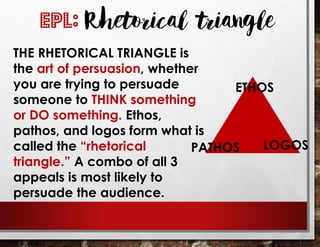
THE RHETORICAL TRIANGLE is
the art of persuasion, whether
you are trying to persuade
someone to THINK something
or DO something. Ethos,
pathos, and logos form what is
called the “rhetorical
triangle.” A combo of all 3
appeals is most likely to
persuade the audience.
EPL: Rhetorical triangle
ETHOS
PATHOS LOGOS
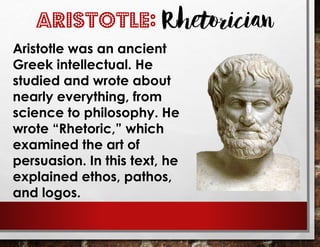
Aristotle was an ancient
Greek intellectual. He
studied and wrote about
nearly everything, from
science to philosophy. He
wrote “Rhetoric,” which
examined the art of
persuasion. In this text, he
explained ethos, pathos,
and logos.
ARISTOTLE: Rhetorician
Because persuasion is a part of life, and these
appeals are tried-and-true. You have probably used
these appeals without even realizing it, and you will
probably use these appeals again. But if you can
fully understand these appeals, you will know
exactly HOW to use them to persuade others to think
or do something. You want to get your way? You
need to know how to play the persuasion game to
win your audience over with ETHOS, PATHOS, AND
LOGOS, or EPL. ☺
PERSUASION: Why care?
Ethos is an appeal to the speaker’s
ethics—his or her character,
credibility, and authority on the
subject.
•The audience must trust the
speaker in order for persuasion to
happen.
•It’s not enough to be credible; the
speaker must deliberately
demonstrate this credibility and
reliability.
ETHOS: Ethical appeal
•Show that you are experienced and
knowledgeable on the subject. Use your own
knowledge when you can, but cite others
when you can’t.
•Show the audience that you are a good
person. Respect them. Connect to them.
•Show that you are professional. Use
appropriate language and tone. Dress
appropriately, if applicable!
ETHOS: How to use it
PATHOS: Emotional appeal
Pathos is an appeal to the
audience’s emotions.
•By evoking emotions, the speaker is
more likely to persuade the
audience.
• Pathos can be very powerful
because humans are emotional
creatures.
•Any emotion: fear, sympathy, love,
joy, pity, etc…
•Pathos makes a personal,
emotional connection.
PATHOS: How to use it
•Know your audience and know what
emotion or subject will move them in the
way you want!
•Make it personal for the audience. Tug on
their heartstrings, or scare them into
persuasion!
•Use descriptive, vivid language and
imagery to make it more real.
•Use examples and stories that will engage
the audience and evoke emotions.
LOGOS: Logical appeal
Logos is an appeal to logic
and reasoning.
•The speaker must prove
his/her claims with
evidence and reasoning.
•Strong evidence and solid
reasoning is difficult to
dismiss, so logos is essential
to persuasion.
LOGOS: How to use it
•Make sure your argument makes
logical sense. Avoid logical fallacies
(FLAWS IN LOGIC)
•Make sure your argument is clear and
easily understood. If your audience
can’t understand it, you can’t convince
them.
•Use facts, statistics, numbers, charts,
etc.
EXAMPLE: Sleep deprivation
Identify the ethos, pathos, and logos in the following example:
“As a doctor who has studied sleep cycles and the effects of
sleep deprivation, I am here to advise you to make a conscious
effort to get 6-8 hours of sleep each night. Sleep deprivation
results in decreased productivity during that day, but it can
have even worse effects. According to the national highway
traffic safety administration, sleep deprivation contributes to
100,000 car crashes each year. Many of these crashes are
fatal. Do you really want to kill someone behind the wheel, just
because you did not get enough sleep? Do you want to go to
jail for an accident you could have prevented? Do you want
that kind of guilt to keep you from sleeping for the rest of your
life? Just get the sleep in the first place, please!”
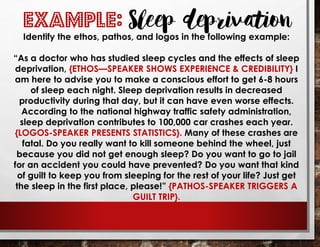
EXAMPLE: Sleep deprivation
Identify the ethos, pathos, and logos in the following example:
“As a doctor who has studied sleep cycles and the effects of sleep
deprivation, {ETHOS—SPEAKER SHOWS EXPERIENCE & CREDIBILITY} I
am here to advise you to make a conscious effort to get 6-8 hours
of sleep each night. Sleep deprivation results in decreased
productivity during that day, but it can have even worse effects.
According to the national highway traffic safety administration,
sleep deprivation contributes to 100,000 car crashes each year.
{LOGOS-SPEAKER PRESENTS STATISTICS}. Many of these crashes are
fatal. Do you really want to kill someone behind the wheel, just
because you did not get enough sleep? Do you want to go to jail
for an accident you could have prevented? Do you want that kind
of guilt to keep you from sleeping for the rest of your life? Just get
the sleep in the first place, please!” {PATHOS-SPEAKER TRIGGERS A
GUILT TRIP}.
EXAMPLES: Commercials
SOME OF THESE CONTAIN MORE THAN ONE APPEAL, SO WATCH
CLOSELY!
• SMOKING PSA
• OBAMA CAMPAIGN
• VERIZON
• ALLSTATE
• GOOGLE CHROME
• DISTRACTED DRIVING
• WESLEY MEREDITH
EXAMPLE: “I have a dream”
But one hundred years later, the negro still is not free.
One hundred years later, the life of the negro is still sadly
crippled by the manacles of segregation and the chains
of discrimination. One hundred years later, the negro
lives on a lonely island of poverty in the midst of a vast
ocean of material prosperity. One hundred years later,
the negro is still languished in the corners of American
society and finds himself an exile in his own land. And so
we've come here today to dramatize a shameful
condition.
“I have a dream,” Martin Luther King Junior
He uses imagery and word choice to help the
audience visualize the “shameful condition” of
inequality, thus evoking pity from the audience.
✓“Sadly crippled by the manacles of
segregation”
✓ “The negro lives on a lonely island of poverty”
✓“Languished in the corners of American
society and finds himself an exile”
✓“a shameful condition”
PATHOS: Emotional appeal
EXAMPLE: “On Women’s Right to Vote”
The Preamble of the Federal Constitution says:
"We, the people of the united states, in order to form a
more perfect union, establish justice, insure domestic
tranquility, provide for the common defense, promote the
general welfare, and secure the blessings of liberty to
ourselves and our posterity, do ordain and establish this
constitution for the united states of America."
It was we, the people; not we, the white male citizens;
nor yet we, the male citizens; but we, the whole people, who
formed the union. And we formed it, not to give the blessings
of liberty, but to secure them; not to the half of ourselves and
the half of our posterity, but to the whole people - women as
well as men.
“On Women’s Right to Vote,” Susan B. Anthony
She cites the Constitution, then uses its original
wording to logically prove her point:
•We = the whole, not half
it was we, the people; not we, the white male
citizens; nor yet we, the male citizens; but we, the
whole people, who formed the union. And we
formed it, not to give the blessings of liberty, but to
secure them; not to the half of ourselves and the half
of our posterity, but to the whole people - women as
well as men.
LOGOS: Logical appeal
EXAMPLE: State of the Union
Will we allow ourselves to be sorted into factions
and turned against one another – or will we recapture the
sense of common purpose that has always propelled
America forward?
In two weeks, I will send this congress a budget
filled with ideas that are practical, not partisan. And in
the months ahead, I’ll crisscross the country making a
case for those ideas.
So tonight, I want to focus less on a checklist of
proposals, and focus more on the values at stake in the
choices before us.
-State of the Union address, 2015, Barack Obama
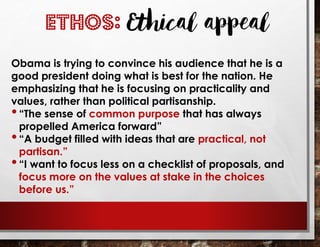
Obama is trying to convince his audience that he is a
good president doing what is best for the nation. He
emphasizing that he is focusing on practicality and
values, rather than political partisanship.
•“The sense of common purpose that has always
propelled America forward”
•“A budget filled with ideas that are practical, not
partisan.”
•“I want to focus less on a checklist of proposals, and
focus more on the values at stake in the choices
before us.”
ETHOS: Ethical appeal
DISCUSS: Turn and talk
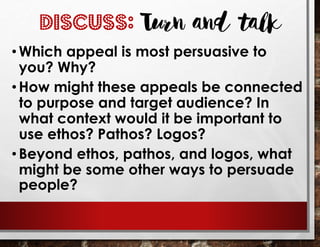
• Which appeal is most persuasive to
you? Why?
•How might these appeals be connected
to purpose and target audience? In
what context would it be important to
use ethos? Pathos? Logos?
• Beyond ethos, pathos, and logos, what
might be some other ways to persuade
people?
EXIT TICKET: Persuade me!
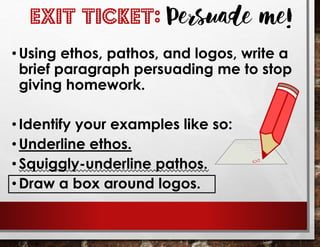
• Using ethos, pathos, and logos, write a
brief paragraph persuading me to stop
giving homework.
•Identify your examples like so:
• Underline ethos.
• Squiggly-underline pathos.
• Draw a box around logos.

The Three Pillars!

  • 3.
    A: NOPE! It’sGreek. Ethos, pathos, and logos are Greek words that essentially mean the following: • Ethos = (ethics) character/credibility • Pathos = emotion • Logos = logic/reason These are the three rhetorical appeals {ways to persuade}. EPL: Is that even English?
  • 4.
    THE RHETORICAL TRIANGLEis the art of persuasion, whether you are trying to persuade someone to THINK something or DO something. Ethos, pathos, and logos form what is called the “rhetorical triangle.” A combo of all 3 appeals is most likely to persuade the audience. EPL: Rhetorical triangle ETHOS PATHOS LOGOS
  • 5.
    Aristotle was anancient Greek intellectual. He studied and wrote about nearly everything, from science to philosophy. He wrote “Rhetoric,” which examined the art of persuasion. In this text, he explained ethos, pathos, and logos. ARISTOTLE: Rhetorician
  • 6.
    Because persuasion isa part of life, and these appeals are tried-and-true. You have probably used these appeals without even realizing it, and you will probably use these appeals again. But if you can fully understand these appeals, you will know exactly HOW to use them to persuade others to think or do something. You want to get your way? You need to know how to play the persuasion game to win your audience over with ETHOS, PATHOS, AND LOGOS, or EPL. ☺ PERSUASION: Why care?
  • 7.
    Ethos is anappeal to the speaker’s ethics—his or her character, credibility, and authority on the subject. •The audience must trust the speaker in order for persuasion to happen. •It’s not enough to be credible; the speaker must deliberately demonstrate this credibility and reliability. ETHOS: Ethical appeal
  • 8.
    •Show that youare experienced and knowledgeable on the subject. Use your own knowledge when you can, but cite others when you can’t. •Show the audience that you are a good person. Respect them. Connect to them. •Show that you are professional. Use appropriate language and tone. Dress appropriately, if applicable! ETHOS: How to use it
  • 9.
    PATHOS: Emotional appeal Pathosis an appeal to the audience’s emotions. •By evoking emotions, the speaker is more likely to persuade the audience. • Pathos can be very powerful because humans are emotional creatures. •Any emotion: fear, sympathy, love, joy, pity, etc… •Pathos makes a personal, emotional connection.
  • 10.
    PATHOS: How touse it •Know your audience and know what emotion or subject will move them in the way you want! •Make it personal for the audience. Tug on their heartstrings, or scare them into persuasion! •Use descriptive, vivid language and imagery to make it more real. •Use examples and stories that will engage the audience and evoke emotions.
  • 11.
    LOGOS: Logical appeal Logosis an appeal to logic and reasoning. •The speaker must prove his/her claims with evidence and reasoning. •Strong evidence and solid reasoning is difficult to dismiss, so logos is essential to persuasion.
  • 12.
    LOGOS: How touse it •Make sure your argument makes logical sense. Avoid logical fallacies (FLAWS IN LOGIC) •Make sure your argument is clear and easily understood. If your audience can’t understand it, you can’t convince them. •Use facts, statistics, numbers, charts, etc.
  • 13.
    EXAMPLE: Sleep deprivation Identifythe ethos, pathos, and logos in the following example: “As a doctor who has studied sleep cycles and the effects of sleep deprivation, I am here to advise you to make a conscious effort to get 6-8 hours of sleep each night. Sleep deprivation results in decreased productivity during that day, but it can have even worse effects. According to the national highway traffic safety administration, sleep deprivation contributes to 100,000 car crashes each year. Many of these crashes are fatal. Do you really want to kill someone behind the wheel, just because you did not get enough sleep? Do you want to go to jail for an accident you could have prevented? Do you want that kind of guilt to keep you from sleeping for the rest of your life? Just get the sleep in the first place, please!”
  • 14.
    EXAMPLE: Sleep deprivation Identifythe ethos, pathos, and logos in the following example: “As a doctor who has studied sleep cycles and the effects of sleep deprivation, {ETHOS—SPEAKER SHOWS EXPERIENCE & CREDIBILITY} I am here to advise you to make a conscious effort to get 6-8 hours of sleep each night. Sleep deprivation results in decreased productivity during that day, but it can have even worse effects. According to the national highway traffic safety administration, sleep deprivation contributes to 100,000 car crashes each year. {LOGOS-SPEAKER PRESENTS STATISTICS}. Many of these crashes are fatal. Do you really want to kill someone behind the wheel, just because you did not get enough sleep? Do you want to go to jail for an accident you could have prevented? Do you want that kind of guilt to keep you from sleeping for the rest of your life? Just get the sleep in the first place, please!” {PATHOS-SPEAKER TRIGGERS A GUILT TRIP}.
  • 15.
    EXAMPLES: Commercials SOME OFTHESE CONTAIN MORE THAN ONE APPEAL, SO WATCH CLOSELY! • SMOKING PSA • OBAMA CAMPAIGN • VERIZON • ALLSTATE • GOOGLE CHROME • DISTRACTED DRIVING • WESLEY MEREDITH
  • 16.
    EXAMPLE: “I havea dream” But one hundred years later, the negro still is not free. One hundred years later, the life of the negro is still sadly crippled by the manacles of segregation and the chains of discrimination. One hundred years later, the negro lives on a lonely island of poverty in the midst of a vast ocean of material prosperity. One hundred years later, the negro is still languished in the corners of American society and finds himself an exile in his own land. And so we've come here today to dramatize a shameful condition. “I have a dream,” Martin Luther King Junior
  • 17.
    He uses imageryand word choice to help the audience visualize the “shameful condition” of inequality, thus evoking pity from the audience. ✓“Sadly crippled by the manacles of segregation” ✓ “The negro lives on a lonely island of poverty” ✓“Languished in the corners of American society and finds himself an exile” ✓“a shameful condition” PATHOS: Emotional appeal
  • 18.
    EXAMPLE: “On Women’sRight to Vote” The Preamble of the Federal Constitution says: "We, the people of the united states, in order to form a more perfect union, establish justice, insure domestic tranquility, provide for the common defense, promote the general welfare, and secure the blessings of liberty to ourselves and our posterity, do ordain and establish this constitution for the united states of America." It was we, the people; not we, the white male citizens; nor yet we, the male citizens; but we, the whole people, who formed the union. And we formed it, not to give the blessings of liberty, but to secure them; not to the half of ourselves and the half of our posterity, but to the whole people - women as well as men. “On Women’s Right to Vote,” Susan B. Anthony
  • 19.
    She cites theConstitution, then uses its original wording to logically prove her point: •We = the whole, not half it was we, the people; not we, the white male citizens; nor yet we, the male citizens; but we, the whole people, who formed the union. And we formed it, not to give the blessings of liberty, but to secure them; not to the half of ourselves and the half of our posterity, but to the whole people - women as well as men. LOGOS: Logical appeal
  • 20.
    EXAMPLE: State ofthe Union Will we allow ourselves to be sorted into factions and turned against one another – or will we recapture the sense of common purpose that has always propelled America forward? In two weeks, I will send this congress a budget filled with ideas that are practical, not partisan. And in the months ahead, I’ll crisscross the country making a case for those ideas. So tonight, I want to focus less on a checklist of proposals, and focus more on the values at stake in the choices before us. -State of the Union address, 2015, Barack Obama
  • 21.
    Obama is tryingto convince his audience that he is a good president doing what is best for the nation. He emphasizing that he is focusing on practicality and values, rather than political partisanship. •“The sense of common purpose that has always propelled America forward” •“A budget filled with ideas that are practical, not partisan.” •“I want to focus less on a checklist of proposals, and focus more on the values at stake in the choices before us.” ETHOS: Ethical appeal
  • 22.
    DISCUSS: Turn andtalk • Which appeal is most persuasive to you? Why? •How might these appeals be connected to purpose and target audience? In what context would it be important to use ethos? Pathos? Logos? • Beyond ethos, pathos, and logos, what might be some other ways to persuade people?
  • 23.
    EXIT TICKET: Persuademe! • Using ethos, pathos, and logos, write a brief paragraph persuading me to stop giving homework. •Identify your examples like so: • Underline ethos. • Squiggly-underline pathos. • Draw a box around logos.