ethos, pathos
and logos
Rhetoric is the ancient art of using language to persuade. If
you use it well, your audience will easily understand what
you're saying, and will more likely be influenced by it.
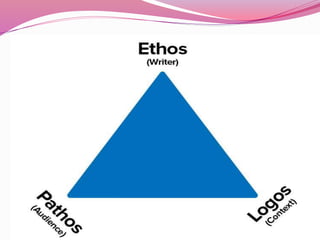
The three points on the Rhetorical Triangle relate directly to
the three classic appeals you should consider when
communicating:
• Ethos: building trust by establishing your credibility and
authority (Writer).
• Pathos: appealing to emotion by connecting with your
audience through their values and interests (Audience).
• Logos: appealing to your audience's intelligence with
well-constructed and clearly argued ideas (Context).
ETHOS (WRITER)
The way in which the writer (or speaker) affects the
argument is known as ethos.
From the outset, you need to clarify who you are, why
you are competent to speak on the issue, and where
your authority comes from.
Your audience might be wary that you're trying to
change their opinions or beliefs. If you don't make it
clear why you are addressing them, some people might
assume that you are hiding something.
Whether you're presenting ideas for problem solving,
analysis, or just to entertain, your audience will try to
figure out your motives, beliefs, values , and
assumptions. This allows them to evaluate your
credibility and decide whether you are being sincere.
Ethos appeals to:
 Intelligence
 Virtue
 Morals
 Perception of trustworthiness
Examples of Ethos in
Contemporary Writing
 Op-ed: Someone writing an op-ed on the importance of
childhood literacy first establishes their decades of
experience as an educator. In their prose they argue that
their position has a strong moral foundation. They might
use relatable anecdotes from their past to build goodwill
(eunoia) with their audience.
 Memoir: An olympic athlete describes the years and years
of training that prepared her to win gold. In her memoir, she
lays out the moral choices that she had to confront in her
career, why she was so driven to succeed, while also adding
a few relatable stories of family, upbringing, and training
regimen that help illustrate her credibility to the reader.
 Magazine advertisement: An ad for
shampoo features a well known celebrity
hairdresser who vouches for the product. The
ad builds eunoia when the hairdresser talks
about how the shampoo is works for anyone,
from their celebrity clients to the customer at
home.
 Newspaper article: A journalist documents
the extensive research they performed to
uncover corruption on the local city council.
Though the prose may be more dry in a news
article, the implication of the story is that this
news is in the public’s best interest.
Pathos (Audience)
When you communicate, you need to understand your
audience and appeal to their emotions. This is known
as pathos.
Consider the audience's expectations – what are they hoping
to take away from what you say? Be clear about why you are
communicating with this audience in the first place, and plan
out your communication style in advance, with the
audience firmly in mind.
Knowing your audience helps you to avoid alienating them by
using technical terms or jargon that they may not
understand, or by "dumbing down" the content, if your
message is intended for professionals.
Think about the emotion you want to evoke. Are you
addressing a pain point, seeking their trust, or inviting their
loyalty?
Pathos appeals to:
 Emotions and feelings
 Biases and prejudices
 Senses
 Motivations
Examples of Pathos in
Contemporary Writing
 Poems: Poems are often abstract and designed
to be evocative and inspire emotion. Pathos is a
driving force in most popular poetry.
Eg. I Know Why The Caged Bird Sings (By Maya
Angelou)
The free bird thinks of another breeze
and the trade winds soft through the sighing trees
and the fat worms waiting on a dawn bright lawn
and he names the sky his own
But a caged bird stands on the grave of dreams
his shadow shouts on a nightmare scream
his wings are clipped and his feet are tied
so he opens his throat to sing.
 Plays: Plays dramatize the lives and emotions of
fictional characters. A good play captures pathos in the
feelings and struggles of its characters.
Eg. Romeo and Juliet (By William Shakespeare)
Then she is well, and nothing can be ill.
Her body sleeps in Capels’ monument,
And her immortal part with angels lives.
I saw her laid low in her kindred’s vault.
 Memoir: Memoirs often focus on the most emotional
and dramatic chapters of their writer’s lives. Pathos is
what separates a successful memoir from a dry
recounting of the writer’s life and accomplishments.
 Novels: Most novels are driven by the emotional lives
of their characters. Novels depend on pathos to
connect readers with the characters and narrative.
Eg. Pride and Prejudice (By Jane Austen)
Mr. Collins’ confession to Elizabeth that he wants her to
be his future partner evokes feelings of sympathy in
readers, as they feel an emotional intensity in his
proposal.
“Believe me, my dear Miss Elizabeth, that your modesty
adds to your other perfections. But you can hardly doubt
the object of my discourse, however your feminine
delicacy may lead you to dissemble. For, as almost as
soon as I entered the house, I singled you out as the
companion of my future life!”
Logos (Context)
Finally, your audience will analyze your message by
putting it into context. Here the emphasis is on logic and
reason, or logos (pronounced log-oss).
Your audience will likely consider the background to your
communication, and the circumstances or events that
preceded it. They'll analyze the kinds of arguments you
used, their relevance, and whether you delivered them
in a clear, coherent and appropriate way.
Your audience must be able to follow what you are
saying for it to be believable. They'll be looking for a
logical, well-constructed argument, and evidence for any
claims that you make. They'll also be thinking about any
possible counterarguments.
Logos utilizes:
 Evidence
 Testimony
 Statistics and Data
 Universal truths
Examples of Logos in
Contemporary Writing
 Politics: Political Ideals (By Bertrand Russell)
“The wage system has made people believe that
what a man needs is work.
This, of course, is absurd. What he needs is the
goods produced by
work, and the less work involved in making a given
amount of goods,
the better … But owing to our economic system
…where a better system would
produce only an increase of wages or a diminution
in the hours of work
without any corresponding diminution of wages.”
 Plays: Othello (By William Shakespeare)
“Oh, beware, my lord, of jealousy!
It is the green-eyed monster which doth mock
The meat it feeds on …
Who, certain of his fate, loves not his wronger,
But, oh, what damnèd minutes tells he o’er
Who dotes, yet doubts — suspects, yet soundly
loves …
She did deceive her father, marrying you …
She loved them most …
I humbly do beseech you of your pardon
For too much loving you …”
 Novels: In Harper Lee’s To Kill a Mockingbird, the
climactic courtroom scene features an
impassioned plea to the jury on the part of lawyer
Atticus Finch, who argues logically and
methodically for his client’s innocence.
 Newspapers: Reporters and columnists depend
on logos to convey the logic of a story or
persuade their readers. One example of logos you
might find would be a newspaper editorial listing
examples of the success of child literacy programs
in arguing for their further implementation.
Establish Your Credibility
(Ethos)
First, establish who you are as a person.
 Reveal your biases, beliefs, values, and assumptions, as
appropriate.
 Explain where your expertise comes from.
 Use expert testimony.
 Show why you should be considered an authority.
Then, consider the purpose of your communication. Is it:
 A call to action?
 To provide information?
 To educate?
 To persuade or change a perspective?
 To present ideas?
 To entertain?
Appeal to the Audience's
Emotions (Pathos)
Ask yourself who the members of your audience
are.
 What are their expectations?
 Why are they reading (or listening) to me?
 How will they use this information?
 What do I want them to take away?
Consider how you can connect with them
emotionally.
 What emotions do I want to evoke?
 Do I use anecdotes or personal stories?
Consider the Context
(Logos)
Think about how you'll present the information.
 What type of reasoning will I use?
 How will I support my position? With statistics? Evidence?
Observations?
 What tone will I use? Formal or informal?
 What is the best way to communicate the message?
Take into account what events surround the communication.
 What background information do I need to supply?
 Are there important counterarguments I should bring up
and deal with?
 Does the method or location of my communication fit with
its message?
Thank You!

Ethos, Pathos, Logos in writing

  • 1.
  • 2.
    Rhetoric is theancient art of using language to persuade. If you use it well, your audience will easily understand what you're saying, and will more likely be influenced by it. The three points on the Rhetorical Triangle relate directly to the three classic appeals you should consider when communicating: • Ethos: building trust by establishing your credibility and authority (Writer). • Pathos: appealing to emotion by connecting with your audience through their values and interests (Audience). • Logos: appealing to your audience's intelligence with well-constructed and clearly argued ideas (Context).
  • 4.
    ETHOS (WRITER) The wayin which the writer (or speaker) affects the argument is known as ethos. From the outset, you need to clarify who you are, why you are competent to speak on the issue, and where your authority comes from. Your audience might be wary that you're trying to change their opinions or beliefs. If you don't make it clear why you are addressing them, some people might assume that you are hiding something. Whether you're presenting ideas for problem solving, analysis, or just to entertain, your audience will try to figure out your motives, beliefs, values , and assumptions. This allows them to evaluate your credibility and decide whether you are being sincere.
  • 5.
    Ethos appeals to: Intelligence  Virtue  Morals  Perception of trustworthiness
  • 6.
    Examples of Ethosin Contemporary Writing  Op-ed: Someone writing an op-ed on the importance of childhood literacy first establishes their decades of experience as an educator. In their prose they argue that their position has a strong moral foundation. They might use relatable anecdotes from their past to build goodwill (eunoia) with their audience.  Memoir: An olympic athlete describes the years and years of training that prepared her to win gold. In her memoir, she lays out the moral choices that she had to confront in her career, why she was so driven to succeed, while also adding a few relatable stories of family, upbringing, and training regimen that help illustrate her credibility to the reader.
  • 7.
     Magazine advertisement:An ad for shampoo features a well known celebrity hairdresser who vouches for the product. The ad builds eunoia when the hairdresser talks about how the shampoo is works for anyone, from their celebrity clients to the customer at home.  Newspaper article: A journalist documents the extensive research they performed to uncover corruption on the local city council. Though the prose may be more dry in a news article, the implication of the story is that this news is in the public’s best interest.
  • 8.
    Pathos (Audience) When youcommunicate, you need to understand your audience and appeal to their emotions. This is known as pathos. Consider the audience's expectations – what are they hoping to take away from what you say? Be clear about why you are communicating with this audience in the first place, and plan out your communication style in advance, with the audience firmly in mind. Knowing your audience helps you to avoid alienating them by using technical terms or jargon that they may not understand, or by "dumbing down" the content, if your message is intended for professionals. Think about the emotion you want to evoke. Are you addressing a pain point, seeking their trust, or inviting their loyalty?
  • 9.
    Pathos appeals to: Emotions and feelings  Biases and prejudices  Senses  Motivations
  • 10.
    Examples of Pathosin Contemporary Writing  Poems: Poems are often abstract and designed to be evocative and inspire emotion. Pathos is a driving force in most popular poetry. Eg. I Know Why The Caged Bird Sings (By Maya Angelou) The free bird thinks of another breeze and the trade winds soft through the sighing trees and the fat worms waiting on a dawn bright lawn and he names the sky his own But a caged bird stands on the grave of dreams his shadow shouts on a nightmare scream his wings are clipped and his feet are tied so he opens his throat to sing.
  • 11.
     Plays: Playsdramatize the lives and emotions of fictional characters. A good play captures pathos in the feelings and struggles of its characters. Eg. Romeo and Juliet (By William Shakespeare) Then she is well, and nothing can be ill. Her body sleeps in Capels’ monument, And her immortal part with angels lives. I saw her laid low in her kindred’s vault.  Memoir: Memoirs often focus on the most emotional and dramatic chapters of their writer’s lives. Pathos is what separates a successful memoir from a dry recounting of the writer’s life and accomplishments.
  • 12.
     Novels: Mostnovels are driven by the emotional lives of their characters. Novels depend on pathos to connect readers with the characters and narrative. Eg. Pride and Prejudice (By Jane Austen) Mr. Collins’ confession to Elizabeth that he wants her to be his future partner evokes feelings of sympathy in readers, as they feel an emotional intensity in his proposal. “Believe me, my dear Miss Elizabeth, that your modesty adds to your other perfections. But you can hardly doubt the object of my discourse, however your feminine delicacy may lead you to dissemble. For, as almost as soon as I entered the house, I singled you out as the companion of my future life!”
  • 13.
    Logos (Context) Finally, youraudience will analyze your message by putting it into context. Here the emphasis is on logic and reason, or logos (pronounced log-oss). Your audience will likely consider the background to your communication, and the circumstances or events that preceded it. They'll analyze the kinds of arguments you used, their relevance, and whether you delivered them in a clear, coherent and appropriate way. Your audience must be able to follow what you are saying for it to be believable. They'll be looking for a logical, well-constructed argument, and evidence for any claims that you make. They'll also be thinking about any possible counterarguments.
  • 14.
    Logos utilizes:  Evidence Testimony  Statistics and Data  Universal truths
  • 15.
    Examples of Logosin Contemporary Writing  Politics: Political Ideals (By Bertrand Russell) “The wage system has made people believe that what a man needs is work. This, of course, is absurd. What he needs is the goods produced by work, and the less work involved in making a given amount of goods, the better … But owing to our economic system …where a better system would produce only an increase of wages or a diminution in the hours of work without any corresponding diminution of wages.”
  • 16.
     Plays: Othello(By William Shakespeare) “Oh, beware, my lord, of jealousy! It is the green-eyed monster which doth mock The meat it feeds on … Who, certain of his fate, loves not his wronger, But, oh, what damnèd minutes tells he o’er Who dotes, yet doubts — suspects, yet soundly loves … She did deceive her father, marrying you … She loved them most … I humbly do beseech you of your pardon For too much loving you …”
  • 17.
     Novels: InHarper Lee’s To Kill a Mockingbird, the climactic courtroom scene features an impassioned plea to the jury on the part of lawyer Atticus Finch, who argues logically and methodically for his client’s innocence.  Newspapers: Reporters and columnists depend on logos to convey the logic of a story or persuade their readers. One example of logos you might find would be a newspaper editorial listing examples of the success of child literacy programs in arguing for their further implementation.
  • 18.
    Establish Your Credibility (Ethos) First,establish who you are as a person.  Reveal your biases, beliefs, values, and assumptions, as appropriate.  Explain where your expertise comes from.  Use expert testimony.  Show why you should be considered an authority. Then, consider the purpose of your communication. Is it:  A call to action?  To provide information?  To educate?  To persuade or change a perspective?  To present ideas?  To entertain?
  • 19.
    Appeal to theAudience's Emotions (Pathos) Ask yourself who the members of your audience are.  What are their expectations?  Why are they reading (or listening) to me?  How will they use this information?  What do I want them to take away? Consider how you can connect with them emotionally.  What emotions do I want to evoke?  Do I use anecdotes or personal stories?
  • 20.
    Consider the Context (Logos) Thinkabout how you'll present the information.  What type of reasoning will I use?  How will I support my position? With statistics? Evidence? Observations?  What tone will I use? Formal or informal?  What is the best way to communicate the message? Take into account what events surround the communication.  What background information do I need to supply?  Are there important counterarguments I should bring up and deal with?  Does the method or location of my communication fit with its message?
  • 21.