Week 1
Rhetorical Appeals
Russell Rodrigo, M.Ed.
Outline
Argumentation
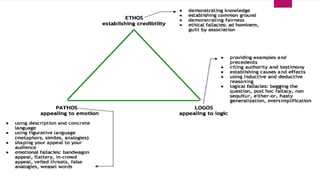
Rhetorical Appeals:
1. Pathos
2. Logos
3. Ethos
Argumentation
a reason or set of reasons given with the aim of
persuading others that an action or idea is right or
wrong.
Key Terms
1. Claim
 When a belief (judgment, opinion) is asserted in a declarative sentence, the result is a claim, statement,
or assertion
2. Objective claim VS Subjective claim
 An objective claim is true or false regardless of whether people think it is true or false. Claims that lack
this property are said to be subjective.
3. Fact VS Opinion
 People sometimes refer to true objective claims as “facts” and use the word “opinion” to designate any
claim that is subjective.
4. Factual Claim
 An objective claim. Saying that a claim is “factual” is not the same as saying it is true. A factual claim is
simply a claim whose truth does not depend on our thinking it is true.
What is Rhetoric?
 Rhetoric (n) - the art of speaking or writing effectively (Webster's
Definition).
 According to Aristotle, rhetoric is "the ability, in each particular case, to see the
available means of persuasion." He described three main forms of rhetoric: Ethos,
Logos, and Pathos.
 In order to be a more effective writer and analytical reader, you must
understand these terms.
Debatable Topics
1. The standards of beauty are never the same.
2. The media responsible for the moral degradation of teens.
3. Intelligence depends more on the environment than genetics.
4. Living together before marriage will lower the divorce rate.
5. Age does not matter in a relationship.
Aristotelian Appeals: Logos, Ethos, and
Pathos
 Whenever you read an argument you must ask yourself, “Is this
persuasive? If so, why? And to whom?” There are many ways to
appeal to an audience. Among them are appealing to logos, ethos,
and pathos. These appeals are identifiable in almost all arguments.
Logos (Greek for “word”)
 Logos: the logic/reasoning used to support a claim; the facts and
statistics used to help support the argument
 Examples:
 Case studies
 Cause and effect reasoning
 Facts and statistics
 Analogies
Logos
 Logos or the appeal to reason and it relies on logic.
 Logos often depends on the use of inductive or deductive reasoning.
 Inductive reasoning takes a specific representative case or facts and then draws
generalizations or conclusions from them. Inductive reasoning must be based on a
sufficient amount of reliable evidence. In other words, the facts you draw on must
fairly represent the larger situation or population.
 Deductive reasoning begins with a generalization and then applies it to a specific
case. The generalization you start with must have been based on a sufficient amount
of reliable evidence.
 Logos can be developed by citing facts and statistics (very important), using
advanced and well developed language, using historical incidents, analogies,
and by constructing logical arguments.
2. Ethos (Greek for “character”)
 Ethos: the source's credibility / authority
 Is the source trustworthy, educated, reliable, credible, honest, fair, and
respectable?
 Examples:
 Client testimonials
 Success stories
 Celebrity endorsements
 Personal anecdotes
Ethos
 Ethos is the appeal based on credibility or authority. – the character
reputation of the writer The audience asks themselves, "What does this
person know about this topic?" and "Why should I trust this person?"
 There are two kinds of ethos:
extrinsic (the character, expertise, education, and experience of the
rhetor), and
intrinsic (how the rhetor writes or speaks).
Pathos (Greek for “suffering” or
“experience”)
 Pathos: appeals to the audience’s capacity for empathy; wants you to care
about the subject matter
 Typical Emotional Appeals:
 Love
 Pity
 Patriotism
 Hope
 Jealousy
 Anger
 Fear
Pathos
 Pathos is the appeal based on emotion.
 It is often done by telling a story or an anecdote.
 Example Let's say a rhetor is trying to convince an audience of middle-class Americans to donate money
to a hurricane relief fund. The rhetor can make pathetic appeals to an audience's feelings of love, pity,
fear, and perhaps anger. (The extent to which any of these emotions will be successfully engaged will
vary from audience to audience.)
 "Love" will be felt if the audience can be made to believe in their fundamental connections to other
human beings.
 "Pity" will be felt if the plight of the homeless hurricane victim can be made very vivid to the
audience.
 "Fear" will be felt if the audience can be made to imagine what they would feel like in that
homeless victim's place.
 "Anger" will be felt if the audience realizes how little has been done by those who are responsible
for helping.
Review your arguments.
 Which of the rhetorical appeals did you use?
 Were they effective? Why or why not?
 How can you improve your arguments?
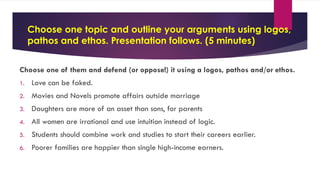
Choose one topic and outline your arguments using logos,
pathos and ethos. Presentation follows. (5 minutes)
Choose one of them and defend (or oppose!) it using a logos, pathos and/or ethos.
1. Love can be faked.
2. Movies and Novels promote affairs outside marriage
3. Daughters are more of an asset than sons, for parents
4. All women are irrational and use intuition instead of logic.
5. Students should combine work and studies to start their careers earlier.
6. Poorer families are happier than single high-income earners.
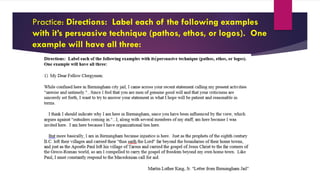
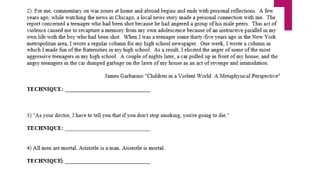
Practice: Directions: Label each of the following examples
with it’s persuasive technique (pathos, ethos, or logos). One
example will have all three:
Week 1 rhetorical appeals

Week 1 rhetorical appeals

  • 1.
  • 2.
  • 3.
    Argumentation a reason orset of reasons given with the aim of persuading others that an action or idea is right or wrong.
  • 4.
    Key Terms 1. Claim When a belief (judgment, opinion) is asserted in a declarative sentence, the result is a claim, statement, or assertion 2. Objective claim VS Subjective claim  An objective claim is true or false regardless of whether people think it is true or false. Claims that lack this property are said to be subjective. 3. Fact VS Opinion  People sometimes refer to true objective claims as “facts” and use the word “opinion” to designate any claim that is subjective. 4. Factual Claim  An objective claim. Saying that a claim is “factual” is not the same as saying it is true. A factual claim is simply a claim whose truth does not depend on our thinking it is true.
  • 5.
    What is Rhetoric? Rhetoric (n) - the art of speaking or writing effectively (Webster's Definition).  According to Aristotle, rhetoric is "the ability, in each particular case, to see the available means of persuasion." He described three main forms of rhetoric: Ethos, Logos, and Pathos.  In order to be a more effective writer and analytical reader, you must understand these terms.
  • 6.
    Debatable Topics 1. Thestandards of beauty are never the same. 2. The media responsible for the moral degradation of teens. 3. Intelligence depends more on the environment than genetics. 4. Living together before marriage will lower the divorce rate. 5. Age does not matter in a relationship.
  • 7.
    Aristotelian Appeals: Logos,Ethos, and Pathos  Whenever you read an argument you must ask yourself, “Is this persuasive? If so, why? And to whom?” There are many ways to appeal to an audience. Among them are appealing to logos, ethos, and pathos. These appeals are identifiable in almost all arguments.
  • 8.
    Logos (Greek for“word”)  Logos: the logic/reasoning used to support a claim; the facts and statistics used to help support the argument  Examples:  Case studies  Cause and effect reasoning  Facts and statistics  Analogies
  • 9.
    Logos  Logos orthe appeal to reason and it relies on logic.  Logos often depends on the use of inductive or deductive reasoning.  Inductive reasoning takes a specific representative case or facts and then draws generalizations or conclusions from them. Inductive reasoning must be based on a sufficient amount of reliable evidence. In other words, the facts you draw on must fairly represent the larger situation or population.  Deductive reasoning begins with a generalization and then applies it to a specific case. The generalization you start with must have been based on a sufficient amount of reliable evidence.  Logos can be developed by citing facts and statistics (very important), using advanced and well developed language, using historical incidents, analogies, and by constructing logical arguments.
  • 10.
    2. Ethos (Greekfor “character”)  Ethos: the source's credibility / authority  Is the source trustworthy, educated, reliable, credible, honest, fair, and respectable?  Examples:  Client testimonials  Success stories  Celebrity endorsements  Personal anecdotes
  • 11.
    Ethos  Ethos isthe appeal based on credibility or authority. – the character reputation of the writer The audience asks themselves, "What does this person know about this topic?" and "Why should I trust this person?"  There are two kinds of ethos: extrinsic (the character, expertise, education, and experience of the rhetor), and intrinsic (how the rhetor writes or speaks).
  • 12.
    Pathos (Greek for“suffering” or “experience”)  Pathos: appeals to the audience’s capacity for empathy; wants you to care about the subject matter  Typical Emotional Appeals:  Love  Pity  Patriotism  Hope  Jealousy  Anger  Fear
  • 13.
    Pathos  Pathos isthe appeal based on emotion.  It is often done by telling a story or an anecdote.  Example Let's say a rhetor is trying to convince an audience of middle-class Americans to donate money to a hurricane relief fund. The rhetor can make pathetic appeals to an audience's feelings of love, pity, fear, and perhaps anger. (The extent to which any of these emotions will be successfully engaged will vary from audience to audience.)  "Love" will be felt if the audience can be made to believe in their fundamental connections to other human beings.  "Pity" will be felt if the plight of the homeless hurricane victim can be made very vivid to the audience.  "Fear" will be felt if the audience can be made to imagine what they would feel like in that homeless victim's place.  "Anger" will be felt if the audience realizes how little has been done by those who are responsible for helping.
  • 15.
    Review your arguments. Which of the rhetorical appeals did you use?  Were they effective? Why or why not?  How can you improve your arguments?
  • 16.
    Choose one topicand outline your arguments using logos, pathos and ethos. Presentation follows. (5 minutes) Choose one of them and defend (or oppose!) it using a logos, pathos and/or ethos. 1. Love can be faked. 2. Movies and Novels promote affairs outside marriage 3. Daughters are more of an asset than sons, for parents 4. All women are irrational and use intuition instead of logic. 5. Students should combine work and studies to start their careers earlier. 6. Poorer families are happier than single high-income earners.
  • 17.
    Practice: Directions: Labeleach of the following examples with it’s persuasive technique (pathos, ethos, or logos). One example will have all three: