Journal 3/16/12

Think of your favorite commercial.
What do you like about it? What
makes it your favorite? Who is in it?
What is said or shown? Does it make
you want to buy that product?
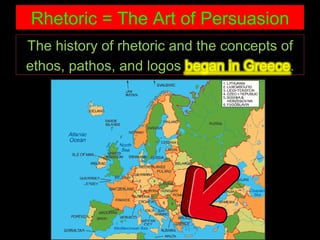
Rhetoric = The Art of Persuasion
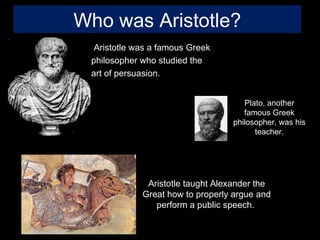
Who was Aristotle?
  Aristotle was a famous Greek
 philosopher who studied the
 art of persuasion.


                                     Plato, another
                                     famous Greek
                                  philosopher, was his
                                        teacher.


              Aristotle taught Alexander the
             Great how to properly argue and
                perform a public speech.
Ethos, Pathos, and Logos
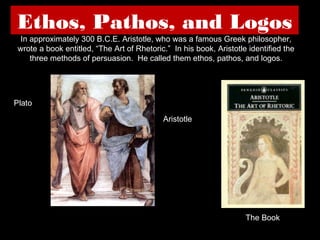
  In approximately 300 B.C.E. Aristotle, who was a famous Greek philosopher,
 wrote a book entitled, “The Art of Rhetoric.” In his book, Aristotle identified the
     three methods of persuasion. He called them ethos, pathos, and logos.


Plato

                                            Aristotle


                                                                     The Book
Ethos, Pathos, & Logos
   There are several ways to appeal to an audience.
Among them are appealing to ethos, pathos, and logos.
 These appeals are prevalent in almost all arguments.
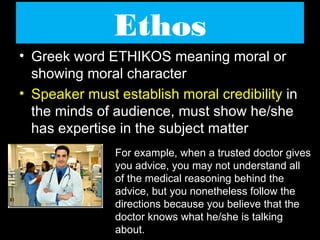
Ethos
• Greek word ETHIKOS meaning moral or
  showing moral character
• Speaker must establish moral credibility in
  the minds of audience, must show he/she
  has expertise in the subject matter
               For example, when a trusted doctor gives
               you advice, you may not understand all
               of the medical reasoning behind the
               advice, but you nonetheless follow the
               directions because you believe that the
               doctor knows what he/she is talking
               about.
Ethos - cont’d
• Ethos = Ethics: refers to the trustworthiness of the speaker/
  writer.
• Ethos is an effective persuasive strategy because when we
  believe that the speaker does not intend to do us harm, we
  are more willing to listen to what s/he has to say.
• We base our opinion on the reputation of the speaker.


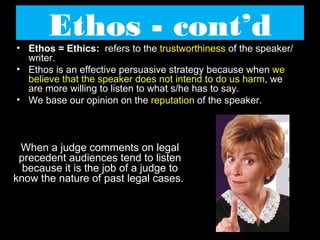
 When a judge comments on legal
 precedent audiences tend to listen
  because it is the job of a judge to
know the nature of past legal cases.
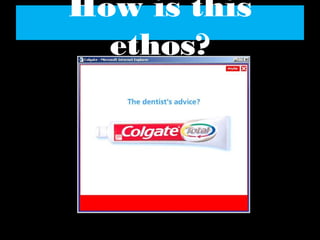
How is this
  ethos?
How is this
  ethos?
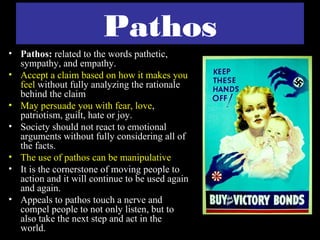
Pathos
• Pathos: related to the words pathetic,
  sympathy, and empathy.
• Accept a claim based on how it makes you
  feel without fully analyzing the rationale
  behind the claim
• May persuade you with fear, love,
  patriotism, guilt, hate or joy.
• Society should not react to emotional
  arguments without fully considering all of
  the facts.
• The use of pathos can be manipulative
• It is the cornerstone of moving people to
  action and it will continue to be used again
  and again.
• Appeals to pathos touch a nerve and
  compel people to not only listen, but to
  also take the next step and act in the
  world.
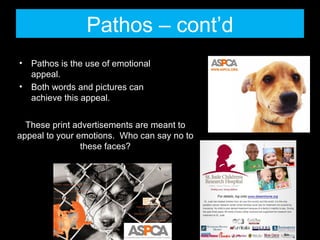
Pathos – cont’d
•   Pathos is the use of emotional
    appeal.
•   Both words and pictures can
    achieve this appeal.


  These print advertisements are meant to
appeal to your emotions. Who can say no to
                these faces?
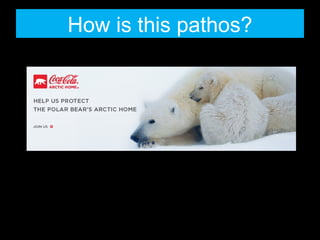
How is this pathos?
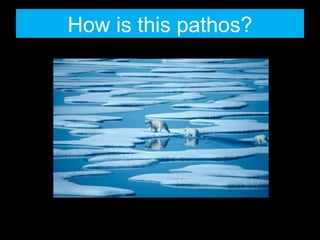
How is this pathos?
Logos
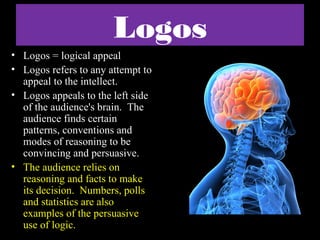
• Logos = logical appeal
• Logos refers to any attempt to
  appeal to the intellect.
• Logos appeals to the left side
  of the audience's brain. The
  audience finds certain
  patterns, conventions and
  modes of reasoning to be
  convincing and persuasive.
• The audience relies on
  reasoning and facts to make
  its decision. Numbers, polls
  and statistics are also
  examples of the persuasive
  use of logic.
Logos
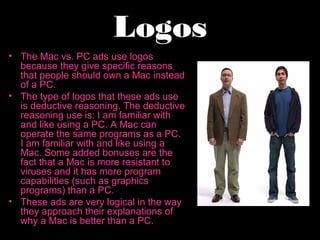
• The Mac vs. PC ads use logos
  because they give specific reasons
  that people should own a Mac instead
  of a PC.
• The type of logos that these ads use
  is deductive reasoning. The deductive
  reasoning use is: I am familiar with
  and like using a PC. A Mac can
  operate the same programs as a PC.
  I am familiar with and like using a
  Mac. Some added bonuses are the
  fact that a Mac is more resistant to
  viruses and it has more program
  capabilities (such as graphics
  programs) than a PC.
• These ads are very logical in the way
  they approach their explanations of
  why a Mac is better than a PC.
How is this
  logos?
How is this
  logos?
REVIEW
       Ethos, Pathos, & Logos
1.   Ethos = an ethical or moral argument

2.   Pathos = an emotional argument

3.   Logos = a logical argument
Now you identify which rhetorical device…
     Ethos, Pathos, & Logos
Now you identify which rhetorical device…
  Ethos, Pathos, & Logos
Now you identify which rhetorical device…
     Ethos, Pathos, & Logos
Now you identify which rhetorical device…
        Ethos, Pathos, & Logos
Old Major’s speech
       Ethos, Pathos, & Logos
Revisit Old Major’s speech and answer the
  following
2.Identify the rhetorical appeals
3.Quote each passage that can be identified
  as ethos, pathos, or logos
4.Explain how each is ethos, pathos or
  logos.

Ethos pathos logos

  • 1.
    Journal 3/16/12 Think ofyour favorite commercial. What do you like about it? What makes it your favorite? Who is in it? What is said or shown? Does it make you want to buy that product?
  • 2.
    Rhetoric = TheArt of Persuasion
  • 4.
    Who was Aristotle? Aristotle was a famous Greek philosopher who studied the art of persuasion. Plato, another famous Greek philosopher, was his teacher. Aristotle taught Alexander the Great how to properly argue and perform a public speech.
  • 5.
    Ethos, Pathos, andLogos In approximately 300 B.C.E. Aristotle, who was a famous Greek philosopher, wrote a book entitled, “The Art of Rhetoric.” In his book, Aristotle identified the three methods of persuasion. He called them ethos, pathos, and logos. Plato Aristotle The Book
  • 6.
    Ethos, Pathos, &Logos There are several ways to appeal to an audience. Among them are appealing to ethos, pathos, and logos. These appeals are prevalent in almost all arguments.
  • 7.
    Ethos • Greek wordETHIKOS meaning moral or showing moral character • Speaker must establish moral credibility in the minds of audience, must show he/she has expertise in the subject matter For example, when a trusted doctor gives you advice, you may not understand all of the medical reasoning behind the advice, but you nonetheless follow the directions because you believe that the doctor knows what he/she is talking about.
  • 8.
    Ethos - cont’d •Ethos = Ethics: refers to the trustworthiness of the speaker/ writer. • Ethos is an effective persuasive strategy because when we believe that the speaker does not intend to do us harm, we are more willing to listen to what s/he has to say. • We base our opinion on the reputation of the speaker. When a judge comments on legal precedent audiences tend to listen because it is the job of a judge to know the nature of past legal cases.
  • 9.
  • 10.
  • 11.
    Pathos • Pathos: relatedto the words pathetic, sympathy, and empathy. • Accept a claim based on how it makes you feel without fully analyzing the rationale behind the claim • May persuade you with fear, love, patriotism, guilt, hate or joy. • Society should not react to emotional arguments without fully considering all of the facts. • The use of pathos can be manipulative • It is the cornerstone of moving people to action and it will continue to be used again and again. • Appeals to pathos touch a nerve and compel people to not only listen, but to also take the next step and act in the world.
  • 12.
    Pathos – cont’d • Pathos is the use of emotional appeal. • Both words and pictures can achieve this appeal. These print advertisements are meant to appeal to your emotions. Who can say no to these faces?
  • 13.
    How is thispathos?
  • 14.
    How is thispathos?
  • 15.
    Logos • Logos =logical appeal • Logos refers to any attempt to appeal to the intellect. • Logos appeals to the left side of the audience's brain. The audience finds certain patterns, conventions and modes of reasoning to be convincing and persuasive. • The audience relies on reasoning and facts to make its decision. Numbers, polls and statistics are also examples of the persuasive use of logic.
  • 16.
    Logos • The Macvs. PC ads use logos because they give specific reasons that people should own a Mac instead of a PC. • The type of logos that these ads use is deductive reasoning. The deductive reasoning use is: I am familiar with and like using a PC. A Mac can operate the same programs as a PC. I am familiar with and like using a Mac. Some added bonuses are the fact that a Mac is more resistant to viruses and it has more program capabilities (such as graphics programs) than a PC. • These ads are very logical in the way they approach their explanations of why a Mac is better than a PC.
  • 17.
  • 18.
  • 19.
    REVIEW Ethos, Pathos, & Logos 1. Ethos = an ethical or moral argument 2. Pathos = an emotional argument 3. Logos = a logical argument
  • 20.
    Now you identifywhich rhetorical device… Ethos, Pathos, & Logos
  • 21.
    Now you identifywhich rhetorical device… Ethos, Pathos, & Logos
  • 22.
    Now you identifywhich rhetorical device… Ethos, Pathos, & Logos
  • 23.
    Now you identifywhich rhetorical device… Ethos, Pathos, & Logos
  • 24.
    Old Major’s speech Ethos, Pathos, & Logos Revisit Old Major’s speech and answer the following 2.Identify the rhetorical appeals 3.Quote each passage that can be identified as ethos, pathos, or logos 4.Explain how each is ethos, pathos or logos.

Editor's Notes

  • #8 The word "ethos" came from the Greek word ethikos meaning moral or showing moral character.  Aristotle contends that a speaker must establish moral credibility in the minds of the audience at the beginning of his or her speech.   In order to do so, the speaker must show that he or she has expertise in the subject matter of the speech and that he or she is disconnected from topic (i.e., the speaker does not and will not have a direct interest or an ulterior motive for convincing their audience).
  • #9 Ethos:  Ethos is related to the English word ethics and refers to the trustworthiness of the speaker/writer.  Ethos is an effective persuasive strategy because when we believe that the speaker does not intend to do us harm, we are more willing to listen to what s/he has to say.    Likewise,
  • #10 Ethos:  Ethos is related to the English word ethics and refers to the trustworthiness of the speaker/writer.  Ethos is an effective persuasive strategy because when we believe that the speaker does not intend to do us harm, we are more willing to listen to what s/he has to say.    Likewise,
  • #11 Ethos:  Ethos is related to the English word ethics and refers to the trustworthiness of the speaker/writer.  Ethos is an effective persuasive strategy because when we believe that the speaker does not intend to do us harm, we are more willing to listen to what s/he has to say.    Likewise,