Ethos, Logos, Pathos:
Three Ways to
Persuade
by Dr. John R. Edlund,
Cal Poly Pomona
Over 2,000 years ago the
Greek philosopher Aristotle
argued that there were three
basic ways to persuade an
audience of your position:
ethos, logos, and pathos.
1.
Ethos: The Writer’s
Character or Image
Ethos:
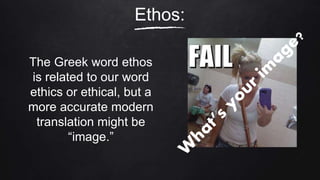
The Greek word ethos
is related to our word
ethics or ethical, but a
more accurate modern
translation might be
“image.”
• Aristotle uses ethos to refer to the speaker’s
character as it appears to the audience.
• Aristotle says that if we believe that a speaker
has good sense, good moral character, and
goodwill, we are inclined to believe what that
speaker says..
Ethos:
✘Today we might add that a
speaker should also appear to
have the appropriate expertise or
authority to speak
knowledgeably about the subject
matter. Ethos is often the first
thing we notice, so it creates the
first impression that influences
how we perceive the rest.
Ethos:
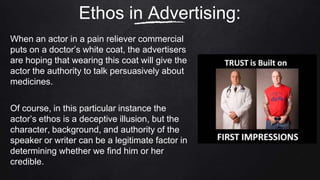
When an actor in a pain reliever commercial
puts on a doctor’s white coat, the advertisers
are hoping that wearing this coat will give the
actor the authority to talk persuasively about
medicines.
Of course, in this particular instance the
actor’s ethos is a deceptive illusion, but the
character, background, and authority of the
speaker or writer can be a legitimate factor in
determining whether we find him or her
credible.
Ethos in Advertising:
A writer’s ethos is created largely by word choice and style.
 Student writers often have a problem with ethos because they
are asked to write research papers, reports, and other types of
texts as if they have authority to speak persuasively, when in
fact they are newcomers to the subject.
 Sometimes students try to create an academic image for
themselves by using a thesaurus to find difficult and unusual
words to sprinkle throughout their texts. Unfortunately, this sort
of effort usually fails, because it is difficult to use a word
correctly that you have not heard or read in context many times.
Ethos in Writing:
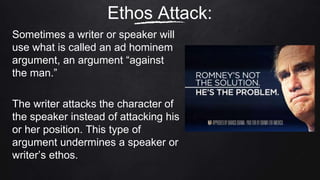
Sometimes a writer or speaker will
use what is called an ad hominem
argument, an argument “against
the man.”
The writer attacks the character of
the speaker instead of attacking his
or her position. This type of
argument undermines a speaker or
writer’s ethos.
Ethos Attack:
When you are writing a paper,
consider the following questions.
What kind of image
do you want to
project to your
audience?
What can you
do to help
project this
image?
What words or ideas
do you want to avoid
in order not to harm
your image?
What effect do
misspelled words and
grammatical errors
have on your image?
2.
Logos: Logical
Arguments
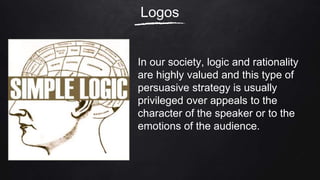
Logos
In our society, logic and rationality
are highly valued and this type of
persuasive strategy is usually
privileged over appeals to the
character of the speaker or to the
emotions of the audience.
Logos- Syllogisms
For Aristotle, formal arguments are based on what
he calls syllogisms.
This is reasoning that takes the form:
All men are mortal.
Socrates is a man.
Therefore, Socrates is mortal.
“All pigs exist. I exist. Therefore, I
am a... pig.
That's not right. I've got it!
All people exist. All pigs
exist.
Therefore all people are pigs.
No, that's not it either
Logos
However, Aristotle notes that in ordinary speaking and
writing we often use what he calls a rhetorical syllogism or
an enthymeme. This is an argument in which some of the
premises or assertions remain unstated or are simply
assumed.
 For example, no one in ordinary life would think that
Socrates could be immortal.
Not all assumptions are as obvious as this one, however.
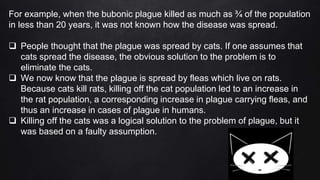
For example, when the bubonic plague killed as much as ¾ of the population
in less than 20 years, it was not known how the disease was spread.
 People thought that the plague was spread by cats. If one assumes that
cats spread the disease, the obvious solution to the problem is to
eliminate the cats.
 We now know that the plague is spread by fleas which live on rats.
Because cats kill rats, killing off the cat population led to an increase in
the rat population, a corresponding increase in plague carrying fleas, and
thus an increase in cases of plague in humans.
 Killing off the cats was a logical solution to the problem of plague, but it
was based on a faulty assumption.
Persuasion, to a large extent, involves convincing
people to accept our assumptions as probably true
and to take appropriate action.
*Similarly, exposing questionable assumptions in someone else’s
argument is an effective means for preparing the audience to accept
your own contrary position.
Questions for Discussion:
Imagine some
arguments that
start from faulty
assumptions, such
as “If pigs could
fly,” or “If money
grew on trees.”
What would be
some of the logical
consequences?
Do you think that
logical arguments are
a better support for a
position than
arguments that are
based on authority or
character? In other
words, would you
support a policy just
because a celebrity or
an important expert
supported it?
Can you think of a
time when you
successfully used
a logical argument
to persuade
someone of
something? What
was it?
3
Pathos: The
Emotions of the
Audience
Pathos:
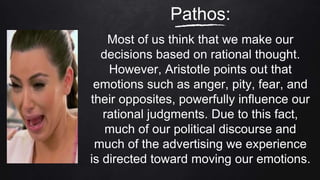
Most of us think that we make our
decisions based on rational thought.
However, Aristotle points out that
emotions such as anger, pity, fear, and
their opposites, powerfully influence our
rational judgments. Due to this fact,
much of our political discourse and
much of the advertising we experience
is directed toward moving our emotions.
Pathos:
Anger is a very powerful motivating force.
Aristotle says that if we want to make an audience
angry we need to know three things:
1. the state of mind of angry people
2. who the people are that this audience usually gets
angry at
3. on what grounds this audience gets angry at those
people.
Pathos in Politics
While the actual causes of a war may be economic or political, and thus
related to logos, the mobilization of a people or a nation to war inevitably
consists of appeals to pathos.
Leaders mobilize their followers to go to war by reminding them of their
historical grievances against other groups or nations, blaming other groups
for economic difficulties, and focusing on perceived insults, crimes, and
atrocities committed against their own citizens by others.
In the twentieth century, such appeals to pathos inspired the Holocaust in
Germany, genocide in Rwanda, and ethnic cleansing in the former
Yugoslavia. Individuals were inspired through pathos to attack, rape, or kill
neighbors who had lived near them all their lives, simply because of their
ethnicity or religion.
Pathos in Advertisements
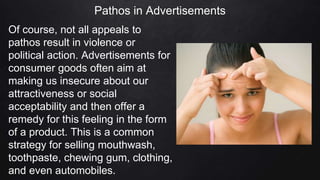
Of course, not all appeals to
pathos result in violence or
political action. Advertisements for
consumer goods often aim at
making us insecure about our
attractiveness or social
acceptability and then offer a
remedy for this feeling in the form
of a product. This is a common
strategy for selling mouthwash,
toothpaste, chewing gum, clothing,
and even automobiles.
Pathos
Appeals to the emotions and passions are often very effective
and are very common in our society. Such appeals are not
always false or illegitimate.
It is natural to feel strong emotions about tragedies, victories,
and other powerful events as well as about one’s own image
and identity.
You may find it effective to use pathos in your own writing.
Questions for Discussion:
Can you think of an
advertisement for a
product or a political
campaign that uses
your emotions to
persuade you to
believe something?
Describe it, and
analyze how it works.
When do you think it is
unfair or deceptive to
try to use emotions to
persuade people?
Have you ever made
a decision based on
your feelings that you
regretted later?
Did
emotions
ever serve
you well in
making a
decision?

PAP100115

  • 1.
    Ethos, Logos, Pathos: ThreeWays to Persuade by Dr. John R. Edlund, Cal Poly Pomona
  • 2.
    Over 2,000 yearsago the Greek philosopher Aristotle argued that there were three basic ways to persuade an audience of your position: ethos, logos, and pathos.
  • 3.
  • 4.
    Ethos: The Greek wordethos is related to our word ethics or ethical, but a more accurate modern translation might be “image.”
  • 5.
    • Aristotle usesethos to refer to the speaker’s character as it appears to the audience. • Aristotle says that if we believe that a speaker has good sense, good moral character, and goodwill, we are inclined to believe what that speaker says.. Ethos:
  • 6.
    ✘Today we mightadd that a speaker should also appear to have the appropriate expertise or authority to speak knowledgeably about the subject matter. Ethos is often the first thing we notice, so it creates the first impression that influences how we perceive the rest. Ethos:
  • 7.
    When an actorin a pain reliever commercial puts on a doctor’s white coat, the advertisers are hoping that wearing this coat will give the actor the authority to talk persuasively about medicines. Of course, in this particular instance the actor’s ethos is a deceptive illusion, but the character, background, and authority of the speaker or writer can be a legitimate factor in determining whether we find him or her credible. Ethos in Advertising:
  • 8.
    A writer’s ethosis created largely by word choice and style.  Student writers often have a problem with ethos because they are asked to write research papers, reports, and other types of texts as if they have authority to speak persuasively, when in fact they are newcomers to the subject.  Sometimes students try to create an academic image for themselves by using a thesaurus to find difficult and unusual words to sprinkle throughout their texts. Unfortunately, this sort of effort usually fails, because it is difficult to use a word correctly that you have not heard or read in context many times. Ethos in Writing:
  • 9.
    Sometimes a writeror speaker will use what is called an ad hominem argument, an argument “against the man.” The writer attacks the character of the speaker instead of attacking his or her position. This type of argument undermines a speaker or writer’s ethos. Ethos Attack:
  • 10.
    When you arewriting a paper, consider the following questions. What kind of image do you want to project to your audience? What can you do to help project this image? What words or ideas do you want to avoid in order not to harm your image? What effect do misspelled words and grammatical errors have on your image?
  • 11.
  • 12.
    Logos In our society,logic and rationality are highly valued and this type of persuasive strategy is usually privileged over appeals to the character of the speaker or to the emotions of the audience.
  • 13.
    Logos- Syllogisms For Aristotle,formal arguments are based on what he calls syllogisms. This is reasoning that takes the form: All men are mortal. Socrates is a man. Therefore, Socrates is mortal.
  • 14.
    “All pigs exist.I exist. Therefore, I am a... pig. That's not right. I've got it! All people exist. All pigs exist. Therefore all people are pigs. No, that's not it either
  • 15.
    Logos However, Aristotle notesthat in ordinary speaking and writing we often use what he calls a rhetorical syllogism or an enthymeme. This is an argument in which some of the premises or assertions remain unstated or are simply assumed.  For example, no one in ordinary life would think that Socrates could be immortal. Not all assumptions are as obvious as this one, however.
  • 16.
    For example, whenthe bubonic plague killed as much as ¾ of the population in less than 20 years, it was not known how the disease was spread.  People thought that the plague was spread by cats. If one assumes that cats spread the disease, the obvious solution to the problem is to eliminate the cats.  We now know that the plague is spread by fleas which live on rats. Because cats kill rats, killing off the cat population led to an increase in the rat population, a corresponding increase in plague carrying fleas, and thus an increase in cases of plague in humans.  Killing off the cats was a logical solution to the problem of plague, but it was based on a faulty assumption.
  • 17.
    Persuasion, to alarge extent, involves convincing people to accept our assumptions as probably true and to take appropriate action. *Similarly, exposing questionable assumptions in someone else’s argument is an effective means for preparing the audience to accept your own contrary position.
  • 18.
    Questions for Discussion: Imaginesome arguments that start from faulty assumptions, such as “If pigs could fly,” or “If money grew on trees.” What would be some of the logical consequences? Do you think that logical arguments are a better support for a position than arguments that are based on authority or character? In other words, would you support a policy just because a celebrity or an important expert supported it? Can you think of a time when you successfully used a logical argument to persuade someone of something? What was it?
  • 19.
  • 20.
    Pathos: Most of usthink that we make our decisions based on rational thought. However, Aristotle points out that emotions such as anger, pity, fear, and their opposites, powerfully influence our rational judgments. Due to this fact, much of our political discourse and much of the advertising we experience is directed toward moving our emotions.
  • 21.
    Pathos: Anger is avery powerful motivating force. Aristotle says that if we want to make an audience angry we need to know three things: 1. the state of mind of angry people 2. who the people are that this audience usually gets angry at 3. on what grounds this audience gets angry at those people.
  • 23.
    Pathos in Politics Whilethe actual causes of a war may be economic or political, and thus related to logos, the mobilization of a people or a nation to war inevitably consists of appeals to pathos. Leaders mobilize their followers to go to war by reminding them of their historical grievances against other groups or nations, blaming other groups for economic difficulties, and focusing on perceived insults, crimes, and atrocities committed against their own citizens by others. In the twentieth century, such appeals to pathos inspired the Holocaust in Germany, genocide in Rwanda, and ethnic cleansing in the former Yugoslavia. Individuals were inspired through pathos to attack, rape, or kill neighbors who had lived near them all their lives, simply because of their ethnicity or religion.
  • 24.
    Pathos in Advertisements Ofcourse, not all appeals to pathos result in violence or political action. Advertisements for consumer goods often aim at making us insecure about our attractiveness or social acceptability and then offer a remedy for this feeling in the form of a product. This is a common strategy for selling mouthwash, toothpaste, chewing gum, clothing, and even automobiles.
  • 25.
    Pathos Appeals to theemotions and passions are often very effective and are very common in our society. Such appeals are not always false or illegitimate. It is natural to feel strong emotions about tragedies, victories, and other powerful events as well as about one’s own image and identity. You may find it effective to use pathos in your own writing.
  • 26.
    Questions for Discussion: Canyou think of an advertisement for a product or a political campaign that uses your emotions to persuade you to believe something? Describe it, and analyze how it works. When do you think it is unfair or deceptive to try to use emotions to persuade people? Have you ever made a decision based on your feelings that you regretted later? Did emotions ever serve you well in making a decision?