INDUCTION, DEPLOYMENT,
RETAINING, PROMOTION,
SUPERANNUATION
DR.YANG TAYENG
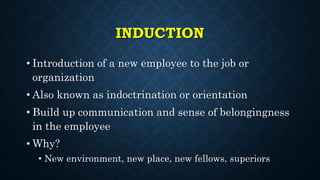
INDUCTION
• Introduction of a new employee to the job or
organization
• Also known as indoctrination or orientation
• Build up communication and sense of belongingness
in the employee
• Why?
• New environment, new place, new fellows, superiors
INDUCTION PROGRAMME
• Covers the following areas;
General introduction of persons
Specific introduction
Personal introduction
Office introduction
•DEPLOYMENT
• Deployment means arrange, manage or give position to their
employees
•RETAINING
• Retaining means ‘possession’ of the employees by the employer.
• To achieve the laid down objectives of the institution
• Organization has their own policies so that skilled managers and
competent workers be retained
• To retain staffs:
a) Promotion of employees
b) Good living and working condition
c) Employees welfare services
d) Motivation/ incentives
e) Fair and equitable wages
f) Effective supervision
g) Fair system of performance appraisal
h) Loan facilities
i) Effective redressal system for employees grievances
PROMOTION
• The word “promote” is derived from Latin word “promovere”
meaning to move forward.
• The dictionary meaning of promote is to exalt in situation, rank or
honour, to elevate, to advance
• “Promotion is the advancement of an employee to better job, better
in terms of greater responsibilities, more prestige, or status,
greater skill and specially increase rate of pay or salary”. Prof
Pigor and Myres
• “Promotion involves a change from one job to another that is better
in terms of status and responsibilities”. Flippo
PRINCIPLES OF PROMOTION
1. Principles of seniority
2. Principles of merit
Methods of testing merit: promotional exam,
efficiency ratings or service records
SUPERANNUATION
• Pension given to employees after retirement
• Pension: a steady income given to a person
usually after retirement.
• Superannuation is 15% of basic and gratuity is
4.81% of the basic
PERSONNEL MANAGEMENT
• Personnel management is not a one man responsibility nor can it be
achieved by one individual.
• Personnel management is getting better results with the
collaboration of people
• Personnel Management involves strategies that ensure right number
of staff, a right combination of talent, training, and performance in
jobs.
DEFINITION
• According to Flippo, “Personnel management is the planning,
organizing, compensation, integration, and maintenance of people to
contribute to organizational, individual and societal goals.”
• According to Brech, “Personnel Management is that part which is
primarily concerned with human resource of an organization.”
• According to Indian Institute of Personnel Management, “Personnel
management aims to achieve both efficiency and justice, neither of
which can be pursued successfully without the other.
Elements of Personnel Management
1. Organization-
An organization can be called as a physical framework of various interrelated
activities. Right from manpower planning to employees’ maintenance, all activities
take place within this framework. The nature of the organization is dependent upon
it’s goal. Clubs, hospitals, schools, etc. their goal being service. In personnel
management, a manager has therefore to understand the importance of
organizational structure.
2. Job-
The second element, i.e., jobs tell us the activities to
organization. It is said that the goals of an enterprise
only through the functional department in it.
organization today, the nature of activities are
3. People-
The last and foremost element in personnel
organizational structure, where the main aim is to
presence of manpower becomes vital. Therefore, in
departmental goals, different kinds of people with
appointed
OBJECTIVES OF PERSONNEL MANAGEMENT
ARE:-
1. Society-Specific Objectives
2. Personnel-Specific Objectives
3. Organization-Specific Objectives
4. Labour Union-Specific Objectives
5. Routine Objectives
6. Problem Solving Objectives
7. Innovation Objectives.
1. SOCIETY-SPECIFIC:
(i) Creation of Employment Opportunities
(ii) Improving Productivity through Efficient Use of
Resources
(iii) Assuring Maximum Material and Mental
Satisfaction to Workers
(iv)Healthy Human Relations and Social Welfare
2. PERSONNEL-SPECIFIC:
(i) Fitting Workers in Network of Inter-Personal Relationships
(ii) Ways in which Personnel Management Satisfies Multiple
Needs of Workers
(a) Adequate Remuneration
(b)Job Security
(c) Facilities for Proper Training and Development
(d) Increased Job Satisfaction
3. ORGANIZATION-SPECIFIC:
(i) Blending Social and Workers-Centric Objectives with Organization-
Specific Objectives:
• Pursuit of social and individual objectives should be blended with overall enterprise
objectives as the two are inter-linked.
(ii) Creating Competent and Dedicated Team of Workers:
• filled by highly competent and contented workers.
• It also seeks to create a sense of belonging among the workers so that when the occasion
demands, they readily and willingly sacrifice their individual interests for the sake of
group interests.
4. LABOUR UNION-SPECIFIC:
(i) Tactful Handling of Issues Raised by Workers’ Unions:
• Ever since the inception of business organization, personnel management is required to
deal with workers.
• concerned with recognition of representative unions and formulation of personnel
policies in consultation with them.
• As unions are dominated by political parties of all kinds, it requires careful handling of
issues raised by them so that they do not resort to strike work to hurt business interests
of the organization.
(i) Promoting Organization-Friendly Attitude among Workers:
5. ROUTINE OBJECTIVES:
• These make provision for the satisfaction of employee
needs and ensure stability in the running of the
enterprise/ organization.
6. PROBLEM SOLVING OBJECTIVES:
•This relates to problems such as labour turnover
and restoring the organisational balance.
7. INNOVATION OBJECTIVES:
• This takes advantage of employee dissatisfaction with
the status quo, in order to move toward a work
structure which will allow for the creation of posts that
will satisfy all employee needs.
FUNCTIONS OF PERSONNEL MANAGEMENT
1. Man power planning
2. Recruitment
3. Selection
4. Training and development
1. Manpower planning
• Manpower Planning which is also called as Human Resource Planning consists
of putting right number of people, right kind of people at the right place, right
time, doing the right things for which they are suited for the achievement of
goals of the organization.
• Human Resource Planning has to be a systems approach and is carried out in
a set procedure.
2. RECRUITMENT
• Internal Recruitment - is a recruitment which takes place within the concern or
organization. Internal sources of recruitment are readily available to an
organization. Internal sources are primarily three - Transfers, promotions and Re-
employment of ex-employees.
• External Recruitment - External sources of recruitment have to be solicited from
outside the organization. External sources are external to a concern. But it involves
lot of time and money. The external sources of recruitment include - Employment
at factory gate, advertisements, employment exchanges, employment agencies,
educational institutes, labour contractors, recommendations etc.
3. SELECTION
• Employee Selection is the process of putting right men on right job. It is a procedure of matching
organizational requirements with the skills and qualifications of people. Moreover, organization will face less
of absenteeism and employee turnover problems.
• By selecting right candidate for the required job, organization will also save time and money and quality
performance.
• Proper screening of candidates takes place during selection procedure. All the potential candidates who
apply for the given job are tested.
4. TRAINING AND DEVELOPMENT
• Training of employees takes place after orientation takes place. Training is the
process of enhancing the skills, capabilities and knowledge of employees for doing
a particular job.
• Training process moulds the thinking of employees and leads to quality
performance of employees. It is continuous and never ending in nature.
PERSONNEL MANAGER
• Personnel manager is the head of personnel department. He
performs both managerial and operative functions of
management.
• Being a manager, he is primarily responsible for the overall
management of the department and performs basic managerial
functions like planning, organizing, directing, and controlling.
ROLE OF A PERSONNEL MANAGER
1. Counsellor
2. Initiating Policies
3. The Advisory Role
4. The Link between the
Employees and the
Management
5. Representative Role
6. Decision-making Role
7. Mediator Role
8. Leadership Role
9. Welfare Role
10. Research Role
1. Counsellor :
• Counselling is one of the main functions of personnel manager.
• As a counsellor, personnel manager discusses the problems with
employees related to career, health, family, finance, social life and
try to solve their problems and offer advice on how to overcome
them.
2. Initiating Policies:
• Initiating policies is another main function of personnel
manager. Initiating policies and formulating them are two
important tasks of a personnel manager.
• He assists the senior management in creating policies
pertaining to personnel management, salary administration,
welfare activities, transfers, working environment, records,
and appraisals.
3. The Advisory Role:
• In any organization, on a daily basis, line managers
face a wide range of problems pertaining to
personnel management.
• This is where a personnel manager steps in and
offers advice on such matters since he is familiar
with the laws and practices that surround human
resources.
4. The Link between the Employees and the
Management
• Apart from personnel management, the personnel manager
tries to maintain good industrial relation within the
organization.
• Understanding the different policies of the organization.
• He also communicates the views and concerns of the
employees to the senior management.
5. Representative Role
• The personnel manager is also responsible to represent
the organization and communicate management policies
which affect the people in the organization.
• This role is best-suited to him because he has a better
overall picture of the organizational operation
operations.
6. Decision-making Role:
• He plays an important part in decision-making on
human resources-related issues.
• He also formulates and designs policies and
programs of personnel management.
7. Mediator role
• In case of a conflict between employees or groups of
employees, a superior and a subordinate, or even the
management and employees, the personnel manager
plays the role of a mediator.
• His role is to ensure peace and harmony in the
organization.
8. Leadership role
• He offers leadership and guidance to employees.
• He/she ensures effective communication in the organization
and motivates employees to work towards achieving the
organization’s objectives.
9. Welfare role
• In most organizations, the personnel manager also acts as the
welfare officer.
• He/she ensures facilities and services like canteen, transport,
hospitalization, and other employee welfare services are
available to the workers.
10. Research role
• He maintains a record of all employees in the
organization.
• He also researches various personnel areas like
absenteeism, alcoholism, labor turnover, etc.
• Further, post-analysis, he recommends apt measures to
help eradicate them to the senior management.
CONCLUSION
• Personnel management includes the administrative
tasks required to oversee an organization's employees,
such as recruiting, hiring, and administering benefits.
• Personnel management is necessary whenever there
are employees to oversee.

Induction, deployment, retaining, promotion,.pptx

  • 1.
  • 2.
    INDUCTION • Introduction ofa new employee to the job or organization • Also known as indoctrination or orientation • Build up communication and sense of belongingness in the employee • Why? • New environment, new place, new fellows, superiors
  • 3.
    INDUCTION PROGRAMME • Coversthe following areas; General introduction of persons Specific introduction Personal introduction Office introduction
  • 4.
    •DEPLOYMENT • Deployment meansarrange, manage or give position to their employees •RETAINING • Retaining means ‘possession’ of the employees by the employer. • To achieve the laid down objectives of the institution • Organization has their own policies so that skilled managers and competent workers be retained
  • 5.
    • To retainstaffs: a) Promotion of employees b) Good living and working condition c) Employees welfare services d) Motivation/ incentives e) Fair and equitable wages f) Effective supervision g) Fair system of performance appraisal h) Loan facilities i) Effective redressal system for employees grievances
  • 6.
    PROMOTION • The word“promote” is derived from Latin word “promovere” meaning to move forward. • The dictionary meaning of promote is to exalt in situation, rank or honour, to elevate, to advance • “Promotion is the advancement of an employee to better job, better in terms of greater responsibilities, more prestige, or status, greater skill and specially increase rate of pay or salary”. Prof Pigor and Myres • “Promotion involves a change from one job to another that is better in terms of status and responsibilities”. Flippo
  • 7.
    PRINCIPLES OF PROMOTION 1.Principles of seniority 2. Principles of merit Methods of testing merit: promotional exam, efficiency ratings or service records
  • 8.
    SUPERANNUATION • Pension givento employees after retirement • Pension: a steady income given to a person usually after retirement. • Superannuation is 15% of basic and gratuity is 4.81% of the basic
  • 9.
  • 10.
    PERSONNEL MANAGEMENT • Personnelmanagement is not a one man responsibility nor can it be achieved by one individual. • Personnel management is getting better results with the collaboration of people • Personnel Management involves strategies that ensure right number of staff, a right combination of talent, training, and performance in jobs.
  • 11.
    DEFINITION • According toFlippo, “Personnel management is the planning, organizing, compensation, integration, and maintenance of people to contribute to organizational, individual and societal goals.” • According to Brech, “Personnel Management is that part which is primarily concerned with human resource of an organization.” • According to Indian Institute of Personnel Management, “Personnel management aims to achieve both efficiency and justice, neither of which can be pursued successfully without the other.
  • 12.
    Elements of PersonnelManagement 1. Organization- An organization can be called as a physical framework of various interrelated activities. Right from manpower planning to employees’ maintenance, all activities take place within this framework. The nature of the organization is dependent upon it’s goal. Clubs, hospitals, schools, etc. their goal being service. In personnel management, a manager has therefore to understand the importance of organizational structure.
  • 13.
    2. Job- The secondelement, i.e., jobs tell us the activities to organization. It is said that the goals of an enterprise only through the functional department in it. organization today, the nature of activities are
  • 14.
    3. People- The lastand foremost element in personnel organizational structure, where the main aim is to presence of manpower becomes vital. Therefore, in departmental goals, different kinds of people with appointed
  • 15.
    OBJECTIVES OF PERSONNELMANAGEMENT ARE:- 1. Society-Specific Objectives 2. Personnel-Specific Objectives 3. Organization-Specific Objectives 4. Labour Union-Specific Objectives 5. Routine Objectives 6. Problem Solving Objectives 7. Innovation Objectives.
  • 16.
    1. SOCIETY-SPECIFIC: (i) Creationof Employment Opportunities (ii) Improving Productivity through Efficient Use of Resources (iii) Assuring Maximum Material and Mental Satisfaction to Workers (iv)Healthy Human Relations and Social Welfare
  • 17.
    2. PERSONNEL-SPECIFIC: (i) FittingWorkers in Network of Inter-Personal Relationships (ii) Ways in which Personnel Management Satisfies Multiple Needs of Workers (a) Adequate Remuneration (b)Job Security (c) Facilities for Proper Training and Development (d) Increased Job Satisfaction
  • 18.
    3. ORGANIZATION-SPECIFIC: (i) BlendingSocial and Workers-Centric Objectives with Organization- Specific Objectives: • Pursuit of social and individual objectives should be blended with overall enterprise objectives as the two are inter-linked. (ii) Creating Competent and Dedicated Team of Workers: • filled by highly competent and contented workers. • It also seeks to create a sense of belonging among the workers so that when the occasion demands, they readily and willingly sacrifice their individual interests for the sake of group interests.
  • 19.
    4. LABOUR UNION-SPECIFIC: (i)Tactful Handling of Issues Raised by Workers’ Unions: • Ever since the inception of business organization, personnel management is required to deal with workers. • concerned with recognition of representative unions and formulation of personnel policies in consultation with them. • As unions are dominated by political parties of all kinds, it requires careful handling of issues raised by them so that they do not resort to strike work to hurt business interests of the organization. (i) Promoting Organization-Friendly Attitude among Workers:
  • 20.
    5. ROUTINE OBJECTIVES: •These make provision for the satisfaction of employee needs and ensure stability in the running of the enterprise/ organization.
  • 21.
    6. PROBLEM SOLVINGOBJECTIVES: •This relates to problems such as labour turnover and restoring the organisational balance.
  • 22.
    7. INNOVATION OBJECTIVES: •This takes advantage of employee dissatisfaction with the status quo, in order to move toward a work structure which will allow for the creation of posts that will satisfy all employee needs.
  • 23.
    FUNCTIONS OF PERSONNELMANAGEMENT 1. Man power planning 2. Recruitment 3. Selection 4. Training and development
  • 24.
    1. Manpower planning •Manpower Planning which is also called as Human Resource Planning consists of putting right number of people, right kind of people at the right place, right time, doing the right things for which they are suited for the achievement of goals of the organization. • Human Resource Planning has to be a systems approach and is carried out in a set procedure.
  • 25.
    2. RECRUITMENT • InternalRecruitment - is a recruitment which takes place within the concern or organization. Internal sources of recruitment are readily available to an organization. Internal sources are primarily three - Transfers, promotions and Re- employment of ex-employees. • External Recruitment - External sources of recruitment have to be solicited from outside the organization. External sources are external to a concern. But it involves lot of time and money. The external sources of recruitment include - Employment at factory gate, advertisements, employment exchanges, employment agencies, educational institutes, labour contractors, recommendations etc.
  • 26.
    3. SELECTION • EmployeeSelection is the process of putting right men on right job. It is a procedure of matching organizational requirements with the skills and qualifications of people. Moreover, organization will face less of absenteeism and employee turnover problems. • By selecting right candidate for the required job, organization will also save time and money and quality performance. • Proper screening of candidates takes place during selection procedure. All the potential candidates who apply for the given job are tested.
  • 27.
    4. TRAINING ANDDEVELOPMENT • Training of employees takes place after orientation takes place. Training is the process of enhancing the skills, capabilities and knowledge of employees for doing a particular job. • Training process moulds the thinking of employees and leads to quality performance of employees. It is continuous and never ending in nature.
  • 28.
    PERSONNEL MANAGER • Personnelmanager is the head of personnel department. He performs both managerial and operative functions of management. • Being a manager, he is primarily responsible for the overall management of the department and performs basic managerial functions like planning, organizing, directing, and controlling.
  • 29.
    ROLE OF APERSONNEL MANAGER 1. Counsellor 2. Initiating Policies 3. The Advisory Role 4. The Link between the Employees and the Management 5. Representative Role 6. Decision-making Role 7. Mediator Role 8. Leadership Role 9. Welfare Role 10. Research Role
  • 30.
    1. Counsellor : •Counselling is one of the main functions of personnel manager. • As a counsellor, personnel manager discusses the problems with employees related to career, health, family, finance, social life and try to solve their problems and offer advice on how to overcome them.
  • 31.
    2. Initiating Policies: •Initiating policies is another main function of personnel manager. Initiating policies and formulating them are two important tasks of a personnel manager. • He assists the senior management in creating policies pertaining to personnel management, salary administration, welfare activities, transfers, working environment, records, and appraisals.
  • 32.
    3. The AdvisoryRole: • In any organization, on a daily basis, line managers face a wide range of problems pertaining to personnel management. • This is where a personnel manager steps in and offers advice on such matters since he is familiar with the laws and practices that surround human resources.
  • 33.
    4. The Linkbetween the Employees and the Management • Apart from personnel management, the personnel manager tries to maintain good industrial relation within the organization. • Understanding the different policies of the organization. • He also communicates the views and concerns of the employees to the senior management.
  • 34.
    5. Representative Role •The personnel manager is also responsible to represent the organization and communicate management policies which affect the people in the organization. • This role is best-suited to him because he has a better overall picture of the organizational operation operations.
  • 35.
    6. Decision-making Role: •He plays an important part in decision-making on human resources-related issues. • He also formulates and designs policies and programs of personnel management.
  • 36.
    7. Mediator role •In case of a conflict between employees or groups of employees, a superior and a subordinate, or even the management and employees, the personnel manager plays the role of a mediator. • His role is to ensure peace and harmony in the organization.
  • 37.
    8. Leadership role •He offers leadership and guidance to employees. • He/she ensures effective communication in the organization and motivates employees to work towards achieving the organization’s objectives.
  • 38.
    9. Welfare role •In most organizations, the personnel manager also acts as the welfare officer. • He/she ensures facilities and services like canteen, transport, hospitalization, and other employee welfare services are available to the workers.
  • 39.
    10. Research role •He maintains a record of all employees in the organization. • He also researches various personnel areas like absenteeism, alcoholism, labor turnover, etc. • Further, post-analysis, he recommends apt measures to help eradicate them to the senior management.
  • 40.
    CONCLUSION • Personnel managementincludes the administrative tasks required to oversee an organization's employees, such as recruiting, hiring, and administering benefits. • Personnel management is necessary whenever there are employees to oversee.