Personality and Values
Course: MBA
Subject: Organization Behavior
Unit: 2
Chapter Learning Objectives
• After studying this chapter, you should be able to:
– Define personality, describe how it is measured, and explain the factors
that determine an individual’s personality.
– Describe the Myers-Briggs Type Indicator personality framework and
assess its strengths and weaknesses.
– Identify the key traits in the Big Five personality model.
– Demonstrate how the Big Five traits predict behavior at work.
– Identify other personality traits relevant to OB.
– Define values, demonstrate their importance, and contrast terminal and
instrumental values.
– Compare generational differences in values, and identify the dominant
values in today’s workforce.
– Identify Hofstede’s six value dimensions of national culture.
What Is Personality?
The dynamic organization within the individual of those
psychophysical systems that determine his unique adjustments
to his environment. - Gordon Allport
– The sum total of ways in which an individual reacts and
interacts with others, the measurable traits a person exhibits
•Measuring Personality
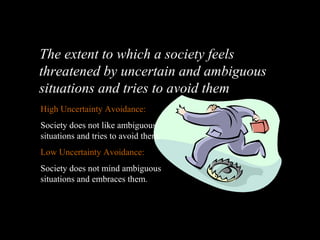
– Helpful in hiring decisions
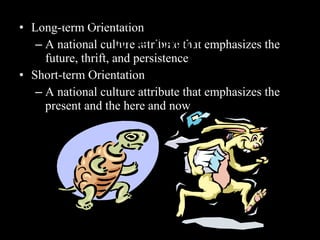
– Most common method: self-reporting surveys
– Observer-ratings surveys provide an independent
assessment of personality – often better predictors
Personality Determinants
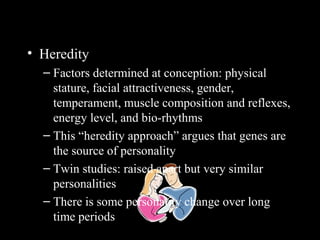
• Heredity
– Factors determined at conception: physical
stature, facial attractiveness, gender,
temperament, muscle composition and reflexes,
energy level, and bio-rhythms
– This “heredity approach” argues that genes are
the source of personality
– Twin studies: raised apart but very similar
personalities
– There is some personality change over long
time periods
Personality Traits
Enduring characteristics that describe an
individual’s behavior
– The more consistent the characteristic and the
more frequently it occurs in diverse situations, the
more important the trait.
•Two dominant frameworks used to describe
personality:
– Myers-Briggs Type Indicator (MBTI®
)
– Big Five Model
The Myers-Briggs Type Indicator
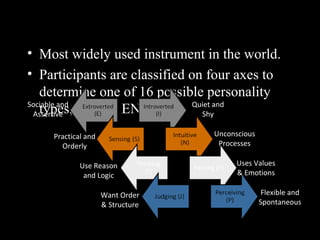
• Most widely used instrument in the world.
• Participants are classified on four axes to
determine one of 16 possible personality
types, such as ENTJ.
Flexible and
Spontaneous
Sociable and
Assertive
Quiet and
Shy
Unconscious
Processes
Uses Values
& Emotions
Practical and
Orderly
Use Reason
and Logic
Want Order
& Structure
The Types and Their Uses
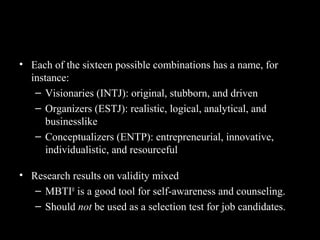
• Each of the sixteen possible combinations has a name, for
instance:
– Visionaries (INTJ): original, stubborn, and driven
– Organizers (ESTJ): realistic, logical, analytical, and
businesslike
– Conceptualizers (ENTP): entrepreneurial, innovative,
individualistic, and resourceful
• Research results on validity mixed
– MBTI®
is a good tool for self-awareness and counseling.
– Should not be used as a selection test for job candidates.
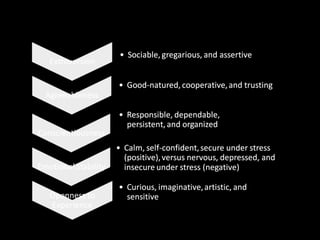
The Big Five Model of Personality
Dimensions
How Do the Big Five Traits Predict
Behavior?
• Research has shown this to be a better framework.
• Certain traits have been shown to strongly relate to higher job
performance:
– Highly conscientious people develop more job knowledge,
exert greater effort, and have better performance.
– Other Big Five Traits also have implications for work.
• Emotional stability is related to job satisfaction.
• Extroverts tend to be happier in their jobs and have
good social skills.
• Open people are more creative and can be good leaders.
• Agreeable people are good in social settings.
Other Personality Traits Relevant
to OB
• Core Self-Evaluation
– The degree to which people like or dislike themselves
– Positive self-evaluation leads to higher job performance
• Machiavellianism
– A pragmatic, emotionally distant power-player who believes that ends
justify the means
– High Machs are manipulative, win more often, and persuade more than
they are persuaded. They flourish when:
• they have direct interaction with others
• they work with minimal rules and regulations
• emotions distract others
• Narcissism
– An arrogant, entitled, self-important person who needs excessive
admiration
– Less effective in their jobs
• Self-Monitoring
– The ability to adjust behavior to meet external, situational
factors.
– High monitors conform more and are more likely to
become leaders.
• Risk Taking
– The willingness to take chances.
– May be best to align propensities with job requirements.
– Risk takers make faster decisions with less information.
More Relevant Personality Traits
Even More Relevant Personality
Traits• Type A Personality
– Aggressively involved in a chronic, incessant struggle to achieve more
in less time
• Impatient: always moving, walking, and eating rapidly
• Strive to think or do two or more things at once
• Cannot cope with leisure time
• Obsessed with achievement numbers
– Prized in today’s competitive times but quality of the work is low
– Type B people are the complete opposite of Type A’s
• Proactive Personality
– Identifies opportunities, shows initiative, takes action, and perseveres
to completion
– Creates positive change in the environment
Values
Basic convictions on how to conduct yourself or how to live a
life that is personally or socially preferable – “How To” live
life properly.
•Attributes of Values:
– Content Attribute: that the mode of conduct or end-state is
important
– Intensity Attribute: just how important that content is
•Value System
– A person’s values rank ordered by intensity
– Tends to be relatively constant and consistent
Importance of Values
• Provide understanding of attitudes,
motivation, and behaviors
• Influence our perception of the world
around us
• Represent interpretations of “right” and
“wrong”
• Imply that some behaviors or outcomes are
preferred over others
Classifying Values – Rokeach Value
Survey• Terminal Values
– Desirable end-states of existence; the goals that a person
would like to achieve during his or her lifetime
• Instrumental Values
– Preferable modes of behavior or means of achieving one’s
terminal values
• People in same occupations or categories tend to hold similar
values
– But values vary between groups
– Value differences make it difficult for groups to negotiate
and may create conflict
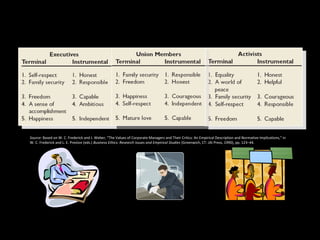
Value Differences Between Groups
Source: Based on W. C. Frederick and J. Weber, “The Values of Corporate Managers and Their Critics: An Empirical Description and Normative Implications,” in
W. C. Frederick and L. E. Preston (eds.) Business Ethics: Research Issues and Empirical Studies (Greenwich, CT: JAI Press, 1990), pp. 123–44.
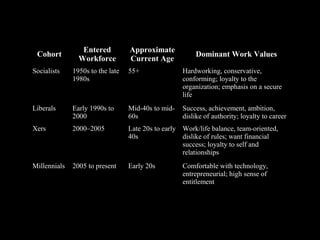
Generational Values
Cohort
Entered
Workforce
Approximate
Current Age
Dominant Work Values
Socialists 1950s to the late
1980s
55+ Hardworking, conservative,
conforming; loyalty to the
organization; emphasis on a secure
life
Liberals Early 1990s to
2000
Mid-40s to mid-
60s
Success, achievement, ambition,
dislike of authority; loyalty to career
Xers 2000–2005 Late 20s to early
40s
Work/life balance, team-oriented,
dislike of rules; want financial
success; loyalty to self and
relationships
Millennials 2005 to present Early 20s Comfortable with technology,
entrepreneurial; high sense of
entitlement
Linking Personality and Values to the
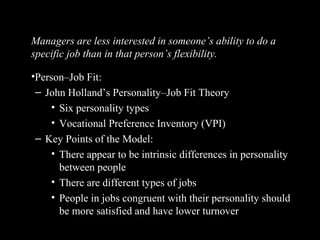
WorkplaceManagers are less interested in someone’s ability to do a
specific job than in that person’s flexibility.
•Person–Job Fit:
– John Holland’s Personality–Job Fit Theory
• Six personality types
• Vocational Preference Inventory (VPI)
– Key Points of the Model:
• There appear to be intrinsic differences in personality
between people
• There are different types of jobs
• People in jobs congruent with their personality should
be more satisfied and have lower turnover
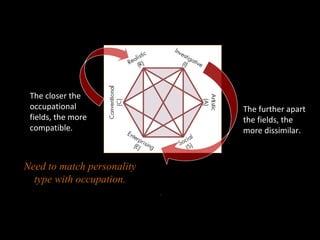
Relationships Among Personality
Types
The closer the
occupational
fields, the more
compatible.
The further apart
the fields, the
more dissimilar.
Need to match personality
type with occupation.
.
Still Linking Personality to the Workplace
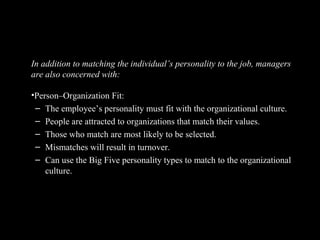
In addition to matching the individual’s personality to the job, managers
are also concerned with:
•Person–Organization Fit:
– The employee’s personality must fit with the organizational culture.
– People are attracted to organizations that match their values.
– Those who match are most likely to be selected.
– Mismatches will result in turnover.
– Can use the Big Five personality types to match to the organizational
culture.
Global Implications
• Personality
– Do frameworks like Big Five transfer across cultures?
• Yes, but the frequency of type in the culture may vary.
• Better in individualistic than collectivist cultures.
• Values
– Values differ across cultures.
– Hofstede’s Framework for assessing culture – six value
dimensions:
• Power Distance
• Individualism vs. Collectivism
• Masculinity vs. Femininity
• Uncertainty Avoidance
• Long-term vs. Short-term Orientation
• Indulgence vs. Restraint
Hofstede’s Framework: Power
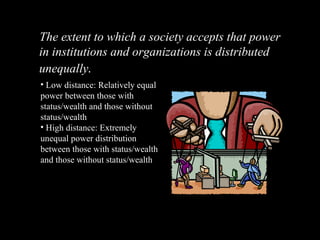
DistanceThe extent to which a society accepts that power
in institutions and organizations is distributed
unequally.
• Low distance: Relatively equal
power between those with
status/wealth and those without
status/wealth
• High distance: Extremely
unequal power distribution
between those with status/wealth
and those without status/wealth
Hofstede’s Framework:
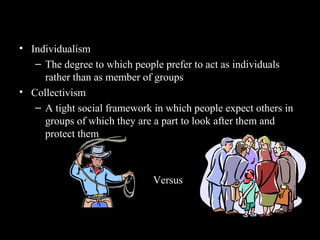
Individualism• Individualism
– The degree to which people prefer to act as individuals
rather than as member of groups
• Collectivism
– A tight social framework in which people expect others in
groups of which they are a part to look after them and
protect them
Versus
Hofstede’s Framework: Masculinity
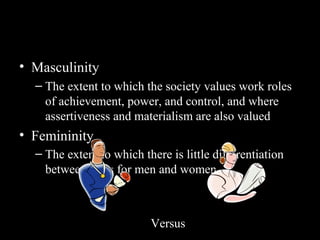
• Masculinity
– The extent to which the society values work roles
of achievement, power, and control, and where
assertiveness and materialism are also valued
• Femininity
– The extent to which there is little differentiation
between roles for men and women
Versus
Hofstede’s Framework: Uncertainty
Avoidance
The extent to which a society feels
threatened by uncertain and ambiguous
situations and tries to avoid them
High Uncertainty Avoidance:
Society does not like ambiguous
situations and tries to avoid them.
Low Uncertainty Avoidance:
Society does not mind ambiguous
situations and embraces them.
• Long-term Orientation
– A national culture attribute that emphasizes the
future, thrift, and persistence
• Short-term Orientation
– A national culture attribute that emphasizes the
present and the here and now
Hofstede’s Framework: Time
Orientation
Hofstede’s Framework: Indulgence
• Indulgence
– The degree to which it is alright for people to enjoy life, have fun,
and fulfill natural human desires
• Restraint
– The extent to which there are social norms governing the
gratification of basic human desires and behavior
Hofstede’s Framework: An
Assessment
• There are regional differences within countries
• The original data is old and based on only one
company
• Hofstede had to make many judgment calls while
doing the research
• Some results don’t match what is believed to be
true about given countries
• Despite these problems it remains a very popular
framework
GLOBE Framework for Assessing
Cultures
• Global Leadership and Organizational Behavior Effectiveness (GLOBE)
research program
– Nine dimensions of national culture
• Similar to Hofstede’s framework with some additional dimensions:
– Humane Orientation: how much society rewards people for being
altruistic, generous, and kind
– Performance Orientation: how much society encourages and rewards
performance improvement and excellence
Summary and Managerial Implications
• Personality
– Screen for the Big Five trait of conscientiousness
– Take into account the situational factors as well
– MBTI®
can help with training and development
• Values
– Often explain attitudes, behaviors, and perceptions
– Higher performance and satisfaction achieved when the individual’s
values match those of the organization
Mba i  ob  u 2.3 personality and values

Mba i ob u 2.3 personality and values

  • 1.
    Personality and Values Course:MBA Subject: Organization Behavior Unit: 2
  • 2.
    Chapter Learning Objectives •After studying this chapter, you should be able to: – Define personality, describe how it is measured, and explain the factors that determine an individual’s personality. – Describe the Myers-Briggs Type Indicator personality framework and assess its strengths and weaknesses. – Identify the key traits in the Big Five personality model. – Demonstrate how the Big Five traits predict behavior at work. – Identify other personality traits relevant to OB. – Define values, demonstrate their importance, and contrast terminal and instrumental values. – Compare generational differences in values, and identify the dominant values in today’s workforce. – Identify Hofstede’s six value dimensions of national culture.
  • 3.
    What Is Personality? Thedynamic organization within the individual of those psychophysical systems that determine his unique adjustments to his environment. - Gordon Allport – The sum total of ways in which an individual reacts and interacts with others, the measurable traits a person exhibits •Measuring Personality – Helpful in hiring decisions – Most common method: self-reporting surveys – Observer-ratings surveys provide an independent assessment of personality – often better predictors
  • 4.
    Personality Determinants • Heredity –Factors determined at conception: physical stature, facial attractiveness, gender, temperament, muscle composition and reflexes, energy level, and bio-rhythms – This “heredity approach” argues that genes are the source of personality – Twin studies: raised apart but very similar personalities – There is some personality change over long time periods
  • 5.
    Personality Traits Enduring characteristicsthat describe an individual’s behavior – The more consistent the characteristic and the more frequently it occurs in diverse situations, the more important the trait. •Two dominant frameworks used to describe personality: – Myers-Briggs Type Indicator (MBTI® ) – Big Five Model
  • 6.
    The Myers-Briggs TypeIndicator • Most widely used instrument in the world. • Participants are classified on four axes to determine one of 16 possible personality types, such as ENTJ. Flexible and Spontaneous Sociable and Assertive Quiet and Shy Unconscious Processes Uses Values & Emotions Practical and Orderly Use Reason and Logic Want Order & Structure
  • 7.
    The Types andTheir Uses • Each of the sixteen possible combinations has a name, for instance: – Visionaries (INTJ): original, stubborn, and driven – Organizers (ESTJ): realistic, logical, analytical, and businesslike – Conceptualizers (ENTP): entrepreneurial, innovative, individualistic, and resourceful • Research results on validity mixed – MBTI® is a good tool for self-awareness and counseling. – Should not be used as a selection test for job candidates.
  • 8.
    The Big FiveModel of Personality Dimensions
  • 9.
    How Do theBig Five Traits Predict Behavior? • Research has shown this to be a better framework. • Certain traits have been shown to strongly relate to higher job performance: – Highly conscientious people develop more job knowledge, exert greater effort, and have better performance. – Other Big Five Traits also have implications for work. • Emotional stability is related to job satisfaction. • Extroverts tend to be happier in their jobs and have good social skills. • Open people are more creative and can be good leaders. • Agreeable people are good in social settings.
  • 10.
    Other Personality TraitsRelevant to OB • Core Self-Evaluation – The degree to which people like or dislike themselves – Positive self-evaluation leads to higher job performance • Machiavellianism – A pragmatic, emotionally distant power-player who believes that ends justify the means – High Machs are manipulative, win more often, and persuade more than they are persuaded. They flourish when: • they have direct interaction with others • they work with minimal rules and regulations • emotions distract others • Narcissism – An arrogant, entitled, self-important person who needs excessive admiration – Less effective in their jobs
  • 11.
    • Self-Monitoring – Theability to adjust behavior to meet external, situational factors. – High monitors conform more and are more likely to become leaders. • Risk Taking – The willingness to take chances. – May be best to align propensities with job requirements. – Risk takers make faster decisions with less information. More Relevant Personality Traits
  • 12.
    Even More RelevantPersonality Traits• Type A Personality – Aggressively involved in a chronic, incessant struggle to achieve more in less time • Impatient: always moving, walking, and eating rapidly • Strive to think or do two or more things at once • Cannot cope with leisure time • Obsessed with achievement numbers – Prized in today’s competitive times but quality of the work is low – Type B people are the complete opposite of Type A’s • Proactive Personality – Identifies opportunities, shows initiative, takes action, and perseveres to completion – Creates positive change in the environment
  • 13.
    Values Basic convictions onhow to conduct yourself or how to live a life that is personally or socially preferable – “How To” live life properly. •Attributes of Values: – Content Attribute: that the mode of conduct or end-state is important – Intensity Attribute: just how important that content is •Value System – A person’s values rank ordered by intensity – Tends to be relatively constant and consistent
  • 14.
    Importance of Values •Provide understanding of attitudes, motivation, and behaviors • Influence our perception of the world around us • Represent interpretations of “right” and “wrong” • Imply that some behaviors or outcomes are preferred over others
  • 15.
    Classifying Values –Rokeach Value Survey• Terminal Values – Desirable end-states of existence; the goals that a person would like to achieve during his or her lifetime • Instrumental Values – Preferable modes of behavior or means of achieving one’s terminal values • People in same occupations or categories tend to hold similar values – But values vary between groups – Value differences make it difficult for groups to negotiate and may create conflict
  • 16.
    Value Differences BetweenGroups Source: Based on W. C. Frederick and J. Weber, “The Values of Corporate Managers and Their Critics: An Empirical Description and Normative Implications,” in W. C. Frederick and L. E. Preston (eds.) Business Ethics: Research Issues and Empirical Studies (Greenwich, CT: JAI Press, 1990), pp. 123–44.
  • 17.
    Generational Values Cohort Entered Workforce Approximate Current Age DominantWork Values Socialists 1950s to the late 1980s 55+ Hardworking, conservative, conforming; loyalty to the organization; emphasis on a secure life Liberals Early 1990s to 2000 Mid-40s to mid- 60s Success, achievement, ambition, dislike of authority; loyalty to career Xers 2000–2005 Late 20s to early 40s Work/life balance, team-oriented, dislike of rules; want financial success; loyalty to self and relationships Millennials 2005 to present Early 20s Comfortable with technology, entrepreneurial; high sense of entitlement
  • 18.
    Linking Personality andValues to the WorkplaceManagers are less interested in someone’s ability to do a specific job than in that person’s flexibility. •Person–Job Fit: – John Holland’s Personality–Job Fit Theory • Six personality types • Vocational Preference Inventory (VPI) – Key Points of the Model: • There appear to be intrinsic differences in personality between people • There are different types of jobs • People in jobs congruent with their personality should be more satisfied and have lower turnover
  • 19.
    Relationships Among Personality Types Thecloser the occupational fields, the more compatible. The further apart the fields, the more dissimilar. Need to match personality type with occupation. .
  • 20.
    Still Linking Personalityto the Workplace In addition to matching the individual’s personality to the job, managers are also concerned with: •Person–Organization Fit: – The employee’s personality must fit with the organizational culture. – People are attracted to organizations that match their values. – Those who match are most likely to be selected. – Mismatches will result in turnover. – Can use the Big Five personality types to match to the organizational culture.
  • 21.
    Global Implications • Personality –Do frameworks like Big Five transfer across cultures? • Yes, but the frequency of type in the culture may vary. • Better in individualistic than collectivist cultures. • Values – Values differ across cultures. – Hofstede’s Framework for assessing culture – six value dimensions: • Power Distance • Individualism vs. Collectivism • Masculinity vs. Femininity • Uncertainty Avoidance • Long-term vs. Short-term Orientation • Indulgence vs. Restraint
  • 22.
    Hofstede’s Framework: Power DistanceTheextent to which a society accepts that power in institutions and organizations is distributed unequally. • Low distance: Relatively equal power between those with status/wealth and those without status/wealth • High distance: Extremely unequal power distribution between those with status/wealth and those without status/wealth
  • 23.
    Hofstede’s Framework: Individualism• Individualism –The degree to which people prefer to act as individuals rather than as member of groups • Collectivism – A tight social framework in which people expect others in groups of which they are a part to look after them and protect them Versus
  • 24.
    Hofstede’s Framework: Masculinity •Masculinity – The extent to which the society values work roles of achievement, power, and control, and where assertiveness and materialism are also valued • Femininity – The extent to which there is little differentiation between roles for men and women Versus
  • 25.
    Hofstede’s Framework: Uncertainty Avoidance Theextent to which a society feels threatened by uncertain and ambiguous situations and tries to avoid them High Uncertainty Avoidance: Society does not like ambiguous situations and tries to avoid them. Low Uncertainty Avoidance: Society does not mind ambiguous situations and embraces them.
  • 26.
    • Long-term Orientation –A national culture attribute that emphasizes the future, thrift, and persistence • Short-term Orientation – A national culture attribute that emphasizes the present and the here and now Hofstede’s Framework: Time Orientation
  • 27.
    Hofstede’s Framework: Indulgence •Indulgence – The degree to which it is alright for people to enjoy life, have fun, and fulfill natural human desires • Restraint – The extent to which there are social norms governing the gratification of basic human desires and behavior
  • 28.
    Hofstede’s Framework: An Assessment •There are regional differences within countries • The original data is old and based on only one company • Hofstede had to make many judgment calls while doing the research • Some results don’t match what is believed to be true about given countries • Despite these problems it remains a very popular framework
  • 29.
    GLOBE Framework forAssessing Cultures • Global Leadership and Organizational Behavior Effectiveness (GLOBE) research program – Nine dimensions of national culture • Similar to Hofstede’s framework with some additional dimensions: – Humane Orientation: how much society rewards people for being altruistic, generous, and kind – Performance Orientation: how much society encourages and rewards performance improvement and excellence
  • 30.
    Summary and ManagerialImplications • Personality – Screen for the Big Five trait of conscientiousness – Take into account the situational factors as well – MBTI® can help with training and development • Values – Often explain attitudes, behaviors, and perceptions – Higher performance and satisfaction achieved when the individual’s values match those of the organization

Editor's Notes

  • #4 Personality is often defined by characteristics such as outgoing or charming. However, psychologists define personality as the growth and development of a person’s whole psychological system. We study personality in Organizational Behavior because it impacts a number of important work outcomes. We can attempt to measure personality through a variety of methods. Often these methods are utilized in the hiring process to assist in hiring the right person for the job and the organization. The most common method is self-reporting surveys where individuals answer questions that determine what type of personality they have. Another, more accurate, method is when others observe the individual and provide an independent assessment of their personality.
  • #5 There has been a long-standing debate about whether genetics or environment are more important in determining personality. They both play an important role. The heredity approach refers to factors determined at conception such as physical stature and gender. This has been reaffirmed by studies that have looked at twins who were raised apart but still had similar personalities. Personalities can, however, change over time.
  • #6 Even though personalities do change overtime, there are enduring characteristics that describe an individual’s behavior. If we see a trait consistently surface in different situations, this trait is important in describing the individual. Some methods used to describe personality are the Myers-Briggs Type Indicator, the MBTI. The Big Five Model is another framework used to describe personality.
  • #7 The MBTI is the most widely used personality instrument worldwide. Participants are classified within four scales to determine 1 of 16 possible personality types. These types are broken down into four dichotomies. The first is extroverts who tend to be sociable and assertive verses introverts who tend to be quiet and shy. The second dichotomy is sensing and intuitive. Sensors are practical and orderly where intuits utilize unconscious processes. The third dichotomy is thinking and feeling. Thinking focuses on using reason and logic where feeling utilizes values and emotions. The final dichotomy is judging and perceiving. Judgers want order and structure whereas perceivers are more flexible and spontaneous.
  • #8 The tool categorizes the individual into one of the four dichotomies, such as INTJ. There are 16 possible combinations and each helps the individual to better understand themselves. The tool is helpful, but should not be used for selection as the results on validity are mixed.
  • #9 The Big Five model of personality sets forth that there are five basic dimensions that underlie all others and encompass most of the significant variations in human personalities. The Big Five factors are: Extroversion, Agreeableness, Conscientiousness, Emotional Stability and Openness to Experience. There is a lot of research that supports the Big Five model and it has been shown to predict behavior at work.
  • #10 There are certain traits that have been shown by extensive research to be strongly related to higher job performance. Conscientiousness has been shown as an effective predictor of better performance based on more extensive job knowledge and the willingness to exert greater effort. In addition, the other five traits have implications for work. Emotional stability is related to job satisfaction and agreeable people are better in social-related jobs such as sales and customer service.
  • #11 There are additional personality traits relevant to organizational behavior. Core self-evaluation is the degree to which people like/dislike themselves. Positive self-evaluation leads to higher job performance. Machiavellianism describes a person who tends to be emotionally distant and believes that the ends justify the means. They tend to have a competitive drive and a need to win. They can be very persuasive in situations where there is direct interaction with minimal rules and people are distracted by emotions. Narcissism is a trait that often hinders job effectiveness. It describes a person who requires excessive admiration and has a strong sense of entitlement.
  • #12 Self-monitoring is another personality trait that is linked to job performance. It is the ability to adjust behavior to meet situational factors. High monitors are more likely to become leaders in the workplace. Risk taking assesses the willingness to take chances. This is important in certain job situations, but not in all.
  • #13 Type A personalities are defined as those who need to achieve more and more. They are always moving, striving to multitask and don’t do well with leisure time. This is something that has been valued in North America, but it is not always a positive as quality of work can be low. Type B personalities operate at a slower pace, find time for leisure and are the opposite of all type A characteristics. Proactive personalities are those that identify opportunities, take initiative, and persevere to completion in all they do. This is a positive in work environments.
  • #14 Values represent basic convictions that make judgments about what is the best mode of conduct or end-state of existence. There are two attributes of values. There is a content component that looks at the level of importance of the mode of conduct or end-state and the intensity component that looks at how important that content is. A person’s value system ranks values by their intensity. This tends to be relatively constant over time.
  • #15 Values are very important because they provide an understanding of attitudes, motivation, and behaviors. Values play a role in how we perceive the world around us and how we interpret right and wrong. Values imply that some behaviors are preferred over others based on how/what we value.
  • #16 The Rokeach Value Survey was created by Milton Rokeach. It consists of two sets of values, terminal values and instrumental values. Terminal values describe the desired values/goals a person would like to keep/achieve through their lifetime. Instrumental values are the preferred modes of behavior or means of achieving one’s terminal values. Values vary between groups and can cause trouble when group members hold different values and negotiation is needed.
  • #17 This table shows some differences between different employment groups as there are often similarities between job categories.
  • #18 The workplace is made up of a number different generations of workers, more so than ever before seen in history. These workers bring with them different sets of values and corresponding work behaviors. For example, veterans tend to be conservative and conform to standards whereas nexters tend to be self-reliant but still team oriented.
  • #19 Personality and value studies are important to the field of organizational behavior because they have been linked to workplace outcomes. The person-job fit theory developed by John Holland has been critical to thinking about how people fit with a specific job. Holland classified people into six personality types utilizing a vocational preference inventory. Through the study of personality it has become clear that there are intrinsic differences in personality between people. Given that there are a number of different jobs it is logical that people in jobs congruent with their personalities would be more satisfied in their work.
  • #20 When the personality is matched with the type of occupation, then there are stronger positive work outcomes.
  • #21 This idea can be further linked to the workplace by looking at person-organization fit. The employee’s personality needs to fit with the organizational culture. When employees find organizations that match their values, they are more likely to be selected and correspondingly be more satisfied with their work. The big five personality types are often helpful in matching the individuals with organizational culture.
  • #22 There are global implications to personality and values in the workplace. Frameworks such as the big five and MBTI are transferable across cultures; in fact, the MBTI has been used worldwide. However, the applicability is higher in some cultures than others. Values, on the other hand, differ to a great degree across cultures. Geert Hofstede developed a framework for assessing culture. He breaks up his framework of understanding into five value dimensions: power distance, individualism vs. collectivism, masculinity vs. femininity, uncertainty avoidance, and long-term vs. short-term orientation.
  • #23 Power distance is the extent to which a society accepts that power in institutions and organizations is distributed unequally. Low distance is when there is relatively equal power between those with status/wealth and those without. Higher distance is when there is a lot of unequal power distribution between groups.
  • #24 The second component in Hofstede’s framework is individualism vs. collectivism. Individualism is the degree to which people prefer to act on their own rather than in a group. Collectivism is the idea that people operate within a social framework where they help others out and they expect help when they need it.
  • #25 Hofstede offers a third component in his model that distinguishes between masculinity and femininity. Masculinity is the extent to which the culture prefers achievement, power, and control vs. characteristics that are more feminine in nature.
  • #26 The fourth component is uncertainty avoidance. This is the extent to which a society is willing to live with uncertainty and ambiguity. High uncertainty avoidance cultures will try to avoid ambiguous situations as much as possible. Lower uncertainty avoidance cultures do not mind ambiguity.
  • #27 The final component is time orientation. Long-term orientation societies will emphasize the future and what it takes to get to the future they desire, thrift and persistence. Short-term orientation societies will emphasize the here and now.
  • #29 This framework shows that there are differences in values between cultures and this encouraged research in the area of cultural differences. However, the original data was limited in scope and many judgment calls were made in the conclusions. Even though there are some variances between common perception of cultures and the research, this framework remains extremely popular and is used widely.
  • #30 The GLOBE framework takes a look at nine dimensions of national culture. It is similar to Hofstede’s model but adds the humane and performance orientations. The humane orientation looks at how much society rewards people for being altruistic and kind where the performance orientation looks at how much society encourages and rewards good work.
  • #31 Personality and values are very important to the workplace and play a solid role in predicting behavior. There are some good frameworks and models that can aid us in applying these theories and assist managers in being better predictors of workplace behavior.