ORGANIZATIONAL EFFECTIVENESS PROF. DOLLY ROY
Presented by:- Sanchi Gaikwad  P-07 Sneha Sharma  P-41 Kavita Singh  P-44 Meghna Rajpura  P-45  SNEHA SHARMA P-41
ORGANIZATION EFFECTIVENESS & GOAL ATTAINMENT APPROACH… SNEHA SHARMA  P-41
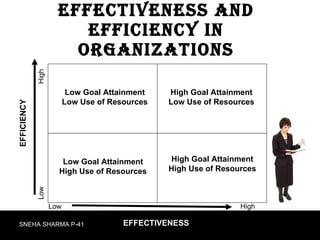
Effectiveness and Efficiency Effectiveness:  the extent to which the organization achieves its goals or goal. Efficiency: Takes into account the amount of resources used to produce the desired output.  SNEHA SHARMA P-41
Organization Effectiveness…?? Organizational effectiveness is the concept of how effective an organization is in achieving the outcomes the organization intends to produce. The idea of organizational effectiveness is especially important for non-profit organizations as most people who donate money to non-profit organizations and charities are interested in knowing whether the organization is effective in accomplishing its goals. SNEHA SHARMA P-41
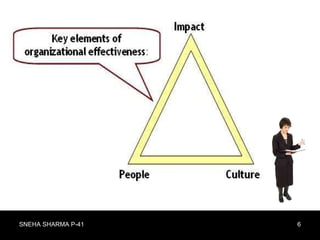
SNEHA SHARMA P-41
Importance of Organization Effectiveness What makes an organization effective??? The answer to this question is proper organization structure. SNEHA SHARMA P-41
Effectiveness and Efficiency in Organizations Low Goal Attainment Low Use of Resources Low Goal Attainment High Use of Resources High Goal Attainment High Use of Resources High Goal Attainment Low Use of Resources Low  High EFFECTIVENESS Low    High EFFICIENCY SNEHA SHARMA P-41
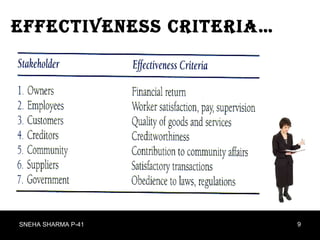
Effectiveness Criteria… SNEHA SHARMA P-41
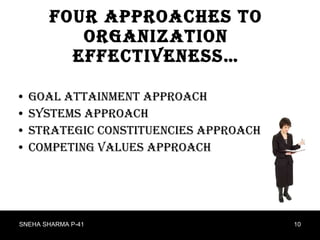
Four Approaches to Organization Effectiveness… Goal Attainment Approach Systems Approach Strategic Constituencies Approach Competing Values Approach SNEHA SHARMA P-41
GOAL ATTAINMENT APPROACH SNEHA SHARMA  P-41
SNEHA SHARMA P-41
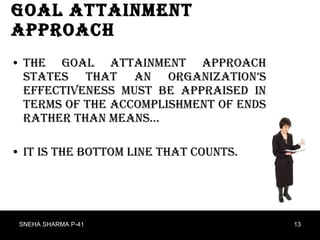
Goal Attainment Approach The Goal Attainment Approach states that an organization’s effectiveness must be appraised in terms of the accomplishment of ends rather than means… It is the bottom line that counts. SNEHA SHARMA P-41
Goal Attainment Approach Based on the identification of goals and the achievement of those goals Goals must be…  Clearly identifiable  Consensual Measurable Time-bound SNEHA SHARMA P-41
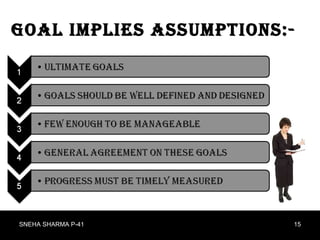
Goal Implies Assumptions:- SNEHA SHARMA P-41
Barriers to Goal Attainment Approach…!!! Failure to sell practitioners on goal setting to ensure commitment. Setting goals that are not measurable and realistic.  Unwillingness to raise and lower goals to maintain optimal difficulty.  Setting too many goals. Focusing too much on outcome goals.  SNEHA SHARMA P-41
SYSTEM APPROACH SANCHI GAIKWAD  P-07
Systems Approach Here end goals are not ignored; but they are only one element in a more complex set of criteria. Systems models emphasize criteria that will increase the long term survival of the organization such as – Its ability to acquire resources, maintain itself internally as a social organism & interact successfully with its external environment. So, this approach focuses not so much on specific ends as on the means needed for the achievement of those ends.  SANCHI GAIKWAD P-07
Assumptions Organizations are made up of interrelated subparts. If any one of these subparts performs poorly, it will negatively affect the performance of the whole system. Effectiveness requires awareness & successful interactions with environmental constituencies. Mgmt has to maintain good relations Raw materials must be secured, vacancies created by employee resignations and retirements must be filled, declining product lines must be replaced Changes in the economy & the tastes of customers or clients need to be anticipated and reacted.  SANCHI GAIKWAD P-07
How Managers can apply the systems approach? The system view looks at factors such as- Relation with the environment The efficiency with which the org. transforms inputs into outputs  The clarity of internal communications. The level of conflict among the group The degree of job satisfaction SANCHI GAIKWAD P-07
Limitations of systems approach… The two most telling shortcomings of the systems approach relate to MEASUREMENT & the issue of whether MEANS REALLY MATTER?  In sports, it is frequently said “it’s whether you win or lose that counts, not how u play the game!” Same holds true for orgns. If ends are achieved,  means are not important But systems approach focus is on MEANS necessary to achieve effectiveness rather than on organizational effectiveness itself. SANCHI GAIKWAD P-07
Contd.. Systems Approach uses means goals The approach that is more meaningful and which is easy to quantify should be used SANCHI GAIKWAD P-07
Value to Managers Managers using systems approach are less prone to look for immediate results Less likely to make decisions This approach increases the Manager’s awareness of the interdependency of organizational activities A final plus for the systems approach is its applicability where end goals either are very vague or cannot be quantified. SANCHI GAIKWAD P-07
Strategic-Constituencies Approach… MEGHNA RAJPURA  P-45
An effective organization is one that satisfies the demands of those constituencies in its environment from whom it requires support for its continued existence.  It seeks to appease only those in the environment who can threaten the organization's survival. For eg. Private universities and public universities  MEGHNA RAJPURA P-45
Assumptions Organization should give importance to constituency then it can take this approach. Each constituency has a unique set of values, so it is unlikely that they are preference will be in agreement. MEGHNA RAJPURA P-45
How can manager apply this? 3 major steps Asking members to identify the constituents Evaluate the list How dependent on it our organization is? Does it have considerable power over us? Are there alternatives? Identifying the expectations What do they want of it? MEGHNA RAJPURA P-45
Problems Distinguishing strategic constituencies from larger environment is not easy to practice Identifying the expectations that the strategic constituencies hold for the organization MEGHNA RAJPURA P-45
Value to managers It is important for manager to understand just who it is that survival is contingent upon Manager might ignore or upset a group whose power could significantly hinder the organization’s operations  MEGHNA RAJPURA P-45
Competing Values Approach SNEHA SHARMA  P-41 MEGHNA RAJPURA  P-45
Competing Values Approach The Competing Values Approach is the criteria you value and use in assessing an organizations effectiveness. SNEHA SHARMA  P-41 MEGHNA RAJPURA P-45
Criteria  Return on investment Market share New product innovation Job security SNEHA SHARMA  P-41 MEGHNA RAJPURA P-45
Assumptions  No best criterion for evaluating an organization effectiveness. There cannot be one single goal that everyone can agree upon. The concept of OE is subjective. SNEHA SHARMA  P-41 MEGHNA RAJPURA P-45
Problem to the approach This approach’s perception is on how well an organization is doing on the criteria rather than clarifying in which criteria the constituencies are emphasizing SNEHA SHARMA  P-41 MEGHNA RAJPURA P-45
Values to manager By reducing a large number of effectiveness criteria, this can guide the manager in identifying the appropriateness of different criteria to different constituencies and in different life cycle stages. SNEHA SHARMA  P-41 MEGHNA RAJPURA P-45
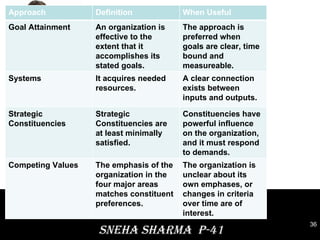
SNEHA SHARMA  P-41 Approach  Definition When Useful Goal Attainment An organization is effective to the extent that it accomplishes its stated goals.  The approach is preferred when goals are clear, time bound and measureable. Systems It acquires needed resources. A clear connection exists between inputs and outputs. Strategic Constituencies Strategic Constituencies are at least minimally satisfied. Constituencies have powerful influence on the organization, and it must respond to demands. Competing Values The emphasis of the organization in the four major areas matches constituent preferences. The organization is unclear about its own emphases, or changes in criteria over time are of interest.
Approaches to measuring organizational effectiveness KAVITA SINGH  P-44
Approaches to measuring organizational effectiveness External resource approach Internal systems approach Technical approach KAVITA SINGH  P-44
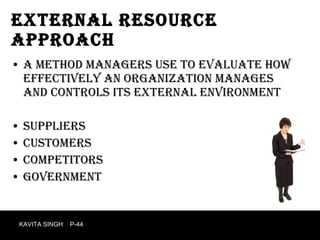
External resource approach  A method managers use to evaluate how effectively an organization manages and controls Its external environment Suppliers Customers Competitors government KAVITA SINGH  P-44
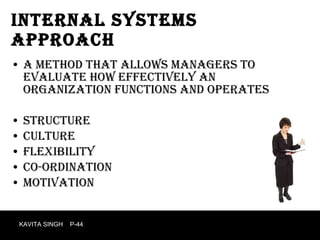
Internal systems approach A method that allows managers to evaluate how effectively an organization functions and operates Structure  culture Flexibility  Co-ordination Motivation  KAVITA SINGH  P-44
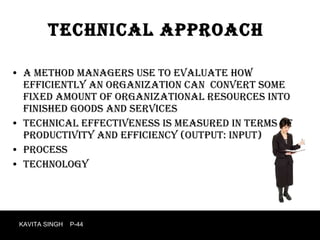
Technical approach A method managers use to evaluate how efficiently an organization can  convert some fixed amount of organizational resources into finished goods and services Technical effectiveness is measured in terms of productivity and efficiency (output: input) Process technology KAVITA SINGH  P-44
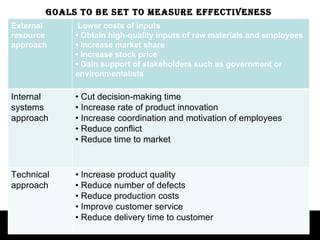
Goals to be set to measure effectiveness External resource approach   Lower costs of inputs •  Obtain high-quality inputs of raw materials and employees •  Increase market share •  Increase stock price •  Gain support of stakeholders such as government or environmentalists  Internal systems approach •  Cut decision-making time •  Increase rate of product innovation •  Increase coordination and motivation of employees •  Reduce conflict •  Reduce time to market  Technical approach •  Increase product quality •  Reduce number of defects •  Reduce production costs •  Improve customer service •  Reduce delivery time to customer 
CASE STUDY SANCHI  P-07 SNEHA  P-41 KAVITA  P-44 MEGHNA  P-45
BIBLIOGRAPHY Behaviour in Organization – Garett Jones Organization theory – Stephen P Robbins www.google.com
SPECIAL THANKS TO  PROF. DOLLY ROY.

Organization Effectiveness Final

  • 1.
  • 2.
    Presented by:- SanchiGaikwad P-07 Sneha Sharma P-41 Kavita Singh P-44 Meghna Rajpura P-45 SNEHA SHARMA P-41
  • 3.
    ORGANIZATION EFFECTIVENESS &GOAL ATTAINMENT APPROACH… SNEHA SHARMA P-41
  • 4.
    Effectiveness and EfficiencyEffectiveness: the extent to which the organization achieves its goals or goal. Efficiency: Takes into account the amount of resources used to produce the desired output. SNEHA SHARMA P-41
  • 5.
    Organization Effectiveness…?? Organizationaleffectiveness is the concept of how effective an organization is in achieving the outcomes the organization intends to produce. The idea of organizational effectiveness is especially important for non-profit organizations as most people who donate money to non-profit organizations and charities are interested in knowing whether the organization is effective in accomplishing its goals. SNEHA SHARMA P-41
  • 6.
  • 7.
    Importance of OrganizationEffectiveness What makes an organization effective??? The answer to this question is proper organization structure. SNEHA SHARMA P-41
  • 8.
    Effectiveness and Efficiencyin Organizations Low Goal Attainment Low Use of Resources Low Goal Attainment High Use of Resources High Goal Attainment High Use of Resources High Goal Attainment Low Use of Resources Low High EFFECTIVENESS Low High EFFICIENCY SNEHA SHARMA P-41
  • 9.
  • 10.
    Four Approaches toOrganization Effectiveness… Goal Attainment Approach Systems Approach Strategic Constituencies Approach Competing Values Approach SNEHA SHARMA P-41
  • 11.
    GOAL ATTAINMENT APPROACHSNEHA SHARMA P-41
  • 12.
  • 13.
    Goal Attainment ApproachThe Goal Attainment Approach states that an organization’s effectiveness must be appraised in terms of the accomplishment of ends rather than means… It is the bottom line that counts. SNEHA SHARMA P-41
  • 14.
    Goal Attainment ApproachBased on the identification of goals and the achievement of those goals Goals must be… Clearly identifiable Consensual Measurable Time-bound SNEHA SHARMA P-41
  • 15.
    Goal Implies Assumptions:-SNEHA SHARMA P-41
  • 16.
    Barriers to GoalAttainment Approach…!!! Failure to sell practitioners on goal setting to ensure commitment. Setting goals that are not measurable and realistic. Unwillingness to raise and lower goals to maintain optimal difficulty. Setting too many goals. Focusing too much on outcome goals. SNEHA SHARMA P-41
  • 17.
  • 18.
    Systems Approach Hereend goals are not ignored; but they are only one element in a more complex set of criteria. Systems models emphasize criteria that will increase the long term survival of the organization such as – Its ability to acquire resources, maintain itself internally as a social organism & interact successfully with its external environment. So, this approach focuses not so much on specific ends as on the means needed for the achievement of those ends. SANCHI GAIKWAD P-07
  • 19.
    Assumptions Organizations aremade up of interrelated subparts. If any one of these subparts performs poorly, it will negatively affect the performance of the whole system. Effectiveness requires awareness & successful interactions with environmental constituencies. Mgmt has to maintain good relations Raw materials must be secured, vacancies created by employee resignations and retirements must be filled, declining product lines must be replaced Changes in the economy & the tastes of customers or clients need to be anticipated and reacted. SANCHI GAIKWAD P-07
  • 20.
    How Managers canapply the systems approach? The system view looks at factors such as- Relation with the environment The efficiency with which the org. transforms inputs into outputs The clarity of internal communications. The level of conflict among the group The degree of job satisfaction SANCHI GAIKWAD P-07
  • 21.
    Limitations of systemsapproach… The two most telling shortcomings of the systems approach relate to MEASUREMENT & the issue of whether MEANS REALLY MATTER? In sports, it is frequently said “it’s whether you win or lose that counts, not how u play the game!” Same holds true for orgns. If ends are achieved, means are not important But systems approach focus is on MEANS necessary to achieve effectiveness rather than on organizational effectiveness itself. SANCHI GAIKWAD P-07
  • 22.
    Contd.. Systems Approachuses means goals The approach that is more meaningful and which is easy to quantify should be used SANCHI GAIKWAD P-07
  • 23.
    Value to ManagersManagers using systems approach are less prone to look for immediate results Less likely to make decisions This approach increases the Manager’s awareness of the interdependency of organizational activities A final plus for the systems approach is its applicability where end goals either are very vague or cannot be quantified. SANCHI GAIKWAD P-07
  • 24.
  • 25.
    An effective organizationis one that satisfies the demands of those constituencies in its environment from whom it requires support for its continued existence. It seeks to appease only those in the environment who can threaten the organization's survival. For eg. Private universities and public universities MEGHNA RAJPURA P-45
  • 26.
    Assumptions Organization shouldgive importance to constituency then it can take this approach. Each constituency has a unique set of values, so it is unlikely that they are preference will be in agreement. MEGHNA RAJPURA P-45
  • 27.
    How can managerapply this? 3 major steps Asking members to identify the constituents Evaluate the list How dependent on it our organization is? Does it have considerable power over us? Are there alternatives? Identifying the expectations What do they want of it? MEGHNA RAJPURA P-45
  • 28.
    Problems Distinguishing strategicconstituencies from larger environment is not easy to practice Identifying the expectations that the strategic constituencies hold for the organization MEGHNA RAJPURA P-45
  • 29.
    Value to managersIt is important for manager to understand just who it is that survival is contingent upon Manager might ignore or upset a group whose power could significantly hinder the organization’s operations MEGHNA RAJPURA P-45
  • 30.
    Competing Values ApproachSNEHA SHARMA P-41 MEGHNA RAJPURA P-45
  • 31.
    Competing Values ApproachThe Competing Values Approach is the criteria you value and use in assessing an organizations effectiveness. SNEHA SHARMA P-41 MEGHNA RAJPURA P-45
  • 32.
    Criteria Returnon investment Market share New product innovation Job security SNEHA SHARMA P-41 MEGHNA RAJPURA P-45
  • 33.
    Assumptions Nobest criterion for evaluating an organization effectiveness. There cannot be one single goal that everyone can agree upon. The concept of OE is subjective. SNEHA SHARMA P-41 MEGHNA RAJPURA P-45
  • 34.
    Problem to theapproach This approach’s perception is on how well an organization is doing on the criteria rather than clarifying in which criteria the constituencies are emphasizing SNEHA SHARMA P-41 MEGHNA RAJPURA P-45
  • 35.
    Values to managerBy reducing a large number of effectiveness criteria, this can guide the manager in identifying the appropriateness of different criteria to different constituencies and in different life cycle stages. SNEHA SHARMA P-41 MEGHNA RAJPURA P-45
  • 36.
    SNEHA SHARMA P-41 Approach Definition When Useful Goal Attainment An organization is effective to the extent that it accomplishes its stated goals. The approach is preferred when goals are clear, time bound and measureable. Systems It acquires needed resources. A clear connection exists between inputs and outputs. Strategic Constituencies Strategic Constituencies are at least minimally satisfied. Constituencies have powerful influence on the organization, and it must respond to demands. Competing Values The emphasis of the organization in the four major areas matches constituent preferences. The organization is unclear about its own emphases, or changes in criteria over time are of interest.
  • 37.
    Approaches to measuringorganizational effectiveness KAVITA SINGH P-44
  • 38.
    Approaches to measuringorganizational effectiveness External resource approach Internal systems approach Technical approach KAVITA SINGH P-44
  • 39.
    External resource approach A method managers use to evaluate how effectively an organization manages and controls Its external environment Suppliers Customers Competitors government KAVITA SINGH P-44
  • 40.
    Internal systems approachA method that allows managers to evaluate how effectively an organization functions and operates Structure culture Flexibility Co-ordination Motivation KAVITA SINGH P-44
  • 41.
    Technical approach Amethod managers use to evaluate how efficiently an organization can convert some fixed amount of organizational resources into finished goods and services Technical effectiveness is measured in terms of productivity and efficiency (output: input) Process technology KAVITA SINGH P-44
  • 42.
    Goals to beset to measure effectiveness External resource approach   Lower costs of inputs •  Obtain high-quality inputs of raw materials and employees •  Increase market share •  Increase stock price •  Gain support of stakeholders such as government or environmentalists  Internal systems approach •  Cut decision-making time •  Increase rate of product innovation •  Increase coordination and motivation of employees •  Reduce conflict •  Reduce time to market  Technical approach •  Increase product quality •  Reduce number of defects •  Reduce production costs •  Improve customer service •  Reduce delivery time to customer 
  • 43.
    CASE STUDY SANCHI P-07 SNEHA P-41 KAVITA P-44 MEGHNA P-45
  • 44.
    BIBLIOGRAPHY Behaviour inOrganization – Garett Jones Organization theory – Stephen P Robbins www.google.com
  • 45.
    SPECIAL THANKS TO PROF. DOLLY ROY.