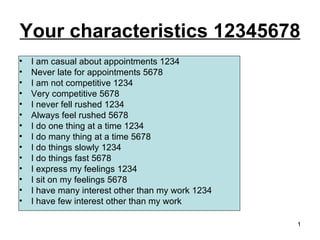
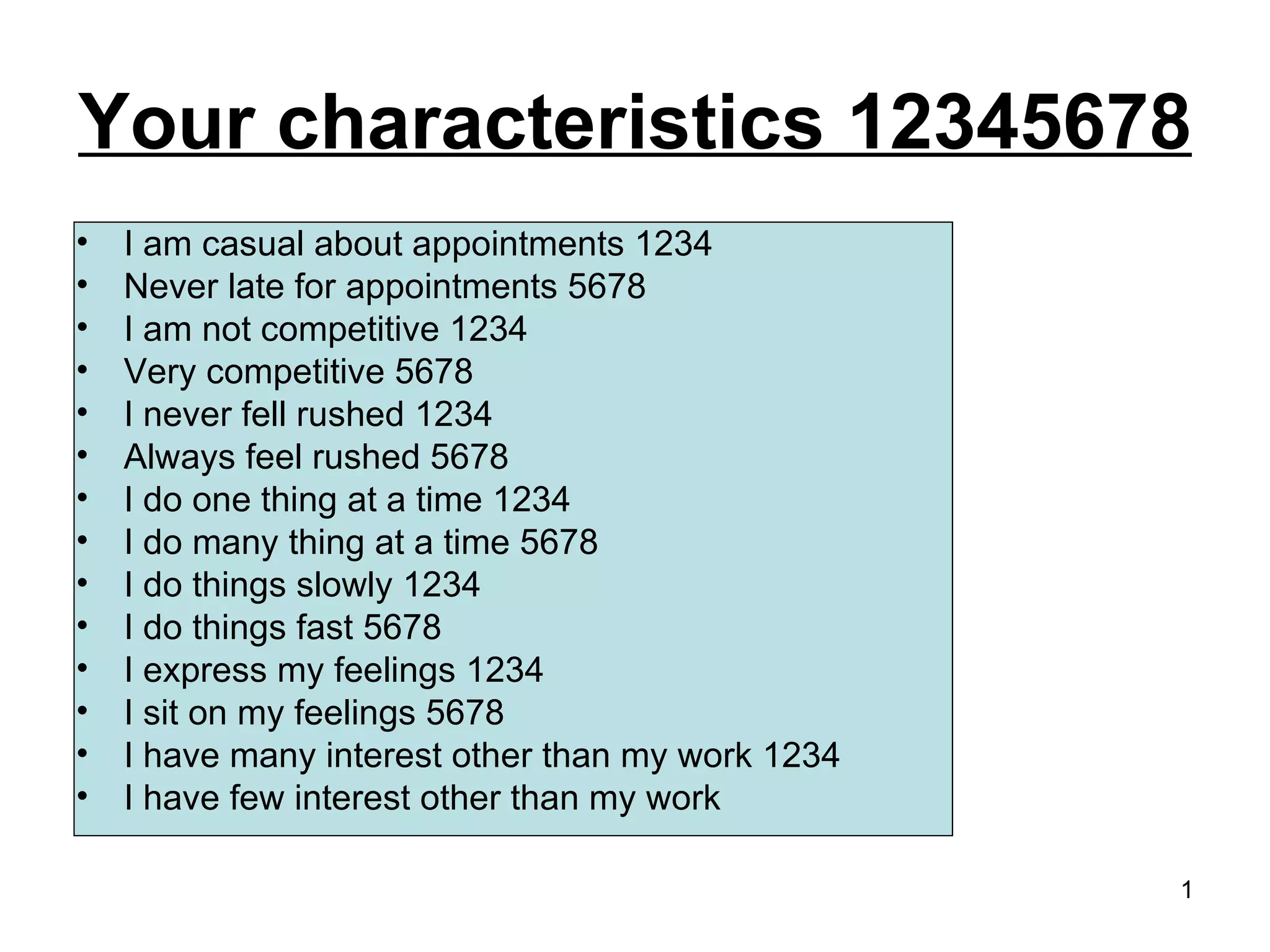
Your characteristics 12345678 I am casual about appointments 1234 Never late for appointments 5678 I am not competitive 1234 Very competitive 5678 I never fell rushed 1234 Always feel rushed 5678 I do one thing at a time 1234 I do many thing at a time 5678 I do things slowly 1234 I do things fast 5678 I express my feelings 1234 I sit on my feelings 5678 I have many interest other than my work 1234 I have few interest other than my work
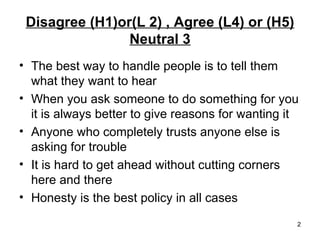
Disagree (H1)or(L 2) , Agree (L4) or (H5) Neutral 3 The best way to handle people is to tell them what they want to hear When you ask someone to do something for you it is always better to give reasons for wanting it Anyone who completely trusts anyone else is asking for trouble It is hard to get ahead without cutting corners here and there Honesty is the best policy in all cases
INDIVIDUAL DIFFERENCES - PERSONALITY MBA
QUESTIONS TO BE ANSWERED Are people same or different? If the answer is No…… If the answer is Yes, then how? Can we identified? What are the types?
BASIC ISSUE  People behave in different ways Why they behave differently  How it can be happen
PEOPLE ARE DIFFERENT Physical skills & abilities Strength Flexibility Stamina Physical balance Mental skills & abilities Numerical Verbal Perceptual Inductive reasoning
DETERMINANT FACTORS  Many factors which govern human behavior Biological factors  Economic  factors Socio  – Cultural factors Political factors Psychological factors
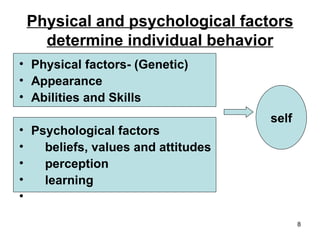
Physical and psychological factors determine individual behavior Physical factors- (Genetic)  Appearance Abilities and Skills Psychological factors beliefs, values and attitudes perception learning self
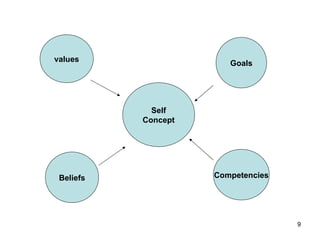
Self Concept values Goals Competencies Beliefs
SELF AND PERSONAL SYSTEM The general consistency of the personal system is organized by the individual’s self-concept; that is, the way the person sees him/herself. Self esteem Self confidence
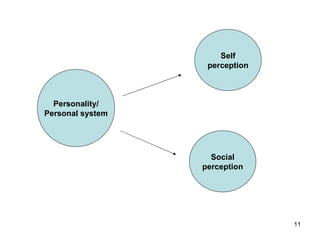
Personality/ Personal system Self perception Social perception
PERSONALITY Characteristics patterns of behavior and modes of thinking that determine a person’s adjustment to the environment Represent the overall profile or combination of traits that characterize the unique nature of a person.
PERSONALITY Characteristics patterns of behavior and modes of thinking that determine a person’s adjustment to the environment How people affect others How they understand and view themselves Pattern of inner and outer measurable traits The person-situation interaction
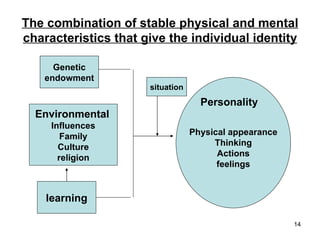
The combination of stable physical and mental characteristics that give the individual identity Genetic endowment Environmental   Influences Family Culture religion learning Physical appearance Thinking Actions feelings Personality situation
PERSONALITY THEORIES Traits: every person has identifiable dominant traits. Those are in born characters  Psychodynamic: a person’s childhood influence his personality. Personality develop in stages.  Social learning: personality develop based on learning, people learning from the society through various methods
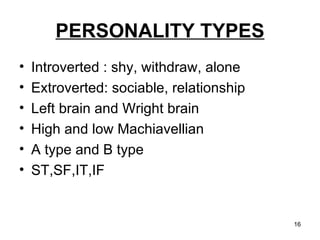
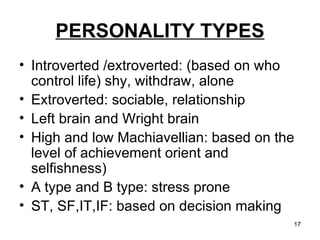
PERSONALITY TYPES Introverted : shy, withdraw, alone Extroverted: sociable, relationship Left brain and Wright brain High and low Machiavellian A type and B type ST,SF,IT,IF
PERSONALITY TYPES Introverted /extroverted: (based on who control life) shy, withdraw, alone Extroverted: sociable, relationship Left brain and Wright brain High and low Machiavellian: based on the level of achievement orient and selfishness)  A type and B type: stress prone ST, SF,IT,IF: based on decision making
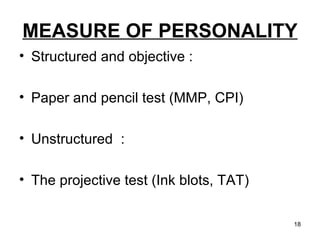
MEASURE OF PERSONALITY Structured and objective : Paper and pencil test (MMP, CPI) Unstructured  : The projective test (Ink blots, TAT)
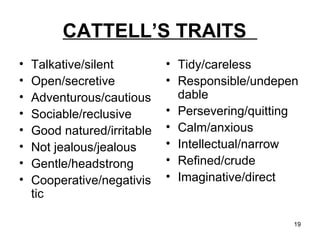
CATTELL’S TRAITS  Talkative/silent Open/secretive Adventurous/cautious Sociable/reclusive Good natured/irritable Not jealous/jealous Gentle/headstrong Cooperative/negativistic Tidy/careless Responsible/undependable Persevering/quitting Calm/anxious Intellectual/narrow Refined/crude Imaginative/direct
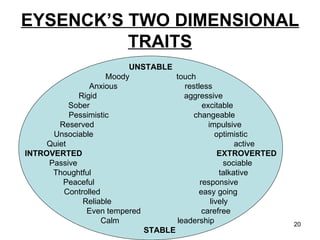
EYSENCK’S TWO DIMENSIONAL TRAITS UNSTABLE Moody  touch Anxious  restless Rigid  aggressive Sober  excitable Pessimistic  changeable Reserved  impulsive Unsociable  optimistic Quiet  active INTROVERTED  EXTROVERTED Passive  sociable Thoughtful  talkative Peaceful  responsive Controlled  easy going Reliable  lively Even tempered  carefree Calm  leadership STABLE
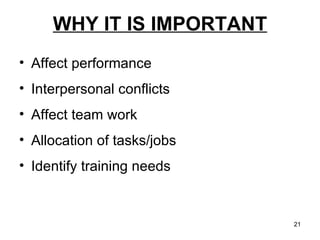
WHY IT IS IMPORTANT Affect performance Interpersonal conflicts Affect team work Allocation of tasks/jobs Identify training needs
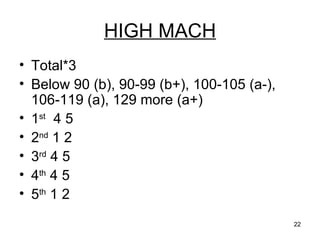
HIGH MACH Total*3 Below 90 (b), 90-99 (b+), 100-105 (a-), 106-119 (a), 129 more (a+) 1 st   4 5 2 nd  1 2 3 rd  4 5 4 th  4 5 5 th  1 2

Individual Differences Personality

  • 1.
    Your characteristics 12345678I am casual about appointments 1234 Never late for appointments 5678 I am not competitive 1234 Very competitive 5678 I never fell rushed 1234 Always feel rushed 5678 I do one thing at a time 1234 I do many thing at a time 5678 I do things slowly 1234 I do things fast 5678 I express my feelings 1234 I sit on my feelings 5678 I have many interest other than my work 1234 I have few interest other than my work
  • 2.
    Disagree (H1)or(L 2), Agree (L4) or (H5) Neutral 3 The best way to handle people is to tell them what they want to hear When you ask someone to do something for you it is always better to give reasons for wanting it Anyone who completely trusts anyone else is asking for trouble It is hard to get ahead without cutting corners here and there Honesty is the best policy in all cases
  • 3.
    INDIVIDUAL DIFFERENCES -PERSONALITY MBA
  • 4.
    QUESTIONS TO BEANSWERED Are people same or different? If the answer is No…… If the answer is Yes, then how? Can we identified? What are the types?
  • 5.
    BASIC ISSUE People behave in different ways Why they behave differently How it can be happen
  • 6.
    PEOPLE ARE DIFFERENTPhysical skills & abilities Strength Flexibility Stamina Physical balance Mental skills & abilities Numerical Verbal Perceptual Inductive reasoning
  • 7.
    DETERMINANT FACTORS Many factors which govern human behavior Biological factors Economic factors Socio – Cultural factors Political factors Psychological factors
  • 8.
    Physical and psychologicalfactors determine individual behavior Physical factors- (Genetic) Appearance Abilities and Skills Psychological factors beliefs, values and attitudes perception learning self
  • 9.
    Self Concept valuesGoals Competencies Beliefs
  • 10.
    SELF AND PERSONALSYSTEM The general consistency of the personal system is organized by the individual’s self-concept; that is, the way the person sees him/herself. Self esteem Self confidence
  • 11.
    Personality/ Personal systemSelf perception Social perception
  • 12.
    PERSONALITY Characteristics patternsof behavior and modes of thinking that determine a person’s adjustment to the environment Represent the overall profile or combination of traits that characterize the unique nature of a person.
  • 13.
    PERSONALITY Characteristics patternsof behavior and modes of thinking that determine a person’s adjustment to the environment How people affect others How they understand and view themselves Pattern of inner and outer measurable traits The person-situation interaction
  • 14.
    The combination ofstable physical and mental characteristics that give the individual identity Genetic endowment Environmental Influences Family Culture religion learning Physical appearance Thinking Actions feelings Personality situation
  • 15.
    PERSONALITY THEORIES Traits:every person has identifiable dominant traits. Those are in born characters Psychodynamic: a person’s childhood influence his personality. Personality develop in stages. Social learning: personality develop based on learning, people learning from the society through various methods
  • 16.
    PERSONALITY TYPES Introverted: shy, withdraw, alone Extroverted: sociable, relationship Left brain and Wright brain High and low Machiavellian A type and B type ST,SF,IT,IF
  • 17.
    PERSONALITY TYPES Introverted/extroverted: (based on who control life) shy, withdraw, alone Extroverted: sociable, relationship Left brain and Wright brain High and low Machiavellian: based on the level of achievement orient and selfishness) A type and B type: stress prone ST, SF,IT,IF: based on decision making
  • 18.
    MEASURE OF PERSONALITYStructured and objective : Paper and pencil test (MMP, CPI) Unstructured : The projective test (Ink blots, TAT)
  • 19.
    CATTELL’S TRAITS Talkative/silent Open/secretive Adventurous/cautious Sociable/reclusive Good natured/irritable Not jealous/jealous Gentle/headstrong Cooperative/negativistic Tidy/careless Responsible/undependable Persevering/quitting Calm/anxious Intellectual/narrow Refined/crude Imaginative/direct
  • 20.
    EYSENCK’S TWO DIMENSIONALTRAITS UNSTABLE Moody touch Anxious restless Rigid aggressive Sober excitable Pessimistic changeable Reserved impulsive Unsociable optimistic Quiet active INTROVERTED EXTROVERTED Passive sociable Thoughtful talkative Peaceful responsive Controlled easy going Reliable lively Even tempered carefree Calm leadership STABLE
  • 21.
    WHY IT ISIMPORTANT Affect performance Interpersonal conflicts Affect team work Allocation of tasks/jobs Identify training needs
  • 22.
    HIGH MACH Total*3Below 90 (b), 90-99 (b+), 100-105 (a-), 106-119 (a), 129 more (a+) 1 st 4 5 2 nd 1 2 3 rd 4 5 4 th 4 5 5 th 1 2