Financial Management I 
TTh 18:30-20:00/ST 222 
Domingo, Dennimar O. 
3rd year/BSBA-Marketing Management
Definition 
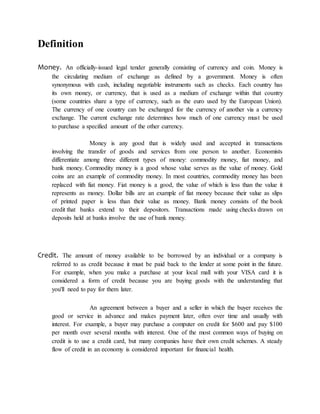
Money. An officially-issued legal tender generally consisting of currency and coin. Money is 
the circulating medium of exchange as defined by a government. Money is often 
synonymous with cash, including negotiable instruments such as checks. Each country has 
its own money, or currency, that is used as a medium of exchange within that country 
(some countries share a type of currency, such as the euro used by the European Union). 
The currency of one country can be exchanged for the currency of another via a currency 
exchange. The current exchange rate determines how much of one currency must be used 
to purchase a specified amount of the other currency. 
Money is any good that is widely used and accepted in transactions 
involving the transfer of goods and services from one person to another. Economists 
differentiate among three different types of money: commodity money, fiat money, and 
bank money. Commodity money is a good whose value serves as the value of money. Gold 
coins are an example of commodity money. In most countries, commodity money has been 
replaced with fiat money. Fiat money is a good, the value of which is less than the value it 
represents as money. Dollar bills are an example of fiat money because their value as slips 
of printed paper is less than their value as money. Bank money consists of the book 
credit that banks extend to their depositors. Transactions made using checks drawn on 
deposits held at banks involve the use of bank money. 
Credit. The amount of money available to be borrowed by an individual or a company is 
referred to as credit because it must be paid back to the lender at some point in the future. 
For example, when you make a purchase at your local mall with your VISA card it is 
considered a form of credit because you are buying goods with the understanding that 
you'll need to pay for them later. 
An agreement between a buyer and a seller in which the buyer receives the 
good or service in advance and makes payment later, often over time and usually with 
interest. For example, a buyer may purchase a computer on credit for $600 and pay $100 
per month over several months with interest. One of the most common ways of buying on 
credit is to use a credit card, but many companies have their own credit schemes. A steady 
flow of credit in an economy is considered important for financial health.
Differentiate 
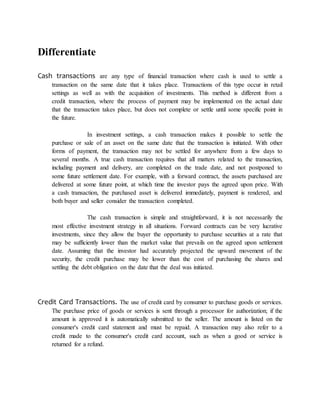
Cash transactions are any type of financial transaction where cash is used to settle a 
transaction on the same date that it takes place. Transactions of this type occur in retail 
settings as well as with the acquisition of investments. This method is different from a 
credit transaction, where the process of payment may be implemented on the actual date 
that the transaction takes place, but does not complete or settle until some specific point in 
the future. 
In investment settings, a cash transaction makes it possible to settle the 
purchase or sale of an asset on the same date that the transaction is initiated. With other 
forms of payment, the transaction may not be settled for anywhere from a few days to 
several months. A true cash transaction requires that all matters related to the transaction, 
including payment and delivery, are completed on the trade date, and not postponed to 
some future settlement date. For example, with a forward contract, the assets purchased are 
delivered at some future point, at which time the investor pays the agreed upon price. With 
a cash transaction, the purchased asset is delivered immediately, payment is rendered, and 
both buyer and seller consider the transaction completed. 
The cash transaction is simple and straightforward, it is not necessarily the 
most effective investment strategy in all situations. Forward contracts can be very lucrative 
investments, since they allow the buyer the opportunity to purchase securities at a rate that 
may be sufficiently lower than the market value that prevails on the agreed upon settlement 
date. Assuming that the investor had accurately projected the upward movement of the 
security, the credit purchase may be lower than the cost of purchasing the shares and 
settling the debt obligation on the date that the deal was initiated. 
Credit Card Transactions. The use of credit card by consumer to purchase goods or services. 
The purchase price of goods or services is sent through a processor for authorization; if the 
amount is approved it is automatically submitted to the seller. The amount is listed on the 
consumer's credit card statement and must be repaid. A transaction may also refer to a 
credit made to the consumer's credit card account, such as when a good or service is 
returned for a refund.

Financial management I

  • 1.
    Financial Management I TTh 18:30-20:00/ST 222 Domingo, Dennimar O. 3rd year/BSBA-Marketing Management
  • 2.
    Definition Money. Anofficially-issued legal tender generally consisting of currency and coin. Money is the circulating medium of exchange as defined by a government. Money is often synonymous with cash, including negotiable instruments such as checks. Each country has its own money, or currency, that is used as a medium of exchange within that country (some countries share a type of currency, such as the euro used by the European Union). The currency of one country can be exchanged for the currency of another via a currency exchange. The current exchange rate determines how much of one currency must be used to purchase a specified amount of the other currency. Money is any good that is widely used and accepted in transactions involving the transfer of goods and services from one person to another. Economists differentiate among three different types of money: commodity money, fiat money, and bank money. Commodity money is a good whose value serves as the value of money. Gold coins are an example of commodity money. In most countries, commodity money has been replaced with fiat money. Fiat money is a good, the value of which is less than the value it represents as money. Dollar bills are an example of fiat money because their value as slips of printed paper is less than their value as money. Bank money consists of the book credit that banks extend to their depositors. Transactions made using checks drawn on deposits held at banks involve the use of bank money. Credit. The amount of money available to be borrowed by an individual or a company is referred to as credit because it must be paid back to the lender at some point in the future. For example, when you make a purchase at your local mall with your VISA card it is considered a form of credit because you are buying goods with the understanding that you'll need to pay for them later. An agreement between a buyer and a seller in which the buyer receives the good or service in advance and makes payment later, often over time and usually with interest. For example, a buyer may purchase a computer on credit for $600 and pay $100 per month over several months with interest. One of the most common ways of buying on credit is to use a credit card, but many companies have their own credit schemes. A steady flow of credit in an economy is considered important for financial health.
  • 3.
    Differentiate Cash transactionsare any type of financial transaction where cash is used to settle a transaction on the same date that it takes place. Transactions of this type occur in retail settings as well as with the acquisition of investments. This method is different from a credit transaction, where the process of payment may be implemented on the actual date that the transaction takes place, but does not complete or settle until some specific point in the future. In investment settings, a cash transaction makes it possible to settle the purchase or sale of an asset on the same date that the transaction is initiated. With other forms of payment, the transaction may not be settled for anywhere from a few days to several months. A true cash transaction requires that all matters related to the transaction, including payment and delivery, are completed on the trade date, and not postponed to some future settlement date. For example, with a forward contract, the assets purchased are delivered at some future point, at which time the investor pays the agreed upon price. With a cash transaction, the purchased asset is delivered immediately, payment is rendered, and both buyer and seller consider the transaction completed. The cash transaction is simple and straightforward, it is not necessarily the most effective investment strategy in all situations. Forward contracts can be very lucrative investments, since they allow the buyer the opportunity to purchase securities at a rate that may be sufficiently lower than the market value that prevails on the agreed upon settlement date. Assuming that the investor had accurately projected the upward movement of the security, the credit purchase may be lower than the cost of purchasing the shares and settling the debt obligation on the date that the deal was initiated. Credit Card Transactions. The use of credit card by consumer to purchase goods or services. The purchase price of goods or services is sent through a processor for authorization; if the amount is approved it is automatically submitted to the seller. The amount is listed on the consumer's credit card statement and must be repaid. A transaction may also refer to a credit made to the consumer's credit card account, such as when a good or service is returned for a refund.