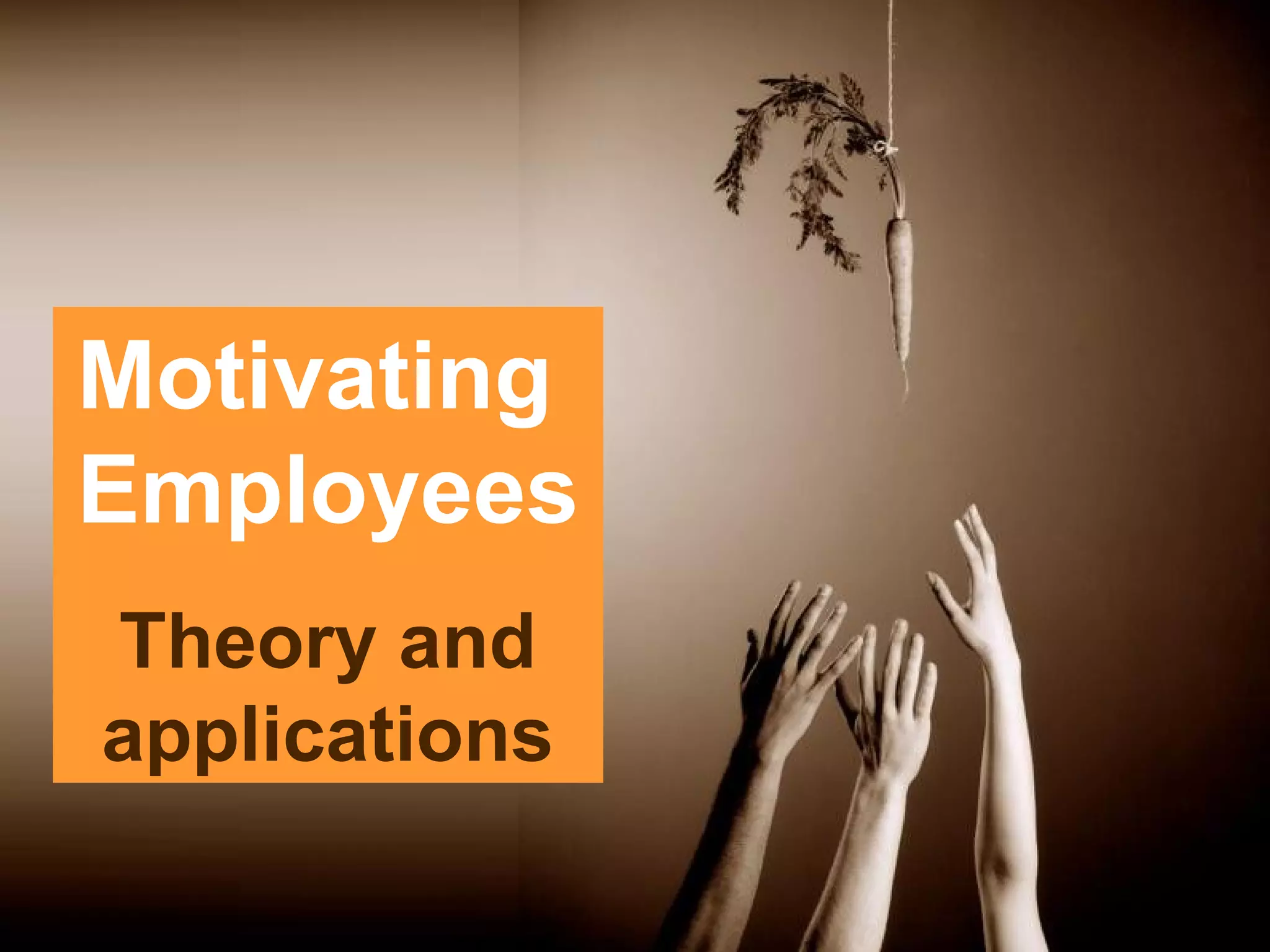

Motivating 
Employees 
Theory and 
applications
The Power of a Smile 
She smiled at the sorrowful stranger. 
The smiling seemed to make him feel better. 
He remembered past kindnesses of a friend 
And wrote him a thank you letter. 
The friend was so pleased with the thank you 
That he left a large tip after lunch. 
The waitress, surprised by the size of the tip, 
Bet the whole thing on a hunch. 
The next day she picked up her winnings, 
And gave part to a man on the street. 
The man on the street was grateful; 
For two days he'd had nothing to eat. 
After he finished his dinner, 
He left for his small dingy room. 
He didn't know at that moment 
That he might be facing his doom. 
On the way he picked up a shivering puppy 
And took him home to get warm. 
The puppy was very grateful 
To be in out of the storm. 
That night the house caught on fire. 
The puppy barked the alarm. 
He barked till he woke the whole household 
And saved everybody from harm. 
One of the boys that he rescued 
Grew up to be President. 
All this because of a simple smile 
That hadn't cost a cent.
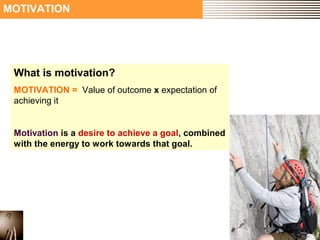
MOTIVATION 
What is motivation? 
MOTIVATION = Value of outcome x expectation of 
achieving it 
Motivation is a desire to achieve a goal, combined 
with the energy to work towards that goal.
Motivation is everything. You can do the work of 
two people, but you can't be two people. Instead, 
you have to inspire the next guy down the line and 
get him to inspire his people. 
Motivation is the art of getting people to do what 
you want them to do because they want to do it.
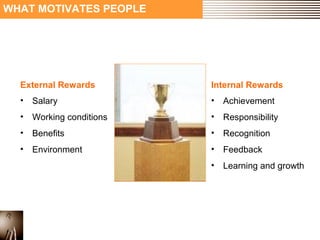
WHAT MOTIVATES PEOPLE 
External Rewards 
• Salary 
• Working conditions 
• Benefits 
• Environment 
Internal Rewards 
• Achievement 
• Responsibility 
• Recognition 
• Feedback 
• Learning and growth
WHAT MOTIVATES PEOPLE 
• Achievement 
• Responsibility 
• Recognition 
• Feedback 
• Learning and growth 
• Recognize achievements through programs 
that showcase performers.
WHAT MOTIVATES PEOPLE 
• Achievement 
• Responsibility 
• Recognition 
• Feedback 
• Learning and growth 
• Have volunteer programs and other 
programs that enable employees to 
showcase their responsibility towards each 
other and the society at large.
WHAT MOTIVATES PEOPLE 
• Recognize winners through awards like 
Service Quality Awards, Best Operations 
Awards, Best Trainer Awards, etc. 
• Achievement 
• Responsibility 
• Recognition 
• Feedback 
• Learning and growth
WHAT MOTIVATES PEOPLE 
• Achievement 
• Responsibility 
• Recognition 
• Feedback 
• Learning and growth 
• Follow a system of feedback and 
performance appraisal i.e the 360o system 
in which both the boss and subordinate 
participate.
WHAT MOTIVATES PEOPLE 
• Achievement 
• Responsibility 
• Recognition 
• Feedback 
• Learning and growth • Give a lot of importance to training and 
development and have various training 
academies to cater to various sections of 
employees. 
• Analyze training needs to recognize 
competency gaps and impart knowledge 
through customized training programs.
WHAT MOTIVATES PEOPLE 
In addition to the external and internal awards, have: 
• Employee engagement 
• Challenging job profiles 
• Keep them self-motivated 
• Good projects 
• Job rotation 
• Job security / stability 
• Good team, co-workers, bosses
But what happens when there is 
not enough motivation among the 
employees? 
LESS or NO MOTIVATION = 
DEMOTIVATION
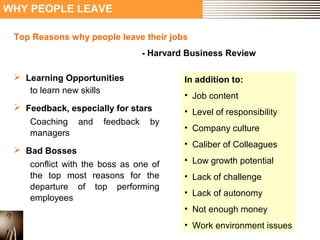
WHY PEOPLE LEAVE 
Top Reasons why people leave their jobs 
- Harvard Business Review 
 Learning Opportunities 
to learn new skills 
 Feedback, especially for stars 
Coaching and feedback by 
managers 
 Bad Bosses 
conflict with the boss as one of 
the top most reasons for the 
departure of top performing 
employees 
In addition to: 
• Job content 
• Level of responsibility 
• Company culture 
• Caliber of Colleagues 
• Low growth potential 
• Lack of challenge 
• Lack of autonomy 
• Not enough money 
• Work environment issues
THEORIES ON 
MOTIVATION 
 Maslow’s 
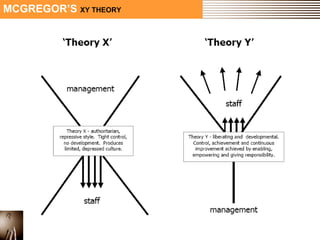
 McGregor’s 
 McClelland’s
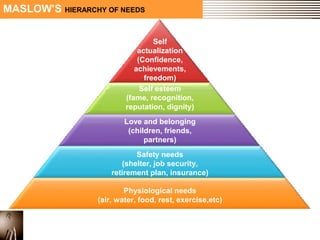
MASLOW’S HIERARCHY OF NEEDS 
Self 
actualization 
(Confidence, 
achievements, 
freedom) 
Self esteem 
(fame, recognition, 
reputation, dignity) 
Love and belonging 
(children, friends, 
partners) 
Safety needs 
(shelter, job security, 
retirement plan, insurance) 
Physiological needs 
(air, water, food, rest, exercise,etc)
MCGREGOR’S XY THEORY
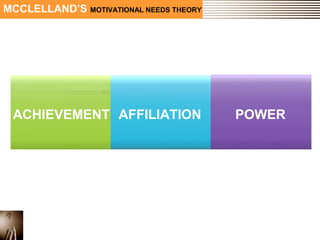
MCCLELLAND’S MOTIVATIONAL NEEDS THEORY 
ACHIEVEMENT AFFILIATION POWER
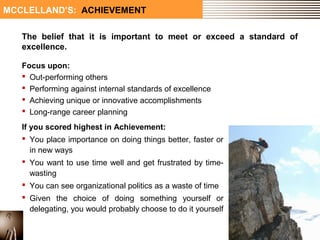
MCCLELLAND’S: ACHIEVEMENT 
The belief that it is important to meet or exceed a standard of 
excellence. 
Focus upon: 
 Out-performing others 
 Performing against internal standards of excellence 
 Achieving unique or innovative accomplishments 
 Long-range career planning 
If you scored highest in Achievement: 
 You place importance on doing things better, faster or 
in new ways 
 You want to use time well and get frustrated by time-wasting 
 You can see organizational politics as a waste of time 
 Given the choice of doing something yourself or 
delegating, you would probably choose to do it yourself
MCCLELLAND’S: AFFILIATION 
The belief that establishing and maintaining close, friendly 
relationships is important 
Focus upon: 
 Being liked, accepted and popular 
 Concern about separation or disruption of relationships 
 Seeing group tasks as primarily social activities 
If you scored highest in Affiliation: 
 You place highest priority on avoiding conflict and 
maintaining good relations 
 You are concerned about people’s feelings 
 You take time to socialize at work and are in touch 
the ‘grapevine’ 
 If you had to delegate to someone who might resent 
the extra work, you would most likely do it yourself
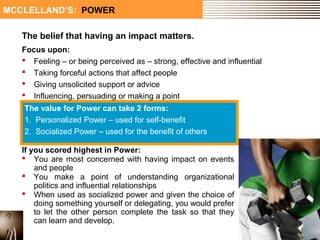
MCCLELLAND’S: POWER 
The belief that having an impact matters. 
Focus upon: 
 Feeling – or being perceived as – strong, effective and influential 
 Taking forceful actions that affect people 
 Giving unsolicited support or advice 
 Influencing, persuading or making a point 
The value for Power can take 2 forms: 
1. Personalized Power – used for self-benefit 
2. Socialized Power – used for the benefit of others 
If you scored highest in Power: 
 You are most concerned with having impact on events 
and people 
 You make a point of understanding organizational 
politics and influential relationships 
 When used as socialized power and given the choice of 
doing something yourself or delegating, you would prefer 
to let the other person complete the task so that they 
can learn and develop.
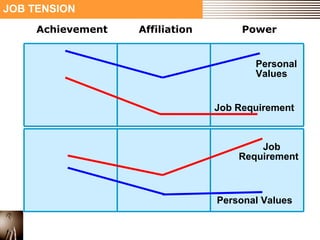
JOB TENSION 
Achievement Affiliation Power 
Personal 
Values 
Job Requirement 
Job 
Requirement 
Personal Values
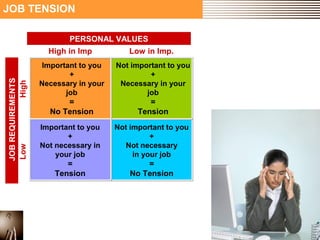
JOB TENSION 
JOB REQUIREMENTS 
Low 
PERSONAL VALUES 
Low in Imp. 
Not important to you 
+ 
Necessary in your 
job 
= 
Tension 
Not important to you 
+ 
Not necessary 
in your job 
= 
No Tension 
High in Imp 
Important to you 
+ 
Necessary in your 
job 
= 
No Tension 
Important to you 
+ 
Not necessary in 
your job 
= 
Tension 
High
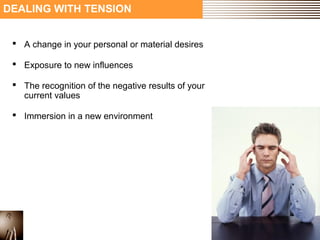
DEALING WITH TENSION 
 A change in your personal or material desires 
 Exposure to new influences 
 The recognition of the negative results of your 
current values 
 Immersion in a new environment
HOW YOU CAN 
DO IT IN YOUR 
ORGANIZATION
MOTIVATING 
 TRUST Respect, communication, credibility 
 PRIDE Work related to the person 
 CAMARADERIE Team building exercises, promoting 
team work, contests, create 
communities
PERFORMANCE APPRAISAL 
How to evaluate your people? 
Performance Appraisal Systems contain two basic systems: 
Evaluation System Feedback System 
• To identify the performance gap 
(if any). 
• This gap is the shortfall that 
occurs when performance does 
not meet the standard set by the 
organization as acceptable. 
• To inform the employee about the 
quality of his or her performance. 
• The appraisers also receives 
feedback from the employee 
about job problems, etc.
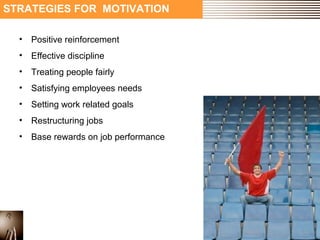
STRATEGIES FOR MOTIVATION 
• Positive reinforcement 
• Effective discipline 
• Treating people fairly 
• Satisfying employees needs 
• Setting work related goals 
• Restructuring jobs 
• Base rewards on job performance
EXECUTIVE COMPENSATION 
Five basic elements of executive compensation: 
• Salary 
• Short-term incentives 
• Long-term incentives 
• Employee benefits 
• Perks
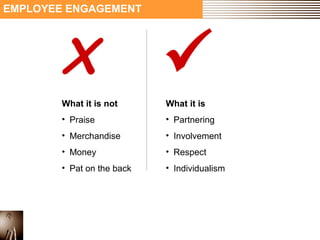
X  
What it is 
• Partnering 
• Involvement 
• Respect 
• Individualism 
EMPLOYEE ENGAGEMENT 
What it is not 
• Praise 
• Merchandise 
• Money 
• Pat on the back
EMPLOYEE ENGAGEMENT 
• Customized training programs 
• Help people build trust, pride and camaraderie 
• Develop high degrees of credibility in everything that we say and do 
• Play hard, party hard 
• Encourage community building 
• Follow a good feedback and appraisal system 
• Give everyone clear goals 
• Maintain mentor-mentee relationships 
• Follow shared responsibilities towards each other, client and the 
franchisee
EMPLOYEE ENGAGEMENT 
Why is employee engagement important? 
• Engaged Employees  Loyal Customers  Bigger Profits. 
• If the staff are motivated then the customers will be happy 
• The shareholders will then benefit through the company's success.
TOP 10 TIPS 
• Notice each individual 
• Say Thank-you, even a smile can make a big difference. 
• Make staff feel respected and valued 
• Share your experience and knowledge 
• Be confidence about people. 
• Be honest and trustworthy 
• Don’t take personal credit for their success 
• Create a blame-free culture 
• Set developmental goals 
• Make work fun!!
Thank you

Motivating Employees

  • 1.
  • 2.
    The Power ofa Smile She smiled at the sorrowful stranger. The smiling seemed to make him feel better. He remembered past kindnesses of a friend And wrote him a thank you letter. The friend was so pleased with the thank you That he left a large tip after lunch. The waitress, surprised by the size of the tip, Bet the whole thing on a hunch. The next day she picked up her winnings, And gave part to a man on the street. The man on the street was grateful; For two days he'd had nothing to eat. After he finished his dinner, He left for his small dingy room. He didn't know at that moment That he might be facing his doom. On the way he picked up a shivering puppy And took him home to get warm. The puppy was very grateful To be in out of the storm. That night the house caught on fire. The puppy barked the alarm. He barked till he woke the whole household And saved everybody from harm. One of the boys that he rescued Grew up to be President. All this because of a simple smile That hadn't cost a cent.
  • 3.
    MOTIVATION What ismotivation? MOTIVATION = Value of outcome x expectation of achieving it Motivation is a desire to achieve a goal, combined with the energy to work towards that goal.
  • 4.
    Motivation is everything.You can do the work of two people, but you can't be two people. Instead, you have to inspire the next guy down the line and get him to inspire his people. Motivation is the art of getting people to do what you want them to do because they want to do it.
  • 5.
    WHAT MOTIVATES PEOPLE External Rewards • Salary • Working conditions • Benefits • Environment Internal Rewards • Achievement • Responsibility • Recognition • Feedback • Learning and growth
  • 6.
    WHAT MOTIVATES PEOPLE • Achievement • Responsibility • Recognition • Feedback • Learning and growth • Recognize achievements through programs that showcase performers.
  • 7.
    WHAT MOTIVATES PEOPLE • Achievement • Responsibility • Recognition • Feedback • Learning and growth • Have volunteer programs and other programs that enable employees to showcase their responsibility towards each other and the society at large.
  • 8.
    WHAT MOTIVATES PEOPLE • Recognize winners through awards like Service Quality Awards, Best Operations Awards, Best Trainer Awards, etc. • Achievement • Responsibility • Recognition • Feedback • Learning and growth
  • 9.
    WHAT MOTIVATES PEOPLE • Achievement • Responsibility • Recognition • Feedback • Learning and growth • Follow a system of feedback and performance appraisal i.e the 360o system in which both the boss and subordinate participate.
  • 10.
    WHAT MOTIVATES PEOPLE • Achievement • Responsibility • Recognition • Feedback • Learning and growth • Give a lot of importance to training and development and have various training academies to cater to various sections of employees. • Analyze training needs to recognize competency gaps and impart knowledge through customized training programs.
  • 11.
    WHAT MOTIVATES PEOPLE In addition to the external and internal awards, have: • Employee engagement • Challenging job profiles • Keep them self-motivated • Good projects • Job rotation • Job security / stability • Good team, co-workers, bosses
  • 12.
    But what happenswhen there is not enough motivation among the employees? LESS or NO MOTIVATION = DEMOTIVATION
  • 13.
    WHY PEOPLE LEAVE Top Reasons why people leave their jobs - Harvard Business Review  Learning Opportunities to learn new skills  Feedback, especially for stars Coaching and feedback by managers  Bad Bosses conflict with the boss as one of the top most reasons for the departure of top performing employees In addition to: • Job content • Level of responsibility • Company culture • Caliber of Colleagues • Low growth potential • Lack of challenge • Lack of autonomy • Not enough money • Work environment issues
  • 14.
    THEORIES ON MOTIVATION  Maslow’s  McGregor’s  McClelland’s
  • 15.
    MASLOW’S HIERARCHY OFNEEDS Self actualization (Confidence, achievements, freedom) Self esteem (fame, recognition, reputation, dignity) Love and belonging (children, friends, partners) Safety needs (shelter, job security, retirement plan, insurance) Physiological needs (air, water, food, rest, exercise,etc)
  • 16.
  • 17.
    MCCLELLAND’S MOTIVATIONAL NEEDSTHEORY ACHIEVEMENT AFFILIATION POWER
  • 18.
    MCCLELLAND’S: ACHIEVEMENT Thebelief that it is important to meet or exceed a standard of excellence. Focus upon:  Out-performing others  Performing against internal standards of excellence  Achieving unique or innovative accomplishments  Long-range career planning If you scored highest in Achievement:  You place importance on doing things better, faster or in new ways  You want to use time well and get frustrated by time-wasting  You can see organizational politics as a waste of time  Given the choice of doing something yourself or delegating, you would probably choose to do it yourself
  • 19.
    MCCLELLAND’S: AFFILIATION Thebelief that establishing and maintaining close, friendly relationships is important Focus upon:  Being liked, accepted and popular  Concern about separation or disruption of relationships  Seeing group tasks as primarily social activities If you scored highest in Affiliation:  You place highest priority on avoiding conflict and maintaining good relations  You are concerned about people’s feelings  You take time to socialize at work and are in touch the ‘grapevine’  If you had to delegate to someone who might resent the extra work, you would most likely do it yourself
  • 20.
    MCCLELLAND’S: POWER Thebelief that having an impact matters. Focus upon:  Feeling – or being perceived as – strong, effective and influential  Taking forceful actions that affect people  Giving unsolicited support or advice  Influencing, persuading or making a point The value for Power can take 2 forms: 1. Personalized Power – used for self-benefit 2. Socialized Power – used for the benefit of others If you scored highest in Power:  You are most concerned with having impact on events and people  You make a point of understanding organizational politics and influential relationships  When used as socialized power and given the choice of doing something yourself or delegating, you would prefer to let the other person complete the task so that they can learn and develop.
  • 21.
    JOB TENSION AchievementAffiliation Power Personal Values Job Requirement Job Requirement Personal Values
  • 22.
    JOB TENSION JOBREQUIREMENTS Low PERSONAL VALUES Low in Imp. Not important to you + Necessary in your job = Tension Not important to you + Not necessary in your job = No Tension High in Imp Important to you + Necessary in your job = No Tension Important to you + Not necessary in your job = Tension High
  • 23.
    DEALING WITH TENSION  A change in your personal or material desires  Exposure to new influences  The recognition of the negative results of your current values  Immersion in a new environment
  • 24.
    HOW YOU CAN DO IT IN YOUR ORGANIZATION
  • 25.
    MOTIVATING  TRUSTRespect, communication, credibility  PRIDE Work related to the person  CAMARADERIE Team building exercises, promoting team work, contests, create communities
  • 26.
    PERFORMANCE APPRAISAL Howto evaluate your people? Performance Appraisal Systems contain two basic systems: Evaluation System Feedback System • To identify the performance gap (if any). • This gap is the shortfall that occurs when performance does not meet the standard set by the organization as acceptable. • To inform the employee about the quality of his or her performance. • The appraisers also receives feedback from the employee about job problems, etc.
  • 27.
    STRATEGIES FOR MOTIVATION • Positive reinforcement • Effective discipline • Treating people fairly • Satisfying employees needs • Setting work related goals • Restructuring jobs • Base rewards on job performance
  • 28.
    EXECUTIVE COMPENSATION Fivebasic elements of executive compensation: • Salary • Short-term incentives • Long-term incentives • Employee benefits • Perks
  • 29.
    X  Whatit is • Partnering • Involvement • Respect • Individualism EMPLOYEE ENGAGEMENT What it is not • Praise • Merchandise • Money • Pat on the back
  • 30.
    EMPLOYEE ENGAGEMENT •Customized training programs • Help people build trust, pride and camaraderie • Develop high degrees of credibility in everything that we say and do • Play hard, party hard • Encourage community building • Follow a good feedback and appraisal system • Give everyone clear goals • Maintain mentor-mentee relationships • Follow shared responsibilities towards each other, client and the franchisee
  • 31.
    EMPLOYEE ENGAGEMENT Whyis employee engagement important? • Engaged Employees  Loyal Customers  Bigger Profits. • If the staff are motivated then the customers will be happy • The shareholders will then benefit through the company's success.
  • 32.
    TOP 10 TIPS • Notice each individual • Say Thank-you, even a smile can make a big difference. • Make staff feel respected and valued • Share your experience and knowledge • Be confidence about people. • Be honest and trustworthy • Don’t take personal credit for their success • Create a blame-free culture • Set developmental goals • Make work fun!!
  • 33.