Personality
Personality is the sum total of ways in which an individual reacts to and
interacts with others.
• Personality tests are useful in hiring decisions and help managers forecast
who is best for a job.
Personality tests are design so that to escape social desirability factors respondent might lie or practice impression management to create a good
impression (when the scores can influence on hiring decisions)
Personality Determinants
Heredity or environment?
Researchers in many different countries have studied thousands of sets of identical
twins who were separated at birth and raised separately. Twins raised apart have
much in common, and a significant part of the behavioral similarity between them
turns out to be associated with genetic factors.
But some traits are undoubtedly fostering in family.
Researchers tried to find characteristics that describe an individual’s behavior,
including shy, aggressive, submissive, lazy, ambitious, loyal, and timid. These
efforts often resulted in long lists.
Recently for identifying and classifying traits and describe personality two models

are used: The Myers-Briggs Type Indicator (MBTI) and Big Five Model.
Big Five Model of Personality
Big Five Model clams that five basic dimensions underlie all others and
encompass most of the significant variation in human personality. Test
scores of these traits can predict how people behave in a variety of reallife situations.

Big Five factors:
● Extraversion.
● Agreeableness.
● Conscientiousness.
● Emotional stability.
● Openness to experience.
Big Five factors
Extraversion. The extraversion dimension captures our comfort level with
relationships. Extraverts tend to be gregarious, assertive, and sociable. Introverts
tend to be reserved, timid, and quiet.
● Agreeableness. The agreeableness dimension refers to an individual’s propensity to
defer to others. Highly agreeable people are cooperative, warm, and trusting.
People who score low on agreeableness are cold, disagreeable, and antagonistic.
● Conscientiousness. The conscientiousness dimension is a measure of reliability. A
highly conscientious person is responsible, organized, dependable, and persistent.
Those who score low on this dimension are easily distracted, disorganized, and
unreliable.
● Emotional stability. The emotional stability dimension—often labeled by its
converse, neuroticism—taps a person’s ability to withstand stress. People with
positive emotional stability tend to be calm, self-confident, and secure. Those with
high negative scores tend to be nervous, anxious, depressed, and insecure.
● Openness to experience. The openness to experience dimension addresses range of
interests and fascination with novelty. Extremely open people are creative,
curious, and artistically sensitive. Those at the other end of the category are
conventional and find comfort in the familiar.
How Do the Big Five Traits Predict Behavior at Work?
There are relationships between these personality dimensions and job
performance.
Conscientiousness Individuals who are dependable, reliable, careful,
thorough, able to plan, organized, hardworking, persistent, and
achievement-oriented tend to have higher job performance in most if not
all occupations. Employees who score higher in conscientiousness develop
higher levels of job knowledge. However, extremely conscientious
individuals typically do not perform better than those who are simply
above average in conscientiousness. Interestingly, conscientious people
live longer because they take better care of themselves (they eat better
and exercise more) and engage in fewer risky behaviors like smoking,
drinking and drugs, and risky sexual or driving behavior. They are generally
performance oriented and have more trouble learning complex skills early
in the training process because their focus is on performing well rather
than on learning. Finally, they are often less creative than less
conscientious people, especially artistically.
How Do the Big Five Traits Predict Behavior at Work?
•

•

Emotional stability is most strongly related to life satisfaction, job satisfaction, and
low stress levels. Individuals with high scores are positive and optimistic and
experience fewer negative emotions. People low on emotional stability are
hypervigilant (looking for problems or impending signs of danger) and are
especially vulnerable to the physical and psychological effects of stress.
Extraverts tend to be happier in their jobs and in their lives as a whole. They
experience more positive emotions than do introverts, and they more freely
express these feelings. They also tend to perform better in jobs that require
significant interpersonal interaction, they have more social skills—they usually
have more friends and spend more time in social situations than introverts. Finally,
extraversion is a relatively strong predictor of leadership emergence in groups;
extraverts are more socially dominant, they are generally more assertive than
introverts. One downside is that extraverts are more impulsive than introverts;
more likely engage in risky behavior such as unprotected sex, drinking, and other
impulsive or sensation-seeking acts. One study also found extraverts were more
likely than introverts to lie during job interviews.
How Do the Big Five Traits Predict Behavior at Work?
Individuals who score high on openness to experience are more creative
in science and art than those who score low. Because creativity is important
to leadership, open people are more likely to be effective leaders,
and more comfortable with ambiguity and change. They cope better with
organizational change and are more adaptable in changing contexts. Recent
evidence also suggests, however, that they are especially susceptible to workplace
accidents.
Agreeable people slightly are happier than disagreeable people.
• When people choose romantic partners, friends, or organizational team members,
agreeable individuals are usually their first choice. Agreeable individuals are better
in interpersonally oriented jobs such as customer service. They also are more
compliant and rule abiding and less likely to get into accidents as a result. People
who are agreeable are more satisfied in their jobs and contribute to organizational
performance by engaging in citizenship behavior. One downside is that
agreeableness is associated with lower levels of career success (especially
earnings).
Traits That Matter Most to Business Success
at Buyout Companies (SEO)

Most Important

Less Important

Persistence

Strong oral communication

Attention to detail

Teamwork

Efficiency

Flexibility/adaptability

Analytical skills

Enthusiasm

Setting high standards

Listening skills
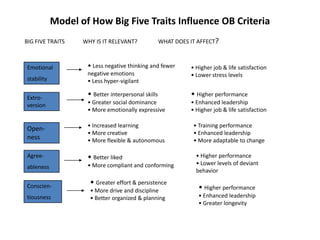
Model of How Big Five Traits Influence OB Criteria
BIG FIVE TRAITS

Emotional
stability

WHY IS IT RELEVANT?

WHAT DOES IT AFFECT?

• Less negative thinking and fewer
negative emotions
• Less hyper-vigilant

• Higher job & life satisfaction
• Lower stress levels

• Better interpersonal skills

• Higher performance

• Greater social dominance
• More emotionally expressive

• Enhanced leadership
• Higher job & life satisfaction

Openness

• Increased learning
• More creative
• More flexible & autonomous

• Training performance
• Enhanced leadership
• More adaptable to change

Agree-

• Better liked

ableness

• More compliant and conforming

Extroversion

Conscientiousness

• Greater effort & persistence
• More drive and discipline
• Better organized & planning

• Higher performance
• Lower levels of deviant
behavior

• Higher performance
• Enhanced leadership
• Greater longevity
Other Personality Traits Relevant to OB
• Core Self-Evaluation (self-esteem, self-reliance, inferiority complex)
People who have positive core self-evaluations like themselves and see
themselves as effective, capable, and in control of their environment. Those with
negative core self-evaluations tend to dislike themselves, question their
capabilities, and view themselves as powerless. People with positive core selfevaluations perform better than others. But overconfidence often causes bad
decisions in organization.

• Risk Taking People differ in their willingness to take chances, a quality that affects

•

how much time and information they need to make a decision. High risk-taking
managers made more rapid decisions and used less information than did the low
risk takers. But sometimes they can lose.
Machiavellianism - is named after Niccolo Machiavelli, who wrote in the sixteenth
century on how to gain and use power. An individual high in Machiavellianism is
pragmatic, maintains emotional distance, and believes ends can justify means (“If
it works, use it”). High Machs like their jobs less, are more stressed by their work,
and engage in more deviant work behaviors
Other Personality Traits Relevant to OB
(continuation)

• Locus of Control – can be internal or external. Some people believe, that
they are masters of their own fate (internal locus). Another – think that
what happens to them is due to luck of chance, or other.
• Self-Monitoring Individuals high in self-monitoring show considerable
adaptability in adjusting their behavior to external situational factors. They
are highly sensitive to external cues and can behave differently in different
situations, sometimes presenting striking contradictions between their
public persona and their private self. Low self-monitors can’t disguise
themselves in that way.
• Proactive Personality Those with a proactive personality identify
opportunities, show initiative, take action, and persevere until meaningful
change occurs, compared to others who passively react to situations.
Proactives create positive change in their environment
Holland’s personality–job fit theory
Occupational Personality Types: The theory argues that satisfaction is highest and turnover lowest when
personality and occupation are in agreement.

• Realistic: Prefers physical activities require skill, strength, and coordination
(assembly-line worker, farmer
• Investigative: Prefers activities that involve thinking, organizing, and
independent. Analytical, original, curious, (Biologist, economist,
mathematician, news reporter)
• Social: Prefers activities that involve helping and developing others .
Sociable, friendly, cooperative, understanding ( Social worker, teacher,
counselor, clinical psychologist)
• Conventional: Prefers rule-regulated, orderly, and unambiguous activities.
Conforming, efficient, practical, unimaginative, inflexible . (Accountant,
corporate manager, bank teller, file clerk)
• Enterprising: Prefers verbal activities in which there are opportunities
influence others and attain power. Self-confident, ambitious, energetic,
domineering (Lawyer, real estate agent, public specialist, small business
manager)
• Artistic: Prefers ambiguous and unsystematic activities that allow creative
expression. Imaginative, disorderly, idealistic, emotional, impractical.
(Painter, musician, writer, interior decorator)

2 personality

  • 1.
    Personality Personality is thesum total of ways in which an individual reacts to and interacts with others. • Personality tests are useful in hiring decisions and help managers forecast who is best for a job. Personality tests are design so that to escape social desirability factors respondent might lie or practice impression management to create a good impression (when the scores can influence on hiring decisions)
  • 2.
    Personality Determinants Heredity orenvironment? Researchers in many different countries have studied thousands of sets of identical twins who were separated at birth and raised separately. Twins raised apart have much in common, and a significant part of the behavioral similarity between them turns out to be associated with genetic factors. But some traits are undoubtedly fostering in family. Researchers tried to find characteristics that describe an individual’s behavior, including shy, aggressive, submissive, lazy, ambitious, loyal, and timid. These efforts often resulted in long lists. Recently for identifying and classifying traits and describe personality two models are used: The Myers-Briggs Type Indicator (MBTI) and Big Five Model.
  • 3.
    Big Five Modelof Personality Big Five Model clams that five basic dimensions underlie all others and encompass most of the significant variation in human personality. Test scores of these traits can predict how people behave in a variety of reallife situations. Big Five factors: ● Extraversion. ● Agreeableness. ● Conscientiousness. ● Emotional stability. ● Openness to experience.
  • 4.
    Big Five factors Extraversion.The extraversion dimension captures our comfort level with relationships. Extraverts tend to be gregarious, assertive, and sociable. Introverts tend to be reserved, timid, and quiet. ● Agreeableness. The agreeableness dimension refers to an individual’s propensity to defer to others. Highly agreeable people are cooperative, warm, and trusting. People who score low on agreeableness are cold, disagreeable, and antagonistic. ● Conscientiousness. The conscientiousness dimension is a measure of reliability. A highly conscientious person is responsible, organized, dependable, and persistent. Those who score low on this dimension are easily distracted, disorganized, and unreliable. ● Emotional stability. The emotional stability dimension—often labeled by its converse, neuroticism—taps a person’s ability to withstand stress. People with positive emotional stability tend to be calm, self-confident, and secure. Those with high negative scores tend to be nervous, anxious, depressed, and insecure. ● Openness to experience. The openness to experience dimension addresses range of interests and fascination with novelty. Extremely open people are creative, curious, and artistically sensitive. Those at the other end of the category are conventional and find comfort in the familiar.
  • 5.
    How Do theBig Five Traits Predict Behavior at Work? There are relationships between these personality dimensions and job performance. Conscientiousness Individuals who are dependable, reliable, careful, thorough, able to plan, organized, hardworking, persistent, and achievement-oriented tend to have higher job performance in most if not all occupations. Employees who score higher in conscientiousness develop higher levels of job knowledge. However, extremely conscientious individuals typically do not perform better than those who are simply above average in conscientiousness. Interestingly, conscientious people live longer because they take better care of themselves (they eat better and exercise more) and engage in fewer risky behaviors like smoking, drinking and drugs, and risky sexual or driving behavior. They are generally performance oriented and have more trouble learning complex skills early in the training process because their focus is on performing well rather than on learning. Finally, they are often less creative than less conscientious people, especially artistically.
  • 6.
    How Do theBig Five Traits Predict Behavior at Work? • • Emotional stability is most strongly related to life satisfaction, job satisfaction, and low stress levels. Individuals with high scores are positive and optimistic and experience fewer negative emotions. People low on emotional stability are hypervigilant (looking for problems or impending signs of danger) and are especially vulnerable to the physical and psychological effects of stress. Extraverts tend to be happier in their jobs and in their lives as a whole. They experience more positive emotions than do introverts, and they more freely express these feelings. They also tend to perform better in jobs that require significant interpersonal interaction, they have more social skills—they usually have more friends and spend more time in social situations than introverts. Finally, extraversion is a relatively strong predictor of leadership emergence in groups; extraverts are more socially dominant, they are generally more assertive than introverts. One downside is that extraverts are more impulsive than introverts; more likely engage in risky behavior such as unprotected sex, drinking, and other impulsive or sensation-seeking acts. One study also found extraverts were more likely than introverts to lie during job interviews.
  • 7.
    How Do theBig Five Traits Predict Behavior at Work? Individuals who score high on openness to experience are more creative in science and art than those who score low. Because creativity is important to leadership, open people are more likely to be effective leaders, and more comfortable with ambiguity and change. They cope better with organizational change and are more adaptable in changing contexts. Recent evidence also suggests, however, that they are especially susceptible to workplace accidents. Agreeable people slightly are happier than disagreeable people. • When people choose romantic partners, friends, or organizational team members, agreeable individuals are usually their first choice. Agreeable individuals are better in interpersonally oriented jobs such as customer service. They also are more compliant and rule abiding and less likely to get into accidents as a result. People who are agreeable are more satisfied in their jobs and contribute to organizational performance by engaging in citizenship behavior. One downside is that agreeableness is associated with lower levels of career success (especially earnings).
  • 8.
    Traits That MatterMost to Business Success at Buyout Companies (SEO) Most Important Less Important Persistence Strong oral communication Attention to detail Teamwork Efficiency Flexibility/adaptability Analytical skills Enthusiasm Setting high standards Listening skills
  • 9.
    Model of HowBig Five Traits Influence OB Criteria BIG FIVE TRAITS Emotional stability WHY IS IT RELEVANT? WHAT DOES IT AFFECT? • Less negative thinking and fewer negative emotions • Less hyper-vigilant • Higher job & life satisfaction • Lower stress levels • Better interpersonal skills • Higher performance • Greater social dominance • More emotionally expressive • Enhanced leadership • Higher job & life satisfaction Openness • Increased learning • More creative • More flexible & autonomous • Training performance • Enhanced leadership • More adaptable to change Agree- • Better liked ableness • More compliant and conforming Extroversion Conscientiousness • Greater effort & persistence • More drive and discipline • Better organized & planning • Higher performance • Lower levels of deviant behavior • Higher performance • Enhanced leadership • Greater longevity
  • 10.
    Other Personality TraitsRelevant to OB • Core Self-Evaluation (self-esteem, self-reliance, inferiority complex) People who have positive core self-evaluations like themselves and see themselves as effective, capable, and in control of their environment. Those with negative core self-evaluations tend to dislike themselves, question their capabilities, and view themselves as powerless. People with positive core selfevaluations perform better than others. But overconfidence often causes bad decisions in organization. • Risk Taking People differ in their willingness to take chances, a quality that affects • how much time and information they need to make a decision. High risk-taking managers made more rapid decisions and used less information than did the low risk takers. But sometimes they can lose. Machiavellianism - is named after Niccolo Machiavelli, who wrote in the sixteenth century on how to gain and use power. An individual high in Machiavellianism is pragmatic, maintains emotional distance, and believes ends can justify means (“If it works, use it”). High Machs like their jobs less, are more stressed by their work, and engage in more deviant work behaviors
  • 11.
    Other Personality TraitsRelevant to OB (continuation) • Locus of Control – can be internal or external. Some people believe, that they are masters of their own fate (internal locus). Another – think that what happens to them is due to luck of chance, or other. • Self-Monitoring Individuals high in self-monitoring show considerable adaptability in adjusting their behavior to external situational factors. They are highly sensitive to external cues and can behave differently in different situations, sometimes presenting striking contradictions between their public persona and their private self. Low self-monitors can’t disguise themselves in that way. • Proactive Personality Those with a proactive personality identify opportunities, show initiative, take action, and persevere until meaningful change occurs, compared to others who passively react to situations. Proactives create positive change in their environment
  • 12.
    Holland’s personality–job fittheory Occupational Personality Types: The theory argues that satisfaction is highest and turnover lowest when personality and occupation are in agreement. • Realistic: Prefers physical activities require skill, strength, and coordination (assembly-line worker, farmer • Investigative: Prefers activities that involve thinking, organizing, and independent. Analytical, original, curious, (Biologist, economist, mathematician, news reporter) • Social: Prefers activities that involve helping and developing others . Sociable, friendly, cooperative, understanding ( Social worker, teacher, counselor, clinical psychologist) • Conventional: Prefers rule-regulated, orderly, and unambiguous activities. Conforming, efficient, practical, unimaginative, inflexible . (Accountant, corporate manager, bank teller, file clerk) • Enterprising: Prefers verbal activities in which there are opportunities influence others and attain power. Self-confident, ambitious, energetic, domineering (Lawyer, real estate agent, public specialist, small business manager) • Artistic: Prefers ambiguous and unsystematic activities that allow creative expression. Imaginative, disorderly, idealistic, emotional, impractical. (Painter, musician, writer, interior decorator)