Parallel and Perpendicular
Lines
Geometry
3.1 Pairs of Lines and Angles
Objectives: By the end of the lesson,
• I can identify lines and planes.
• I can identify parallel and perpendicular lines.
• I can identify pairs of angles formed by transversals.
3.1 Pairs of Lines and Angles
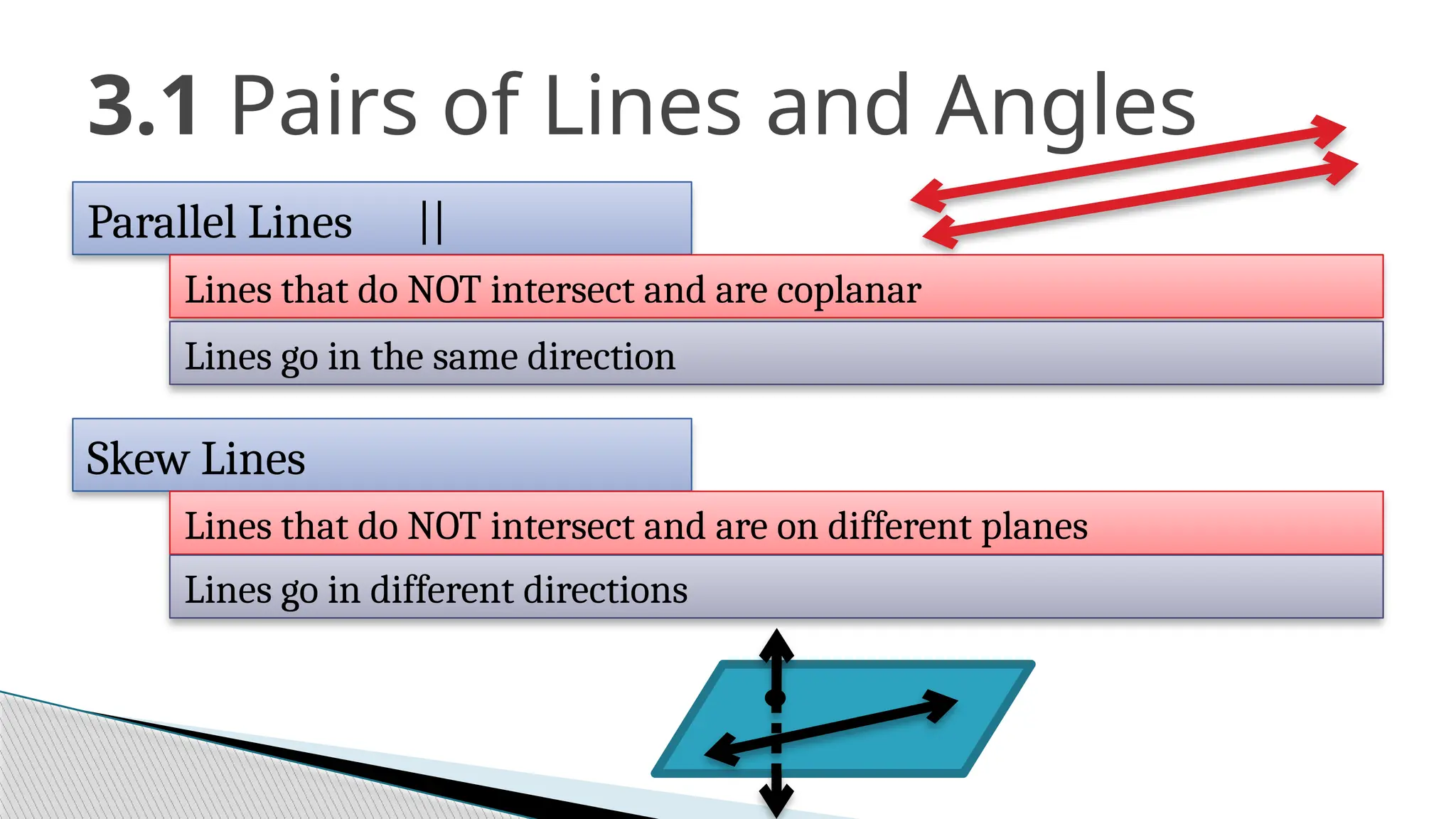
Parallel Lines ||
Lines that do NOT intersect and are coplanar
Lines go in the same direction
Skew Lines
Lines that do NOT intersect and are on different planes
Lines go in different directions

3.1 Pairs of Lines and Angles
 In a plane, two lines are either
◦ Parallel
◦ Intersect
3.1 Pairs of Lines and Angles
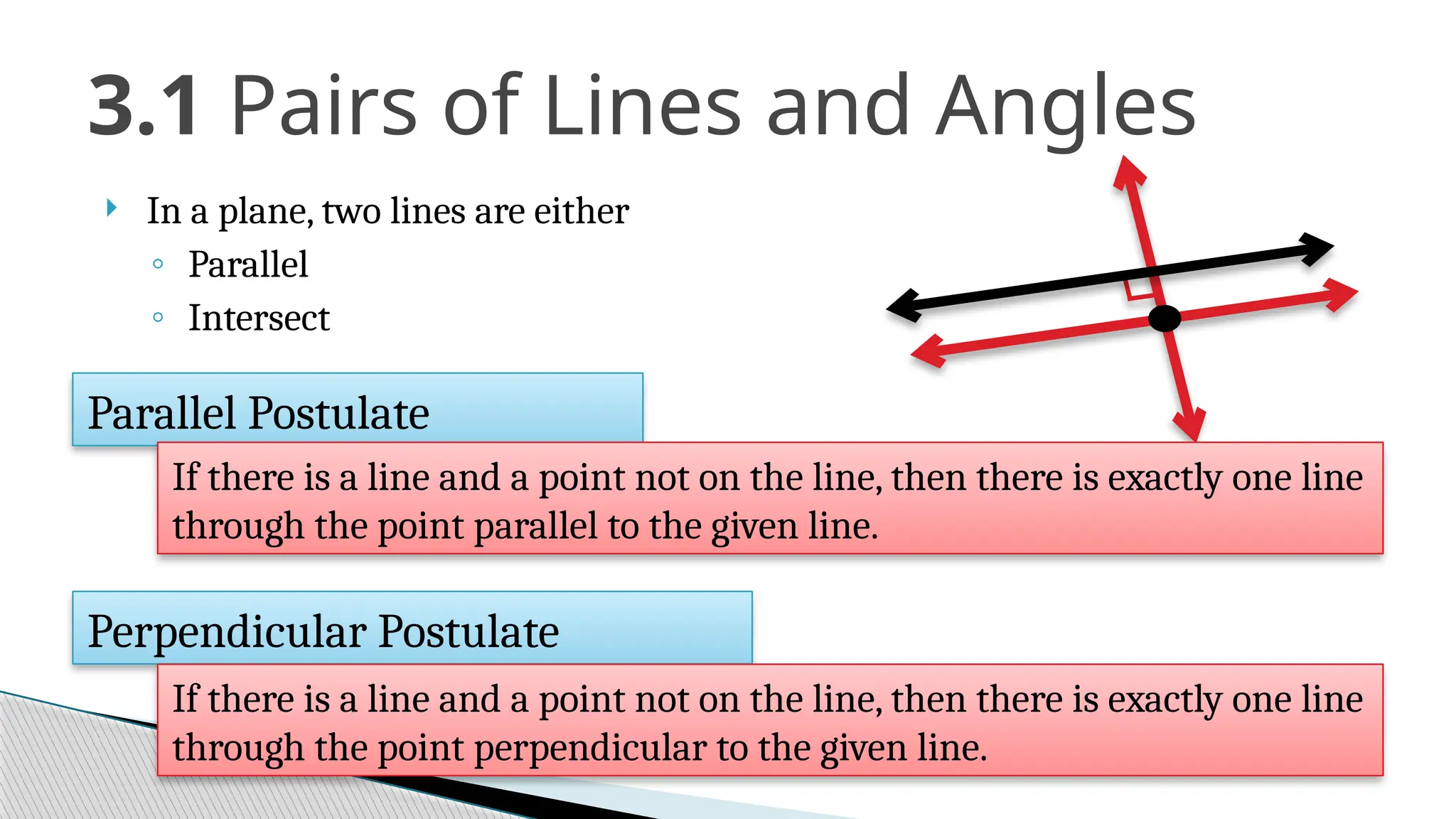
Parallel Postulate
If there is a line and a point not on the line, then there is exactly one line
through the point parallel to the given line.
Perpendicular Postulate
If there is a line and a point not on the line, then there is exactly one line
through the point perpendicular to the given line.
3.1 Pairs of Lines and Angles
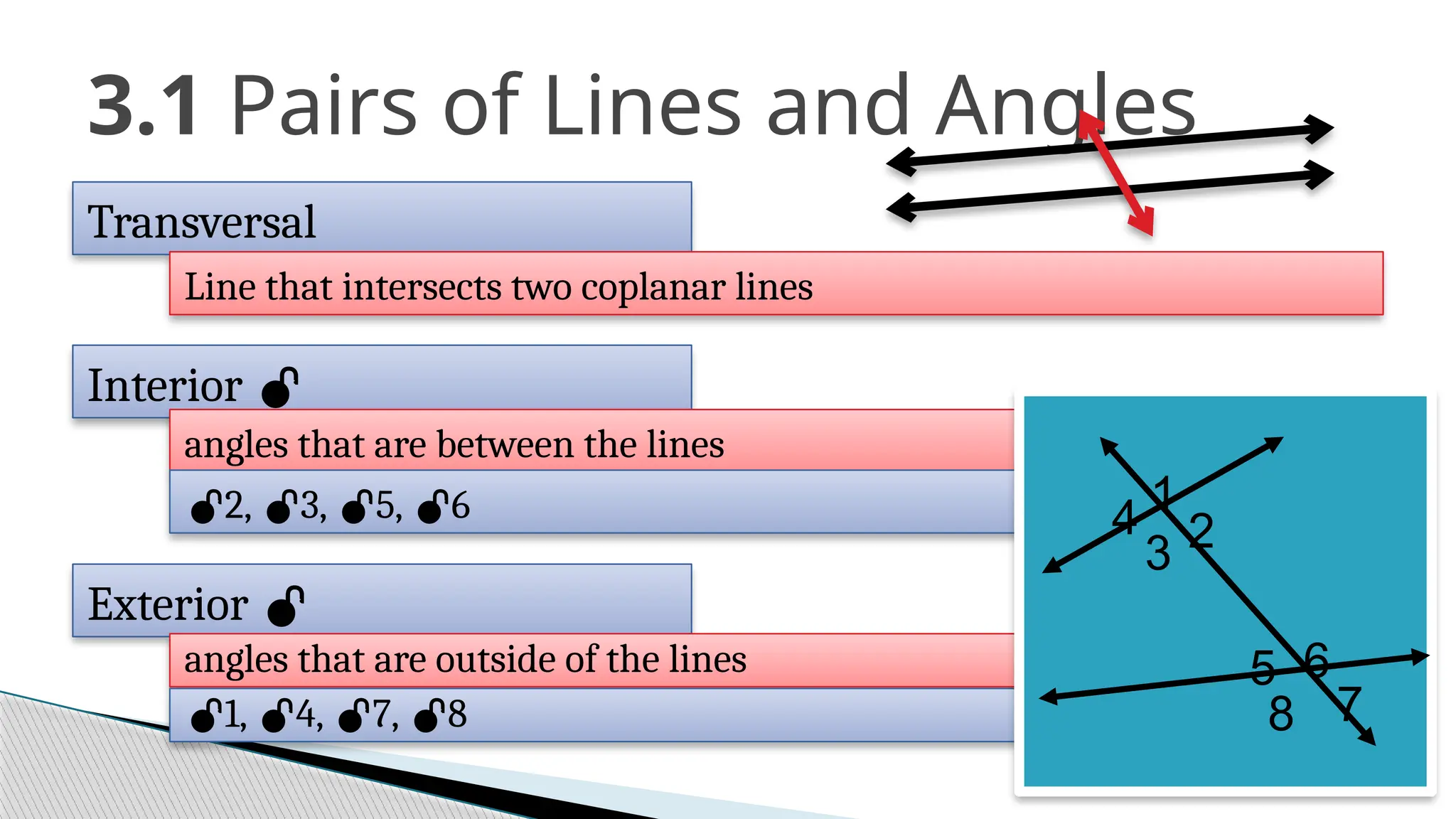
Transversal
Line that intersects two coplanar lines
Interior 
angles that are between the lines
2, 3, 5, 6
Exterior 
angles that are outside of the lines
1, 4, 7, 8
2
6
1
4
3
5
8 7
3.1 Pairs of Lines and Angles
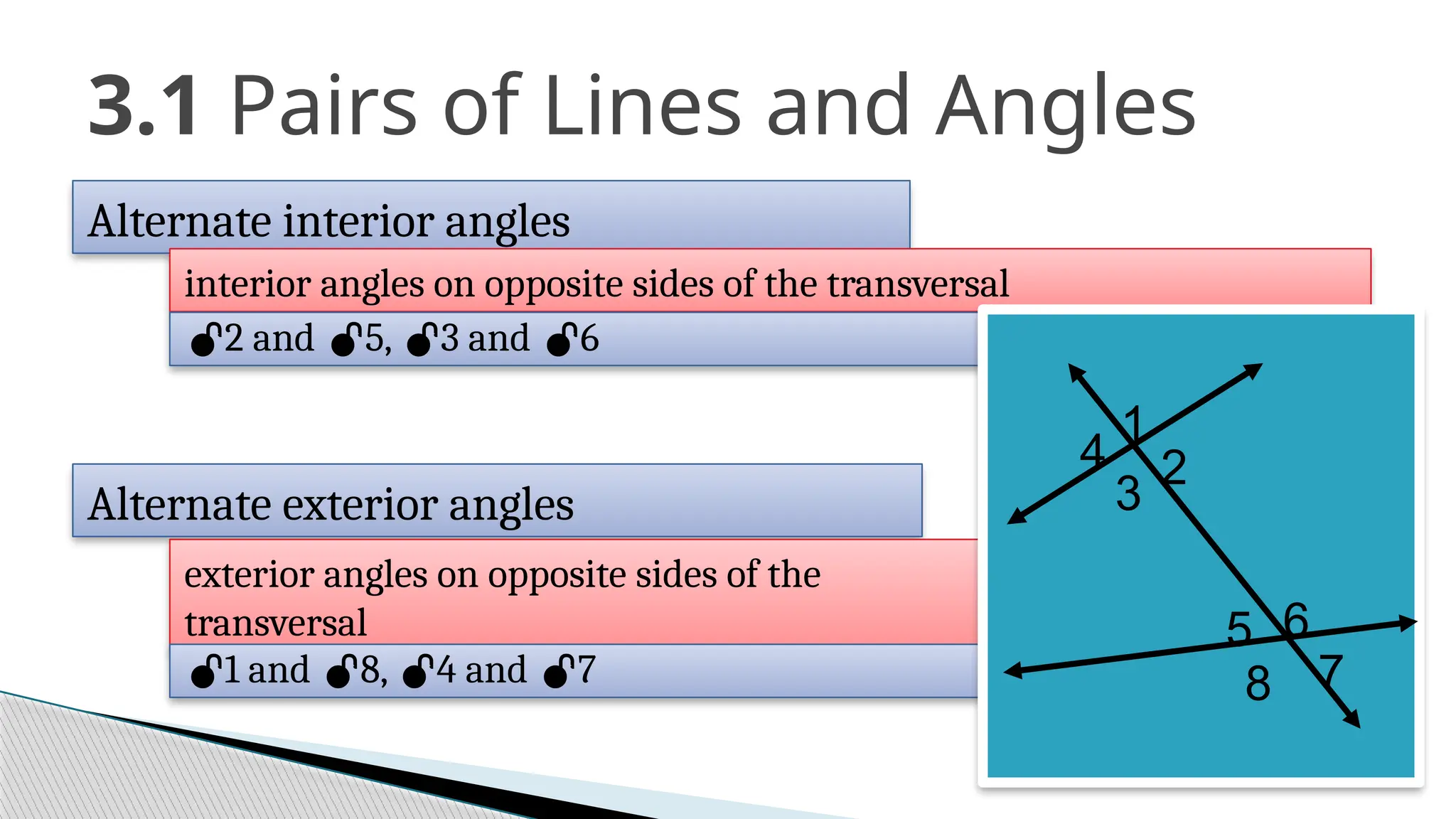
Alternate interior angles
interior angles on opposite sides of the transversal
2 and 5, 3 and 6
Alternate exterior angles
exterior angles on opposite sides of the
transversal
1 and 8, 4 and 7
2
6
1
4
3
5
8 7
3.1 Pairs of Lines and Angles
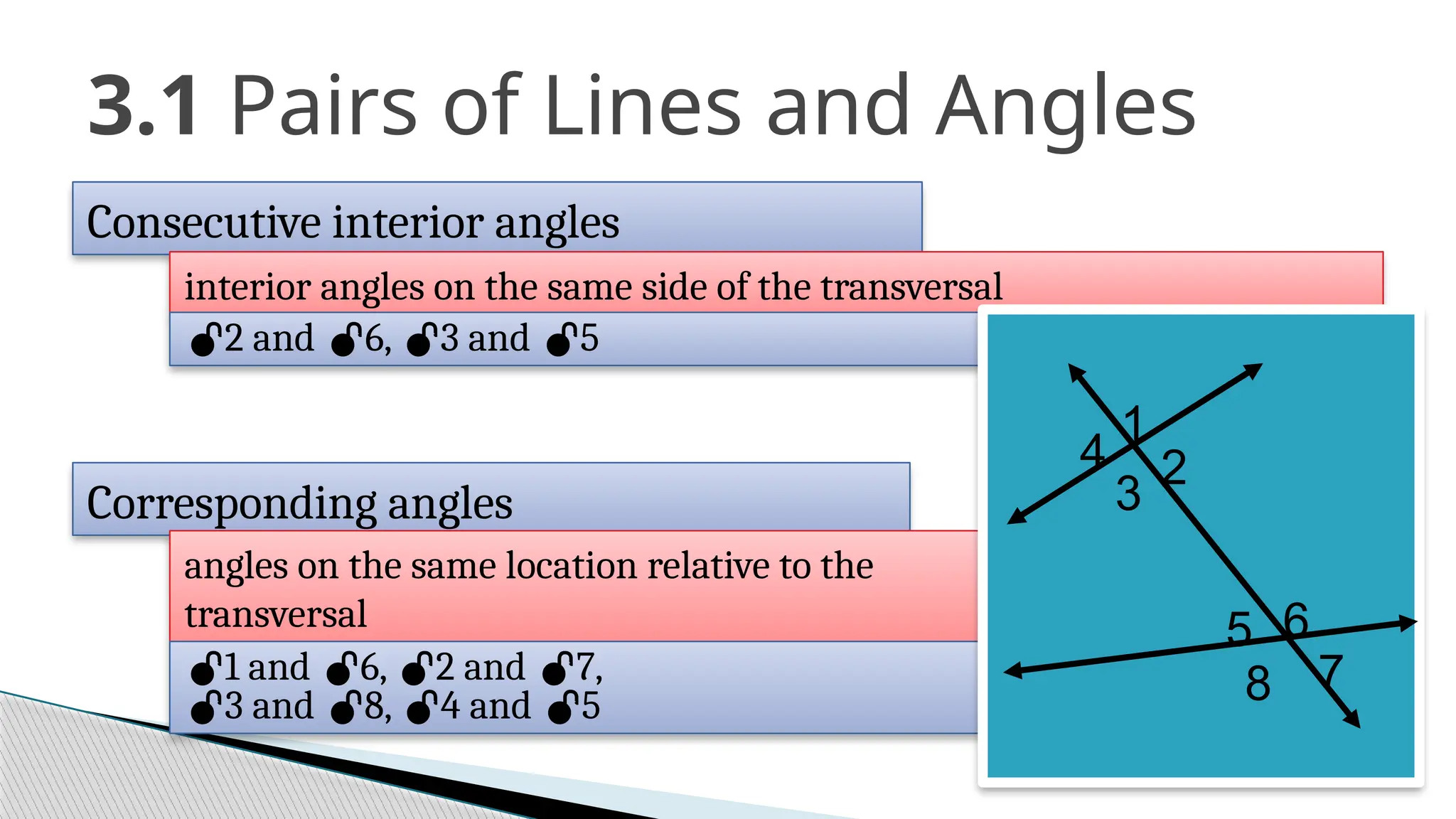
Corresponding angles
angles on the same location relative to the
transversal
1 and 6, 2 and 7,
3 and 8, 4 and 5
Consecutive interior angles
interior angles on the same side of the transversal
2 and 6, 3 and 5
2
6
1
4
3
5
8 7
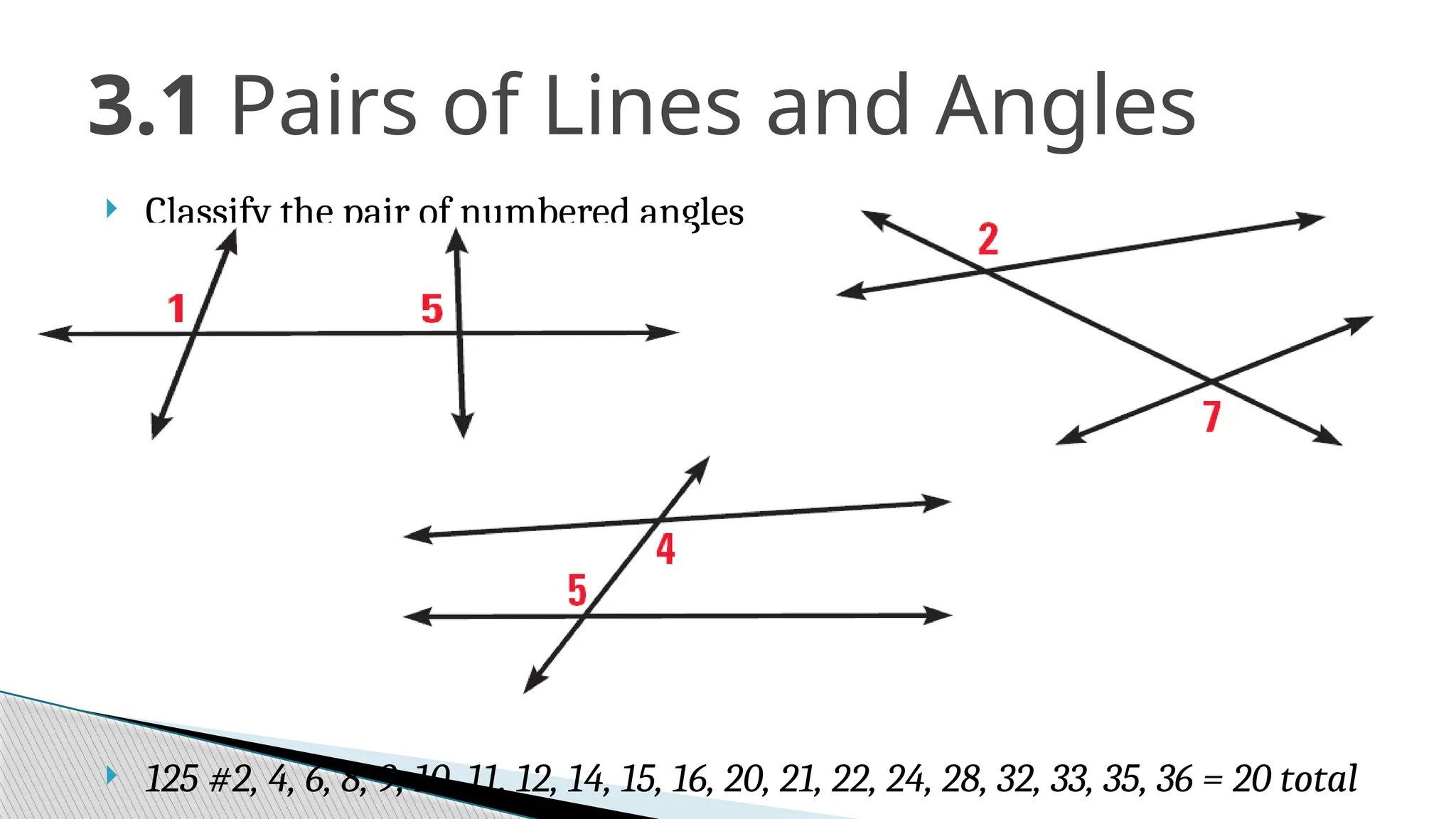
 Classify the pair of numbered angles
 125 #2, 4, 6, 8, 9, 10, 11, 12, 14, 15, 16, 20, 21, 22, 24, 28, 32, 33, 35, 36 = 20 total
3.1 Pairs of Lines and Angles
3.2 Parallel Lines and
Transversals
Objectives: By the end of the lesson,
• I can use properties of parallel lines to find angle measures.
• I can prove theorems about parallel lines.
3.2 Parallel Lines and Transversals
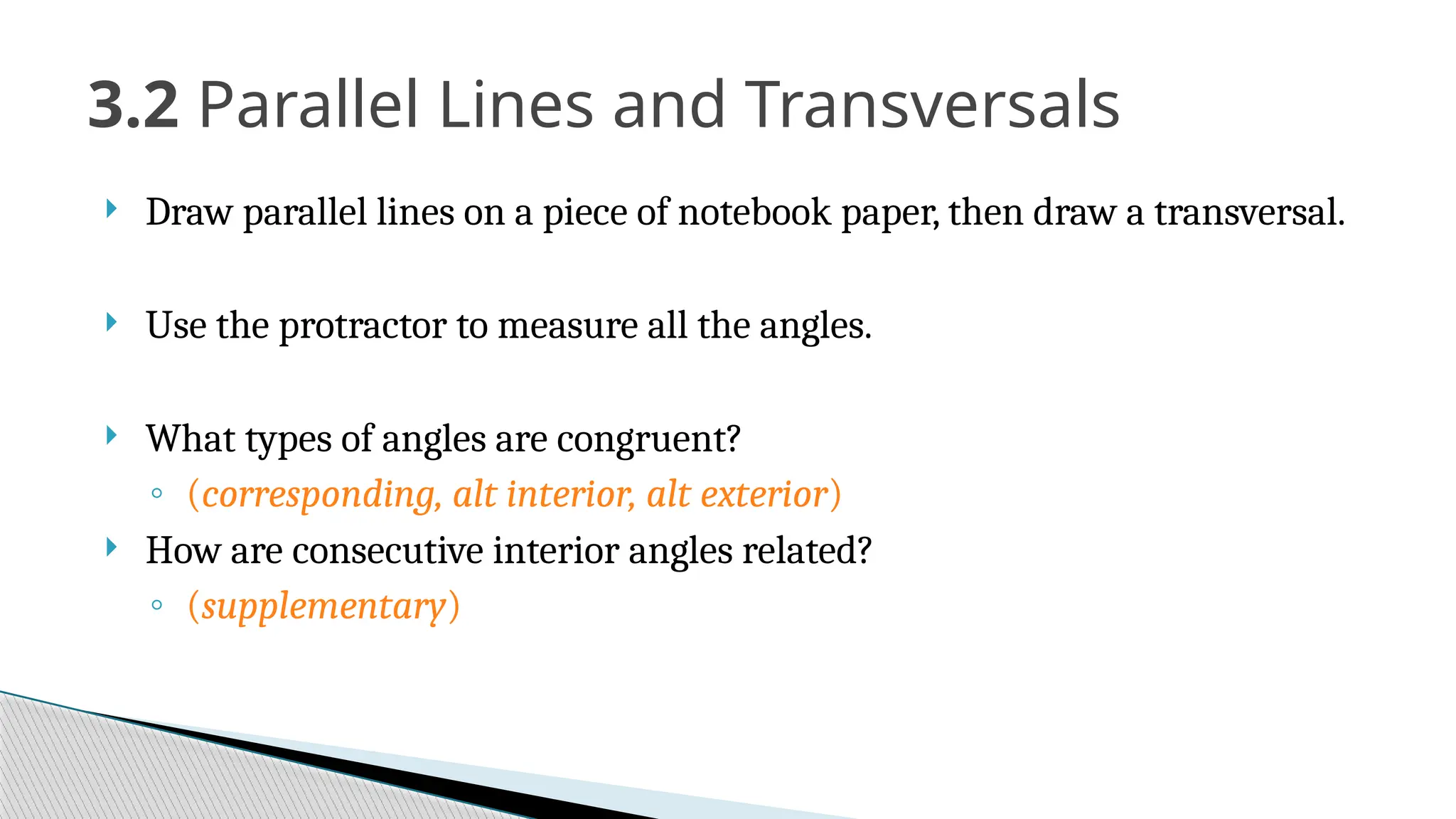
 Draw parallel lines on a piece of notebook paper, then draw a transversal.
 Use the protractor to measure all the angles.
 What types of angles are congruent?
◦ (corresponding, alt interior, alt exterior)
 How are consecutive interior angles related?
◦ (supplementary)
3.2 Parallel Lines and Transversals
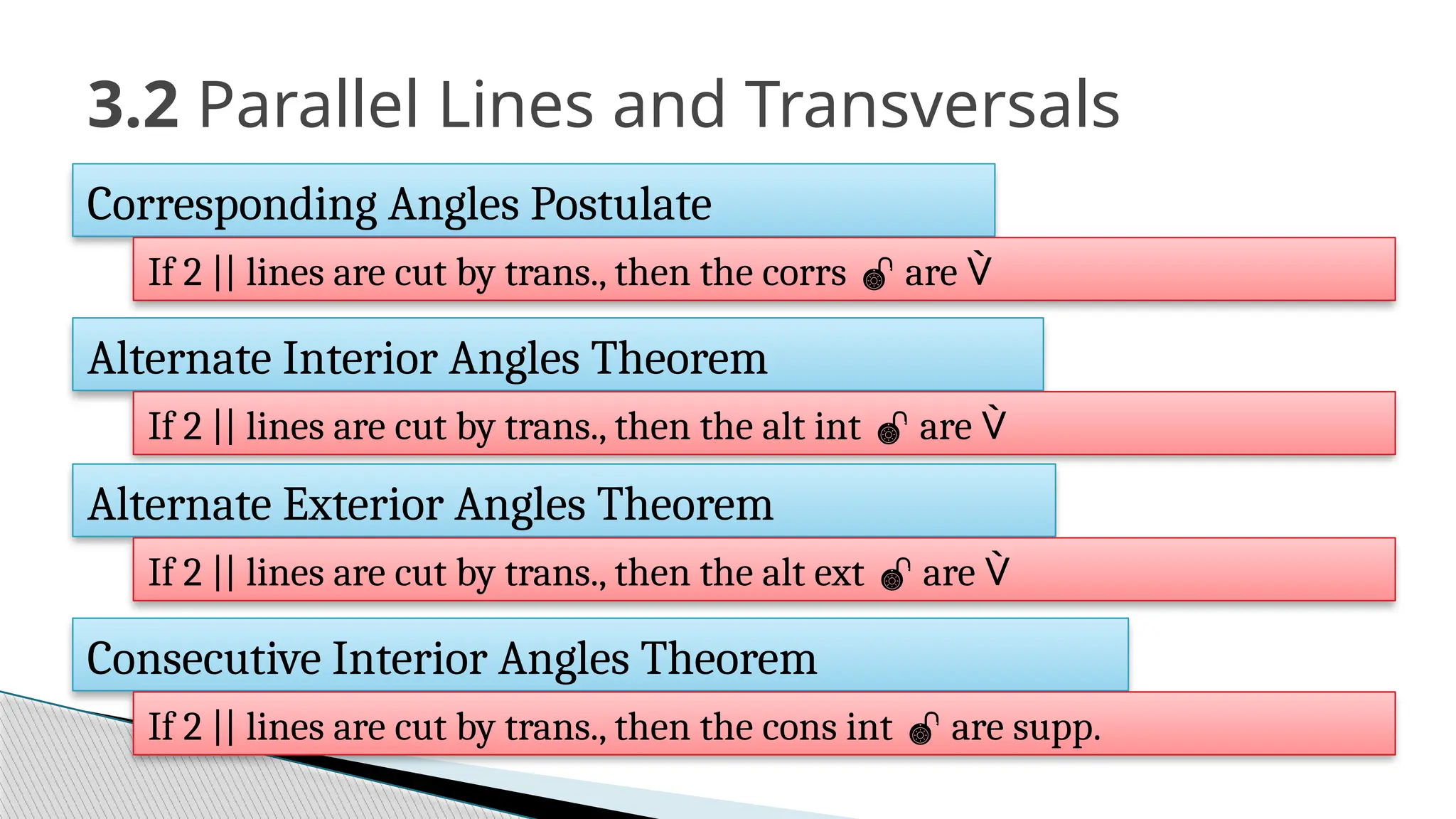
Corresponding Angles Postulate
If 2 || lines are cut by trans., then the corrs  are 
Alternate Interior Angles Theorem
If 2 || lines are cut by trans., then the alt int  are 
Alternate Exterior Angles Theorem
If 2 || lines are cut by trans., then the alt ext  are 
Consecutive Interior Angles Theorem
If 2 || lines are cut by trans., then the cons int  are supp.
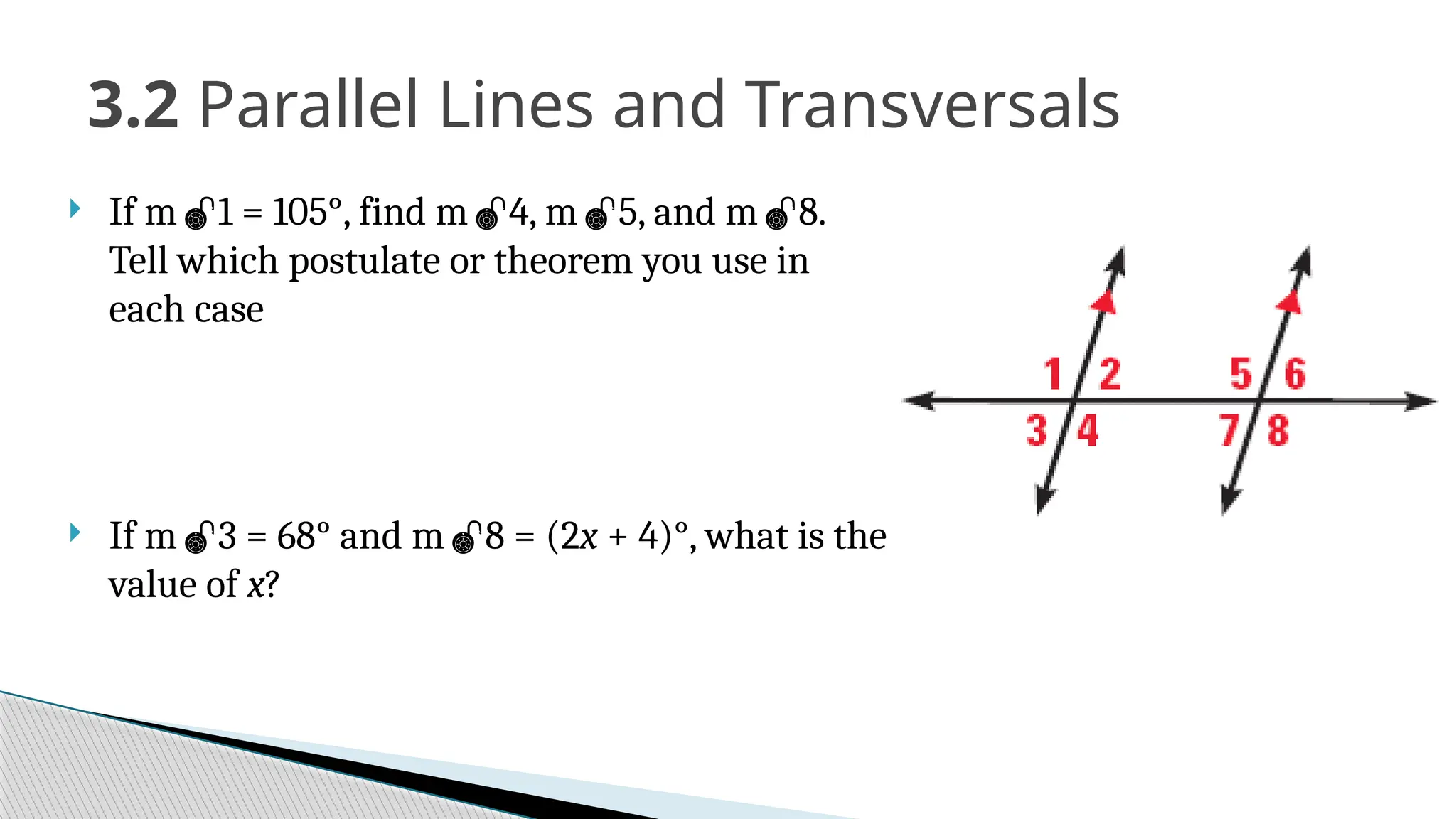
 If m1 = 105°, find m4, m5, and m8.
Tell which postulate or theorem you use in
each case
 If m3 = 68° and m8 = (2x + 4)°, what is the
value of x?
3.2 Parallel Lines and Transversals
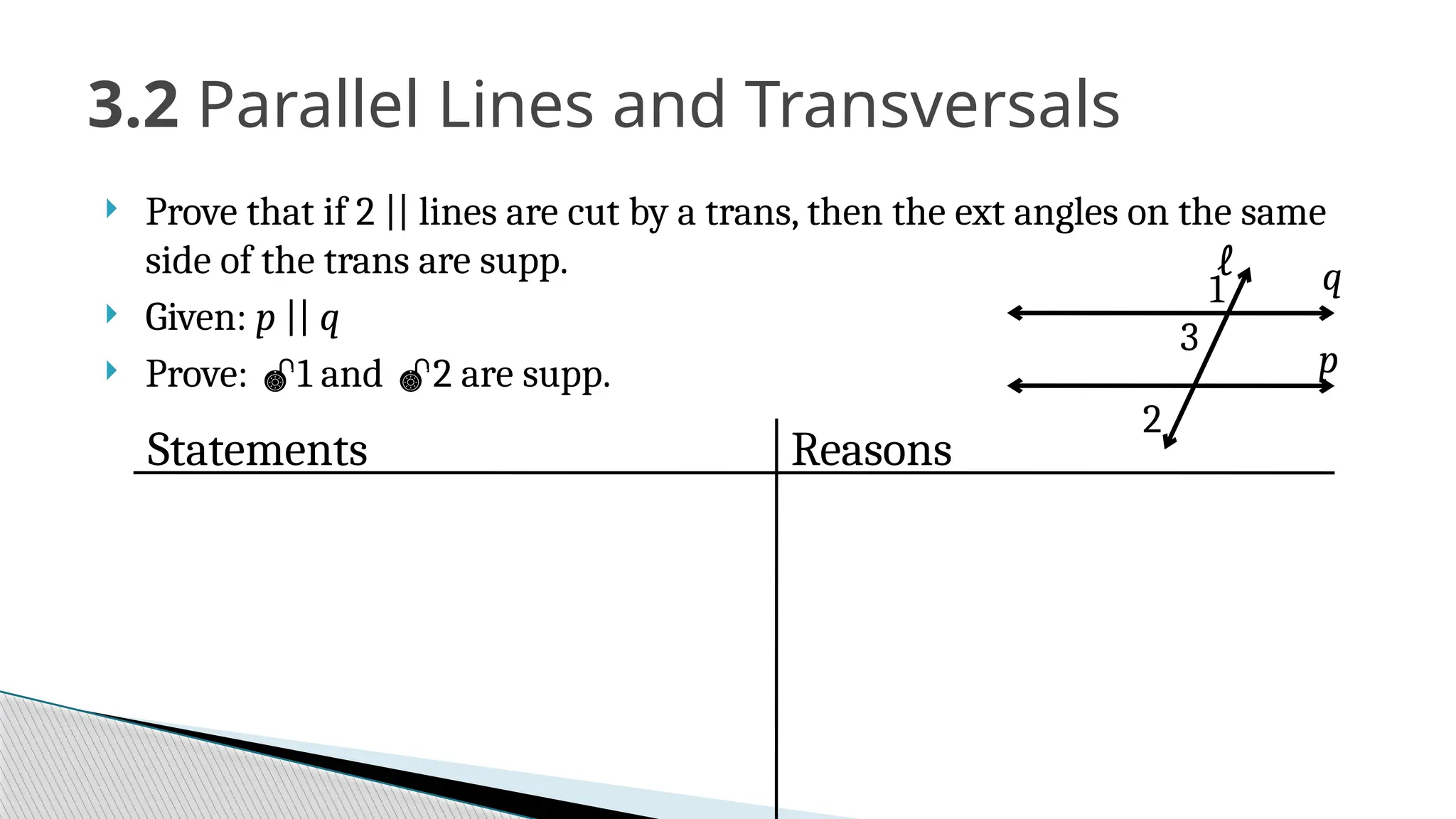
 Prove that if 2 || lines are cut by a trans, then the ext angles on the same
side of the trans are supp.
 Given: p || q
 Prove: 1 and 2 are supp.
Statements Reasons
q
p
ℓ
1
2
3
 131 #2, 4, 5, 6, 8, 10, 12, 14, 15, 18, 20, 22, 23, 24, 26, 29, 30, 32, 33, 38 = 20 total
3.2 Parallel Lines and Transversals
3.3 Proofs with Parallel Lines
Objectives: By the end of the lesson,
• I can use theorems to identify parallel lines.
• I can prove theorems about identifying parallel lines.
3.3 Prove Lines are Parallel
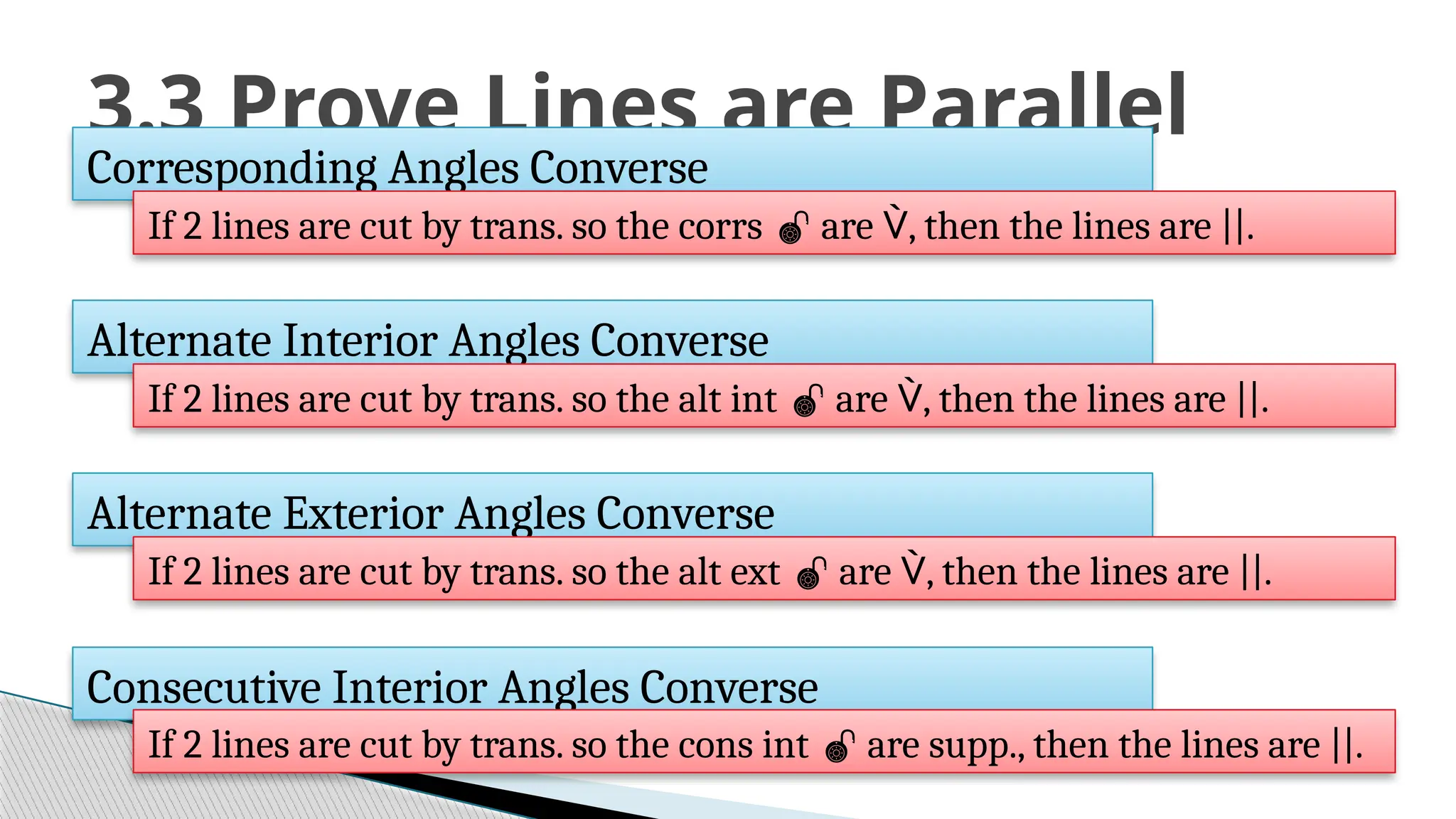
Corresponding Angles Converse
If 2 lines are cut by trans. so the corrs  are , then the lines are ||.
Alternate Interior Angles Converse
If 2 lines are cut by trans. so the alt int  are , then the lines are ||.
Alternate Exterior Angles Converse
If 2 lines are cut by trans. so the alt ext  are , then the lines are ||.
Consecutive Interior Angles Converse
If 2 lines are cut by trans. so the cons int  are supp., then the lines are ||.
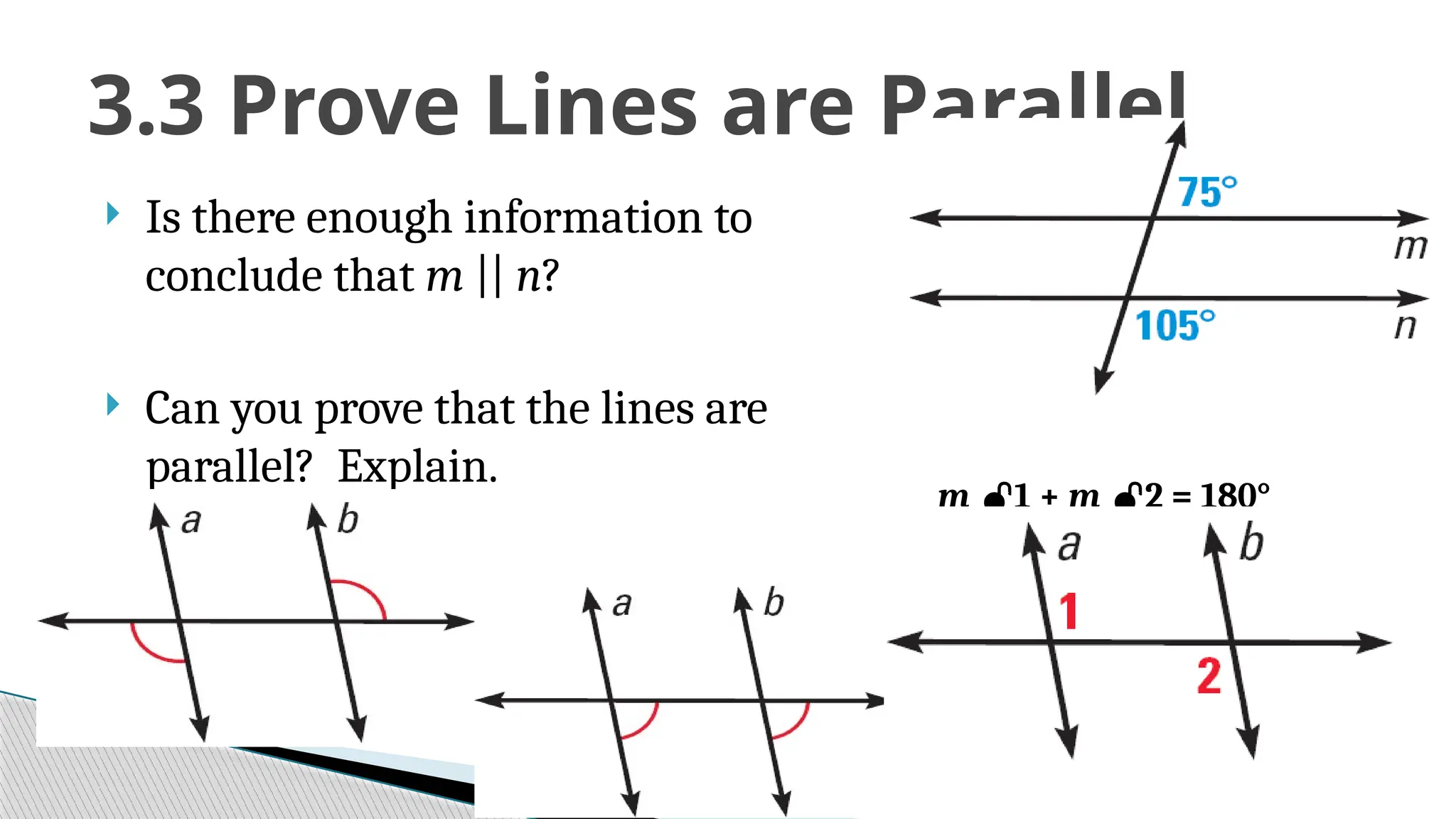
 Is there enough information to
conclude that m || n?
 Can you prove that the lines are
parallel? Explain.
3.3 Prove Lines are Parallel
m 1 + m 2 = 180°
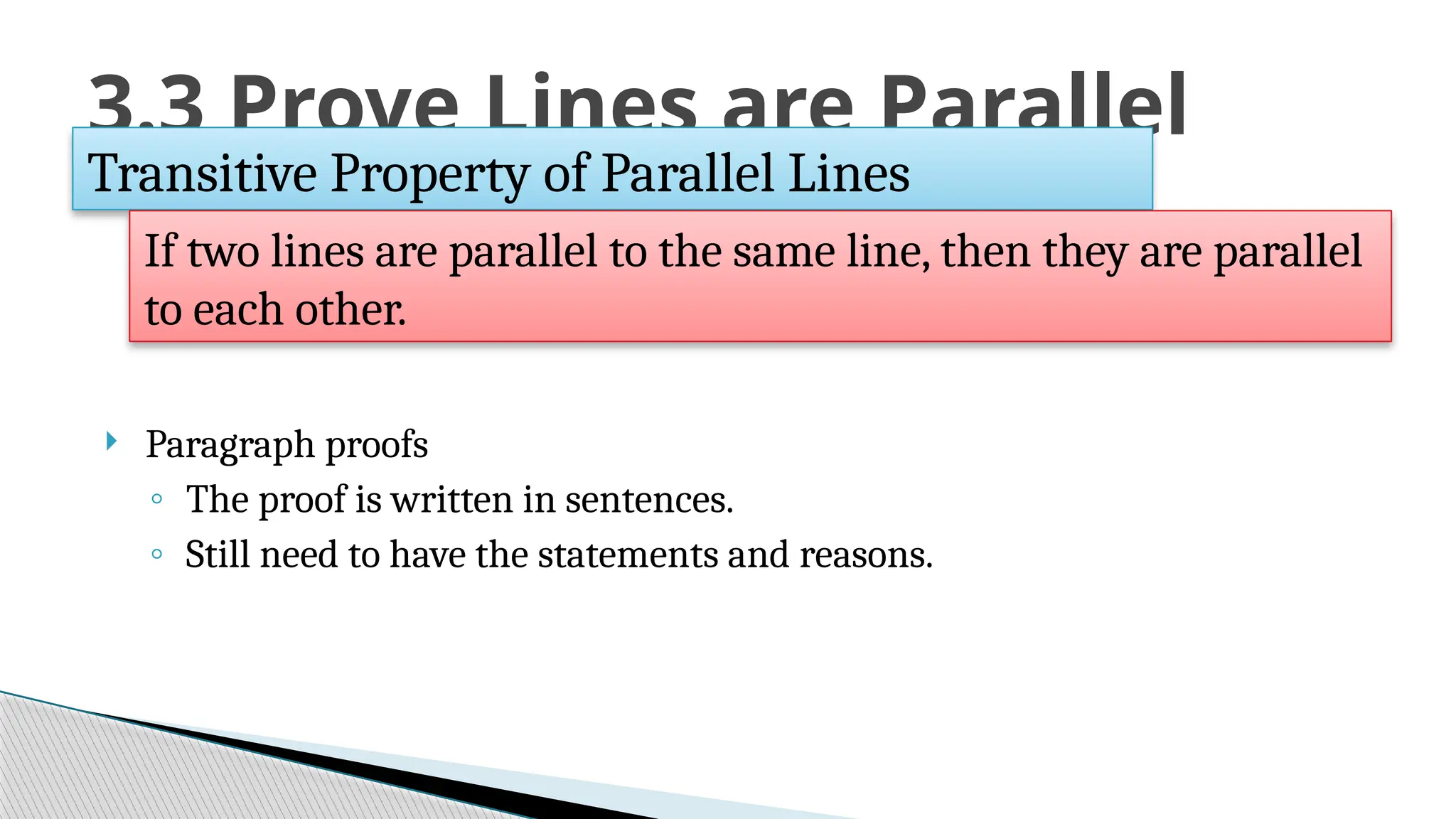
 Paragraph proofs
◦ The proof is written in sentences.
◦ Still need to have the statements and reasons.
3.3 Prove Lines are Parallel
Transitive Property of Parallel Lines
If two lines are parallel to the same line, then they are parallel
to each other.
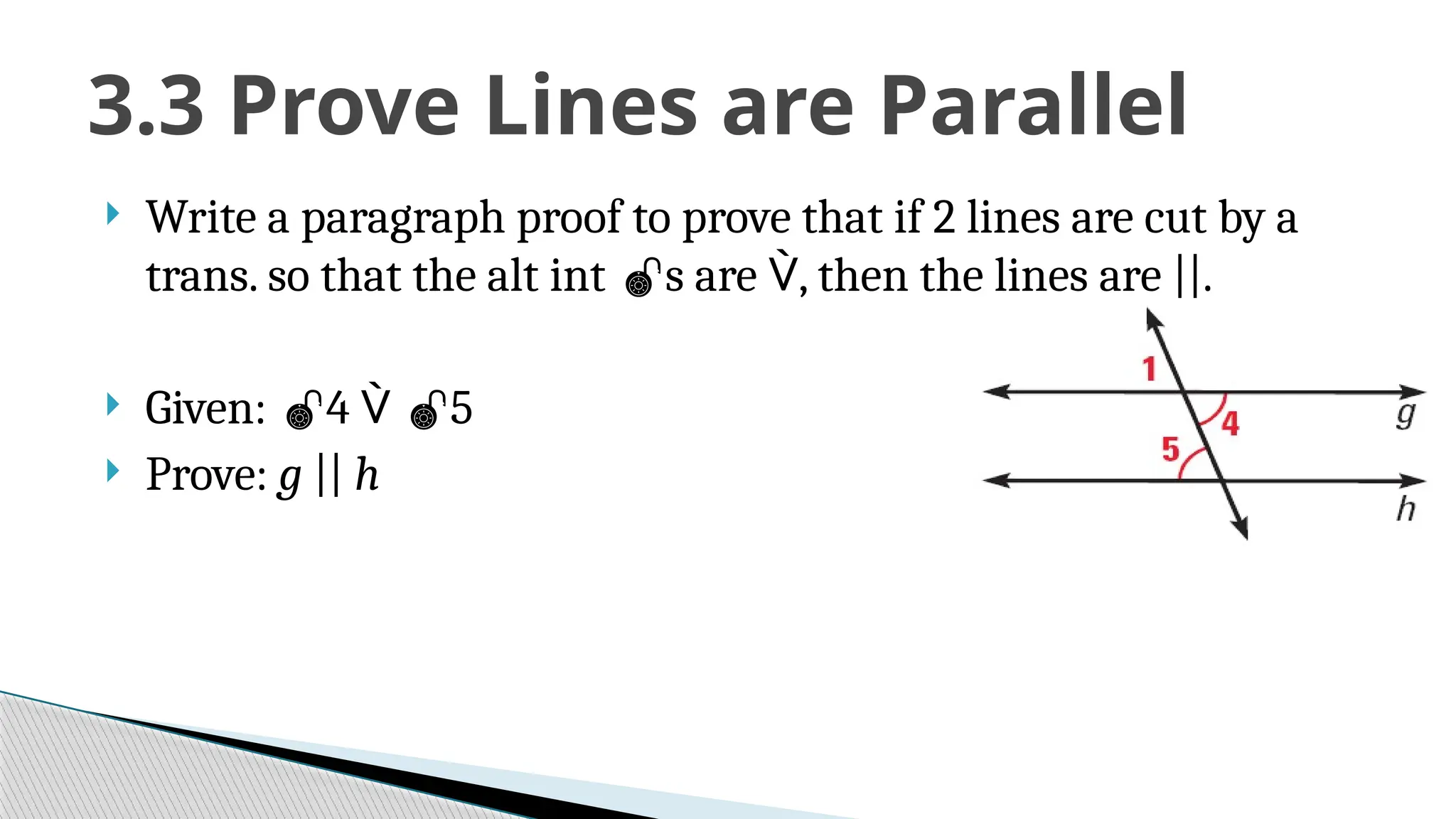
 Write a paragraph proof to prove that if 2 lines are cut by a
trans. so that the alt int s are , then the lines are ||.
 Given: 4  5
 Prove: g || h
3.3 Prove Lines are Parallel
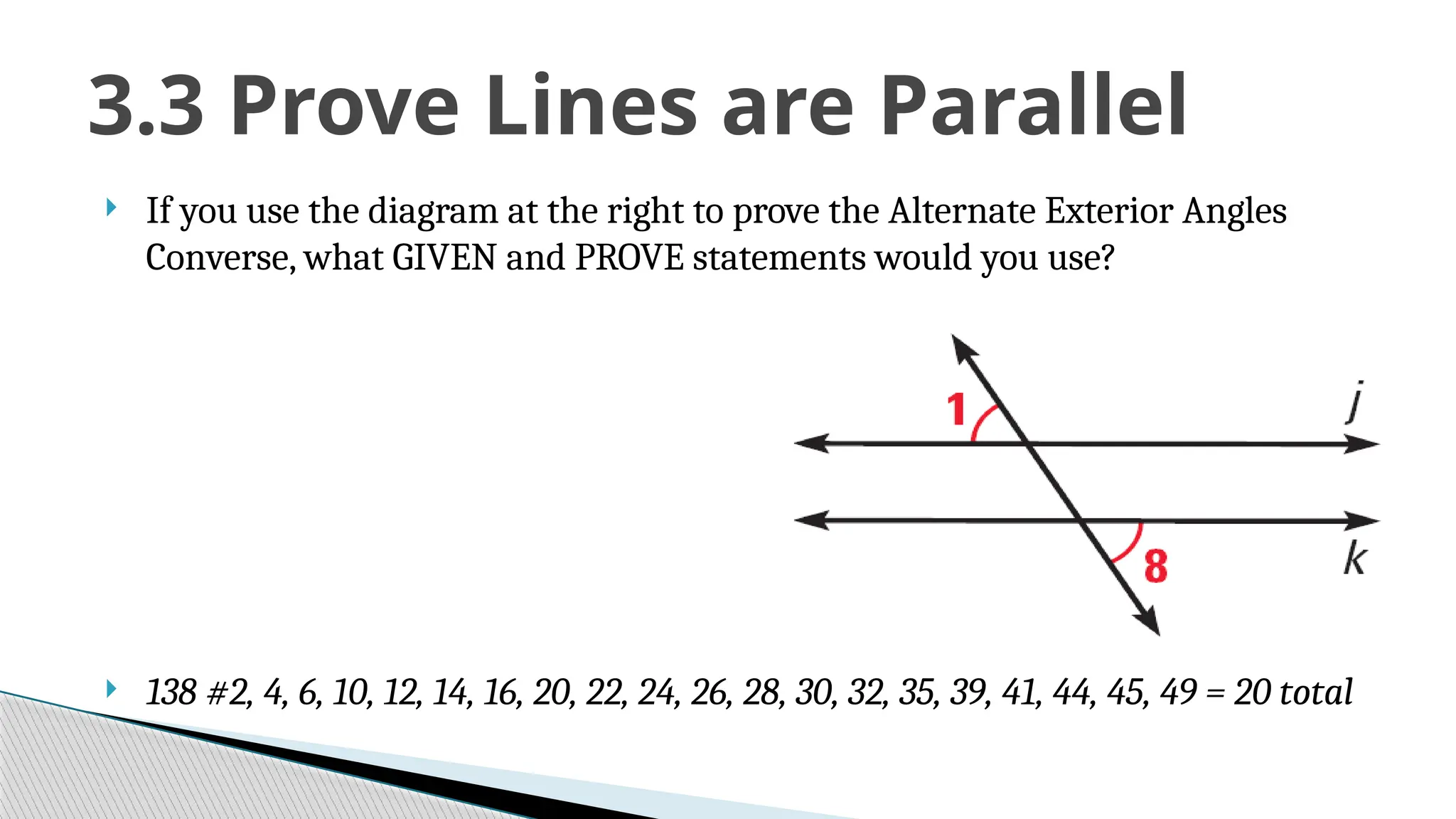
 If you use the diagram at the right to prove the Alternate Exterior Angles
Converse, what GIVEN and PROVE statements would you use?
 138 #2, 4, 6, 10, 12, 14, 16, 20, 22, 24, 26, 28, 30, 32, 35, 39, 41, 44, 45, 49 = 20 total
3.3 Prove Lines are Parallel
3.4 Proofs with Perpendicular
Lines
Objectives: By the end of the lesson,
• I can find the distance from a point to a line.
• I can prove theorems about perpendicular lines.
3.4 Proofs with Perpendicular Lines
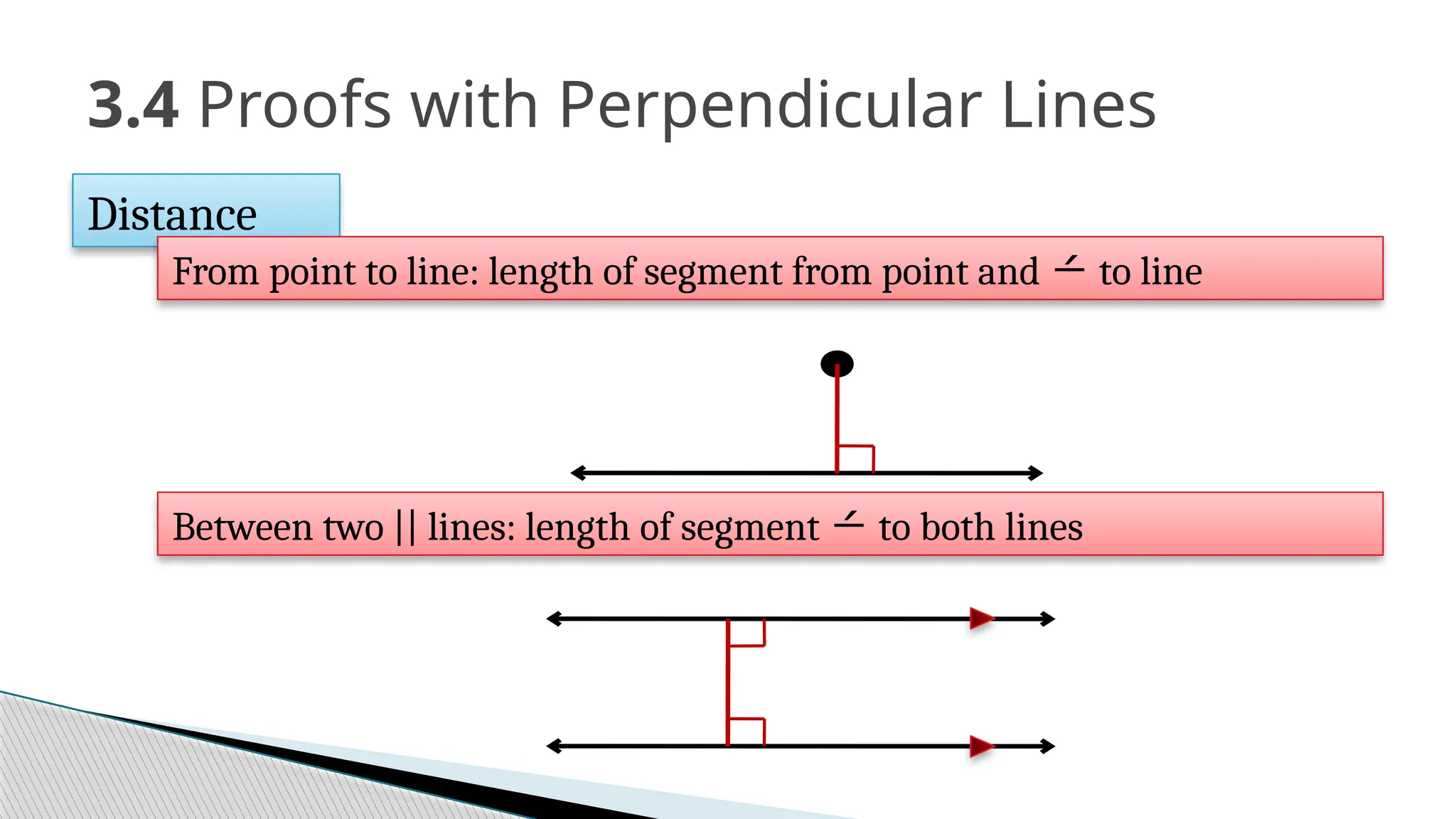
Distance
From point to line: length of segment from point and  to line
Between two || lines: length of segment  to both lines

3.4 Proofs with Perpendicular Lines
Linear Pair Perpendicular Theorem
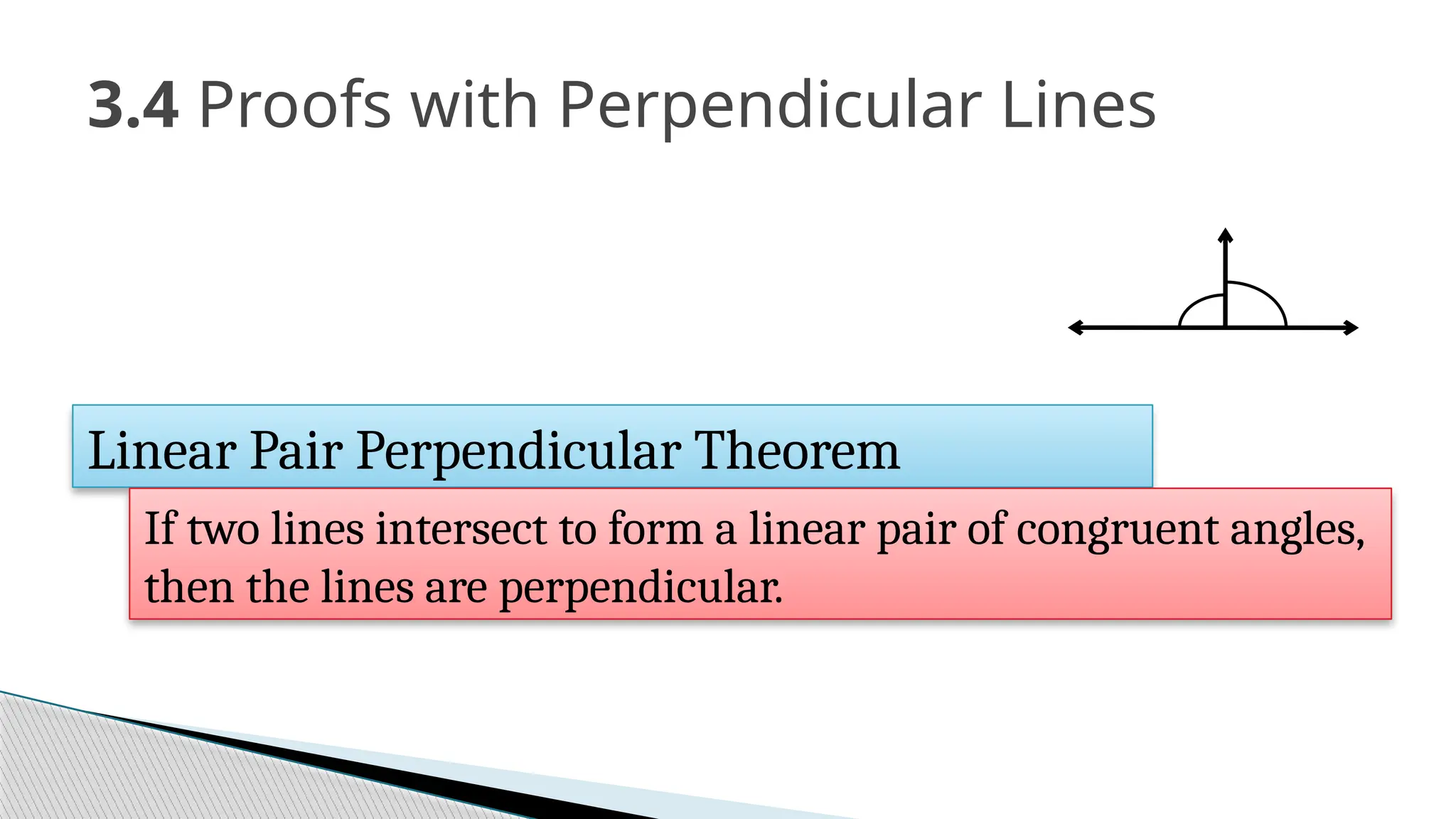
If two lines intersect to form a linear pair of congruent angles,
then the lines are perpendicular.
3.4 Proofs with Perpendicular Lines
Perpendicular Transversal Theorem
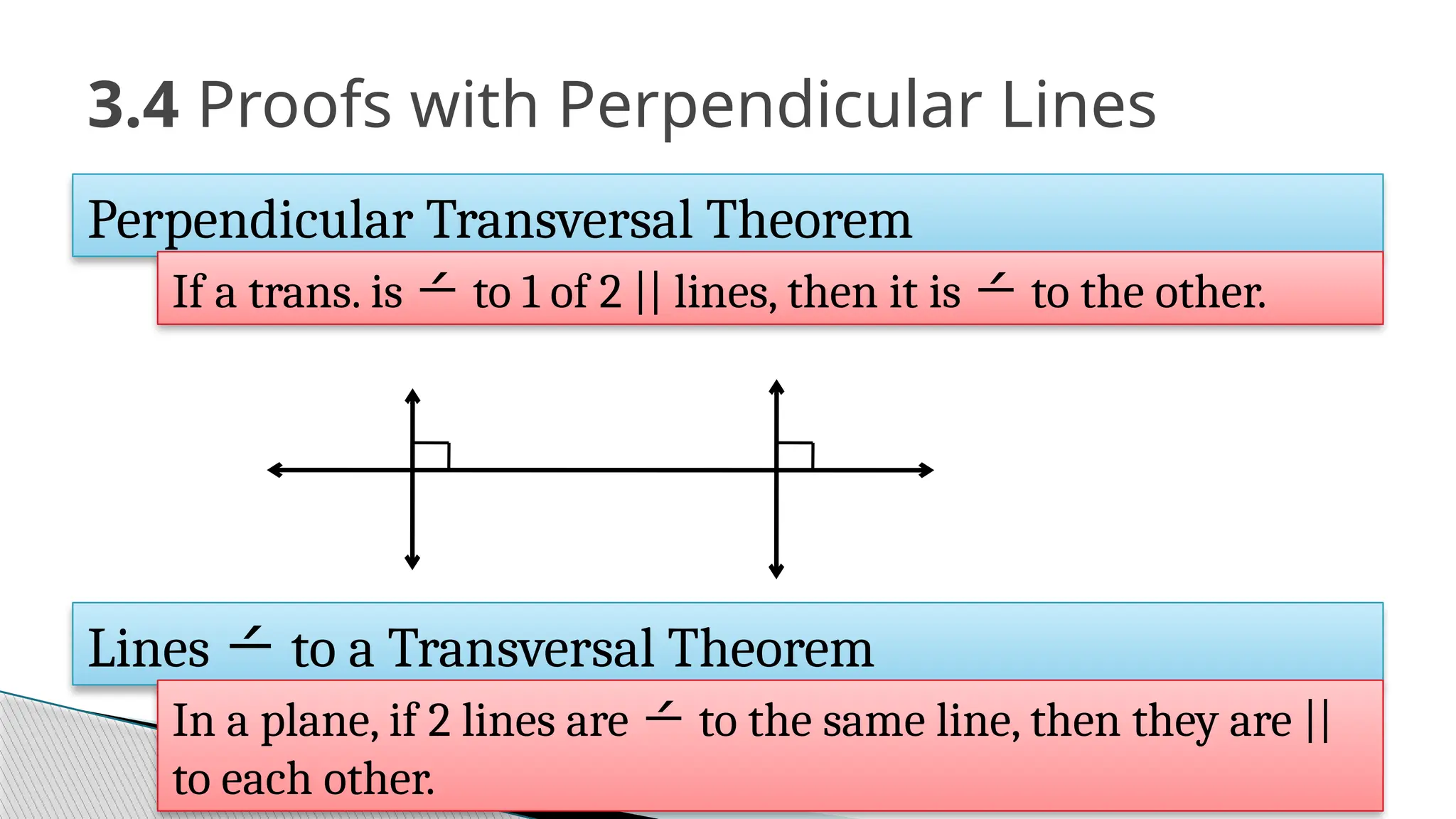
If a trans. is  to 1 of 2 || lines, then it is  to the other.
Lines  to a Transversal Theorem
In a plane, if 2 lines are  to the same line, then they are ||
to each other.
3.4 Proofs with Perpendicular Lines
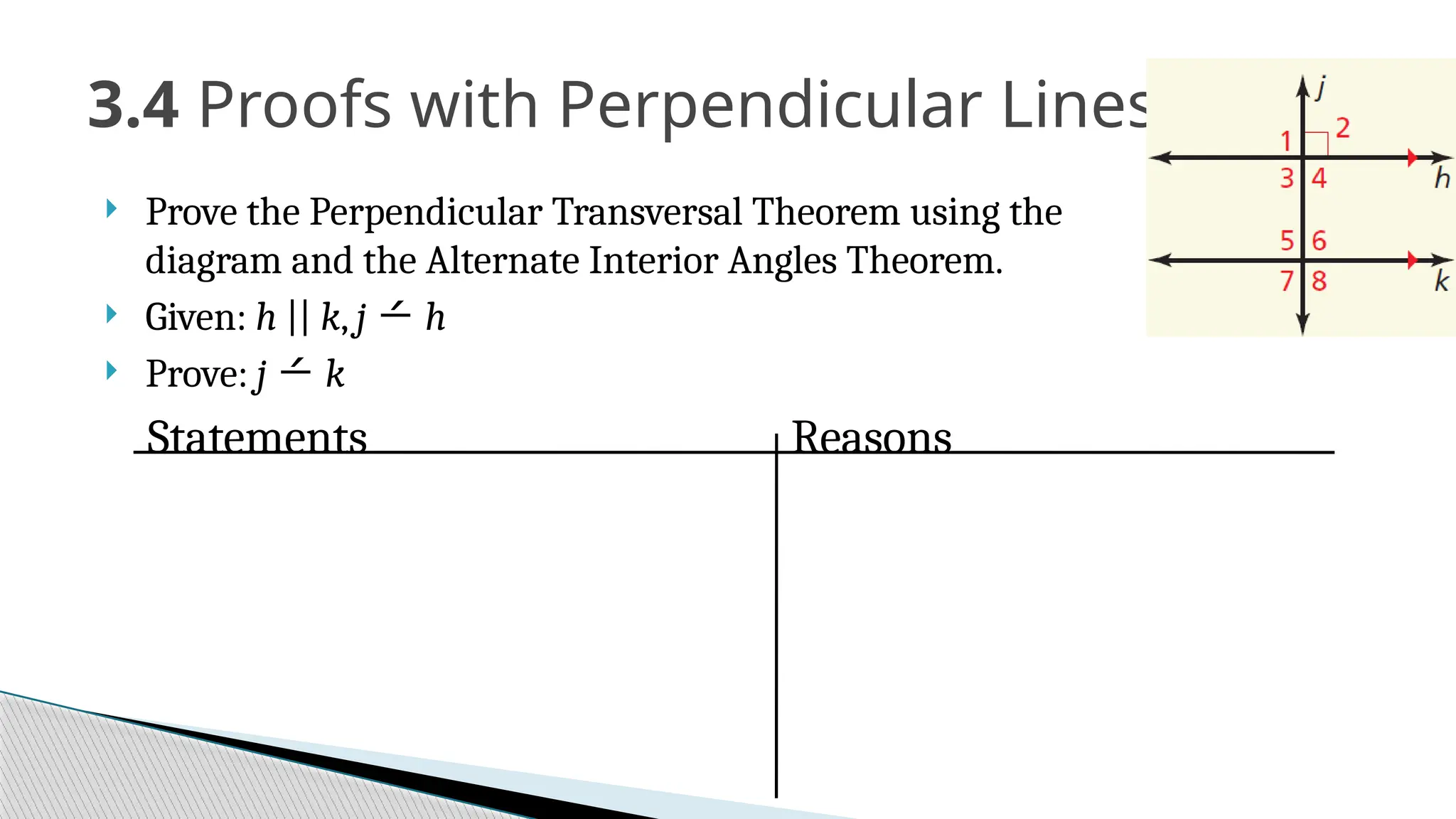
 Prove the Perpendicular Transversal Theorem using the
diagram and the Alternate Interior Angles Theorem.
 Given: h || k, j  h
 Prove: j  k
Statements Reasons
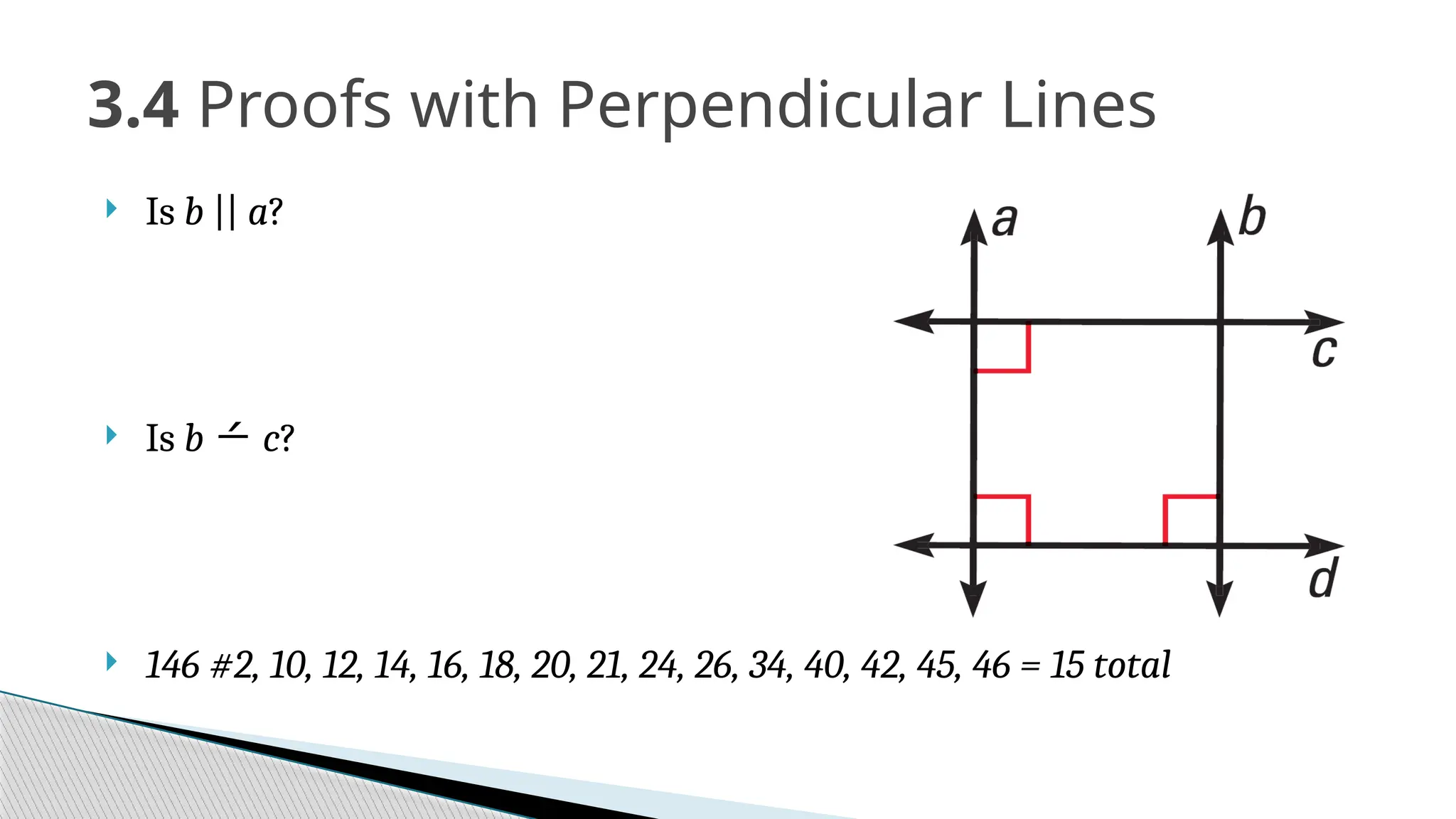
 Is b || a?
 Is b  c?
 146 #2, 10, 12, 14, 16, 18, 20, 21, 24, 26, 34, 40, 42, 45, 46 = 15 total
3.4 Proofs with Perpendicular Lines
3.5A Equations of Parallel and
Perpendicular Lines
Objectives: By the end of the lesson,
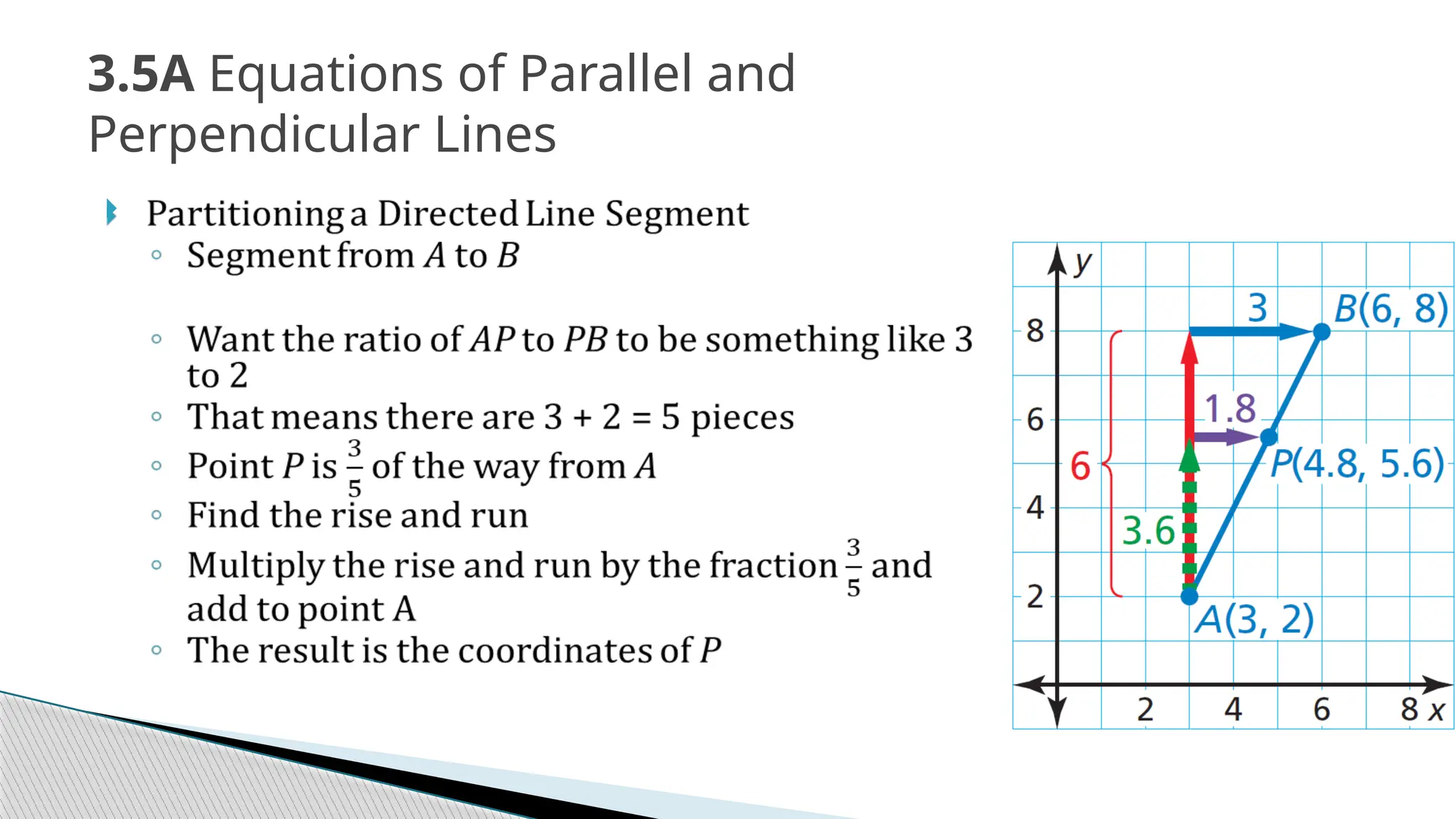
• I can partition directed line segments using slope.
• I can use slopes to identify parallel and perpendicular lines.

3.5A Equations of Parallel and
Perpendicular Lines
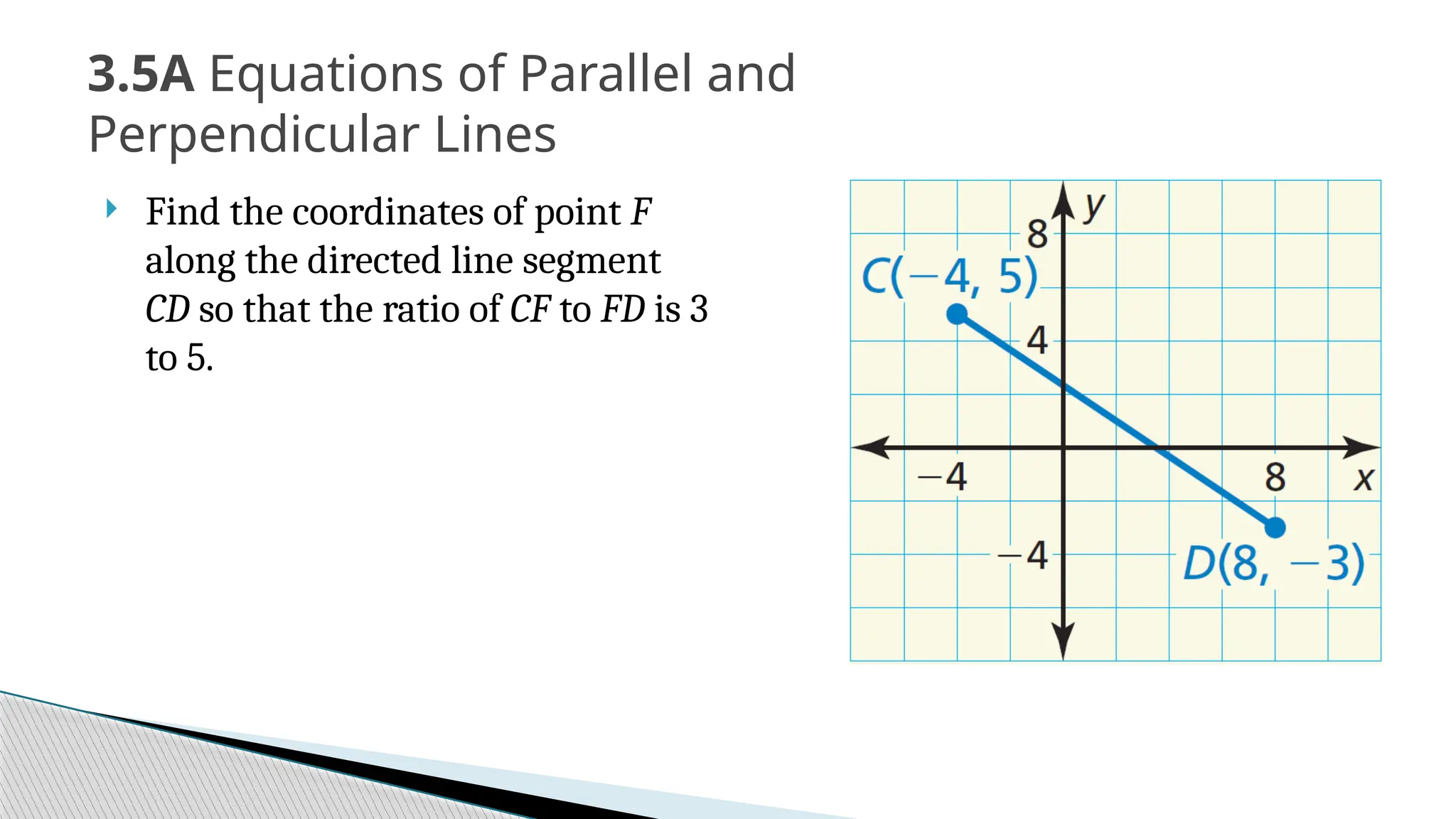
 Find the coordinates of point F
along the directed line segment
CD so that the ratio of CF to FD is 3
to 5.
3.5A Equations of Parallel and
Perpendicular Lines

3.5A Equations of Parallel and
Perpendicular Lines
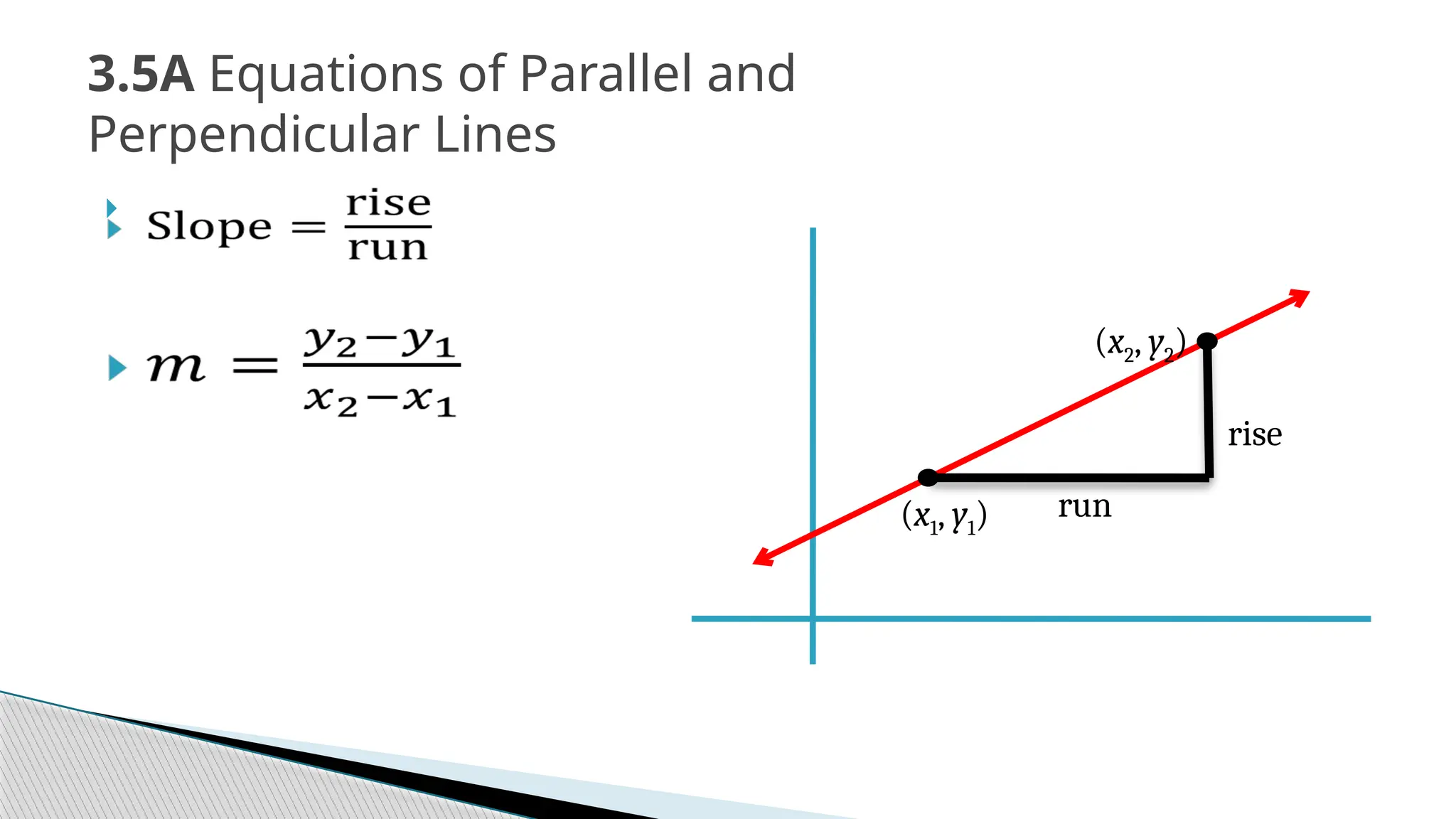
(x2, y2)
(x1, y1) run
rise
3.5A Equations of Parallel and
Perpendicular Lines
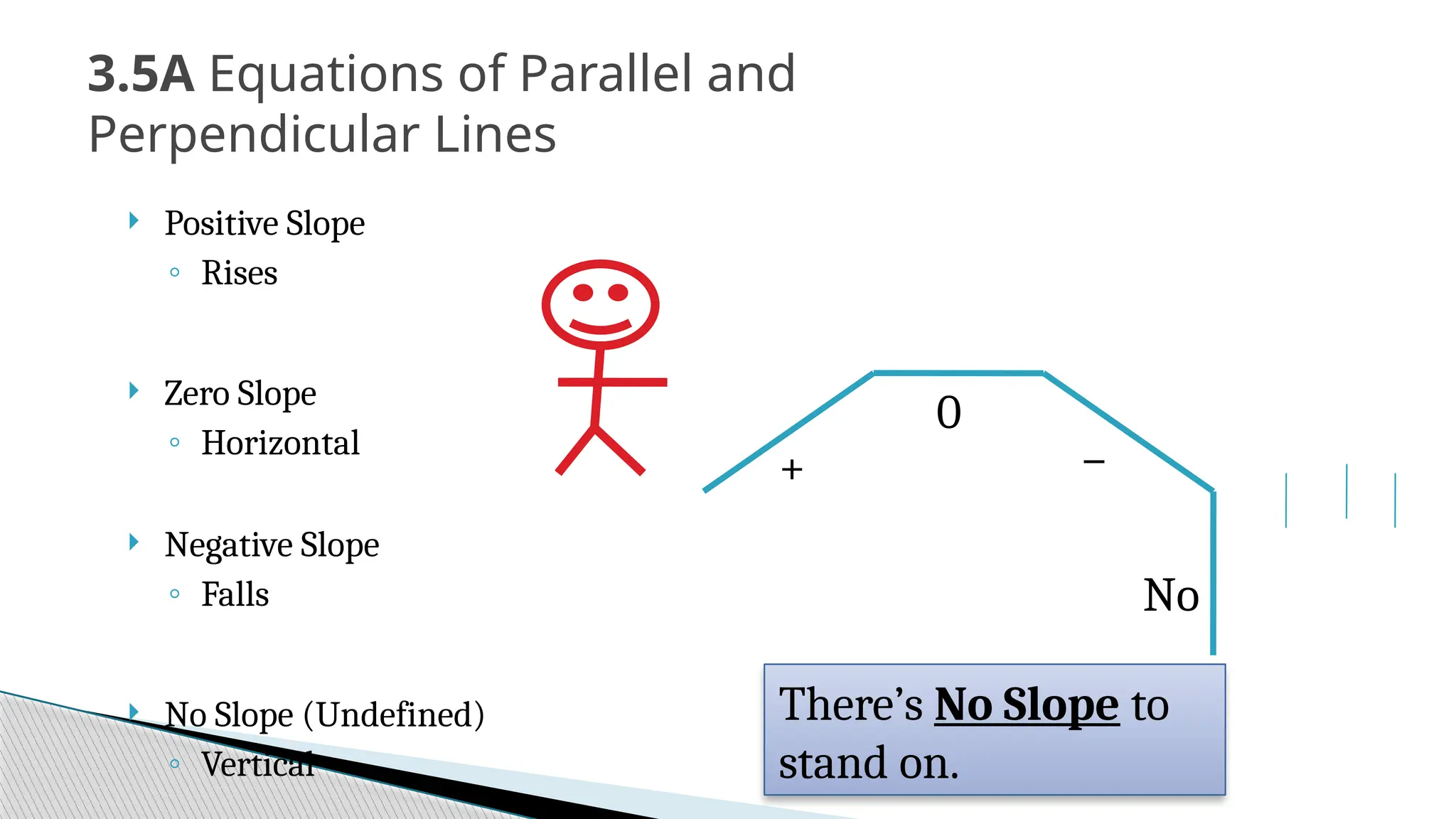
 Positive Slope
◦ Rises
 Zero Slope
◦ Horizontal
 Negative Slope
◦ Falls
 No Slope (Undefined)
◦ Vertical
There’s No Slope to
stand on.
+
0
–
No
3.5A Equations of Parallel and
Perpendicular Lines
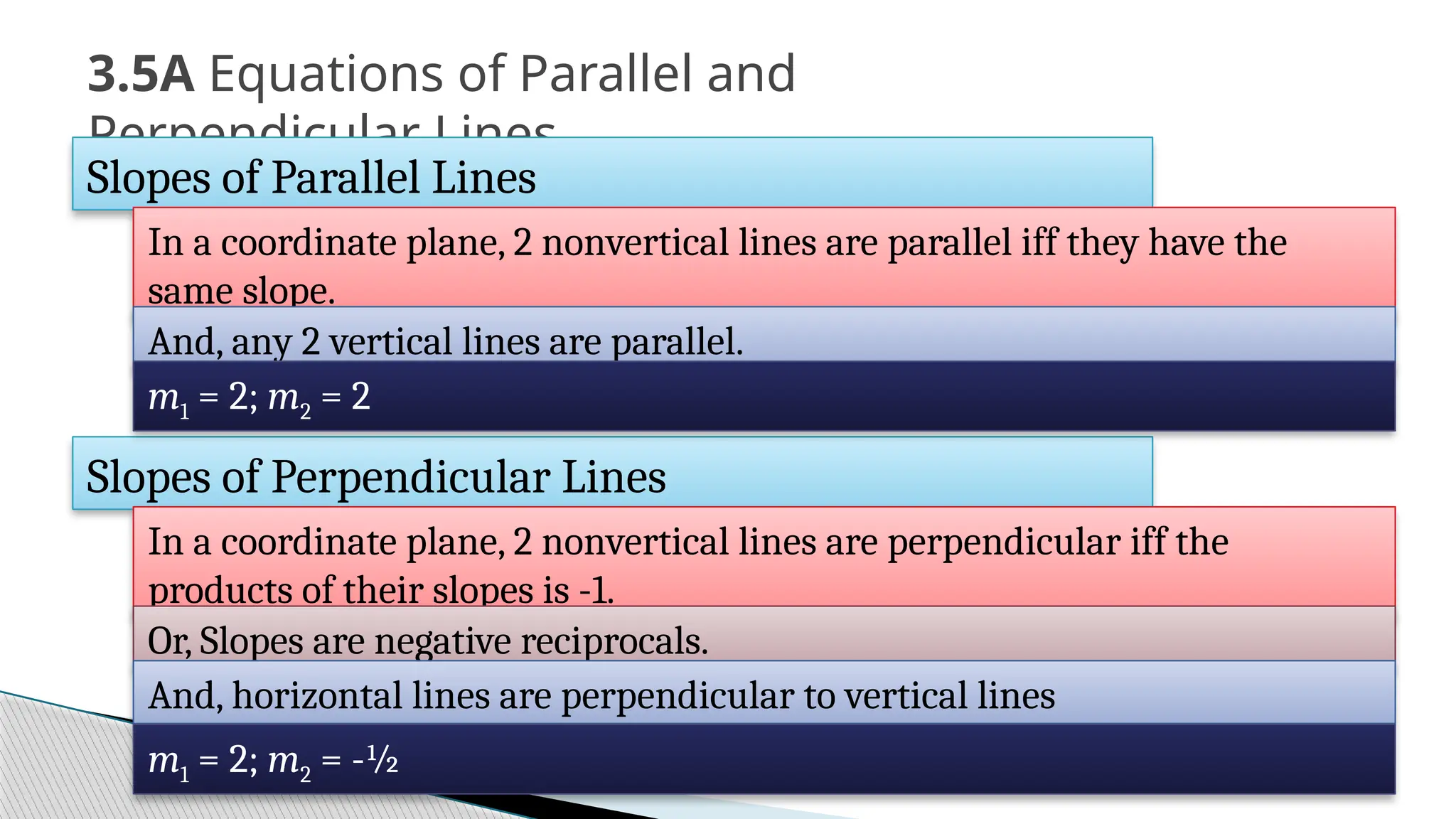
Slopes of Parallel Lines
In a coordinate plane, 2 nonvertical lines are parallel iff they have the
same slope.
And, any 2 vertical lines are parallel.
Slopes of Perpendicular Lines
In a coordinate plane, 2 nonvertical lines are perpendicular iff the
products of their slopes is -1.
Or, Slopes are negative reciprocals.
And, horizontal lines are perpendicular to vertical lines
m1 = 2; m2 = 2
m1 = 2; m2 = -½
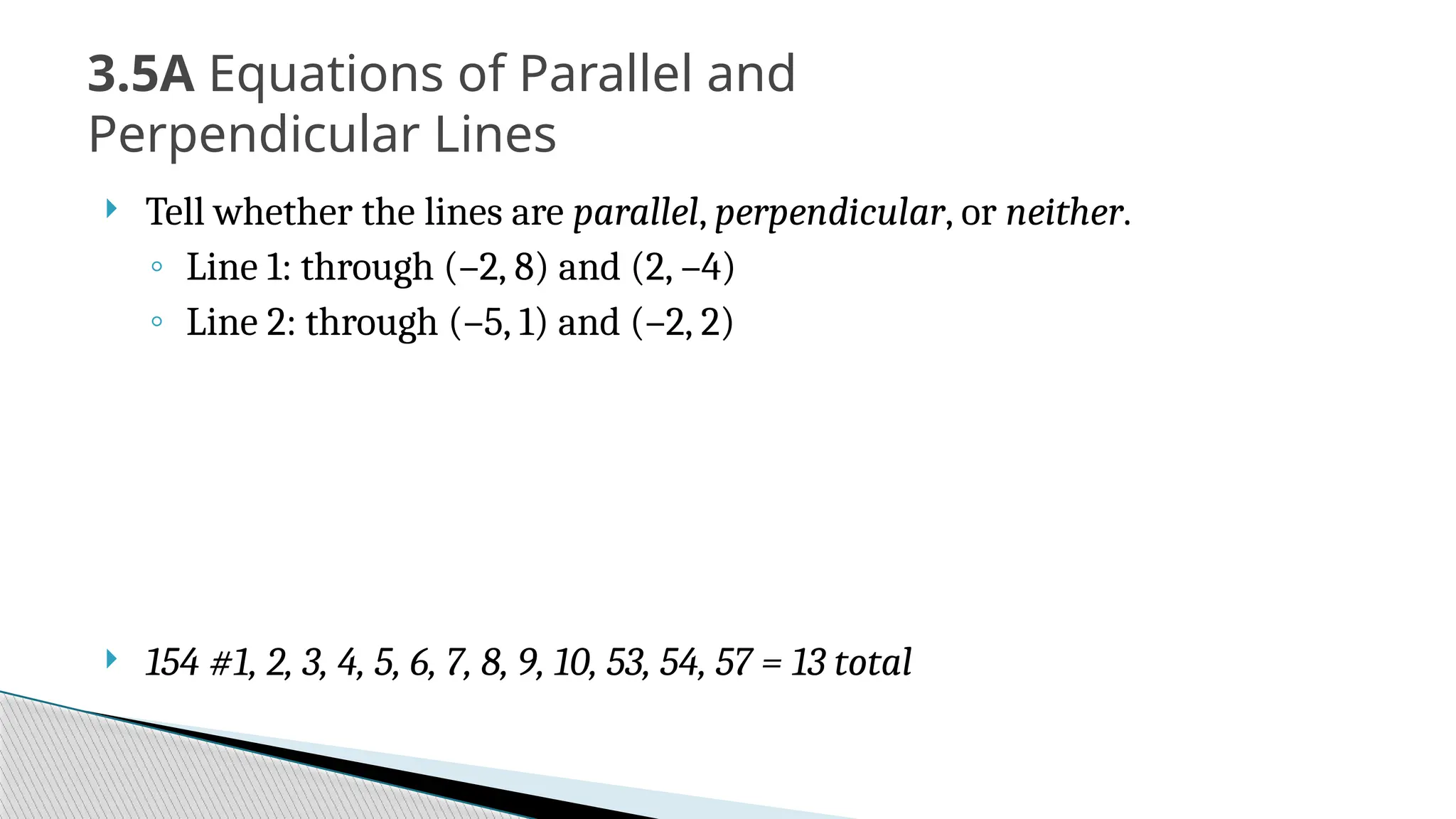
 Tell whether the lines are parallel, perpendicular, or neither.
◦ Line 1: through (–2, 8) and (2, –4)
◦ Line 2: through (–5, 1) and (–2, 2)
 154 #1, 2, 3, 4, 5, 6, 7, 8, 9, 10, 53, 54, 57 = 13 total
3.5A Equations of Parallel and
Perpendicular Lines
3.5B Equations of Parallel and
Perpendicular Lines
Objectives: By the end of the lesson,
• I can write equations of parallel and perpendicular lines.
• I can find the distance from a point to a line.
 Slope-intercept form of a line
◦ y = mx + b
 m = slope
 b = y-intercept
 To write equations of lines using slope-intercept form
◦ Find the slope
◦ Find the y-intercept
 It is given or,
 Plug the slope and a point into y = mx + b and solve for b
◦ Write the equation of the line by plugging in m and b into y = mx + b
3.5B Equations of Parallel and
Perpendicular Lines
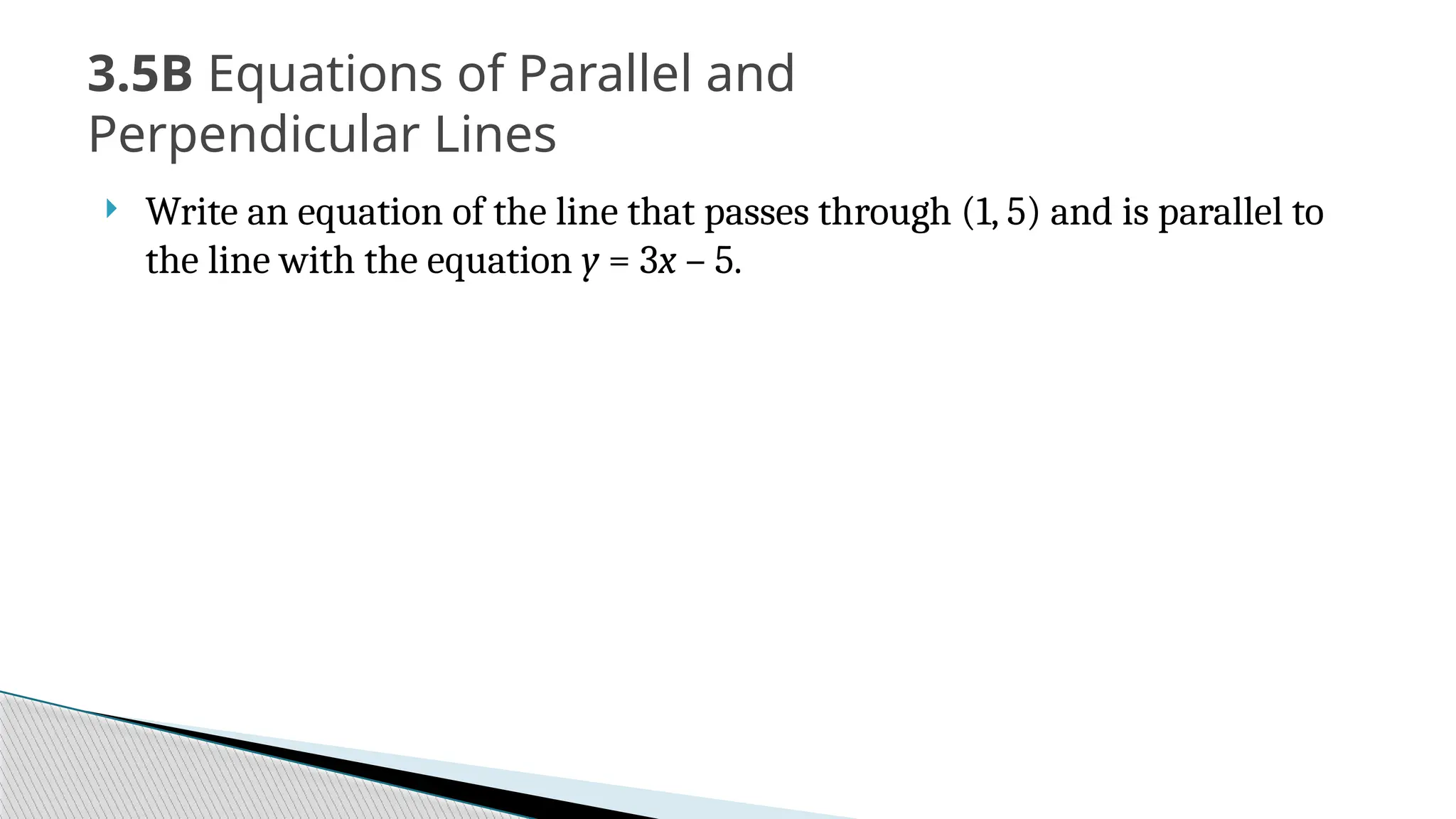
 Write an equation of the line that passes through (1, 5) and is parallel to
the line with the equation y = 3x – 5.
3.5B Equations of Parallel and
Perpendicular Lines
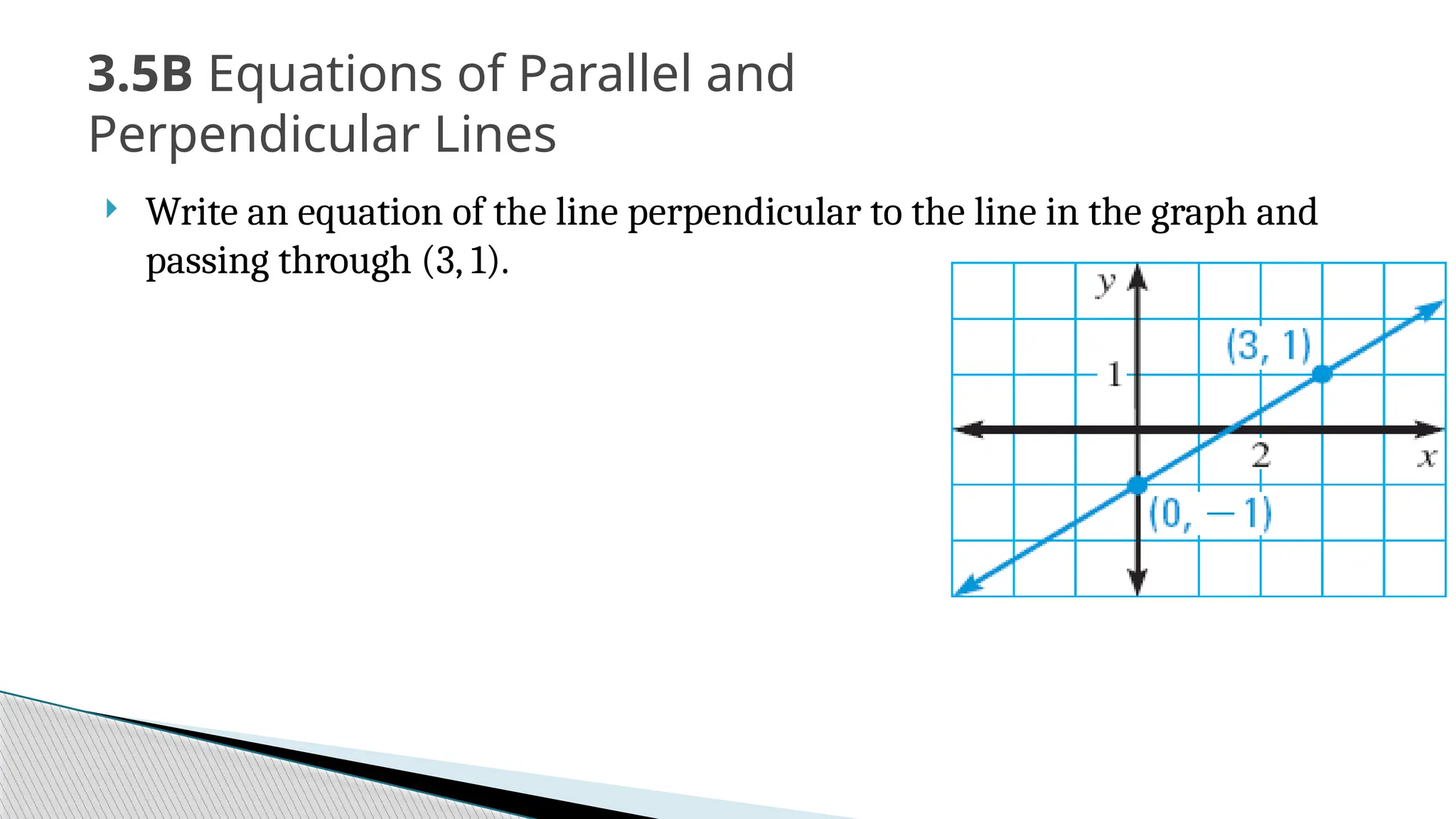
 Write an equation of the line perpendicular to the line in the graph and
passing through (3, 1).
3.5B Equations of Parallel and
Perpendicular Lines
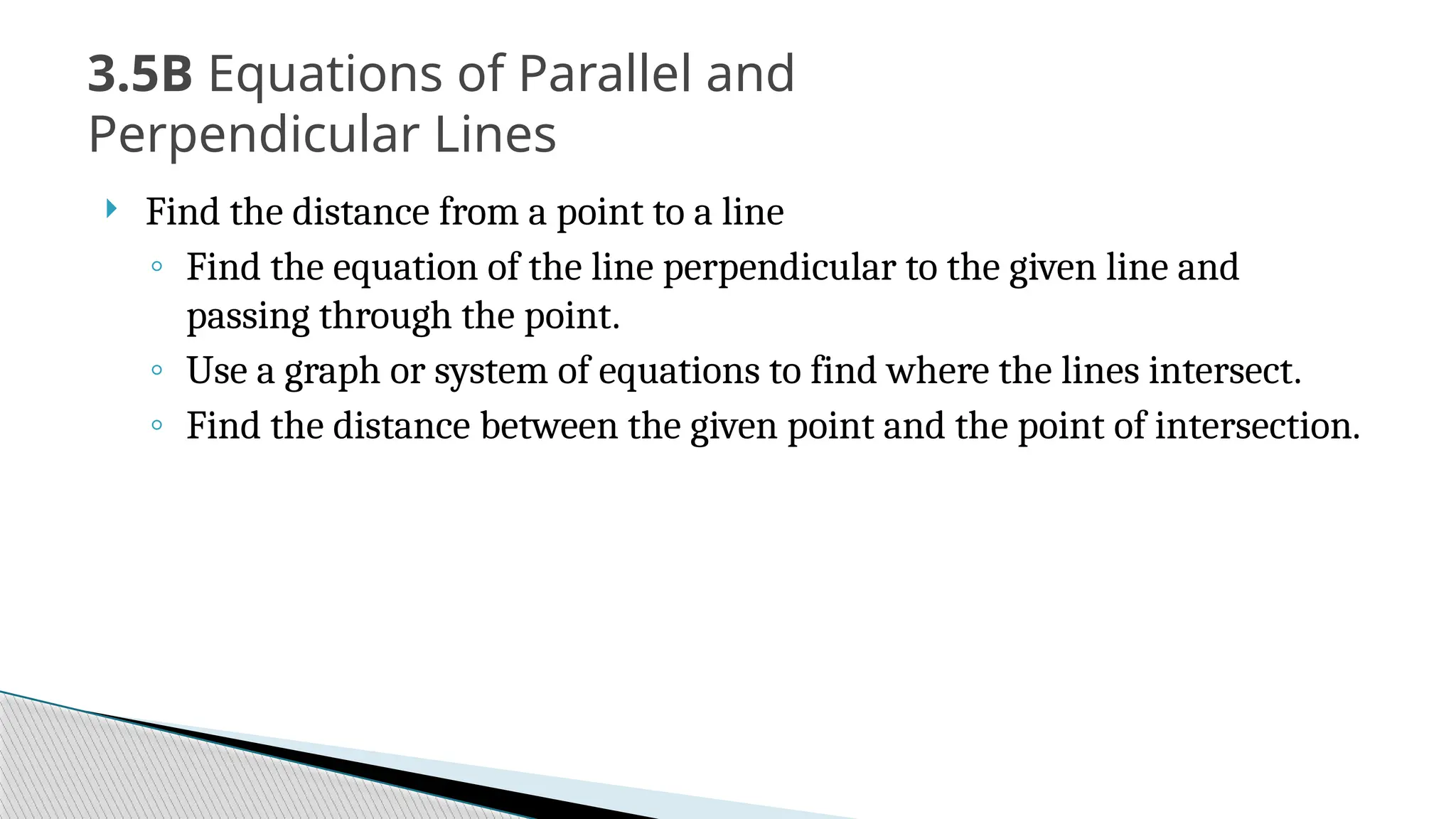
 Find the distance from a point to a line
◦ Find the equation of the line perpendicular to the given line and
passing through the point.
◦ Use a graph or system of equations to find where the lines intersect.
◦ Find the distance between the given point and the point of intersection.
3.5B Equations of Parallel and
Perpendicular Lines
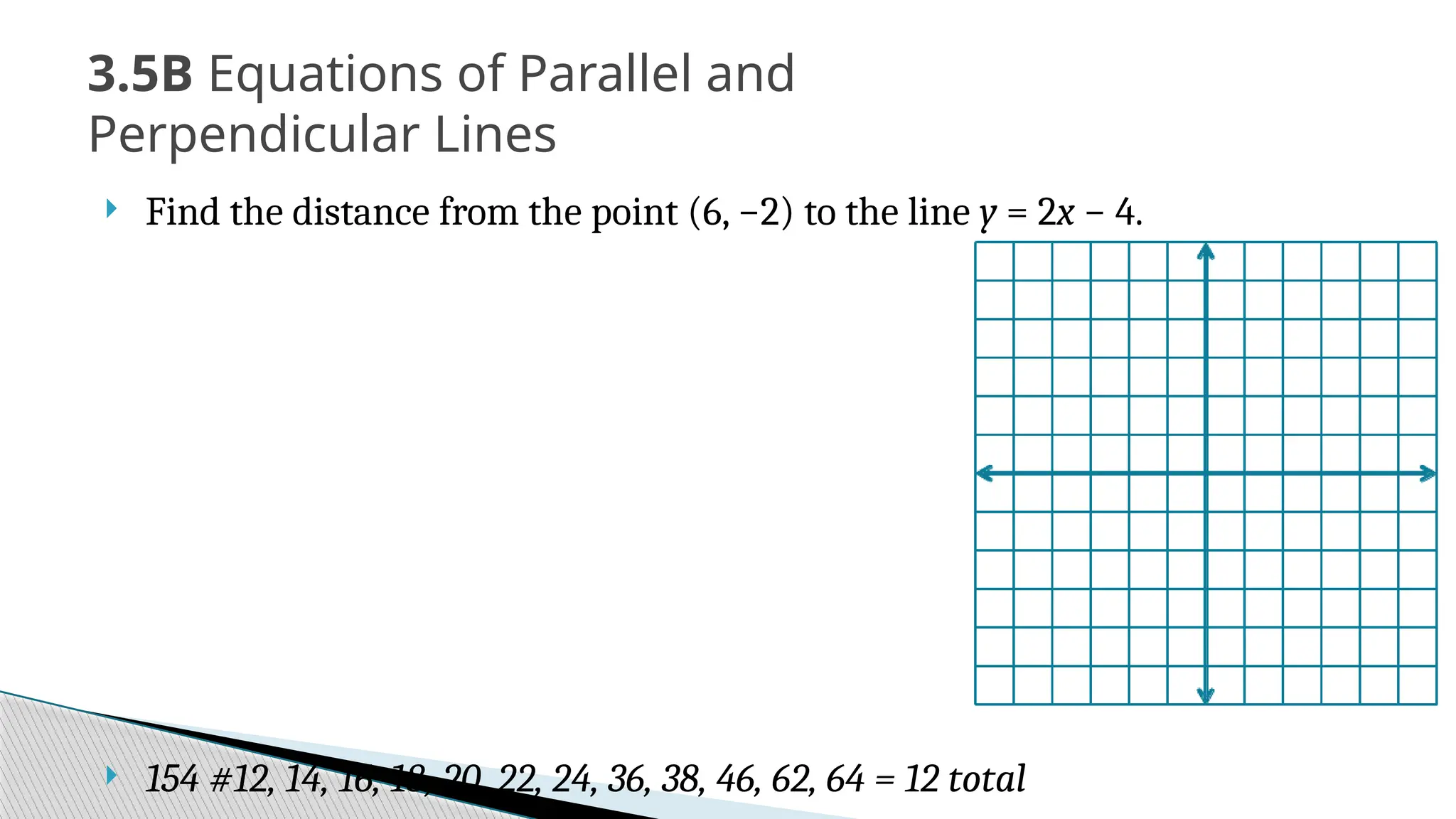
 Find the distance from the point (6, −2) to the line y = 2x − 4.
 154 #12, 14, 16, 18, 20, 22, 24, 36, 38, 46, 62, 64 = 12 total
3.5B Equations of Parallel and
Perpendicular Lines

GEOMETRY 2.pptx in mathematics help you improved your knowledge

  • 1.
  • 2.
    3.1 Pairs ofLines and Angles Objectives: By the end of the lesson, • I can identify lines and planes. • I can identify parallel and perpendicular lines. • I can identify pairs of angles formed by transversals.
  • 3.
    3.1 Pairs ofLines and Angles Parallel Lines || Lines that do NOT intersect and are coplanar Lines go in the same direction Skew Lines Lines that do NOT intersect and are on different planes Lines go in different directions
  • 4.
     3.1 Pairs ofLines and Angles
  • 5.
     In aplane, two lines are either ◦ Parallel ◦ Intersect 3.1 Pairs of Lines and Angles Parallel Postulate If there is a line and a point not on the line, then there is exactly one line through the point parallel to the given line. Perpendicular Postulate If there is a line and a point not on the line, then there is exactly one line through the point perpendicular to the given line.
  • 6.
    3.1 Pairs ofLines and Angles Transversal Line that intersects two coplanar lines Interior  angles that are between the lines 2, 3, 5, 6 Exterior  angles that are outside of the lines 1, 4, 7, 8 2 6 1 4 3 5 8 7
  • 7.
    3.1 Pairs ofLines and Angles Alternate interior angles interior angles on opposite sides of the transversal 2 and 5, 3 and 6 Alternate exterior angles exterior angles on opposite sides of the transversal 1 and 8, 4 and 7 2 6 1 4 3 5 8 7
  • 8.
    3.1 Pairs ofLines and Angles Corresponding angles angles on the same location relative to the transversal 1 and 6, 2 and 7, 3 and 8, 4 and 5 Consecutive interior angles interior angles on the same side of the transversal 2 and 6, 3 and 5 2 6 1 4 3 5 8 7
  • 9.
     Classify thepair of numbered angles  125 #2, 4, 6, 8, 9, 10, 11, 12, 14, 15, 16, 20, 21, 22, 24, 28, 32, 33, 35, 36 = 20 total 3.1 Pairs of Lines and Angles
  • 10.
    3.2 Parallel Linesand Transversals Objectives: By the end of the lesson, • I can use properties of parallel lines to find angle measures. • I can prove theorems about parallel lines.
  • 11.
    3.2 Parallel Linesand Transversals  Draw parallel lines on a piece of notebook paper, then draw a transversal.  Use the protractor to measure all the angles.  What types of angles are congruent? ◦ (corresponding, alt interior, alt exterior)  How are consecutive interior angles related? ◦ (supplementary)
  • 12.
    3.2 Parallel Linesand Transversals Corresponding Angles Postulate If 2 || lines are cut by trans., then the corrs  are  Alternate Interior Angles Theorem If 2 || lines are cut by trans., then the alt int  are  Alternate Exterior Angles Theorem If 2 || lines are cut by trans., then the alt ext  are  Consecutive Interior Angles Theorem If 2 || lines are cut by trans., then the cons int  are supp.
  • 13.
     If m1= 105°, find m4, m5, and m8. Tell which postulate or theorem you use in each case  If m3 = 68° and m8 = (2x + 4)°, what is the value of x? 3.2 Parallel Lines and Transversals
  • 14.
    3.2 Parallel Linesand Transversals  Prove that if 2 || lines are cut by a trans, then the ext angles on the same side of the trans are supp.  Given: p || q  Prove: 1 and 2 are supp. Statements Reasons q p ℓ 1 2 3
  • 15.
     131 #2,4, 5, 6, 8, 10, 12, 14, 15, 18, 20, 22, 23, 24, 26, 29, 30, 32, 33, 38 = 20 total 3.2 Parallel Lines and Transversals
  • 16.
    3.3 Proofs withParallel Lines Objectives: By the end of the lesson, • I can use theorems to identify parallel lines. • I can prove theorems about identifying parallel lines.
  • 17.
    3.3 Prove Linesare Parallel Corresponding Angles Converse If 2 lines are cut by trans. so the corrs  are , then the lines are ||. Alternate Interior Angles Converse If 2 lines are cut by trans. so the alt int  are , then the lines are ||. Alternate Exterior Angles Converse If 2 lines are cut by trans. so the alt ext  are , then the lines are ||. Consecutive Interior Angles Converse If 2 lines are cut by trans. so the cons int  are supp., then the lines are ||.
  • 18.
     Is thereenough information to conclude that m || n?  Can you prove that the lines are parallel? Explain. 3.3 Prove Lines are Parallel m 1 + m 2 = 180°
  • 19.
     Paragraph proofs ◦The proof is written in sentences. ◦ Still need to have the statements and reasons. 3.3 Prove Lines are Parallel Transitive Property of Parallel Lines If two lines are parallel to the same line, then they are parallel to each other.
  • 20.
     Write aparagraph proof to prove that if 2 lines are cut by a trans. so that the alt int s are , then the lines are ||.  Given: 4  5  Prove: g || h 3.3 Prove Lines are Parallel
  • 21.
     If youuse the diagram at the right to prove the Alternate Exterior Angles Converse, what GIVEN and PROVE statements would you use?  138 #2, 4, 6, 10, 12, 14, 16, 20, 22, 24, 26, 28, 30, 32, 35, 39, 41, 44, 45, 49 = 20 total 3.3 Prove Lines are Parallel
  • 22.
    3.4 Proofs withPerpendicular Lines Objectives: By the end of the lesson, • I can find the distance from a point to a line. • I can prove theorems about perpendicular lines.
  • 23.
    3.4 Proofs withPerpendicular Lines Distance From point to line: length of segment from point and  to line Between two || lines: length of segment  to both lines
  • 24.
     3.4 Proofs withPerpendicular Lines
  • 25.
    3.4 Proofs withPerpendicular Lines Linear Pair Perpendicular Theorem If two lines intersect to form a linear pair of congruent angles, then the lines are perpendicular.
  • 26.
    3.4 Proofs withPerpendicular Lines Perpendicular Transversal Theorem If a trans. is  to 1 of 2 || lines, then it is  to the other. Lines  to a Transversal Theorem In a plane, if 2 lines are  to the same line, then they are || to each other.
  • 27.
    3.4 Proofs withPerpendicular Lines  Prove the Perpendicular Transversal Theorem using the diagram and the Alternate Interior Angles Theorem.  Given: h || k, j  h  Prove: j  k Statements Reasons
  • 28.
     Is b|| a?  Is b  c?  146 #2, 10, 12, 14, 16, 18, 20, 21, 24, 26, 34, 40, 42, 45, 46 = 15 total 3.4 Proofs with Perpendicular Lines
  • 29.
    3.5A Equations ofParallel and Perpendicular Lines Objectives: By the end of the lesson, • I can partition directed line segments using slope. • I can use slopes to identify parallel and perpendicular lines.
  • 30.
     3.5A Equations ofParallel and Perpendicular Lines
  • 31.
     Find thecoordinates of point F along the directed line segment CD so that the ratio of CF to FD is 3 to 5. 3.5A Equations of Parallel and Perpendicular Lines
  • 32.
     3.5A Equations ofParallel and Perpendicular Lines (x2, y2) (x1, y1) run rise
  • 33.
    3.5A Equations ofParallel and Perpendicular Lines  Positive Slope ◦ Rises  Zero Slope ◦ Horizontal  Negative Slope ◦ Falls  No Slope (Undefined) ◦ Vertical There’s No Slope to stand on. + 0 – No
  • 34.
    3.5A Equations ofParallel and Perpendicular Lines Slopes of Parallel Lines In a coordinate plane, 2 nonvertical lines are parallel iff they have the same slope. And, any 2 vertical lines are parallel. Slopes of Perpendicular Lines In a coordinate plane, 2 nonvertical lines are perpendicular iff the products of their slopes is -1. Or, Slopes are negative reciprocals. And, horizontal lines are perpendicular to vertical lines m1 = 2; m2 = 2 m1 = 2; m2 = -½
  • 35.
     Tell whetherthe lines are parallel, perpendicular, or neither. ◦ Line 1: through (–2, 8) and (2, –4) ◦ Line 2: through (–5, 1) and (–2, 2)  154 #1, 2, 3, 4, 5, 6, 7, 8, 9, 10, 53, 54, 57 = 13 total 3.5A Equations of Parallel and Perpendicular Lines
  • 36.
    3.5B Equations ofParallel and Perpendicular Lines Objectives: By the end of the lesson, • I can write equations of parallel and perpendicular lines. • I can find the distance from a point to a line.
  • 37.
     Slope-intercept formof a line ◦ y = mx + b  m = slope  b = y-intercept  To write equations of lines using slope-intercept form ◦ Find the slope ◦ Find the y-intercept  It is given or,  Plug the slope and a point into y = mx + b and solve for b ◦ Write the equation of the line by plugging in m and b into y = mx + b 3.5B Equations of Parallel and Perpendicular Lines
  • 38.
     Write anequation of the line that passes through (1, 5) and is parallel to the line with the equation y = 3x – 5. 3.5B Equations of Parallel and Perpendicular Lines
  • 39.
     Write anequation of the line perpendicular to the line in the graph and passing through (3, 1). 3.5B Equations of Parallel and Perpendicular Lines
  • 40.
     Find thedistance from a point to a line ◦ Find the equation of the line perpendicular to the given line and passing through the point. ◦ Use a graph or system of equations to find where the lines intersect. ◦ Find the distance between the given point and the point of intersection. 3.5B Equations of Parallel and Perpendicular Lines
  • 41.
     Find thedistance from the point (6, −2) to the line y = 2x − 4.  154 #12, 14, 16, 18, 20, 22, 24, 36, 38, 46, 62, 64 = 12 total 3.5B Equations of Parallel and Perpendicular Lines

Editor's Notes

  • #1 Geometry 3
  • #4 AH, EH GH BGH
  • #9 Corresponding Alternate Exterior Alternate Interior
  • #13 m4 = 105; vertical angles are congruent m5 = 105; corresponding angles postulate m8 = 105; alt ext angles theorem m3 = m2 m8 = m5 2 and 5 are cons int angles and are supp m2 + m5 = 180 m3 + m8 = 180 68 + 2x + 4 = 180 2x + 72 = 180 2x = 108 x = 54
  • #14 p || q (given) m1 + m3 = 180 (linear pair post) 2  3 (corrs angles post) m2 = m3 (def ) m1 + m2 = 180 (substitution) 1 and 2 are supp (def supp)
  • #18 Yes, corresponding angles will both be 75° Yes, alt ext angles converse Yes, corres angles converse No, should be 1  2 by alt int angles converse
  • #20 It is given that 4  5. By the vertical angle congruence theorem, 1  4. Then by the Transitive Property of Congruence, 1  5. So, by the Corresponding Angles Converse, g || h.
  • #21 Given: 1  8 Prove: j || k
  • #27 STATEMENTS REASONS 1. h || k, j ⊥ h 1. Given 2. m∠2 = 90° 2. Definition of perpendicular lines 3. ∠2 ≅ ∠3 3. Vertical Angles Congruence Theorem 4. ∠3 ≅ ∠6 4. Alternate Interior Angles Theorem 5. ∠2 ≅ ∠6 5. Transitive Property of Angle Congruence 6. m∠2 = m∠6 6. Definition of congruent angles 7. m∠6 = 90° 7. Substitution Property of Equality 8. j ⊥ k 8. Definition of perpendicular lines
  • #28 Yes, lines perpendicular to transversal theorem Yes, c || d by the lines  to trans theorem; b  c by the  trans theorem
  • #35 Line 1: (-4 – 8)/(2 – (-2))  -12/4  -3 Line 2: (2 – 1)/(-2 – (-5))  1/3 Perpendicular