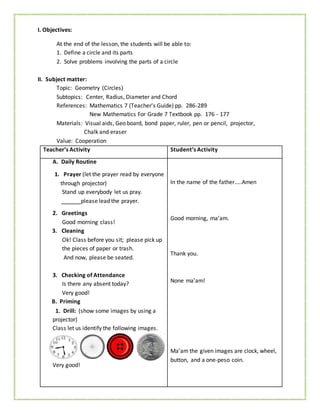
I. Objectives:
At the end of the lesson, the students will be able to:
1. Define a circle and its parts
2. Solve problems involving the parts of a circle
II. Subject matter:
Topic: Geometry (Circles)
Subtopics: Center, Radius, Diameter and Chord
References: Mathematics 7 (Teacher's Guide) pp. 286-289
New Mathematics For Grade 7 Textbook pp. 176 - 177
Materials: Visual aids, Geo board, bond paper, ruler, pen or pencil, projector,
Chalk and eraser
Value: Cooperation
Teacher’s Activity Student’s Activity
A. Daily Routine
1. Prayer (let the prayer read by everyone
through projector)
Stand up everybody let us pray.
please lead the prayer.
2. Greetings
Good morning class!
3. Cleaning
Ok! Class before you sit; please pick up
the pieces of paper or trash.
And now, please be seated.
3. Checking of Attendance
Is there any absent today?
Very good!
B. Priming
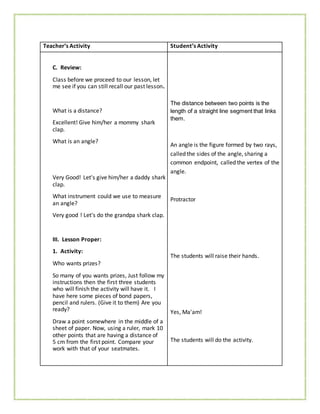
1. Drill: (show some images by using a
projector)
Class let us identify the following images.
Very good!
In the name of the father…..Amen
Good morning, ma’am.
Thank you.
None ma’am!
Ma’am the given images are clock, wheel,
button, and a one-peso coin.
Teacher’s Activity Student’s Activity
C. Review:
Class before we proceed to our lesson, let
me see if you can still recall our past lesson.
What is a distance?
Excellent! Give him/her a mommy shark
clap.
What is an angle?
Very Good! Let's give him/her a daddy shark
clap.
What instrument could we use to measure
an angle?
Very good ! Let's do the grandpa shark clap.
III. Lesson Proper:
1. Activity:
Who wants prizes?
So many of you wants prizes, Just follow my
instructions then the first three students
who will finish the activity will have it. I
have here some pieces of bond papers,
pencil and rulers. (Give it to them) Are you
ready?
Draw a point somewhere in the middle of a
sheet of paper. Now, using a ruler, mark 10
other points that are having a distance of
5 cm from the first point. Compare your
work with that of your seatmates.
The distance between two points is the
length of a straight line segment that links
them.
An angle is the figure formed by two rays,
called the sides of the angle, sharing a
common endpoint, called the vertex of the
angle.
Protractor
The students will raise their hands.
Yes, Ma'am!
The students will do the activity.
Teacher’s Activity Student’s Activity
Show the prizes, then give it to the first three
students who finished the activity as a
reward for their activeness. (Giving of prizes)
2. Abstract:
So from our drill and activity, who could
guess our topic for today?
Very good!
(Post the objectives by a tarpaper)
1. Presentation of the lesson and
discussion. (using powerpoint and geo
board)
Do you have any idea of what is circle?
Yes, very good!
From the activity before, you saw that
points that are the same distance from a
fixed point yields a round shape.
Because Circle is the set of all points that are
the same distance from a fixed point. This
fixed point is called a center of the circle.
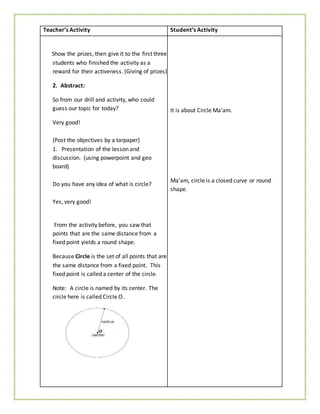
Note: A circle is named by its center. The
circle here is called Circle O.
It is about Circle Ma'am.
Ma’am, circle is a closed curve or round
shape.
Teacher’s Activity Student’s Activity
(The teacher will present the other parts
related to the circle).
Let's discuss it one by one.
Please read the paragraph
Yes, ___________ .
Thank you, ____________.
Next, please read.
Yes, ______.
Thanks, ________.
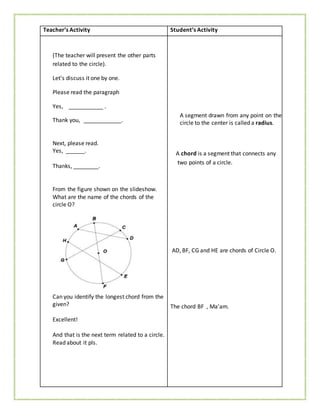
From the figure shown on the slideshow.
What are the name of the chords of the
circle O?
Can you identify the longest chord from the
given?
Excellent!
And that is the next term related to a circle.
Read about it pls.
A segment drawn from any point on the
circle to the center is called a radius.
A chord is a segment that connects any
two points of a circle.
AD, BF, CG and HE are chords of Circle O.
The chord BF , Ma'am.
Teacher’s Activity Student’s Activity
Ok, _________________.
Thank you, __________.
Show another examples of diameter using the
geo board.
3. Analysis:
Determine whether each statement is true or
false.
a. Two radii always have the same length.
b. Two chords always have the same length.
c. All chords are diameters.
d. All diameters are chords.
e. A radius is not a chord.
4. Generalization:
What is a circle?
What are the terms related to a circle?
Very good! Let's proceed.
5 . Application:
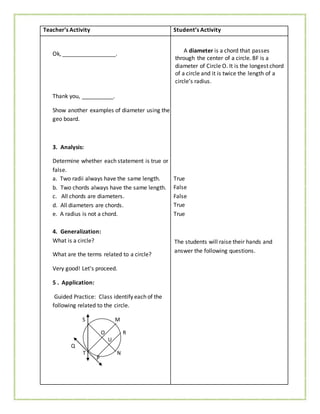
Guided Practice: Class identify each of the
following related to the circle.
A diameter is a chord that passes
through the center of a circle. BF is a
diameter of Circle O. It is the longest chord
of a circle and it is twice the length of a
circle’s radius.
True
False
False
True
True
The students will raise their hands and
answer the following questions.
S M
O R
Q
T N
P
U
Teacher’s Activity Student’s Activity
1. ST - Chord
The first number is given already to
serve as your guide. What is number
2?
2. O
3. SN
4. OM
5. PR
6. SN
IV. Evaluation:
A. Draw your own circle and illustrate the
following:
1. chord QR
2. center A
3. diameter DE
4. radius AC
5. radius AP
B. The table below refers to radius and
diameter of a circle. Complete the table.
Radius Diameter
6. 12 cm
7. 488 cm
8. 112 dm
9. 36 m
10. 27 km
Okay, class are you through? Pass your paper
forward.
V. Assignment:
Cut out at least five (5) pictures of things
around us that best represent a circle. Glue
it on your notebook.
2. Center
3. Diameter or chord
4. radius
5. Chord
6. Diameter or chord

Detailed lesson plan in mathematics 7 (circles)

  • 2.
    I. Objectives: At theend of the lesson, the students will be able to: 1. Define a circle and its parts 2. Solve problems involving the parts of a circle II. Subject matter: Topic: Geometry (Circles) Subtopics: Center, Radius, Diameter and Chord References: Mathematics 7 (Teacher's Guide) pp. 286-289 New Mathematics For Grade 7 Textbook pp. 176 - 177 Materials: Visual aids, Geo board, bond paper, ruler, pen or pencil, projector, Chalk and eraser Value: Cooperation Teacher’s Activity Student’s Activity A. Daily Routine 1. Prayer (let the prayer read by everyone through projector) Stand up everybody let us pray. please lead the prayer. 2. Greetings Good morning class! 3. Cleaning Ok! Class before you sit; please pick up the pieces of paper or trash. And now, please be seated. 3. Checking of Attendance Is there any absent today? Very good! B. Priming 1. Drill: (show some images by using a projector) Class let us identify the following images. Very good! In the name of the father…..Amen Good morning, ma’am. Thank you. None ma’am! Ma’am the given images are clock, wheel, button, and a one-peso coin.
  • 3.
    Teacher’s Activity Student’sActivity C. Review: Class before we proceed to our lesson, let me see if you can still recall our past lesson. What is a distance? Excellent! Give him/her a mommy shark clap. What is an angle? Very Good! Let's give him/her a daddy shark clap. What instrument could we use to measure an angle? Very good ! Let's do the grandpa shark clap. III. Lesson Proper: 1. Activity: Who wants prizes? So many of you wants prizes, Just follow my instructions then the first three students who will finish the activity will have it. I have here some pieces of bond papers, pencil and rulers. (Give it to them) Are you ready? Draw a point somewhere in the middle of a sheet of paper. Now, using a ruler, mark 10 other points that are having a distance of 5 cm from the first point. Compare your work with that of your seatmates. The distance between two points is the length of a straight line segment that links them. An angle is the figure formed by two rays, called the sides of the angle, sharing a common endpoint, called the vertex of the angle. Protractor The students will raise their hands. Yes, Ma'am! The students will do the activity.
  • 4.
    Teacher’s Activity Student’sActivity Show the prizes, then give it to the first three students who finished the activity as a reward for their activeness. (Giving of prizes) 2. Abstract: So from our drill and activity, who could guess our topic for today? Very good! (Post the objectives by a tarpaper) 1. Presentation of the lesson and discussion. (using powerpoint and geo board) Do you have any idea of what is circle? Yes, very good! From the activity before, you saw that points that are the same distance from a fixed point yields a round shape. Because Circle is the set of all points that are the same distance from a fixed point. This fixed point is called a center of the circle. Note: A circle is named by its center. The circle here is called Circle O. It is about Circle Ma'am. Ma’am, circle is a closed curve or round shape.
  • 5.
    Teacher’s Activity Student’sActivity (The teacher will present the other parts related to the circle). Let's discuss it one by one. Please read the paragraph Yes, ___________ . Thank you, ____________. Next, please read. Yes, ______. Thanks, ________. From the figure shown on the slideshow. What are the name of the chords of the circle O? Can you identify the longest chord from the given? Excellent! And that is the next term related to a circle. Read about it pls. A segment drawn from any point on the circle to the center is called a radius. A chord is a segment that connects any two points of a circle. AD, BF, CG and HE are chords of Circle O. The chord BF , Ma'am.
  • 6.
    Teacher’s Activity Student’sActivity Ok, _________________. Thank you, __________. Show another examples of diameter using the geo board. 3. Analysis: Determine whether each statement is true or false. a. Two radii always have the same length. b. Two chords always have the same length. c. All chords are diameters. d. All diameters are chords. e. A radius is not a chord. 4. Generalization: What is a circle? What are the terms related to a circle? Very good! Let's proceed. 5 . Application: Guided Practice: Class identify each of the following related to the circle. A diameter is a chord that passes through the center of a circle. BF is a diameter of Circle O. It is the longest chord of a circle and it is twice the length of a circle’s radius. True False False True True The students will raise their hands and answer the following questions. S M O R Q T N P U
  • 7.
    Teacher’s Activity Student’sActivity 1. ST - Chord The first number is given already to serve as your guide. What is number 2? 2. O 3. SN 4. OM 5. PR 6. SN IV. Evaluation: A. Draw your own circle and illustrate the following: 1. chord QR 2. center A 3. diameter DE 4. radius AC 5. radius AP B. The table below refers to radius and diameter of a circle. Complete the table. Radius Diameter 6. 12 cm 7. 488 cm 8. 112 dm 9. 36 m 10. 27 km Okay, class are you through? Pass your paper forward. V. Assignment: Cut out at least five (5) pictures of things around us that best represent a circle. Glue it on your notebook. 2. Center 3. Diameter or chord 4. radius 5. Chord 6. Diameter or chord