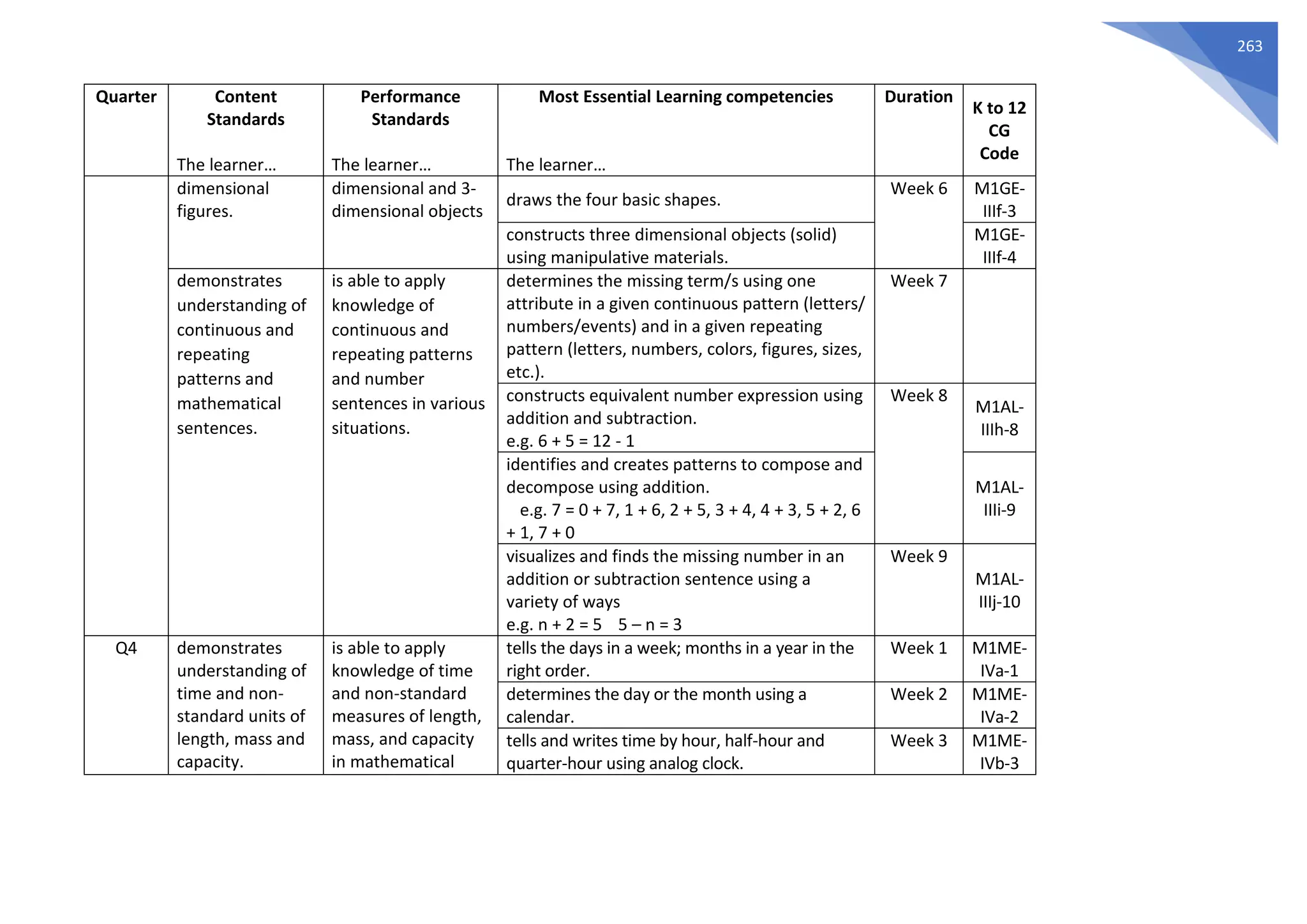
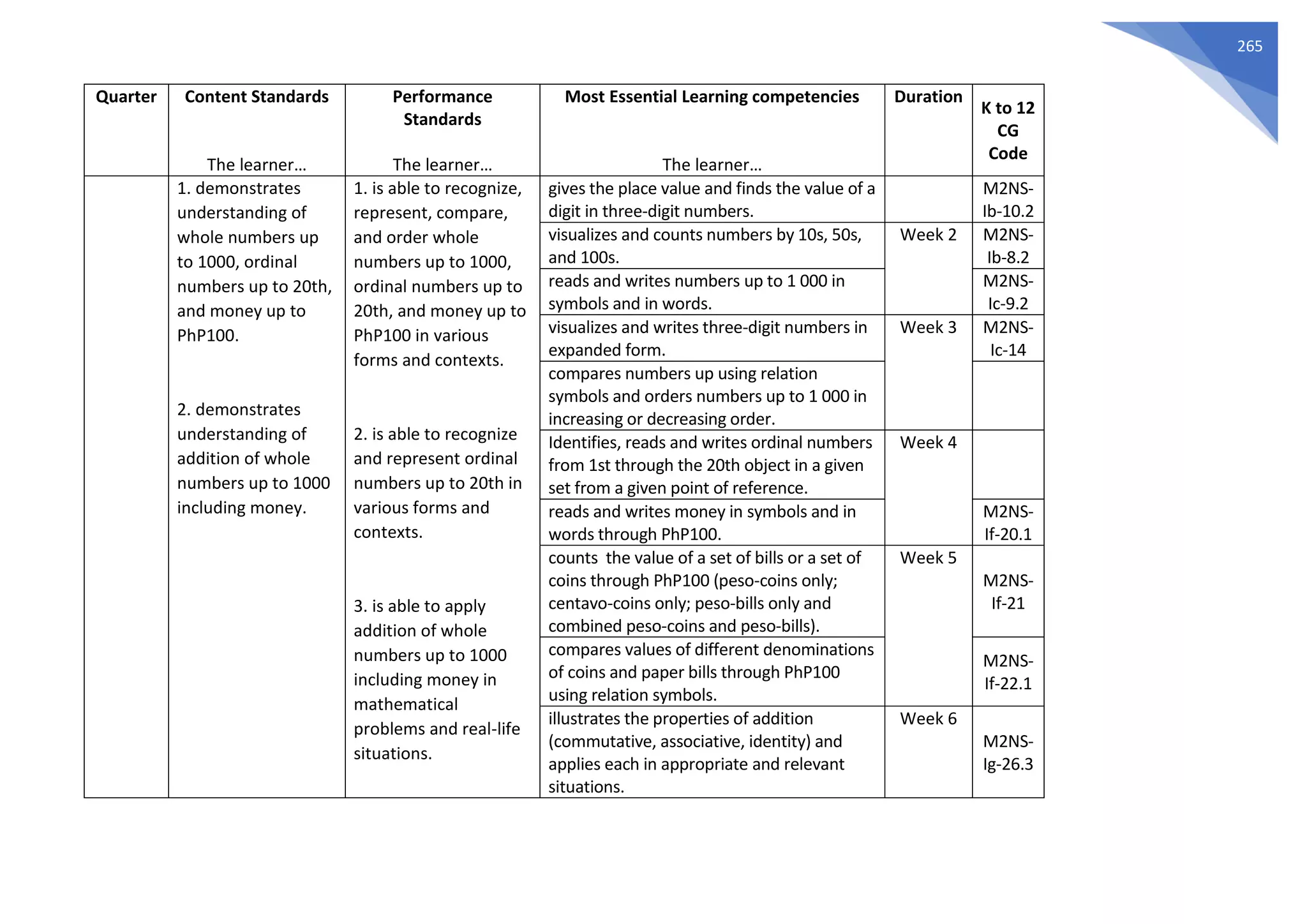
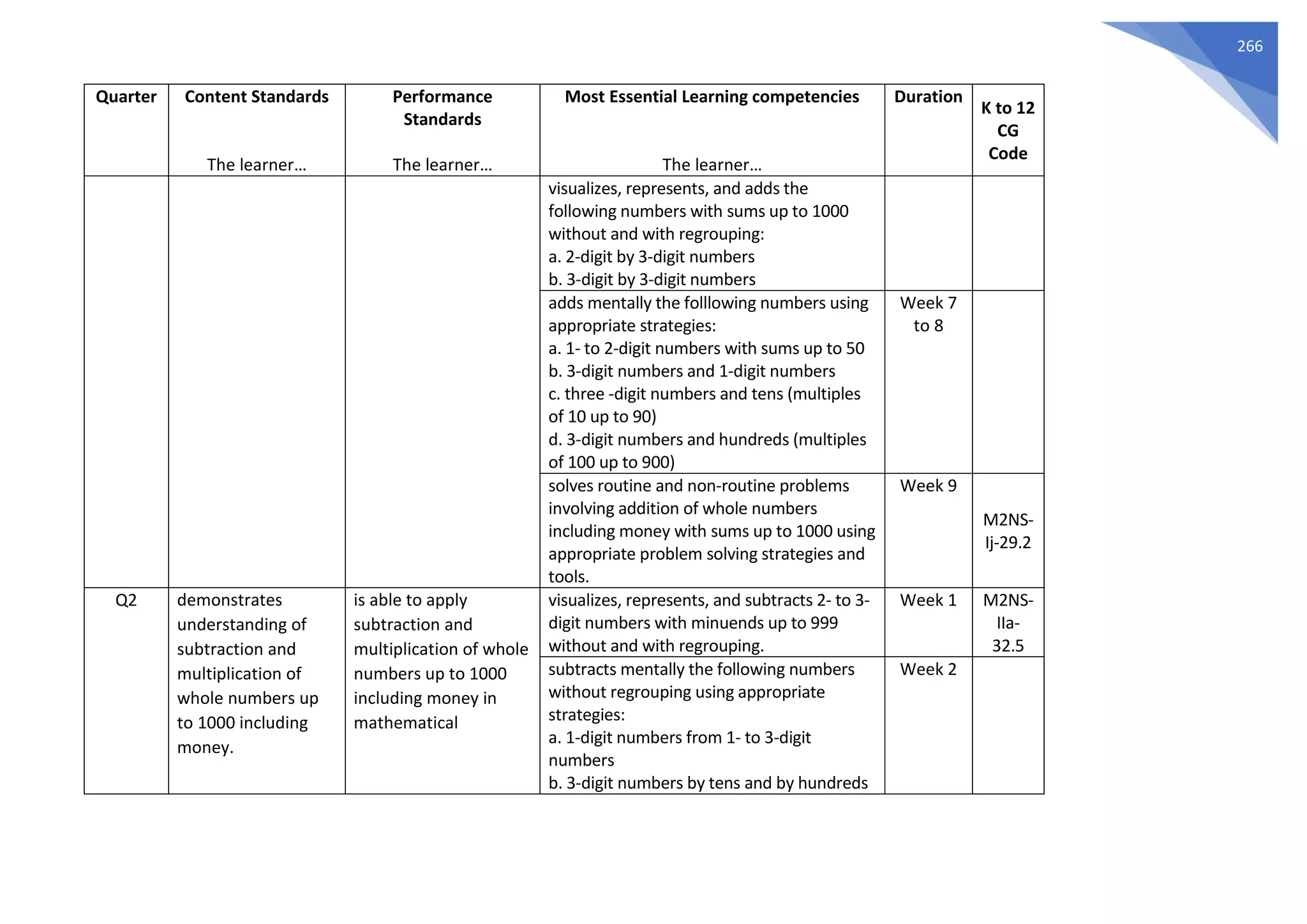
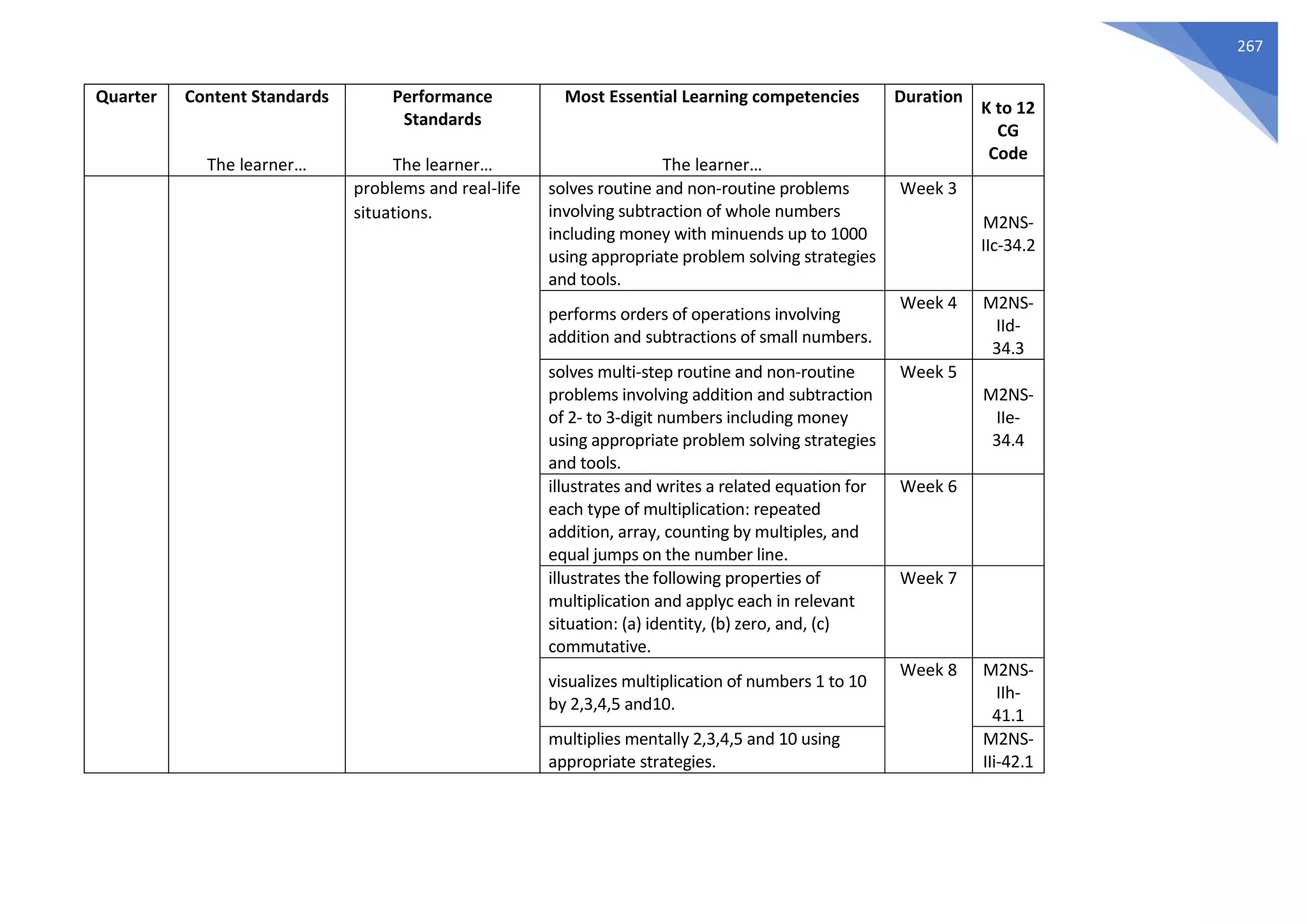
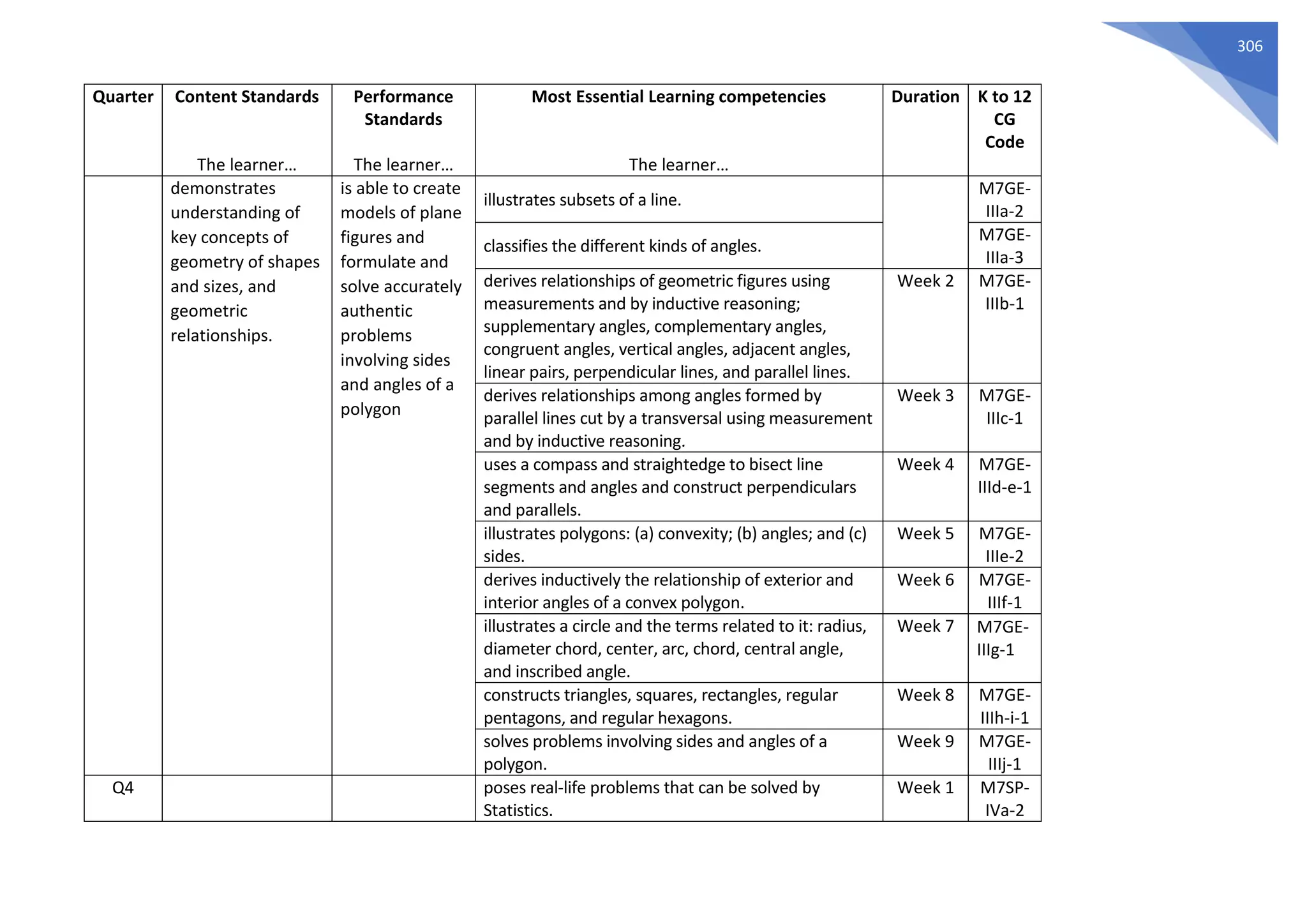
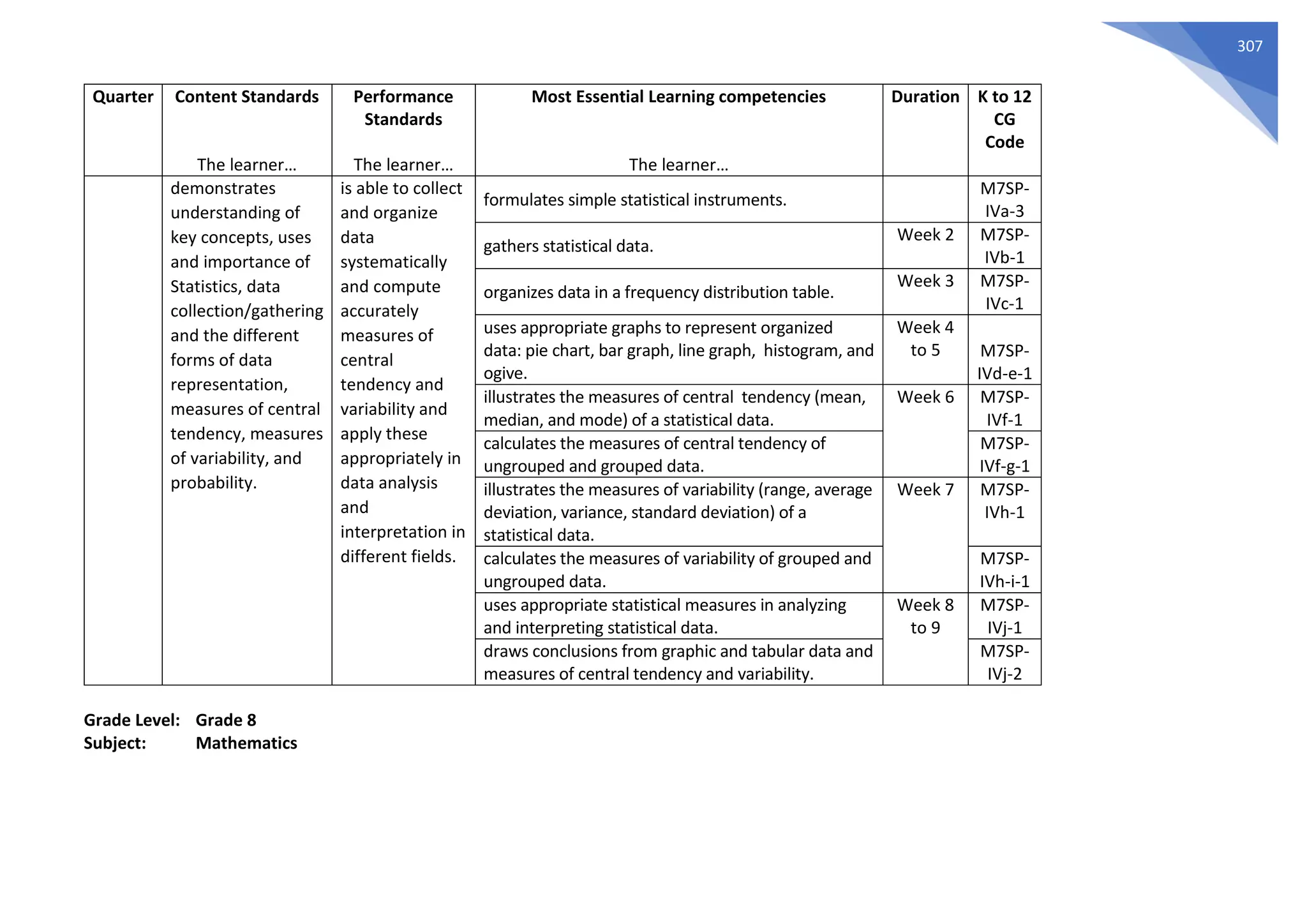
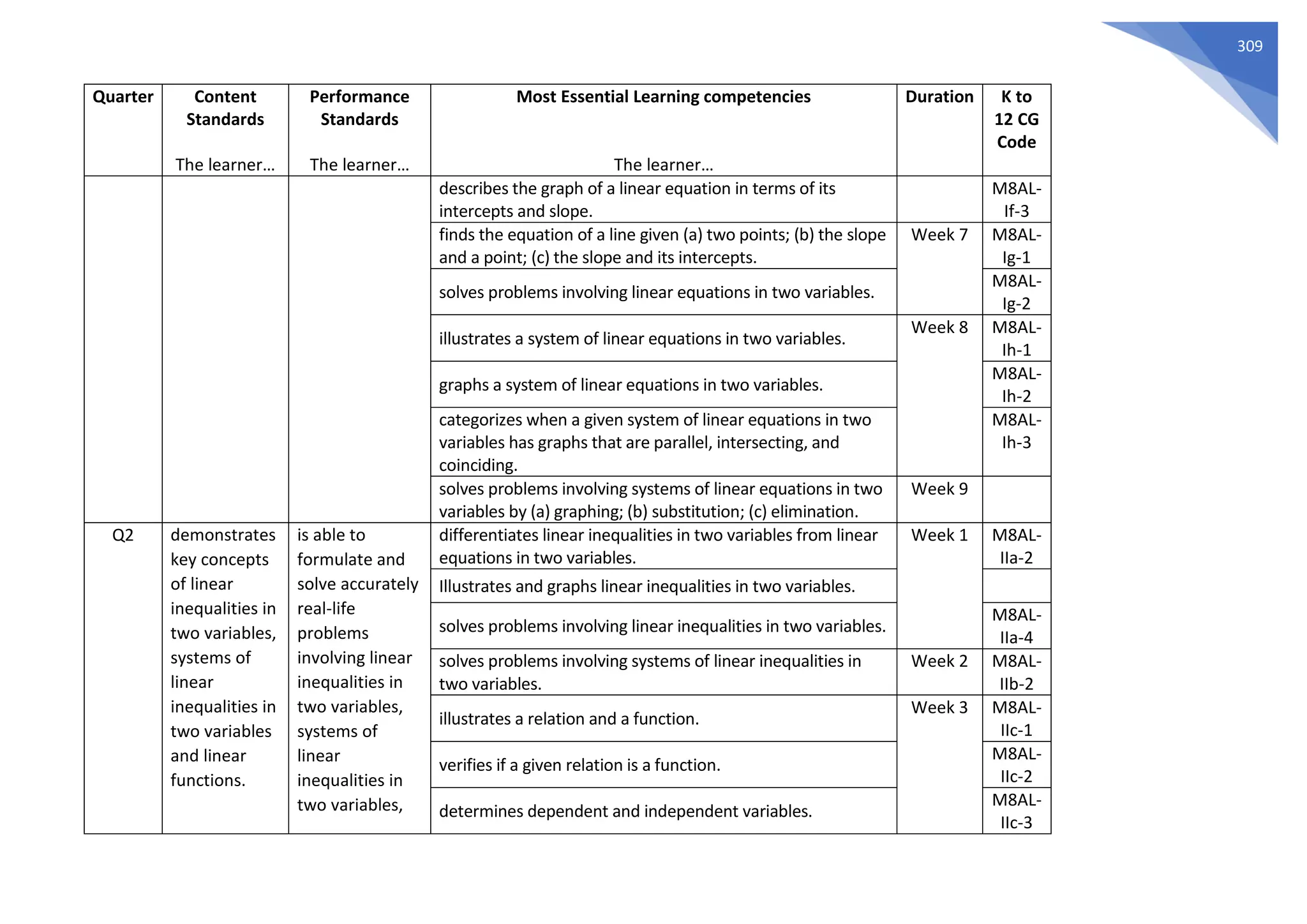
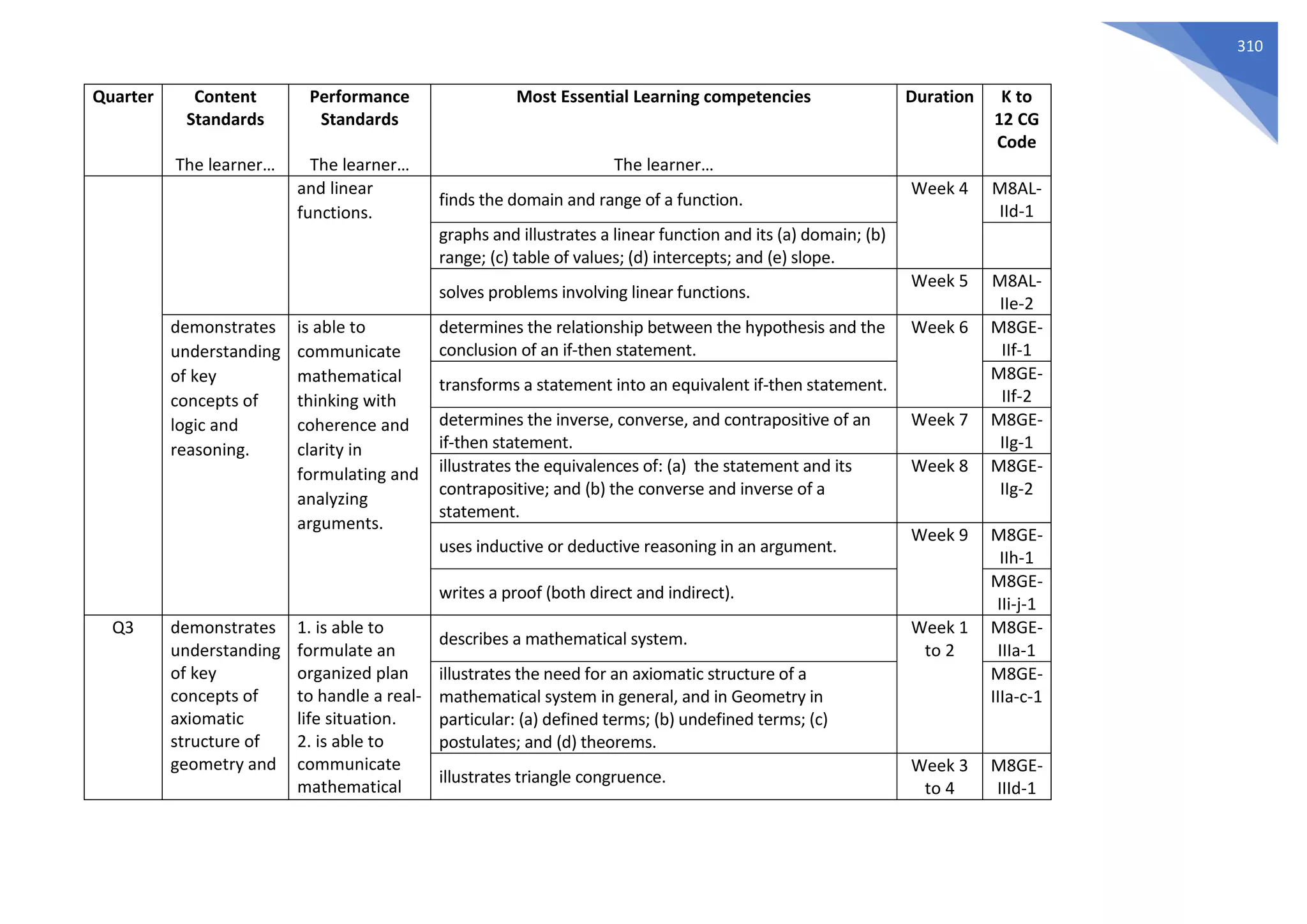
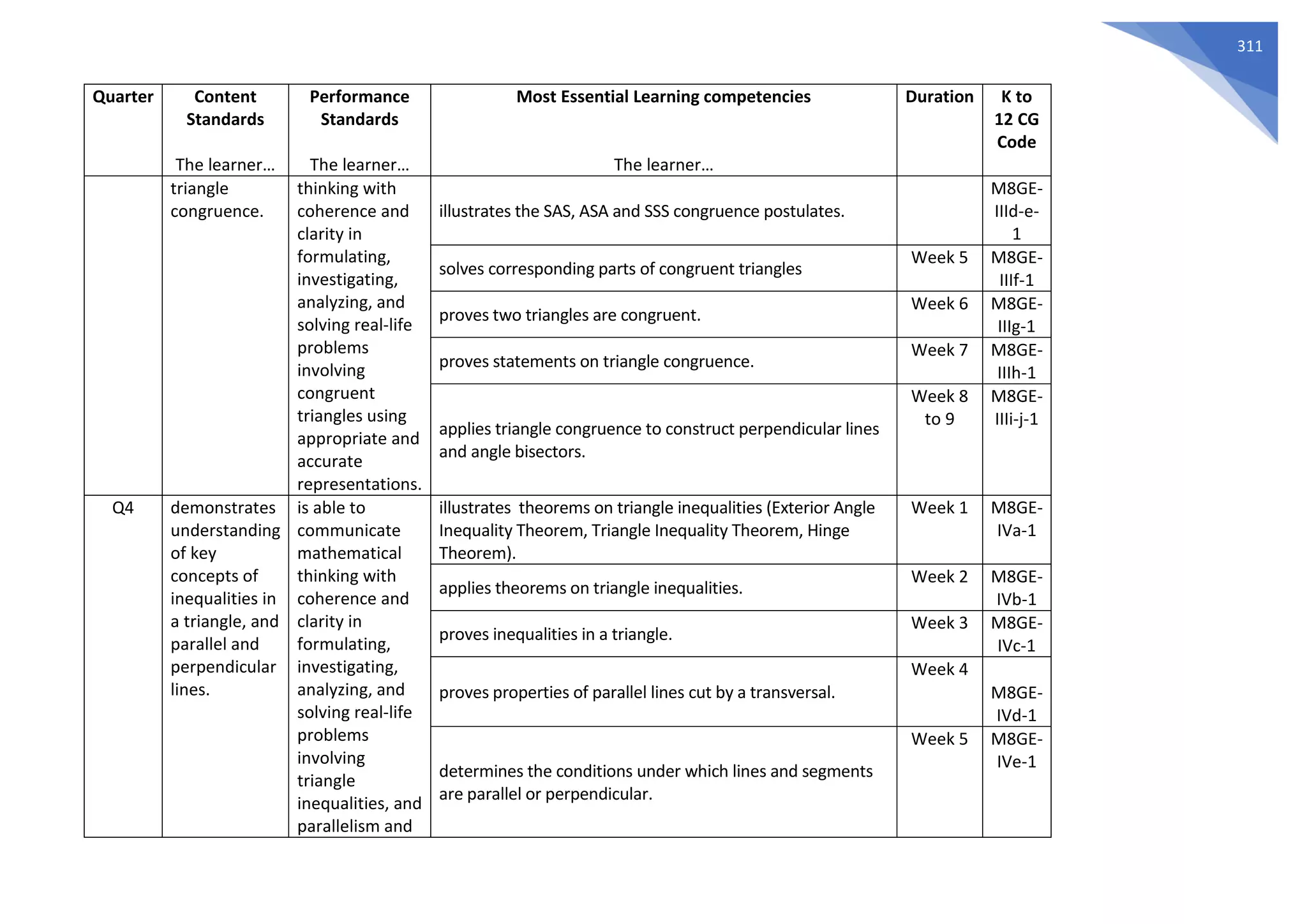
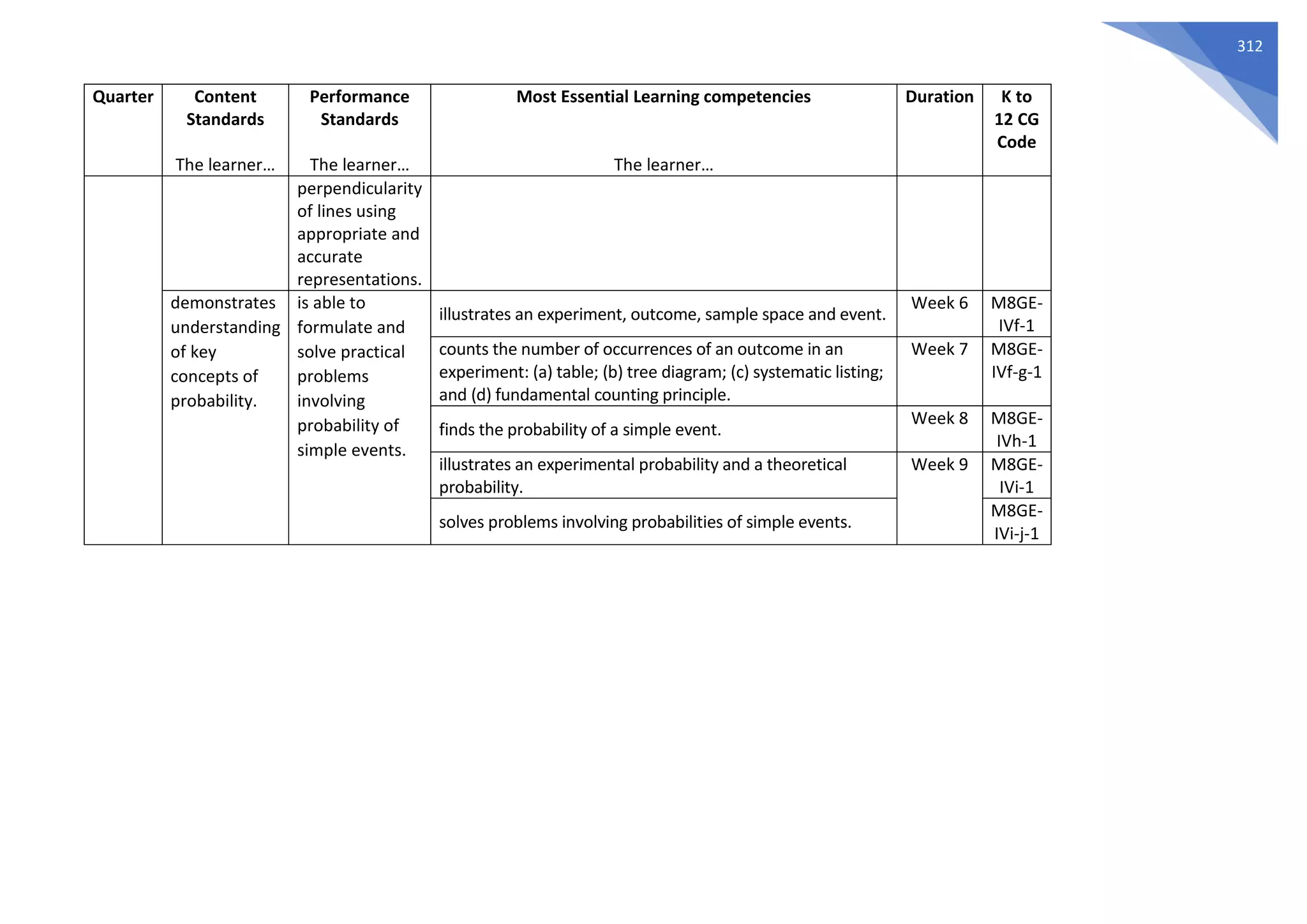
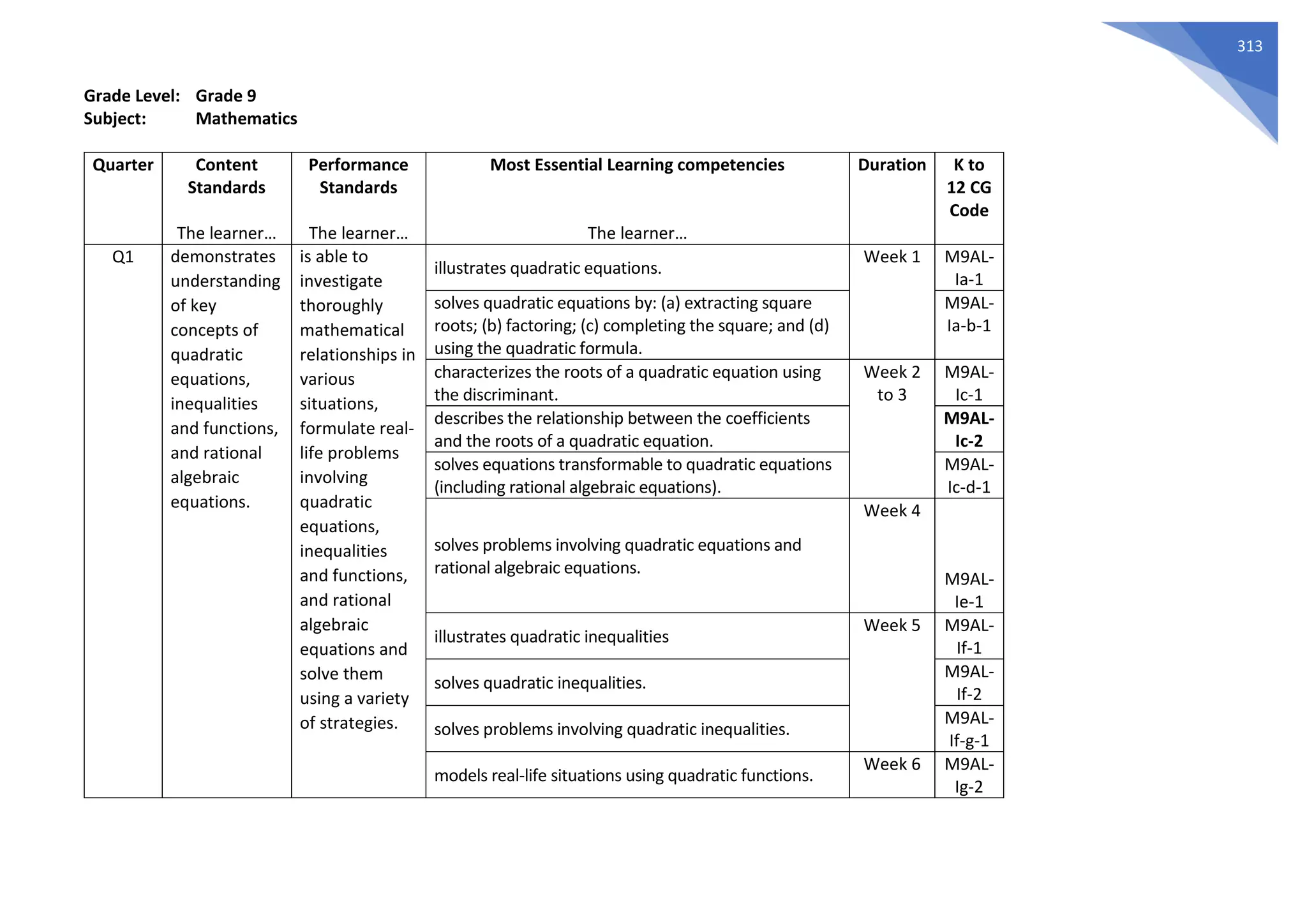
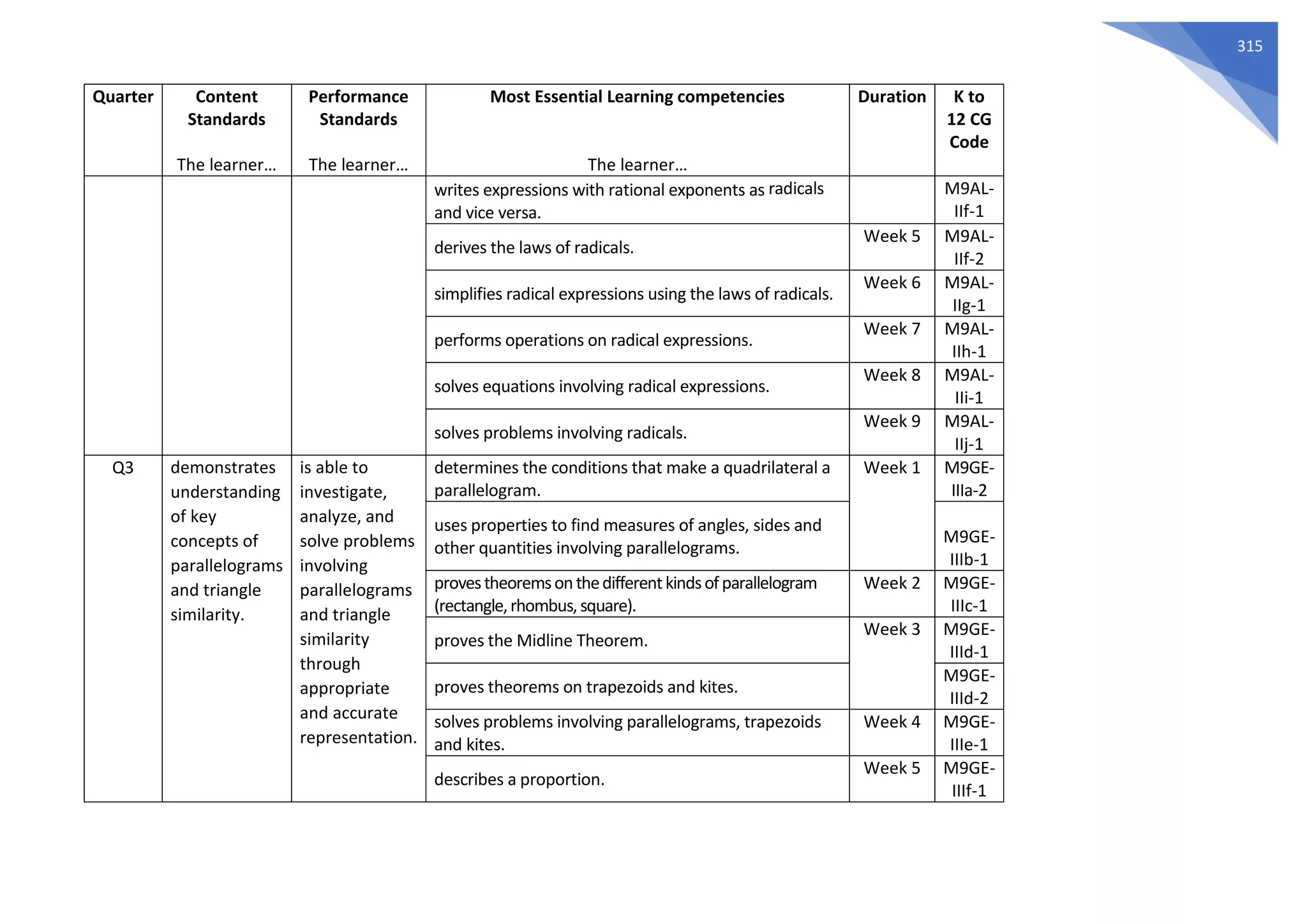
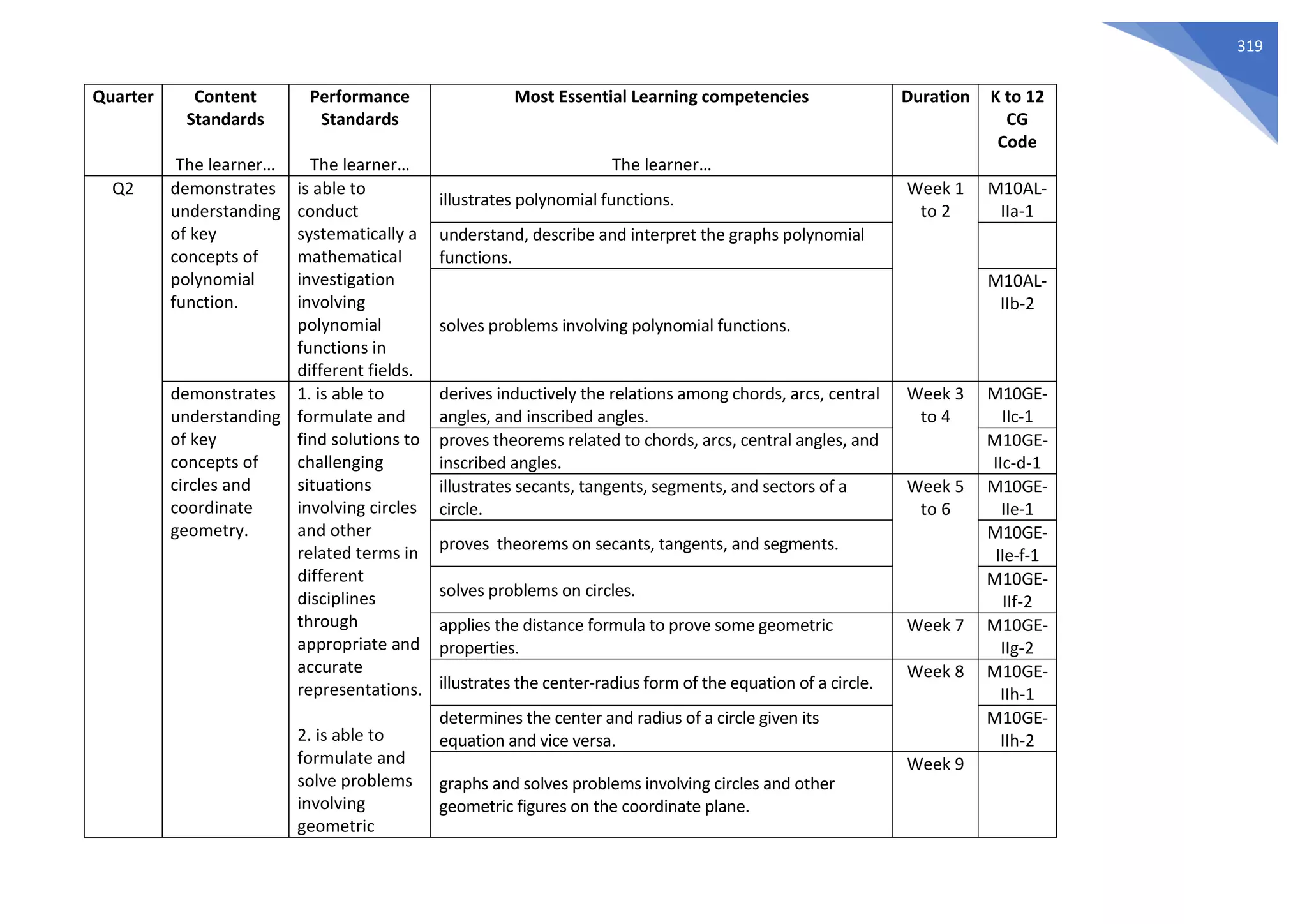
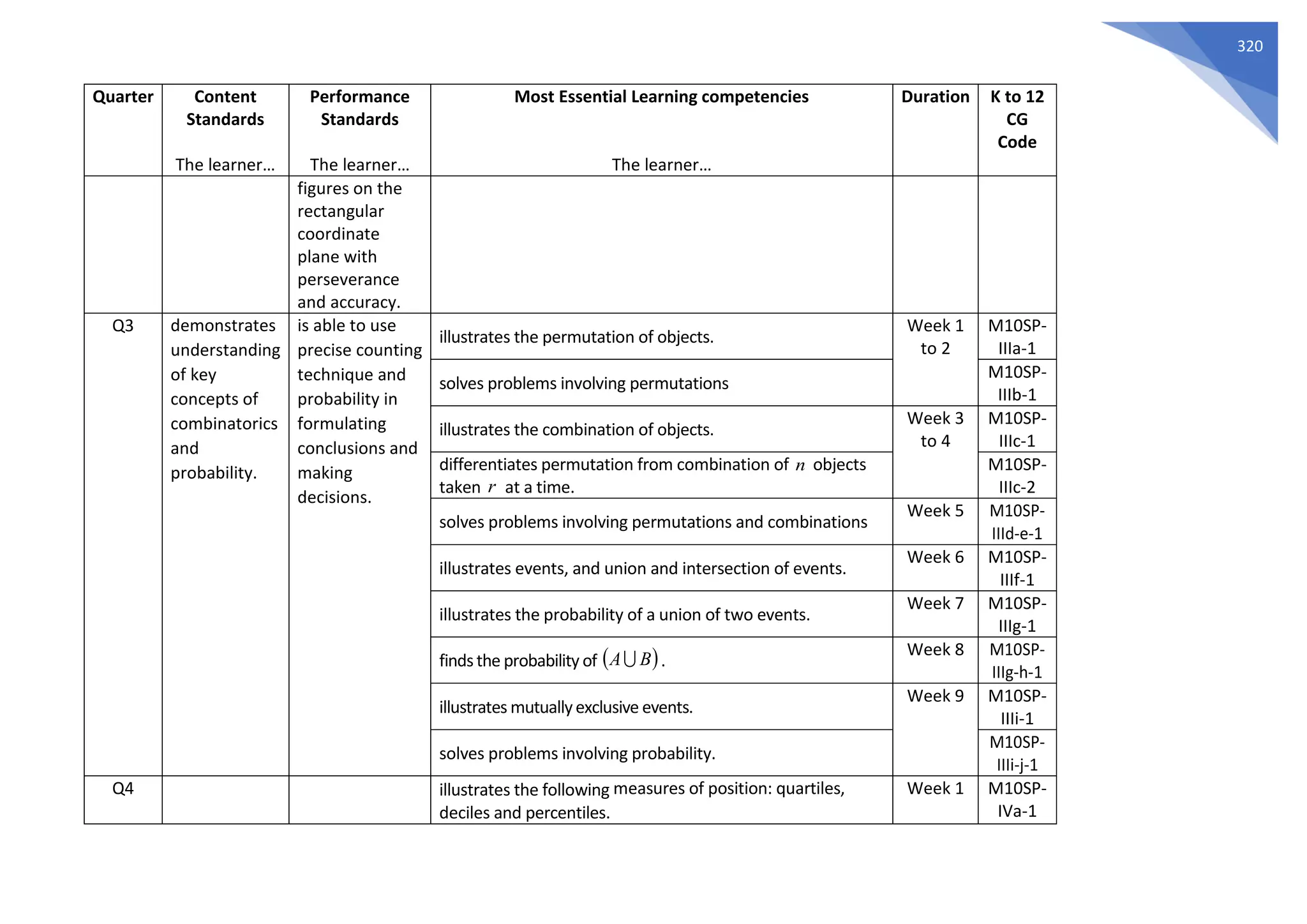
This document outlines the quarterly content standards, performance standards, and most essential learning competencies for mathematics for grades 1 and 2. For grade 1 quarter 1, the content standard is understanding of whole numbers up to 100, ordinal numbers up to 10th, and money up to PhP100. The associated learning competencies include visualizing, representing, and counting numbers from 0 to 100 using various materials. For grade 2 quarter 1, the content standards are understanding of whole numbers up to 1000, ordinal numbers up to 20th, money up to PhP100, and addition of whole numbers up to 1000 including money. The associated learning competencies include visualizing and representing numbers from 0 to 1000 with an emphasis on 101 to 1000
260
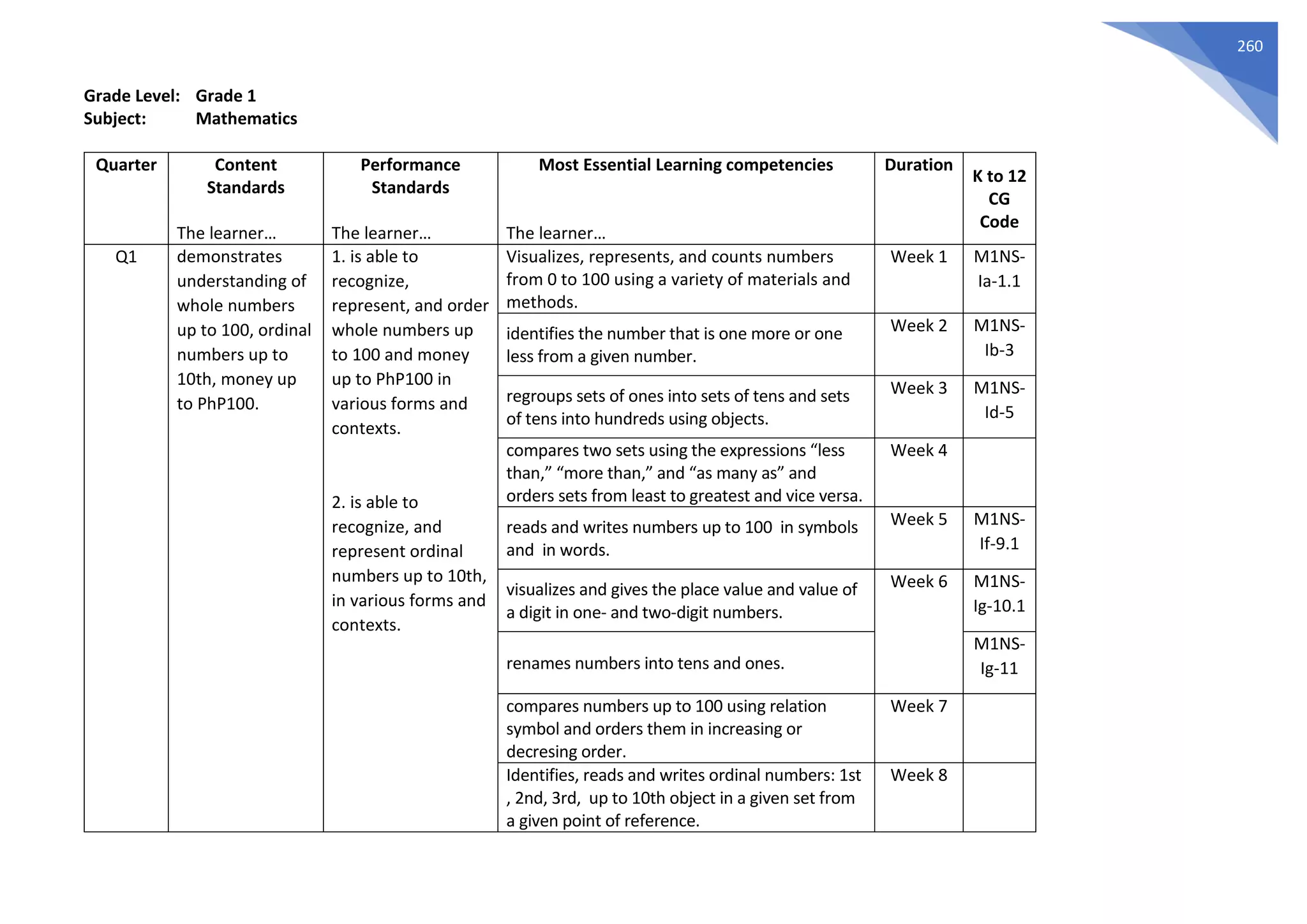
Grade Level: Grade1
Subject: Mathematics
Quarter Content
Standards
The learner…
Performance
Standards
The learner…
Most Essential Learning competencies
The learner…
Duration
K to 12
CG
Code
Q1 demonstrates
understanding of
whole numbers
up to 100, ordinal
numbers up to
10th, money up
to PhP100.
1. is able to
recognize,
represent, and order
whole numbers up
to 100 and money
up to PhP100 in
various forms and
contexts.
2. is able to
recognize, and
represent ordinal
numbers up to 10th,
in various forms and
contexts.
Visualizes, represents, and counts numbers
from 0 to 100 using a variety of materials and
methods.
Week 1 M1NS-
Ia-1.1
identifies the number that is one more or one
less from a given number.
Week 2 M1NS-
Ib-3
regroups sets of ones into sets of tens and sets
of tens into hundreds using objects.
Week 3 M1NS-
Id-5
compares two sets using the expressions “less
than,” “more than,” and “as many as” and
orders sets from least to greatest and vice versa.
Week 4
reads and writes numbers up to 100 in symbols
and in words.
Week 5 M1NS-
If-9.1
visualizes and gives the place value and value of
a digit in one- and two-digit numbers.
Week 6 M1NS-
Ig-10.1
renames numbers into tens and ones.
M1NS-
Ig-11
compares numbers up to 100 using relation
symbol and orders them in increasing or
decresing order.
Week 7
Identifies, reads and writes ordinal numbers: 1st
, 2nd, 3rd, up to 10th object in a given set from
a given point of reference.
Week 8
3.
261
Quarter Content
Standards
The learner…
Performance
Standards
Thelearner…
Most Essential Learning competencies
The learner…
Duration
K to 12
CG
Code
recognizes and compares coins and bills up to
PhP100 and their notations.
Week 9 M1NS-
Ij-19.1
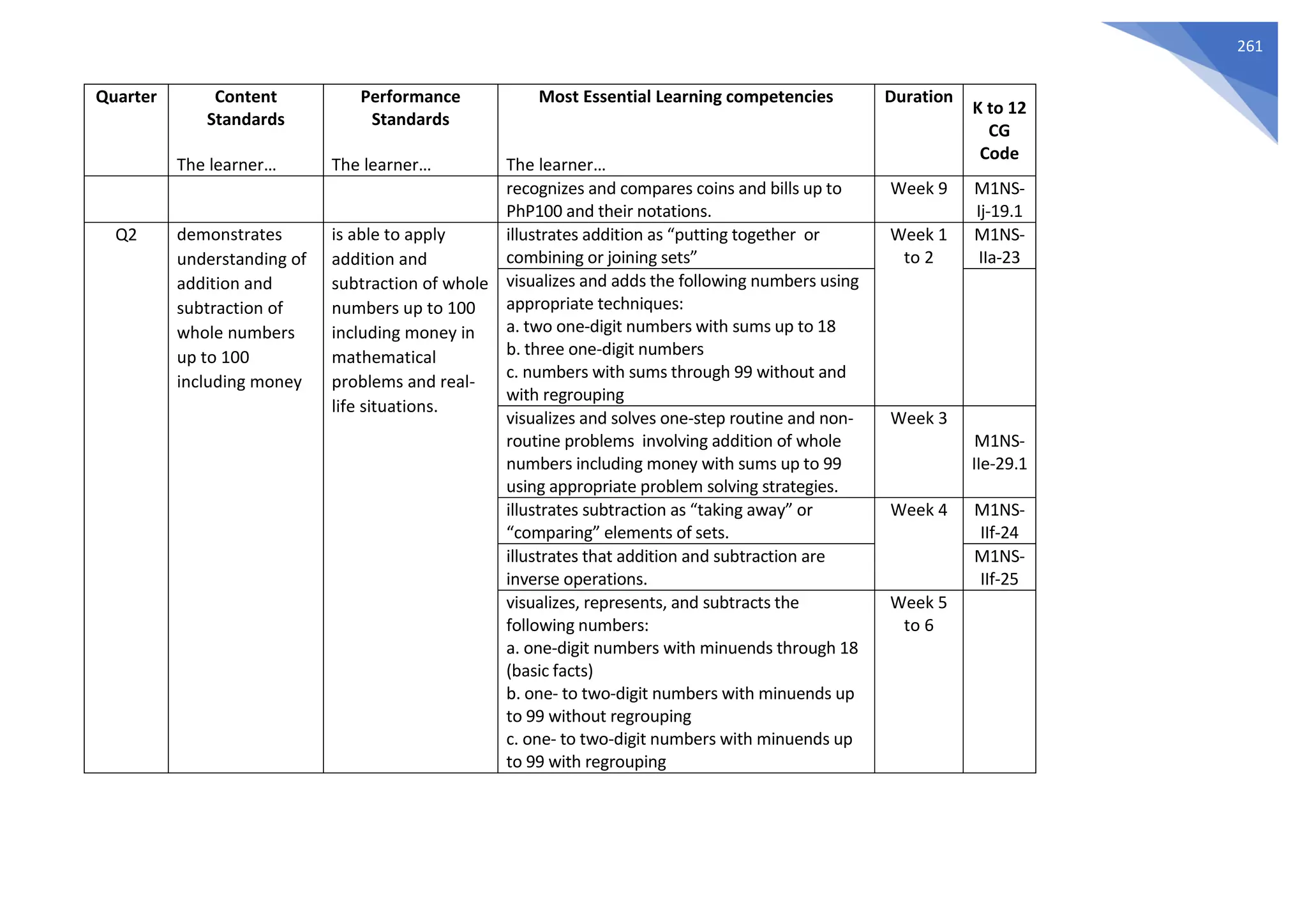
Q2 demonstrates
understanding of
addition and
subtraction of
whole numbers
up to 100
including money
is able to apply
addition and
subtraction of whole
numbers up to 100
including money in
mathematical
problems and real-
life situations.
illustrates addition as “putting together or
combining or joining sets”
Week 1
to 2
M1NS-
IIa-23
visualizes and adds the following numbers using
appropriate techniques:
a. two one-digit numbers with sums up to 18
b. three one-digit numbers
c. numbers with sums through 99 without and
with regrouping
visualizes and solves one-step routine and non-
routine problems involving addition of whole
numbers including money with sums up to 99
using appropriate problem solving strategies.
Week 3
M1NS-
IIe-29.1
illustrates subtraction as “taking away” or
“comparing” elements of sets.
Week 4 M1NS-
IIf-24
illustrates that addition and subtraction are
inverse operations.
M1NS-
IIf-25
visualizes, represents, and subtracts the
following numbers:
a. one-digit numbers with minuends through 18
(basic facts)
b. one- to two-digit numbers with minuends up
to 99 without regrouping
c. one- to two-digit numbers with minuends up
to 99 with regrouping
Week 5
to 6
4.
262
Quarter Content
Standards
The learner…
Performance
Standards
Thelearner…
Most Essential Learning competencies
The learner…
Duration
K to 12
CG
Code
subtracts mentally one-digit numbers from two-
digit minuends without regrouping using
appropriate strategies.
Week 7
M1NS-
IIi-33.1
visualizes, represents, and solves routine and
non-routine problems involving subtraction of
whole numbers including money with minuends
up to 99 with and without regrouping using
appropriate problem solving strategies and
tools.
Week 8
M1NS-
IIi-34.1
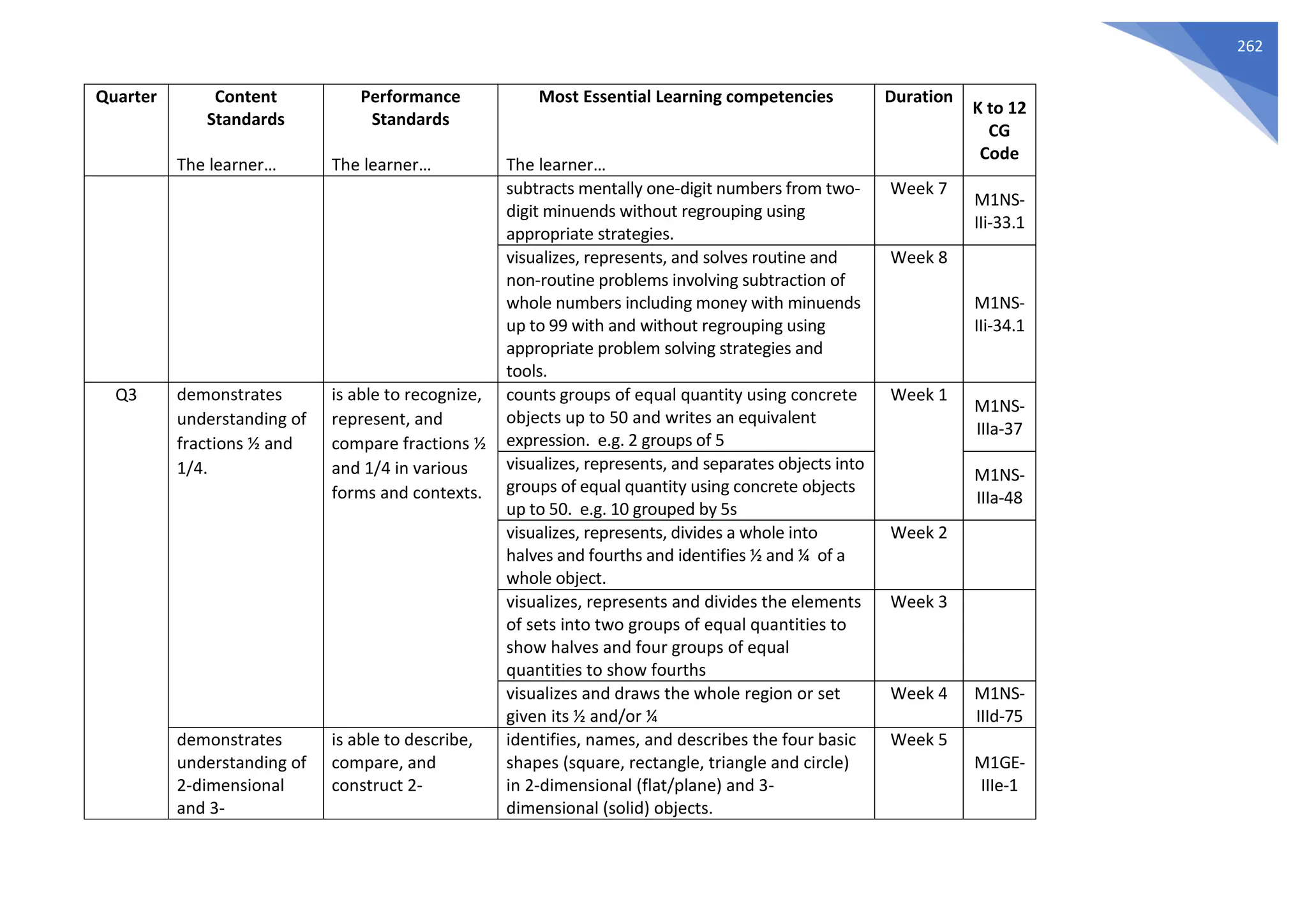
Q3 demonstrates
understanding of
fractions ½ and
1/4.
is able to recognize,
represent, and
compare fractions ½
and 1/4 in various
forms and contexts.
counts groups of equal quantity using concrete
objects up to 50 and writes an equivalent
expression. e.g. 2 groups of 5
Week 1
M1NS-
IIIa-37
visualizes, represents, and separates objects into
groups of equal quantity using concrete objects
up to 50. e.g. 10 grouped by 5s
M1NS-
IIIa-48
visualizes, represents, divides a whole into
halves and fourths and identifies ½ and ¼ of a
whole object.
Week 2
visualizes, represents and divides the elements
of sets into two groups of equal quantities to
show halves and four groups of equal
quantities to show fourths
Week 3
visualizes and draws the whole region or set
given its ½ and/or ¼
Week 4 M1NS-
IIId-75
demonstrates
understanding of
2-dimensional
and 3-
is able to describe,
compare, and
construct 2-
identifies, names, and describes the four basic
shapes (square, rectangle, triangle and circle)
in 2-dimensional (flat/plane) and 3-
dimensional (solid) objects.
Week 5
M1GE-
IIIe-1
5.
263
Quarter Content
Standards
The learner…
Performance
Standards
Thelearner…
Most Essential Learning competencies
The learner…
Duration
K to 12
CG
Code
dimensional
figures.
dimensional and 3-
dimensional objects
draws the four basic shapes.
Week 6 M1GE-
IIIf-3
constructs three dimensional objects (solid)
using manipulative materials.
M1GE-
IIIf-4
demonstrates
understanding of
continuous and
repeating
patterns and
mathematical
sentences.
is able to apply
knowledge of
continuous and
repeating patterns
and number
sentences in various
situations.
determines the missing term/s using one
attribute in a given continuous pattern (letters/
numbers/events) and in a given repeating
pattern (letters, numbers, colors, figures, sizes,
etc.).
Week 7
constructs equivalent number expression using
addition and subtraction.
e.g. 6 + 5 = 12 - 1
Week 8
M1AL-
IIIh-8
identifies and creates patterns to compose and
decompose using addition.
e.g. 7 = 0 + 7, 1 + 6, 2 + 5, 3 + 4, 4 + 3, 5 + 2, 6
+ 1, 7 + 0
M1AL-
IIIi-9
visualizes and finds the missing number in an
addition or subtraction sentence using a
variety of ways
e.g. n + 2 = 5 5 – n = 3
Week 9
M1AL-
IIIj-10
Q4 demonstrates
understanding of
time and non-
standard units of
length, mass and
capacity.
is able to apply
knowledge of time
and non-standard
measures of length,
mass, and capacity
in mathematical
tells the days in a week; months in a year in the
right order.
Week 1 M1ME-
IVa-1
determines the day or the month using a
calendar.
Week 2 M1ME-
IVa-2
tells and writes time by hour, half-hour and
quarter-hour using analog clock.
Week 3 M1ME-
IVb-3
6.
264
Quarter Content
Standards
The learner…
Performance
Standards
Thelearner…
Most Essential Learning competencies
The learner…
Duration
K to 12
CG
Code
problems and real-
life situations
solves problems involving time (days in a week,
months in a year, hour, half-hour, and quarter-
hour)
Week 4
M1ME-
IVb-4
compares objects using comparative words:
short, shorter, shortest; long, longer, longest;
heavy, heavier, heaviest; light, lighter, lightest.
Week 5
to 6
M1ME-
IVc-19
estimates and measures length, mass and
capacity using non- standard units of
measures.
Week 7
demonstrates
understanding of
pictographs
without scales
and outcomes of
an event.
is able to interpret
simple
representations of
data (tables and
pictographs without
scales).
infers and interprets data presented in a
pictograph without scales.
e.g. finding out from the title what the
pictograph is all about, comparing which has
the least or greatest …
Week 8
M1SP-
IVh-3.1
solves routine and non-routine problems using
data presented in pictograph without scales.
Week 9 M1SP-
IVh-4.1
Grade Level: Grade 2
Subject: Mathematics
Quarter Content Standards
The learner…
Performance
Standards
The learner…
Most Essential Learning competencies
The learner…
Duration
K to 12
CG
Code
Q1 visualizes and represents numbers from 0-
1000 with emphasis on numbers 101 – 1
000 using a variety of materials.
Week 1
M2NS-
Ia-1.2
7.
265
Quarter Content Standards
Thelearner…
Performance
Standards
The learner…
Most Essential Learning competencies
The learner…
Duration
K to 12
CG
Code
1. demonstrates
understanding of
whole numbers up
to 1000, ordinal
numbers up to 20th,
and money up to
PhP100.
2. demonstrates
understanding of
addition of whole
numbers up to 1000
including money.
1. is able to recognize,
represent, compare,
and order whole
numbers up to 1000,
ordinal numbers up to
20th, and money up to
PhP100 in various
forms and contexts.
2. is able to recognize
and represent ordinal
numbers up to 20th in
various forms and
contexts.
3. is able to apply
addition of whole
numbers up to 1000
including money in
mathematical
problems and real-life
situations.
gives the place value and finds the value of a
digit in three-digit numbers.
M2NS-
Ib-10.2
visualizes and counts numbers by 10s, 50s,
and 100s.
Week 2 M2NS-
Ib-8.2
reads and writes numbers up to 1 000 in
symbols and in words.
M2NS-
Ic-9.2
visualizes and writes three-digit numbers in
expanded form.
Week 3 M2NS-
Ic-14
compares numbers up using relation
symbols and orders numbers up to 1 000 in
increasing or decreasing order.
Identifies, reads and writes ordinal numbers
from 1st through the 20th object in a given
set from a given point of reference.
Week 4
reads and writes money in symbols and in
words through PhP100.
M2NS-
If-20.1
counts the value of a set of bills or a set of
coins through PhP100 (peso-coins only;
centavo-coins only; peso-bills only and
combined peso-coins and peso-bills).
Week 5
M2NS-
If-21
compares values of different denominations
of coins and paper bills through PhP100
using relation symbols.
M2NS-
If-22.1
illustrates the properties of addition
(commutative, associative, identity) and
applies each in appropriate and relevant
situations.
Week 6
M2NS-
Ig-26.3
8.
266
Quarter Content Standards
Thelearner…
Performance
Standards
The learner…
Most Essential Learning competencies
The learner…
Duration
K to 12
CG
Code
visualizes, represents, and adds the
following numbers with sums up to 1000
without and with regrouping:
a. 2-digit by 3-digit numbers
b. 3-digit by 3-digit numbers
adds mentally the folllowing numbers using
appropriate strategies:
a. 1- to 2-digit numbers with sums up to 50
b. 3-digit numbers and 1-digit numbers
c. three -digit numbers and tens (multiples
of 10 up to 90)
d. 3-digit numbers and hundreds (multiples
of 100 up to 900)
Week 7
to 8
solves routine and non-routine problems
involving addition of whole numbers
including money with sums up to 1000 using
appropriate problem solving strategies and
tools.
Week 9
M2NS-
Ij-29.2
Q2 demonstrates
understanding of
subtraction and
multiplication of
whole numbers up
to 1000 including
money.
is able to apply
subtraction and
multiplication of whole
numbers up to 1000
including money in
mathematical
visualizes, represents, and subtracts 2- to 3-
digit numbers with minuends up to 999
without and with regrouping.
Week 1 M2NS-
IIa-
32.5
subtracts mentally the following numbers
without regrouping using appropriate
strategies:
a. 1-digit numbers from 1- to 3-digit
numbers
b. 3-digit numbers by tens and by hundreds
Week 2
9.
267
Quarter Content Standards
Thelearner…
Performance
Standards
The learner…
Most Essential Learning competencies
The learner…
Duration
K to 12
CG
Code
problems and real-life
situations.
solves routine and non-routine problems
involving subtraction of whole numbers
including money with minuends up to 1000
using appropriate problem solving strategies
and tools.
Week 3
M2NS-
IIc-34.2
performs orders of operations involving
addition and subtractions of small numbers.
Week 4 M2NS-
IId-
34.3
solves multi-step routine and non-routine
problems involving addition and subtraction
of 2- to 3-digit numbers including money
using appropriate problem solving strategies
and tools.
Week 5
M2NS-
IIe-
34.4
illustrates and writes a related equation for
each type of multiplication: repeated
addition, array, counting by multiples, and
equal jumps on the number line.
Week 6
illustrates the following properties of
multiplication and applyc each in relevant
situation: (a) identity, (b) zero, and, (c)
commutative.
Week 7
visualizes multiplication of numbers 1 to 10
by 2,3,4,5 and10.
Week 8 M2NS-
IIh-
41.1
multiplies mentally 2,3,4,5 and 10 using
appropriate strategies.
M2NS-
IIi-42.1
10.
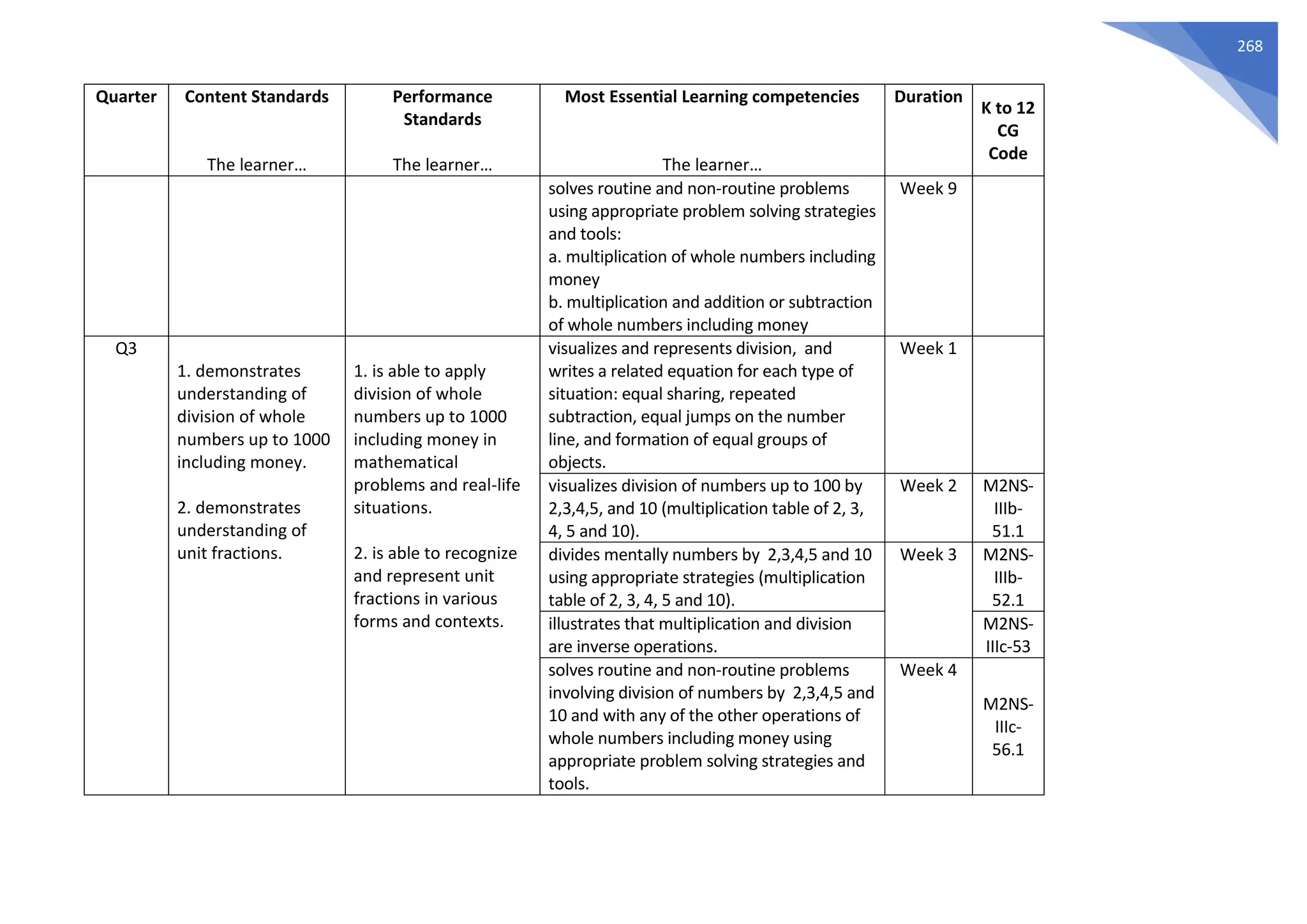
268
Quarter Content Standards
Thelearner…
Performance
Standards
The learner…
Most Essential Learning competencies
The learner…
Duration
K to 12
CG
Code
solves routine and non-routine problems
using appropriate problem solving strategies
and tools:
a. multiplication of whole numbers including
money
b. multiplication and addition or subtraction
of whole numbers including money
Week 9
Q3
1. demonstrates
understanding of
division of whole
numbers up to 1000
including money.
2. demonstrates
understanding of
unit fractions.
1. is able to apply
division of whole
numbers up to 1000
including money in
mathematical
problems and real-life
situations.
2. is able to recognize
and represent unit
fractions in various
forms and contexts.
visualizes and represents division, and
writes a related equation for each type of
situation: equal sharing, repeated
subtraction, equal jumps on the number
line, and formation of equal groups of
objects.
Week 1
visualizes division of numbers up to 100 by
2,3,4,5, and 10 (multiplication table of 2, 3,
4, 5 and 10).
Week 2 M2NS-
IIIb-
51.1
divides mentally numbers by 2,3,4,5 and 10
using appropriate strategies (multiplication
table of 2, 3, 4, 5 and 10).
Week 3 M2NS-
IIIb-
52.1
illustrates that multiplication and division
are inverse operations.
M2NS-
IIIc-53
solves routine and non-routine problems
involving division of numbers by 2,3,4,5 and
10 and with any of the other operations of
whole numbers including money using
appropriate problem solving strategies and
tools.
Week 4
M2NS-
IIIc-
56.1
11.
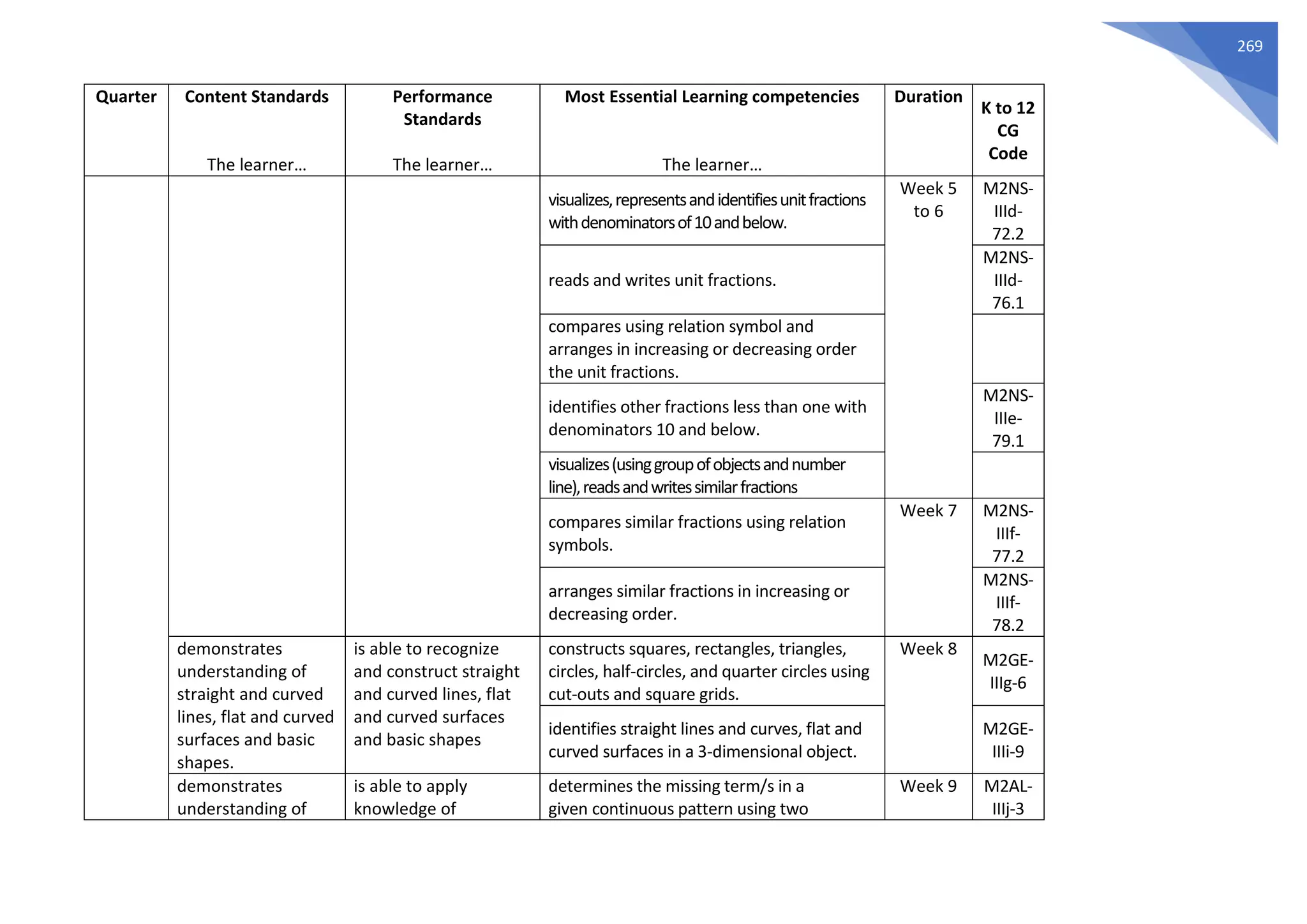
269
Quarter Content Standards
Thelearner…
Performance
Standards
The learner…
Most Essential Learning competencies
The learner…
Duration
K to 12
CG
Code
visualizes,representsandidentifiesunitfractions
withdenominatorsof10andbelow.
Week 5
to 6
M2NS-
IIId-
72.2
reads and writes unit fractions.
M2NS-
IIId-
76.1
compares using relation symbol and
arranges in increasing or decreasing order
the unit fractions.
identifies other fractions less than one with
denominators 10 and below.
M2NS-
IIIe-
79.1
visualizes(usinggroupofobjectsandnumber
line),readsandwritessimilarfractions
compares similar fractions using relation
symbols.
Week 7 M2NS-
IIIf-
77.2
arranges similar fractions in increasing or
decreasing order.
M2NS-
IIIf-
78.2
demonstrates
understanding of
straight and curved
lines, flat and curved
surfaces and basic
shapes.
is able to recognize
and construct straight
and curved lines, flat
and curved surfaces
and basic shapes
constructs squares, rectangles, triangles,
circles, half-circles, and quarter circles using
cut-outs and square grids.
Week 8
M2GE-
IIIg-6
identifies straight lines and curves, flat and
curved surfaces in a 3-dimensional object.
M2GE-
IIIi-9
demonstrates
understanding of
is able to apply
knowledge of
determines the missing term/s in a
given continuous pattern using two
Week 9 M2AL-
IIIj-3
12.
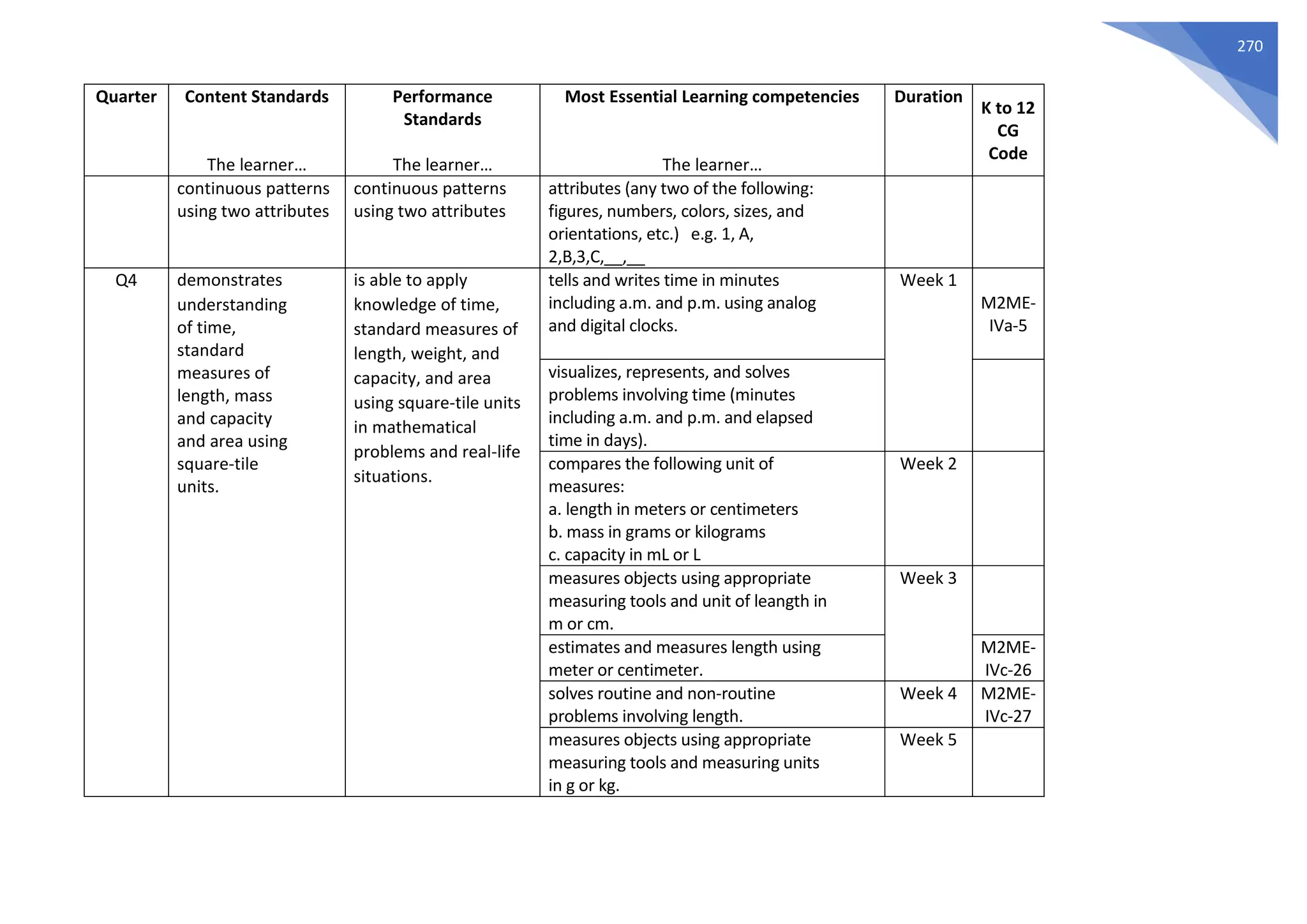
270
Quarter Content Standards
Thelearner…
Performance
Standards
The learner…
Most Essential Learning competencies
The learner…
Duration
K to 12
CG
Code
continuous patterns
using two attributes
continuous patterns
using two attributes
attributes (any two of the following:
figures, numbers, colors, sizes, and
orientations, etc.) e.g. 1, A,
2,B,3,C,__,__
Q4 demonstrates
understanding
of time,
standard
measures of
length, mass
and capacity
and area using
square-tile
units.
is able to apply
knowledge of time,
standard measures of
length, weight, and
capacity, and area
using square-tile units
in mathematical
problems and real-life
situations.
tells and writes time in minutes
including a.m. and p.m. using analog
and digital clocks.
Week 1
M2ME-
IVa-5
visualizes, represents, and solves
problems involving time (minutes
including a.m. and p.m. and elapsed
time in days).
compares the following unit of
measures:
a. length in meters or centimeters
b. mass in grams or kilograms
c. capacity in mL or L
Week 2
measures objects using appropriate
measuring tools and unit of leangth in
m or cm.
Week 3
estimates and measures length using
meter or centimeter.
M2ME-
IVc-26
solves routine and non-routine
problems involving length.
Week 4 M2ME-
IVc-27
measures objects using appropriate
measuring tools and measuring units
in g or kg.
Week 5
13.
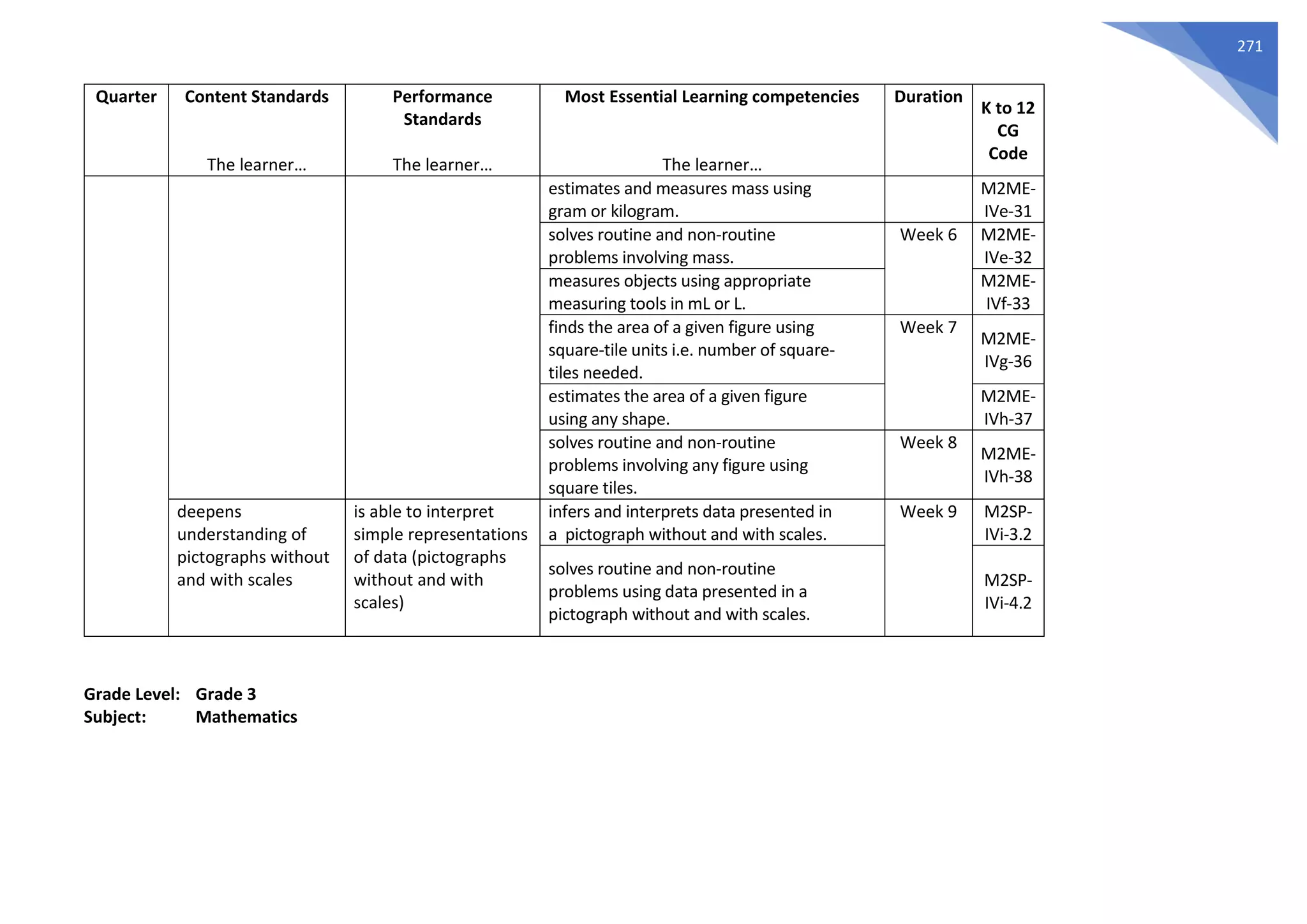
271
Quarter Content Standards
Thelearner…
Performance
Standards
The learner…
Most Essential Learning competencies
The learner…
Duration
K to 12
CG
Code
estimates and measures mass using
gram or kilogram.
M2ME-
IVe-31
solves routine and non-routine
problems involving mass.
Week 6 M2ME-
IVe-32
measures objects using appropriate
measuring tools in mL or L.
M2ME-
IVf-33
finds the area of a given figure using
square-tile units i.e. number of square-
tiles needed.
Week 7
M2ME-
IVg-36
estimates the area of a given figure
using any shape.
M2ME-
IVh-37
solves routine and non-routine
problems involving any figure using
square tiles.
Week 8
M2ME-
IVh-38
deepens
understanding of
pictographs without
and with scales
is able to interpret
simple representations
of data (pictographs
without and with
scales)
infers and interprets data presented in
a pictograph without and with scales.
Week 9 M2SP-
IVi-3.2
solves routine and non-routine
problems using data presented in a
pictograph without and with scales.
M2SP-
IVi-4.2
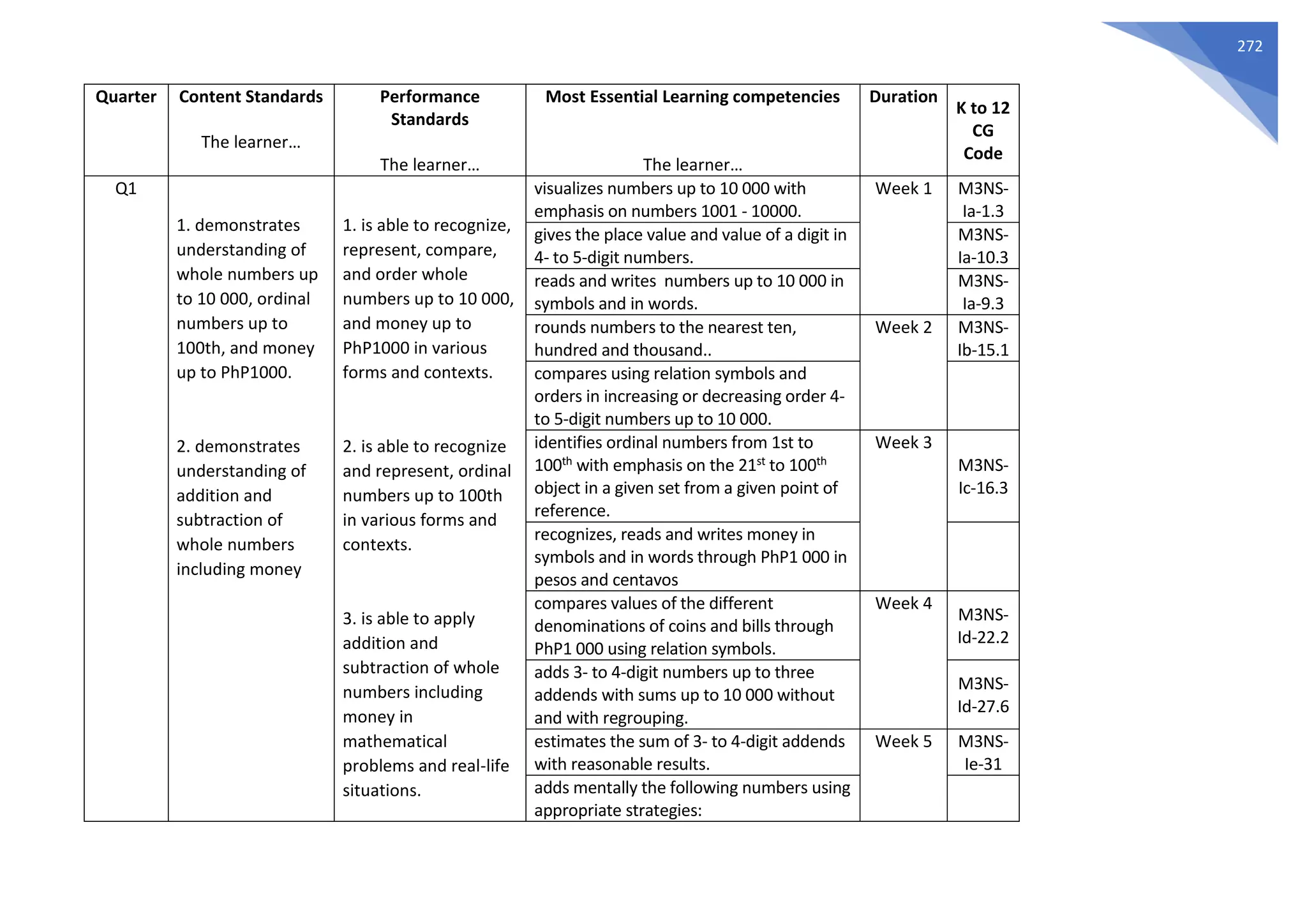
Grade Level: Grade 3
Subject: Mathematics
14.
272
Quarter Content Standards
Thelearner…
Performance
Standards
The learner…
Most Essential Learning competencies
The learner…
Duration
K to 12
CG
Code
Q1
1. demonstrates
understanding of
whole numbers up
to 10 000, ordinal
numbers up to
100th, and money
up to PhP1000.
2. demonstrates
understanding of
addition and
subtraction of
whole numbers
including money
1. is able to recognize,
represent, compare,
and order whole
numbers up to 10 000,
and money up to
PhP1000 in various
forms and contexts.
2. is able to recognize
and represent, ordinal
numbers up to 100th
in various forms and
contexts.
3. is able to apply
addition and
subtraction of whole
numbers including
money in
mathematical
problems and real-life
situations.
visualizes numbers up to 10 000 with
emphasis on numbers 1001 - 10000.
Week 1 M3NS-
Ia-1.3
gives the place value and value of a digit in
4- to 5-digit numbers.
M3NS-
Ia-10.3
reads and writes numbers up to 10 000 in
symbols and in words.
M3NS-
Ia-9.3
rounds numbers to the nearest ten,
hundred and thousand..
Week 2 M3NS-
Ib-15.1
compares using relation symbols and
orders in increasing or decreasing order 4-
to 5-digit numbers up to 10 000.
identifies ordinal numbers from 1st to
100th with emphasis on the 21st to 100th
object in a given set from a given point of
reference.
Week 3
M3NS-
Ic-16.3
recognizes, reads and writes money in
symbols and in words through PhP1 000 in
pesos and centavos
compares values of the different
denominations of coins and bills through
PhP1 000 using relation symbols.
Week 4
M3NS-
Id-22.2
adds 3- to 4-digit numbers up to three
addends with sums up to 10 000 without
and with regrouping.
M3NS-
Id-27.6
estimates the sum of 3- to 4-digit addends
with reasonable results.
Week 5 M3NS-
Ie-31
adds mentally the following numbers using
appropriate strategies:
15.
273
Quarter Content Standards
Thelearner…
Performance
Standards
The learner…
Most Essential Learning competencies
The learner…
Duration
K to 12
CG
Code
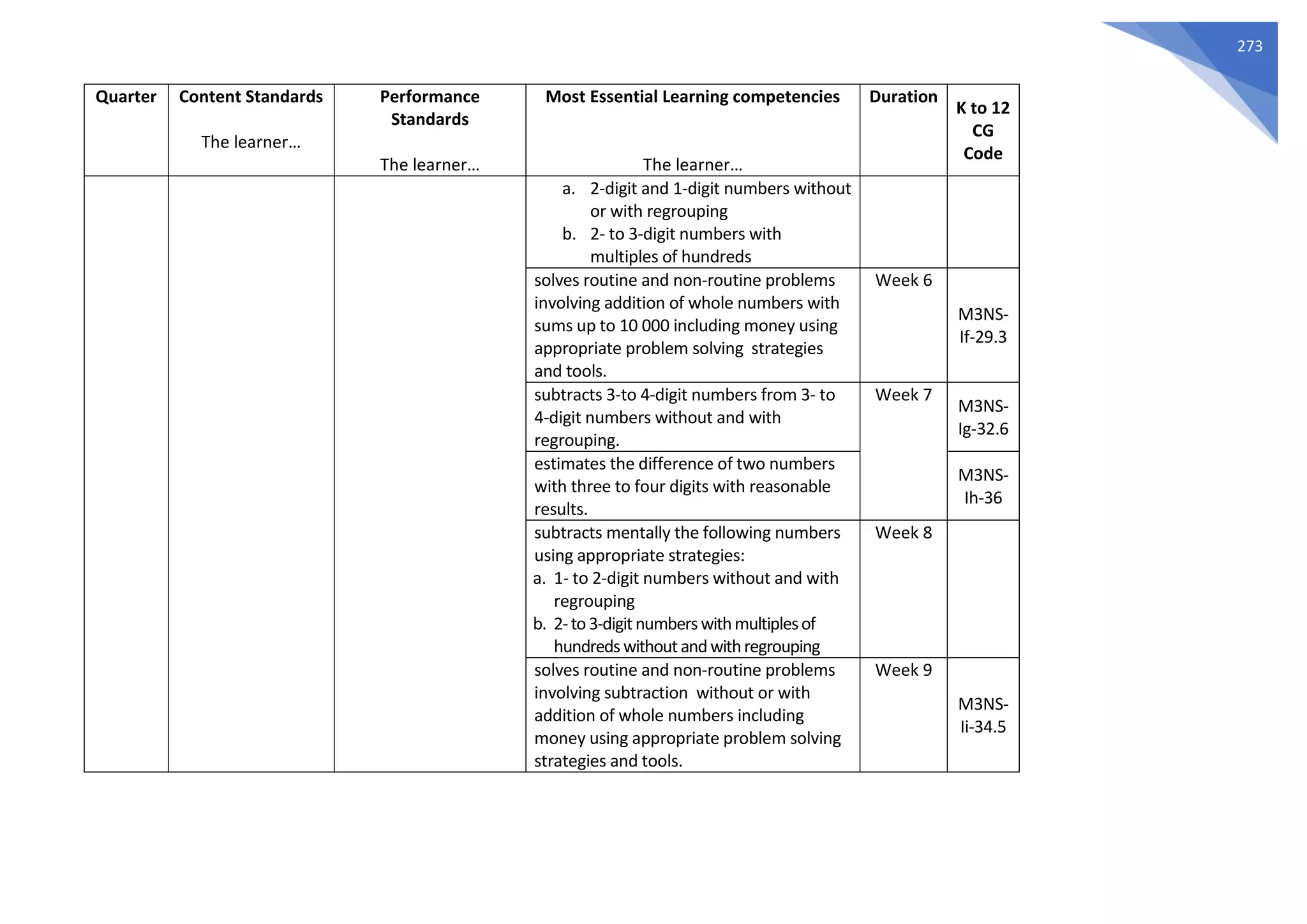
a. 2-digit and 1-digit numbers without
or with regrouping
b. 2- to 3-digit numbers with
multiples of hundreds
solves routine and non-routine problems
involving addition of whole numbers with
sums up to 10 000 including money using
appropriate problem solving strategies
and tools.
Week 6
M3NS-
If-29.3
subtracts 3-to 4-digit numbers from 3- to
4-digit numbers without and with
regrouping.
Week 7
M3NS-
Ig-32.6
estimates the difference of two numbers
with three to four digits with reasonable
results.
M3NS-
Ih-36
subtracts mentally the following numbers
using appropriate strategies:
a. 1- to 2-digit numbers without and with
regrouping
b. 2-to3-digitnumberswithmultiplesof
hundredswithoutandwithregrouping
Week 8
solves routine and non-routine problems
involving subtraction without or with
addition of whole numbers including
money using appropriate problem solving
strategies and tools.
Week 9
M3NS-
Ii-34.5
16.
274
Quarter Content Standards
Thelearner…
Performance
Standards
The learner…
Most Essential Learning competencies
The learner…
Duration
K to 12
CG
Code
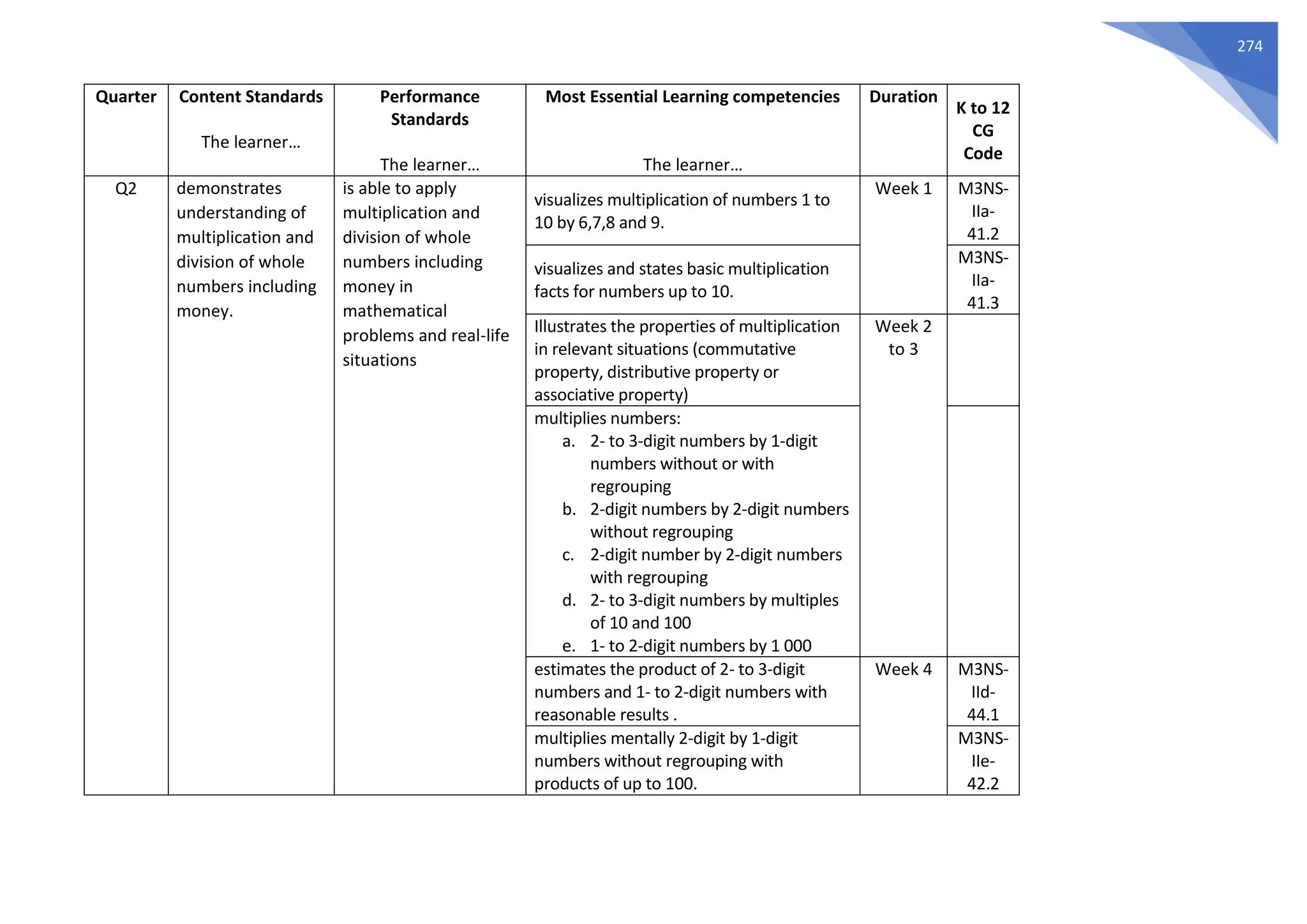
Q2 demonstrates
understanding of
multiplication and
division of whole
numbers including
money.
is able to apply
multiplication and
division of whole
numbers including
money in
mathematical
problems and real-life
situations
visualizes multiplication of numbers 1 to
10 by 6,7,8 and 9.
Week 1 M3NS-
IIa-
41.2
visualizes and states basic multiplication
facts for numbers up to 10.
M3NS-
IIa-
41.3
Illustrates the properties of multiplication
in relevant situations (commutative
property, distributive property or
associative property)
Week 2
to 3
multiplies numbers:
a. 2- to 3-digit numbers by 1-digit
numbers without or with
regrouping
b. 2-digit numbers by 2-digit numbers
without regrouping
c. 2-digit number by 2-digit numbers
with regrouping
d. 2- to 3-digit numbers by multiples
of 10 and 100
e. 1- to 2-digit numbers by 1 000
estimates the product of 2- to 3-digit
numbers and 1- to 2-digit numbers with
reasonable results .
Week 4 M3NS-
IId-
44.1
multiplies mentally 2-digit by 1-digit
numbers without regrouping with
products of up to 100.
M3NS-
IIe-
42.2
17.
275
Quarter Content Standards
Thelearner…
Performance
Standards
The learner…
Most Essential Learning competencies
The learner…
Duration
K to 12
CG
Code
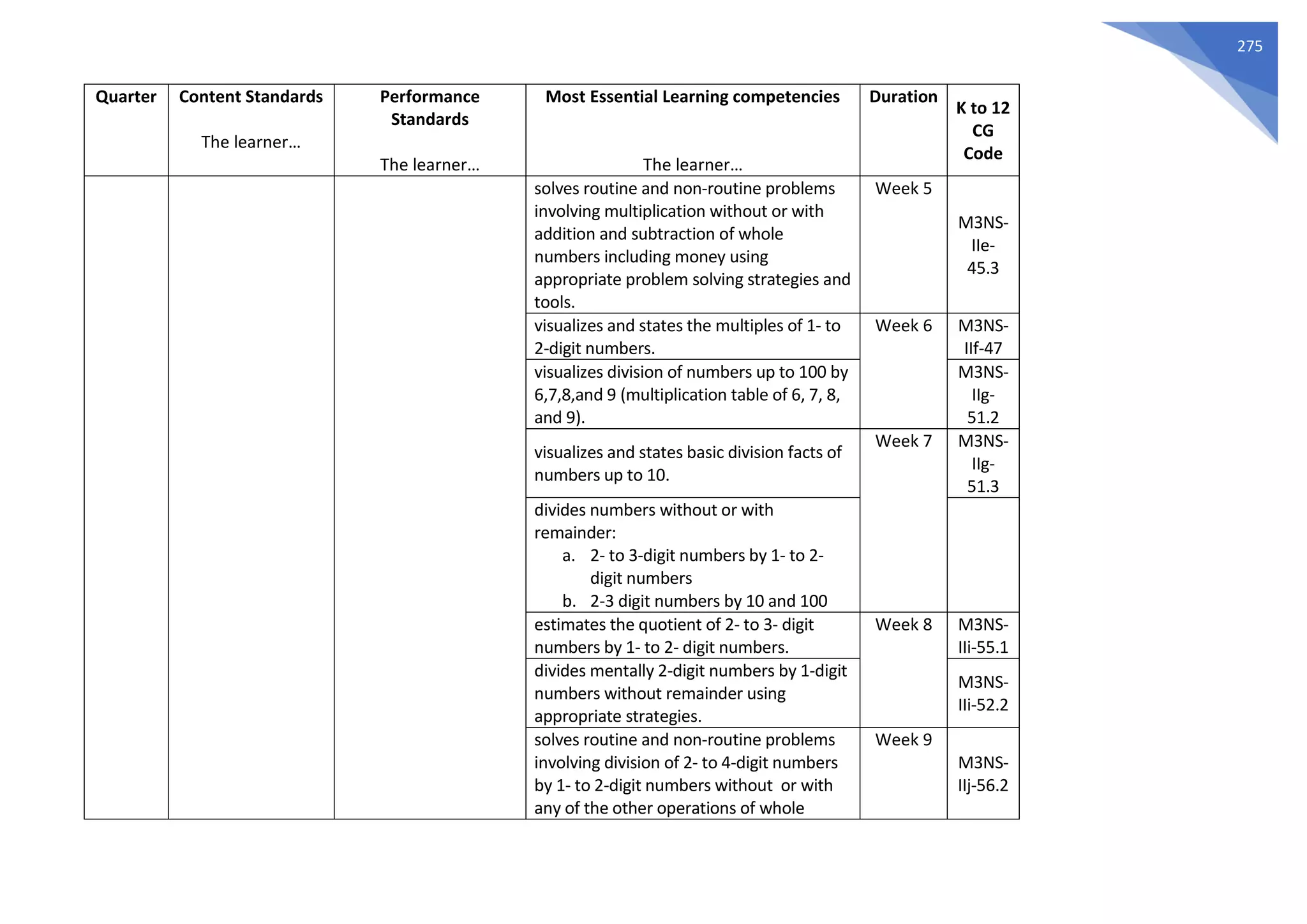
solves routine and non-routine problems
involving multiplication without or with
addition and subtraction of whole
numbers including money using
appropriate problem solving strategies and
tools.
Week 5
M3NS-
IIe-
45.3
visualizes and states the multiples of 1- to
2-digit numbers.
Week 6 M3NS-
IIf-47
visualizes division of numbers up to 100 by
6,7,8,and 9 (multiplication table of 6, 7, 8,
and 9).
M3NS-
IIg-
51.2
visualizes and states basic division facts of
numbers up to 10.
Week 7 M3NS-
IIg-
51.3
divides numbers without or with
remainder:
a. 2- to 3-digit numbers by 1- to 2-
digit numbers
b. 2-3 digit numbers by 10 and 100
estimates the quotient of 2- to 3- digit
numbers by 1- to 2- digit numbers.
Week 8 M3NS-
IIi-55.1
divides mentally 2-digit numbers by 1-digit
numbers without remainder using
appropriate strategies.
M3NS-
IIi-52.2
solves routine and non-routine problems
involving division of 2- to 4-digit numbers
by 1- to 2-digit numbers without or with
any of the other operations of whole
Week 9
M3NS-
IIj-56.2
18.
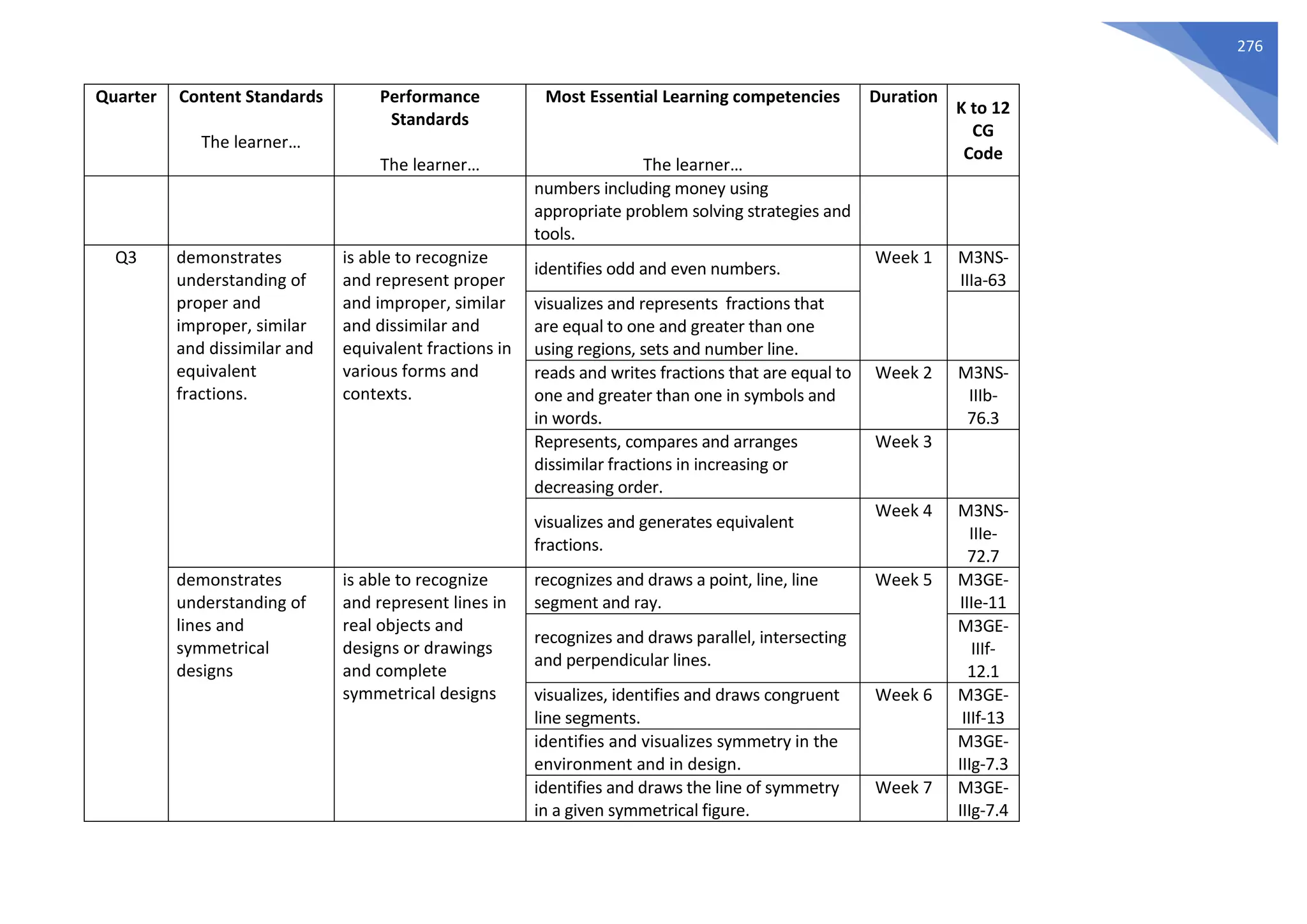
276
Quarter Content Standards
Thelearner…
Performance
Standards
The learner…
Most Essential Learning competencies
The learner…
Duration
K to 12
CG
Code
numbers including money using
appropriate problem solving strategies and
tools.
Q3 demonstrates
understanding of
proper and
improper, similar
and dissimilar and
equivalent
fractions.
is able to recognize
and represent proper
and improper, similar
and dissimilar and
equivalent fractions in
various forms and
contexts.
identifies odd and even numbers.
Week 1 M3NS-
IIIa-63
visualizes and represents fractions that
are equal to one and greater than one
using regions, sets and number line.
reads and writes fractions that are equal to
one and greater than one in symbols and
in words.
Week 2 M3NS-
IIIb-
76.3
Represents, compares and arranges
dissimilar fractions in increasing or
decreasing order.
Week 3
visualizes and generates equivalent
fractions.
Week 4 M3NS-
IIIe-
72.7
demonstrates
understanding of
lines and
symmetrical
designs
is able to recognize
and represent lines in
real objects and
designs or drawings
and complete
symmetrical designs
recognizes and draws a point, line, line
segment and ray.
Week 5 M3GE-
IIIe-11
recognizes and draws parallel, intersecting
and perpendicular lines.
M3GE-
IIIf-
12.1
visualizes, identifies and draws congruent
line segments.
Week 6 M3GE-
IIIf-13
identifies and visualizes symmetry in the
environment and in design.
M3GE-
IIIg-7.3
identifies and draws the line of symmetry
in a given symmetrical figure.
Week 7 M3GE-
IIIg-7.4
19.
277
Quarter Content Standards
Thelearner…
Performance
Standards
The learner…
Most Essential Learning competencies
The learner…
Duration
K to 12
CG
Code
completes a symmetric figure with respect
to a given line of symmetry.
M3GE-
IIIh-7.5
demonstrates
understanding of
continuous and
repeating patterns
and mathematical
sentences involving
multiplication and
division of whole
numbers.
is able to apply
knowledge of
continuous and
repeating patterns and
number sentences
involving
multiplication or
division of whole
numbers in various
situations.
determines the missing term/s in a given
combination of continuous and repeating
pattern.
e.g. 4A,5B, 6A,7B,__
1 2 3 4 ___
Week 8
M3AL-
IIIi-4
finds the missing value in a number
sentence involving multiplication or
division of whole numbers.
e.g. n x 7 = 56 56 ÷ n = 8
Week 9
M3AL-
IIIj-12
Q4 demonstrates
understanding of
conversion of time,
linear, mass and
capacity measures
and area of square
and rectangle.
is able to apply
knowledge of
conversion of time,
linear, mass and
capacity measures and
area of rectangle and
square in
mathematical
problems and real-life
situations.
visualizes, represents, and converts time
measure:
a. from seconds to minutes, minutes to
hours, and hours to a day and vice versa
b. days to week, month and year and vice
versa
c. weeks to months and year and vice
versa
d. months to year and vice versa.
Week 1
solves problems involving conversion of
time measure.
Week 2
visualizes, and represents, and converts
common units of measure from larger to
smaller unit and vice versa: meter and
centimeter, kilogram and gram, liter and
milliliter.
Week 3
M3ME-
IVb-39
20.
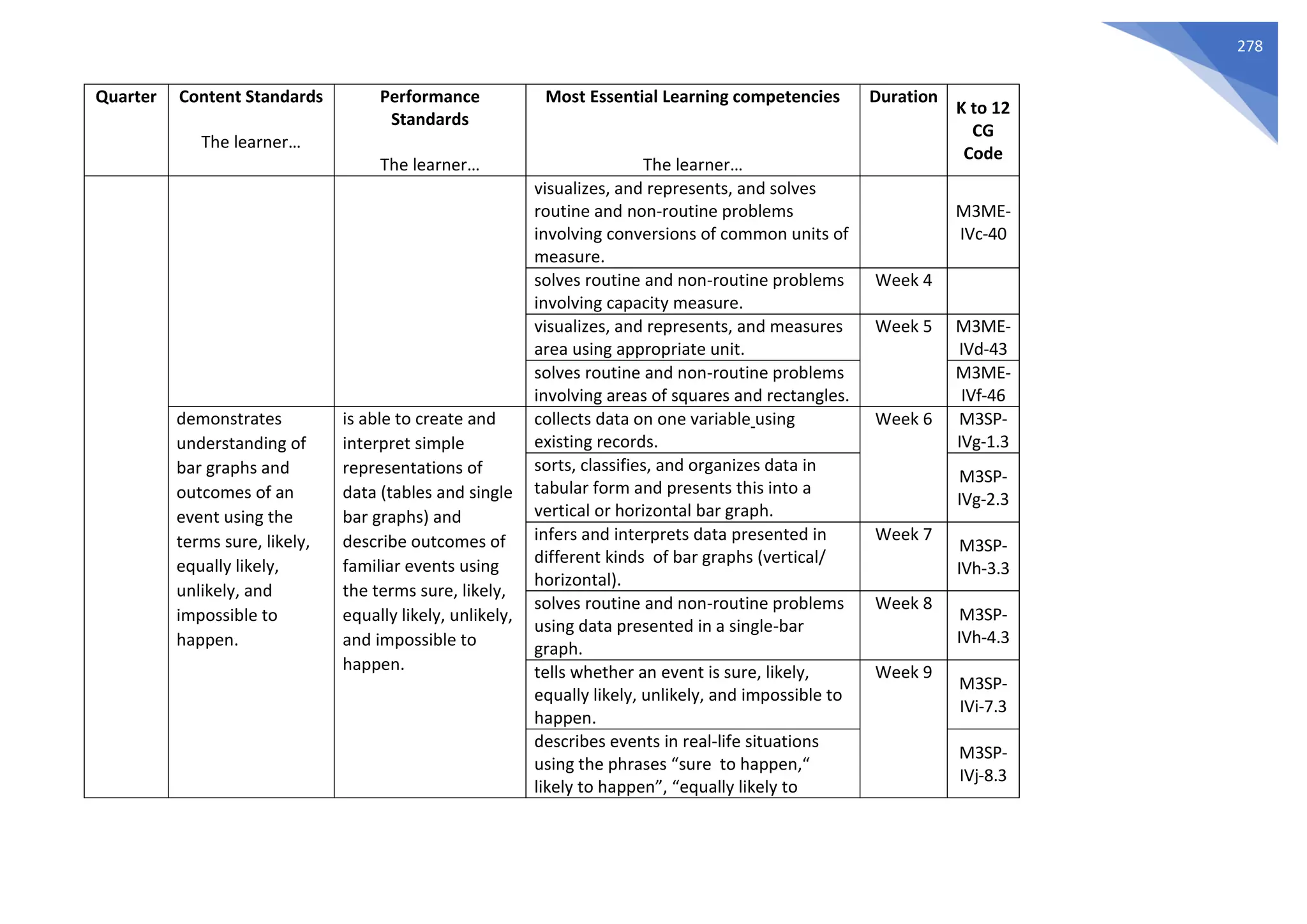
278
Quarter Content Standards
Thelearner…
Performance
Standards
The learner…
Most Essential Learning competencies
The learner…
Duration
K to 12
CG
Code
visualizes, and represents, and solves
routine and non-routine problems
involving conversions of common units of
measure.
M3ME-
IVc-40
solves routine and non-routine problems
involving capacity measure.
Week 4
visualizes, and represents, and measures
area using appropriate unit.
Week 5 M3ME-
IVd-43
solves routine and non-routine problems
involving areas of squares and rectangles.
M3ME-
IVf-46
demonstrates
understanding of
bar graphs and
outcomes of an
event using the
terms sure, likely,
equally likely,
unlikely, and
impossible to
happen.
is able to create and
interpret simple
representations of
data (tables and single
bar graphs) and
describe outcomes of
familiar events using
the terms sure, likely,
equally likely, unlikely,
and impossible to
happen.
collects data on one variable using
existing records.
Week 6 M3SP-
IVg-1.3
sorts, classifies, and organizes data in
tabular form and presents this into a
vertical or horizontal bar graph.
M3SP-
IVg-2.3
infers and interprets data presented in
different kinds of bar graphs (vertical/
horizontal).
Week 7
M3SP-
IVh-3.3
solves routine and non-routine problems
using data presented in a single-bar
graph.
Week 8
M3SP-
IVh-4.3
tells whether an event is sure, likely,
equally likely, unlikely, and impossible to
happen.
Week 9
M3SP-
IVi-7.3
describes events in real-life situations
using the phrases “sure to happen,“
likely to happen”, “equally likely to
M3SP-
IVj-8.3
21.
279
Quarter Content Standards
Thelearner…
Performance
Standards
The learner…
Most Essential Learning competencies
The learner…
Duration
K to 12
CG
Code
happen”, “unlikely to happen”, and
“impossible to happen”.
22.
280
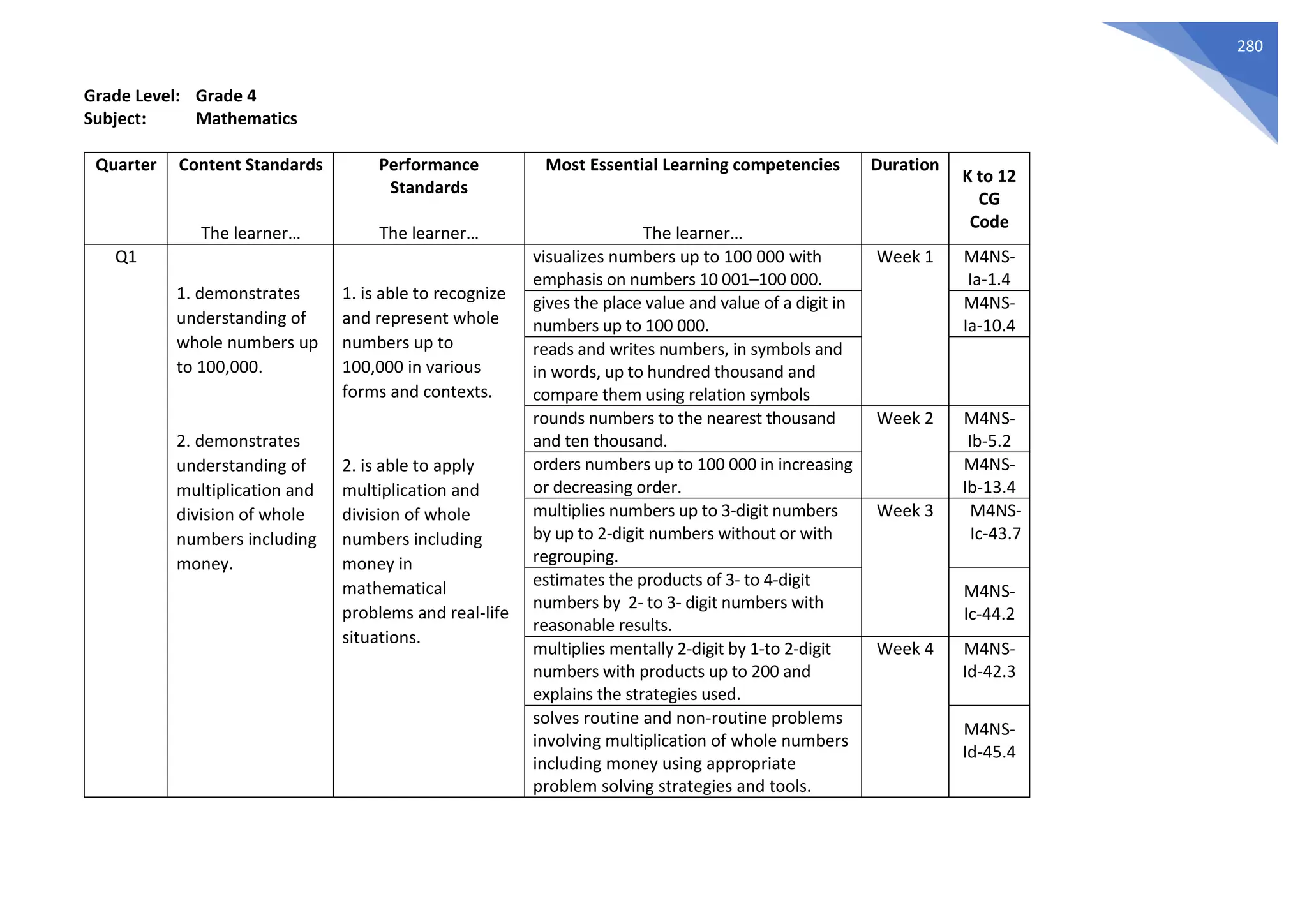
Grade Level: Grade4
Subject: Mathematics
Quarter Content Standards
The learner…
Performance
Standards
The learner…
Most Essential Learning competencies
The learner…
Duration
K to 12
CG
Code
Q1
1. demonstrates
understanding of
whole numbers up
to 100,000.
2. demonstrates
understanding of
multiplication and
division of whole
numbers including
money.
1. is able to recognize
and represent whole
numbers up to
100,000 in various
forms and contexts.
2. is able to apply
multiplication and
division of whole
numbers including
money in
mathematical
problems and real-life
situations.
visualizes numbers up to 100 000 with
emphasis on numbers 10 001–100 000.
Week 1 M4NS-
Ia-1.4
gives the place value and value of a digit in
numbers up to 100 000.
M4NS-
Ia-10.4
reads and writes numbers, in symbols and
in words, up to hundred thousand and
compare them using relation symbols
rounds numbers to the nearest thousand
and ten thousand.
Week 2 M4NS-
Ib-5.2
orders numbers up to 100 000 in increasing
or decreasing order.
M4NS-
Ib-13.4
multiplies numbers up to 3-digit numbers
by up to 2-digit numbers without or with
regrouping.
Week 3 M4NS-
Ic-43.7
estimates the products of 3- to 4-digit
numbers by 2- to 3- digit numbers with
reasonable results.
M4NS-
Ic-44.2
multiplies mentally 2-digit by 1-to 2-digit
numbers with products up to 200 and
explains the strategies used.
Week 4 M4NS-
Id-42.3
solves routine and non-routine problems
involving multiplication of whole numbers
including money using appropriate
problem solving strategies and tools.
M4NS-
Id-45.4
23.
281
Quarter Content Standards
Thelearner…
Performance
Standards
The learner…
Most Essential Learning competencies
The learner…
Duration
K to 12
CG
Code
solves multi-step routine and non-routine
problems involving multiplication and
addition or subtraction using appropriate
problem solving strategies and tools.
Week 5
M4NS-
Ie-45.5
divides 3- to 4-digit numbers by 1-to 2-digit
numbers without and with remainder.
Week 6 M4NS-
If-54.3
divides mentally 2- to 4-digit numbers by
tens or hundreds or by 1 000 without and
with remainder.
estimates the quotient of 3- to 4-digit
dividends by 1- to 2-digit divisors with
reasonable results.
Week 7
M4NS-
Ig-55.2
solves routine and non-routine problems
involving division of 3- to 4-digit numbers
by 1- to 2-digit numbers including money
using appropriate problem solving
strategies and tools.
Week 8
M4NS-
Ih-56.3
solves multi-step routine and non-routine
problems involving division and any of the
other operations of whole numbers
including money using appropriate
problem solving strategies and tools.
M4NS-
Ih-56.4
performs a series of two or more
operations applying Multiplication,
Division, Addition, Subtraction (MDAS)
correctly.
Week 9
Q2 identifies factors of a given number up to
100.
Week 1 M4NS-
IIa-64
24.
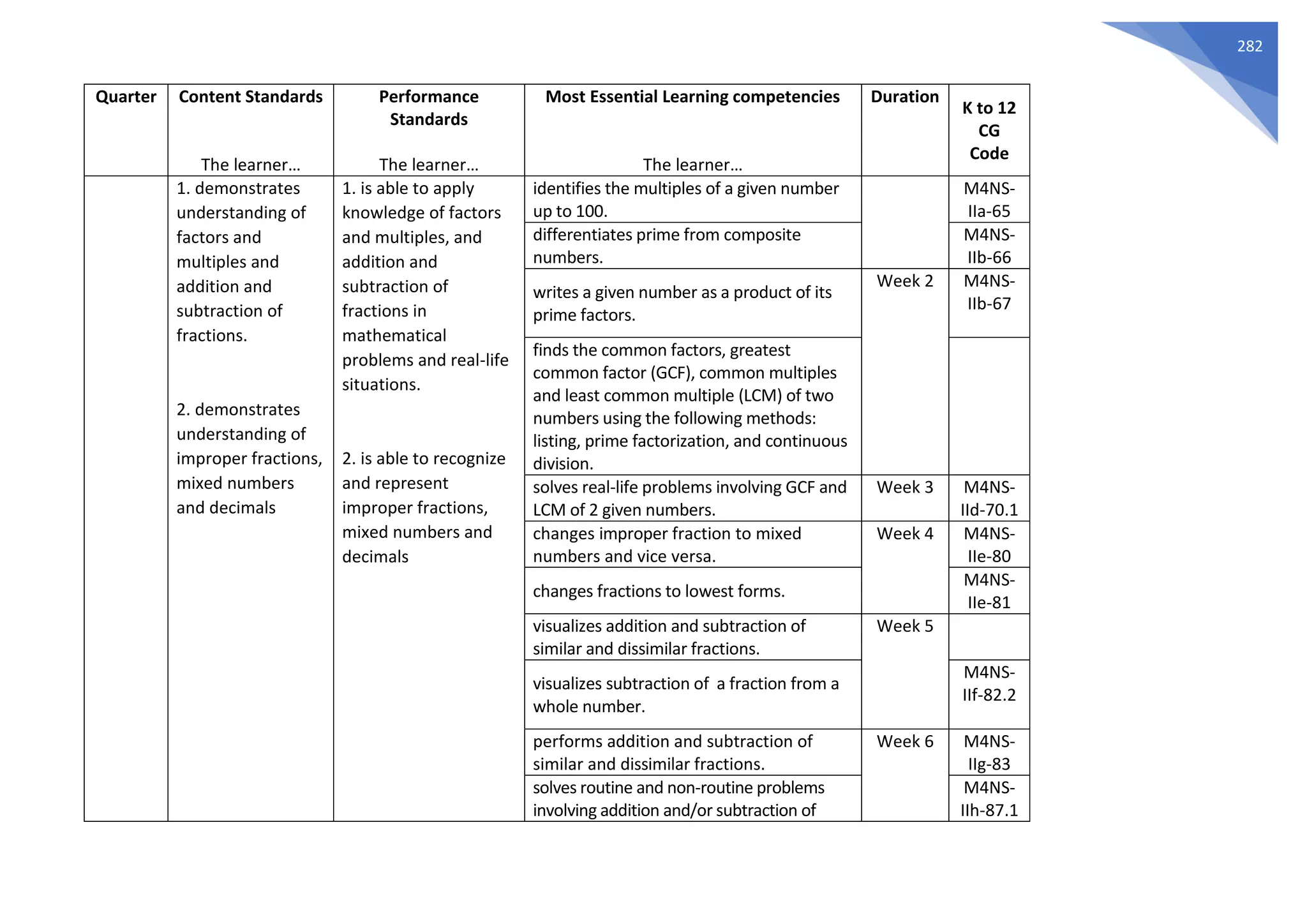
282
Quarter Content Standards
Thelearner…
Performance
Standards
The learner…
Most Essential Learning competencies
The learner…
Duration
K to 12
CG
Code
1. demonstrates
understanding of
factors and
multiples and
addition and
subtraction of
fractions.
2. demonstrates
understanding of
improper fractions,
mixed numbers
and decimals
1. is able to apply
knowledge of factors
and multiples, and
addition and
subtraction of
fractions in
mathematical
problems and real-life
situations.
2. is able to recognize
and represent
improper fractions,
mixed numbers and
decimals
identifies the multiples of a given number
up to 100.
M4NS-
IIa-65
differentiates prime from composite
numbers.
M4NS-
IIb-66
writes a given number as a product of its
prime factors.
Week 2 M4NS-
IIb-67
finds the common factors, greatest
common factor (GCF), common multiples
and least common multiple (LCM) of two
numbers using the following methods:
listing, prime factorization, and continuous
division.
solves real-life problems involving GCF and
LCM of 2 given numbers.
Week 3 M4NS-
IId-70.1
changes improper fraction to mixed
numbers and vice versa.
Week 4 M4NS-
IIe-80
changes fractions to lowest forms.
M4NS-
IIe-81
visualizes addition and subtraction of
similar and dissimilar fractions.
Week 5
visualizes subtraction of a fraction from a
whole number.
M4NS-
IIf-82.2
performs addition and subtraction of
similar and dissimilar fractions.
Week 6 M4NS-
IIg-83
solves routine and non-routine problems
involving addition and/or subtraction of
M4NS-
IIh-87.1
25.
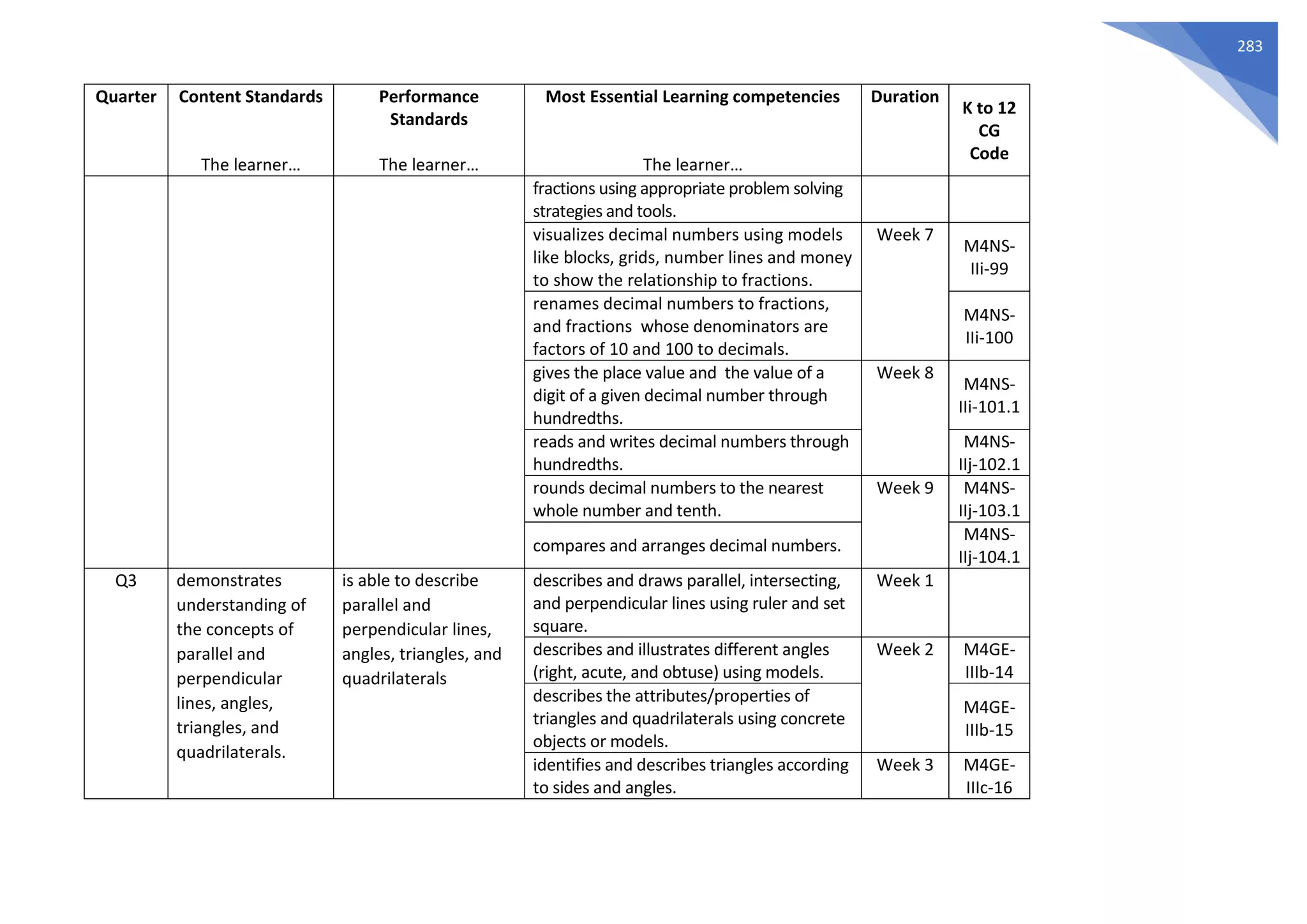
283
Quarter Content Standards
Thelearner…
Performance
Standards
The learner…
Most Essential Learning competencies
The learner…
Duration
K to 12
CG
Code
fractions using appropriate problem solving
strategies and tools.
visualizes decimal numbers using models
like blocks, grids, number lines and money
to show the relationship to fractions.
Week 7
M4NS-
IIi-99
renames decimal numbers to fractions,
and fractions whose denominators are
factors of 10 and 100 to decimals.
M4NS-
IIi-100
gives the place value and the value of a
digit of a given decimal number through
hundredths.
Week 8
M4NS-
IIi-101.1
reads and writes decimal numbers through
hundredths.
M4NS-
IIj-102.1
rounds decimal numbers to the nearest
whole number and tenth.
Week 9 M4NS-
IIj-103.1
compares and arranges decimal numbers.
M4NS-
IIj-104.1
Q3 demonstrates
understanding of
the concepts of
parallel and
perpendicular
lines, angles,
triangles, and
quadrilaterals.
is able to describe
parallel and
perpendicular lines,
angles, triangles, and
quadrilaterals
describes and draws parallel, intersecting,
and perpendicular lines using ruler and set
square.
Week 1
describes and illustrates different angles
(right, acute, and obtuse) using models.
Week 2 M4GE-
IIIb-14
describes the attributes/properties of
triangles and quadrilaterals using concrete
objects or models.
M4GE-
IIIb-15
identifies and describes triangles according
to sides and angles.
Week 3 M4GE-
IIIc-16
26.
284
Quarter Content Standards
Thelearner…
Performance
Standards
The learner…
Most Essential Learning competencies
The learner…
Duration
K to 12
CG
Code
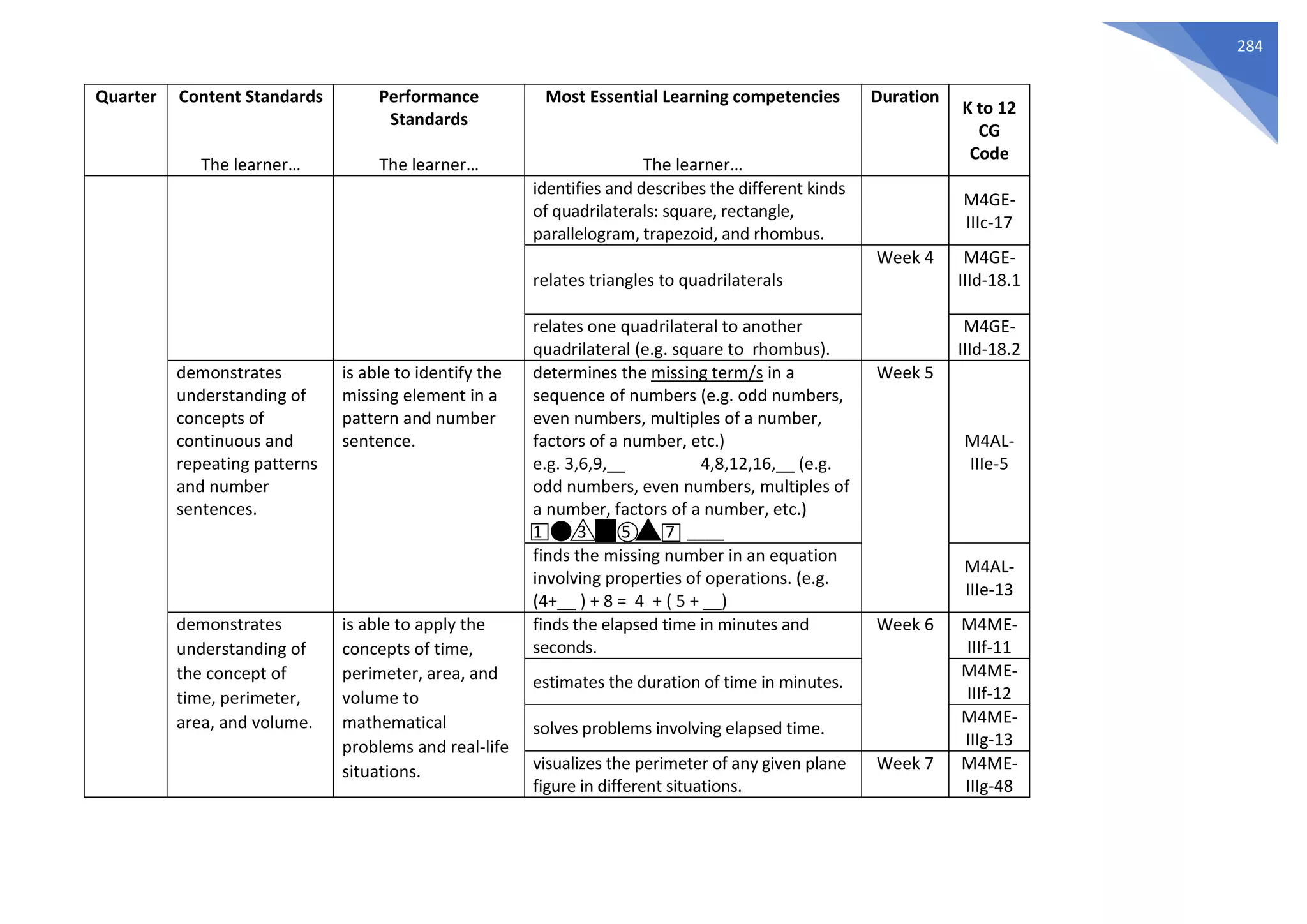
identifies and describes the different kinds
of quadrilaterals: square, rectangle,
parallelogram, trapezoid, and rhombus.
M4GE-
IIIc-17
relates triangles to quadrilaterals
Week 4 M4GE-
IIId-18.1
relates one quadrilateral to another
quadrilateral (e.g. square to rhombus).
M4GE-
IIId-18.2
demonstrates
understanding of
concepts of
continuous and
repeating patterns
and number
sentences.
is able to identify the
missing element in a
pattern and number
sentence.
determines the missing term/s in a
sequence of numbers (e.g. odd numbers,
even numbers, multiples of a number,
factors of a number, etc.)
e.g. 3,6,9,__ 4,8,12,16,__ (e.g.
odd numbers, even numbers, multiples of
a number, factors of a number, etc.)
1 2 3 4 5 6 7 ____
Week 5
M4AL-
IIIe-5
finds the missing number in an equation
involving properties of operations. (e.g.
(4+__ ) + 8 = 4 + ( 5 + __)
M4AL-
IIIe-13
demonstrates
understanding of
the concept of
time, perimeter,
area, and volume.
is able to apply the
concepts of time,
perimeter, area, and
volume to
mathematical
problems and real-life
situations.
finds the elapsed time in minutes and
seconds.
Week 6 M4ME-
IIIf-11
estimates the duration of time in minutes.
M4ME-
IIIf-12
solves problems involving elapsed time.
M4ME-
IIIg-13
visualizes the perimeter of any given plane
figure in different situations.
Week 7 M4ME-
IIIg-48
27.
285
Quarter Content Standards
Thelearner…
Performance
Standards
The learner…
Most Essential Learning competencies
The learner…
Duration
K to 12
CG
Code
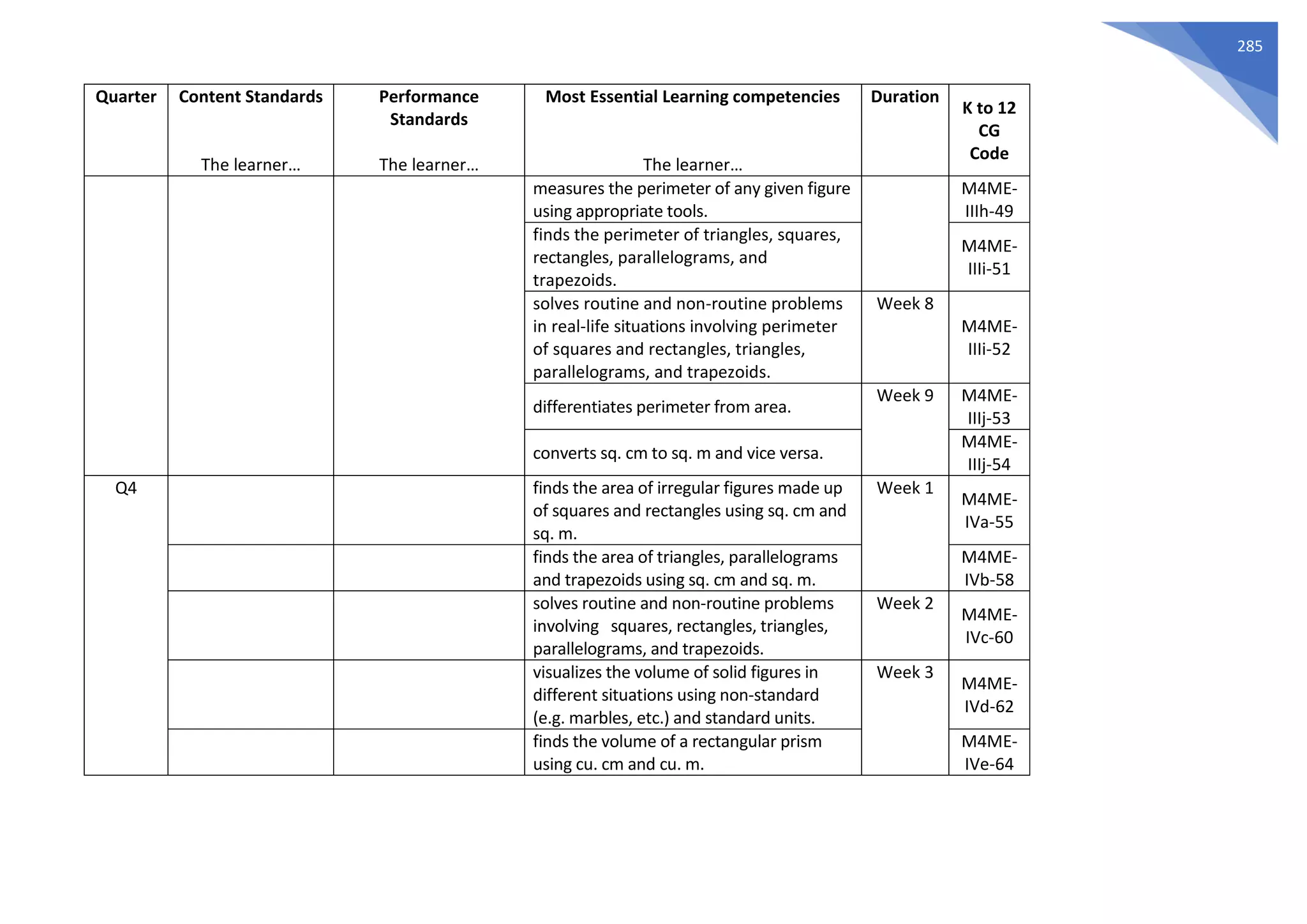
measures the perimeter of any given figure
using appropriate tools.
M4ME-
IIIh-49
finds the perimeter of triangles, squares,
rectangles, parallelograms, and
trapezoids.
M4ME-
IIIi-51
solves routine and non-routine problems
in real-life situations involving perimeter
of squares and rectangles, triangles,
parallelograms, and trapezoids.
Week 8
M4ME-
IIIi-52
differentiates perimeter from area.
Week 9 M4ME-
IIIj-53
converts sq. cm to sq. m and vice versa.
M4ME-
IIIj-54
Q4 finds the area of irregular figures made up
of squares and rectangles using sq. cm and
sq. m.
Week 1
M4ME-
IVa-55
finds the area of triangles, parallelograms
and trapezoids using sq. cm and sq. m.
M4ME-
IVb-58
solves routine and non-routine problems
involving squares, rectangles, triangles,
parallelograms, and trapezoids.
Week 2
M4ME-
IVc-60
visualizes the volume of solid figures in
different situations using non-standard
(e.g. marbles, etc.) and standard units.
Week 3
M4ME-
IVd-62
finds the volume of a rectangular prism
using cu. cm and cu. m.
M4ME-
IVe-64
28.
286
Quarter Content Standards
Thelearner…
Performance
Standards
The learner…
Most Essential Learning competencies
The learner…
Duration
K to 12
CG
Code
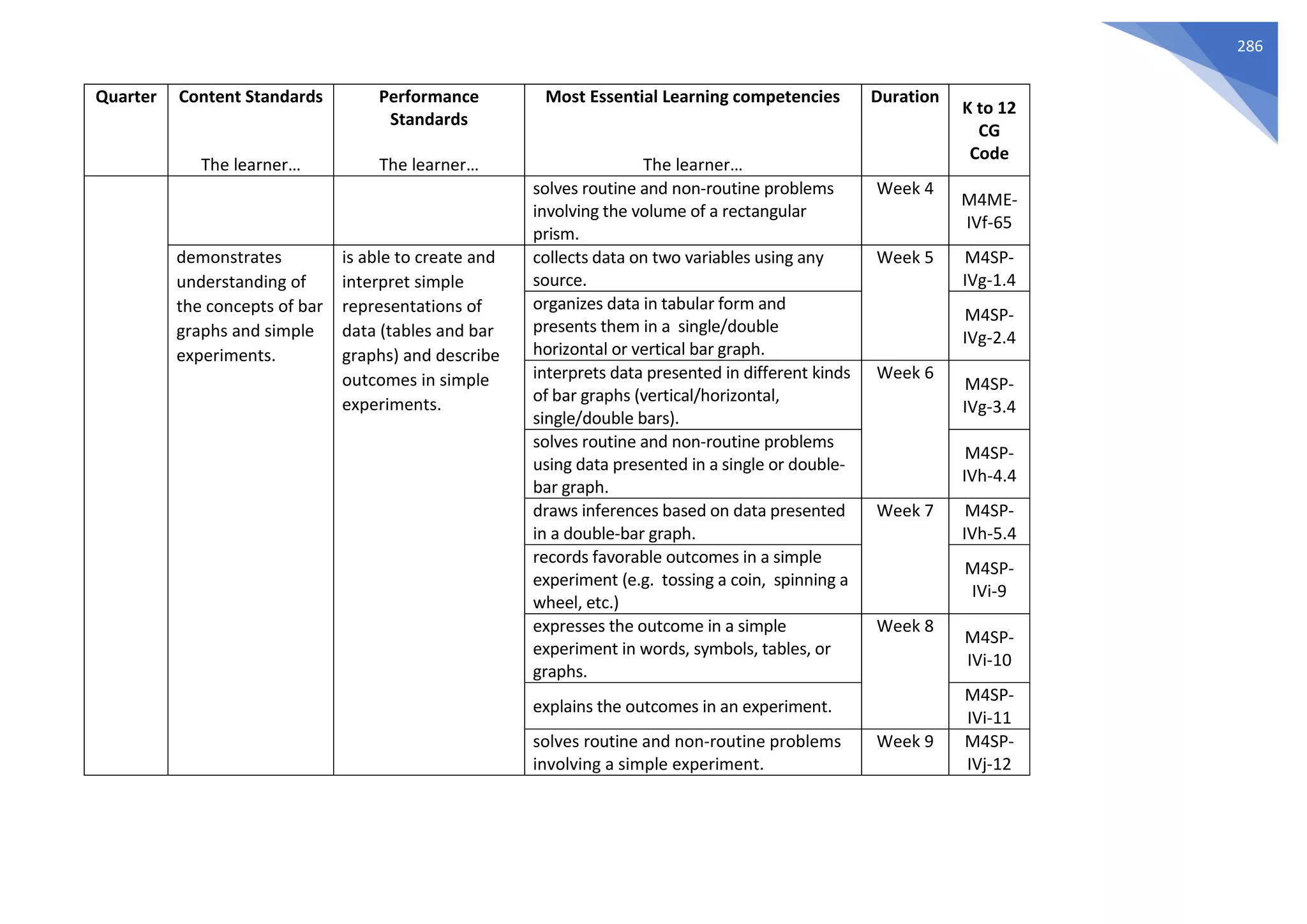
solves routine and non-routine problems
involving the volume of a rectangular
prism.
Week 4
M4ME-
IVf-65
demonstrates
understanding of
the concepts of bar
graphs and simple
experiments.
is able to create and
interpret simple
representations of
data (tables and bar
graphs) and describe
outcomes in simple
experiments.
collects data on two variables using any
source.
Week 5 M4SP-
IVg-1.4
organizes data in tabular form and
presents them in a single/double
horizontal or vertical bar graph.
M4SP-
IVg-2.4
interprets data presented in different kinds
of bar graphs (vertical/horizontal,
single/double bars).
Week 6
M4SP-
IVg-3.4
solves routine and non-routine problems
using data presented in a single or double-
bar graph.
M4SP-
IVh-4.4
draws inferences based on data presented
in a double-bar graph.
Week 7 M4SP-
IVh-5.4
records favorable outcomes in a simple
experiment (e.g. tossing a coin, spinning a
wheel, etc.)
M4SP-
IVi-9
expresses the outcome in a simple
experiment in words, symbols, tables, or
graphs.
Week 8
M4SP-
IVi-10
explains the outcomes in an experiment.
M4SP-
IVi-11
solves routine and non-routine problems
involving a simple experiment.
Week 9 M4SP-
IVj-12
29.
287
Grade Level: Grade5
Subject: Mathematics
Quarter Content Standards
The learner…
Performance
Standards
The learner…
Most Essential Learning competencies
The learner…
Duration
K to 12
CG
Code
Q1
demonstrates
understanding of
divisibility, order of
operations, factors
and multiples, and
the four
fundamental
operations
involving fractions
is able to apply
divisibility, order of
operations, factors and
multiples, and the four
fundamental
operations involving
fractions in
mathematical
problems and real-life
situations.
uses divisibility rules for 2, 5, and 10 to
find the common factors of numbers.
Week 1 M5NS-
Ib-58.1
uses divisibility rules for 3, 6, and 9 to find
common factors.
M5NS-
Ib-58.2
uses divisibility rules for 4, 8, 12, and 11 to
find common factors.
Week 2 M5NS-
Ib-58.3
solves routine and non-routine problems
involving factors, multiples, and divisibility
rules for 2,3,4,5,6,8,9,10,11, and 12.
M5NS-
Ic-59
Performs a series of more than two
operations on whole numbers applying
Parenthesis, Multiplication, Division,
Addition, Subtraction (PMDAS) or
Grouping, Multiplication, Division,
Addition, Subtraction (GMDAS) correctly.
Week 3
finds the common factors, GCF, common
multiples and LCM of 2–4 numbers using
continuous division.
Week 4
solves real-life problems involving GCF and
LCM of 2-3 given numbers.
M5NS-
Ie-70.2
adds and subtracts fractions and mixed
fractions without and with regrouping.
Week 5 M5NS-
Ie-84
solves routine and non-routine problems
involving addition and/or subtraction of
M5NS-
If-87.2
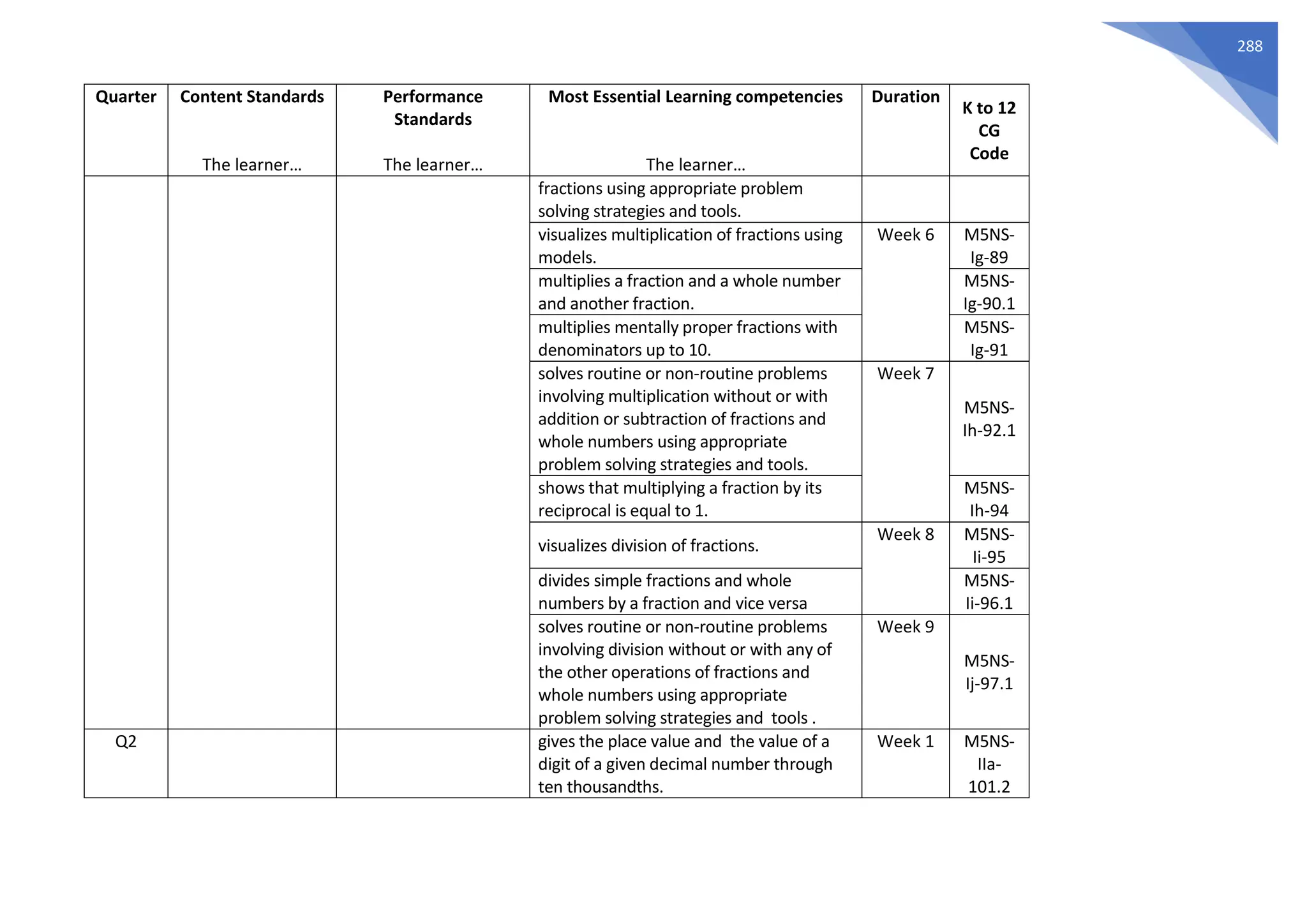
30.
288
Quarter Content Standards
Thelearner…
Performance
Standards
The learner…
Most Essential Learning competencies
The learner…
Duration
K to 12
CG
Code
fractions using appropriate problem
solving strategies and tools.
visualizes multiplication of fractions using
models.
Week 6 M5NS-
Ig-89
multiplies a fraction and a whole number
and another fraction.
M5NS-
Ig-90.1
multiplies mentally proper fractions with
denominators up to 10.
M5NS-
Ig-91
solves routine or non-routine problems
involving multiplication without or with
addition or subtraction of fractions and
whole numbers using appropriate
problem solving strategies and tools.
Week 7
M5NS-
Ih-92.1
shows that multiplying a fraction by its
reciprocal is equal to 1.
M5NS-
Ih-94
visualizes division of fractions.
Week 8 M5NS-
Ii-95
divides simple fractions and whole
numbers by a fraction and vice versa
M5NS-
Ii-96.1
solves routine or non-routine problems
involving division without or with any of
the other operations of fractions and
whole numbers using appropriate
problem solving strategies and tools .
Week 9
M5NS-
Ij-97.1
Q2 gives the place value and the value of a
digit of a given decimal number through
ten thousandths.
Week 1 M5NS-
IIa-
101.2
31.
289
Quarter Content Standards
Thelearner…
Performance
Standards
The learner…
Most Essential Learning competencies
The learner…
Duration
K to 12
CG
Code
1. demonstrates
understanding of
decimals.
2. demonstrates
understanding of
the four
fundamental
operations
involving decimals
and ratio and
proportion.
1. is able to recognize
and represent
decimals in various
forms and contexts.
2. is able to apply the
four fundamental
operations involving
decimals and ratio and
proportion in
mathematical
problems and real-life
situations.
reads and writes decimal numbers
through ten thousandths.
M5NS-
IIa-
102.2
rounds decimal numbers to the nearest
hundredth and thousandth.
M5NS-
IIa-
103.2
compares and arranges decimal numbers.
Week 2 M5NS-
IIb-
104.2
adds and subtracts decimal numbers
through thousandths without and with
regrouping.
M5NS-
IIb-
106.1
solves routine or non-routine problems
involving addition and subtraction of
decimal numbers including money using
appropriate problem solving strategies
and tools.
Week 3
M5NS-
IIc-
108.1
multiplies decimals up to 2 decimal places
by 1- to 2-digit whole numbers.
Week 4 M5NS-
IId-
111.1
multiplies decimals with factors up to 2
decimal places.
M5NS-
IId-
111.2
estimates the products of decimal
numbers with reasonable results.
Week 5 M5NS-
IIe-112
solves routine and non-routine problems
involving multiplication without or with
addition or subtraction of decimals and
M5NS-
IIe-
113.1
32.
290
Quarter Content Standards
Thelearner…
Performance
Standards
The learner…
Most Essential Learning competencies
The learner…
Duration
K to 12
CG
Code
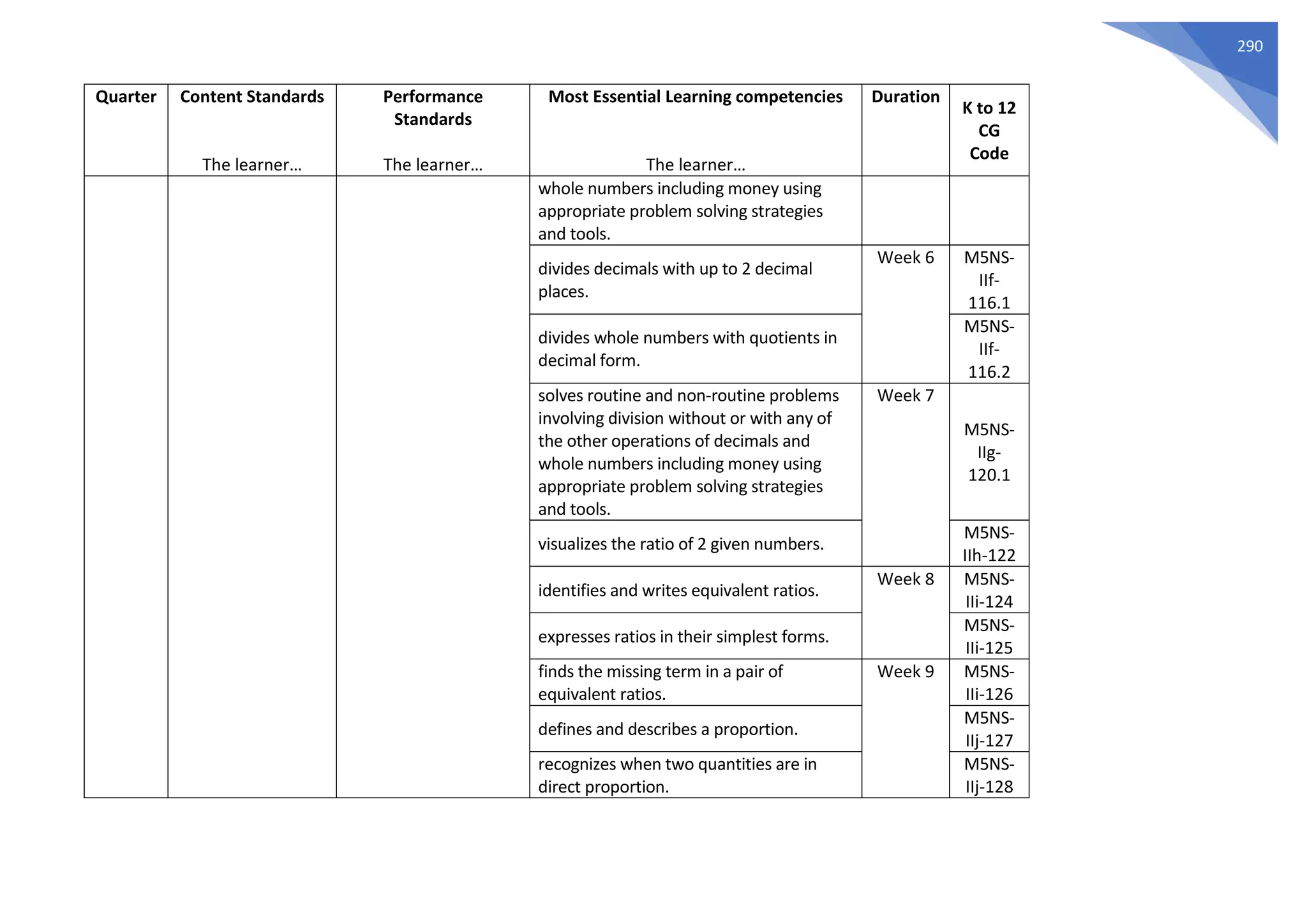
whole numbers including money using
appropriate problem solving strategies
and tools.
divides decimals with up to 2 decimal
places.
Week 6 M5NS-
IIf-
116.1
divides whole numbers with quotients in
decimal form.
M5NS-
IIf-
116.2
solves routine and non-routine problems
involving division without or with any of
the other operations of decimals and
whole numbers including money using
appropriate problem solving strategies
and tools.
Week 7
M5NS-
IIg-
120.1
visualizes the ratio of 2 given numbers.
M5NS-
IIh-122
identifies and writes equivalent ratios.
Week 8 M5NS-
IIi-124
expresses ratios in their simplest forms.
M5NS-
IIi-125
finds the missing term in a pair of
equivalent ratios.
Week 9 M5NS-
IIi-126
defines and describes a proportion.
M5NS-
IIj-127
recognizes when two quantities are in
direct proportion.
M5NS-
IIj-128
33.
291
Quarter Content Standards
Thelearner…
Performance
Standards
The learner…
Most Essential Learning competencies
The learner…
Duration
K to 12
CG
Code
Q3 demonstrates
understanding of
percent.
is able to apply
percent in
mathematical
problems and real-life
situations
visualizes percent and its relationship to
fractions, ratios, and decimal numbers
using models.
Week 1
M5NS-
IIIa-136
defines percentage, rate or percent, and
base.
M5NS-
IIIa-137
identifies the base, percentage, and rate in
a problem.
M5NS-
IIIa-138
finds the percentage in a given problem.
Week 2 M5NS-
IIIb-139
solves routine and non-routine problems
involving percentage using appropriate
strategies and tools.
M5NS-
IIIb-140
demonstrates
understanding of
polygons, circles,
and solid figures.
is able to construct
and describe polygons,
circles, and solid
figures.
visualizes, names, describes and draws
polygons with 5 or more sides.
Week 3 M5GE-
IIIc-19
describes and compares properties of
polygons (regular and irregular polygons).
M5GE-
IIIc-20
visualizes congruent polygons.
M5GE-
IIId-22
identifies the terms related to a circle.
Week 4 M5GE-
IIId-23.2
draws circles with different radii using a
compass.
M5GE-
IIIe-24
visualizes and describes solid figures.
Week 5 M5GE-
IIIe-25
makes models of different solid figures:
cube, prism, pyramid, cylinder, cone, and
sphere using plane figures.
M5GE-
IIIe-26
34.
292
Quarter Content Standards
Thelearner…
Performance
Standards
The learner…
Most Essential Learning competencies
The learner…
Duration
K to 12
CG
Code
demonstrates
understanding of
the concept of
sequence and
solving simple
equations.
1. is able to apply the
knowledge of
sequence in various
situations.
2. is able to use
different problem
solving strategies
formulates the rule in finding the next
term in a sequence.
e.g. 1, 3, 7,15, (15 x 2+1) Possible
answers: (x 2 + 1) (+2, +4, +8, +16)
Week 6
M5AL-
IIIf-6
uses different strategies (looking for a
pattern, working backwards, etc.) to solve
for the unknown in simple equations
involving one or more operations on
whole numbers and fractions.
e.g. 3 x _ + 1 = 10 (the unknown is solved
by working backwards)
M5AL-
IIIf-14
demonstrates
understanding of
time and
circumference.
is able to apply
knowledge of time and
circumference in
mathematical
problems and real-life
situations.
measures time using a 12-hour and a 24-
hour clock.
Week 7 M5ME-
IIIg-14
calculates time in the different world time
zones in relation to the Philippines.
M5ME-
IIIg-15
solves problems involving time.
M5ME-
IIIg-16
visualizes circumference of a circle.
Week 8 M5ME-
IIIh-67
measures circumference of a circle using
appropriate tools.
M5ME-
IIIh-68
finds the circumference of a circle.
M5ME-
IIIi-70
solves routine and non-routine problems
involving circumference of a circle.
Week 9 M5ME-
IIIj-71
Q4
finds the area of a given circle.
Week 1 M5ME-
IVa-74
35.
293
Quarter Content Standards
Thelearner…
Performance
Standards
The learner…
Most Essential Learning competencies
The learner…
Duration
K to 12
CG
Code
demonstrates
understanding of
area, volume and
temperature.
is able to apply
knowledge of area,
volume and
temperature in
mathematical
problems and real-life
situations.
solves routine and non-routine problems
involving the area of a circle.
M5ME-
IVb-75
visualizes the volume of a cube and
rectangular prism.
Week 2 M5ME-
IVc-77
names the appropriate unit of measure
used for measuring the volume of a cube
and a rectangle prism.
M5ME-
IVc-78
converts cu. cm to cu. m and vice versa;
cu.cm to L and vice versa.
M5ME-
IVd-80
finds the volume of a given cube and
rectangular prism using cu. cm and cu. m.
Week 3 M5ME-
IVd-81
estimates and uses appropriate units of
measure for volume.
M5ME-
IVd-82
solves routine and non-routine problems
involving volume of a cube and
rectangular prism in real-life situations
using appropriate strategies and tools.
Week 4
M5ME-
IVe-83
reads and measures temperature using
thermometer (alcohol and/or digital) in
degree Celsius.
Week 5
M5ME-
IVf-85
solves routine and non-routine problems
involving temperature in real-life
situations.
M5ME-
IVf-87
demonstrates
understanding of
line graphs and
is able to create and
interpret
representations of
data (tables and line
organizes data in tabular form and
presents them in a line graph.
Week 6 M5SP-
IVg-2.5
interprets data presented in different
kinds of line graphs (single to double-line
graph).
M5SP-
IVh-3.5
36.
294
Quarter Content Standards
Thelearner…
Performance
Standards
The learner…
Most Essential Learning competencies
The learner…
Duration
K to 12
CG
Code
experimental
probability.
graphs) and apply
experimental
probability in
mathematical
problems and real-life
situations.
solves routine and non-routine problems
using data presented in a line graph.
Week 7 M5SP-
IVh-4.5
draws inferences based on data presented
in a line graph.
M5SP-
IVh-5.5
describes experimental probability.
Week 8 M5SP-
IVi-14
performs an experimental probability and
records result by listing.
M5SP-
IVi-15
analyzes data obtained from chance using
experiments involving letter cards (A to Z)
and number cards (0 to 20).
Week 9
M5SP-
IVi-16
solves routine and non-routine problems
involving experimental probability.
M5SP-
IVj-17
37.
295
Grade Level: Grade6
Subject: Mathematics
Quarter Content Standards
The learner…
Performance
Standards
The learner…
Most Essential Learning competencies
The learner…
Duration
K to 12
CG
Code
Q1 demonstrates
understanding of
the four
fundamental
operations
involving fractions
and decimals.
is able to apply the four
fundamental
operations involving
fractions and decimals
in mathematical
problems and real-life
situations.
adds and subtracts simple fractions and
mixed numbers without or with regrouping.
Week 1 M6NS-
Ia-86
solves routine and non-routine problems
involving addition and/or subtraction of
fractions using appropriate problem solving
strategies and tools.
M6NS-
Ia-87.3
multiplies simple fractions and mixed
fractions.
Week 2 M6NS-
Ib-90.2
solves routine or non-routine problems
involving multiplication without or with
addition or subtraction of fractions and
mixed fractions using appropriate problem
solving strategies and tools.
M6NS-
Ib-92.2
divides simple fractions and mixed
fractions.
Week 3 M6NS-
Ic-96.2
solves routine or non-routine problems
involving division without or with any of the
other operations of fractions and mixed
fractions using appropriate problem solving
strategies and tools.
M6NS-
Ic-97.2
adds and subtracts decimals and mixed
decimals through ten thousandths without
or with regrouping.
Week 4
M6NS-
Id-106.2
38.
296
Quarter Content Standards
Thelearner…
Performance
Standards
The learner…
Most Essential Learning competencies
The learner…
Duration
K to 12
CG
Code
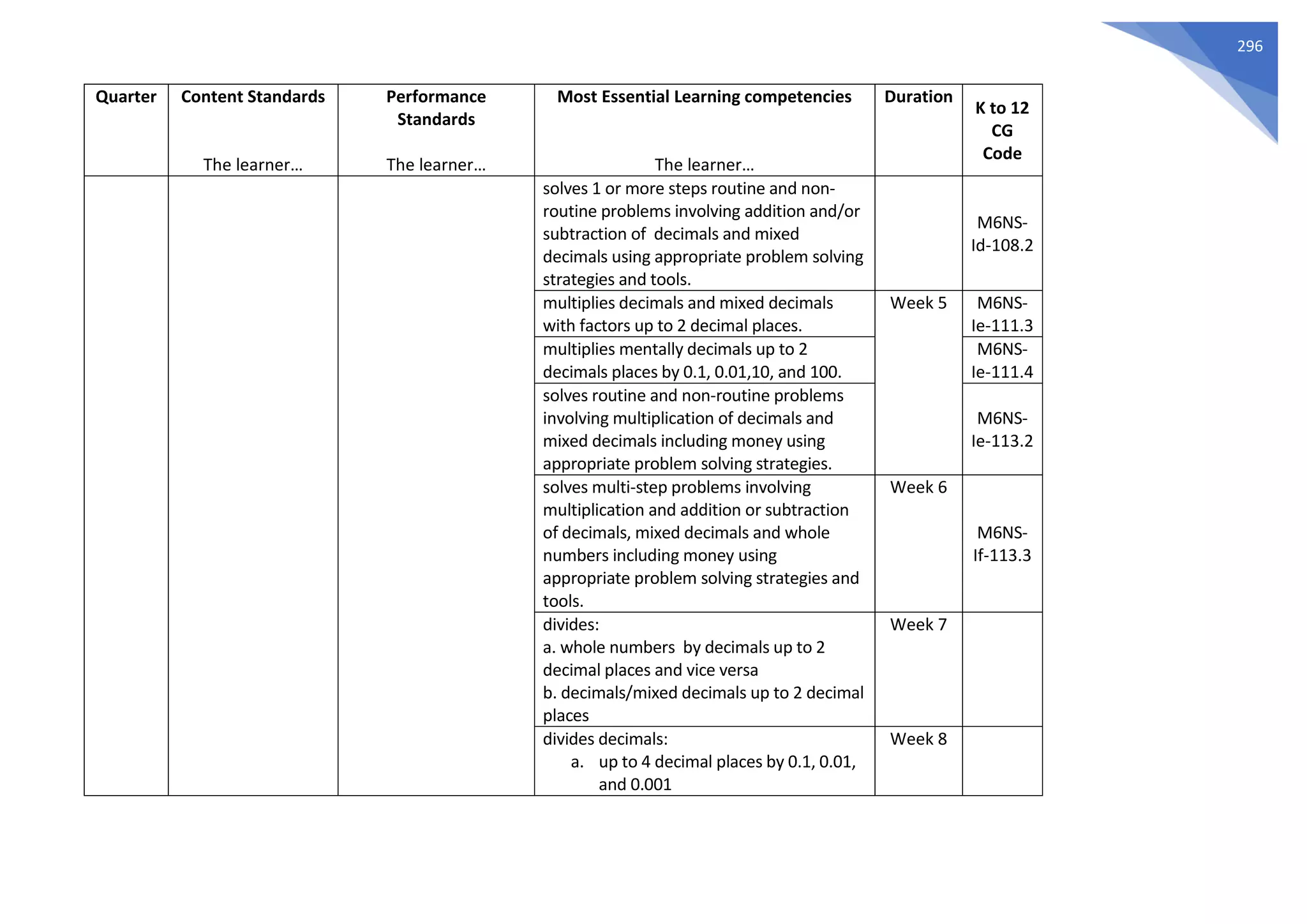
solves 1 or more steps routine and non-
routine problems involving addition and/or
subtraction of decimals and mixed
decimals using appropriate problem solving
strategies and tools.
M6NS-
Id-108.2
multiplies decimals and mixed decimals
with factors up to 2 decimal places.
Week 5 M6NS-
Ie-111.3
multiplies mentally decimals up to 2
decimals places by 0.1, 0.01,10, and 100.
M6NS-
Ie-111.4
solves routine and non-routine problems
involving multiplication of decimals and
mixed decimals including money using
appropriate problem solving strategies.
M6NS-
Ie-113.2
solves multi-step problems involving
multiplication and addition or subtraction
of decimals, mixed decimals and whole
numbers including money using
appropriate problem solving strategies and
tools.
Week 6
M6NS-
If-113.3
divides:
a. whole numbers by decimals up to 2
decimal places and vice versa
b. decimals/mixed decimals up to 2 decimal
places
Week 7
divides decimals:
a. up to 4 decimal places by 0.1, 0.01,
and 0.001
Week 8
39.
297
Quarter Content Standards
Thelearner…
Performance
Standards
The learner…
Most Essential Learning competencies
The learner…
Duration
K to 12
CG
Code
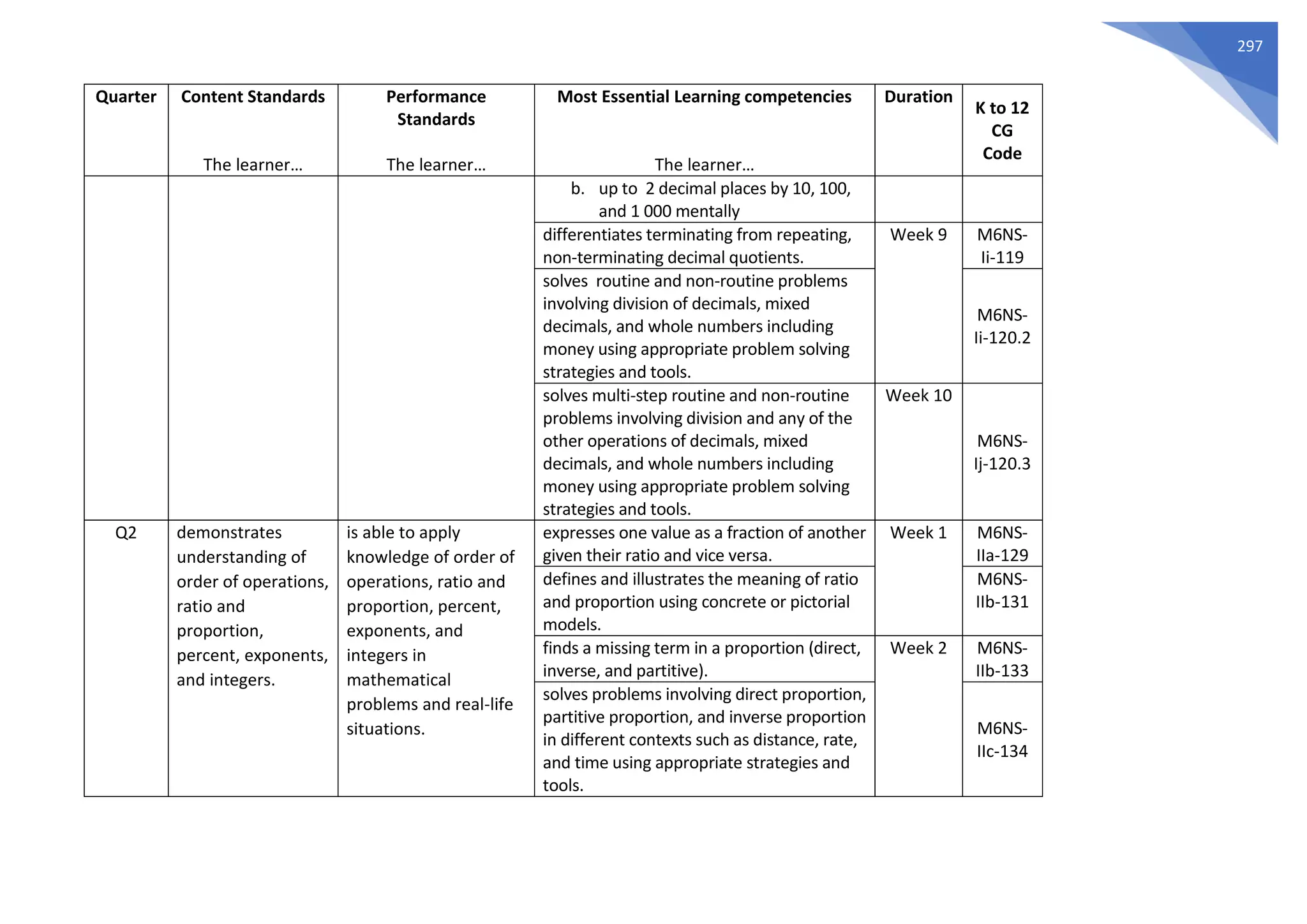
b. up to 2 decimal places by 10, 100,
and 1 000 mentally
differentiates terminating from repeating,
non-terminating decimal quotients.
Week 9 M6NS-
Ii-119
solves routine and non-routine problems
involving division of decimals, mixed
decimals, and whole numbers including
money using appropriate problem solving
strategies and tools.
M6NS-
Ii-120.2
solves multi-step routine and non-routine
problems involving division and any of the
other operations of decimals, mixed
decimals, and whole numbers including
money using appropriate problem solving
strategies and tools.
Week 10
M6NS-
Ij-120.3
Q2 demonstrates
understanding of
order of operations,
ratio and
proportion,
percent, exponents,
and integers.
is able to apply
knowledge of order of
operations, ratio and
proportion, percent,
exponents, and
integers in
mathematical
problems and real-life
situations.
expresses one value as a fraction of another
given their ratio and vice versa.
Week 1 M6NS-
IIa-129
defines and illustrates the meaning of ratio
and proportion using concrete or pictorial
models.
M6NS-
IIb-131
finds a missing term in a proportion (direct,
inverse, and partitive).
Week 2 M6NS-
IIb-133
solves problems involving direct proportion,
partitive proportion, and inverse proportion
in different contexts such as distance, rate,
and time using appropriate strategies and
tools.
M6NS-
IIc-134
40.
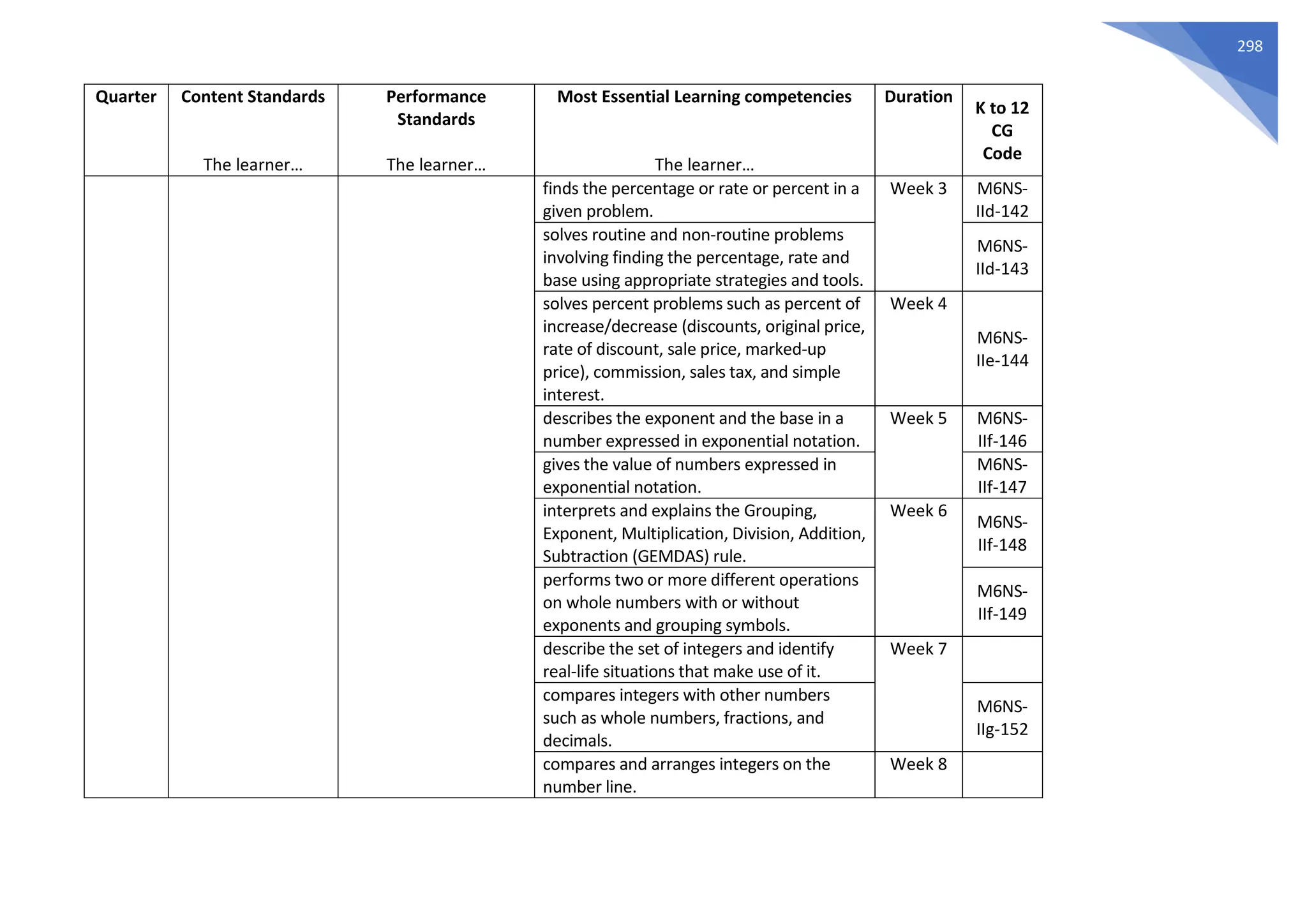
298
Quarter Content Standards
Thelearner…
Performance
Standards
The learner…
Most Essential Learning competencies
The learner…
Duration
K to 12
CG
Code
finds the percentage or rate or percent in a
given problem.
Week 3 M6NS-
IId-142
solves routine and non-routine problems
involving finding the percentage, rate and
base using appropriate strategies and tools.
M6NS-
IId-143
solves percent problems such as percent of
increase/decrease (discounts, original price,
rate of discount, sale price, marked-up
price), commission, sales tax, and simple
interest.
Week 4
M6NS-
IIe-144
describes the exponent and the base in a
number expressed in exponential notation.
Week 5 M6NS-
IIf-146
gives the value of numbers expressed in
exponential notation.
M6NS-
IIf-147
interprets and explains the Grouping,
Exponent, Multiplication, Division, Addition,
Subtraction (GEMDAS) rule.
Week 6
M6NS-
IIf-148
performs two or more different operations
on whole numbers with or without
exponents and grouping symbols.
M6NS-
IIf-149
describe the set of integers and identify
real-life situations that make use of it.
Week 7
compares integers with other numbers
such as whole numbers, fractions, and
decimals.
M6NS-
IIg-152
compares and arranges integers on the
number line.
Week 8
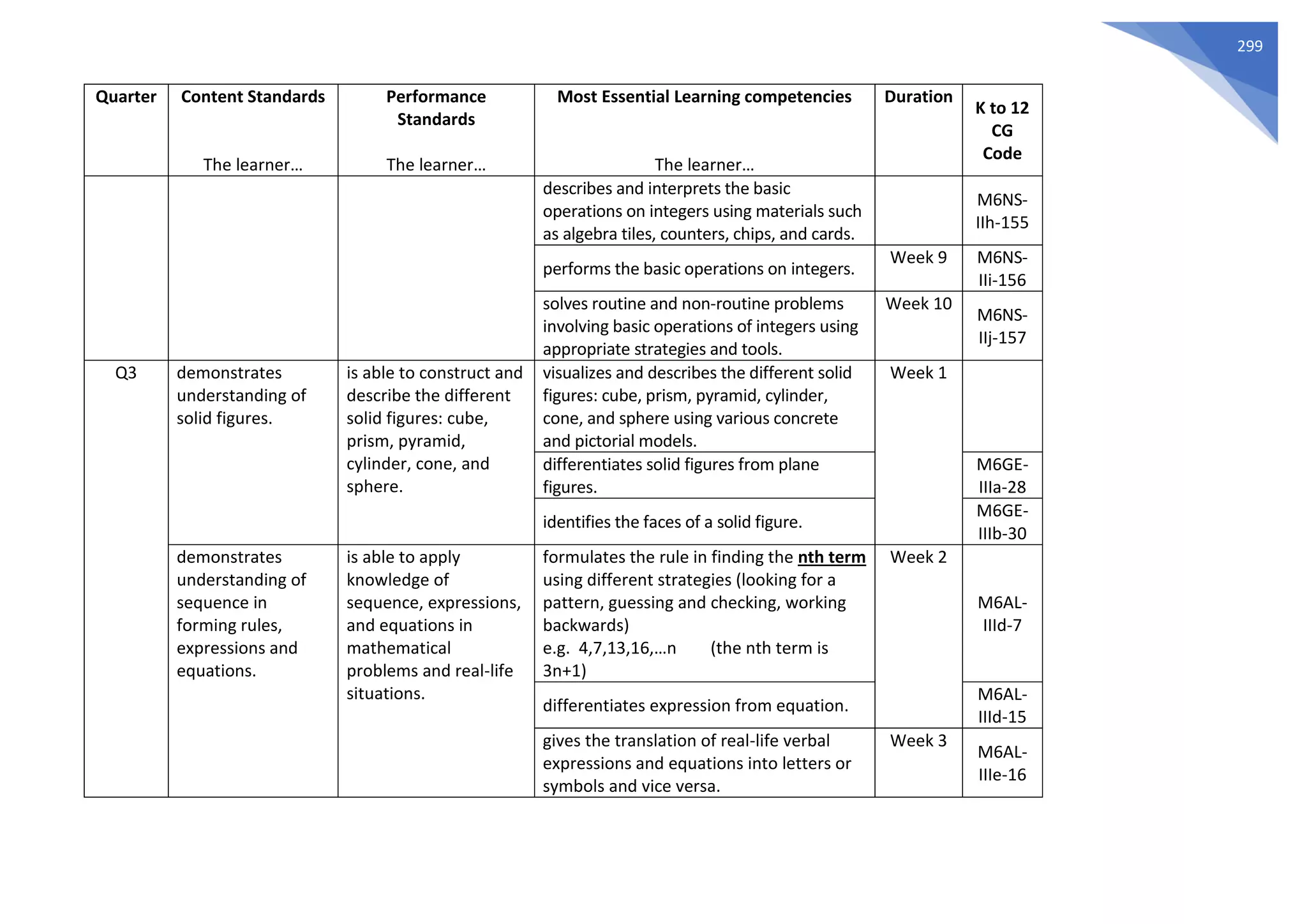
41.
299
Quarter Content Standards
Thelearner…
Performance
Standards
The learner…
Most Essential Learning competencies
The learner…
Duration
K to 12
CG
Code
describes and interprets the basic
operations on integers using materials such
as algebra tiles, counters, chips, and cards.
M6NS-
IIh-155
performs the basic operations on integers.
Week 9 M6NS-
IIi-156
solves routine and non-routine problems
involving basic operations of integers using
appropriate strategies and tools.
Week 10
M6NS-
IIj-157
Q3 demonstrates
understanding of
solid figures.
is able to construct and
describe the different
solid figures: cube,
prism, pyramid,
cylinder, cone, and
sphere.
visualizes and describes the different solid
figures: cube, prism, pyramid, cylinder,
cone, and sphere using various concrete
and pictorial models.
Week 1
differentiates solid figures from plane
figures.
M6GE-
IIIa-28
identifies the faces of a solid figure.
M6GE-
IIIb-30
demonstrates
understanding of
sequence in
forming rules,
expressions and
equations.
is able to apply
knowledge of
sequence, expressions,
and equations in
mathematical
problems and real-life
situations.
formulates the rule in finding the nth term
using different strategies (looking for a
pattern, guessing and checking, working
backwards)
e.g. 4,7,13,16,…n (the nth term is
3n+1)
Week 2
M6AL-
IIId-7
differentiates expression from equation.
M6AL-
IIId-15
gives the translation of real-life verbal
expressions and equations into letters or
symbols and vice versa.
Week 3
M6AL-
IIIe-16
42.
300
Quarter Content Standards
Thelearner…
Performance
Standards
The learner…
Most Essential Learning competencies
The learner…
Duration
K to 12
CG
Code
defines a variable in an algebraic
expression and equation.
M6AL-
IIIe-17
represents quantities in real-life situations
using algebraic expressions and equations.
Week 4 M6AL-
IIIe-18
solves routine and non-routine problems
involving different types of numerical
expressions and equations such as 7+ 9
=___ + 6.
M6AL-
IIIf-19
demonstrates
understanding of
rate and speed, and
of area and surface
area of plane and
solid/space figures.
is able to apply
knowledge of speed,
area, and surface area
of plane and
solid/space figures in
mathematical
problems and real-life
situations
calculates speed, distance, and time.
Week 5 M6ME-
IIIg-17
solves problems involving average rate
and speed.
M6ME-
IIIg-18
finds the area of composite figures formed
by any two or more of the following:
triangle, square, rectangle, circle, and
semi-circle.
Week 6
M6ME-
IIIh-89
solves routine and non-routine problems
involving area of composite figures
formed by any two or more of the
following: triangle, square, rectangle,
circle, and semi-circle.
M6ME-
IIIh-90
visualizes and describes surface area and
names the unit of measure used for
measuring the surface area of solid/space
figures.
Week 7
M6ME-
IIIi-91
finds the surface area of cubes, prisms,
pyramids, cylinders, cones, and spheres.
Week 8 M6ME-
IIIi-93
43.
301
Quarter Content Standards
Thelearner…
Performance
Standards
The learner…
Most Essential Learning competencies
The learner…
Duration
K to 12
CG
Code
solves word problems involving
measurement of surface area.
Week 9 M6ME-
IIIj-94
Q4 demonstrates
understanding of
volume of solid
figures and meter
reading.
is able to apply
knowledge of volume
of solid figures and
meter reading in
mathematical
problems and real-life
situations.
determines the relationship of the volume
between a rectangular prism and a
pyramid; a cylinder and a cone; and a
cylinder and sphere.
Week 1 M6ME-
IVa-95
finds the volume of cylinders, pyramids,
cones, and spheres.
Week 2 M6ME-
IVb-97
solves routine and non-routine problems
involving volumes of solids.
M6ME-
IVc-98
reads and interprets electric and water
meter readings.
Week 3 M6ME-
IVd-100
solves routine and non-routine problems
involving electric and water consumption.
M6ME-
IVd-101
demonstrates
understanding of
pie graphs and
experimental
probability.
is able to create and
interpret
representations of data
(tables and pie graphs)
and apply experimental
probability in
mathematical
problems and real-life
situations.
constructs a pie graph based on a given
set of data and interpret it.
Week 4
solves routine and non-routine problems
using data presented in a pie graph.
Week 5 M6SP-
IVf-4.6
describes the meaning of probability such
as 50% chance of rain and one in a million
chance of winning.
Week 6 M6SP-
IVg-19
performs experiments and records
outcomes.
M6SP-
IVh-21
makes listings and diagrams of outcomes
and tells the number of favorable
outcomes and chances using these listings
and diagrams.
Week 7
M6SP-
IVi-22
44.
302
Quarter Content Standards
Thelearner…
Performance
Standards
The learner…
Most Essential Learning competencies
The learner…
Duration
K to 12
CG
Code
makes simple predictions of events based
on the results of experiments.
Week 8 M6SP-
IVi-23
solves routine and non-routine problems
involving experimental and theoretical
probability.
Week 9
M6SP-
IVj-24
45.
303
Grade Level: Grade7
Subject: Mathematics
Quarter Content Standards
The learner…
Performance
Standards
The learner…
Most Essential Learning competencies
The learner…
Duration K to 12
CG
Code
Q1 demonstrates
understanding of
key concepts of sets
and the real
number system.
is able to
formulate
challenging
situations
involving sets
and real
numbers and
solve these in a
variety of
strategies.
illustrates well-defined sets, subsets, universal sets,
null set, cardinality of sets, union and intersection of
sets and the different of two sets
Week 1
solves problems involving sets with the use of Venn
Diagram.
Week 2
represents the absolute value of a number on a
number line as the distance of a number from 0.
Week 3 M7NS-
Ic-1
performs fundamental operations on integers.
M7NS-
Ic-d-1
illustrates the different properties of operations on
the set of integers.
Week 4 M7NS-
Id-2
expresses rational numbers from fraction form to
decimal form and vice versa.
M7NS-
Ie-1
performs operations on rational numbers
Week 5 M7NS-
If-1
describes principal roots and tells whether they are
rational or irrational.
Week 6 M7NS-
Ig-1
determines between what two integers the square
root of a number is.
M7NS-
Ig-2
estimates the square root of a whole number to
the nearest hundredth.
Week 7 M7NS-
Ig-3
plots irrational numbers (up to square roots) on a
number line.***
M7NS-
Ig-4
46.
304
Quarter Content Standards
Thelearner…
Performance
Standards
The learner…
Most Essential Learning competencies
The learner…
Duration K to 12
CG
Code
illustrates the different subsets of real numbers.
Week 8 M7NS-
Ih-1
arranges real numbers in increasing or decreasing
order and on a number line.
writes numbers in scientific notation and vice
versa.
Week 9 M7NS-
Ii-1
represents real-life situations and solves problems
involving real numbers.
Q2 demonstrates
understanding of
the key concepts of
measurement.
is able to
formulate real-
life problems
involving
measurements
and solve these
using a variety
of strategies.
approximates the measures of quantities particularly
length , weight/mass, volume, time, angle and
temperature and rate.
Week 1 M7ME-
IIa-3
converts measurements from one unit to another in
both Metric and English systems.
Week 2 M7ME-
IIb-1
solves problems involving conversion of units of
measurement.
M7ME-
IIb-2
demonstrates
understanding of
key concepts of
algebraic
expressions, the
properties of real
numbers as applied
in linear equations,
is able to model
situations using
oral, written,
graphical, and
algebraic
methods in
solving
problems
involving
algebraic
translates English phrases to mathematical phrases
and English sentences to mathematics sentences,
and vice versa.
Week 3
Illustrates and differentiates related terms in
algebra:
a. where is a positive integer
b. constants and variables
c. literal coefficients and numerical coefficients
d. algebraic expressions, terms and polynomials
e. number of terms, degree of the term and degree
of the polynomial.
n
a n
47.
305
Quarter Content Standards
Thelearner…
Performance
Standards
The learner…
Most Essential Learning competencies
The learner…
Duration K to 12
CG
Code
and inequalities in
one variable.
expressions,
linear
equations, and
inequalities in
one variable.
evaluates algebraic expressions for given values of
the variables.
Week 4 M7AL-
IIc-4
adds and subtracts polynomials.
M7AL-
IId-2
derives the laws of exponent.
Week 5 M7AL-
IId-e-1
multiplies and divides polynomials.
M7AL-
IIe-2
uses models and algebraic methods to find the: (a)
product of two binomials; (b) product of the sum
and difference of two terms; (c) square of a
binomial; (d) cube of a binomial; (e) product of a
binomial and a trinomial.
Week 6 M7AL-
IIe-g-1
solves problems involving algebraic expressions.
Week 7
to 8
M7AL-
IIg-2
differentiates algebraic expressions, equations and
inequalities.
illustrates linear equation and inequality in one
variable.
M7AL-
IIh-4
finds the solution of linear equation or inequality in
one variable.
Week 9 M7AL-
IIi-1
solves linear equation or inequality in one variable
involving absolute value by: (a) graphing; and (b)
algebraic methods.
M7AL-
IIi-j-1
solves problems involving equations and inequalities
in one variable.
M7AL-
IIj-2
Q3 represents point, line and plane using concrete and
pictorial models.
Week 1 M7GE-
IIIa-1
48.
306
Quarter Content Standards
Thelearner…
Performance
Standards
The learner…
Most Essential Learning competencies
The learner…
Duration K to 12
CG
Code
demonstrates
understanding of
key concepts of
geometry of shapes
and sizes, and
geometric
relationships.
is able to create
models of plane
figures and
formulate and
solve accurately
authentic
problems
involving sides
and angles of a
polygon
illustrates subsets of a line.
M7GE-
IIIa-2
classifies the different kinds of angles.
M7GE-
IIIa-3
derives relationships of geometric figures using
measurements and by inductive reasoning;
supplementary angles, complementary angles,
congruent angles, vertical angles, adjacent angles,
linear pairs, perpendicular lines, and parallel lines.
Week 2 M7GE-
IIIb-1
derives relationships among angles formed by
parallel lines cut by a transversal using measurement
and by inductive reasoning.
Week 3 M7GE-
IIIc-1
uses a compass and straightedge to bisect line
segments and angles and construct perpendiculars
and parallels.
Week 4 M7GE-
IIId-e-1
illustrates polygons: (a) convexity; (b) angles; and (c)
sides.
Week 5 M7GE-
IIIe-2
derives inductively the relationship of exterior and
interior angles of a convex polygon.
Week 6 M7GE-
IIIf-1
illustrates a circle and the terms related to it: radius,
diameter chord, center, arc, chord, central angle,
and inscribed angle.
Week 7 M7GE-
IIIg-1
constructs triangles, squares, rectangles, regular
pentagons, and regular hexagons.
Week 8 M7GE-
IIIh-i-1
solves problems involving sides and angles of a
polygon.
Week 9 M7GE-
IIIj-1
Q4 poses real-life problems that can be solved by
Statistics.
Week 1 M7SP-
IVa-2
49.
307
Quarter Content Standards
Thelearner…
Performance
Standards
The learner…
Most Essential Learning competencies
The learner…
Duration K to 12
CG
Code
demonstrates
understanding of
key concepts, uses
and importance of
Statistics, data
collection/gathering
and the different
forms of data
representation,
measures of central
tendency, measures
of variability, and
probability.
is able to collect
and organize
data
systematically
and compute
accurately
measures of
central
tendency and
variability and
apply these
appropriately in
data analysis
and
interpretation in
different fields.
formulates simple statistical instruments.
M7SP-
IVa-3
gathers statistical data.
Week 2 M7SP-
IVb-1
organizes data in a frequency distribution table.
Week 3 M7SP-
IVc-1
uses appropriate graphs to represent organized
data: pie chart, bar graph, line graph, histogram, and
ogive.
Week 4
to 5 M7SP-
IVd-e-1
illustrates the measures of central tendency (mean,
median, and mode) of a statistical data.
Week 6 M7SP-
IVf-1
calculates the measures of central tendency of
ungrouped and grouped data.
M7SP-
IVf-g-1
illustrates the measures of variability (range, average
deviation, variance, standard deviation) of a
statistical data.
Week 7 M7SP-
IVh-1
calculates the measures of variability of grouped and
ungrouped data.
M7SP-
IVh-i-1
uses appropriate statistical measures in analyzing
and interpreting statistical data.
Week 8
to 9
M7SP-
IVj-1
draws conclusions from graphic and tabular data and
measures of central tendency and variability.
M7SP-
IVj-2
Grade Level: Grade 8
Subject: Mathematics
50.
308
Quarter Content
Standards
The learner…
Performance
Standards
Thelearner…
Most Essential Learning competencies
The learner…
Duration K to
12 CG
Code
Q1 demonstrates
understanding
of key
concepts of
factors of
polynomials,
rational
algebraic
expressions,
linear
equations and
inequalities in
two variables,
systems of
linear
equations and
inequalities in
two variables
and linear
functions.
is able to
formulate real-
life problems
involving factors
of polynomials,
rational
algebraic
expressions,
linear equations
and inequalities
in two variables,
systems of
linear equations
and inequalities
in two variables
and linear
functions, and
solve these
problems
accurately using
a variety of
strategies.
factors completely different types of polynomials
(polynomials with common monomial factor, difference of
two squares, sum and difference of two cubes, perfect
square trinomials, and general trinomials).
Week 1
to 2
M8AL-
Ia-b-1
solves problems involving factors of polynomials.
M8AL-
Ib-2
illustrates rational algebraic expressions.
Week 3 M8AL-
Ic-1
simplifies rational algebraic expressions.
M8AL-
Ic-2
performs operations on rational algebraic expressions.
Week 4 M8AL-
Ic-d-1
solves problems involving rational algebraic expressions.
M8AL-
Id-2
illustrates the rectangular coordinate system and its uses.
Week 5 M8AL-
Ie-1
illustrates linear equations in two variables.
M8AL-
Ie-3
Illustrates and finds the slope of a line given two points,
equation, and graph.
writes the linear equation in the form
and vice versa.
Week 6 M8AL-
If-1
graphs a linear equation given (a) any two points; (b) the –
and – intercepts; (c) the slope and a point on the line.
M8AL-
If-2
c
by
ax
b
mx
y
x
y
51.
309
Quarter Content
Standards
The learner…
Performance
Standards
Thelearner…
Most Essential Learning competencies
The learner…
Duration K to
12 CG
Code
describes the graph of a linear equation in terms of its
intercepts and slope.
M8AL-
If-3
finds the equation of a line given (a) two points; (b) the slope
and a point; (c) the slope and its intercepts.
Week 7 M8AL-
Ig-1
solves problems involving linear equations in two variables.
M8AL-
Ig-2
illustrates a system of linear equations in two variables.
Week 8 M8AL-
Ih-1
graphs a system of linear equations in two variables.
M8AL-
Ih-2
categorizes when a given system of linear equations in two
variables has graphs that are parallel, intersecting, and
coinciding.
M8AL-
Ih-3
solves problems involving systems of linear equations in two
variables by (a) graphing; (b) substitution; (c) elimination.
Week 9
Q2 demonstrates
key concepts
of linear
inequalities in
two variables,
systems of
linear
inequalities in
two variables
and linear
functions.
is able to
formulate and
solve accurately
real-life
problems
involving linear
inequalities in
two variables,
systems of
linear
inequalities in
two variables,
differentiates linear inequalities in two variables from linear
equations in two variables.
Week 1 M8AL-
IIa-2
Illustrates and graphs linear inequalities in two variables.
solves problems involving linear inequalities in two variables.
M8AL-
IIa-4
solves problems involving systems of linear inequalities in
two variables.
Week 2 M8AL-
IIb-2
illustrates a relation and a function.
Week 3 M8AL-
IIc-1
verifies if a given relation is a function.
M8AL-
IIc-2
determines dependent and independent variables.
M8AL-
IIc-3
52.
310
Quarter Content
Standards
The learner…
Performance
Standards
Thelearner…
Most Essential Learning competencies
The learner…
Duration K to
12 CG
Code
and linear
functions.
finds the domain and range of a function.
Week 4 M8AL-
IId-1
graphs and illustrates a linear function and its (a) domain; (b)
range; (c) table of values; (d) intercepts; and (e) slope.
solves problems involving linear functions.
Week 5 M8AL-
IIe-2
demonstrates
understanding
of key
concepts of
logic and
reasoning.
is able to
communicate
mathematical
thinking with
coherence and
clarity in
formulating and
analyzing
arguments.
determines the relationship between the hypothesis and the
conclusion of an if-then statement.
Week 6 M8GE-
IIf-1
transforms a statement into an equivalent if-then statement.
M8GE-
IIf-2
determines the inverse, converse, and contrapositive of an
if-then statement.
Week 7 M8GE-
IIg-1
illustrates the equivalences of: (a) the statement and its
contrapositive; and (b) the converse and inverse of a
statement.
Week 8 M8GE-
IIg-2
uses inductive or deductive reasoning in an argument.
Week 9 M8GE-
IIh-1
writes a proof (both direct and indirect).
M8GE-
IIi-j-1
Q3 demonstrates
understanding
of key
concepts of
axiomatic
structure of
geometry and
1. is able to
formulate an
organized plan
to handle a real-
life situation.
2. is able to
communicate
mathematical
describes a mathematical system.
Week 1
to 2
M8GE-
IIIa-1
illustrates the need for an axiomatic structure of a
mathematical system in general, and in Geometry in
particular: (a) defined terms; (b) undefined terms; (c)
postulates; and (d) theorems.
M8GE-
IIIa-c-1
illustrates triangle congruence.
Week 3
to 4
M8GE-
IIId-1
53.
311
Quarter Content
Standards
The learner…
Performance
Standards
Thelearner…
Most Essential Learning competencies
The learner…
Duration K to
12 CG
Code
triangle
congruence.
thinking with
coherence and
clarity in
formulating,
investigating,
analyzing, and
solving real-life
problems
involving
congruent
triangles using
appropriate and
accurate
representations.
illustrates the SAS, ASA and SSS congruence postulates.
M8GE-
IIId-e-
1
solves corresponding parts of congruent triangles
Week 5 M8GE-
IIIf-1
proves two triangles are congruent.
Week 6 M8GE-
IIIg-1
proves statements on triangle congruence.
Week 7 M8GE-
IIIh-1
applies triangle congruence to construct perpendicular lines
and angle bisectors.
Week 8
to 9
M8GE-
IIIi-j-1
Q4 demonstrates
understanding
of key
concepts of
inequalities in
a triangle, and
parallel and
perpendicular
lines.
is able to
communicate
mathematical
thinking with
coherence and
clarity in
formulating,
investigating,
analyzing, and
solving real-life
problems
involving
triangle
inequalities, and
parallelism and
illustrates theorems on triangle inequalities (Exterior Angle
Inequality Theorem, Triangle Inequality Theorem, Hinge
Theorem).
Week 1 M8GE-
IVa-1
applies theorems on triangle inequalities.
Week 2 M8GE-
IVb-1
proves inequalities in a triangle.
Week 3 M8GE-
IVc-1
proves properties of parallel lines cut by a transversal.
Week 4
M8GE-
IVd-1
determines the conditions under which lines and segments
are parallel or perpendicular.
Week 5 M8GE-
IVe-1
54.
312
Quarter Content
Standards
The learner…
Performance
Standards
Thelearner…
Most Essential Learning competencies
The learner…
Duration K to
12 CG
Code
perpendicularity
of lines using
appropriate and
accurate
representations.
demonstrates
understanding
of key
concepts of
probability.
is able to
formulate and
solve practical
problems
involving
probability of
simple events.
illustrates an experiment, outcome, sample space and event.
Week 6 M8GE-
IVf-1
counts the number of occurrences of an outcome in an
experiment: (a) table; (b) tree diagram; (c) systematic listing;
and (d) fundamental counting principle.
Week 7 M8GE-
IVf-g-1
finds the probability of a simple event.
Week 8 M8GE-
IVh-1
illustrates an experimental probability and a theoretical
probability.
Week 9 M8GE-
IVi-1
solves problems involving probabilities of simple events.
M8GE-
IVi-j-1
55.
313
Grade Level: Grade9
Subject: Mathematics
Quarter Content
Standards
The learner…
Performance
Standards
The learner…
Most Essential Learning competencies
The learner…
Duration K to
12 CG
Code
Q1 demonstrates
understanding
of key
concepts of
quadratic
equations,
inequalities
and functions,
and rational
algebraic
equations.
is able to
investigate
thoroughly
mathematical
relationships in
various
situations,
formulate real-
life problems
involving
quadratic
equations,
inequalities
and functions,
and rational
algebraic
equations and
solve them
using a variety
of strategies.
illustrates quadratic equations.
Week 1 M9AL-
Ia-1
solves quadratic equations by: (a) extracting square
roots; (b) factoring; (c) completing the square; and (d)
using the quadratic formula.
M9AL-
Ia-b-1
characterizes the roots of a quadratic equation using
the discriminant.
Week 2
to 3
M9AL-
Ic-1
describes the relationship between the coefficients
and the roots of a quadratic equation.
M9AL-
Ic-2
solves equations transformable to quadratic equations
(including rational algebraic equations).
M9AL-
Ic-d-1
solves problems involving quadratic equations and
rational algebraic equations.
Week 4
M9AL-
Ie-1
illustrates quadratic inequalities
Week 5 M9AL-
If-1
solves quadratic inequalities.
M9AL-
If-2
solves problems involving quadratic inequalities.
M9AL-
If-g-1
models real-life situations using quadratic functions.
Week 6 M9AL-
Ig-2
56.
314
Quarter Content
Standards
The learner…
Performance
Standards
Thelearner…
Most Essential Learning competencies
The learner…
Duration K to
12 CG
Code
represents a quadratic function using: (a) table of
values; (b) graph; and (c) equation.
M9AL-
Ig-3
transforms the quadratic function definedbyy=ax2+ bx+
cintotheformy=a(x–h)2 +k.
Week 7
to 8
M9AL-
Ih-1
graphs a quadratic function: (a) domain; (b) range; (c)
intercepts; (d) axis of symmetry; (e) vertex; (f)
direction of the opening of the parabola.
M9AL-
Ig-h-i-
1
analyzes the effects of changing the values of a, h and k
in the equation y = a(x – h)2 + k of a quadratic function
on its graph.
M9AL-
Ii-2
determines the equation of a quadratic function given:
(a) a table of values; (b) graph; (c) zeros.
Week 9 M9AL-
Ij-1
solves problems involving quadratic functions.
M9AL-
Ii-j-2
Q2 demonstrates
understanding
of key
concepts of
variation and
radicals.
is able to
formulate and
solve
accurately
problems
involving
radicals.
illustrates situations that involve the following
variations: (a) direct; (b) inverse; (c) joint; (d) combined.
Week 1
to 2
M9AL-
IIa-1
translates into variation statement a relationship
between two quantities given by: (a) a table of values;
(b) a mathematical equation; (c) a graph, and vice
versa.
M9AL-
IIa-b-1
solves problems involving variation.
M9AL-
IIb-c-1
applies the laws involving positive integral exponents
to zero and negative integral exponents.
Week 3 M9AL-
IId-1
simplifies expressions with rational exponents.
Week 4 M9AL-
IIe-1
57.
315
Quarter Content
Standards
The learner…
Performance
Standards
Thelearner…
Most Essential Learning competencies
The learner…
Duration K to
12 CG
Code
writes expressions with rational exponents as radicals
and vice versa.
M9AL-
IIf-1
derives the laws of radicals.
Week 5 M9AL-
IIf-2
simplifies radical expressions using the laws of radicals.
Week 6 M9AL-
IIg-1
performs operations on radical expressions.
Week 7 M9AL-
IIh-1
solves equations involving radical expressions.
Week 8 M9AL-
IIi-1
solves problems involving radicals.
Week 9 M9AL-
IIj-1
Q3 demonstrates
understanding
of key
concepts of
parallelograms
and triangle
similarity.
is able to
investigate,
analyze, and
solve problems
involving
parallelograms
and triangle
similarity
through
appropriate
and accurate
representation.
determines the conditions that make a quadrilateral a
parallelogram.
Week 1 M9GE-
IIIa-2
uses properties to find measures of angles, sides and
other quantities involving parallelograms.
M9GE-
IIIb-1
provestheoremsonthedifferentkindsofparallelogram
(rectangle,rhombus,square).
Week 2 M9GE-
IIIc-1
proves the Midline Theorem.
Week 3 M9GE-
IIId-1
proves theorems on trapezoids and kites.
M9GE-
IIId-2
solves problems involving parallelograms, trapezoids
and kites.
Week 4 M9GE-
IIIe-1
describes a proportion.
Week 5 M9GE-
IIIf-1
58.
316
Quarter Content
Standards
The learner…
Performance
Standards
Thelearner…
Most Essential Learning competencies
The learner…
Duration K to
12 CG
Code
appliesthefundamentaltheoremsofproportionalitytosolve
problemsinvolvingproportions.
M9GE-
IIIf-2
illustrates similarity of figures.
Week 6
to 7
M9GE-
IIIg-1
proves the conditions for similarity of triangles.
1.1 SAS similarity theorem
1.2 SSS similarity theorem
1.3 AA similarity theorem
1.4 right triangle similarity theorem
1.5 special right triangle theorems
M9GE-
IIIg-h-
1
applies the theorems to show that given triangles are
similar.
Week 8 M9GE-
IIIi-1
proves the Pythagorean Theorem.
M9GE-
IIIi-2
solves problems that involve triangle similarity and
right triangles.
Week 9
M9GE-
IIIj-1
Q4 demonstrates
understanding
is able to apply
the concepts of
illustrates the six trigonometric ratios: sine, cosine,
tangent, secant, cosecant, and cotangent.
Week 1
to 2
59.
317
Quarter Content
Standards
The learner…
Performance
Standards
Thelearner…
Most Essential Learning competencies
The learner…
Duration K to
12 CG
Code
of the basic
concepts of
trigonometry.
trigonometric
ratios to
formulate and
solve real-life
problems with
precision and
accuracy.
M9GE-
IVa-1
finds the trigonometric ratios of special angles.
M9GE
-IVb-c-
1
illustrates angles of elevation and angles of depression.
Week 3
to 5
M9GE-
IVd-1
uses trigonometric ratios to solve real-life problems
involving right triangles. M9GE-
IVe-1
illustrates laws of sines and cosines.
Week 6
to 9
M9GE-
IVf-g-1
solves problems involving oblique triangles.
M9GE-
IVh-j-1
Grade Level: Grade 10
Subject: Mathematics
60.
318
Quarter Content
Standards
The learner…
Performance
Standards
Thelearner…
Most Essential Learning competencies
The learner…
Duration K to 12
CG
Code
Q1 demonstrates
understanding
of key
concepts of
sequences,
polynomials
and
polynomial
equations.
is able to
formulate and
solve problems
involving
sequences,
polynomials and
polynomial
equations in
different
disciplines
through
appropriate and
accurate
representations.
generates patterns.
Week 1
to 2
M10AL-
Ia-1
illustrates an arithmetic sequence
M10AL-
Ib-1
determines arithmetic means, nth term of an arithmetic
sequence and sum of the terms of a given arithmetics
sequence.
illustrates a geometric sequence.
Week 3 M10AL-
Id-1
differentiates a geometric sequence from an arithmetic
sequence.
M10AL-
Id-2
determines geometric means, nth term of a geometric
sequence and sum of the terms of a given finite or infinite
geometric sequence
Week 4
solves problems involving sequences.
Week 5 M10AL-
If-2
performs division of polynomials using long division and
synthetic division.
Week 6 M10AL-
Ig-1
proves the Remainder Theorem, Factor Theorem and the
Rational Root Theorem.
factors polynomials.
Week 7 M10AL-
Ih-1
illustrates polynomial equations.
Week 8 M10AL-
Ii-1
solves problems involving polynomials and polynomial
equations.
Week 9 M10AL-
Ij-2
61.
319
Quarter Content
Standards
The learner…
Performance
Standards
Thelearner…
Most Essential Learning competencies
The learner…
Duration K to 12
CG
Code
Q2 demonstrates
understanding
of key
concepts of
polynomial
function.
is able to
conduct
systematically a
mathematical
investigation
involving
polynomial
functions in
different fields.
illustrates polynomial functions.
Week 1
to 2
M10AL-
IIa-1
understand, describe and interpret the graphs polynomial
functions.
solves problems involving polynomial functions.
M10AL-
IIb-2
demonstrates
understanding
of key
concepts of
circles and
coordinate
geometry.
1. is able to
formulate and
find solutions to
challenging
situations
involving circles
and other
related terms in
different
disciplines
through
appropriate and
accurate
representations.
2. is able to
formulate and
solve problems
involving
geometric
derives inductively the relations among chords, arcs, central
angles, and inscribed angles.
Week 3
to 4
M10GE-
IIc-1
proves theorems related to chords, arcs, central angles, and
inscribed angles.
M10GE-
IIc-d-1
illustrates secants, tangents, segments, and sectors of a
circle.
Week 5
to 6
M10GE-
IIe-1
proves theorems on secants, tangents, and segments.
M10GE-
IIe-f-1
solves problems on circles.
M10GE-
IIf-2
applies the distance formula to prove some geometric
properties.
Week 7 M10GE-
IIg-2
illustrates the center-radius form of the equation of a circle.
Week 8 M10GE-
IIh-1
determines the center and radius of a circle given its
equation and vice versa.
M10GE-
IIh-2
graphs and solves problems involving circles and other
geometric figures on the coordinate plane.
Week 9
62.
320
Quarter Content
Standards
The learner…
Performance
Standards
Thelearner…
Most Essential Learning competencies
The learner…
Duration K to 12
CG
Code
figures on the
rectangular
coordinate
plane with
perseverance
and accuracy.
Q3 demonstrates
understanding
of key
concepts of
combinatorics
and
probability.
is able to use
precise counting
technique and
probability in
formulating
conclusions and
making
decisions.
illustrates the permutation of objects.
Week 1
to 2
M10SP-
IIIa-1
solves problems involving permutations
M10SP-
IIIb-1
illustrates the combination of objects.
Week 3
to 4
M10SP-
IIIc-1
differentiates permutation from combination of objects
taken at a time.
M10SP-
IIIc-2
solves problems involving permutations and combinations
Week 5 M10SP-
IIId-e-1
illustrates events, and union and intersection of events.
Week 6 M10SP-
IIIf-1
illustrates the probability of a union of two events.
Week 7 M10SP-
IIIg-1
findsthe probability of .
Week 8 M10SP-
IIIg-h-1
illustrates mutuallyexclusive events.
Week 9 M10SP-
IIIi-1
solves problems involving probability.
M10SP-
IIIi-j-1
Q4 illustrates the following measures of position: quartiles,
deciles and percentiles.
Week 1 M10SP-
IVa-1
n
r
B
A
63.
321
Quarter Content
Standards
The learner…
Performance
Standards
Thelearner…
Most Essential Learning competencies
The learner…
Duration K to 12
CG
Code
demonstrates
understanding
of key
concepts of
measures of
position.
is able to
conduct
systematically a
mini-research
applying the
different
statistical
methods.
calculates a specified measure of position (e.g. 90th
percentile) of a set of data.
Week 2 M10SP-
IVb-1
interprets measures of position.
Week 3 M10SP-
IVc-1
solves problems involving measures of position.
Week 4
to 5
M10SP-
IVd-e-1
formulates statistical mini-research.
Week 6
to 7 M10SP-
IVf-g-1
uses appropriate measures of position and other statistical
methods in analyzing and interpreting research data.
Week 8
to 9 M10SP-
IVh-j-1