5
or
AIRs - LM
Mathematics
Quarter 3 – Week 5
Module 5-Lesson 1 & 2
Visualizing, Describing and Making
Models of Different Solid Figures
Mathematics 5
Quarter 3- Week 5, Module 5
Lesson 1 - Visualizes and describes solid figures
Lesson 2 - Makes models of different solid figures: cubes, prism,
pyramid, cylinder, cone and sphere using plane figures.
First Edition, 2021
COPYRIGHT 2020
La Union Schools Division Region I
Development Team of the Module
Writer: Allan R. Domingo
Layout Artist: : Ernesto F. Ramos Jr., P II
Editor: SDO La Union, Learning Resource Quality Assurance Team
Management Team:
Atty. Donato D. Balderas, Jr.
Schools Division Superintendent
Vivian Luz S. Pagatpatan, PhD
Assistant Schools Division Superintendent
German E. Flora, PhD, CID Chief
Virgilio C. Boado, PhD, EPS in Charge of LRMS
Erlinda M. Dela Peña, EdD, EPS in Charge of Mathematics
Michael Jason D. Morales, PDO II
Claire P. Toluyen, Librarian II
In this module you are going to visualize and describes and makes models of
different solid figures like cube, prism, pyramid, cylinder, cone and sphere using
plane figures.
In the previous lesson, you had studied about different plane figures, and
before going to this lesson it is understood that you had visualize and create the
different plane figures
With this module you will gain knowledge about spatial figures like sphere,
prism, cube, pyramid and cylinder.
After going through this module, you are expected to attain the objectives:
Learning Competency:
- Visualizes and describes solid figures. (M5GE-llle-25)
- Makes models of different solid figures: cube, prism, pyramid, cylinder,
cone and sphere using plane figures (M5GE-IIIe-26)
Target
(Pre-Test/Activity)
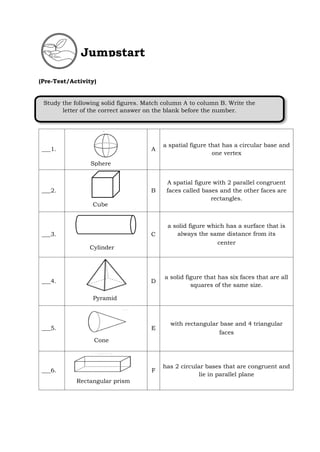
___1. A
a spatial figure that has a circular base and
one vertex
___2. B
A spatial figure with 2 parallel congruent
faces called bases and the other faces are
rectangles.
___3. C
a solid figure which has a surface that is
always the same distance from its
center
___4. D
a solid figure that has six faces that are all
squares of the same size.
___5. E
with rectangular base and 4 triangular
faces
___6. F
has 2 circular bases that are congruent and
lie in parallel plane
Study the following solid figures. Match column A to column B. Write the
letter of the correct answer on the blank before the number.
Jumpstart
Cube
Cylinder
Pyramid
Cone
Rectangular prism
Sphere
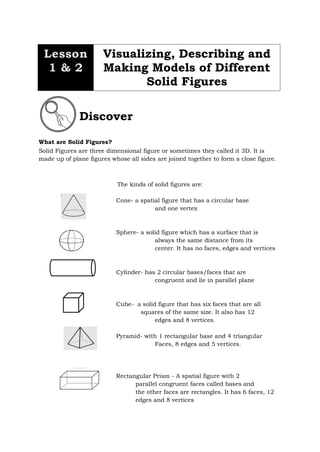
What are Solid Figures?
Solid Figures are three dimensional figure or sometimes they called it 3D. It is
made up of plane figures whose all sides are joined together to form a close figure.
The kinds of solid figures are:
Cone- a spatial figure that has a circular base
and one vertex
Sphere- a solid figure which has a surface that is
always the same distance from its
center. It has no faces, edges and vertices
Cylinder- has 2 circular bases/faces that are
congruent and lie in parallel plane
Cube- a solid figure that has six faces that are all
squares of the same size. It also has 12
edges and 8 vertices.
Pyramid- with 1 rectangular base and 4 triangular
Faces, 8 edges and 5 vertices.
Rectangular Prism - A spatial figure with 2
parallel congruent faces called bases and
the other faces are rectangles. It has 6 faces, 12
edges and 8 vertices
Discover
Lesson
1 & 2
Visualizing, Describing and
Making Models of Different
Solid Figures
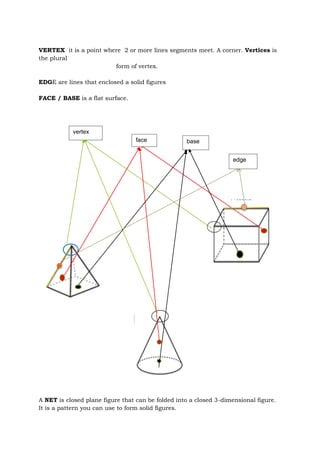
VERTEX it is a point where 2 or more lines segments meet. A corner. Vertices is
the plural
form of vertex.
EDGE are lines that enclosed a solid figures
FACE / BASE is a flat surface.
A NET is closed plane figure that can be folded into a closed 3-dimensional figure.
It is a pattern you can use to form solid figures.
base
vertex
face
edge
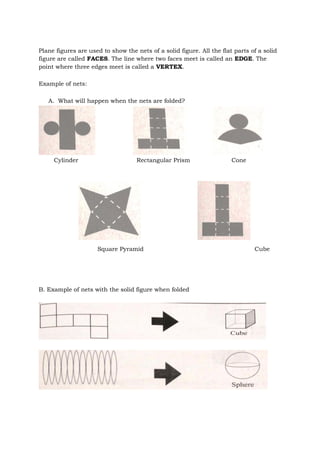
Plane figures are used to show the nets of a solid figure. All the flat parts of a solid
figure are called FACES. The line where two faces meet is called an EDGE. The
point where three edges meet is called a VERTEX.
Example of nets:
A. What will happen when the nets are folded?
Cylinder Rectangular Prism Cone
Square Pyramid Cube
B. Example of nets with the solid figure when folded
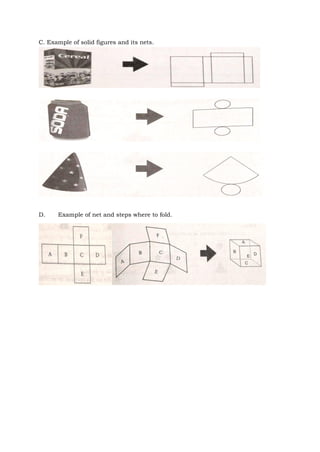
C. Example of solid figures and its nets.
D. Example of net and steps where to fold.
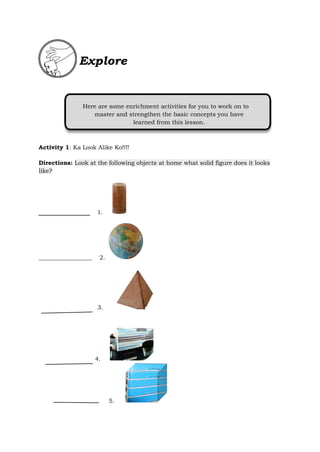
Activity 1: Ka Look Alike Ko!!!!
Directions: Look at the following objects at home what solid figure does it looks
like?
1.
__________________ 2.
3.
4.
5.
Here are some enrichment activities for you to work on to
master and strengthen the basic concepts you have
learned from this lesson.
Explore
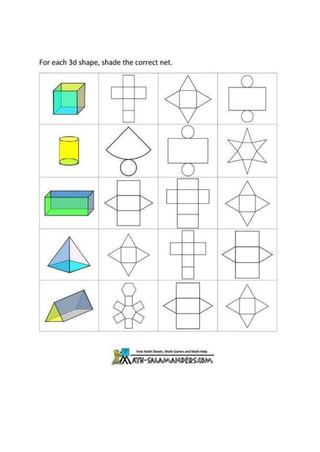
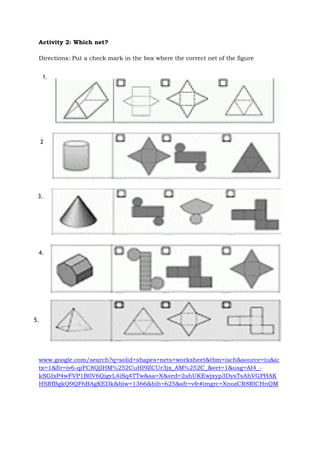
Activity 2: Which net?
Directions: Put a check mark in the box where the correct net of the figure
www.google.com/search?q=solid+shapes+nets+worksheet&tbm=isch&source=iu&ic
tx=1&fir=iv6-qiFC8QjlHM%252CuHI9ZCUr3jx_AM%252C_&vet=1&usg=AI4_-
kSGIxP4wFVP1B0V6QigvL4iSq4TTw&sa=X&ved=2ahUKEwjxyp3DysTsAhVGPHAK
HSRfBgkQ9QF6BAgKEDk&biw=1366&bih=625&sfr=vfe#imgrc=XnozCR8RlCHnQM
1. 1
1
.
2
.
.
3.
4.
5.
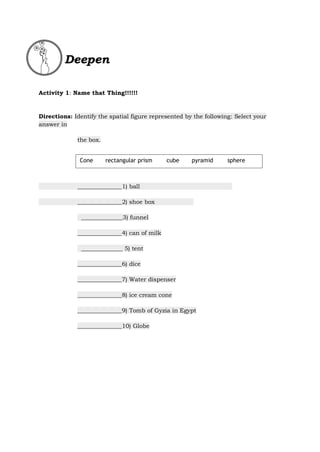
Activity 1: Name that Thing!!!!!!
Directions: Identify the spatial figure represented by the following: Select your
answer in
the box.
_______________1) ball
_______________2) shoe box
______________3) funnel
_______________4) can of milk
______________ 5) tent
_______________6) dice
_______________7) Water dispenser
_______________8) ice cream cone
_______________9) Tomb of Gyzia in Egypt
_______________10) Globe
Deepen
Cone rectangular prism cube pyramid sphere
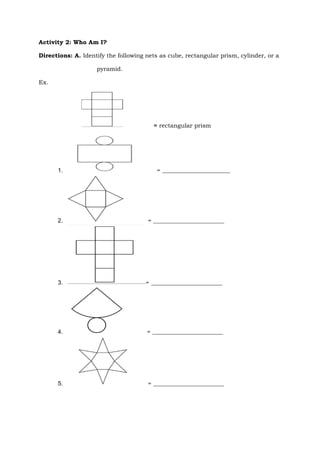
Activity 2: Who Am I?
Directions: A. Identify the following nets as cube, rectangular prism, cylinder, or a
pyramid.
Ex.
= rectangular prism
1. = _______________________
2. = ________________________
3. = ________________________
4. = ________________________
5. = ________________________
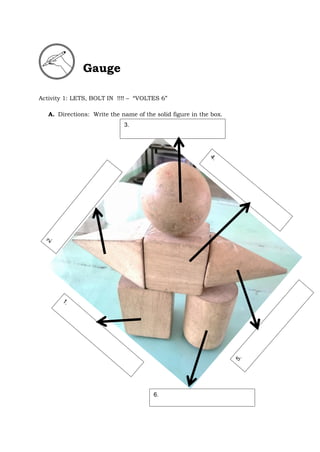
Activity 1: LETS, BOLT IN !!!! – “VOLTES 6”
A. Directions: Write the name of the solid figure in the box.
3.
6.
Gauge
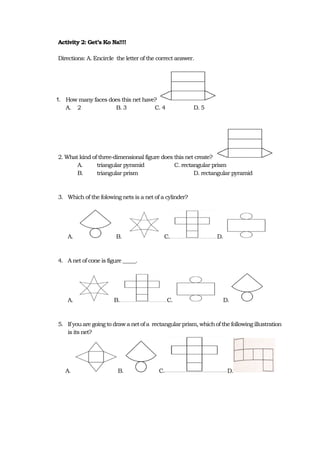
Activity 2: Get’s Ko Na!!!!
Directions: A. Encircle the letter of the correct answer.
1. How many faces does this net have?
A. 2 B. 3 C. 4 D. 5
2. What kind of three-dimensional figure does this net create?
A. triangular pyramid C. rectangular prism
B. triangular prism D. rectangular pyramid
3. Which of the folowing nets is a net of a cylinder?
A. B. C. D.
4. A net of cone is figure _____.
A. B. C. D.
5. If youare going to drawa netof a rectangularprism, whichof the following illustration
is its net?
A. B. C. D.
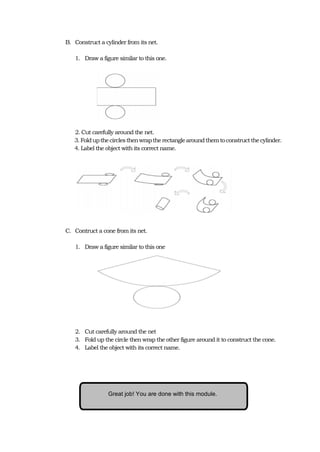
B. Construct a cylinder from its net.
1. Draw a figure similar to this one.
2. Cut carefully around the net.
3.Foldupthecirclesthenwraptherectanglearoundthemtoconstructthecylinder.
4. Label the object with its correct name.
C. Contruct a cone from its net.
1. Draw a figure similar to this one
2. Cut carefully around the net
3. Fold up the circle then wrap the other figure around it to construct the cone.
4. Label the object with its correct name.
Great job! You are done with this module.
References
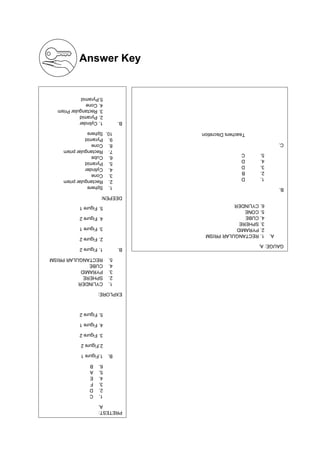
Answer Key
PRETEST:
A.
1.
C
2.
D
3.
F
4.
E
5.
A
6.
B
B.
1.Figure
1
2.Figure
2
3.
Figure
2
4.
Figure
1
5.
Figure
2
EXPLORE:
1.
CYLINDER
2.
SPHERE
3.
PYRAMID
4.
CUBE
5.
RECTANGULAR
PRISM
B.
1.
Figure
2
2.
Figure
2
3.
Figure
1
4.
Figure
2
5.
Figure
1
DEEPEN:
1.
Sphere
2.
Rectangular
prism
3.
Cone
4.
Cylinder
5.
Pyramid
6.
Cube
7.
Rectangular
prism
8.
Cone
9.
Pyramid
10.
Sphere
B.
1.
Cylinder
2.
Pyramid
3.
Rectangular
Prism
4.
Cone
5.Pyramid
GAUGE:
A.
A.
1.
RECTANGULAR
PRISM
2.
PYRAMID
3.
SPHERE
4.
CUBE
5.
CONE
6.
CYLINDER
B.
1.
D
2.
B
3.
D
4.
D
5.
C
C.
Teachers
Discretion
A. Books
1. Department of Education
Vibal Group Inc. 2016, 1253 G. Araneta Ave. Quezon City, Philippines
Authors: Alvin C. Ursua, Angelina Lumbre
21st Century MATHletes 5
Lesson 4, pages 236 -243
2. 21st Century MATHLETES 6, pp. 200-209
Perez, Placer, Burgos, Dimaranan, Mercurio T. Elenzano, EdD, Chin Uy,
PhD
3. TG. Lesson Exemplar Mathematics 5 , pp. 590-593
B. Online References
1.
https://www.google.com/search?q=solid+shapes+nets+worksheet&tbm=isch
&source=iu&ictx=1&fir=iv6-
qiFC8QjlHM%252CuHI9ZCUr3jx_AM%252C_&vet=1&usg=AI4_-
kSGIxP4wFVP1B0V6QigvL4iSq4TTw&sa=X&ved=2ahUKEwjxyp3DysTsAhVG
PHAKHSRfBgkQ9QF6BAgKEDk&biw=1366&bih=625&sfr=vfe#imgrc=iv6-
qiFC8QjlHM
2. https://www.google.com/search?q=solid+shapes+nets+worksheet&tbm=isch
&source=iu&ictx=1&fir=iv6-
qiFC8QjlHM%252CuHI9ZCUr3jx_AM%252C_&vet=1&usg=AI4_-
kSGIxP4wFVP1B0V6QigvL4iSq4TTw&sa=X&ved=2ahUKEwjxyp3DysTsAhVG
PHAKHSRfBgkQ9QF6BAgKEDk&biw=1366&bih=625&sfr=vfe#imgrc=tmuxFc
hcB7DJkM

MATH 5- QUARTER 3-WEEK 5-Module 5-Final-Allan-Domingo.pdf

  • 1.
    5 or AIRs - LM Mathematics Quarter3 – Week 5 Module 5-Lesson 1 & 2 Visualizing, Describing and Making Models of Different Solid Figures
  • 2.
    Mathematics 5 Quarter 3-Week 5, Module 5 Lesson 1 - Visualizes and describes solid figures Lesson 2 - Makes models of different solid figures: cubes, prism, pyramid, cylinder, cone and sphere using plane figures. First Edition, 2021 COPYRIGHT 2020 La Union Schools Division Region I Development Team of the Module Writer: Allan R. Domingo Layout Artist: : Ernesto F. Ramos Jr., P II Editor: SDO La Union, Learning Resource Quality Assurance Team Management Team: Atty. Donato D. Balderas, Jr. Schools Division Superintendent Vivian Luz S. Pagatpatan, PhD Assistant Schools Division Superintendent German E. Flora, PhD, CID Chief Virgilio C. Boado, PhD, EPS in Charge of LRMS Erlinda M. Dela Peña, EdD, EPS in Charge of Mathematics Michael Jason D. Morales, PDO II Claire P. Toluyen, Librarian II
  • 3.
    In this moduleyou are going to visualize and describes and makes models of different solid figures like cube, prism, pyramid, cylinder, cone and sphere using plane figures. In the previous lesson, you had studied about different plane figures, and before going to this lesson it is understood that you had visualize and create the different plane figures With this module you will gain knowledge about spatial figures like sphere, prism, cube, pyramid and cylinder. After going through this module, you are expected to attain the objectives: Learning Competency: - Visualizes and describes solid figures. (M5GE-llle-25) - Makes models of different solid figures: cube, prism, pyramid, cylinder, cone and sphere using plane figures (M5GE-IIIe-26) Target
  • 4.
    (Pre-Test/Activity) ___1. A a spatialfigure that has a circular base and one vertex ___2. B A spatial figure with 2 parallel congruent faces called bases and the other faces are rectangles. ___3. C a solid figure which has a surface that is always the same distance from its center ___4. D a solid figure that has six faces that are all squares of the same size. ___5. E with rectangular base and 4 triangular faces ___6. F has 2 circular bases that are congruent and lie in parallel plane Study the following solid figures. Match column A to column B. Write the letter of the correct answer on the blank before the number. Jumpstart Cube Cylinder Pyramid Cone Rectangular prism Sphere
  • 6.
    What are SolidFigures? Solid Figures are three dimensional figure or sometimes they called it 3D. It is made up of plane figures whose all sides are joined together to form a close figure. The kinds of solid figures are: Cone- a spatial figure that has a circular base and one vertex Sphere- a solid figure which has a surface that is always the same distance from its center. It has no faces, edges and vertices Cylinder- has 2 circular bases/faces that are congruent and lie in parallel plane Cube- a solid figure that has six faces that are all squares of the same size. It also has 12 edges and 8 vertices. Pyramid- with 1 rectangular base and 4 triangular Faces, 8 edges and 5 vertices. Rectangular Prism - A spatial figure with 2 parallel congruent faces called bases and the other faces are rectangles. It has 6 faces, 12 edges and 8 vertices Discover Lesson 1 & 2 Visualizing, Describing and Making Models of Different Solid Figures
  • 7.
    VERTEX it isa point where 2 or more lines segments meet. A corner. Vertices is the plural form of vertex. EDGE are lines that enclosed a solid figures FACE / BASE is a flat surface. A NET is closed plane figure that can be folded into a closed 3-dimensional figure. It is a pattern you can use to form solid figures. base vertex face edge
  • 8.
    Plane figures areused to show the nets of a solid figure. All the flat parts of a solid figure are called FACES. The line where two faces meet is called an EDGE. The point where three edges meet is called a VERTEX. Example of nets: A. What will happen when the nets are folded? Cylinder Rectangular Prism Cone Square Pyramid Cube B. Example of nets with the solid figure when folded
  • 9.
    C. Example ofsolid figures and its nets. D. Example of net and steps where to fold.
  • 10.
    Activity 1: KaLook Alike Ko!!!! Directions: Look at the following objects at home what solid figure does it looks like? 1. __________________ 2. 3. 4. 5. Here are some enrichment activities for you to work on to master and strengthen the basic concepts you have learned from this lesson. Explore
  • 11.
    Activity 2: Whichnet? Directions: Put a check mark in the box where the correct net of the figure www.google.com/search?q=solid+shapes+nets+worksheet&tbm=isch&source=iu&ic tx=1&fir=iv6-qiFC8QjlHM%252CuHI9ZCUr3jx_AM%252C_&vet=1&usg=AI4_- kSGIxP4wFVP1B0V6QigvL4iSq4TTw&sa=X&ved=2ahUKEwjxyp3DysTsAhVGPHAK HSRfBgkQ9QF6BAgKEDk&biw=1366&bih=625&sfr=vfe#imgrc=XnozCR8RlCHnQM 1. 1 1 . 2 . . 3. 4. 5.
  • 12.
    Activity 1: Namethat Thing!!!!!! Directions: Identify the spatial figure represented by the following: Select your answer in the box. _______________1) ball _______________2) shoe box ______________3) funnel _______________4) can of milk ______________ 5) tent _______________6) dice _______________7) Water dispenser _______________8) ice cream cone _______________9) Tomb of Gyzia in Egypt _______________10) Globe Deepen Cone rectangular prism cube pyramid sphere
  • 13.
    Activity 2: WhoAm I? Directions: A. Identify the following nets as cube, rectangular prism, cylinder, or a pyramid. Ex. = rectangular prism 1. = _______________________ 2. = ________________________ 3. = ________________________ 4. = ________________________ 5. = ________________________
  • 14.
    Activity 1: LETS,BOLT IN !!!! – “VOLTES 6” A. Directions: Write the name of the solid figure in the box. 3. 6. Gauge
  • 15.
    Activity 2: Get’sKo Na!!!! Directions: A. Encircle the letter of the correct answer. 1. How many faces does this net have? A. 2 B. 3 C. 4 D. 5 2. What kind of three-dimensional figure does this net create? A. triangular pyramid C. rectangular prism B. triangular prism D. rectangular pyramid 3. Which of the folowing nets is a net of a cylinder? A. B. C. D. 4. A net of cone is figure _____. A. B. C. D. 5. If youare going to drawa netof a rectangularprism, whichof the following illustration is its net? A. B. C. D.
  • 16.
    B. Construct acylinder from its net. 1. Draw a figure similar to this one. 2. Cut carefully around the net. 3.Foldupthecirclesthenwraptherectanglearoundthemtoconstructthecylinder. 4. Label the object with its correct name. C. Contruct a cone from its net. 1. Draw a figure similar to this one 2. Cut carefully around the net 3. Fold up the circle then wrap the other figure around it to construct the cone. 4. Label the object with its correct name. Great job! You are done with this module.
  • 17.
  • 18.
    A. Books 1. Departmentof Education Vibal Group Inc. 2016, 1253 G. Araneta Ave. Quezon City, Philippines Authors: Alvin C. Ursua, Angelina Lumbre 21st Century MATHletes 5 Lesson 4, pages 236 -243 2. 21st Century MATHLETES 6, pp. 200-209 Perez, Placer, Burgos, Dimaranan, Mercurio T. Elenzano, EdD, Chin Uy, PhD 3. TG. Lesson Exemplar Mathematics 5 , pp. 590-593 B. Online References 1. https://www.google.com/search?q=solid+shapes+nets+worksheet&tbm=isch &source=iu&ictx=1&fir=iv6- qiFC8QjlHM%252CuHI9ZCUr3jx_AM%252C_&vet=1&usg=AI4_- kSGIxP4wFVP1B0V6QigvL4iSq4TTw&sa=X&ved=2ahUKEwjxyp3DysTsAhVG PHAKHSRfBgkQ9QF6BAgKEDk&biw=1366&bih=625&sfr=vfe#imgrc=iv6- qiFC8QjlHM 2. https://www.google.com/search?q=solid+shapes+nets+worksheet&tbm=isch &source=iu&ictx=1&fir=iv6- qiFC8QjlHM%252CuHI9ZCUr3jx_AM%252C_&vet=1&usg=AI4_- kSGIxP4wFVP1B0V6QigvL4iSq4TTw&sa=X&ved=2ahUKEwjxyp3DysTsAhVG PHAKHSRfBgkQ9QF6BAgKEDk&biw=1366&bih=625&sfr=vfe#imgrc=tmuxFc hcB7DJkM