REDEVELOPMENT AND
RESIDENTIAL TOWNSHIP
Prepared By:
Arbaz Kazi
Asst. Professor
VCET, Vasai (W)
Contents
•Introduction
•Reasons for redevelopment
•Merits & Demerits
•Documents required
•NOCs required
•Procedure
•Role of PMC
•DC Rules
•Residential Township
•Advantages & Disadvantages
of Residential Township
What is Redevelopment?
• “Redevelopment” means demolition of the old and
existing structure and replacing it with a new
structure having new dimensions and space.
• The prime advantage of such a transformation can
be seen from the usual difference between the old
and the new.
• Blight or Dilapidated structures are mostly
redeveloped.
• Redevelopment agencies declare areas as blighted or
dilapidated.
Reason for Redevelopment
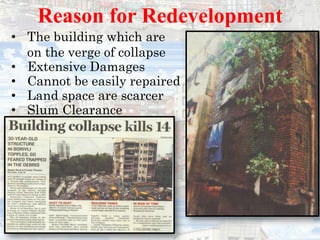
• The building which are
on the verge of collapse
• Extensive Damages
• Cannot be easily repaired
• Land space are scarcer
• Slum Clearance
Reasons for Redevelopment
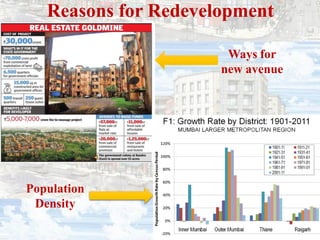
Population
Density
Ways for
new avenue
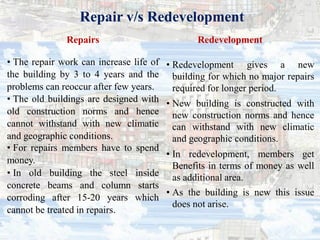
Repair v/s Redevelopment
Repairs
• The repair work can increase life of
the building by 3 to 4 years and the
problems can reoccur after few years.
• The old buildings are designed with
old construction norms and hence
cannot withstand with new climatic
and geographic conditions.
• For repairs members have to spend
money.
• In old building the steel inside
concrete beams and column starts
corroding after 15-20 years which
cannot be treated in repairs.
Redevelopment
• Redevelopment gives a new
building for which no major repairs
required for longer period.
• New building is constructed with
new construction norms and hence
can withstand with new climatic
and geographic conditions.
• In redevelopment, members get
Benefits in terms of money as well
as additional area.
• As the building is new this issue
does not arise.
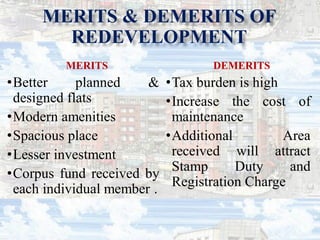
MERITS & DEMERITS OF
REDEVELOPMENT
•Better planned &
designed flats
•Modern amenities
•Spacious place
•Lesser investment
•Corpus fund received by
each individual member .
•Tax burden is high
•Increase the cost of
maintenance
•Additional Area
received will attract
Stamp Duty and
Registration Charge
MERITS DEMERITS
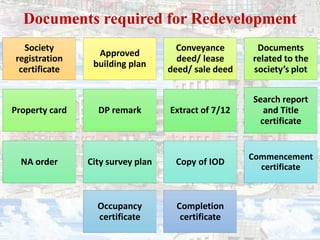
Documents required for Redevelopment
Society
registration
certificate
Approved
building plan
Conveyance
deed/ lease
deed/ sale deed
Documents
related to the
society’s plot
Property card DP remark Extract of 7/12
Search report
and Title
certificate
NA order City survey plan Copy of IOD
Commencement
certificate
Occupancy
certificate
Completion
certificate
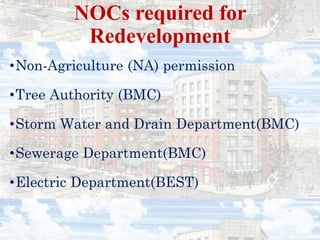
NOCs required for
Redevelopment
•Non-Agriculture (NA) permission
•Tree Authority (BMC)
•Storm Water and Drain Department(BMC)
•Sewerage Department(BMC)
•Electric Department(BEST)
NOCs required for Redevelopment
•Chief fire officer (Fire fighting department)
•Environmental Clearance
•Airport Authority of India (Aviation department)
•Ancient Monument Approval
•Traffic and Coordination Department
•NOC for Coastal area.
Non-Agriculture (NA) permission
Time required- Minimum of 3 months. It depends
on compliance of other conditions.
Cost for obtaining approval: It depends on the
location of the project and ranges between Rs 2-8
per sqft.
Grant of Permission by Revenue Department.
Procedure is time taking and cumbersome.
Tree Authority (BMC)
 Time required 30-60 days
 Cost for obtaining approval - INR 4,000 (per tree)
 Approving Authority: Tree Authority Committee of Municipal
Corporation
Due to stringent environmental regulations, the building
company must receive clearance from the
Tree Authority set up under the Maharashtra (urban areas)
Preservation of Trees Act (1975). The Tree Authority
Commission only meets once a month. The Tree Authority
must ascertain what trees (if any) will be cut down as a
result of construction. If trees are to be cut down, the
building company will have to plant trees to replace them.
Storm Water and Drain Department(BMC)
Time Required: 15-30 Days
 Cost for obtaining approval: Scrutiny Fees INR 2/sqmt (BMC
limit)
No cost for this NOC but BMC is considering imposing some
fee.
Sewerage Department(BMC)
• Time Required: 15-30 Days
Electric Department(BEST)
The electric consultant hired by the developer works out
the load requirement, transformer capacity etc. Load is
sanctioned by the power distribution company. The building
company will inform BEST of the project's power requirements
along with a copy of application submitted for building plan
approval. BEST will assess whether an electrical sub-station up-
grade is required at this stage.
✓ Time Required: 15-30 days
Chief fire officer (Fire fighting department)
In Mumbai, buildings above 24 meters in height require Chief
Fire Officer (CFO) clearance.
Time Required: 30 days
Cost for obtaining approval: Official cost is Rs. 50 per square
meter. Cost varies between Rs.50,000 to Rs 1,00,000.
Environmental Clearance
Approving Authority: Ministry of Environment/State
Environment Impact Assessment Authority (SEIAA)/ State
level expert Appraisal Committee.
Time Required: 3 months to 1 year
Cost for obtaining approval: Charges depend on the size of
project
Airport Authority of India (Aviation department)
 Approving Authority: Civil Aviation Department
 Time Required: 3-4 months
Ancient Monument Approval
Approving Authority: Archaeological Survey of India.
 Time Required: 6 months
NOC if near coastal Area
Approving Authority: Coastal Zone Management Authority
Time Required: 6 months – 1 year (+)
Construction is not allowed upto 500 meters from the coast
line.
Procedure for Redevelopment
1. Appointment of PMC(Project Management
Consultant)
2. Offer letter to the society
3. Terms and conditions with the society
4. Agreement with the society
5. Sanction from MCGM in favor of the society
6. Loading of TDR in the society’s name
7. Obtaining the IOD
Procedure for Redevelopment
8. Shifting of the tenants
9. Demolition of the building
10.Obtaining the CC
11.Construction of the new building
12.Obtaining the OC
13.Shifting the old tenants
Who can apply for Redevelopment?
Tenant /member/occupant with a permission of
owner/society
Owner of the premises
Association of tenants
Role of PMC for Redevelopment
PMC is mandatory for redevelopment of housing
society (According to clause 79(A) MCS Act,1960)
•To analyze project feasibility.
•To Seek information of the conveyance of society’s
land.
•Seek information about available F.S.I. & T.D.R.
•To evaluate the developers who have submitted their
offers.
DC Rules of Redevelopment
•Balconies, Ornamental Projections, Flower Beds,
Voids would now be counted in the Floor Space
Index (FSI). To compensate this, Fungible FSI to
the extent of 35% for Residential and 20% for
Industrial and Commercial Developments has
been allowed with premium.
DC Rules of Redevelopment
•Fungible FSI would be available at
➢60% premium for Residential,
➢80% for Industrial and
➢100% for Commercial at the Ready
Reckoner Rates
•Parking would be available as per the provisions of
the DCR, but 25% more at the option of the
Developer.
DC Rules of Redevelopment
•In case of redevelopment of cessed buildings the
fungible compensatory F.S.I. to the extent of 35%
shall be granted without charging premium.
Defect Liability Period
•It is the period after giving Occupation
Certificate during which if any defect in the
work is noticed, it is the developer’s
responsibility to rectify the defect.
•This period is usually of 1.5 to 2 years.
Redevelopment Success depends on
•The developer should be strictly chosen.
•All the members of the society should give their
consents.
•All agreements / documents should be got
scrutinized by a competent Advocate.
•Bank guarantee should be obtained from developer.
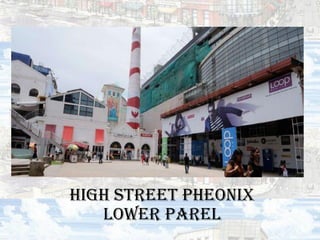
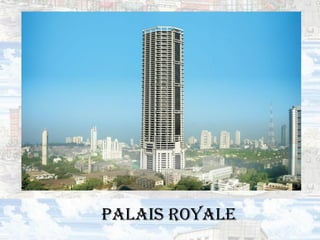
Some of the Redeveloped Projects
in Mumbai
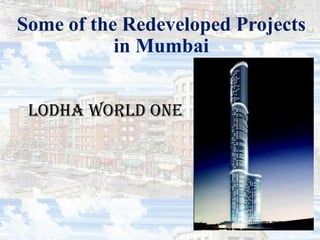
Lodha World One
HIGH STREET PHEONIX
LOWER PAREL
PALAIS ROYALE
NATHANI HEIGHTS
Residential Township
• The word township is used to refer to various kinds of
settlements in different countries.
• While a township may be associated with an urban area,
there are many exceptions to this rule. In Australia,
Canada, and the United States, they may be settlements
too small to be considered urban.
• Simply it is a concept where a large part of land owned is
used for making residential structures along with the
basic amenities.
1. Exceptional living experience
Compared to a conventional residential space, townships provide
bigger open spaces, gardens, jogging tracks and play grounds
which suit the requirements of all age-groups from kids to
youngsters towards the elders. There’s additionally a Walk-to-
Work possibility which augments work existence balance also.
2. One-stop solution
A township is sort of a one-stop living solution where you get
everything that satisfies your needs, from shopping complexes,
to entertainment venues to work.
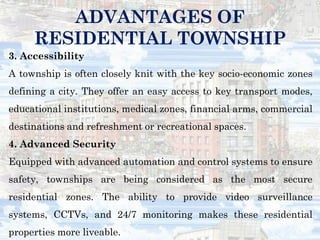
ADVANTAGES OF
RESIDENTIAL TOWNSHIP
3. Accessibility
A township is often closely knit with the key socio-economic zones
defining a city. They offer an easy access to key transport modes,
educational institutions, medical zones, financial arms, commercial
destinations and refreshment or recreational spaces.
4. Advanced Security
Equipped with advanced automation and control systems to ensure
safety, townships are being considered as the most secure
residential zones. The ability to provide video surveillance
systems, CCTVs, and 24/7 monitoring makes these residential
properties more liveable.
ADVANTAGES OF
RESIDENTIAL TOWNSHIP
ADVANTAGES OF
RESIDENTIAL TOWNSHIP
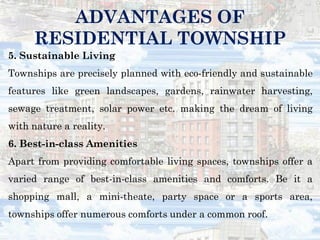
5. Sustainable Living
Townships are precisely planned with eco-friendly and sustainable
features like green landscapes, gardens, rainwater harvesting,
sewage treatment, solar power etc. making the dream of living
with nature a reality.
6. Best-in-class Amenities
Apart from providing comfortable living spaces, townships offer a
varied range of best-in-class amenities and comforts. Be it a
shopping mall, a mini-theate, party space or a sports area,
townships offer numerous comforts under a common roof.
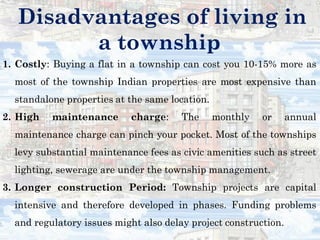
Disadvantages of living in
a township
1. Costly: Buying a flat in a township can cost you 10-15% more as
most of the township Indian properties are most expensive than
standalone properties at the same location.
2. High maintenance charge: The monthly or annual
maintenance charge can pinch your pocket. Most of the townships
levy substantial maintenance fees as civic amenities such as street
lighting, sewerage are under the township management.
3. Longer construction Period: Township projects are capital
intensive and therefore developed in phases. Funding problems
and regulatory issues might also delay project construction.
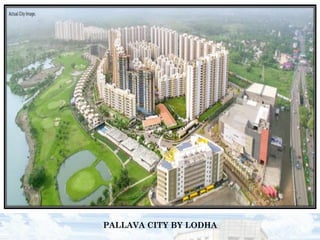
PALLAVA CITY BY LODHA
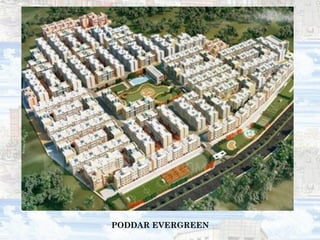
PODDAR EVERGREEN
Redevelopment

Redevelopment

  • 1.
    REDEVELOPMENT AND RESIDENTIAL TOWNSHIP PreparedBy: Arbaz Kazi Asst. Professor VCET, Vasai (W)
  • 2.
    Contents •Introduction •Reasons for redevelopment •Merits& Demerits •Documents required •NOCs required •Procedure •Role of PMC •DC Rules •Residential Township •Advantages & Disadvantages of Residential Township
  • 3.
    What is Redevelopment? •“Redevelopment” means demolition of the old and existing structure and replacing it with a new structure having new dimensions and space. • The prime advantage of such a transformation can be seen from the usual difference between the old and the new. • Blight or Dilapidated structures are mostly redeveloped. • Redevelopment agencies declare areas as blighted or dilapidated.
  • 4.
    Reason for Redevelopment •The building which are on the verge of collapse • Extensive Damages • Cannot be easily repaired • Land space are scarcer • Slum Clearance
  • 5.
  • 6.
    Repair v/s Redevelopment Repairs •The repair work can increase life of the building by 3 to 4 years and the problems can reoccur after few years. • The old buildings are designed with old construction norms and hence cannot withstand with new climatic and geographic conditions. • For repairs members have to spend money. • In old building the steel inside concrete beams and column starts corroding after 15-20 years which cannot be treated in repairs. Redevelopment • Redevelopment gives a new building for which no major repairs required for longer period. • New building is constructed with new construction norms and hence can withstand with new climatic and geographic conditions. • In redevelopment, members get Benefits in terms of money as well as additional area. • As the building is new this issue does not arise.
  • 7.
    MERITS & DEMERITSOF REDEVELOPMENT •Better planned & designed flats •Modern amenities •Spacious place •Lesser investment •Corpus fund received by each individual member . •Tax burden is high •Increase the cost of maintenance •Additional Area received will attract Stamp Duty and Registration Charge MERITS DEMERITS
  • 8.
    Documents required forRedevelopment Society registration certificate Approved building plan Conveyance deed/ lease deed/ sale deed Documents related to the society’s plot Property card DP remark Extract of 7/12 Search report and Title certificate NA order City survey plan Copy of IOD Commencement certificate Occupancy certificate Completion certificate
  • 9.
    NOCs required for Redevelopment •Non-Agriculture(NA) permission •Tree Authority (BMC) •Storm Water and Drain Department(BMC) •Sewerage Department(BMC) •Electric Department(BEST)
  • 10.
    NOCs required forRedevelopment •Chief fire officer (Fire fighting department) •Environmental Clearance •Airport Authority of India (Aviation department) •Ancient Monument Approval •Traffic and Coordination Department •NOC for Coastal area.
  • 11.
    Non-Agriculture (NA) permission Timerequired- Minimum of 3 months. It depends on compliance of other conditions. Cost for obtaining approval: It depends on the location of the project and ranges between Rs 2-8 per sqft. Grant of Permission by Revenue Department. Procedure is time taking and cumbersome.
  • 12.
    Tree Authority (BMC) Time required 30-60 days  Cost for obtaining approval - INR 4,000 (per tree)  Approving Authority: Tree Authority Committee of Municipal Corporation Due to stringent environmental regulations, the building company must receive clearance from the Tree Authority set up under the Maharashtra (urban areas) Preservation of Trees Act (1975). The Tree Authority Commission only meets once a month. The Tree Authority must ascertain what trees (if any) will be cut down as a result of construction. If trees are to be cut down, the building company will have to plant trees to replace them.
  • 13.
    Storm Water andDrain Department(BMC) Time Required: 15-30 Days  Cost for obtaining approval: Scrutiny Fees INR 2/sqmt (BMC limit) No cost for this NOC but BMC is considering imposing some fee. Sewerage Department(BMC) • Time Required: 15-30 Days
  • 14.
    Electric Department(BEST) The electricconsultant hired by the developer works out the load requirement, transformer capacity etc. Load is sanctioned by the power distribution company. The building company will inform BEST of the project's power requirements along with a copy of application submitted for building plan approval. BEST will assess whether an electrical sub-station up- grade is required at this stage. ✓ Time Required: 15-30 days
  • 15.
    Chief fire officer(Fire fighting department) In Mumbai, buildings above 24 meters in height require Chief Fire Officer (CFO) clearance. Time Required: 30 days Cost for obtaining approval: Official cost is Rs. 50 per square meter. Cost varies between Rs.50,000 to Rs 1,00,000. Environmental Clearance Approving Authority: Ministry of Environment/State Environment Impact Assessment Authority (SEIAA)/ State level expert Appraisal Committee. Time Required: 3 months to 1 year Cost for obtaining approval: Charges depend on the size of project
  • 16.
    Airport Authority ofIndia (Aviation department)  Approving Authority: Civil Aviation Department  Time Required: 3-4 months Ancient Monument Approval Approving Authority: Archaeological Survey of India.  Time Required: 6 months NOC if near coastal Area Approving Authority: Coastal Zone Management Authority Time Required: 6 months – 1 year (+) Construction is not allowed upto 500 meters from the coast line.
  • 17.
    Procedure for Redevelopment 1.Appointment of PMC(Project Management Consultant) 2. Offer letter to the society 3. Terms and conditions with the society 4. Agreement with the society 5. Sanction from MCGM in favor of the society 6. Loading of TDR in the society’s name 7. Obtaining the IOD
  • 18.
    Procedure for Redevelopment 8.Shifting of the tenants 9. Demolition of the building 10.Obtaining the CC 11.Construction of the new building 12.Obtaining the OC 13.Shifting the old tenants
  • 19.
    Who can applyfor Redevelopment? Tenant /member/occupant with a permission of owner/society Owner of the premises Association of tenants
  • 20.
    Role of PMCfor Redevelopment PMC is mandatory for redevelopment of housing society (According to clause 79(A) MCS Act,1960) •To analyze project feasibility. •To Seek information of the conveyance of society’s land. •Seek information about available F.S.I. & T.D.R. •To evaluate the developers who have submitted their offers.
  • 21.
    DC Rules ofRedevelopment •Balconies, Ornamental Projections, Flower Beds, Voids would now be counted in the Floor Space Index (FSI). To compensate this, Fungible FSI to the extent of 35% for Residential and 20% for Industrial and Commercial Developments has been allowed with premium.
  • 22.
    DC Rules ofRedevelopment •Fungible FSI would be available at ➢60% premium for Residential, ➢80% for Industrial and ➢100% for Commercial at the Ready Reckoner Rates •Parking would be available as per the provisions of the DCR, but 25% more at the option of the Developer.
  • 23.
    DC Rules ofRedevelopment •In case of redevelopment of cessed buildings the fungible compensatory F.S.I. to the extent of 35% shall be granted without charging premium.
  • 24.
    Defect Liability Period •Itis the period after giving Occupation Certificate during which if any defect in the work is noticed, it is the developer’s responsibility to rectify the defect. •This period is usually of 1.5 to 2 years.
  • 25.
    Redevelopment Success dependson •The developer should be strictly chosen. •All the members of the society should give their consents. •All agreements / documents should be got scrutinized by a competent Advocate. •Bank guarantee should be obtained from developer.
  • 26.
    Some of theRedeveloped Projects in Mumbai Lodha World One
  • 27.
  • 28.
  • 29.
  • 30.
    Residential Township • Theword township is used to refer to various kinds of settlements in different countries. • While a township may be associated with an urban area, there are many exceptions to this rule. In Australia, Canada, and the United States, they may be settlements too small to be considered urban. • Simply it is a concept where a large part of land owned is used for making residential structures along with the basic amenities.
  • 31.
    1. Exceptional livingexperience Compared to a conventional residential space, townships provide bigger open spaces, gardens, jogging tracks and play grounds which suit the requirements of all age-groups from kids to youngsters towards the elders. There’s additionally a Walk-to- Work possibility which augments work existence balance also. 2. One-stop solution A township is sort of a one-stop living solution where you get everything that satisfies your needs, from shopping complexes, to entertainment venues to work. ADVANTAGES OF RESIDENTIAL TOWNSHIP
  • 32.
    3. Accessibility A townshipis often closely knit with the key socio-economic zones defining a city. They offer an easy access to key transport modes, educational institutions, medical zones, financial arms, commercial destinations and refreshment or recreational spaces. 4. Advanced Security Equipped with advanced automation and control systems to ensure safety, townships are being considered as the most secure residential zones. The ability to provide video surveillance systems, CCTVs, and 24/7 monitoring makes these residential properties more liveable. ADVANTAGES OF RESIDENTIAL TOWNSHIP
  • 33.
    ADVANTAGES OF RESIDENTIAL TOWNSHIP 5.Sustainable Living Townships are precisely planned with eco-friendly and sustainable features like green landscapes, gardens, rainwater harvesting, sewage treatment, solar power etc. making the dream of living with nature a reality. 6. Best-in-class Amenities Apart from providing comfortable living spaces, townships offer a varied range of best-in-class amenities and comforts. Be it a shopping mall, a mini-theate, party space or a sports area, townships offer numerous comforts under a common roof.
  • 34.
    Disadvantages of livingin a township 1. Costly: Buying a flat in a township can cost you 10-15% more as most of the township Indian properties are most expensive than standalone properties at the same location. 2. High maintenance charge: The monthly or annual maintenance charge can pinch your pocket. Most of the townships levy substantial maintenance fees as civic amenities such as street lighting, sewerage are under the township management. 3. Longer construction Period: Township projects are capital intensive and therefore developed in phases. Funding problems and regulatory issues might also delay project construction.
  • 35.
  • 36.