PERITONEAL
DIALYSIS
Prepared by:
Abdulaziz m.Shahbaz
What is Peritoneal Dialysis?
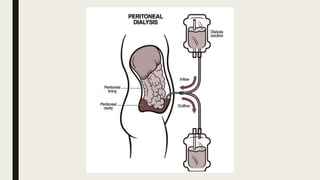
■ Peritoneal Dialysis (PD) is a treatment that utilizes the peritoneum, as a filter to
remove wastes from the body. This type of dialysis requires a care partner to help
with the process.
■ The peritoneum does a similar job as the dialyzer on a dialysis machine during
treatment or that the kidneys do every day.
■ Waste products and fluid pass through the membrane into dialysate (dialysis fluid)
and the fluid is drained with the waste products.
How I t works ?
■ Osmosis and ultrafiltration : by the high dextrose
concentration excess body water is removed.
■ Diffusion : wastes are removed from the peritoneal
capillaries into the dialysate.
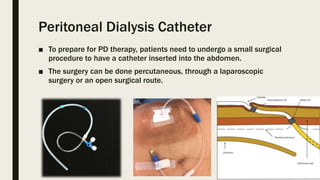
Peritoneal Dialysis Catheter
■ To prepare for PD therapy, patients need to undergo a small surgical
procedure to have a catheter inserted into the abdomen.
■ The surgery can be done percutaneous, through a laparoscopic
surgery or an open surgical route.
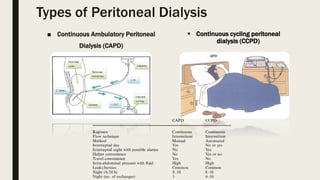
Types of Peritoneal Dialysis
■ Continuous Ambulatory Peritoneal
Dialysis (CAPD)
 Continuous cycling peritoneal
dialysis (CCPD)
Indications
 Acute peritoneal dialysis
1. R.F after cardiac surgery
2. HUS
3. Cong. Urethral stricture
4. Bronchopulmonary
dysplasia
 Chronic peritoneal dialysis
1. ESRD due to
glomerulonephritis
2. ESRD due to chronic
infection
3. HUS
4. Cong. Renal artery stenosis
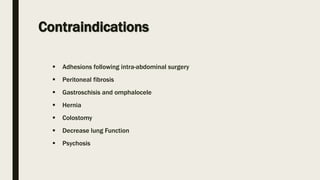
Contraindications
 Adhesions following intra-abdominal surgery
 Peritoneal fibrosis
 Gastroschisis and omphalocele
 Hernia
 Colostomy
 Decrease lung Function
 Psychosis
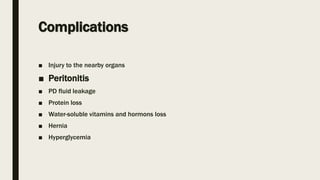
Complications
■ Injury to the nearby organs
■ Peritonitis
■ PD fluid leakage
■ Protein loss
■ Water-soluble vitamins and hormons loss
■ Hernia
■ Hyperglycemia
peritoneal dialysis
peritoneal dialysis

peritoneal dialysis

  • 1.
  • 3.
    What is PeritonealDialysis? ■ Peritoneal Dialysis (PD) is a treatment that utilizes the peritoneum, as a filter to remove wastes from the body. This type of dialysis requires a care partner to help with the process. ■ The peritoneum does a similar job as the dialyzer on a dialysis machine during treatment or that the kidneys do every day. ■ Waste products and fluid pass through the membrane into dialysate (dialysis fluid) and the fluid is drained with the waste products.
  • 4.
    How I tworks ? ■ Osmosis and ultrafiltration : by the high dextrose concentration excess body water is removed. ■ Diffusion : wastes are removed from the peritoneal capillaries into the dialysate.
  • 5.
    Peritoneal Dialysis Catheter ■To prepare for PD therapy, patients need to undergo a small surgical procedure to have a catheter inserted into the abdomen. ■ The surgery can be done percutaneous, through a laparoscopic surgery or an open surgical route.
  • 6.
    Types of PeritonealDialysis ■ Continuous Ambulatory Peritoneal Dialysis (CAPD)  Continuous cycling peritoneal dialysis (CCPD)
  • 7.
    Indications  Acute peritonealdialysis 1. R.F after cardiac surgery 2. HUS 3. Cong. Urethral stricture 4. Bronchopulmonary dysplasia  Chronic peritoneal dialysis 1. ESRD due to glomerulonephritis 2. ESRD due to chronic infection 3. HUS 4. Cong. Renal artery stenosis
  • 8.
    Contraindications  Adhesions followingintra-abdominal surgery  Peritoneal fibrosis  Gastroschisis and omphalocele  Hernia  Colostomy  Decrease lung Function  Psychosis
  • 9.
    Complications ■ Injury tothe nearby organs ■ Peritonitis ■ PD fluid leakage ■ Protein loss ■ Water-soluble vitamins and hormons loss ■ Hernia ■ Hyperglycemia