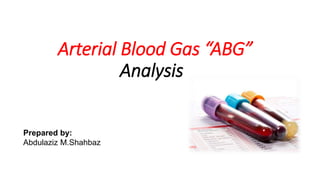
Arterial Blood Gas “ABG”
Analysis
Prepared by:
Abdulaziz M.Shahbaz
Overview
• What Is An ABG?
• Why To Order An ABG?
• Components Of ABG?
• Normal Values?
• Steps In Interpretation Of ABG?
• Acid_Base Disorders?
• Examples.
Introduction
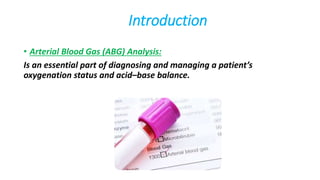
• Arterial Blood Gas (ABG) Analysis:
Is an essential part of diagnosing and managing a patient’s
oxygenation status and acid–base balance.
Why To Order An ABG?
• The Utilization Of An ABG Analysis Becomes Necessary In
View Of The Following Advantages:
• Aids in establishing diagnosis and severity of Respiratory failure.
• Guides treatment plan.
• Aids in ventilator management.
• Improvement in acid/base management; allows for optimal
function of medications.
• Help in management of ICU patient.
•Why ABG instead of pulse oximetry?
ABG directly measures both the amount of oxygen
carried by your blood and the actual amount of gases
(oxygen and carbon dioxide) that are in your blood,
pulse oximetry doesn’t measure CO2 level
Which artery to chose ?
• Radial artery
• Brachial artery
• Femoral artery
• Dorsalis pedis artery
• Posterior tibial
Contraindications
• Local infection.
• Distorted anatomy.
• Presence of arterio-venous fistulas.
• Peripheral vascular disease of the limb to be sampled.
• Severe coagulopathy or recent thrombolysis.
Complications
• Infection (bacteremia)
• Distal ischemia
• Numbness of the hand
• Infection of health care provider
Components Of ABG?
❑ PH [H+]
❑ PaCO2 partial pressure CO2
❑ PaO2 partial pressure O2
❑ HCO3 Bicarbonate
❑ SaO2 Oxygen saturation
❑ BE Base excess
❑ Others….
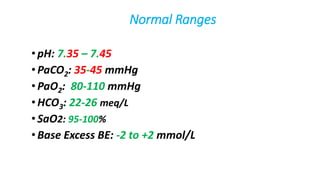
Normal Ranges
•pH: 7.35 – 7.45
•PaCO2: 35-45 mmHg
•PaO2: 80-110 mmHg
•HCO3: 22-26 meq/L
•SaO2: 95-100%
•Base Excess BE: -2 to +2 mmol/L
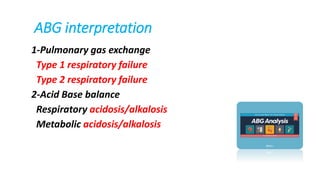
ABG interpretation
1-Pulmonary gas exchange
Type 1 respiratory failure
Type 2 respiratory failure
2-Acid Base balance
Respiratory acidosis/alkalosis
Metabolic acidosis/alkalosis
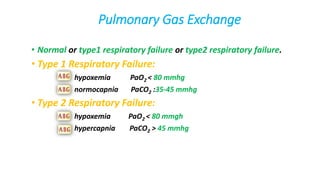
Pulmonary Gas Exchange
• Normal or type1 respiratory failure or type2 respiratory failure.
• Type 1 Respiratory Failure:
hypoxemia PaO2 < 80 mmhg
normocapnia PaCO2 :35-45 mmhg
• Type 2 Respiratory Failure:
hypoxemia PaO2 < 80 mmgh
hypercapnia PaCO2 > 45 mmhg
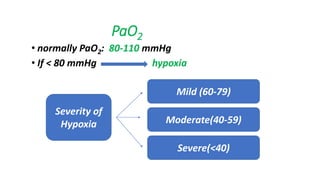
PaO2
• normally PaO2: 80-110 mmHg
• If < 80 mmHg hypoxia
Severity of
Hypoxia
Mild (60-79)
Moderate(40-59)
Severe(<40)
Type 2 Respiratory Failure
PaCO2 PH HCO3
Acute N
Chronic N
Acute on
chronic
Examples
•pH: 7.33 Low
•PaCO2: 38 mmHg Normal
•PaO2: 61 mmHg Low
•HCO3: 19.8 meq/L Low
So its ( mild type1 respiratory failure).
Examples
• pH: 7.12 Low
• PaCO2: 85 mmHg High
•PaO2: 35 mmHg Low
• HCO3: 23 meq/L Normal
So its (Acute type 2 respiratory failure
with severe hypoxemia).
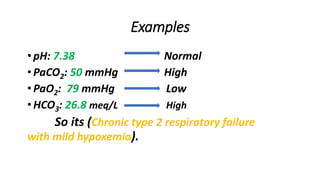
Examples
•pH: 7.38 Normal
•PaCO2: 50 mmHg High
•PaO2: 79 mmHg Low
•HCO3: 26.8 meq/L High
So its (Chronic type 2 respiratory failure
with mild hypoxemia).
Examples
• pH: 7.32 Low
• PaCO2: 70 mmHg High
• PaO2: 48 mmHg Low
•HCO3: 30 meq/L High
So its (Acute on chronic type 2
respiratory failure with moderate hypoxemia).
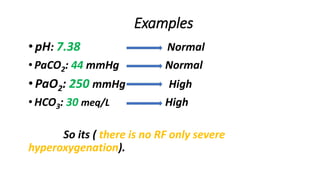
Examples
• pH: 7.38 Normal
•PaCO2: 44 mmHg Normal
• PaO2: 250 mmHg High
• HCO3: 30 meq/L High
So its ( there is no RF only severe
hyperoxygenation).
Acid-Base disorders
•We Have Four Primary Acid Base Disorders:
I. Primary Respiratory Acidosis.
II. Primary Respiratory Alkalosis.
III. Primary Metabolic Acidosis.
IV. Primary Metabolic Alkalosis.
“PH“ is it (acidosis or alkalosis)?
• Seemingly small abnormalities in pH have very significant
and wide-spanning effects on the physiology of the human
body, Therefore, paying close attention to Ph abnormalities
is essential.
• So we need to ask ourselves, is the pH
normal, acidotic or alkalotic?
• Acidotic: pH <7.35
• Normal: pH 7.35 – 7.45
• Alkalotic: pH >7.45
“PaCO2”is it (Respiratory or Metabolic)
•A PaCO2 is less than 35 is
indicative of Respiratory Alkalosis.
•A PaCO2 greater than 45 is
indicative of Respiratory Acidosis.
“HCO3”
• HCO3 level less than 22 is indicative of Metabolic Acidosis.
• A HCO3 level greater than 28 is indicative of Metabolic Alkalosis.
Metabolic Acidosis
PH stHCO3 PCO2
uncompensated ↓ ↓ N
partially compensated ↓ ↓ ↓
compensated N ↓ ↓
Metabolic Alkalosis
PH stHCO3 PCO2
uncompensated ↑ ↑ N
partially compensated ↑ ↑ ↑
compensated N ↑ ↑
Respiratory Acidosis
PH PCO2 stHCO3
uncompensated ↓ ↑ N
partially compensated ↓ ↑ ↑
compensated N ↑ ↑
Respiratory Alkalosis
PH PCO2 stHCO3
uncompensated ↑ ↓ N
partially compensated ↑ ↓ ↓
compensated N ↓ ↓
Compensation
•Either ( Uncompensated , Partially Compensated ,
Fully Compensated ).
• Uncompensated: pH: abnormal
PaCO2:
HCO3:
(One abnormal other unchanged)
Compensation
•Partially Compensated: pH:
PaCO2:
HCO3:
(All are abnormal)
•Fully Compensated: pH: normal
PaCO2:
HCO3:
( both are abnormal)
Examples
•pH: 7.15 Low
•PaCO2: 42 mmHg Normal N
•HCO3: 16 meq/L Low
so its ( metabolic acidosis Uncompensated ).
Examples
•pH: 7.25 Low
•HCO3: 18 meq/L Low
• PaCO2: 16mmHg Low
so its ( Partially compensated ).
Examples
•pH: 7.37 Normal Normal N
•PaCO2: 56 mmHg High
•HCO3: 51meq/L High
so its (fully compensated ).
How wewillknowitsrespiratoryacidosisormetabolic alkalosis?
If PH 7.35-7.39 then itsrespiratoryacidosis
If PH 7.41-7.45 then metabolic alkalosis
BY PH:
Acid-Base Status?
• pH: 7.05 Low
• PaCO2: 16mmHg Low
• HCO3: 15 meq/L Low
• Na : 150 mmol/L , K+: 5.6 , Cl:100
So its ( Metabolic acidosis partially
compensated by respiratory alkalosis ).
Acid-Base Status?
• pH: 7.58 High
• PaCO2: 20 mmHg Low
• HCO3: 11meq/L Low
So its ( Respiratory alkalosis partially
compensated by Metabolic acidosis ).
Acid-Base Status?
• pH: 7.58 High
• PaCO2: 22 mmHg Low
• HCO3: 24 meq/L Normal N
So its ( Non compensated
Respiratory alkalosis).
Acid-Base Status?
• pH: 7.37 Normal N
• PaCO2: 64 mmHg High
• HCO3: 38 meq/L High
So its ( Respiratory acidosis fully
compensated).
Anion Gap
• If the ABG results in (metabolic acidosis) then we
should measure anion gap.
• Normally: AG= 12±4.
• Anion gap(AG) = Na+ - [Cl- + HCO3
-]
• Na: 150 mmol/L , HCO3: 15 , Cl:100
So 150-(100+15)
150-115= 35 its High
ABG .pptx
ABG .pptx
ABG .pptx

ABG .pptx

  • 1.
    Arterial Blood Gas“ABG” Analysis Prepared by: Abdulaziz M.Shahbaz
  • 2.
    Overview • What IsAn ABG? • Why To Order An ABG? • Components Of ABG? • Normal Values? • Steps In Interpretation Of ABG? • Acid_Base Disorders? • Examples.
  • 3.
    Introduction • Arterial BloodGas (ABG) Analysis: Is an essential part of diagnosing and managing a patient’s oxygenation status and acid–base balance.
  • 4.
    Why To OrderAn ABG? • The Utilization Of An ABG Analysis Becomes Necessary In View Of The Following Advantages: • Aids in establishing diagnosis and severity of Respiratory failure. • Guides treatment plan. • Aids in ventilator management. • Improvement in acid/base management; allows for optimal function of medications. • Help in management of ICU patient.
  • 5.
    •Why ABG insteadof pulse oximetry? ABG directly measures both the amount of oxygen carried by your blood and the actual amount of gases (oxygen and carbon dioxide) that are in your blood, pulse oximetry doesn’t measure CO2 level
  • 6.
    Which artery tochose ? • Radial artery • Brachial artery • Femoral artery • Dorsalis pedis artery • Posterior tibial
  • 7.
    Contraindications • Local infection. •Distorted anatomy. • Presence of arterio-venous fistulas. • Peripheral vascular disease of the limb to be sampled. • Severe coagulopathy or recent thrombolysis.
  • 8.
    Complications • Infection (bacteremia) •Distal ischemia • Numbness of the hand • Infection of health care provider
  • 9.
    Components Of ABG? ❑PH [H+] ❑ PaCO2 partial pressure CO2 ❑ PaO2 partial pressure O2 ❑ HCO3 Bicarbonate ❑ SaO2 Oxygen saturation ❑ BE Base excess ❑ Others….
  • 10.
    Normal Ranges •pH: 7.35– 7.45 •PaCO2: 35-45 mmHg •PaO2: 80-110 mmHg •HCO3: 22-26 meq/L •SaO2: 95-100% •Base Excess BE: -2 to +2 mmol/L
  • 11.
    ABG interpretation 1-Pulmonary gasexchange Type 1 respiratory failure Type 2 respiratory failure 2-Acid Base balance Respiratory acidosis/alkalosis Metabolic acidosis/alkalosis
  • 12.
    Pulmonary Gas Exchange •Normal or type1 respiratory failure or type2 respiratory failure. • Type 1 Respiratory Failure: hypoxemia PaO2 < 80 mmhg normocapnia PaCO2 :35-45 mmhg • Type 2 Respiratory Failure: hypoxemia PaO2 < 80 mmgh hypercapnia PaCO2 > 45 mmhg
  • 13.
    PaO2 • normally PaO2:80-110 mmHg • If < 80 mmHg hypoxia Severity of Hypoxia Mild (60-79) Moderate(40-59) Severe(<40)
  • 14.
    Type 2 RespiratoryFailure PaCO2 PH HCO3 Acute N Chronic N Acute on chronic
  • 15.
    Examples •pH: 7.33 Low •PaCO2:38 mmHg Normal •PaO2: 61 mmHg Low •HCO3: 19.8 meq/L Low So its ( mild type1 respiratory failure).
  • 16.
    Examples • pH: 7.12Low • PaCO2: 85 mmHg High •PaO2: 35 mmHg Low • HCO3: 23 meq/L Normal So its (Acute type 2 respiratory failure with severe hypoxemia).
  • 17.
    Examples •pH: 7.38 Normal •PaCO2:50 mmHg High •PaO2: 79 mmHg Low •HCO3: 26.8 meq/L High So its (Chronic type 2 respiratory failure with mild hypoxemia).
  • 18.
    Examples • pH: 7.32Low • PaCO2: 70 mmHg High • PaO2: 48 mmHg Low •HCO3: 30 meq/L High So its (Acute on chronic type 2 respiratory failure with moderate hypoxemia).
  • 19.
    Examples • pH: 7.38Normal •PaCO2: 44 mmHg Normal • PaO2: 250 mmHg High • HCO3: 30 meq/L High So its ( there is no RF only severe hyperoxygenation).
  • 20.
    Acid-Base disorders •We HaveFour Primary Acid Base Disorders: I. Primary Respiratory Acidosis. II. Primary Respiratory Alkalosis. III. Primary Metabolic Acidosis. IV. Primary Metabolic Alkalosis.
  • 21.
    “PH“ is it(acidosis or alkalosis)? • Seemingly small abnormalities in pH have very significant and wide-spanning effects on the physiology of the human body, Therefore, paying close attention to Ph abnormalities is essential. • So we need to ask ourselves, is the pH normal, acidotic or alkalotic? • Acidotic: pH <7.35 • Normal: pH 7.35 – 7.45 • Alkalotic: pH >7.45
  • 22.
    “PaCO2”is it (Respiratoryor Metabolic) •A PaCO2 is less than 35 is indicative of Respiratory Alkalosis. •A PaCO2 greater than 45 is indicative of Respiratory Acidosis.
  • 23.
    “HCO3” • HCO3 levelless than 22 is indicative of Metabolic Acidosis. • A HCO3 level greater than 28 is indicative of Metabolic Alkalosis. Metabolic Acidosis PH stHCO3 PCO2 uncompensated ↓ ↓ N partially compensated ↓ ↓ ↓ compensated N ↓ ↓ Metabolic Alkalosis PH stHCO3 PCO2 uncompensated ↑ ↑ N partially compensated ↑ ↑ ↑ compensated N ↑ ↑
  • 24.
    Respiratory Acidosis PH PCO2stHCO3 uncompensated ↓ ↑ N partially compensated ↓ ↑ ↑ compensated N ↑ ↑ Respiratory Alkalosis PH PCO2 stHCO3 uncompensated ↑ ↓ N partially compensated ↑ ↓ ↓ compensated N ↓ ↓
  • 25.
    Compensation •Either ( Uncompensated, Partially Compensated , Fully Compensated ). • Uncompensated: pH: abnormal PaCO2: HCO3: (One abnormal other unchanged)
  • 26.
    Compensation •Partially Compensated: pH: PaCO2: HCO3: (Allare abnormal) •Fully Compensated: pH: normal PaCO2: HCO3: ( both are abnormal)
  • 27.
    Examples •pH: 7.15 Low •PaCO2:42 mmHg Normal N •HCO3: 16 meq/L Low so its ( metabolic acidosis Uncompensated ).
  • 28.
    Examples •pH: 7.25 Low •HCO3:18 meq/L Low • PaCO2: 16mmHg Low so its ( Partially compensated ).
  • 29.
    Examples •pH: 7.37 NormalNormal N •PaCO2: 56 mmHg High •HCO3: 51meq/L High so its (fully compensated ).
  • 30.
    How wewillknowitsrespiratoryacidosisormetabolic alkalosis? IfPH 7.35-7.39 then itsrespiratoryacidosis If PH 7.41-7.45 then metabolic alkalosis BY PH:
  • 31.
    Acid-Base Status? • pH:7.05 Low • PaCO2: 16mmHg Low • HCO3: 15 meq/L Low • Na : 150 mmol/L , K+: 5.6 , Cl:100 So its ( Metabolic acidosis partially compensated by respiratory alkalosis ).
  • 32.
    Acid-Base Status? • pH:7.58 High • PaCO2: 20 mmHg Low • HCO3: 11meq/L Low So its ( Respiratory alkalosis partially compensated by Metabolic acidosis ).
  • 33.
    Acid-Base Status? • pH:7.58 High • PaCO2: 22 mmHg Low • HCO3: 24 meq/L Normal N So its ( Non compensated Respiratory alkalosis).
  • 34.
    Acid-Base Status? • pH:7.37 Normal N • PaCO2: 64 mmHg High • HCO3: 38 meq/L High So its ( Respiratory acidosis fully compensated).
  • 35.
    Anion Gap • Ifthe ABG results in (metabolic acidosis) then we should measure anion gap. • Normally: AG= 12±4. • Anion gap(AG) = Na+ - [Cl- + HCO3 -] • Na: 150 mmol/L , HCO3: 15 , Cl:100 So 150-(100+15) 150-115= 35 its High