1
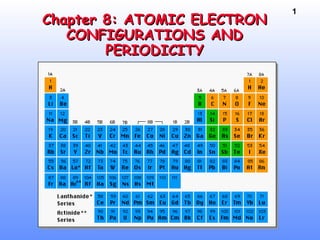
Chapter 8: ATOMIC ELECTRONChapter 8: ATOMIC ELECTRON
CONFIGURATIONS ANDCONFIGURATIONS AND
PERIODICITYPERIODICITY
2
Arrangement ofArrangement of
Electrons in AtomsElectrons in Atoms
Electrons in atoms are arranged asElectrons in atoms are arranged as
SHELLSSHELLS (n)(n)
SUBSHELLSSUBSHELLS (l)(l)
ORBITALSORBITALS (m(mll))
3
Each orbital can be assigned noEach orbital can be assigned no
more than 2 electrons!more than 2 electrons!
This is tied to the existence of a 4thThis is tied to the existence of a 4th
quantum number, thequantum number, the electronelectron
spin quantum number, mspin quantum number, mss..
Arrangement ofArrangement of
Electrons in AtomsElectrons in Atoms
4
ElectronElectron
SpinSpin
QuantumQuantum
Number,Number,
mmss
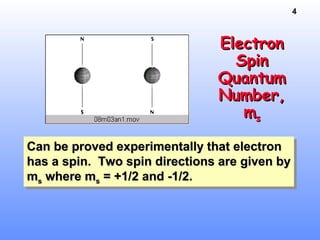
Can be proved experimentally that electronCan be proved experimentally that electron
has a spin. Two spin directions are given byhas a spin. Two spin directions are given by
mmss where mwhere mss = +1/2 and -1/2.= +1/2 and -1/2.
Can be proved experimentally that electronCan be proved experimentally that electron
has a spin. Two spin directions are given byhas a spin. Two spin directions are given by
mmss where mwhere mss = +1/2 and -1/2.= +1/2 and -1/2.
5
Electron Spin Quantum NumberElectron Spin Quantum Number
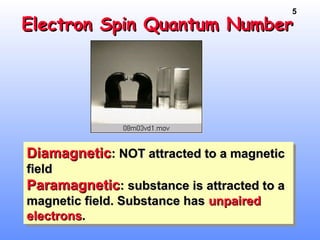
DiamagneticDiamagnetic: NOT attracted to a magnetic: NOT attracted to a magnetic
fieldfield
ParamagneticParamagnetic: substance is attracted to a: substance is attracted to a
magnetic field. Substance hasmagnetic field. Substance has unpairedunpaired
electronselectrons..
DiamagneticDiamagnetic: NOT attracted to a magnetic: NOT attracted to a magnetic
fieldfield
ParamagneticParamagnetic: substance is attracted to a: substance is attracted to a
magnetic field. Substance hasmagnetic field. Substance has unpairedunpaired
electronselectrons..
6
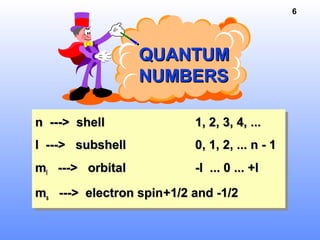
n ---> shelln ---> shell 1, 2, 3, 4, ...1, 2, 3, 4, ...
l ---> subshelll ---> subshell 0, 1, 2, ... n - 10, 1, 2, ... n - 1
mmll ---> orbital---> orbital -l ... 0 ... +l-l ... 0 ... +l
mmss ---> electron spin---> electron spin+1/2 and -1/2+1/2 and -1/2
n ---> shelln ---> shell 1, 2, 3, 4, ...1, 2, 3, 4, ...
l ---> subshelll ---> subshell 0, 1, 2, ... n - 10, 1, 2, ... n - 1
mmll ---> orbital---> orbital -l ... 0 ... +l-l ... 0 ... +l
mmss ---> electron spin---> electron spin+1/2 and -1/2+1/2 and -1/2
QUANTUMQUANTUM
NUMBERSNUMBERS
7
Pauli Exclusion PrinciplePauli Exclusion Principle
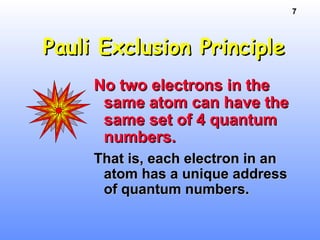
No two electrons in theNo two electrons in the
same atom can have thesame atom can have the
same set of 4 quantumsame set of 4 quantum
numbers.numbers.
That is, each electron in anThat is, each electron in an
atom has a unique addressatom has a unique address
of quantum numbers.of quantum numbers.
8
Electrons in AtomsElectrons in AtomsElectrons in AtomsElectrons in Atoms
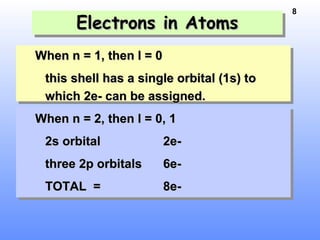
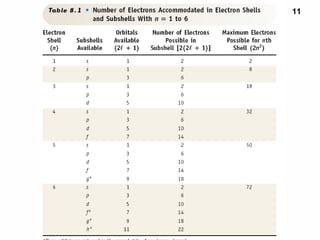
When n = 1, then l = 0When n = 1, then l = 0
this shell has a single orbital (1s) tothis shell has a single orbital (1s) to
which 2e- can be assigned.which 2e- can be assigned.
When n = 2, then l = 0, 1When n = 2, then l = 0, 1
2s orbital2s orbital 2e-2e-
three 2p orbitalsthree 2p orbitals 6e-6e-
TOTAL =TOTAL = 8e-8e-
9
Electrons in AtomsElectrons in AtomsElectrons in AtomsElectrons in Atoms
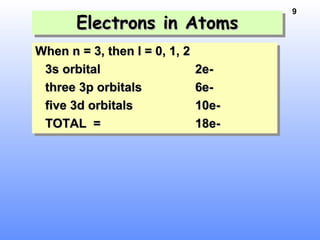
When n = 3, then l = 0, 1, 2When n = 3, then l = 0, 1, 2
3s orbital3s orbital 2e-2e-
three 3p orbitalsthree 3p orbitals 6e-6e-
five 3d orbitalsfive 3d orbitals 10e-10e-
TOTAL =TOTAL = 18e-18e-
When n = 3, then l = 0, 1, 2When n = 3, then l = 0, 1, 2
3s orbital3s orbital 2e-2e-
three 3p orbitalsthree 3p orbitals 6e-6e-
five 3d orbitalsfive 3d orbitals 10e-10e-
TOTAL =TOTAL = 18e-18e-
10
Electrons in AtomsElectrons in AtomsElectrons in AtomsElectrons in Atoms
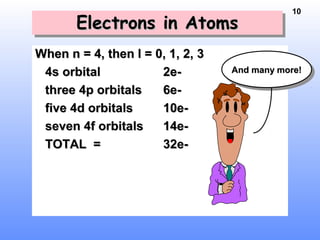
When n = 4, then l = 0, 1, 2, 3When n = 4, then l = 0, 1, 2, 3
4s orbital4s orbital 2e-2e-
three 4p orbitalsthree 4p orbitals 6e-6e-
five 4d orbitalsfive 4d orbitals 10e-10e-
seven 4f orbitalsseven 4f orbitals 14e-14e-
TOTAL =TOTAL = 32e-32e-
And many more!And many more!And many more!And many more!
11
12
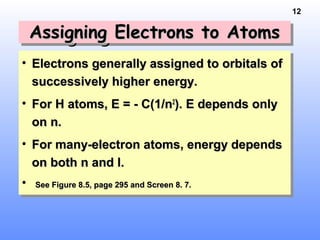
Assigning Electrons to AtomsAssigning Electrons to AtomsAssigning Electrons to AtomsAssigning Electrons to Atoms
• Electrons generally assigned to orbitals ofElectrons generally assigned to orbitals of
successively higher energy.successively higher energy.
• For H atoms, E = - C(1/nFor H atoms, E = - C(1/n22
). E depends only). E depends only
on n.on n.
• For many-electron atoms, energy dependsFor many-electron atoms, energy depends
on both n and l.on both n and l.
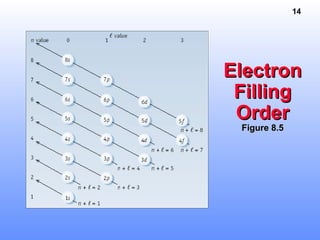
• See Figure 8.5, page 295 and Screen 8. 7.See Figure 8.5, page 295 and Screen 8. 7.
• Electrons generally assigned to orbitals ofElectrons generally assigned to orbitals of
successively higher energy.successively higher energy.
• For H atoms, E = - C(1/nFor H atoms, E = - C(1/n22
). E depends only). E depends only
on n.on n.
• For many-electron atoms, energy dependsFor many-electron atoms, energy depends
on both n and l.on both n and l.
• See Figure 8.5, page 295 and Screen 8. 7.See Figure 8.5, page 295 and Screen 8. 7.
13
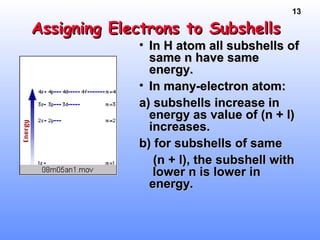
Assigning Electrons to SubshellsAssigning Electrons to Subshells
• In H atom all subshells ofIn H atom all subshells of
same n have samesame n have same
energy.energy.
• In many-electron atom:In many-electron atom:
a) subshells increase ina) subshells increase in
energy as value of (n + l)energy as value of (n + l)
increases.increases.
b) for subshells of sameb) for subshells of same
(n + l), the subshell with(n + l), the subshell with
lower n is lower inlower n is lower in
energy.energy.
14
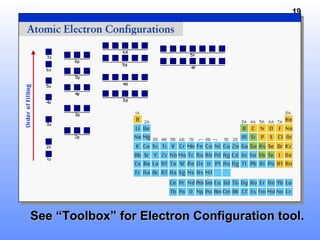
ElectronElectron
FillingFilling
OrderOrder
Figure 8.5Figure 8.5
15
Effective Nuclear Charge, Z*Effective Nuclear Charge, Z*Effective Nuclear Charge, Z*Effective Nuclear Charge, Z*
• Z* is the nuclear chargeZ* is the nuclear charge
experienced by the outermostexperienced by the outermost
electrons.electrons.
• Explains why E(2s) < E(2p)Explains why E(2s) < E(2p)
• Z* increases across a period owing toZ* increases across a period owing to
incomplete shielding by inner electrons.incomplete shielding by inner electrons.
• Estimate Z* by --> [Estimate Z* by --> [ Z - (no. innerZ - (no. inner
electrons)electrons) ]]
• Charge felt by 2s e- in LiCharge felt by 2s e- in Li Z* = 3 -Z* = 3 -
2 = 12 = 1
• BeBe Z* = 4 - 2 = 2Z* = 4 - 2 = 2
16
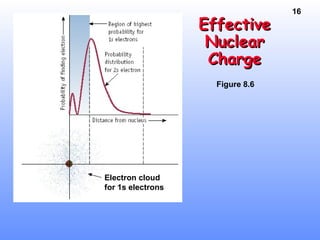
EffectiveEffective
NuclearNuclear
ChargeCharge
Electron cloud
for 1s electrons
Figure 8.6
17
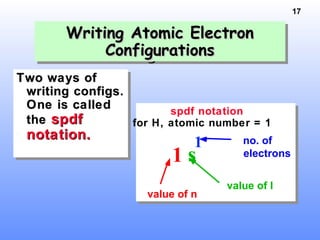
Writing Atomic ElectronWriting Atomic Electron
ConfigurationsConfigurations
Writing Atomic ElectronWriting Atomic Electron
ConfigurationsConfigurations
1
1 s
value of n
value of l
no. of
electrons
spdf notation
for H, atomic number = 1
Two ways ofTwo ways of
writing configs.writing configs.
One is calledOne is called
thethe spdfspdf
notation.notation.
Two ways ofTwo ways of
writing configs.writing configs.
One is calledOne is called
thethe spdfspdf
notation.notation.
18
Writing Atomic ElectronWriting Atomic Electron
ConfigurationsConfigurations
Writing Atomic ElectronWriting Atomic Electron
ConfigurationsConfigurations
Two ways ofTwo ways of
writingwriting
configs. Otherconfigs. Other
is called theis called the
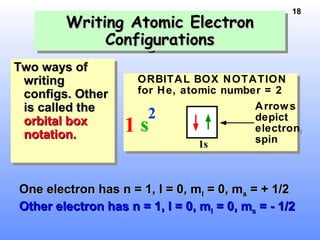
orbital boxorbital box
notation.notation.
Two ways ofTwo ways of
writingwriting
configs. Otherconfigs. Other
is called theis called the
orbital boxorbital box
notation.notation.
Arrows
depict
electron
spin
ORBITAL BOX NOTATION
for He, atomic number = 2
1s
2
1 s
Arrows
depict
electron
spin
ORBITAL BOX NOTATION
for He, atomic number = 2
1s
2
1 s
One electron has n = 1, l = 0, mOne electron has n = 1, l = 0, mll = 0, m= 0, mss = + 1/2= + 1/2
Other electron has n = 1, l = 0, mOther electron has n = 1, l = 0, mll = 0, m= 0, mss = - 1/2= - 1/2
19
See “Toolbox” for Electron Configuration tool.See “Toolbox” for Electron Configuration tool.
20
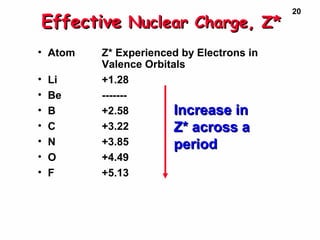
EffectiveEffective Nuclear Charge, Z*Nuclear Charge, Z*
• Atom Z* Experienced by Electrons in
Valence Orbitals
• Li +1.28
• Be -------
• B +2.58
• C +3.22
• N +3.85
• O +4.49
• F +5.13
Increase inIncrease in
Z* across aZ* across a
periodperiod
21
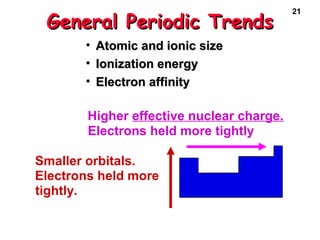
General Periodic TrendsGeneral Periodic Trends
• Atomic and ionic sizeAtomic and ionic size
• Ionization energyIonization energy
• Electron affinityElectron affinity
Higher effective nuclear charge.
Electrons held more tightly
Smaller orbitals.
Electrons held more
tightly.
22
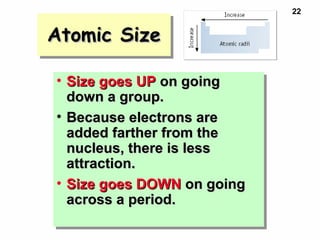
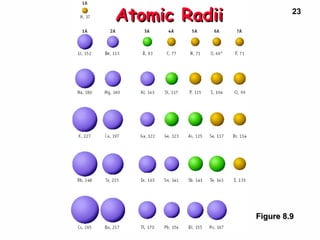
Atomic SizeAtomic SizeAtomic SizeAtomic Size
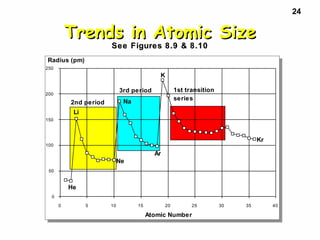
• Size goes UPSize goes UP on goingon going
down a group.down a group.
• Because electrons areBecause electrons are
added farther from theadded farther from the
nucleus, there is lessnucleus, there is less
attraction.attraction.
• Size goes DOWNSize goes DOWN on goingon going
across a period.across a period.
• Size goes UPSize goes UP on goingon going
down a group.down a group.
• Because electrons areBecause electrons are
added farther from theadded farther from the
nucleus, there is lessnucleus, there is less
attraction.attraction.
• Size goes DOWNSize goes DOWN on goingon going
across a period.across a period.
23
Atomic RadiiAtomic Radii
Figure 8.9Figure 8.9
24
Trends in Atomic SizeTrends in Atomic Size
See Figures 8.9 & 8.10See Figures 8.9 & 8.10
0
50
100
150
200
250
0 5 10 15 20 25 30 35 40
Li
Na
K
Kr
He
Ne
Ar
2nd period
3rd period 1st transition
series
Radius (pm)
Atomic Number
0
50
100
150
200
250
0 5 10 15 20 25 30 35 40
Li
Na
K
Kr
He
Ne
Ar
2nd period
3rd period 1st transition
series
Radius (pm)
Atomic Number
25
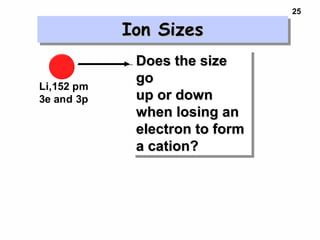
Ion SizesIon SizesIon SizesIon Sizes
Li,152 pm
3e and 3p
Li +, 60 pm
2e and 3 p
+Does the sizeDoes the size
gogo
up or downup or down
when losing anwhen losing an
electron to formelectron to form
a cation?a cation?
Does the sizeDoes the size
gogo
up or downup or down
when losing anwhen losing an
electron to formelectron to form
a cation?a cation?
26
Ion SizesIon SizesIon SizesIon Sizes
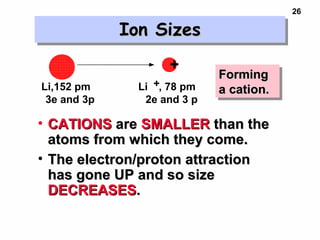
• CATIONSCATIONS areare SMALLERSMALLER than thethan the
atoms from which they come.atoms from which they come.
• The electron/proton attractionThe electron/proton attraction
has gone UP and so sizehas gone UP and so size
DECREASESDECREASES..
Li,152 pm
3e and 3p
Li +, 78 pm
2e and 3 p
+
FormingForming
a cation.a cation.
FormingForming
a cation.a cation.
27
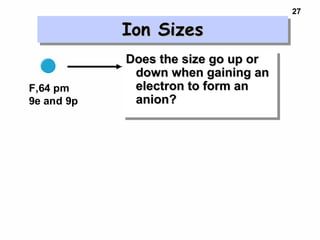
Ion SizesIon SizesIon SizesIon Sizes
F,64 pm
9e and 9p
F- , 136 pm
10 e and 9 p
-Does the size go up orDoes the size go up or
down when gaining andown when gaining an
electron to form anelectron to form an
anion?anion?
Does the size go up orDoes the size go up or
down when gaining andown when gaining an
electron to form anelectron to form an
anion?anion?
28
Ion SizesIon SizesIon SizesIon Sizes
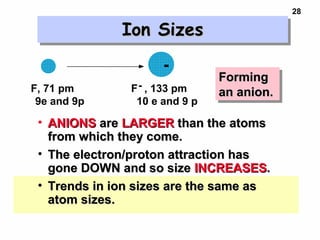
• ANIONSANIONS areare LARGERLARGER than the atomsthan the atoms
from which they come.from which they come.
• The electron/proton attraction hasThe electron/proton attraction has
gone DOWN and so sizegone DOWN and so size INCREASESINCREASES..
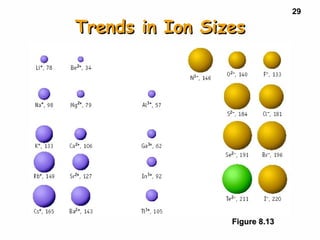
• Trends in ion sizes are the same asTrends in ion sizes are the same as
atom sizes.atom sizes.
FormingForming
an anion.an anion.
FormingForming
an anion.an anion.F, 71 pm
9e and 9p
F- , 133 pm
10 e and 9 p
-
29
Trends in Ion SizesTrends in Ion Sizes
Figure 8.13Figure 8.13
30
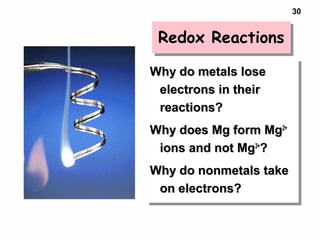
Redox ReactionsRedox Reactions
Why do metals loseWhy do metals lose
electrons in theirelectrons in their
reactions?reactions?
Why does Mg form MgWhy does Mg form Mg2+2+
ions and not Mgions and not Mg3+3+
??
Why do nonmetals takeWhy do nonmetals take
on electrons?on electrons?
Why do metals loseWhy do metals lose
electrons in theirelectrons in their
reactions?reactions?
Why does Mg form MgWhy does Mg form Mg2+2+
ions and not Mgions and not Mg3+3+
??
Why do nonmetals takeWhy do nonmetals take
on electrons?on electrons?
31
Ionization EnergyIonization Energy
See Screen 8.12See Screen 8.12
Ionization EnergyIonization Energy
See Screen 8.12See Screen 8.12
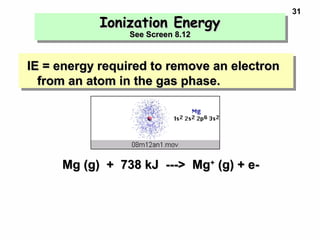
IE = energy required to remove an electronIE = energy required to remove an electron
from an atom in the gas phase.from an atom in the gas phase.
Mg (g) + 738 kJ ---> MgMg (g) + 738 kJ ---> Mg++
(g) + e-(g) + e-
32
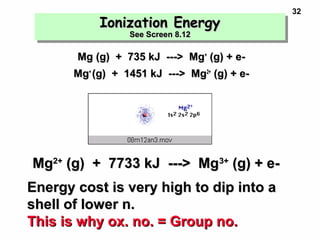
Mg (g) + 735 kJ ---> MgMg (g) + 735 kJ ---> Mg++
(g) + e-(g) + e-
MgMg++
(g) + 1451 kJ ---> Mg(g) + 1451 kJ ---> Mg2+2+
(g) + e-(g) + e-
MgMg2+2+
(g) + 7733 kJ ---> Mg(g) + 7733 kJ ---> Mg3+3+
(g) + e-(g) + e-
Energy cost is very high to dip into aEnergy cost is very high to dip into a
shell of lower n.shell of lower n.
This is why ox. no. = Group no.This is why ox. no. = Group no.
Ionization EnergyIonization Energy
See Screen 8.12See Screen 8.12
Ionization EnergyIonization Energy
See Screen 8.12See Screen 8.12
33
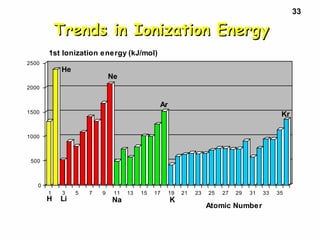
Trends in Ionization EnergyTrends in Ionization Energy
1 3 5 7 9 11 13 15 17 19 21 23 25 27 29 31 33 35
0
500
1000
1500
2000
2500
1st Ionization energy (kJ/mol)
Atomic Number
H Li Na K
He
Ne
Ar
Kr
34
Trends in Ionization EnergyTrends in Ionization EnergyTrends in Ionization EnergyTrends in Ionization Energy
• IE increases across a periodIE increases across a period
because Z* increases.because Z* increases.
• Metals lose electrons moreMetals lose electrons more
easily than nonmetals.easily than nonmetals.
• Metals are good reducingMetals are good reducing
agents.agents.
• Nonmetals lose electrons withNonmetals lose electrons with
difficulty.difficulty.
35
Trends in Ionization EnergyTrends in Ionization EnergyTrends in Ionization EnergyTrends in Ionization Energy
• IE decreases down a groupIE decreases down a group
• Because size increases.Because size increases.
• Reducing ability generallyReducing ability generally
increases down the periodicincreases down the periodic
table.table.
• See reactions of Li, Na, KSee reactions of Li, Na, K
36
Electron AffinityElectron Affinity
A few elementsA few elements GAINGAIN electrons toelectrons to
formform anionsanions..
Electron affinity is the energyElectron affinity is the energy
change when an electron is added:change when an electron is added:
A(g) + e- ---> AA(g) + e- ---> A--
(g) E.A. = ∆E(g) E.A. = ∆E
37
Electron Affinity of OxygenElectron Affinity of Oxygen
∆∆E isE is EXOEXOthermicthermic
because O hasbecause O has
an affinity for anan affinity for an
e-.e-.
[He] ↓↑ ↓↑ ↑ ↑O atom
EA = - 141 kJ
+ electron
O [He] ↓↑ ↓↑ ↑ ↑- ion
38
Electron Affinity of NitrogenElectron Affinity of Nitrogen
∆∆E isE is zerozero for Nfor N--
due to electron-due to electron-
electronelectron
repulsions.repulsions.
EA = 0 kJ
[He] ↓↑ ↑ ↑N atom ↑
[He] ↓↑ ↑ ↑N-
ion ↑
+ electron
39
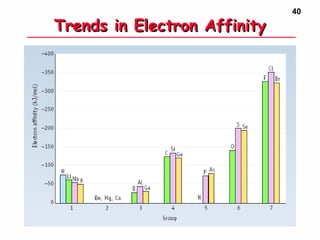
• Affinity for electronAffinity for electron
increases across aincreases across a
period (EA becomesperiod (EA becomes
more negative).more negative).
• Affinity decreases downAffinity decreases down
a group (EA becomesa group (EA becomes
less negative).less negative).
Atom EAAtom EA
FF -328 kJ-328 kJ
ClCl -349 kJ-349 kJ
BrBr -325 kJ-325 kJ
II -295 kJ-295 kJ
Atom EAAtom EA
FF -328 kJ-328 kJ
ClCl -349 kJ-349 kJ
BrBr -325 kJ-325 kJ
II -295 kJ-295 kJ
Trends in Electron AffinityTrends in Electron Affinity
40
Trends in Electron AffinityTrends in Electron Affinity

Periodic table n electron config

  • 1.
    1 Chapter 8: ATOMICELECTRONChapter 8: ATOMIC ELECTRON CONFIGURATIONS ANDCONFIGURATIONS AND PERIODICITYPERIODICITY
  • 2.
    2 Arrangement ofArrangement of Electronsin AtomsElectrons in Atoms Electrons in atoms are arranged asElectrons in atoms are arranged as SHELLSSHELLS (n)(n) SUBSHELLSSUBSHELLS (l)(l) ORBITALSORBITALS (m(mll))
  • 3.
    3 Each orbital canbe assigned noEach orbital can be assigned no more than 2 electrons!more than 2 electrons! This is tied to the existence of a 4thThis is tied to the existence of a 4th quantum number, thequantum number, the electronelectron spin quantum number, mspin quantum number, mss.. Arrangement ofArrangement of Electrons in AtomsElectrons in Atoms
  • 4.
    4 ElectronElectron SpinSpin QuantumQuantum Number,Number, mmss Can be provedexperimentally that electronCan be proved experimentally that electron has a spin. Two spin directions are given byhas a spin. Two spin directions are given by mmss where mwhere mss = +1/2 and -1/2.= +1/2 and -1/2. Can be proved experimentally that electronCan be proved experimentally that electron has a spin. Two spin directions are given byhas a spin. Two spin directions are given by mmss where mwhere mss = +1/2 and -1/2.= +1/2 and -1/2.
  • 5.
    5 Electron Spin QuantumNumberElectron Spin Quantum Number DiamagneticDiamagnetic: NOT attracted to a magnetic: NOT attracted to a magnetic fieldfield ParamagneticParamagnetic: substance is attracted to a: substance is attracted to a magnetic field. Substance hasmagnetic field. Substance has unpairedunpaired electronselectrons.. DiamagneticDiamagnetic: NOT attracted to a magnetic: NOT attracted to a magnetic fieldfield ParamagneticParamagnetic: substance is attracted to a: substance is attracted to a magnetic field. Substance hasmagnetic field. Substance has unpairedunpaired electronselectrons..
  • 6.
    6 n ---> shelln---> shell 1, 2, 3, 4, ...1, 2, 3, 4, ... l ---> subshelll ---> subshell 0, 1, 2, ... n - 10, 1, 2, ... n - 1 mmll ---> orbital---> orbital -l ... 0 ... +l-l ... 0 ... +l mmss ---> electron spin---> electron spin+1/2 and -1/2+1/2 and -1/2 n ---> shelln ---> shell 1, 2, 3, 4, ...1, 2, 3, 4, ... l ---> subshelll ---> subshell 0, 1, 2, ... n - 10, 1, 2, ... n - 1 mmll ---> orbital---> orbital -l ... 0 ... +l-l ... 0 ... +l mmss ---> electron spin---> electron spin+1/2 and -1/2+1/2 and -1/2 QUANTUMQUANTUM NUMBERSNUMBERS
  • 7.
    7 Pauli Exclusion PrinciplePauliExclusion Principle No two electrons in theNo two electrons in the same atom can have thesame atom can have the same set of 4 quantumsame set of 4 quantum numbers.numbers. That is, each electron in anThat is, each electron in an atom has a unique addressatom has a unique address of quantum numbers.of quantum numbers.
  • 8.
    8 Electrons in AtomsElectronsin AtomsElectrons in AtomsElectrons in Atoms When n = 1, then l = 0When n = 1, then l = 0 this shell has a single orbital (1s) tothis shell has a single orbital (1s) to which 2e- can be assigned.which 2e- can be assigned. When n = 2, then l = 0, 1When n = 2, then l = 0, 1 2s orbital2s orbital 2e-2e- three 2p orbitalsthree 2p orbitals 6e-6e- TOTAL =TOTAL = 8e-8e-
  • 9.
    9 Electrons in AtomsElectronsin AtomsElectrons in AtomsElectrons in Atoms When n = 3, then l = 0, 1, 2When n = 3, then l = 0, 1, 2 3s orbital3s orbital 2e-2e- three 3p orbitalsthree 3p orbitals 6e-6e- five 3d orbitalsfive 3d orbitals 10e-10e- TOTAL =TOTAL = 18e-18e- When n = 3, then l = 0, 1, 2When n = 3, then l = 0, 1, 2 3s orbital3s orbital 2e-2e- three 3p orbitalsthree 3p orbitals 6e-6e- five 3d orbitalsfive 3d orbitals 10e-10e- TOTAL =TOTAL = 18e-18e-
  • 10.
    10 Electrons in AtomsElectronsin AtomsElectrons in AtomsElectrons in Atoms When n = 4, then l = 0, 1, 2, 3When n = 4, then l = 0, 1, 2, 3 4s orbital4s orbital 2e-2e- three 4p orbitalsthree 4p orbitals 6e-6e- five 4d orbitalsfive 4d orbitals 10e-10e- seven 4f orbitalsseven 4f orbitals 14e-14e- TOTAL =TOTAL = 32e-32e- And many more!And many more!And many more!And many more!
  • 11.
  • 12.
    12 Assigning Electrons toAtomsAssigning Electrons to AtomsAssigning Electrons to AtomsAssigning Electrons to Atoms • Electrons generally assigned to orbitals ofElectrons generally assigned to orbitals of successively higher energy.successively higher energy. • For H atoms, E = - C(1/nFor H atoms, E = - C(1/n22 ). E depends only). E depends only on n.on n. • For many-electron atoms, energy dependsFor many-electron atoms, energy depends on both n and l.on both n and l. • See Figure 8.5, page 295 and Screen 8. 7.See Figure 8.5, page 295 and Screen 8. 7. • Electrons generally assigned to orbitals ofElectrons generally assigned to orbitals of successively higher energy.successively higher energy. • For H atoms, E = - C(1/nFor H atoms, E = - C(1/n22 ). E depends only). E depends only on n.on n. • For many-electron atoms, energy dependsFor many-electron atoms, energy depends on both n and l.on both n and l. • See Figure 8.5, page 295 and Screen 8. 7.See Figure 8.5, page 295 and Screen 8. 7.
  • 13.
    13 Assigning Electrons toSubshellsAssigning Electrons to Subshells • In H atom all subshells ofIn H atom all subshells of same n have samesame n have same energy.energy. • In many-electron atom:In many-electron atom: a) subshells increase ina) subshells increase in energy as value of (n + l)energy as value of (n + l) increases.increases. b) for subshells of sameb) for subshells of same (n + l), the subshell with(n + l), the subshell with lower n is lower inlower n is lower in energy.energy.
  • 14.
  • 15.
    15 Effective Nuclear Charge,Z*Effective Nuclear Charge, Z*Effective Nuclear Charge, Z*Effective Nuclear Charge, Z* • Z* is the nuclear chargeZ* is the nuclear charge experienced by the outermostexperienced by the outermost electrons.electrons. • Explains why E(2s) < E(2p)Explains why E(2s) < E(2p) • Z* increases across a period owing toZ* increases across a period owing to incomplete shielding by inner electrons.incomplete shielding by inner electrons. • Estimate Z* by --> [Estimate Z* by --> [ Z - (no. innerZ - (no. inner electrons)electrons) ]] • Charge felt by 2s e- in LiCharge felt by 2s e- in Li Z* = 3 -Z* = 3 - 2 = 12 = 1 • BeBe Z* = 4 - 2 = 2Z* = 4 - 2 = 2
  • 16.
  • 17.
    17 Writing Atomic ElectronWritingAtomic Electron ConfigurationsConfigurations Writing Atomic ElectronWriting Atomic Electron ConfigurationsConfigurations 1 1 s value of n value of l no. of electrons spdf notation for H, atomic number = 1 Two ways ofTwo ways of writing configs.writing configs. One is calledOne is called thethe spdfspdf notation.notation. Two ways ofTwo ways of writing configs.writing configs. One is calledOne is called thethe spdfspdf notation.notation.
  • 18.
    18 Writing Atomic ElectronWritingAtomic Electron ConfigurationsConfigurations Writing Atomic ElectronWriting Atomic Electron ConfigurationsConfigurations Two ways ofTwo ways of writingwriting configs. Otherconfigs. Other is called theis called the orbital boxorbital box notation.notation. Two ways ofTwo ways of writingwriting configs. Otherconfigs. Other is called theis called the orbital boxorbital box notation.notation. Arrows depict electron spin ORBITAL BOX NOTATION for He, atomic number = 2 1s 2 1 s Arrows depict electron spin ORBITAL BOX NOTATION for He, atomic number = 2 1s 2 1 s One electron has n = 1, l = 0, mOne electron has n = 1, l = 0, mll = 0, m= 0, mss = + 1/2= + 1/2 Other electron has n = 1, l = 0, mOther electron has n = 1, l = 0, mll = 0, m= 0, mss = - 1/2= - 1/2
  • 19.
    19 See “Toolbox” forElectron Configuration tool.See “Toolbox” for Electron Configuration tool.
  • 20.
    20 EffectiveEffective Nuclear Charge,Z*Nuclear Charge, Z* • Atom Z* Experienced by Electrons in Valence Orbitals • Li +1.28 • Be ------- • B +2.58 • C +3.22 • N +3.85 • O +4.49 • F +5.13 Increase inIncrease in Z* across aZ* across a periodperiod
  • 21.
    21 General Periodic TrendsGeneralPeriodic Trends • Atomic and ionic sizeAtomic and ionic size • Ionization energyIonization energy • Electron affinityElectron affinity Higher effective nuclear charge. Electrons held more tightly Smaller orbitals. Electrons held more tightly.
  • 22.
    22 Atomic SizeAtomic SizeAtomicSizeAtomic Size • Size goes UPSize goes UP on goingon going down a group.down a group. • Because electrons areBecause electrons are added farther from theadded farther from the nucleus, there is lessnucleus, there is less attraction.attraction. • Size goes DOWNSize goes DOWN on goingon going across a period.across a period. • Size goes UPSize goes UP on goingon going down a group.down a group. • Because electrons areBecause electrons are added farther from theadded farther from the nucleus, there is lessnucleus, there is less attraction.attraction. • Size goes DOWNSize goes DOWN on goingon going across a period.across a period.
  • 23.
  • 24.
    24 Trends in AtomicSizeTrends in Atomic Size See Figures 8.9 & 8.10See Figures 8.9 & 8.10 0 50 100 150 200 250 0 5 10 15 20 25 30 35 40 Li Na K Kr He Ne Ar 2nd period 3rd period 1st transition series Radius (pm) Atomic Number 0 50 100 150 200 250 0 5 10 15 20 25 30 35 40 Li Na K Kr He Ne Ar 2nd period 3rd period 1st transition series Radius (pm) Atomic Number
  • 25.
    25 Ion SizesIon SizesIonSizesIon Sizes Li,152 pm 3e and 3p Li +, 60 pm 2e and 3 p +Does the sizeDoes the size gogo up or downup or down when losing anwhen losing an electron to formelectron to form a cation?a cation? Does the sizeDoes the size gogo up or downup or down when losing anwhen losing an electron to formelectron to form a cation?a cation?
  • 26.
    26 Ion SizesIon SizesIonSizesIon Sizes • CATIONSCATIONS areare SMALLERSMALLER than thethan the atoms from which they come.atoms from which they come. • The electron/proton attractionThe electron/proton attraction has gone UP and so sizehas gone UP and so size DECREASESDECREASES.. Li,152 pm 3e and 3p Li +, 78 pm 2e and 3 p + FormingForming a cation.a cation. FormingForming a cation.a cation.
  • 27.
    27 Ion SizesIon SizesIonSizesIon Sizes F,64 pm 9e and 9p F- , 136 pm 10 e and 9 p -Does the size go up orDoes the size go up or down when gaining andown when gaining an electron to form anelectron to form an anion?anion? Does the size go up orDoes the size go up or down when gaining andown when gaining an electron to form anelectron to form an anion?anion?
  • 28.
    28 Ion SizesIon SizesIonSizesIon Sizes • ANIONSANIONS areare LARGERLARGER than the atomsthan the atoms from which they come.from which they come. • The electron/proton attraction hasThe electron/proton attraction has gone DOWN and so sizegone DOWN and so size INCREASESINCREASES.. • Trends in ion sizes are the same asTrends in ion sizes are the same as atom sizes.atom sizes. FormingForming an anion.an anion. FormingForming an anion.an anion.F, 71 pm 9e and 9p F- , 133 pm 10 e and 9 p -
  • 29.
    29 Trends in IonSizesTrends in Ion Sizes Figure 8.13Figure 8.13
  • 30.
    30 Redox ReactionsRedox Reactions Whydo metals loseWhy do metals lose electrons in theirelectrons in their reactions?reactions? Why does Mg form MgWhy does Mg form Mg2+2+ ions and not Mgions and not Mg3+3+ ?? Why do nonmetals takeWhy do nonmetals take on electrons?on electrons? Why do metals loseWhy do metals lose electrons in theirelectrons in their reactions?reactions? Why does Mg form MgWhy does Mg form Mg2+2+ ions and not Mgions and not Mg3+3+ ?? Why do nonmetals takeWhy do nonmetals take on electrons?on electrons?
  • 31.
    31 Ionization EnergyIonization Energy SeeScreen 8.12See Screen 8.12 Ionization EnergyIonization Energy See Screen 8.12See Screen 8.12 IE = energy required to remove an electronIE = energy required to remove an electron from an atom in the gas phase.from an atom in the gas phase. Mg (g) + 738 kJ ---> MgMg (g) + 738 kJ ---> Mg++ (g) + e-(g) + e-
  • 32.
    32 Mg (g) +735 kJ ---> MgMg (g) + 735 kJ ---> Mg++ (g) + e-(g) + e- MgMg++ (g) + 1451 kJ ---> Mg(g) + 1451 kJ ---> Mg2+2+ (g) + e-(g) + e- MgMg2+2+ (g) + 7733 kJ ---> Mg(g) + 7733 kJ ---> Mg3+3+ (g) + e-(g) + e- Energy cost is very high to dip into aEnergy cost is very high to dip into a shell of lower n.shell of lower n. This is why ox. no. = Group no.This is why ox. no. = Group no. Ionization EnergyIonization Energy See Screen 8.12See Screen 8.12 Ionization EnergyIonization Energy See Screen 8.12See Screen 8.12
  • 33.
    33 Trends in IonizationEnergyTrends in Ionization Energy 1 3 5 7 9 11 13 15 17 19 21 23 25 27 29 31 33 35 0 500 1000 1500 2000 2500 1st Ionization energy (kJ/mol) Atomic Number H Li Na K He Ne Ar Kr
  • 34.
    34 Trends in IonizationEnergyTrends in Ionization EnergyTrends in Ionization EnergyTrends in Ionization Energy • IE increases across a periodIE increases across a period because Z* increases.because Z* increases. • Metals lose electrons moreMetals lose electrons more easily than nonmetals.easily than nonmetals. • Metals are good reducingMetals are good reducing agents.agents. • Nonmetals lose electrons withNonmetals lose electrons with difficulty.difficulty.
  • 35.
    35 Trends in IonizationEnergyTrends in Ionization EnergyTrends in Ionization EnergyTrends in Ionization Energy • IE decreases down a groupIE decreases down a group • Because size increases.Because size increases. • Reducing ability generallyReducing ability generally increases down the periodicincreases down the periodic table.table. • See reactions of Li, Na, KSee reactions of Li, Na, K
  • 36.
    36 Electron AffinityElectron Affinity Afew elementsA few elements GAINGAIN electrons toelectrons to formform anionsanions.. Electron affinity is the energyElectron affinity is the energy change when an electron is added:change when an electron is added: A(g) + e- ---> AA(g) + e- ---> A-- (g) E.A. = ∆E(g) E.A. = ∆E
  • 37.
    37 Electron Affinity ofOxygenElectron Affinity of Oxygen ∆∆E isE is EXOEXOthermicthermic because O hasbecause O has an affinity for anan affinity for an e-.e-. [He] ↓↑ ↓↑ ↑ ↑O atom EA = - 141 kJ + electron O [He] ↓↑ ↓↑ ↑ ↑- ion
  • 38.
    38 Electron Affinity ofNitrogenElectron Affinity of Nitrogen ∆∆E isE is zerozero for Nfor N-- due to electron-due to electron- electronelectron repulsions.repulsions. EA = 0 kJ [He] ↓↑ ↑ ↑N atom ↑ [He] ↓↑ ↑ ↑N- ion ↑ + electron
  • 39.
    39 • Affinity forelectronAffinity for electron increases across aincreases across a period (EA becomesperiod (EA becomes more negative).more negative). • Affinity decreases downAffinity decreases down a group (EA becomesa group (EA becomes less negative).less negative). Atom EAAtom EA FF -328 kJ-328 kJ ClCl -349 kJ-349 kJ BrBr -325 kJ-325 kJ II -295 kJ-295 kJ Atom EAAtom EA FF -328 kJ-328 kJ ClCl -349 kJ-349 kJ BrBr -325 kJ-325 kJ II -295 kJ-295 kJ Trends in Electron AffinityTrends in Electron Affinity
  • 40.
    40 Trends in ElectronAffinityTrends in Electron Affinity

Editor's Notes

  • #2 To play the movies and simulations included, view the presentation in Slide Show Mode.