FUNDAMENTAL PARTICLES:
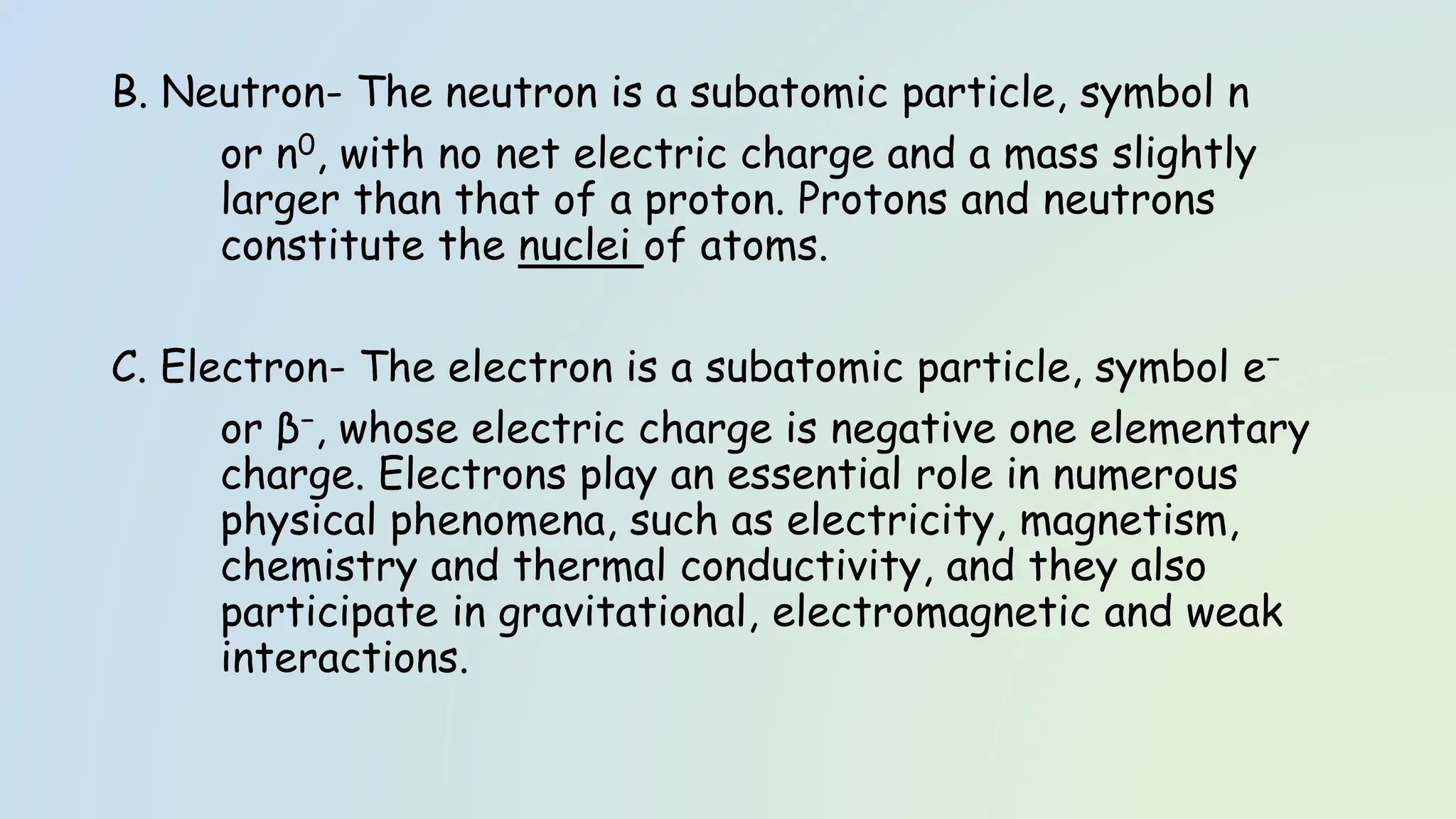
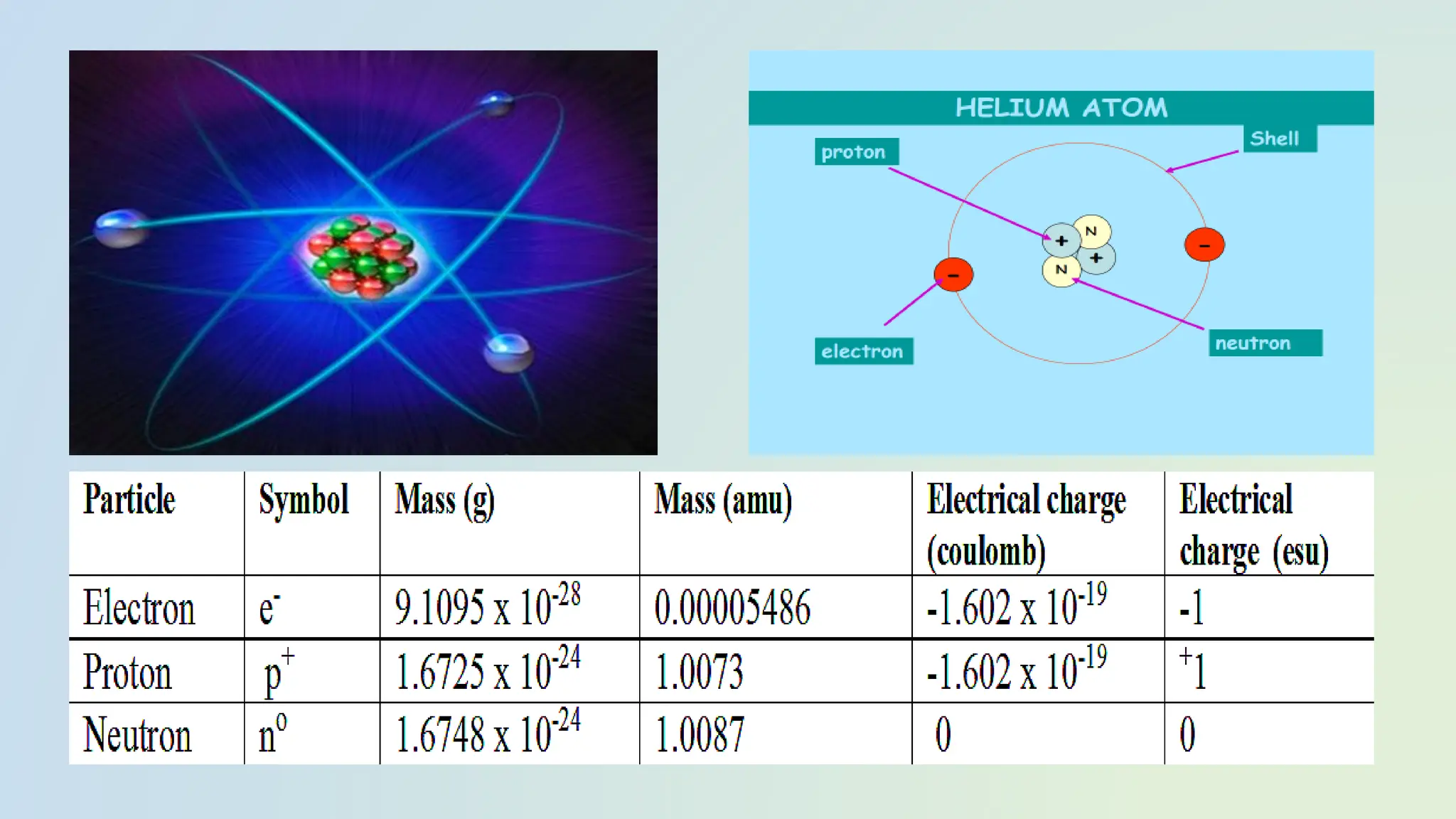
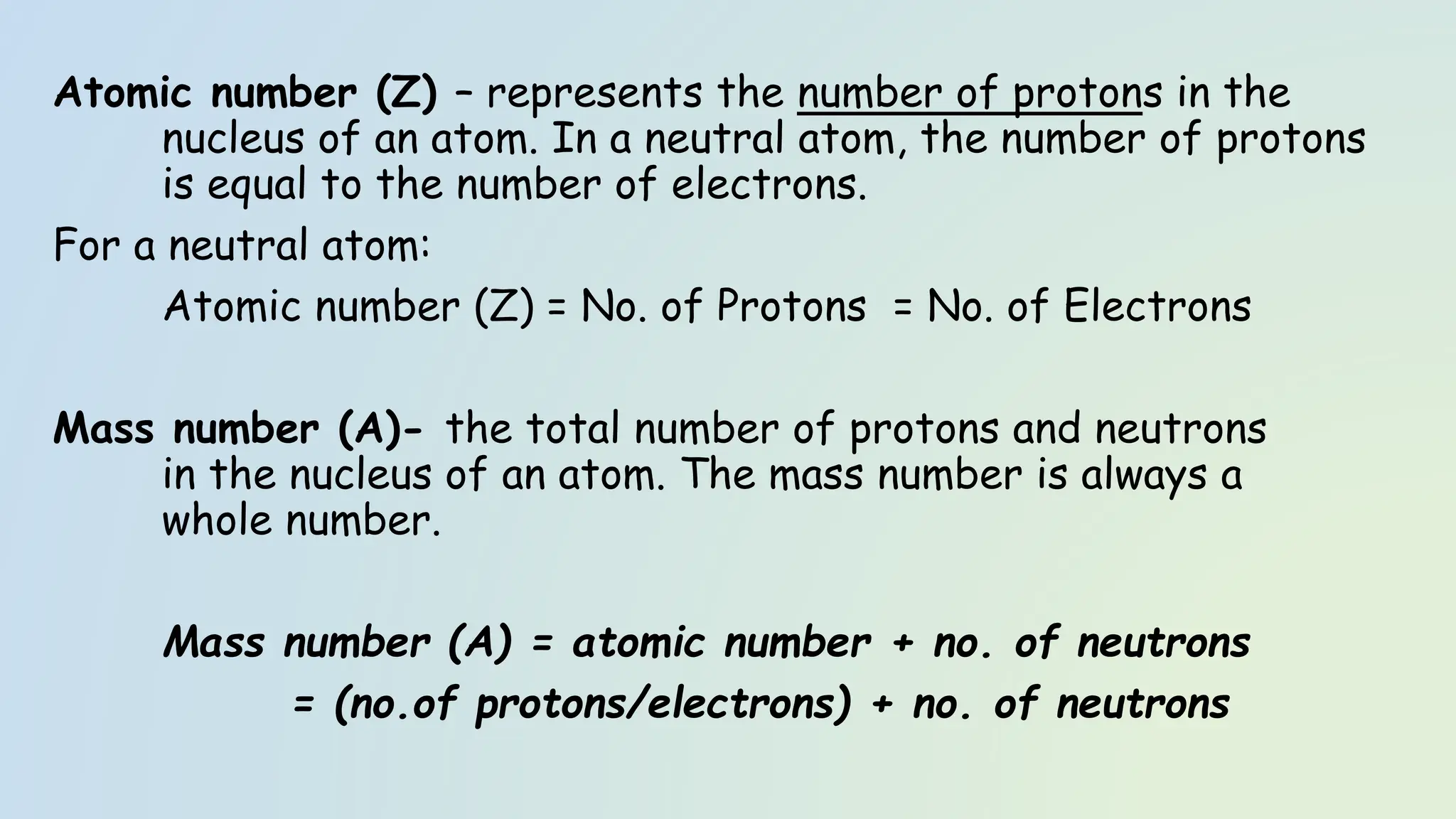
A. Proton- is a subatomic particle, symbol p or p+, with a
positive electric charge of +1 elementary charge and a
mass slightly less than that of a neutron. The word
proton is Greek for "first", and this name was given to
the hydrogen nucleus.
The number of protons in the nucleus is the defining
property of an element, and is referred to as the atomic
number (represented by the symbol Z).
B. Neutron- The neutron is a subatomic particle, symbol n
or n0, with no net electric charge and a mass slightly
larger than that of a proton. Protons and neutrons
constitute the nuclei of atoms.
C. Electron- The electron is a subatomic particle, symbol e−
or β−, whose electric charge is negative one elementary
charge. Electrons play an essential role in numerous
physical phenomena, such as electricity, magnetism,
chemistry and thermal conductivity, and they also
participate in gravitational, electromagnetic and weak
interactions.
Atomic number (Z) – represents the number of protons in the
nucleus of an atom. In a neutral atom, the number of protons
is equal to the number of electrons.
For a neutral atom:
Atomic number (Z) = No. of Protons = No. of Electrons
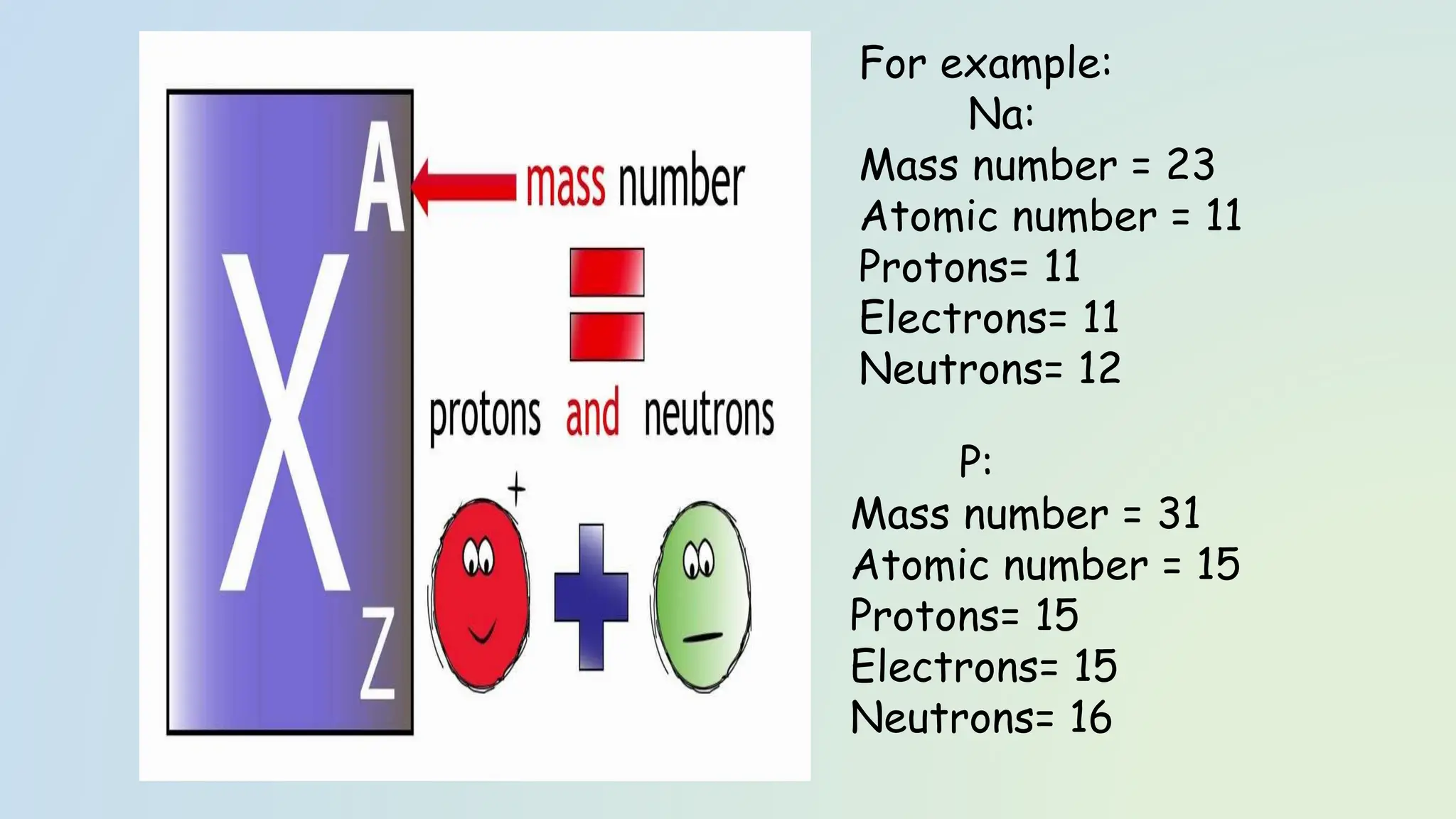
Mass number (A)- the total number of protons and neutrons
in the nucleus of an atom. The mass number is always a
whole number.
Mass number (A) = atomic number + no. of neutrons
= (no.of protons/electrons) + no. of neutrons
For example:
Na:
Mass number = 23
Atomic number = 11
Protons= 11
Electrons= 11
Neutrons= 12
P:
Mass number = 31
Atomic number = 15
Protons= 15
Electrons= 15
Neutrons= 16
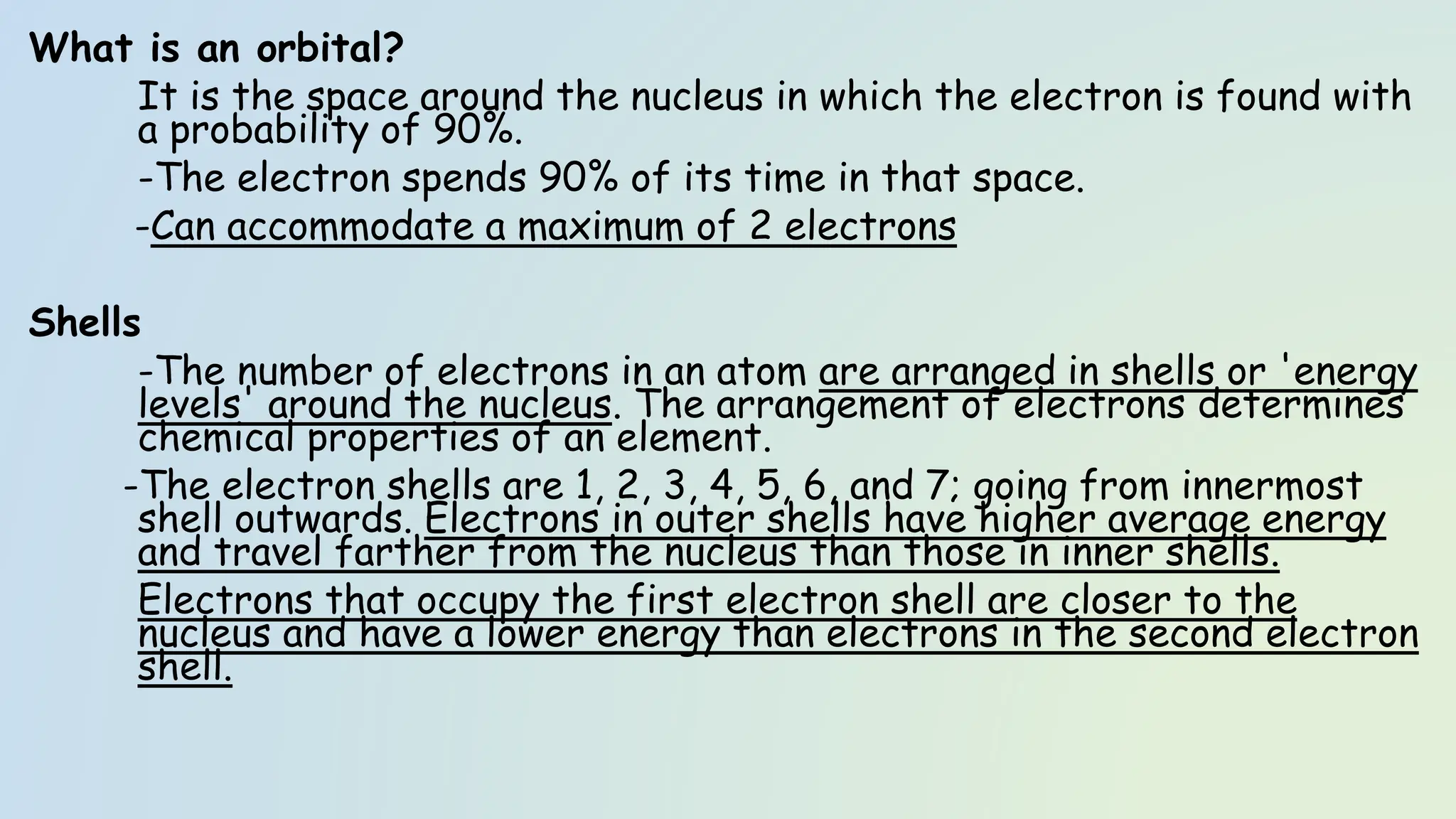
What is an orbital?
It is the space around the nucleus in which the electron is found with
a probability of 90%.
-The electron spends 90% of its time in that space.
-Can accommodate a maximum of 2 electrons
Shells
-The number of electrons in an atom are arranged in shells or 'energy
levels' around the nucleus. The arrangement of electrons determines
chemical properties of an element.
-The electron shells are 1, 2, 3, 4, 5, 6, and 7; going from innermost
shell outwards. Electrons in outer shells have higher average energy
and travel farther from the nucleus than those in inner shells.
Electrons that occupy the first electron shell are closer to the
nucleus and have a lower energy than electrons in the second electron
shell.
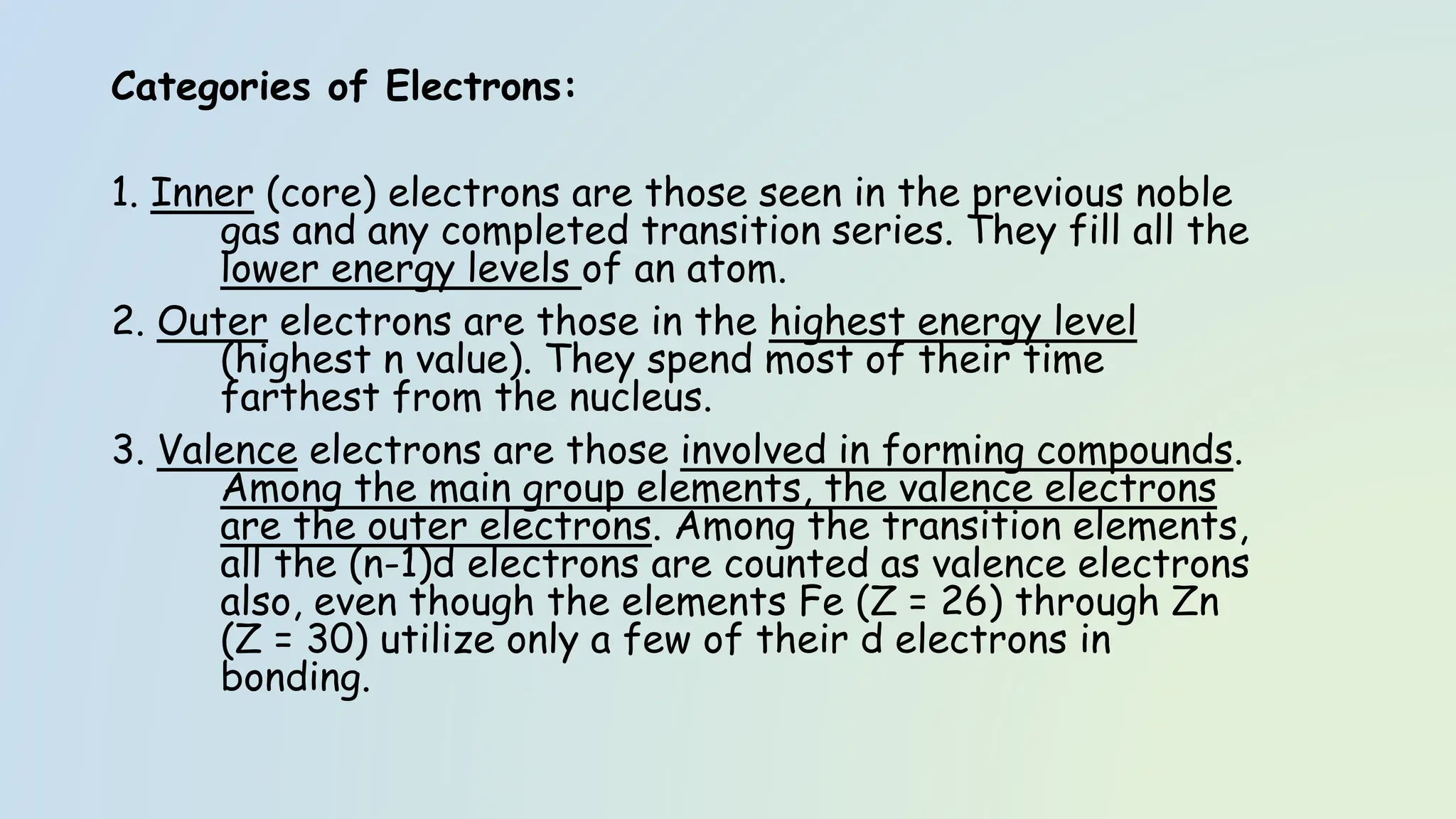
Categories of Electrons:
1. Inner (core) electrons are those seen in the previous noble
gas and any completed transition series. They fill all the
lower energy levels of an atom.
2. Outer electrons are those in the highest energy level
(highest n value). They spend most of their time
farthest from the nucleus.
3. Valence electrons are those involved in forming compounds.
Among the main group elements, the valence electrons
are the outer electrons. Among the transition elements,
all the (n-1)d electrons are counted as valence electrons
also, even though the elements Fe (Z = 26) through Zn
(Z = 30) utilize only a few of their d electrons in
bonding.
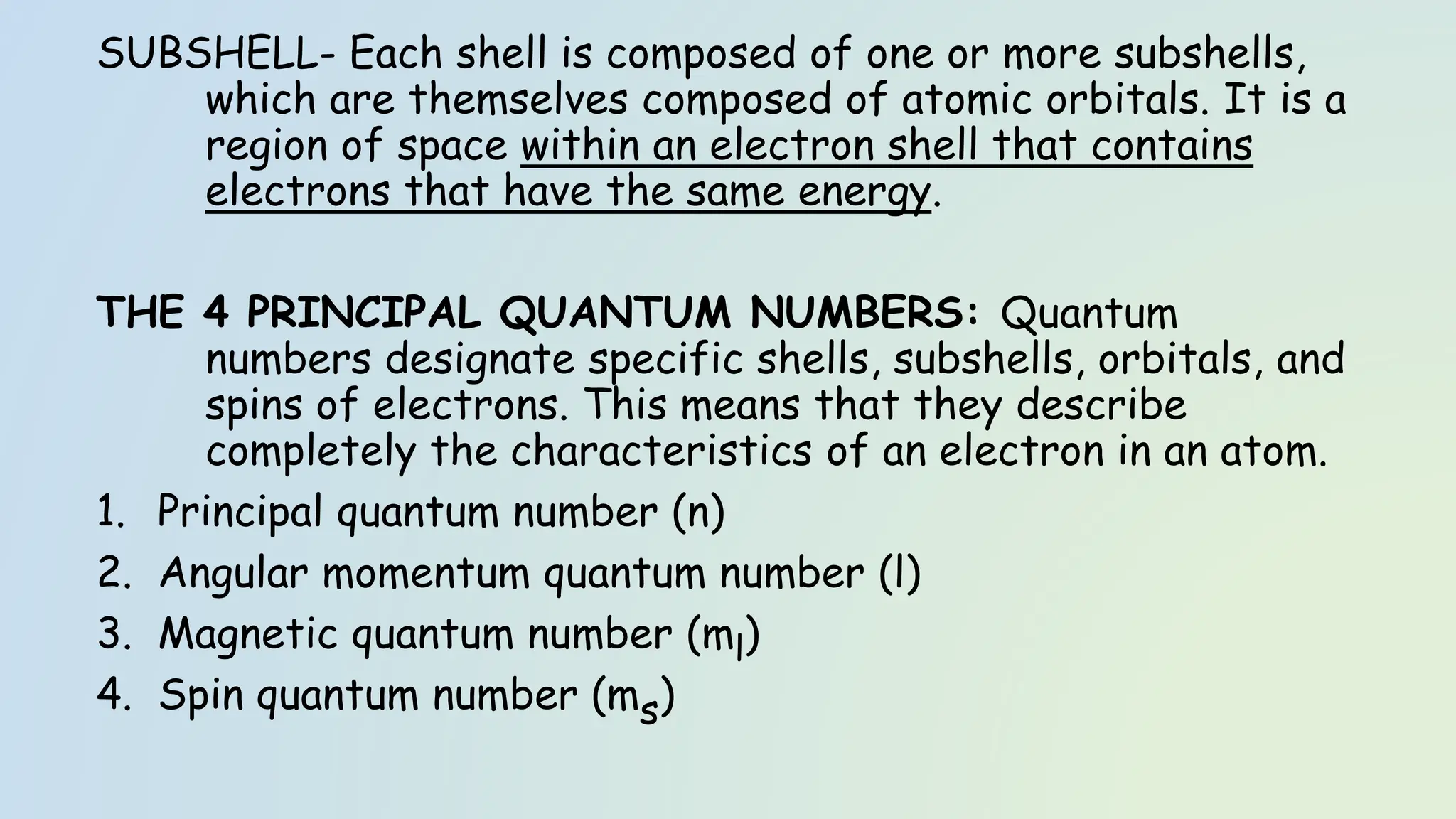
SUBSHELL- Each shell is composed of one or more subshells,
which are themselves composed of atomic orbitals. It is a
region of space within an electron shell that contains
electrons that have the same energy.
THE 4 PRINCIPAL QUANTUM NUMBERS: Quantum
numbers designate specific shells, subshells, orbitals, and
spins of electrons. This means that they describe
completely the characteristics of an electron in an atom.
1. Principal quantum number (n)
2. Angular momentum quantum number (l)
3. Magnetic quantum number (ml)
4. Spin quantum number (ms)
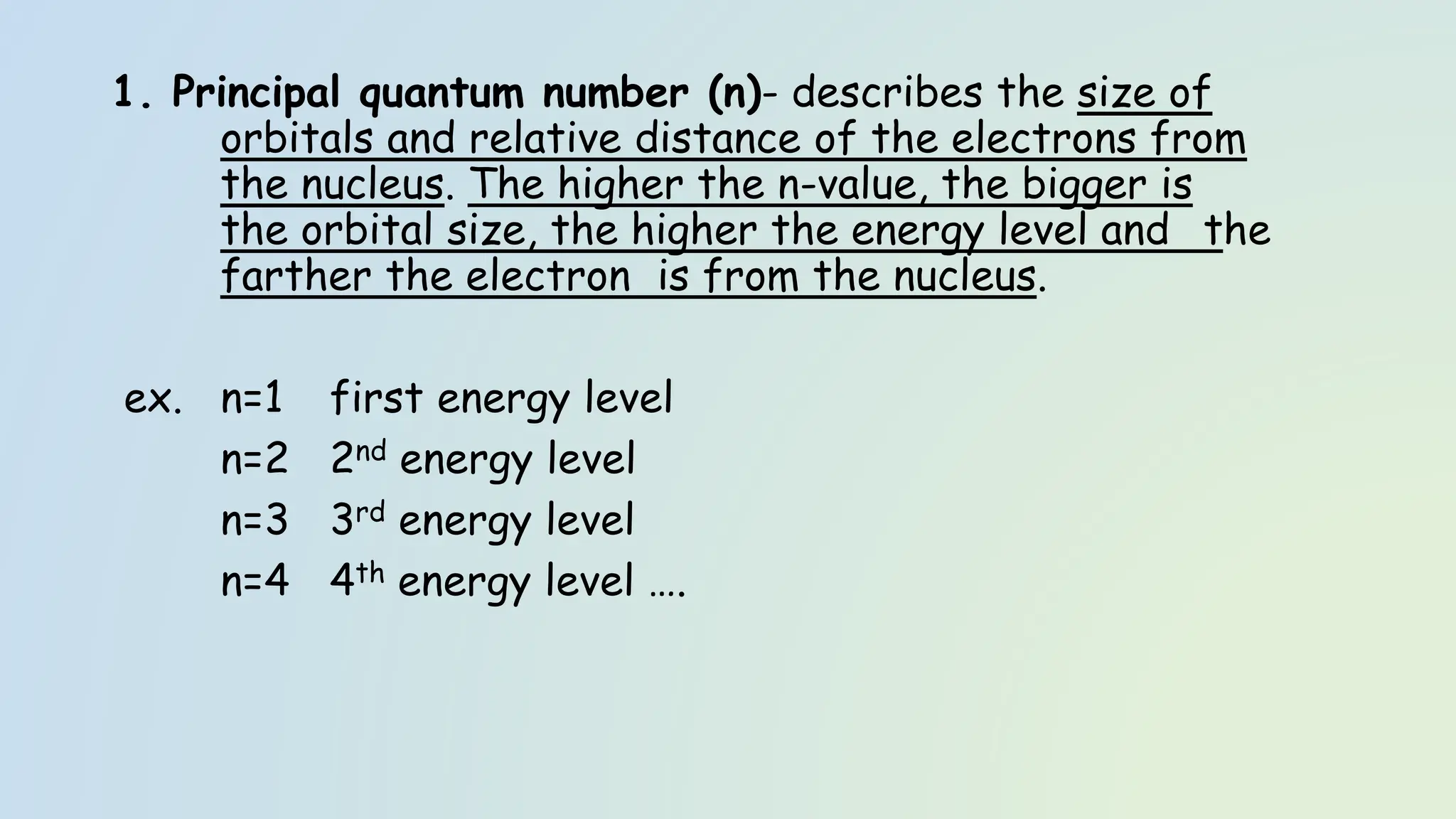
1. Principal quantum number (n)- describes the size of
orbitals and relative distance of the electrons from
the nucleus. The higher the n-value, the bigger is
the orbital size, the higher the energy level and the
farther the electron is from the nucleus.
ex. n=1 first energy level
n=2 2nd energy level
n=3 3rd energy level
n=4 4th energy level ….
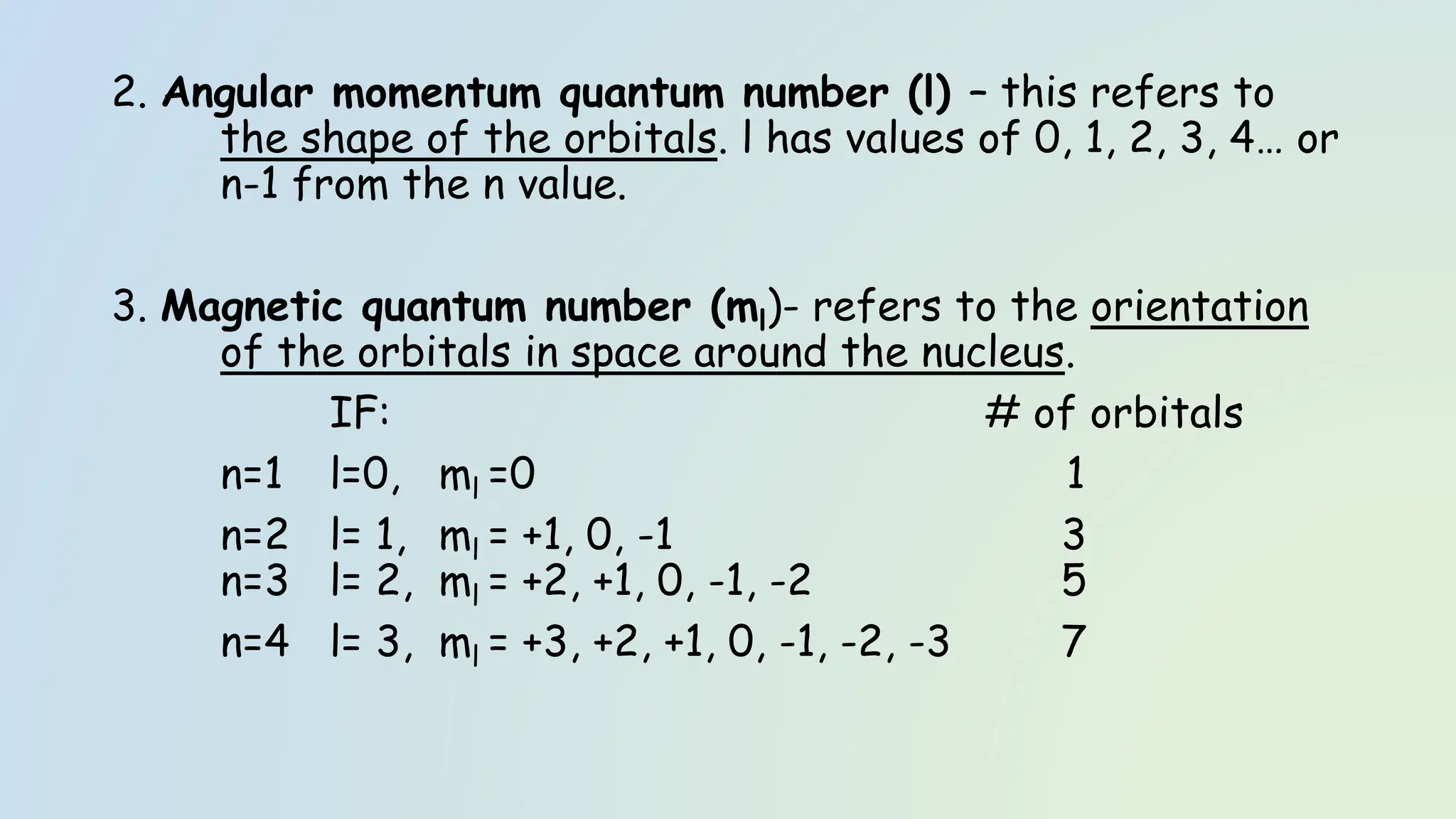
2. Angular momentum quantum number (l) – this refers to
the shape of the orbitals. l has values of 0, 1, 2, 3, 4… or
n-1 from the n value.
3. Magnetic quantum number (ml)- refers to the orientation
of the orbitals in space around the nucleus.
IF: # of orbitals
n=1 l=0, ml =0 1
n=2 l= 1, ml = +1, 0, -1 3
n=3 l= 2, ml = +2, +1, 0, -1, -2 5
n=4 l= 3, ml = +3, +2, +1, 0, -1, -2, -3 7
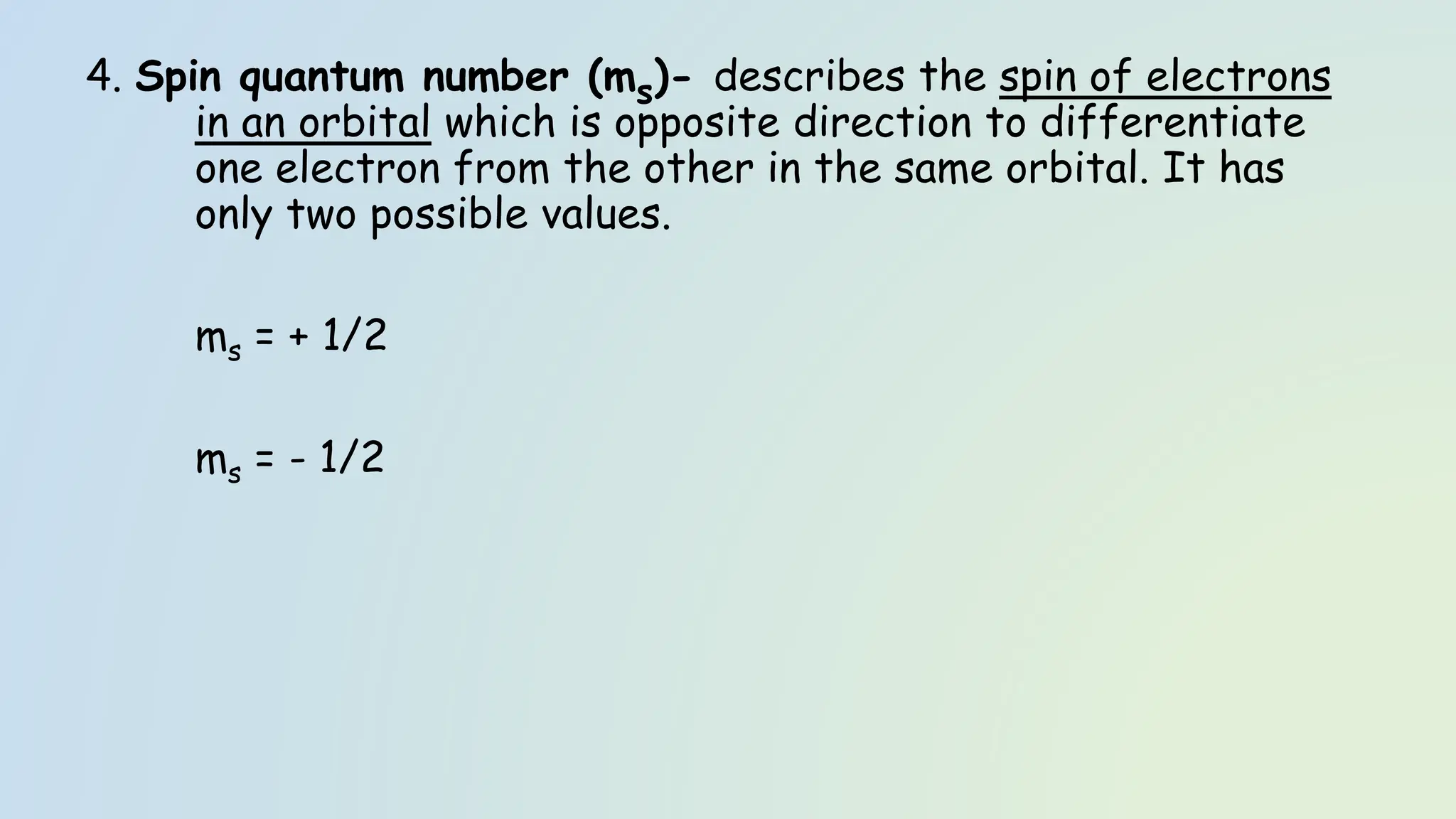
4. Spin quantum number (ms)- describes the spin of electrons
in an orbital which is opposite direction to differentiate
one electron from the other in the same orbital. It has
only two possible values.
ms = + 1/2
ms = - 1/2
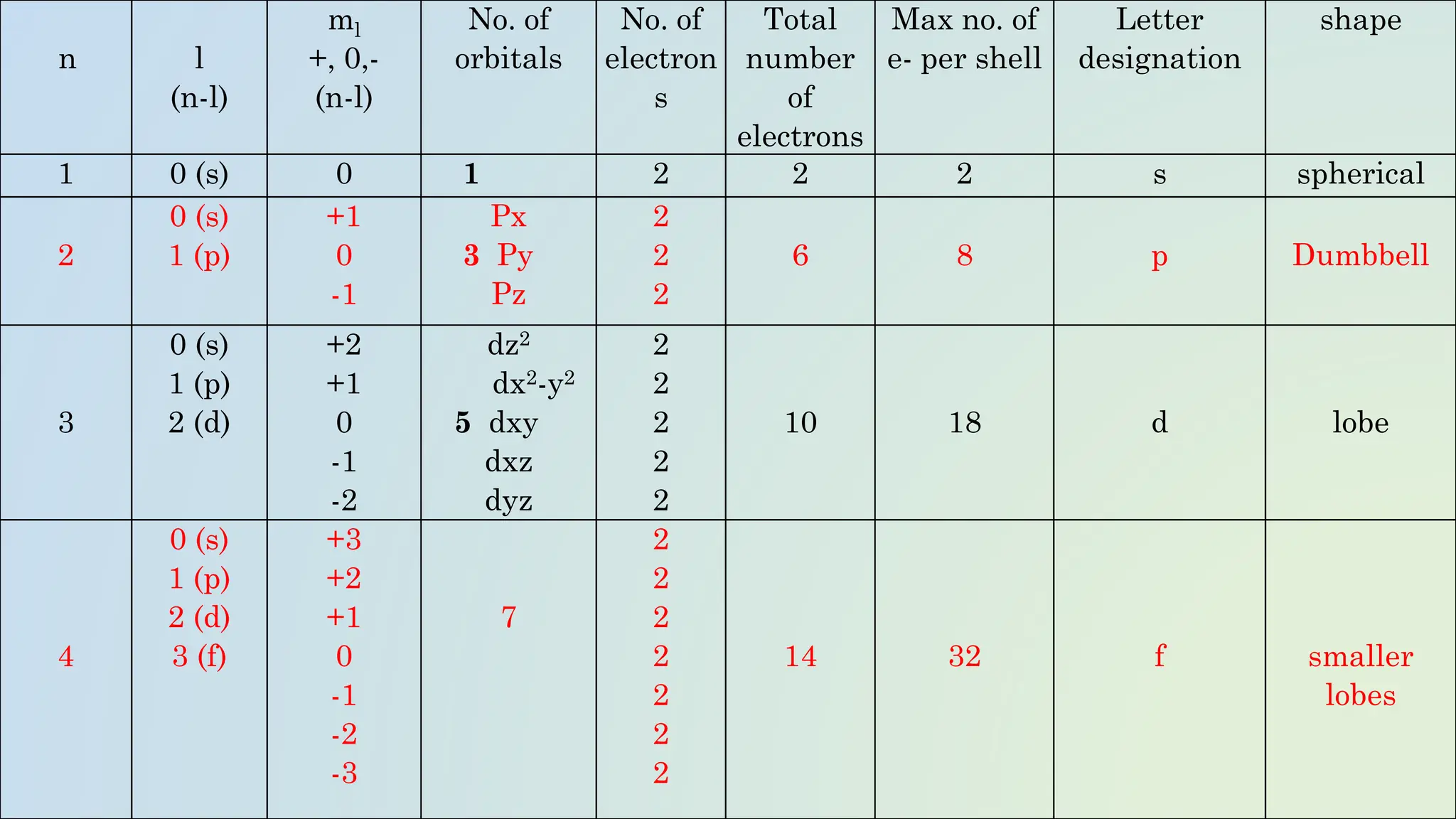
n l
(n-l)
ml
+, 0,-
(n-l)
No. of
orbitals
No. of
electron
s
Total
number
of
electrons
Max no. of
e- per shell
Letter
designation
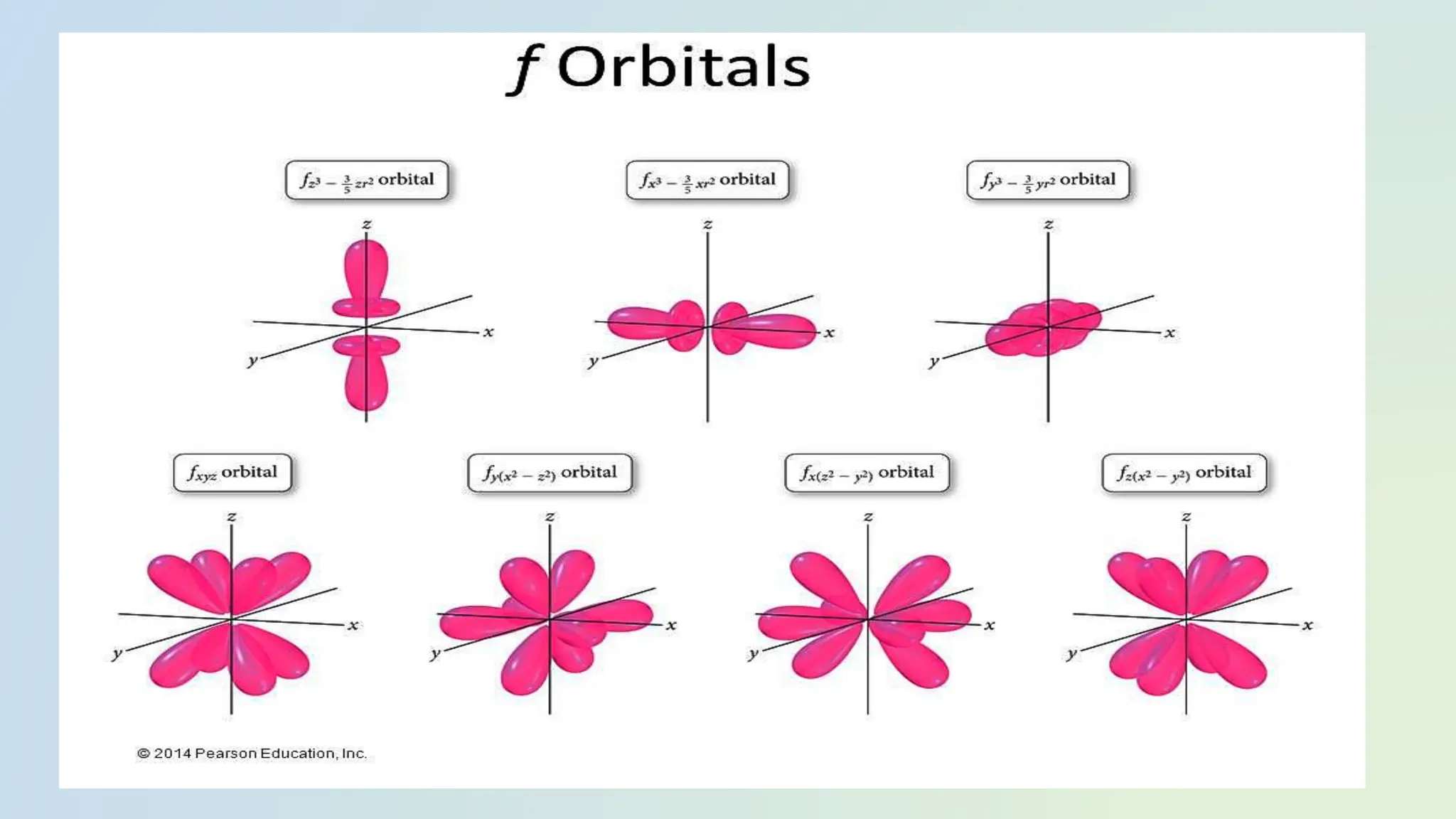
shape
1 0 (s) 0 1 2 2 2 s spherical
2
0 (s)
1 (p)
+1
0
-1
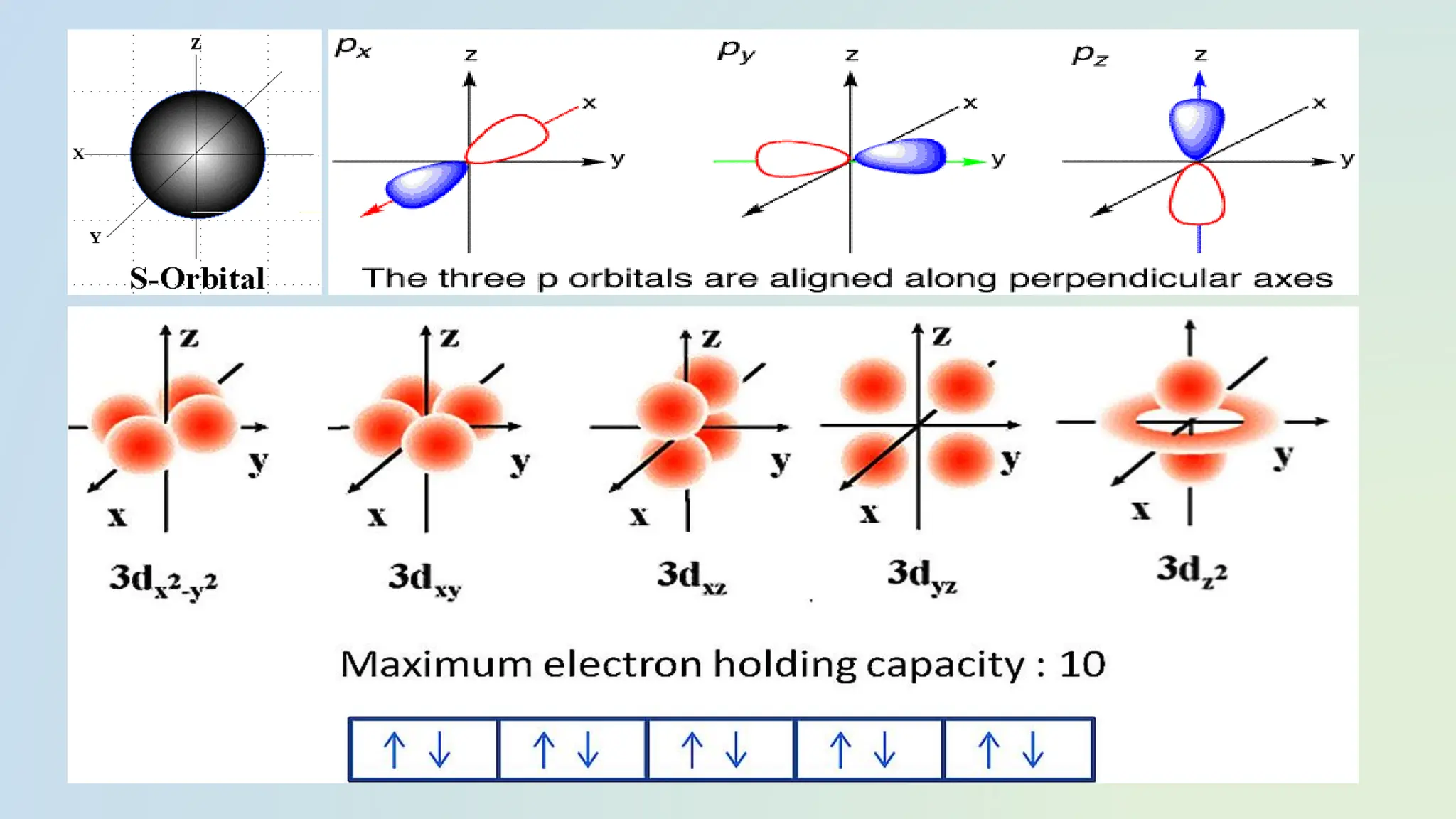
Px
3 Py
Pz
2
2
2
6 8 p Dumbbell
3
0 (s)
1 (p)
2 (d)
+2
+1
0
-1
-2
dz2
dx2-y2
5 dxy
dxz
dyz
2
2
2
2
2
10 18 d lobe
4
0 (s)
1 (p)
2 (d)
3 (f)
+3
+2
+1
0
-1
-2
-3
7
2
2
2
2
2
2
2
14 32 f smaller
lobes
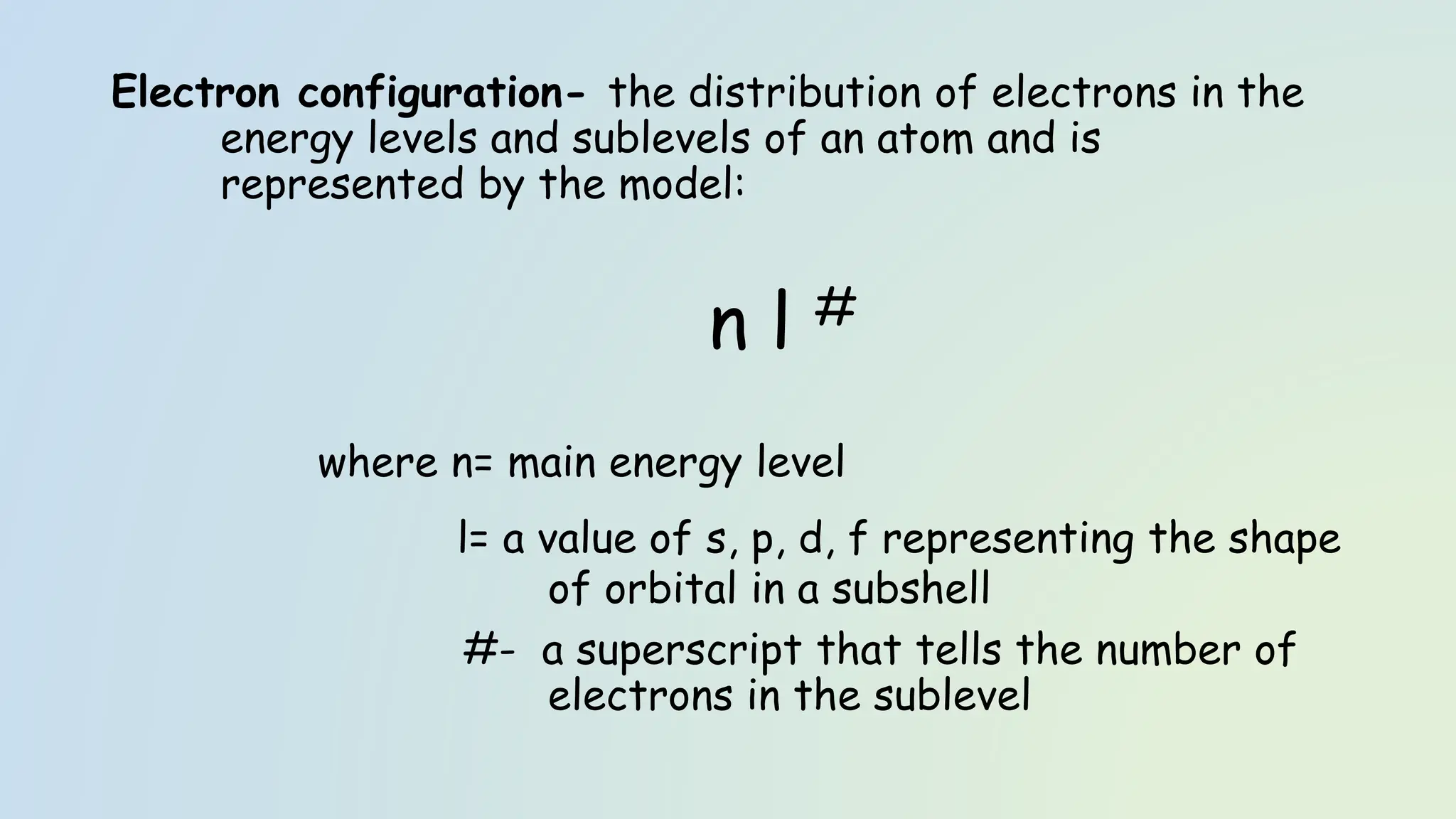
Electron configuration- the distribution of electrons in the
energy levels and sublevels of an atom and is
represented by the model:
n l #
where n= main energy level
l= a value of s, p, d, f representing the shape
of orbital in a subshell
#- a superscript that tells the number of
electrons in the sublevel
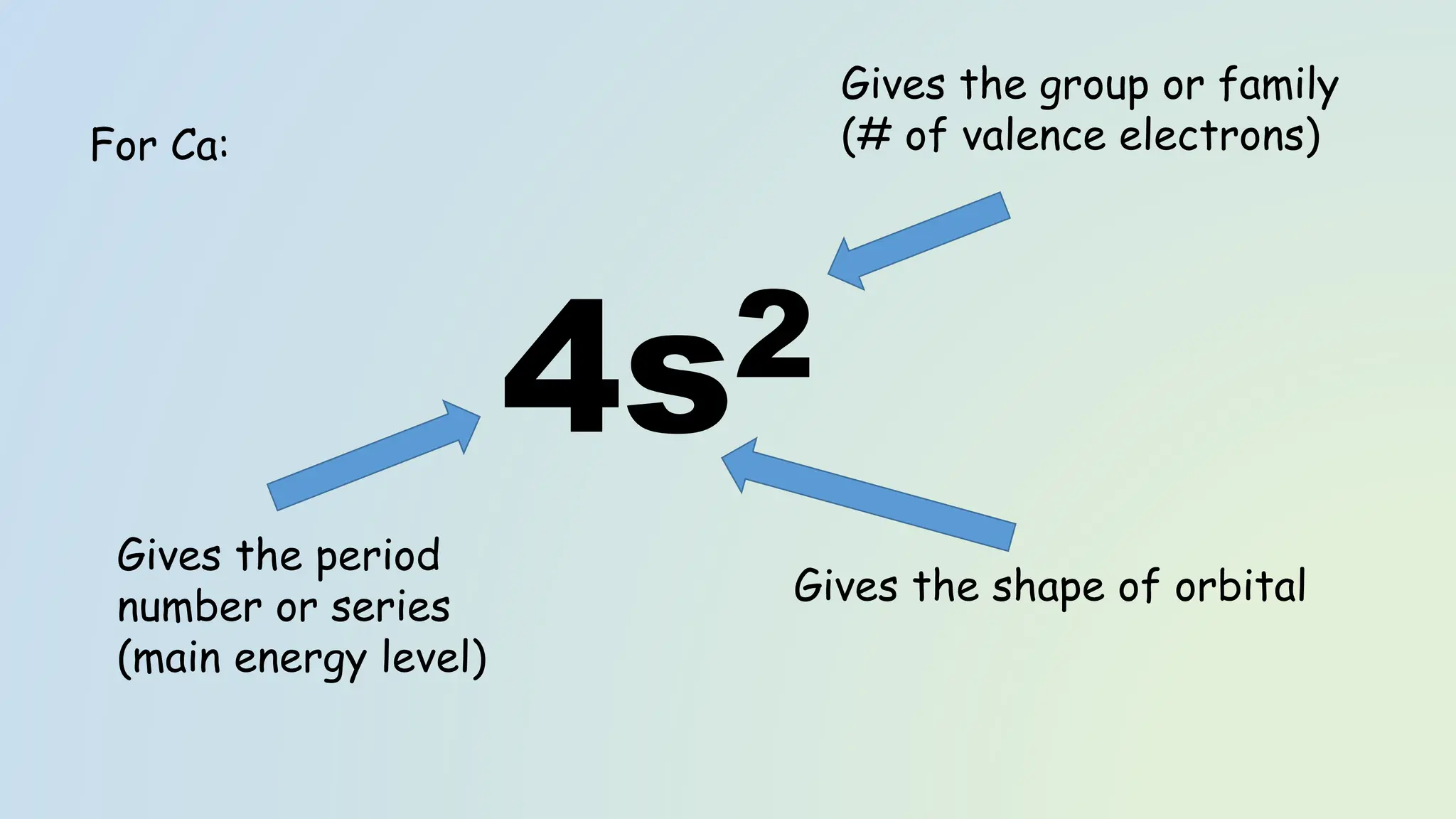
For Ca:
4s2
Gives the group or family
(# of valence electrons)
Gives the period
number or series
(main energy level)
Gives the shape of orbital
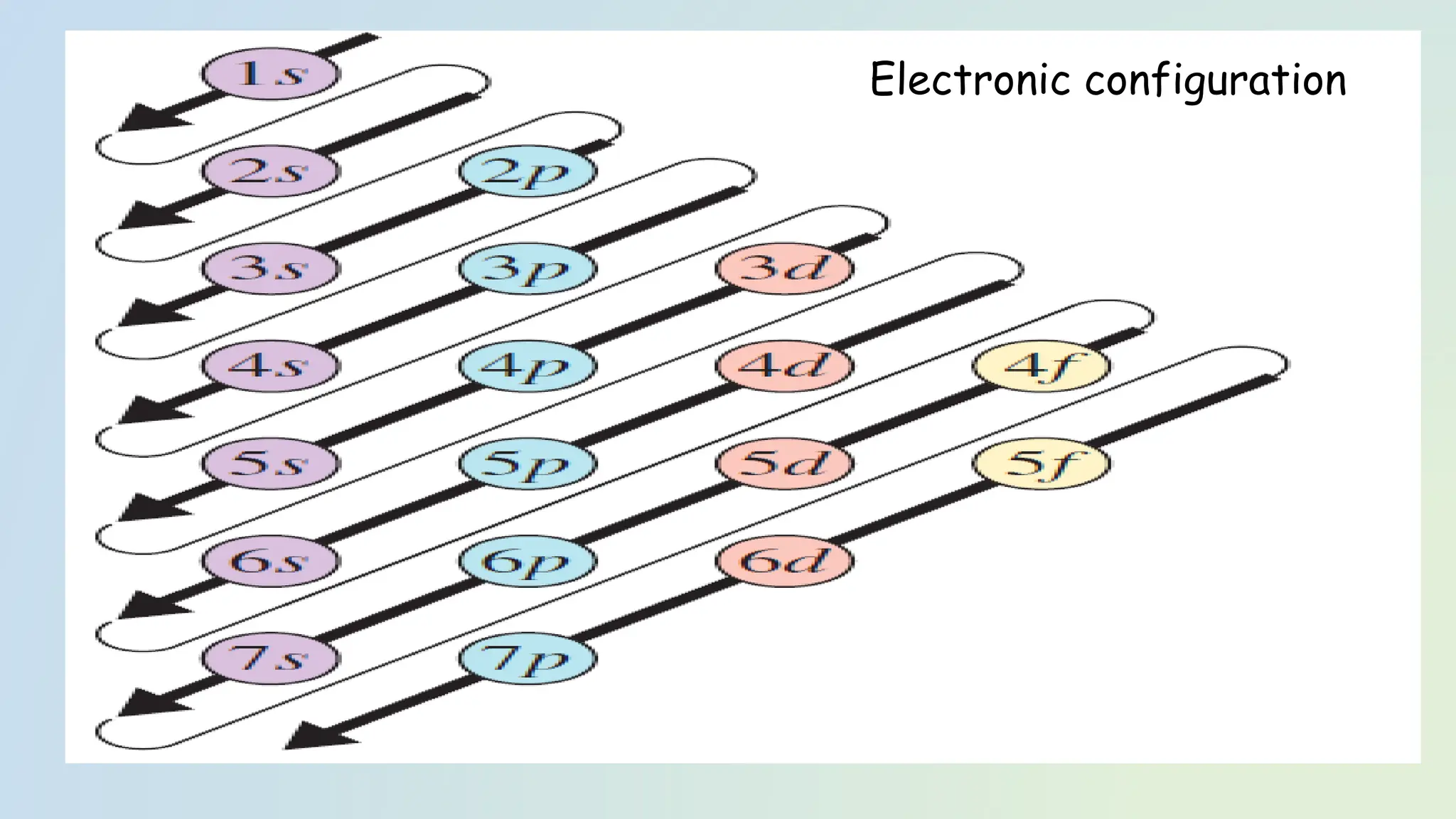
Electronic configuration
RULES in writing electronic configurations:
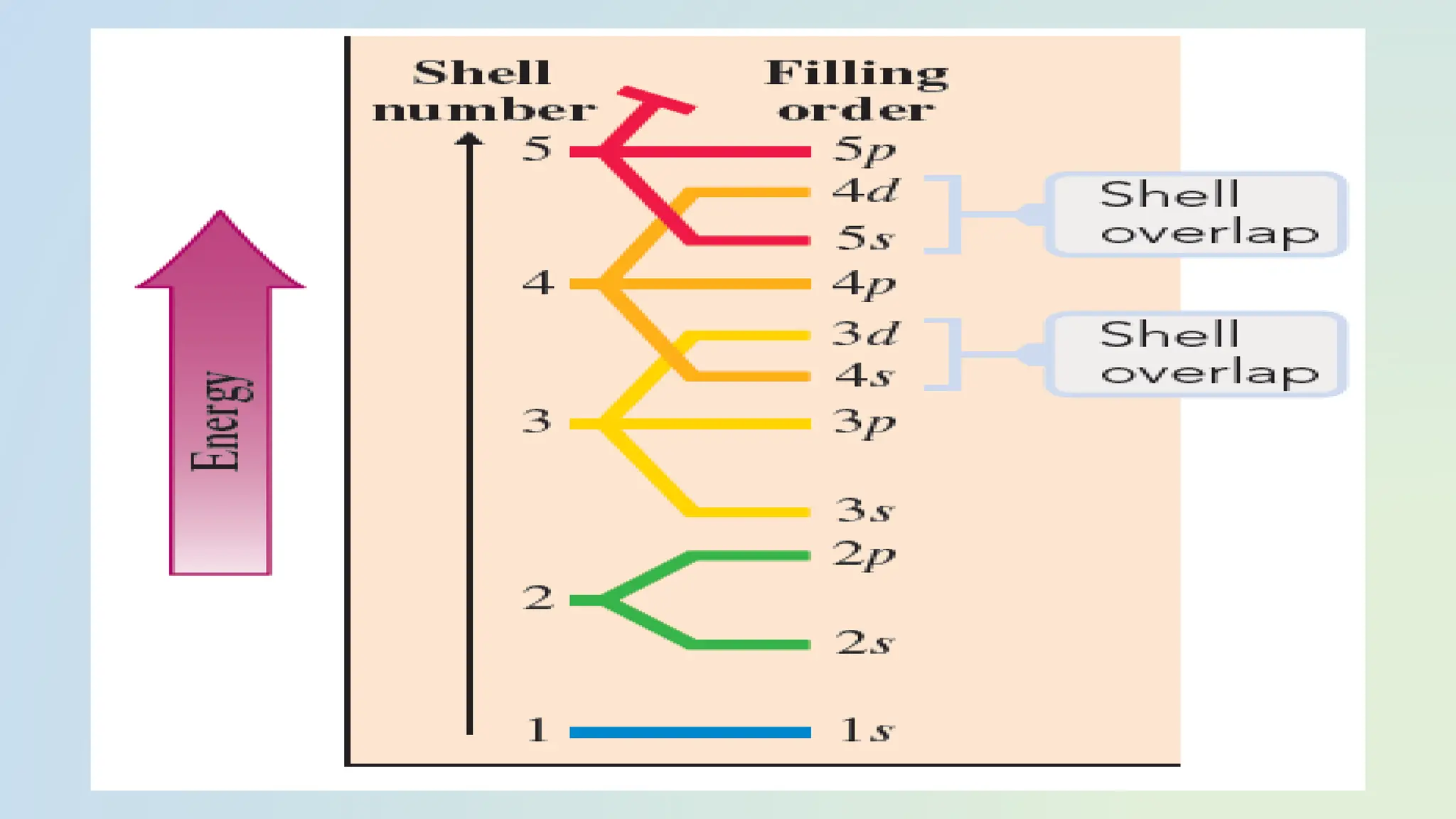
1. Aufbau (building–up) principle: Electrons first occupy the
lowest energy orbitals available to them; only when the
lower-energy orbitals are filled that they enter higher –
energy orbitals.
2. Pauli’s exclusion principle: only two electrons having
opposite spins can occupy an orbital. The third electron
will eventually be repelled.
3. Hund’s rule: electrons distribute singly before pairing.
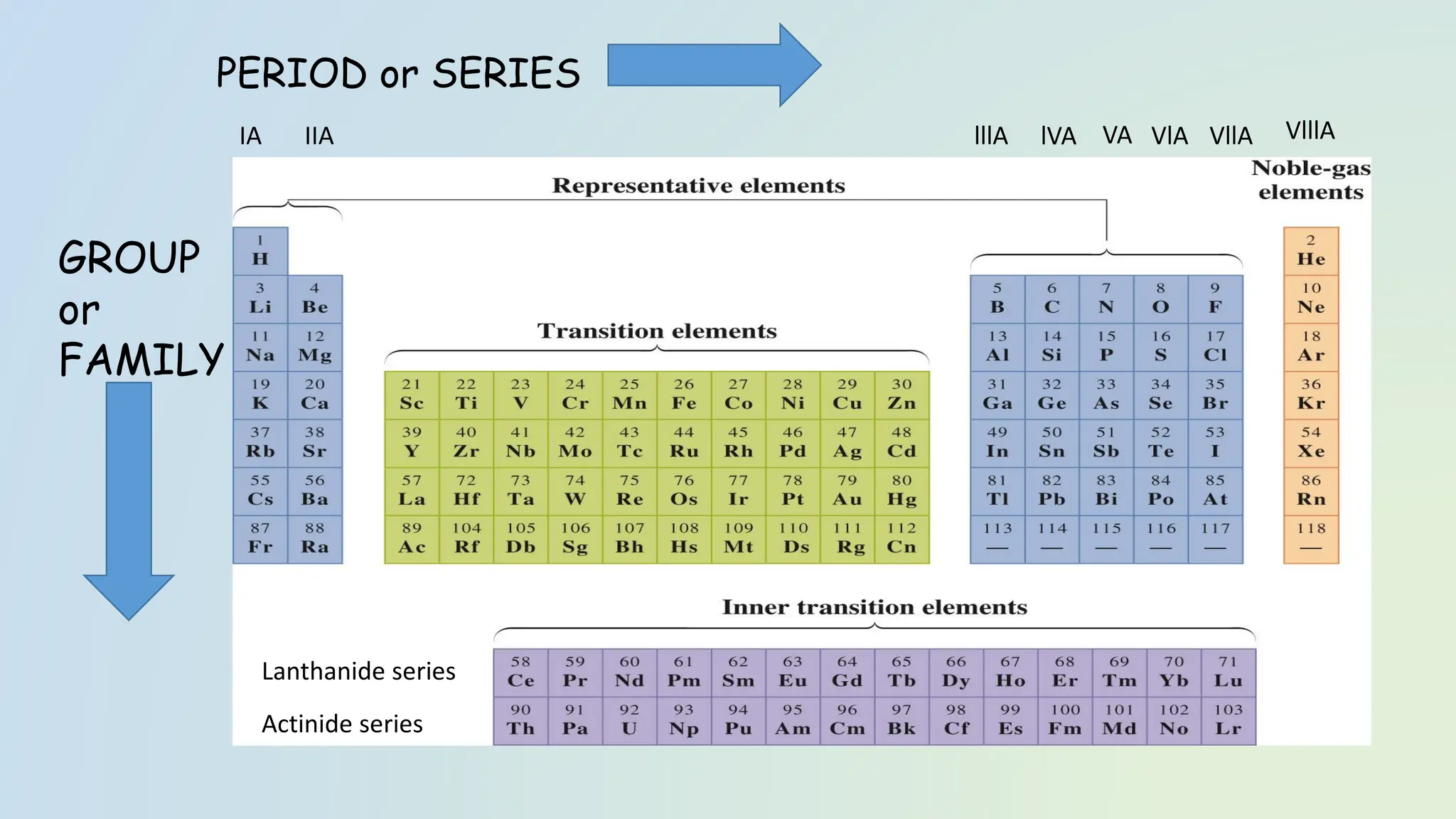
GROUP
or
FAMILY
PERIOD or SERIES
IA VllA
IIA lllA lVA VlA
VA VlllA
Lanthanide series
Actinide series
8.2
ns
1
ns
2
ns
2
np
1
ns
2
np
2
ns
2
np
3
ns
2
np
4
ns
2
np
5
ns
2
np
6
d
1
d
5
d
10
4f
5f
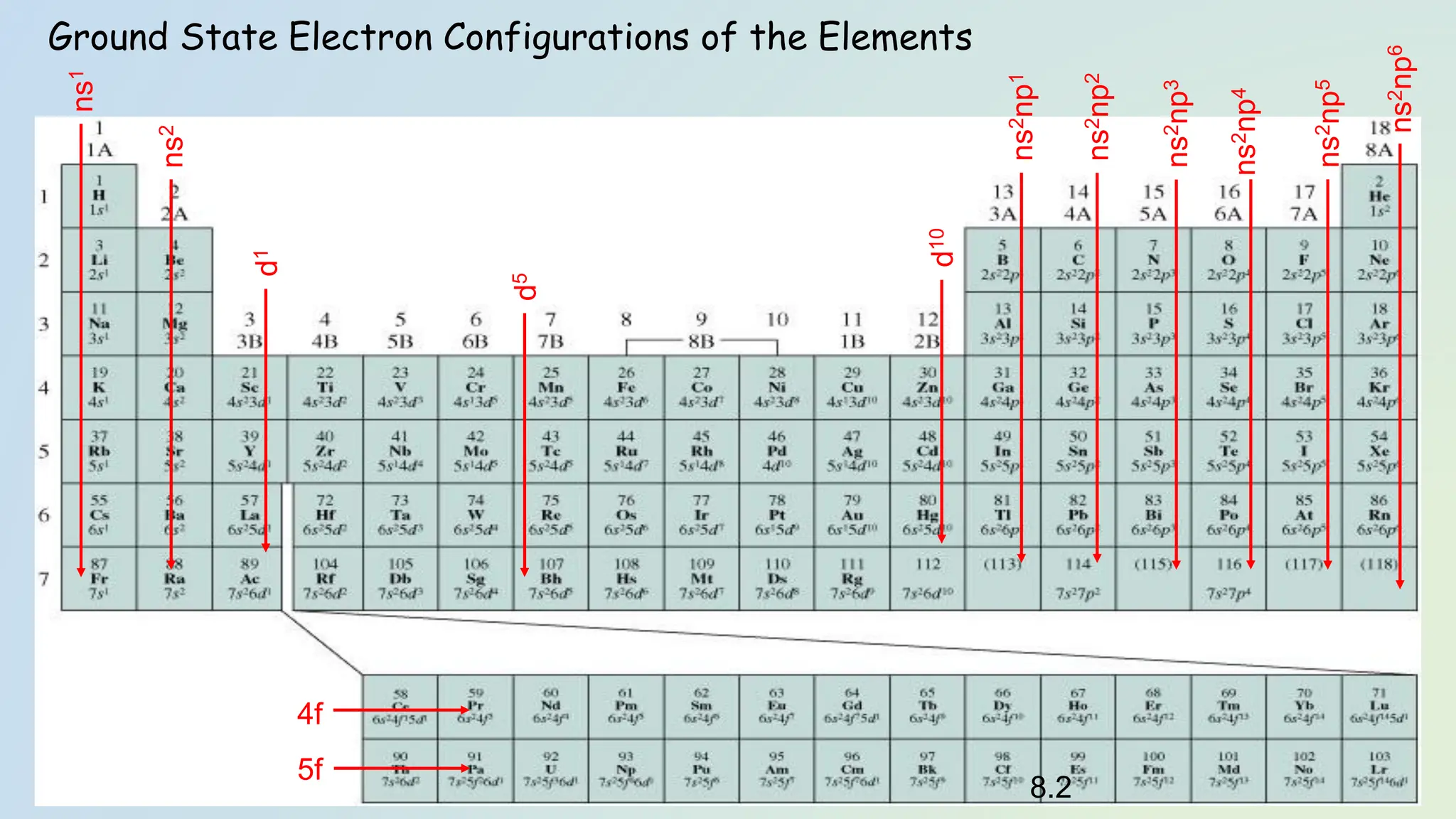
Ground State Electron Configurations of the Elements
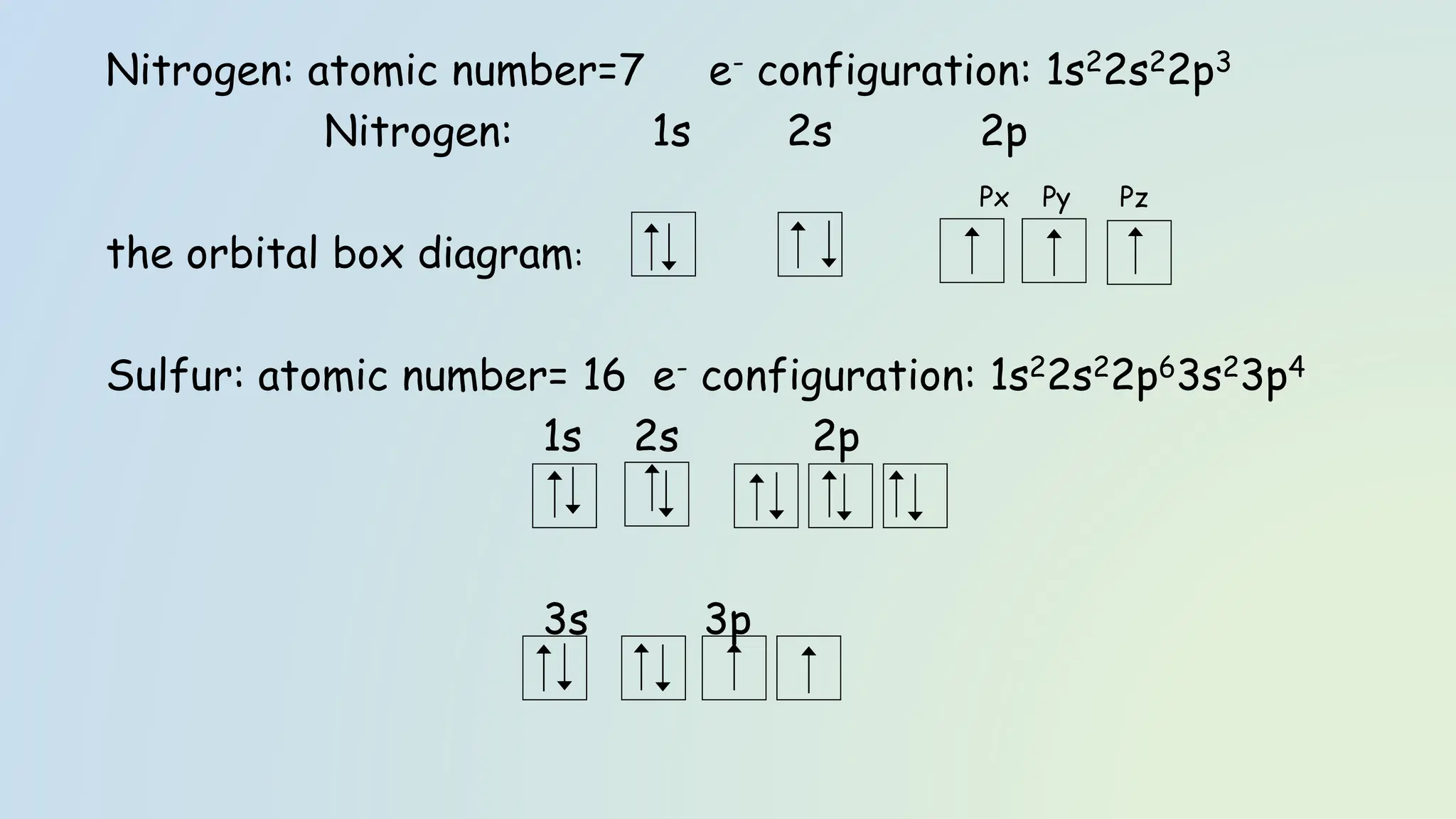
Nitrogen: atomic number=7 e- configuration: 1s22s22p3
Nitrogen: 1s 2s 2p
Px Py Pz
the orbital box diagram:
Sulfur: atomic number= 16 e- configuration: 1s22s22p63s23p4
1s 2s 2p
3s 3p
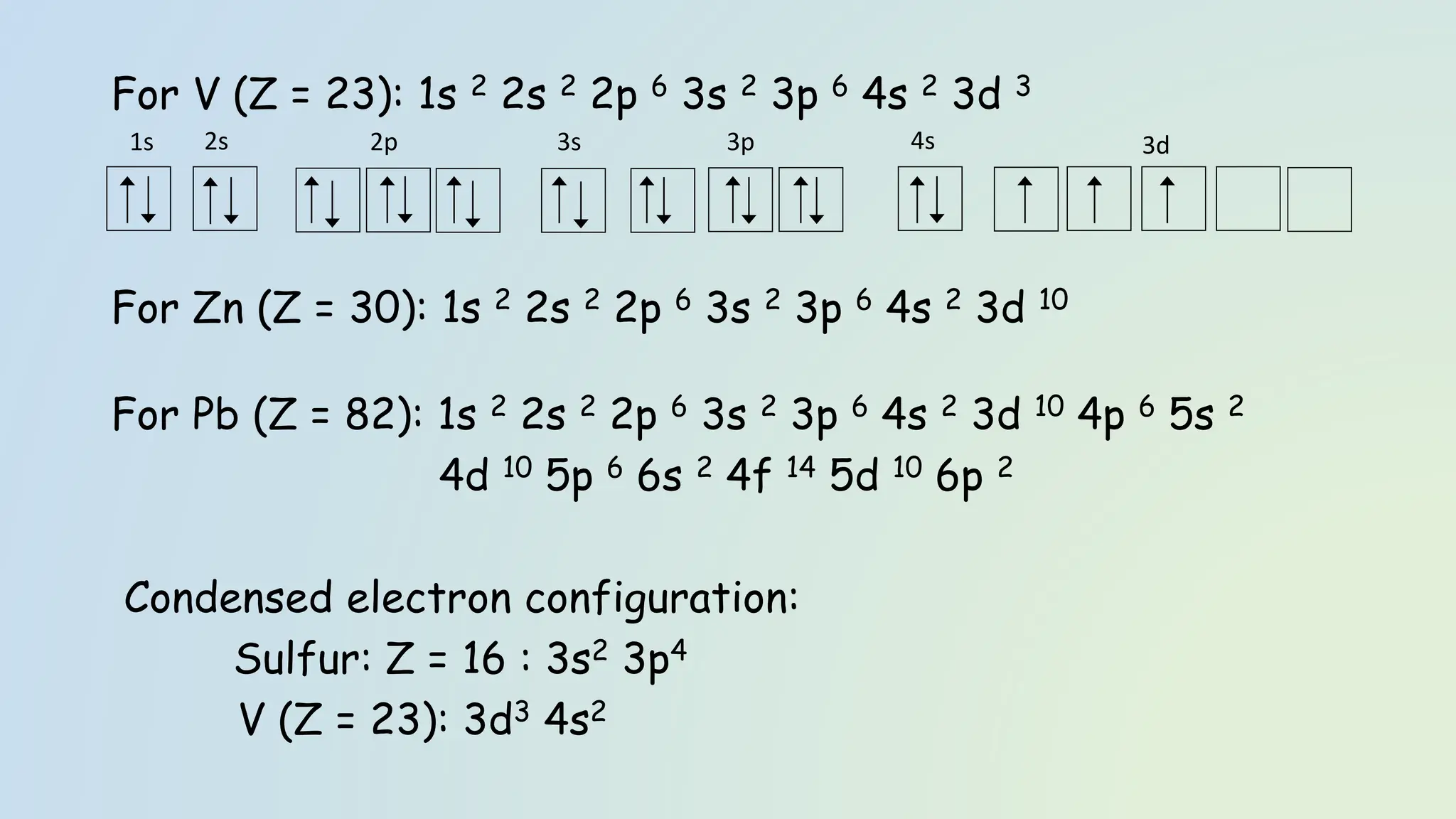
For V (Z = 23): 1s 2 2s 2 2p 6 3s 2 3p 6 4s 2 3d 3
For Zn (Z = 30): 1s 2 2s 2 2p 6 3s 2 3p 6 4s 2 3d 10
For Pb (Z = 82): 1s 2 2s 2 2p 6 3s 2 3p 6 4s 2 3d 10 4p 6 5s 2
4d 10 5p 6 6s 2 4f 14 5d 10 6p 2
Condensed electron configuration:
Sulfur: Z = 16 : 3s2 3p4
V (Z = 23): 3d3 4s2
1s 3d
2s 2p 3s 3p 4s
Electron configuration of noble gases: these gases have
complete e- configuration of ns2np6 except for He
making them difficult to either gain or loss electrons.
Noble gas configuration:
Sulfur: Z = 16 : [Ne] 3s2 3p4
V (Z = 23): [Ar] 3d3 4s2
Zn (Z = 30): [Ar] 3d10 4s2
Pb (Z = 82): [Xe] 6s2 6p2
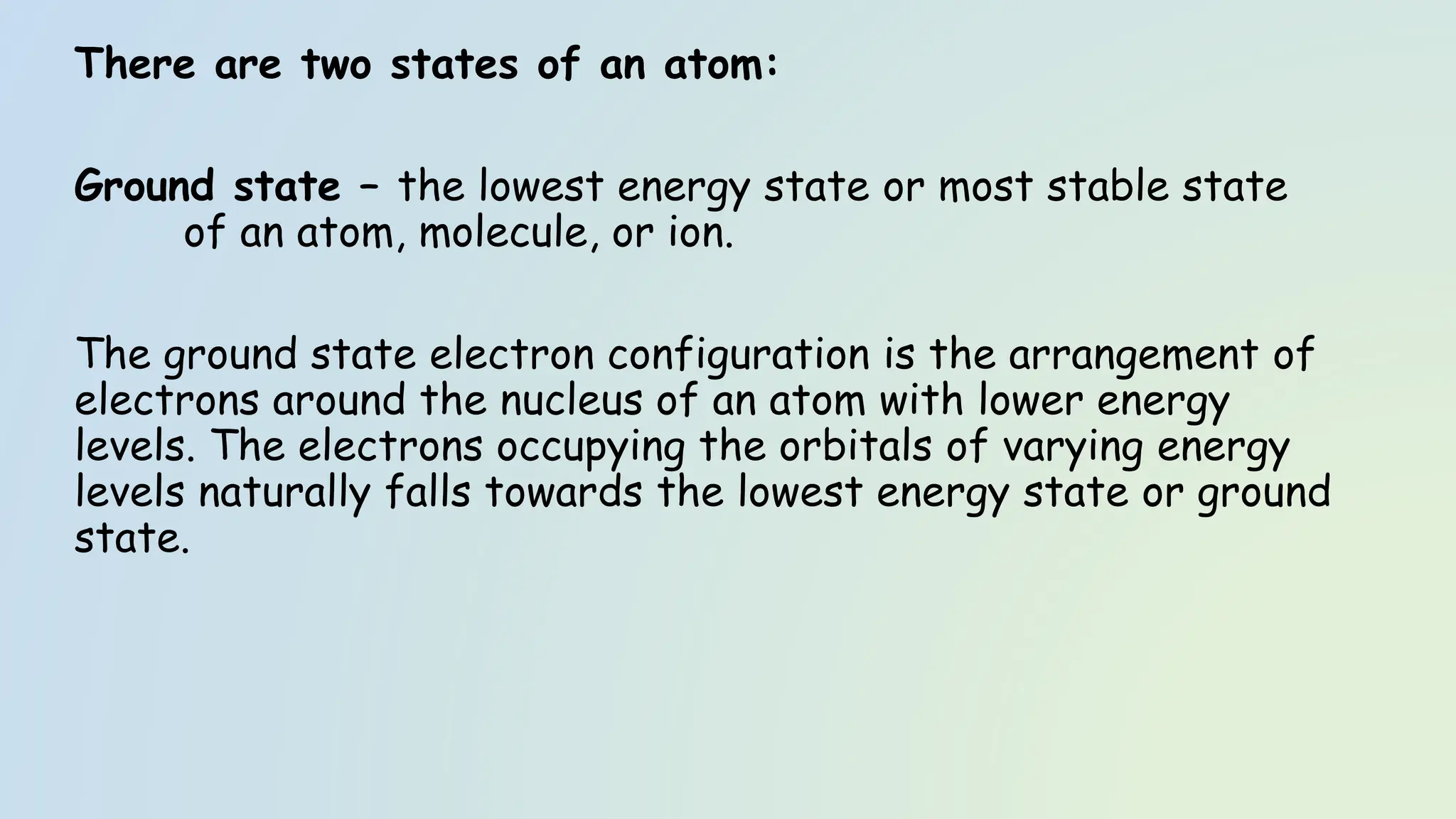
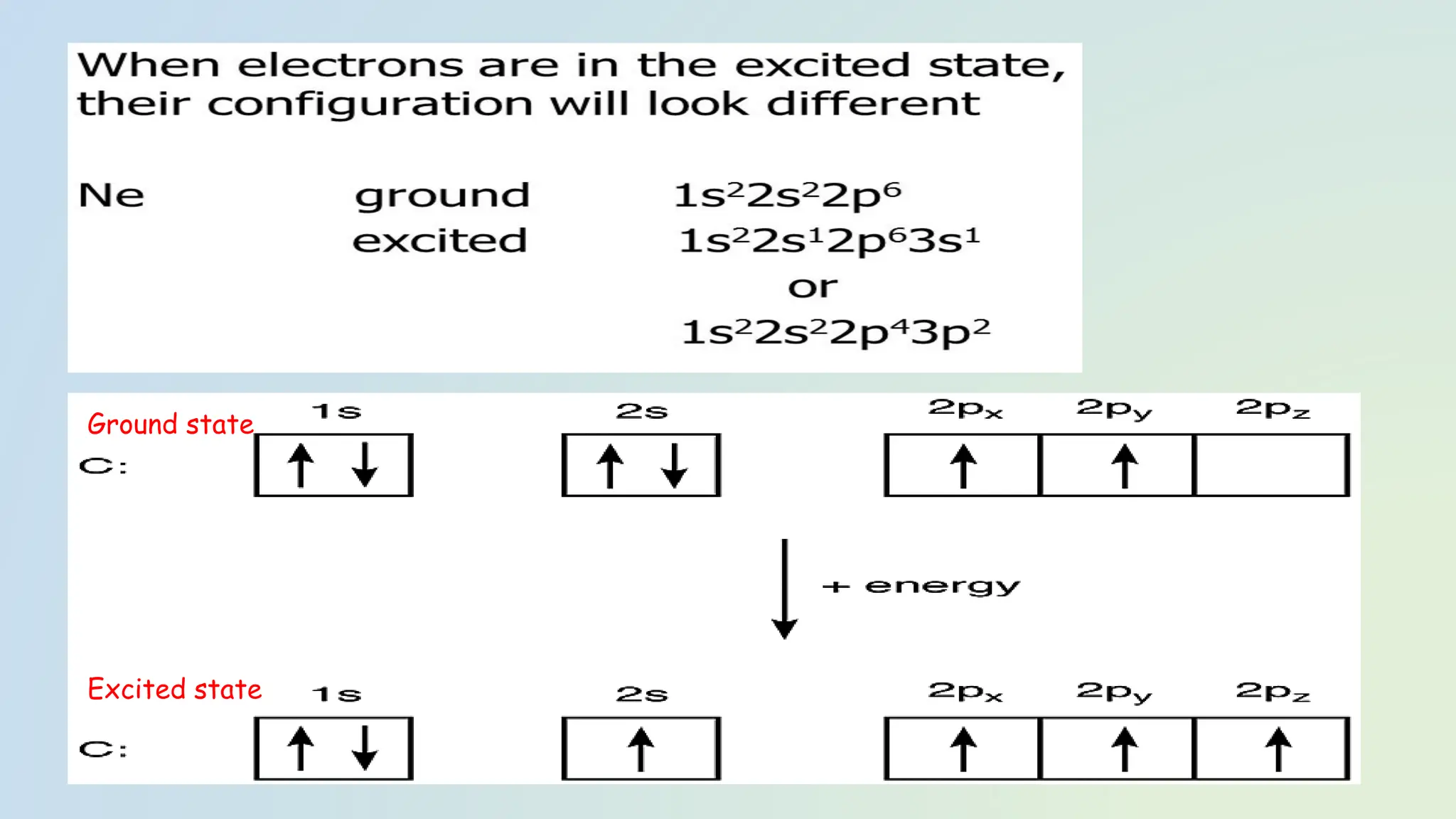
There are two states of an atom:
Ground state – the lowest energy state or most stable state
of an atom, molecule, or ion.
The ground state electron configuration is the arrangement of
electrons around the nucleus of an atom with lower energy
levels. The electrons occupying the orbitals of varying energy
levels naturally falls towards the lowest energy state or ground
state.
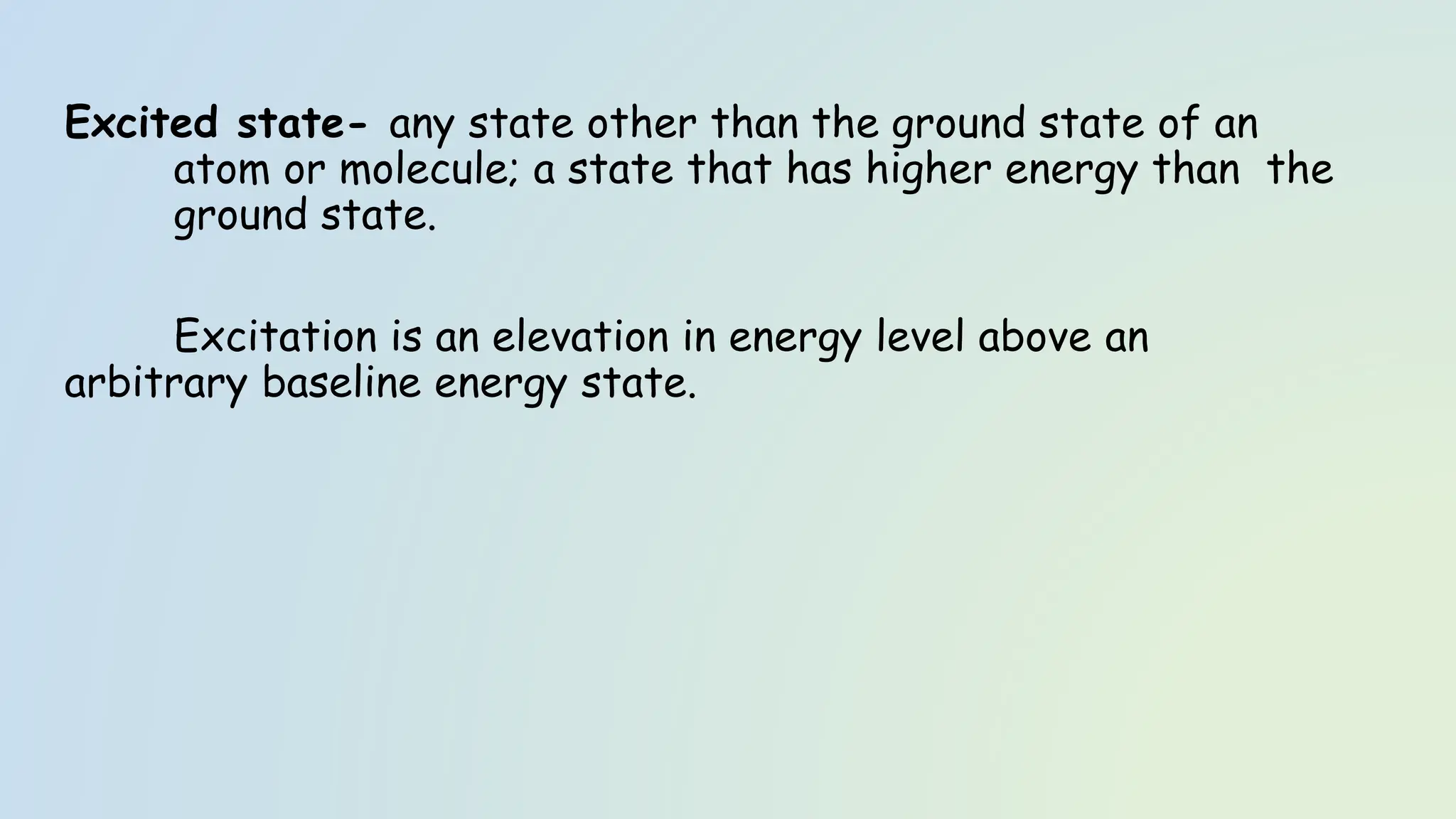
Excited state- any state other than the ground state of an
atom or molecule; a state that has higher energy than the
ground state.
Excitation is an elevation in energy level above an
arbitrary baseline energy state.
Ground state
Excited state
Chemical bond- the electrostatic force which holds the atoms in a
compound or molecule. This results from the gain and loss of
electrons, or from the sharing of electrons between atoms.
Valence is the ability of an atom to form bonds. The valence of an element
is determined by the number of electrons in the outermost level of
the atom.
In bond formation, it generally follows the Octet Rule.
The octet rule states that atoms are most stable when they
have a full shell of electrons in the outside electron shell.
➢ The first shell has only two electrons in a single s subshell.
➢ Helium has a full shell, so it is stable, an inert element.
➢ All the other shells have an s and a p subshell, giving them
at least eight electrons on the outside. The s and p subshells
often are the only valence electrons, thus the octet rule is
named for the eight s and p electrons.
➢ When atoms combine, they revert to the noble gas
configuration which has eight electrons in the outermost
shell.
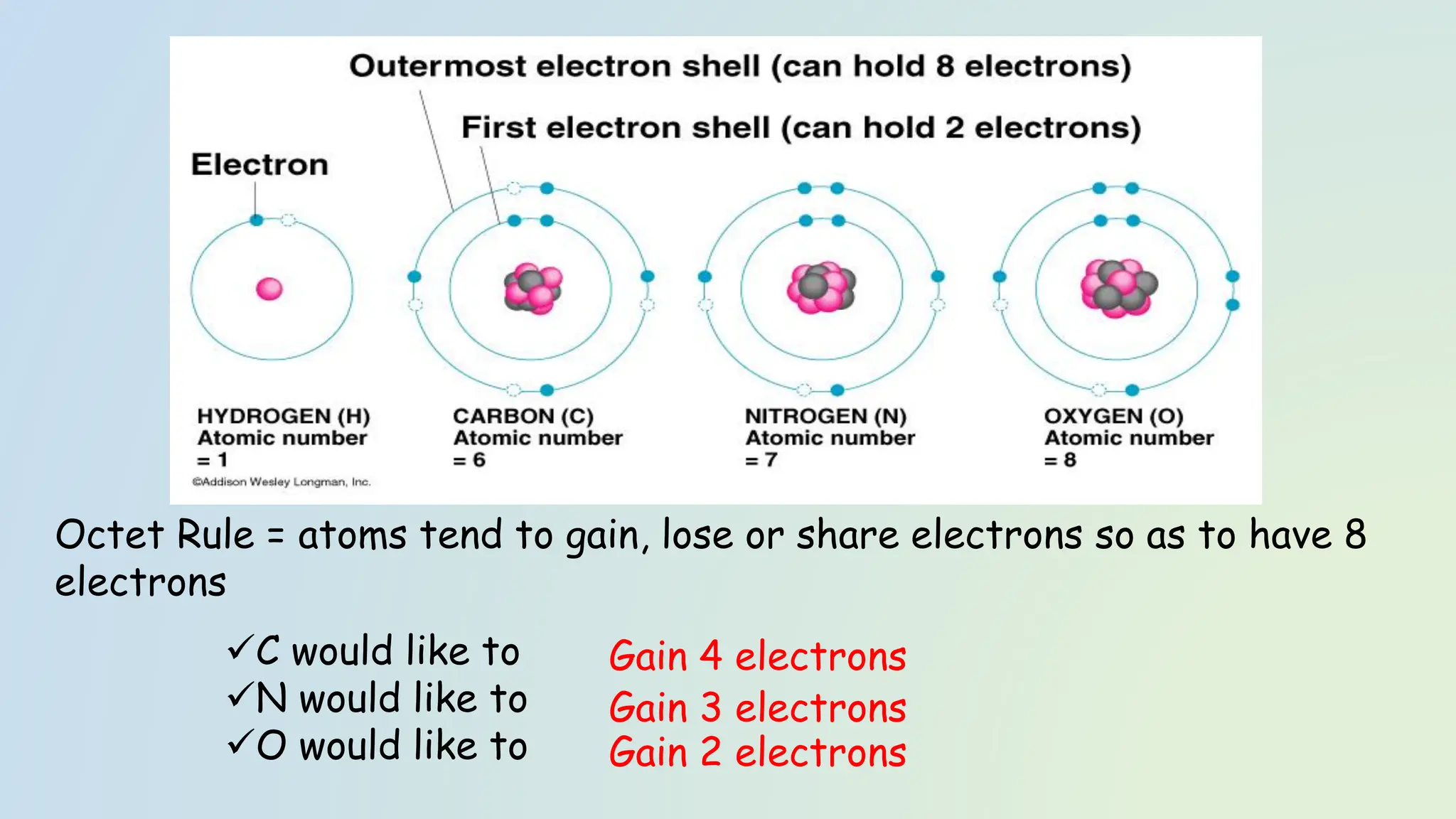
Octet Rule = atoms tend to gain, lose or share electrons so as to have 8
electrons
✓C would like to
✓N would like to
✓O would like to
Gain 4 electrons
Gain 3 electrons
Gain 2 electrons
The properties of a substance can be explained in terms of the
nature of the bonds holding the atoms together.
There are two general types of chemical bonds.
1. ionic or electrovalent
2. covalent bonds.
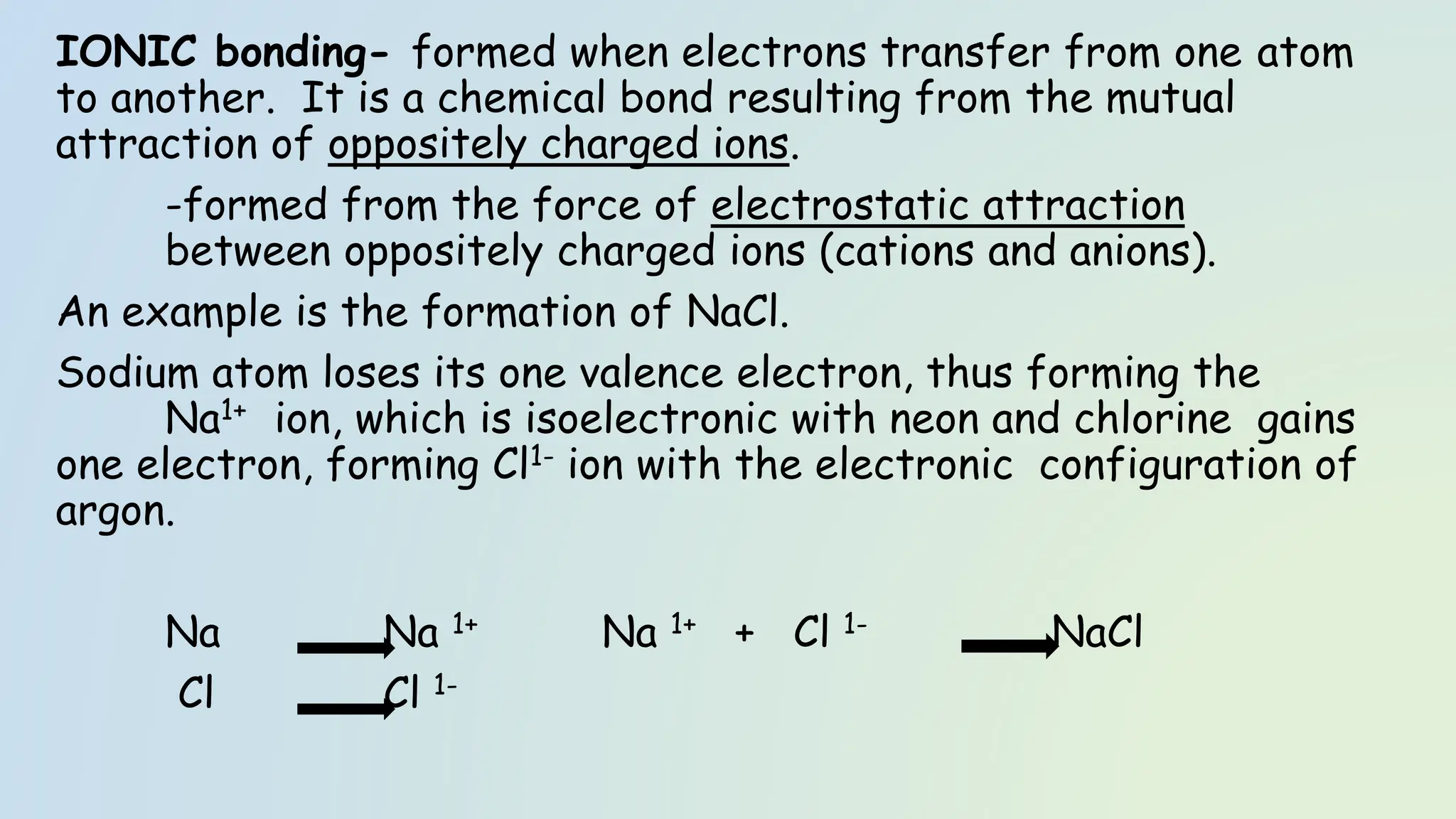
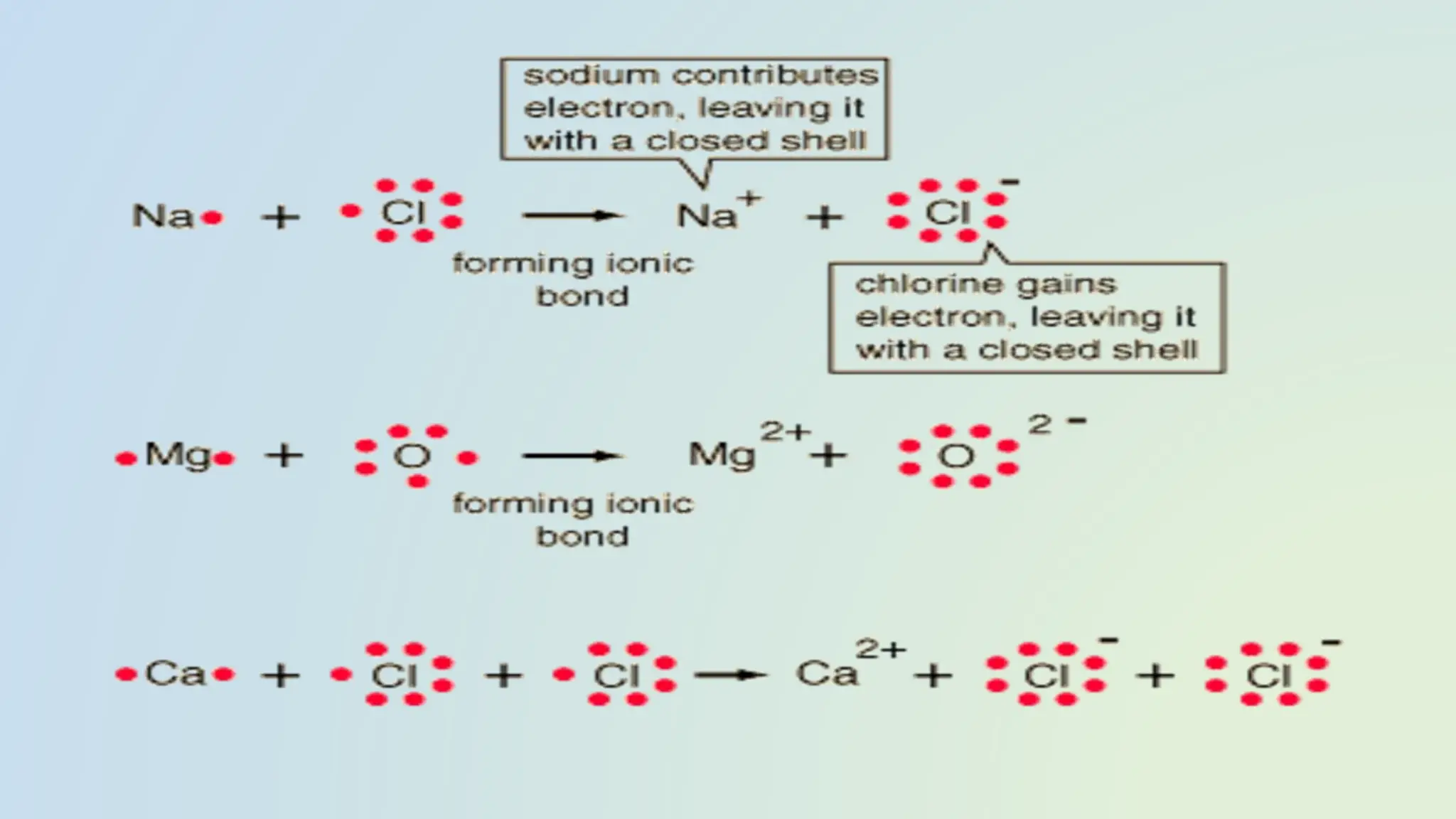
IONIC bonding- formed when electrons transfer from one atom
to another. It is a chemical bond resulting from the mutual
attraction of oppositely charged ions.
-formed from the force of electrostatic attraction
between oppositely charged ions (cations and anions).
An example is the formation of NaCl.
Sodium atom loses its one valence electron, thus forming the
Na1+ ion, which is isoelectronic with neon and chlorine gains
one electron, forming Cl1- ion with the electronic configuration of
argon.
Na Na 1+ Na 1+ + Cl 1- NaCl
Cl Cl 1-
An ion is an electrically charged atom of an element or group of
atoms that carries an electrical charge.
Cation is a positively charged atom of an element. It is formed
when an atom loses electron (s).
Anion is a negatively charged atom of an element. It is
produced when an atom gains electron(s).
➢ the elements most likely to form cations in ionic compounds
are the Group IA and Group IIA, and the elements most
likely to form anions are the halogens (Group VIIA).
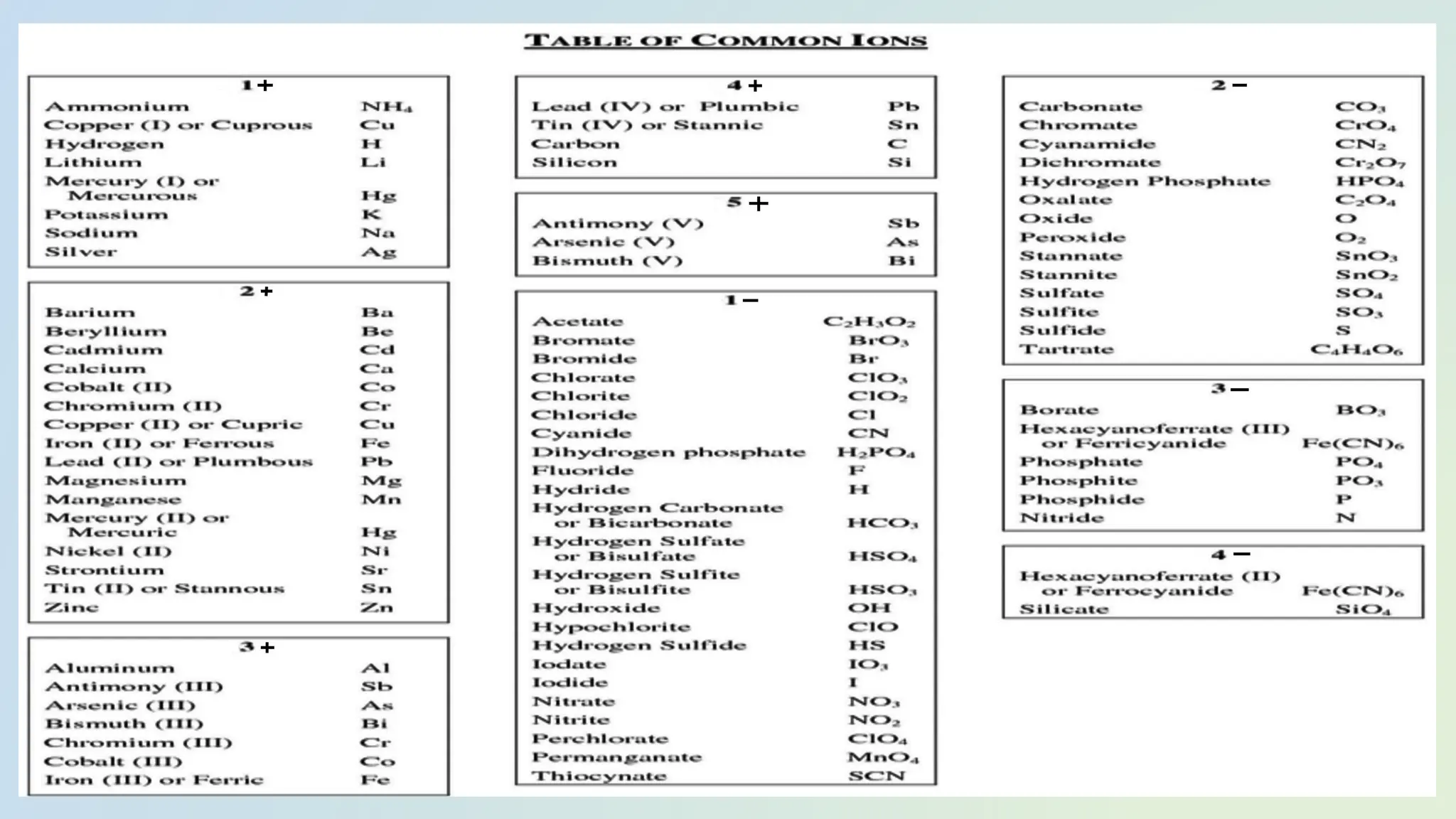
Examples of monoatomic ions: Cl1-, K1+, Fe2+, Bi5+
Examples of polyatomic ions: NO2
1-, CO3
2-, PO4
3-
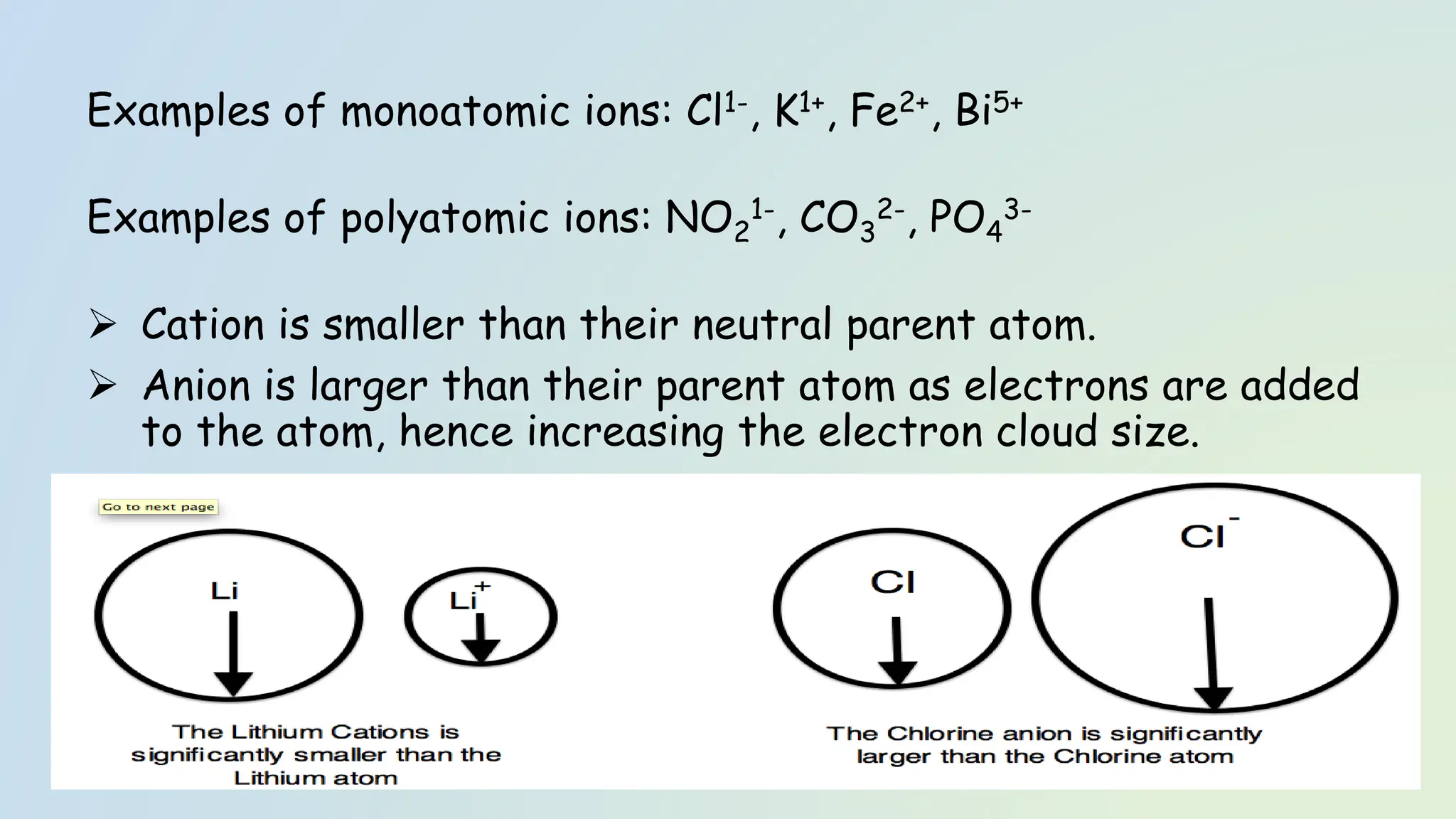
➢ Cation is smaller than their neutral parent atom.
➢ Anion is larger than their parent atom as electrons are added
to the atom, hence increasing the electron cloud size.
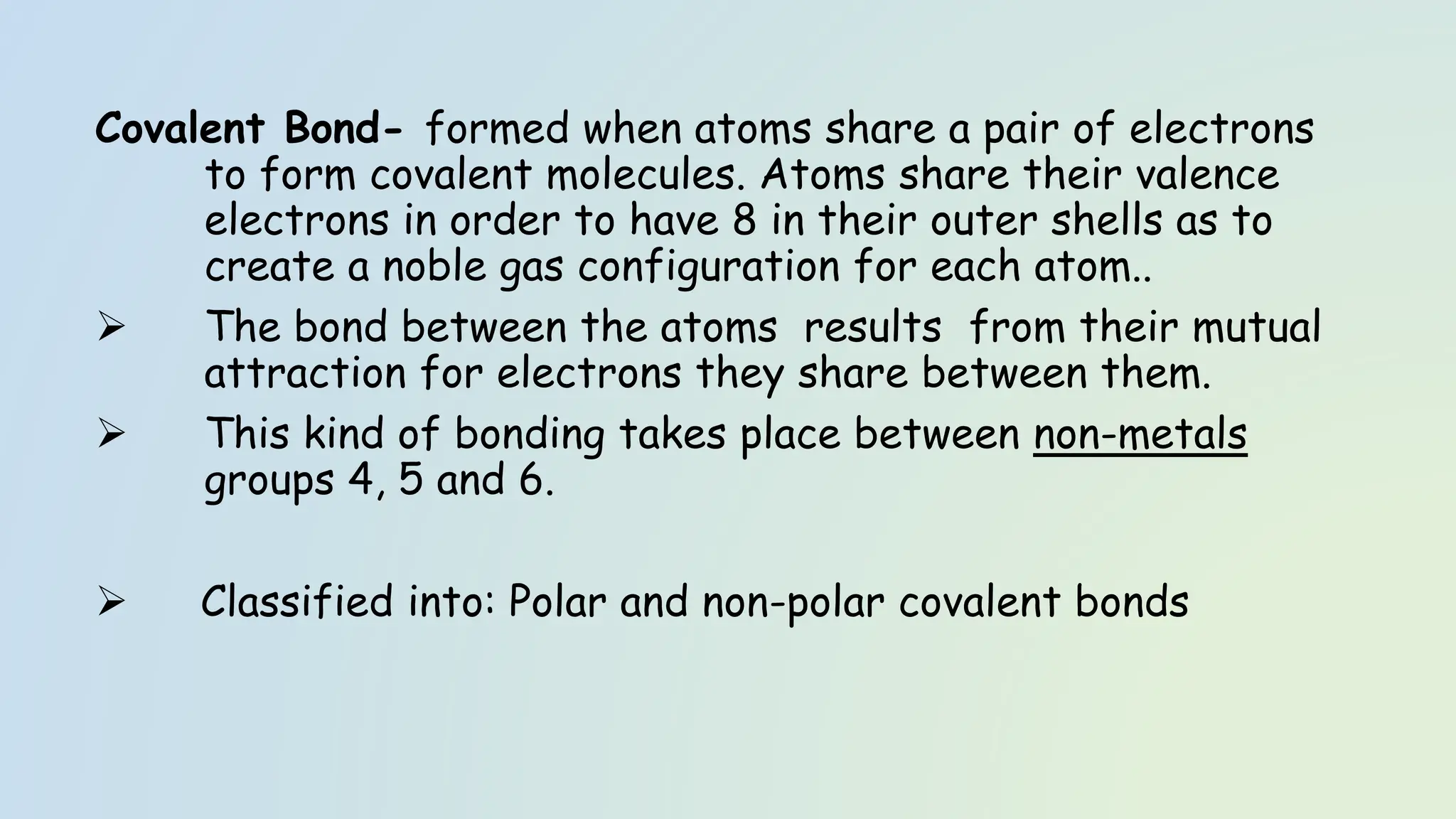
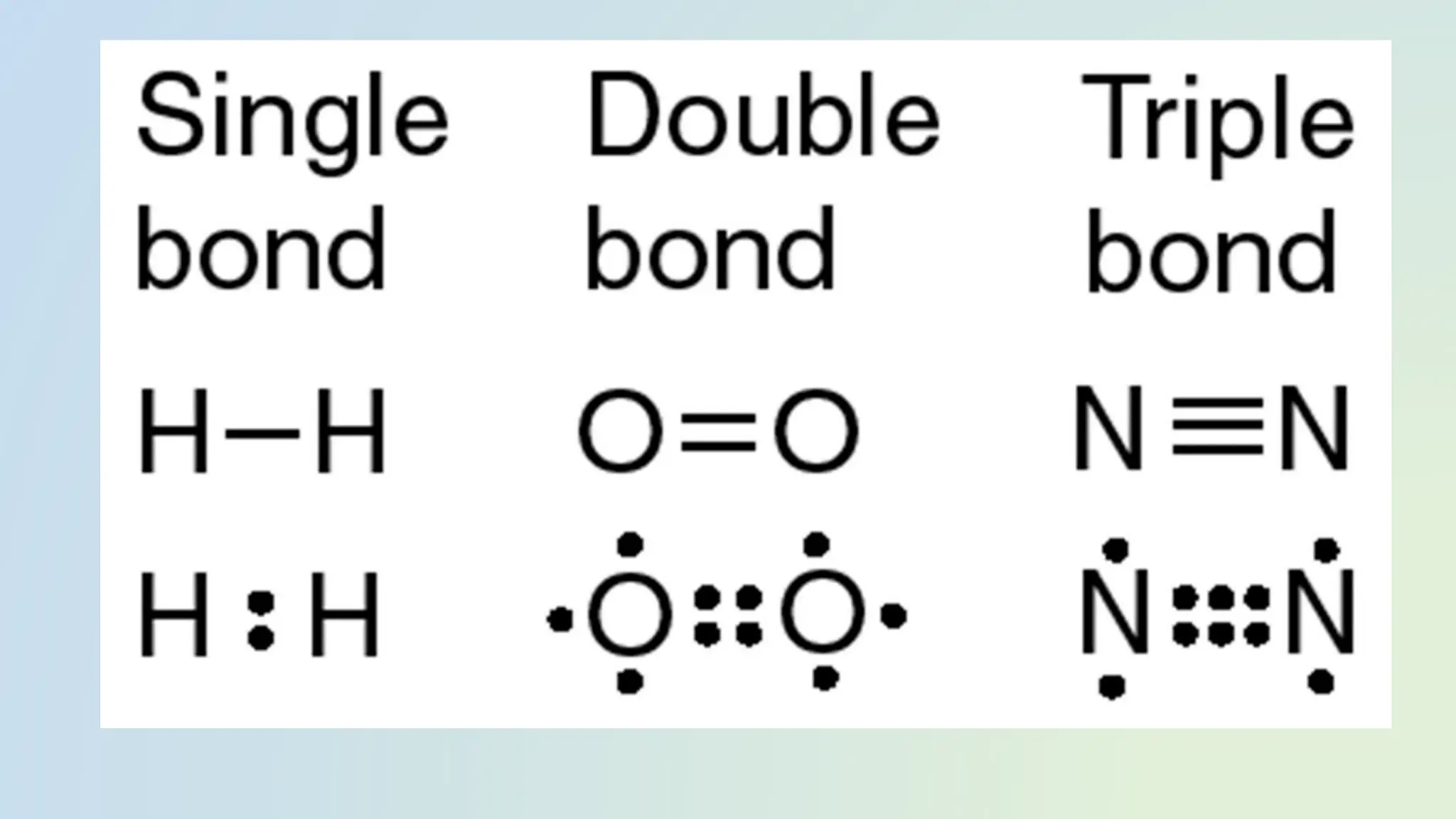
Covalent Bond- formed when atoms share a pair of electrons
to form covalent molecules. Atoms share their valence
electrons in order to have 8 in their outer shells as to
create a noble gas configuration for each atom..
➢ The bond between the atoms results from their mutual
attraction for electrons they share between them.
➢ This kind of bonding takes place between non-metals
groups 4, 5 and 6.
➢ Classified into: Polar and non-polar covalent bonds
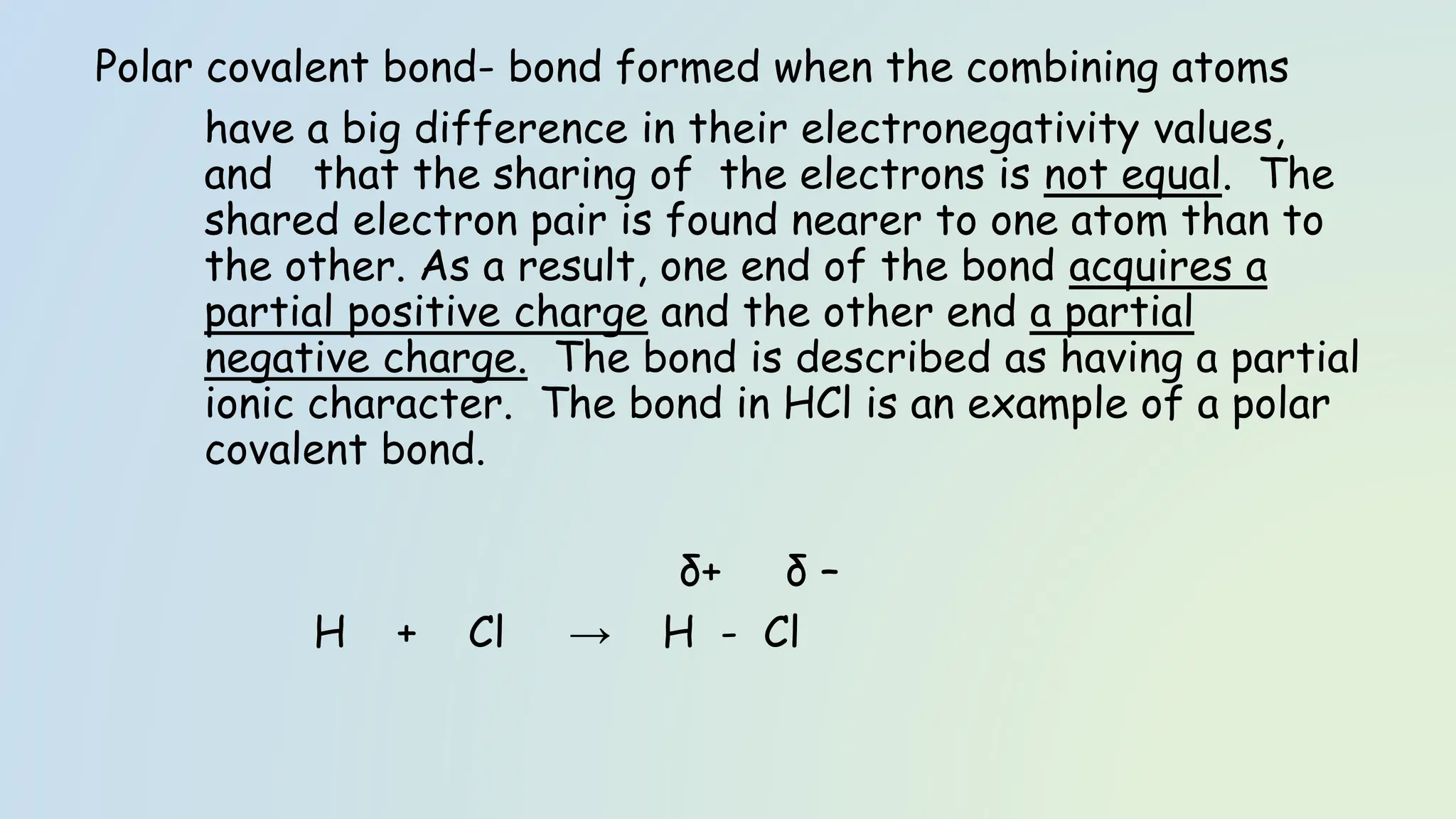
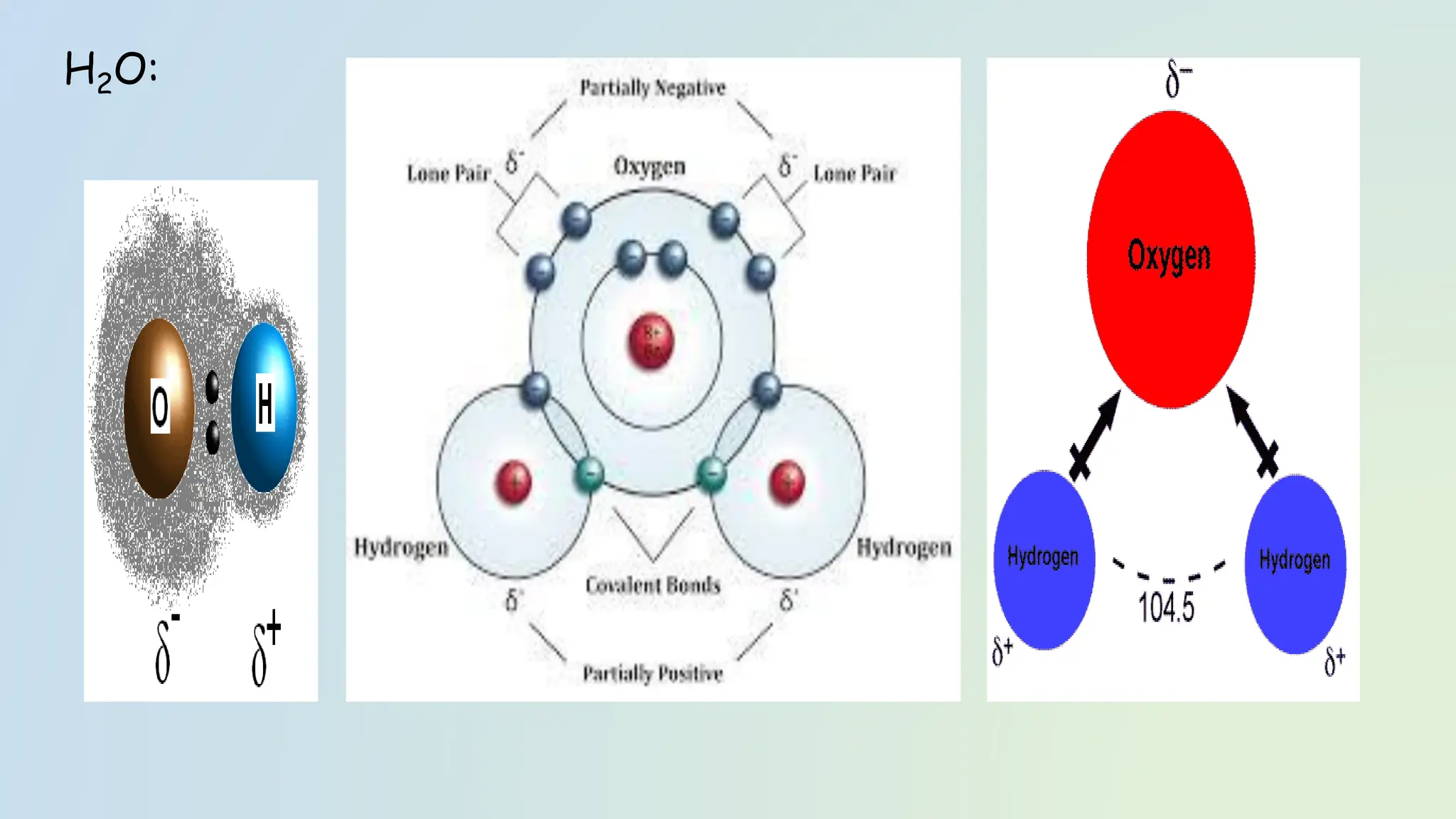
Polar covalent bond- bond formed when the combining atoms
have a big difference in their electronegativity values,
and that the sharing of the electrons is not equal. The
shared electron pair is found nearer to one atom than to
the other. As a result, one end of the bond acquires a
partial positive charge and the other end a partial
negative charge. The bond is described as having a partial
ionic character. The bond in HCl is an example of a polar
covalent bond.
δ+ δ –
H + Cl → H - Cl
H2O:
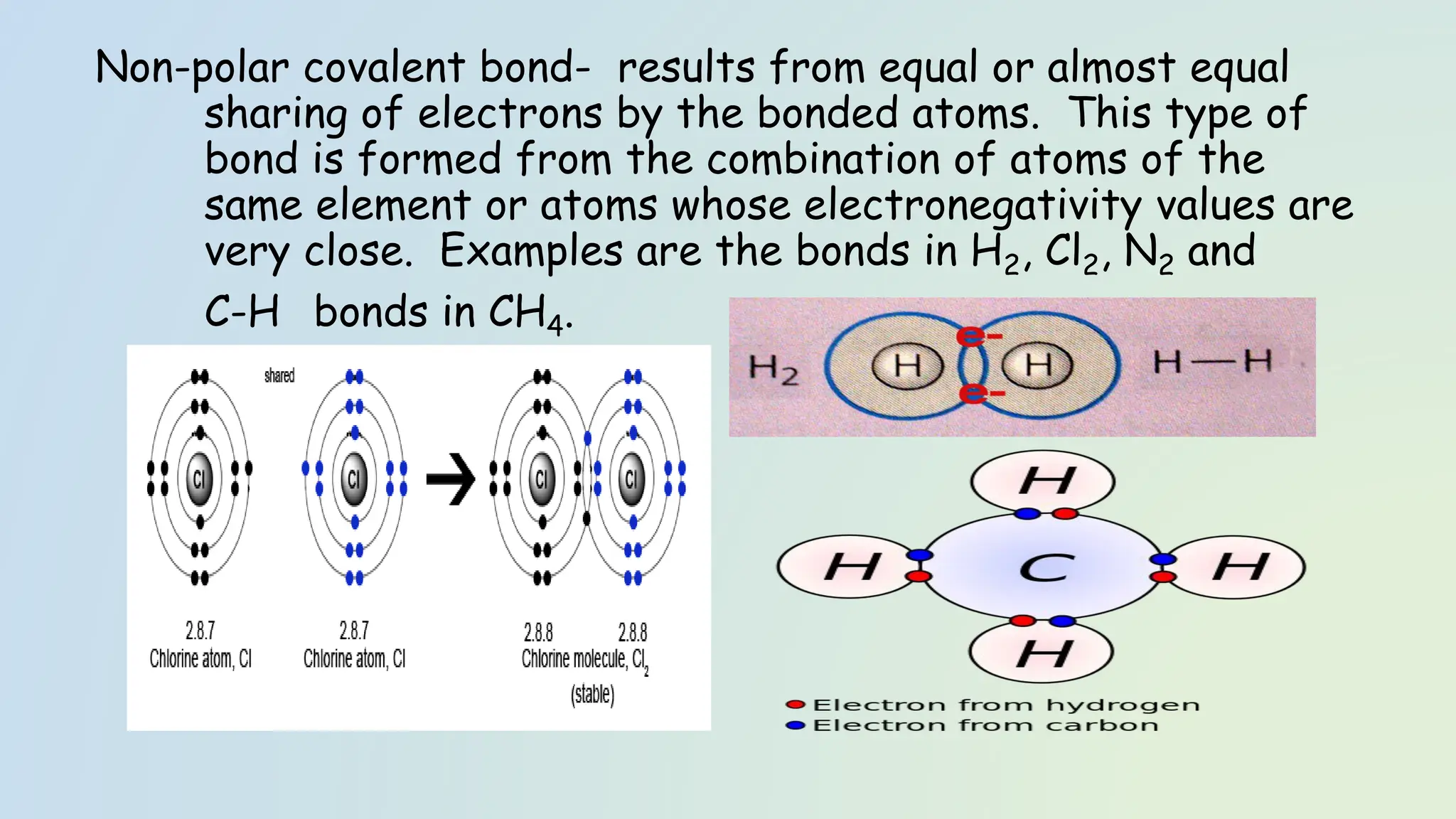
Non-polar covalent bond- results from equal or almost equal
sharing of electrons by the bonded atoms. This type of
bond is formed from the combination of atoms of the
same element or atoms whose electronegativity values are
very close. Examples are the bonds in H2, Cl2, N2 and
C-H bonds in CH4.
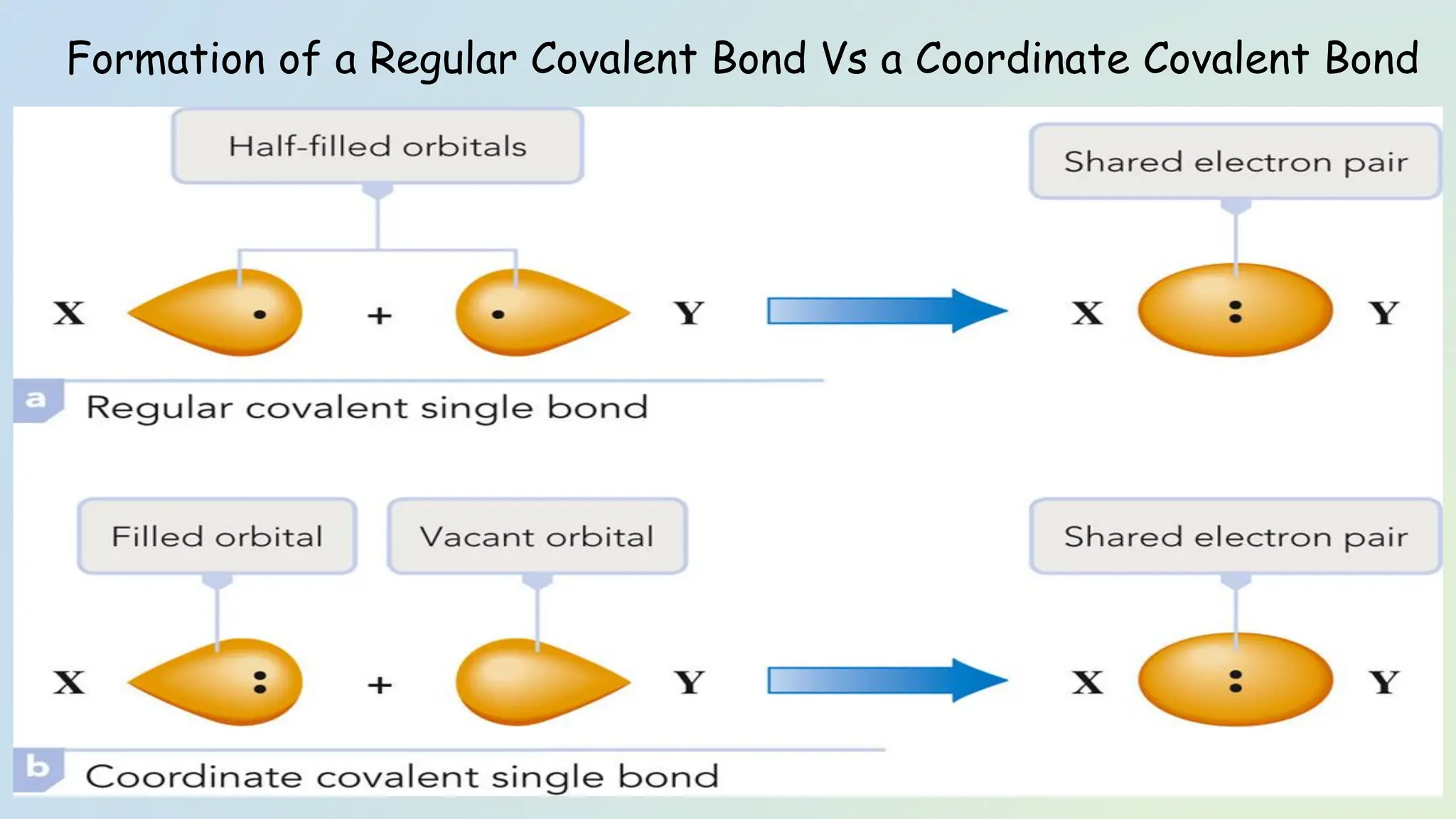
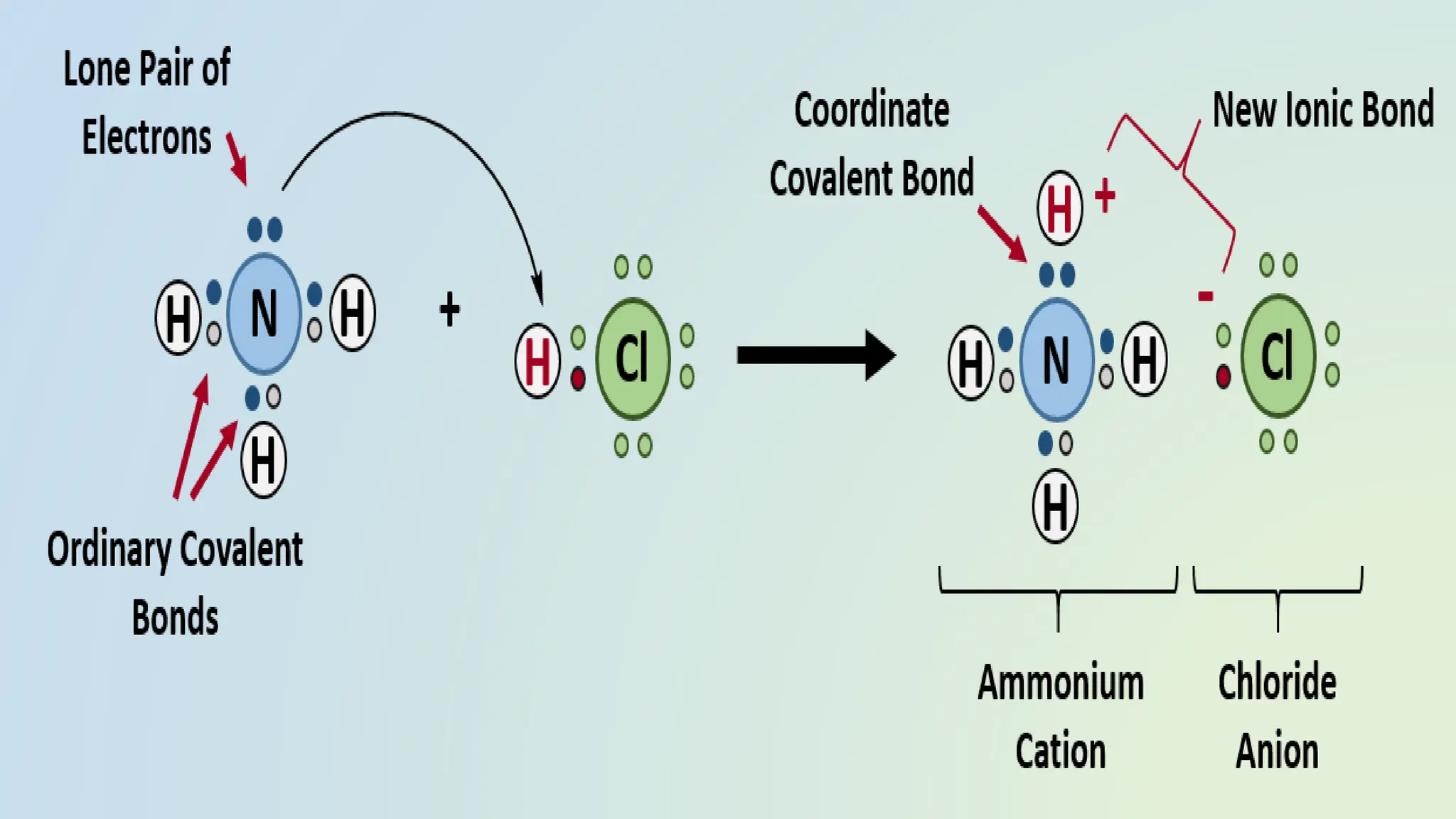
Coordinate Covalent bond- is a covalent bond (a shared pair of
electrons) in which both electrons come from the same atom
Covalent VS Coordinate covalent bond:
When two atoms having similar or very low electronegativity
difference, react together, they form a covalent bond by
sharing electrons. Both atoms can obtain the noble gas
electronic configuration by sharing electrons in this way.
Coordinate covalent bond is a type of covalent bond where the
two electrons in the bond are only donated by a single atom.
Formation of a Regular Covalent Bond Vs a Coordinate Covalent Bond
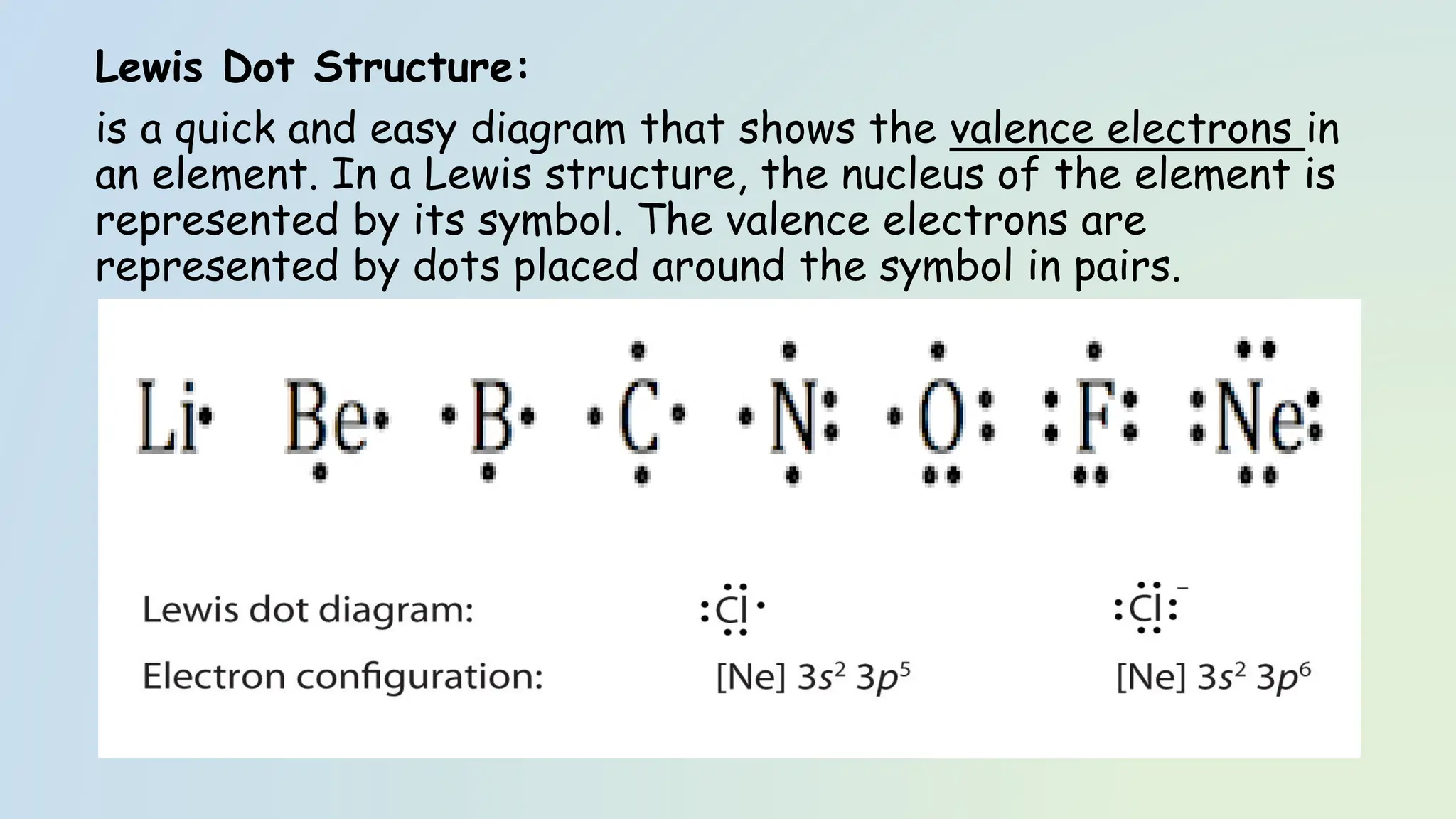
Lewis Dot Structure:
is a quick and easy diagram that shows the valence electrons in
an element. In a Lewis structure, the nucleus of the element is
represented by its symbol. The valence electrons are
represented by dots placed around the symbol in pairs.
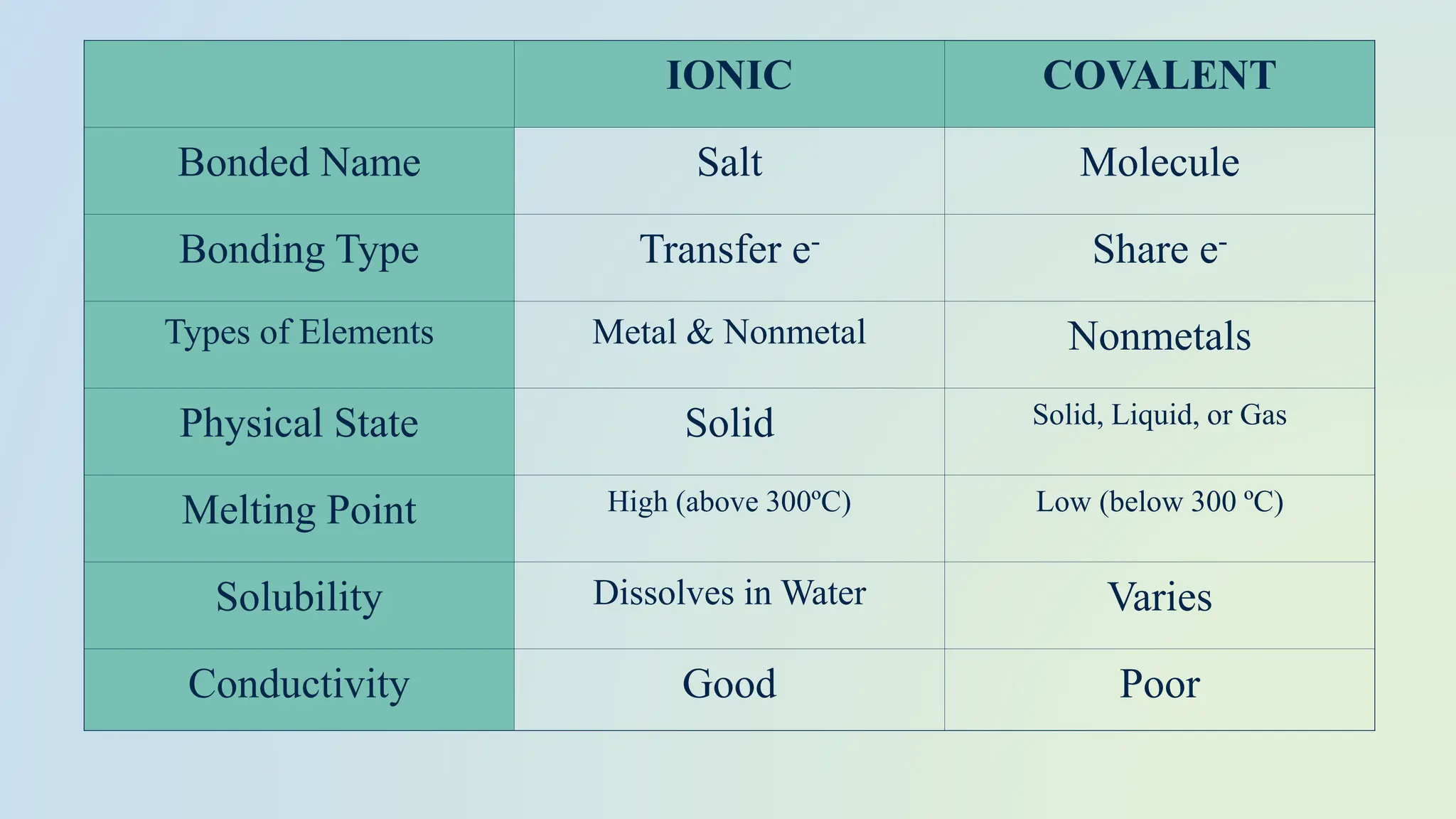
IONIC COVALENT
Bonded Name Salt Molecule
Bonding Type Transfer e- Share e-
Types of Elements Metal & Nonmetal Nonmetals
Physical State Solid Solid, Liquid, or Gas
Melting Point High (above 300ºC) Low (below 300 ºC)
Solubility Dissolves in Water Varies
Conductivity Good Poor
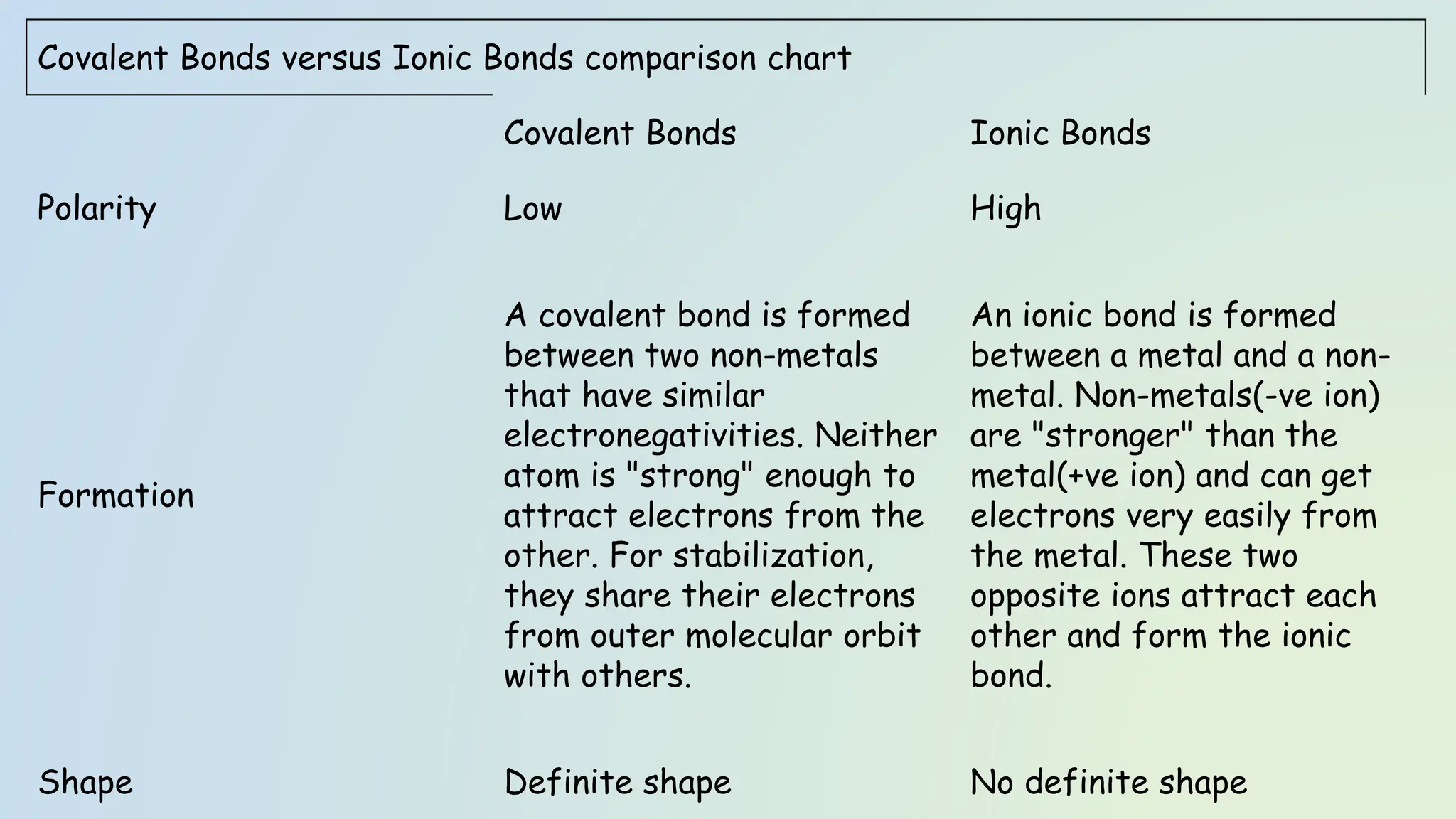
Covalent Bonds versus Ionic Bonds comparison chart
Covalent Bonds Ionic Bonds
Polarity Low High
Formation
A covalent bond is formed
between two non-metals
that have similar
electronegativities. Neither
atom is "strong" enough to
attract electrons from the
other. For stabilization,
they share their electrons
from outer molecular orbit
with others.
An ionic bond is formed
between a metal and a non-
metal. Non-metals(-ve ion)
are "stronger" than the
metal(+ve ion) and can get
electrons very easily from
the metal. These two
opposite ions attract each
other and form the ionic
bond.
Shape Definite shape No definite shape
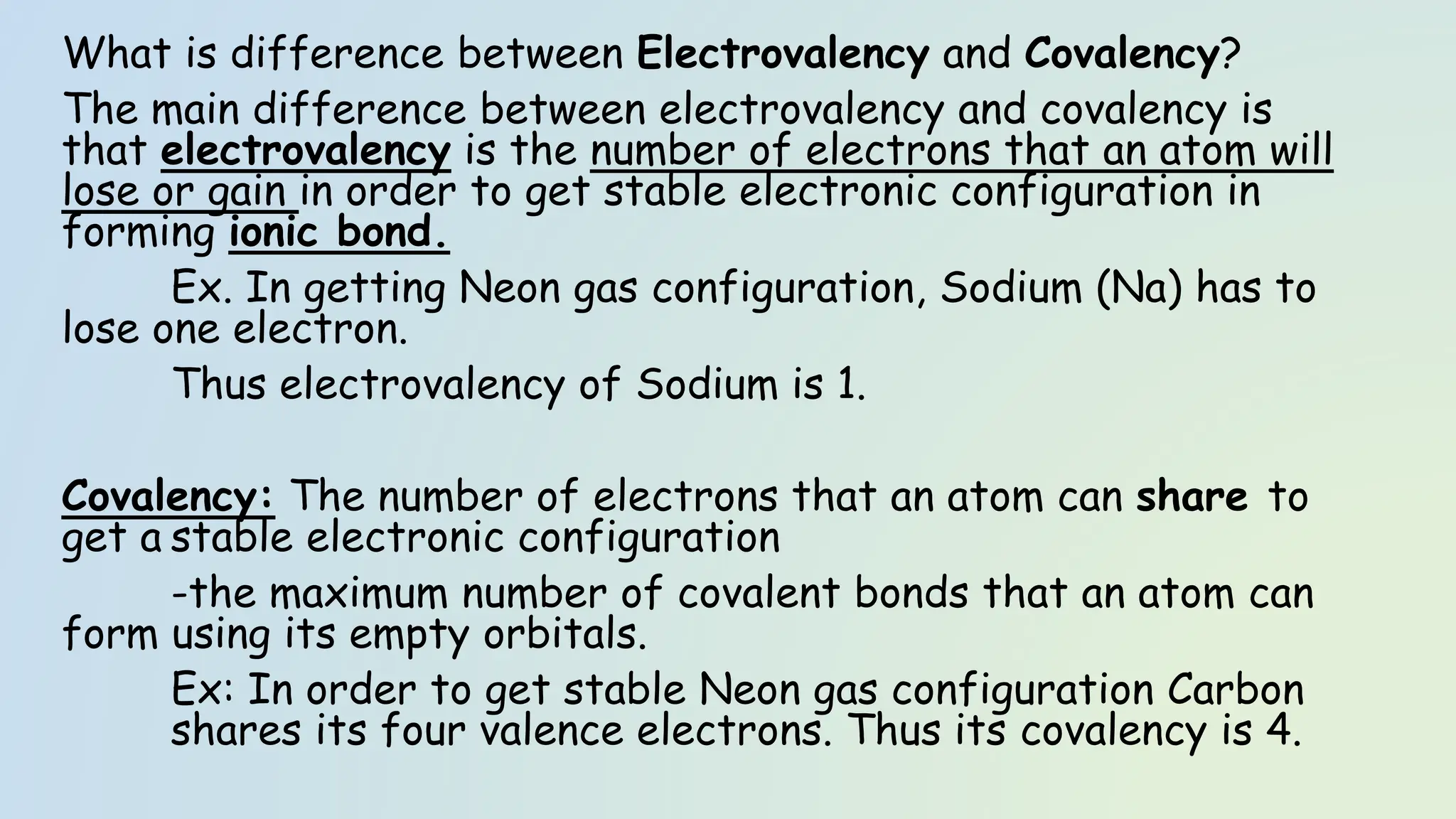
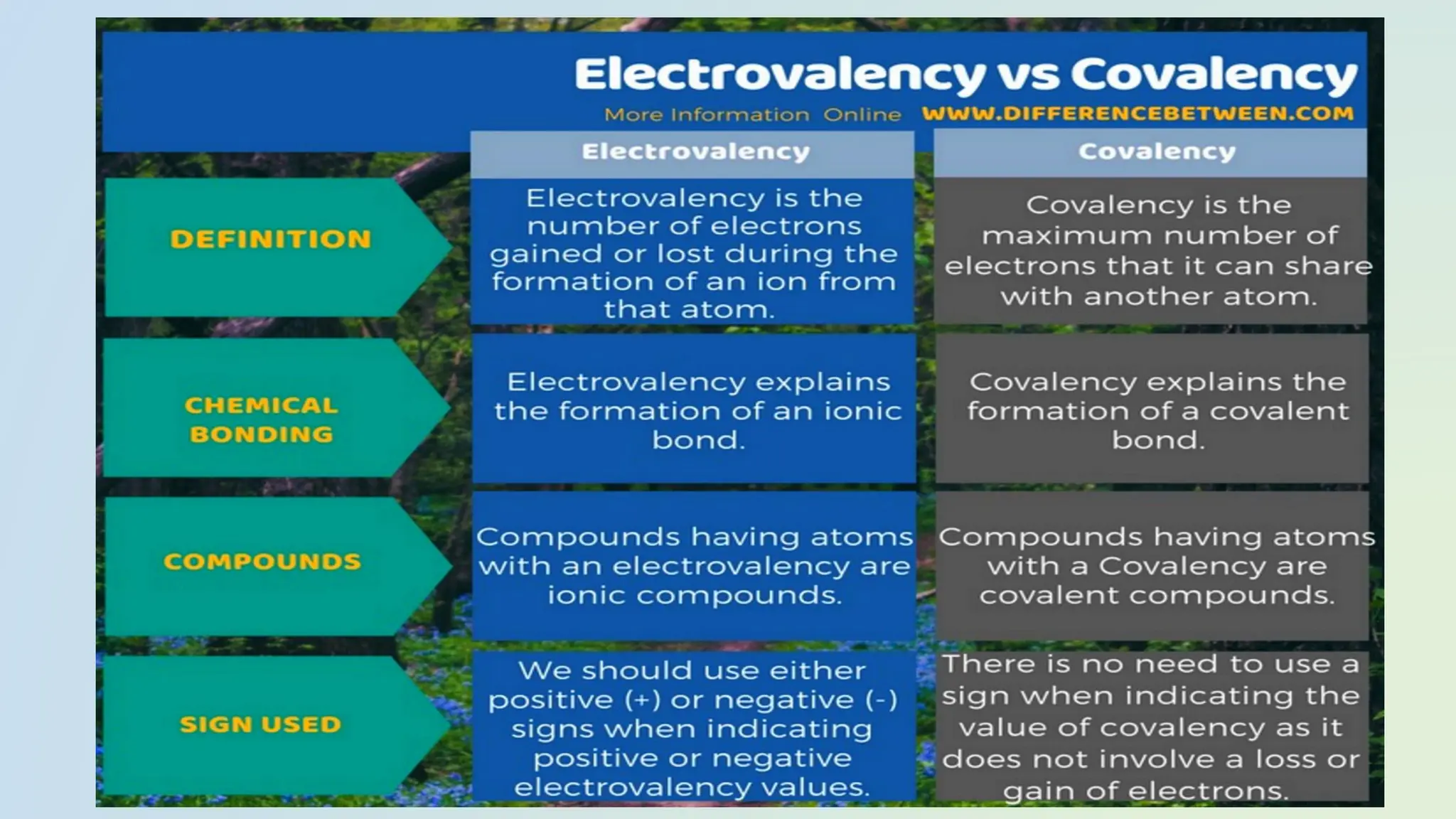
What is difference between Electrovalency and Covalency?
The main difference between electrovalency and covalency is
that electrovalency is the number of electrons that an atom will
lose or gain in order to get stable electronic configuration in
forming ionic bond.
Ex. In getting Neon gas configuration, Sodium (Na) has to
lose one electron.
Thus electrovalency of Sodium is 1.
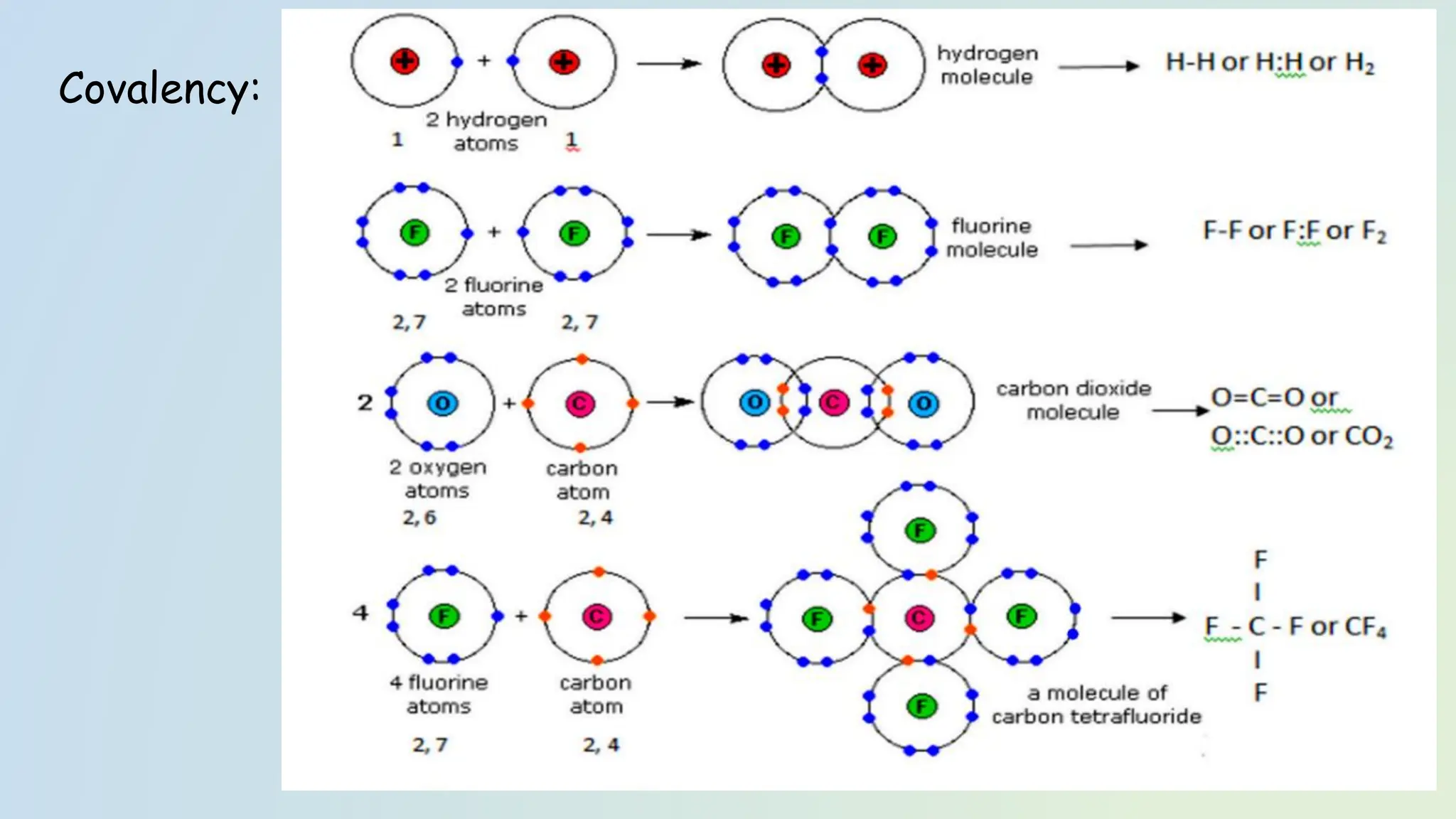
Covalency: The number of electrons that an atom can share to
get a stable electronic configuration
-the maximum number of covalent bonds that an atom can
form using its empty orbitals.
Ex: In order to get stable Neon gas configuration Carbon
shares its four valence electrons. Thus its covalency is 4.
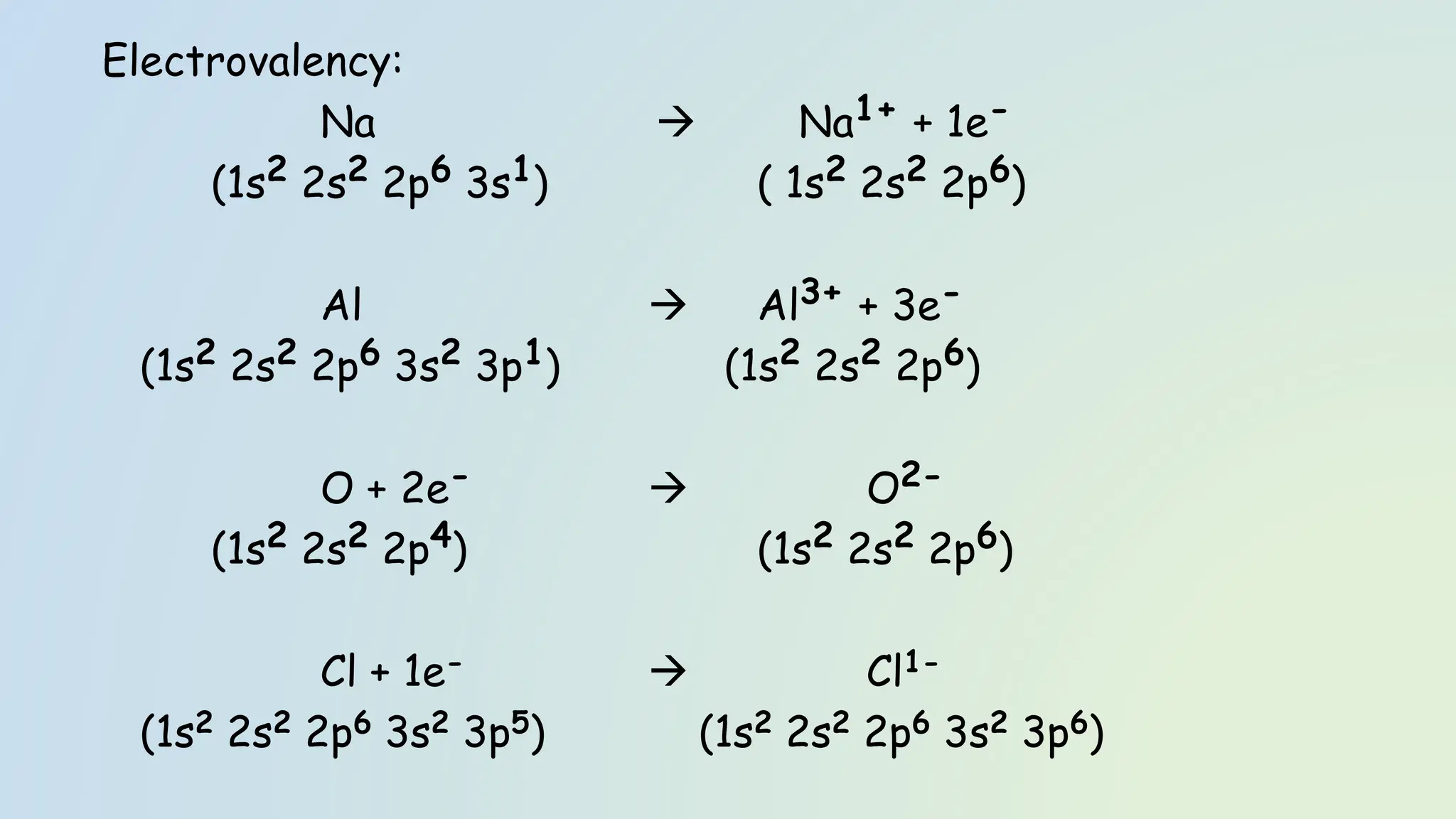
Electrovalency:
Na → Na1+ + 1e-
(1s2 2s2 2p6 3s1) ( 1s2 2s2 2p6)
Al → Al3+ + 3e-
(1s2 2s2 2p6 3s2 3p1) (1s2 2s2 2p6)
O + 2e- → O2-
(1s2 2s2 2p4) (1s2 2s2 2p6)
Cl + 1e- → Cl1-
(1s2 2s2 2p6 3s2 3p5) (1s2 2s2 2p6 3s2 3p6)
Covalency:
End of slide …

Unit 2 Review of Atomic Structure and Chemical Bonding.pdf

  • 2.
    FUNDAMENTAL PARTICLES: A. Proton-is a subatomic particle, symbol p or p+, with a positive electric charge of +1 elementary charge and a mass slightly less than that of a neutron. The word proton is Greek for "first", and this name was given to the hydrogen nucleus. The number of protons in the nucleus is the defining property of an element, and is referred to as the atomic number (represented by the symbol Z).
  • 3.
    B. Neutron- Theneutron is a subatomic particle, symbol n or n0, with no net electric charge and a mass slightly larger than that of a proton. Protons and neutrons constitute the nuclei of atoms. C. Electron- The electron is a subatomic particle, symbol e− or β−, whose electric charge is negative one elementary charge. Electrons play an essential role in numerous physical phenomena, such as electricity, magnetism, chemistry and thermal conductivity, and they also participate in gravitational, electromagnetic and weak interactions.
  • 5.
    Atomic number (Z)– represents the number of protons in the nucleus of an atom. In a neutral atom, the number of protons is equal to the number of electrons. For a neutral atom: Atomic number (Z) = No. of Protons = No. of Electrons Mass number (A)- the total number of protons and neutrons in the nucleus of an atom. The mass number is always a whole number. Mass number (A) = atomic number + no. of neutrons = (no.of protons/electrons) + no. of neutrons
  • 6.
    For example: Na: Mass number= 23 Atomic number = 11 Protons= 11 Electrons= 11 Neutrons= 12 P: Mass number = 31 Atomic number = 15 Protons= 15 Electrons= 15 Neutrons= 16
  • 7.
    What is anorbital? It is the space around the nucleus in which the electron is found with a probability of 90%. -The electron spends 90% of its time in that space. -Can accommodate a maximum of 2 electrons Shells -The number of electrons in an atom are arranged in shells or 'energy levels' around the nucleus. The arrangement of electrons determines chemical properties of an element. -The electron shells are 1, 2, 3, 4, 5, 6, and 7; going from innermost shell outwards. Electrons in outer shells have higher average energy and travel farther from the nucleus than those in inner shells. Electrons that occupy the first electron shell are closer to the nucleus and have a lower energy than electrons in the second electron shell.
  • 8.
    Categories of Electrons: 1.Inner (core) electrons are those seen in the previous noble gas and any completed transition series. They fill all the lower energy levels of an atom. 2. Outer electrons are those in the highest energy level (highest n value). They spend most of their time farthest from the nucleus. 3. Valence electrons are those involved in forming compounds. Among the main group elements, the valence electrons are the outer electrons. Among the transition elements, all the (n-1)d electrons are counted as valence electrons also, even though the elements Fe (Z = 26) through Zn (Z = 30) utilize only a few of their d electrons in bonding.
  • 9.
    SUBSHELL- Each shellis composed of one or more subshells, which are themselves composed of atomic orbitals. It is a region of space within an electron shell that contains electrons that have the same energy. THE 4 PRINCIPAL QUANTUM NUMBERS: Quantum numbers designate specific shells, subshells, orbitals, and spins of electrons. This means that they describe completely the characteristics of an electron in an atom. 1. Principal quantum number (n) 2. Angular momentum quantum number (l) 3. Magnetic quantum number (ml) 4. Spin quantum number (ms)
  • 10.
    1. Principal quantumnumber (n)- describes the size of orbitals and relative distance of the electrons from the nucleus. The higher the n-value, the bigger is the orbital size, the higher the energy level and the farther the electron is from the nucleus. ex. n=1 first energy level n=2 2nd energy level n=3 3rd energy level n=4 4th energy level ….
  • 11.
    2. Angular momentumquantum number (l) – this refers to the shape of the orbitals. l has values of 0, 1, 2, 3, 4… or n-1 from the n value. 3. Magnetic quantum number (ml)- refers to the orientation of the orbitals in space around the nucleus. IF: # of orbitals n=1 l=0, ml =0 1 n=2 l= 1, ml = +1, 0, -1 3 n=3 l= 2, ml = +2, +1, 0, -1, -2 5 n=4 l= 3, ml = +3, +2, +1, 0, -1, -2, -3 7
  • 12.
    4. Spin quantumnumber (ms)- describes the spin of electrons in an orbital which is opposite direction to differentiate one electron from the other in the same orbital. It has only two possible values. ms = + 1/2 ms = - 1/2
  • 13.
    n l (n-l) ml +, 0,- (n-l) No.of orbitals No. of electron s Total number of electrons Max no. of e- per shell Letter designation shape 1 0 (s) 0 1 2 2 2 s spherical 2 0 (s) 1 (p) +1 0 -1 Px 3 Py Pz 2 2 2 6 8 p Dumbbell 3 0 (s) 1 (p) 2 (d) +2 +1 0 -1 -2 dz2 dx2-y2 5 dxy dxz dyz 2 2 2 2 2 10 18 d lobe 4 0 (s) 1 (p) 2 (d) 3 (f) +3 +2 +1 0 -1 -2 -3 7 2 2 2 2 2 2 2 14 32 f smaller lobes
  • 16.
    Electron configuration- thedistribution of electrons in the energy levels and sublevels of an atom and is represented by the model: n l # where n= main energy level l= a value of s, p, d, f representing the shape of orbital in a subshell #- a superscript that tells the number of electrons in the sublevel
  • 17.
    For Ca: 4s2 Gives thegroup or family (# of valence electrons) Gives the period number or series (main energy level) Gives the shape of orbital
  • 18.
  • 20.
    RULES in writingelectronic configurations: 1. Aufbau (building–up) principle: Electrons first occupy the lowest energy orbitals available to them; only when the lower-energy orbitals are filled that they enter higher – energy orbitals. 2. Pauli’s exclusion principle: only two electrons having opposite spins can occupy an orbital. The third electron will eventually be repelled. 3. Hund’s rule: electrons distribute singly before pairing.
  • 21.
    GROUP or FAMILY PERIOD or SERIES IAVllA IIA lllA lVA VlA VA VlllA Lanthanide series Actinide series
  • 22.
  • 23.
    Nitrogen: atomic number=7e- configuration: 1s22s22p3 Nitrogen: 1s 2s 2p Px Py Pz the orbital box diagram: Sulfur: atomic number= 16 e- configuration: 1s22s22p63s23p4 1s 2s 2p 3s 3p
  • 24.
    For V (Z= 23): 1s 2 2s 2 2p 6 3s 2 3p 6 4s 2 3d 3 For Zn (Z = 30): 1s 2 2s 2 2p 6 3s 2 3p 6 4s 2 3d 10 For Pb (Z = 82): 1s 2 2s 2 2p 6 3s 2 3p 6 4s 2 3d 10 4p 6 5s 2 4d 10 5p 6 6s 2 4f 14 5d 10 6p 2 Condensed electron configuration: Sulfur: Z = 16 : 3s2 3p4 V (Z = 23): 3d3 4s2 1s 3d 2s 2p 3s 3p 4s
  • 25.
    Electron configuration ofnoble gases: these gases have complete e- configuration of ns2np6 except for He making them difficult to either gain or loss electrons. Noble gas configuration: Sulfur: Z = 16 : [Ne] 3s2 3p4 V (Z = 23): [Ar] 3d3 4s2 Zn (Z = 30): [Ar] 3d10 4s2 Pb (Z = 82): [Xe] 6s2 6p2
  • 26.
    There are twostates of an atom: Ground state – the lowest energy state or most stable state of an atom, molecule, or ion. The ground state electron configuration is the arrangement of electrons around the nucleus of an atom with lower energy levels. The electrons occupying the orbitals of varying energy levels naturally falls towards the lowest energy state or ground state.
  • 27.
    Excited state- anystate other than the ground state of an atom or molecule; a state that has higher energy than the ground state. Excitation is an elevation in energy level above an arbitrary baseline energy state.
  • 28.
  • 29.
    Chemical bond- theelectrostatic force which holds the atoms in a compound or molecule. This results from the gain and loss of electrons, or from the sharing of electrons between atoms. Valence is the ability of an atom to form bonds. The valence of an element is determined by the number of electrons in the outermost level of the atom.
  • 30.
    In bond formation,it generally follows the Octet Rule. The octet rule states that atoms are most stable when they have a full shell of electrons in the outside electron shell. ➢ The first shell has only two electrons in a single s subshell. ➢ Helium has a full shell, so it is stable, an inert element. ➢ All the other shells have an s and a p subshell, giving them at least eight electrons on the outside. The s and p subshells often are the only valence electrons, thus the octet rule is named for the eight s and p electrons. ➢ When atoms combine, they revert to the noble gas configuration which has eight electrons in the outermost shell.
  • 31.
    Octet Rule =atoms tend to gain, lose or share electrons so as to have 8 electrons ✓C would like to ✓N would like to ✓O would like to Gain 4 electrons Gain 3 electrons Gain 2 electrons
  • 32.
    The properties ofa substance can be explained in terms of the nature of the bonds holding the atoms together. There are two general types of chemical bonds. 1. ionic or electrovalent 2. covalent bonds.
  • 33.
    IONIC bonding- formedwhen electrons transfer from one atom to another. It is a chemical bond resulting from the mutual attraction of oppositely charged ions. -formed from the force of electrostatic attraction between oppositely charged ions (cations and anions). An example is the formation of NaCl. Sodium atom loses its one valence electron, thus forming the Na1+ ion, which is isoelectronic with neon and chlorine gains one electron, forming Cl1- ion with the electronic configuration of argon. Na Na 1+ Na 1+ + Cl 1- NaCl Cl Cl 1-
  • 34.
    An ion isan electrically charged atom of an element or group of atoms that carries an electrical charge. Cation is a positively charged atom of an element. It is formed when an atom loses electron (s). Anion is a negatively charged atom of an element. It is produced when an atom gains electron(s). ➢ the elements most likely to form cations in ionic compounds are the Group IA and Group IIA, and the elements most likely to form anions are the halogens (Group VIIA).
  • 36.
    Examples of monoatomicions: Cl1-, K1+, Fe2+, Bi5+ Examples of polyatomic ions: NO2 1-, CO3 2-, PO4 3- ➢ Cation is smaller than their neutral parent atom. ➢ Anion is larger than their parent atom as electrons are added to the atom, hence increasing the electron cloud size.
  • 38.
    Covalent Bond- formedwhen atoms share a pair of electrons to form covalent molecules. Atoms share their valence electrons in order to have 8 in their outer shells as to create a noble gas configuration for each atom.. ➢ The bond between the atoms results from their mutual attraction for electrons they share between them. ➢ This kind of bonding takes place between non-metals groups 4, 5 and 6. ➢ Classified into: Polar and non-polar covalent bonds
  • 39.
    Polar covalent bond-bond formed when the combining atoms have a big difference in their electronegativity values, and that the sharing of the electrons is not equal. The shared electron pair is found nearer to one atom than to the other. As a result, one end of the bond acquires a partial positive charge and the other end a partial negative charge. The bond is described as having a partial ionic character. The bond in HCl is an example of a polar covalent bond. δ+ δ – H + Cl → H - Cl
  • 40.
  • 41.
    Non-polar covalent bond-results from equal or almost equal sharing of electrons by the bonded atoms. This type of bond is formed from the combination of atoms of the same element or atoms whose electronegativity values are very close. Examples are the bonds in H2, Cl2, N2 and C-H bonds in CH4.
  • 43.
    Coordinate Covalent bond-is a covalent bond (a shared pair of electrons) in which both electrons come from the same atom Covalent VS Coordinate covalent bond: When two atoms having similar or very low electronegativity difference, react together, they form a covalent bond by sharing electrons. Both atoms can obtain the noble gas electronic configuration by sharing electrons in this way. Coordinate covalent bond is a type of covalent bond where the two electrons in the bond are only donated by a single atom.
  • 44.
    Formation of aRegular Covalent Bond Vs a Coordinate Covalent Bond
  • 46.
    Lewis Dot Structure: isa quick and easy diagram that shows the valence electrons in an element. In a Lewis structure, the nucleus of the element is represented by its symbol. The valence electrons are represented by dots placed around the symbol in pairs.
  • 47.
    IONIC COVALENT Bonded NameSalt Molecule Bonding Type Transfer e- Share e- Types of Elements Metal & Nonmetal Nonmetals Physical State Solid Solid, Liquid, or Gas Melting Point High (above 300ºC) Low (below 300 ºC) Solubility Dissolves in Water Varies Conductivity Good Poor
  • 48.
    Covalent Bonds versusIonic Bonds comparison chart Covalent Bonds Ionic Bonds Polarity Low High Formation A covalent bond is formed between two non-metals that have similar electronegativities. Neither atom is "strong" enough to attract electrons from the other. For stabilization, they share their electrons from outer molecular orbit with others. An ionic bond is formed between a metal and a non- metal. Non-metals(-ve ion) are "stronger" than the metal(+ve ion) and can get electrons very easily from the metal. These two opposite ions attract each other and form the ionic bond. Shape Definite shape No definite shape
  • 49.
    What is differencebetween Electrovalency and Covalency? The main difference between electrovalency and covalency is that electrovalency is the number of electrons that an atom will lose or gain in order to get stable electronic configuration in forming ionic bond. Ex. In getting Neon gas configuration, Sodium (Na) has to lose one electron. Thus electrovalency of Sodium is 1. Covalency: The number of electrons that an atom can share to get a stable electronic configuration -the maximum number of covalent bonds that an atom can form using its empty orbitals. Ex: In order to get stable Neon gas configuration Carbon shares its four valence electrons. Thus its covalency is 4.
  • 51.
    Electrovalency: Na → Na1++ 1e- (1s2 2s2 2p6 3s1) ( 1s2 2s2 2p6) Al → Al3+ + 3e- (1s2 2s2 2p6 3s2 3p1) (1s2 2s2 2p6) O + 2e- → O2- (1s2 2s2 2p4) (1s2 2s2 2p6) Cl + 1e- → Cl1- (1s2 2s2 2p6 3s2 3p5) (1s2 2s2 2p6 3s2 3p6)
  • 52.
  • 53.