Performance Archaeology 
Tomáš Vondra, GoodData 
tomas.vondra@gooddata.com / tomas@pgaddict.com 
@fuzzycz, http://blog.pgaddict.com 
Photo by Jason Quinlan, Creative Commons CC-BY-NC-SA 
https://www.flickr.com/photos/catalhoyuk/9400568431
How did the PostgreSQL performance 
evolve over the time? 
7.4 released 2003, i.e. ~10 years
(surprisingly) tricky question 
● usually “partial” tests during development 
– compare two versions / commits 
– focused on a particular part of the code / feature 
● more complex benchmarks compare two versions 
– difficult to “combine” (different hardware, ...) 
● application performance (ultimate benchmark) 
– apps are subject to (regulard) hardware upgrades 
– amounts of data grow, applications evolve (new features)
(somehow) unfair question 
● we do develop within context of the current hardware 
– How much RAM did you use 10 years ago? 
– Who of you had SSD/NVRAM drives 10 years ago? 
– How common were machines with 8 cores? 
● some differences are consequence of these changes 
● a lot of stuff was improved outside PostgreSQL (ext3 -> ext4) 
Better performance on current 
hardware is always nice ;-)
Let's do some benchmarks!
short version: 
We're much faster and more scalable.
If you're scared of numbers or charts, 
you should probably leave now.
http://blog.pgaddict.com 
http://planet.postgresql.org 
http://slidesha.re/1CUv3xO
Benchmarks (overview) 
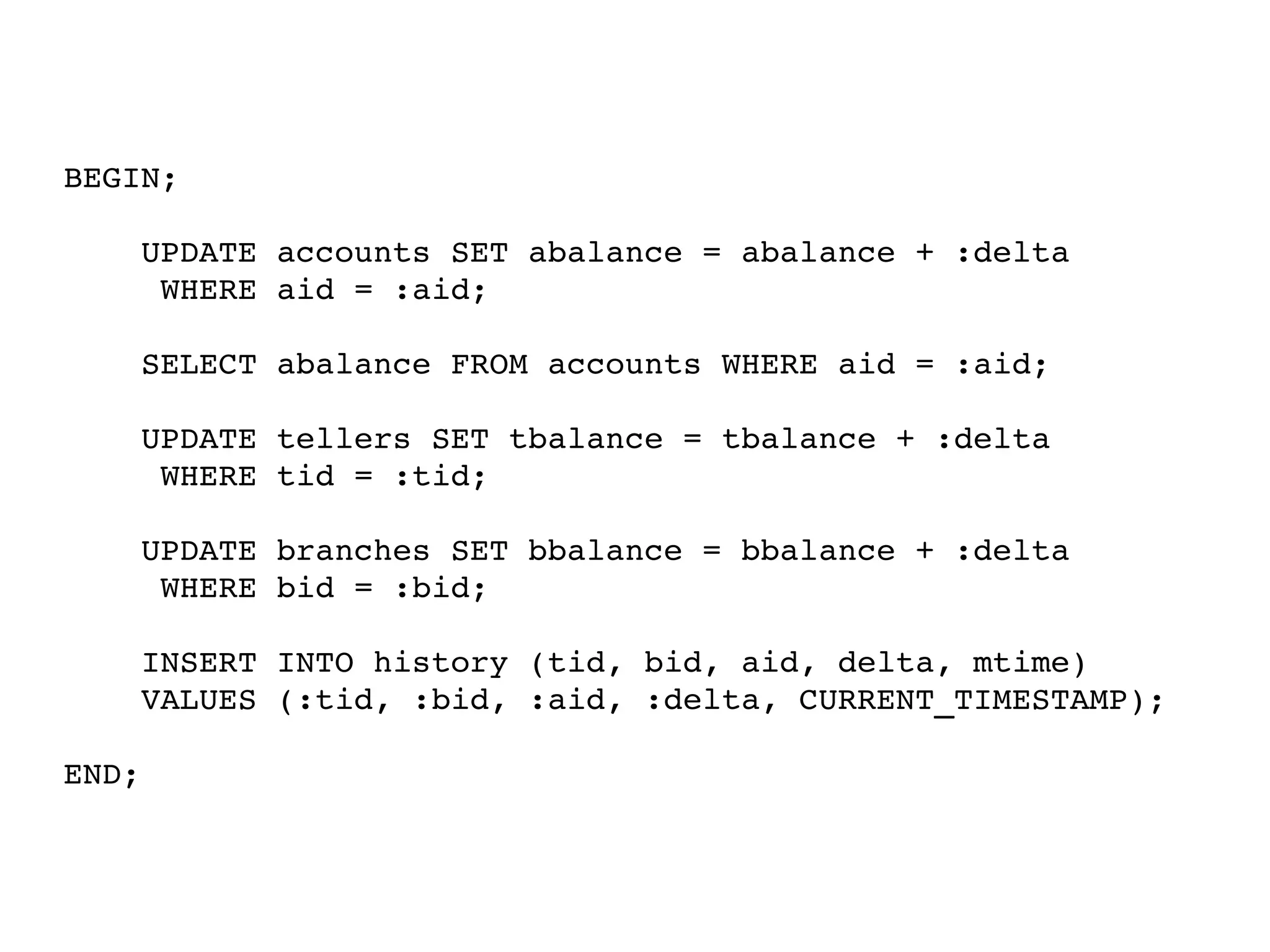
● pgbench (TPC-B) 
– “transactional” benchmark 
– operations work with small row sets (access through PKs, ...) 
● TPC-DS (replaces TPC-H) 
– “warehouse” benchmark 
– queries chewing large amounts of data (aggregations, joins, 
ROLLUP/CUBE, ...) 
● fulltext benchmark (tsearch2) 
– primarily about improvements of GIN/GiST indexes 
– now just fulltext, there are many other uses for GIN/GiST (geo, ...)
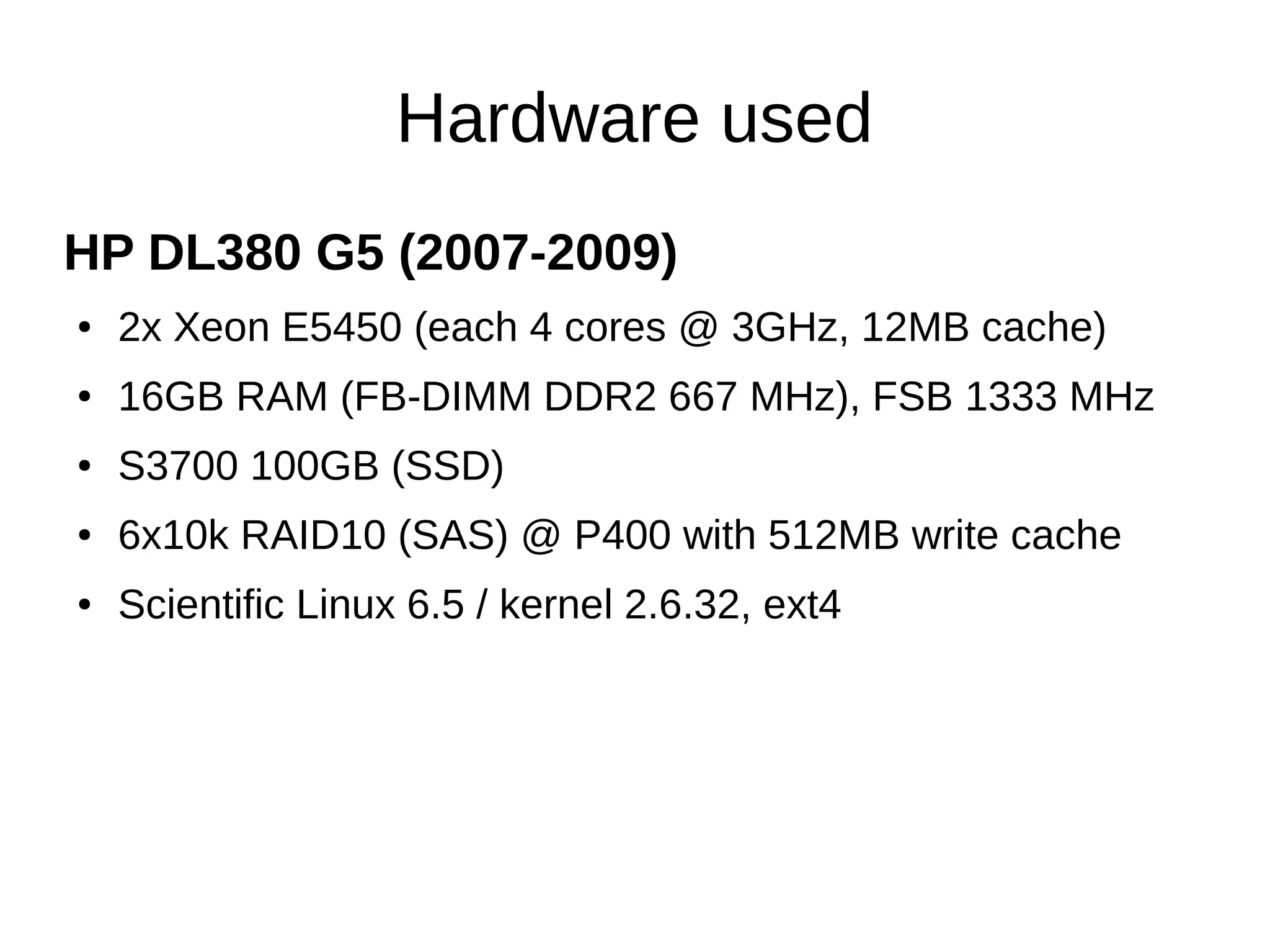
Hardware used 
HP DL380 G5 (2007-2009) 
● 2x Xeon E5450 (each 4 cores @ 3GHz, 12MB cache) 
● 16GB RAM (FB-DIMM DDR2 667 MHz), FSB 1333 MHz 
● S3700 100GB (SSD) 
● 6x10k RAID10 (SAS) @ P400 with 512MB write cache 
● Scientific Linux 6.5 / kernel 2.6.32, ext4
pgbench 
TPC-B “transactional” benchmark
pgbench 
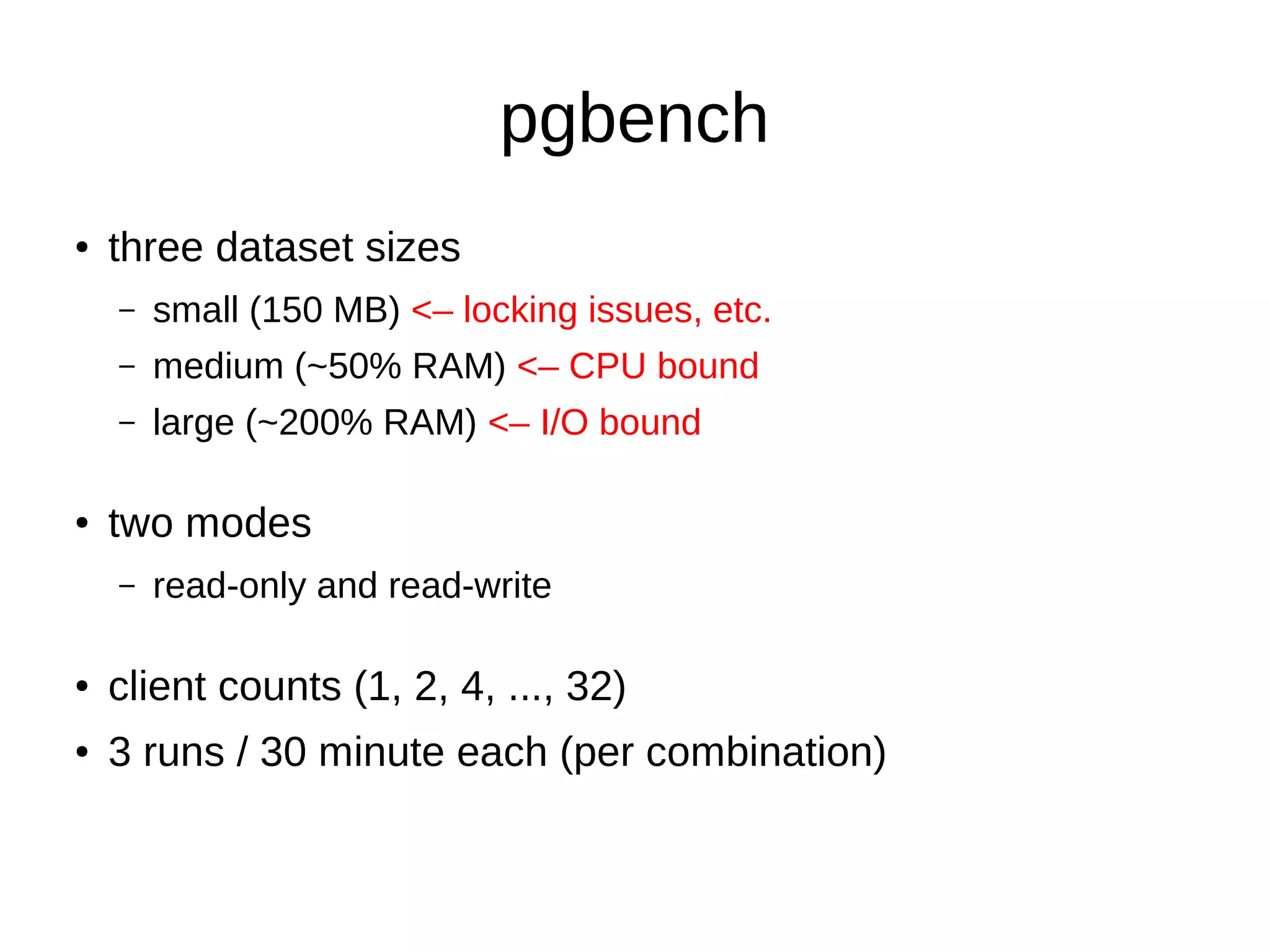
● three dataset sizes 
– small (150 MB) 
– medium (~50% RAM) 
– large (~200% RAM) 
● two modes 
– read-only and read-write 
● client counts (1, 2, 4, ..., 32) 
● 3 runs / 30 minute each (per combination)
pgbench 
● three dataset sizes 
– small (150 MB) <– locking issues, etc. 
– medium (~50% RAM) <– CPU bound 
– large (~200% RAM) <– I/O bound 
● two modes 
– read-only and read-write 
● client counts (1, 2, 4, ..., 32) 
● 3 runs / 30 minute each (per combination)
BEGIN; 
UPDATE accounts SET abalance = abalance + :delta 
WHERE aid = :aid; 
SELECT abalance FROM accounts WHERE aid = :aid; 
UPDATE tellers SET tbalance = tbalance + :delta 
WHERE tid = :tid; 
UPDATE branches SET bbalance = bbalance + :delta 
WHERE bid = :bid; 
INSERT INTO history (tid, bid, aid, delta, mtime) 
VALUES (:tid, :bid, :aid, :delta, CURRENT_TIMESTAMP); 
END;
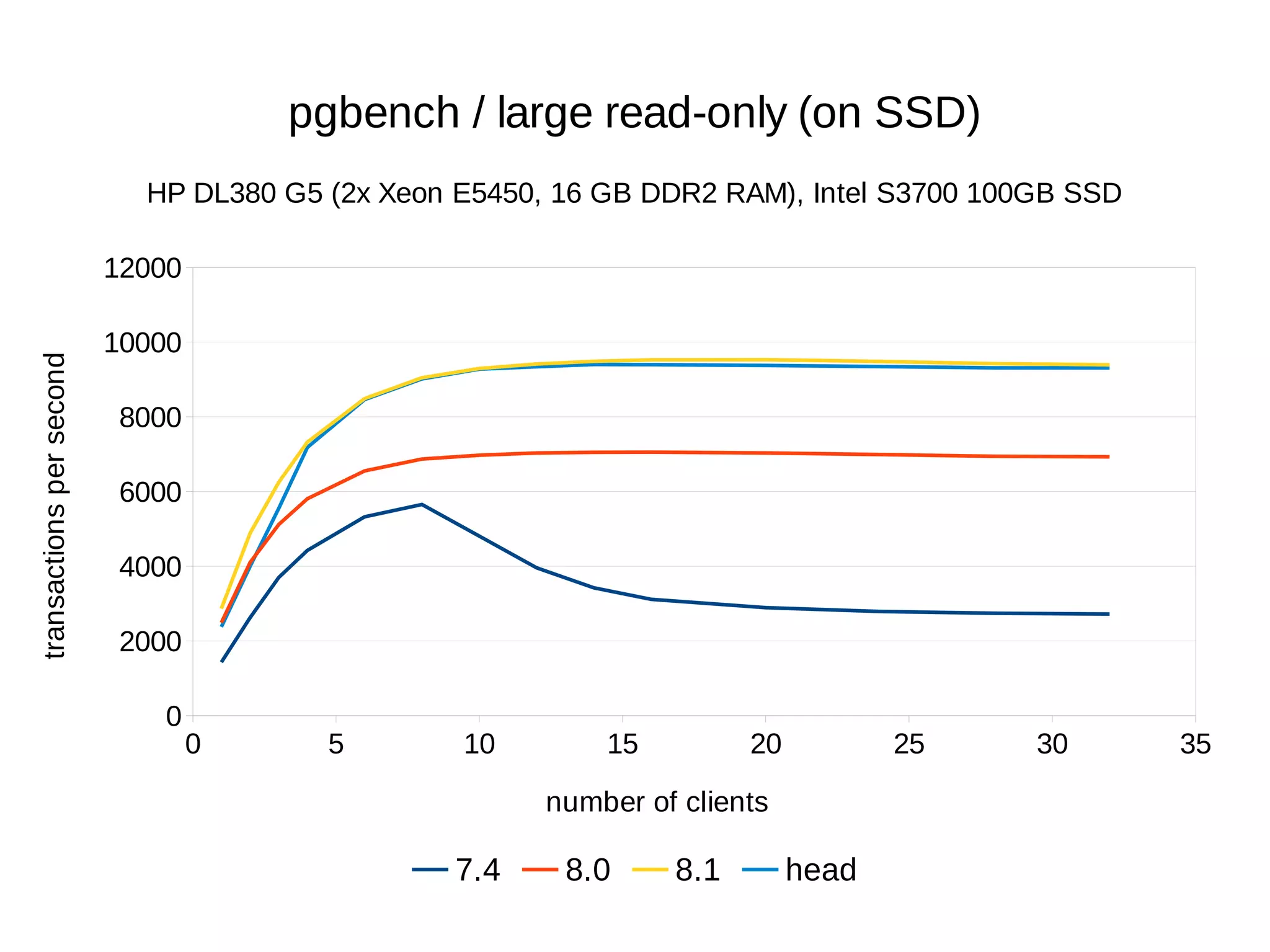
0 5 10 15 20 25 30 35 
12000 
10000 
8000 
6000 
4000 
2000 
0 
pgbench / large read-only (on SSD) 
HP DL380 G5 (2x Xeon E5450, 16 GB DDR2 RAM), Intel S3700 100GB SSD 
number of clients 
7.4 8.0 8.1 head 
transactions per second
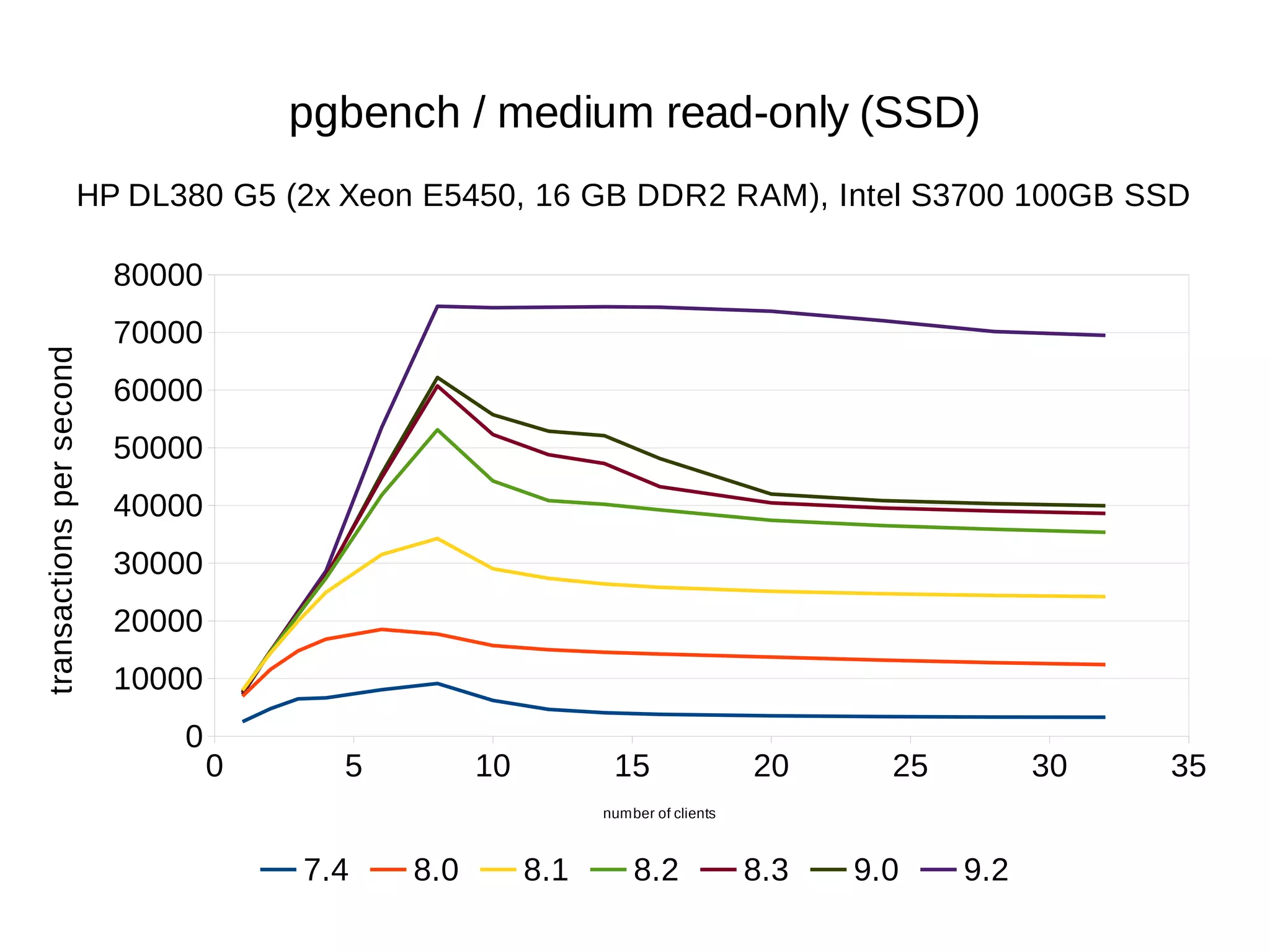
0 5 10 15 20 25 30 35 
80000 
70000 
60000 
50000 
40000 
30000 
20000 
10000 
0 
pgbench / medium read-only (SSD) 
HP DL380 G5 (2x Xeon E5450, 16 GB DDR2 RAM), Intel S3700 100GB SSD 
number of clients 
7.4 8.0 8.1 8.2 8.3 9.0 9.2 
transactions per second
0 5 10 15 20 25 30 35 
3000 
2500 
2000 
1500 
1000 
500 
0 
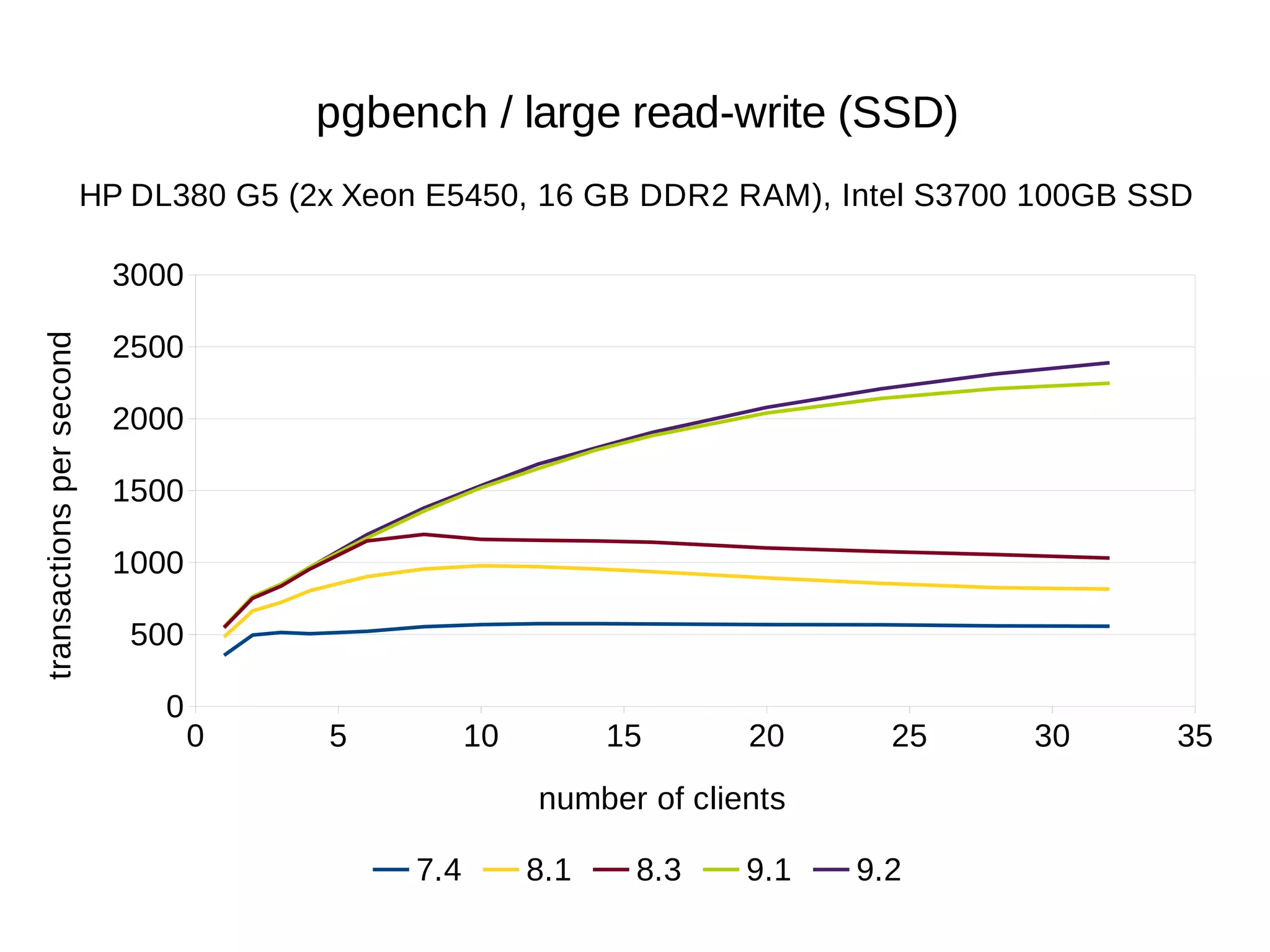
pgbench / large read-write (SSD) 
HP DL380 G5 (2x Xeon E5450, 16 GB DDR2 RAM), Intel S3700 100GB SSD 
number of clients 
7.4 8.1 8.3 9.1 9.2 
transactions per second
0 5 10 15 20 25 30 35 
6000 
5000 
4000 
3000 
2000 
1000 
0 
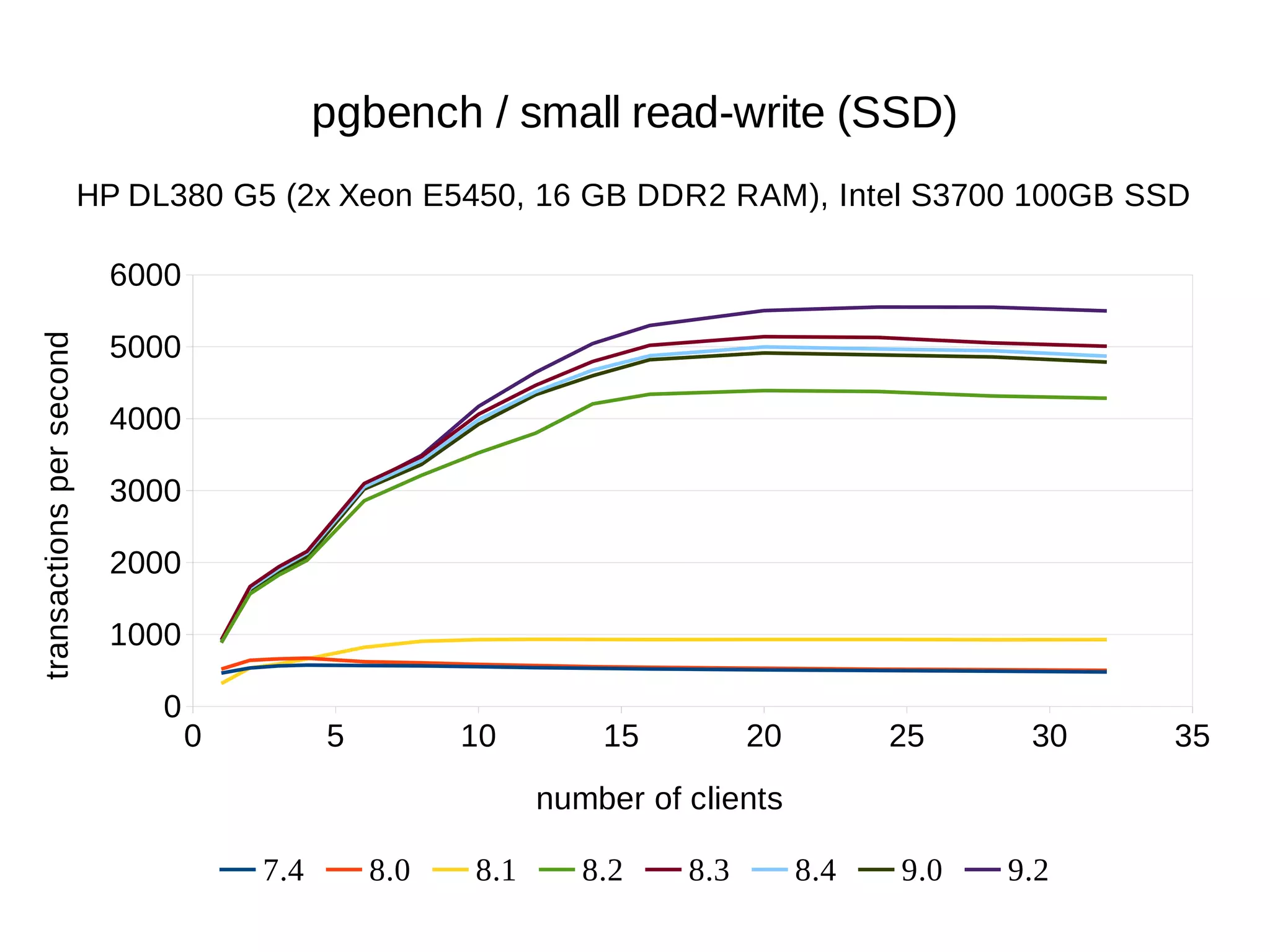
pgbench / small read-write (SSD) 
HP DL380 G5 (2x Xeon E5450, 16 GB DDR2 RAM), Intel S3700 100GB SSD 
number of clients 
7.4 8.0 8.1 8.2 8.3 8.4 9.0 9.2 
transactions per second
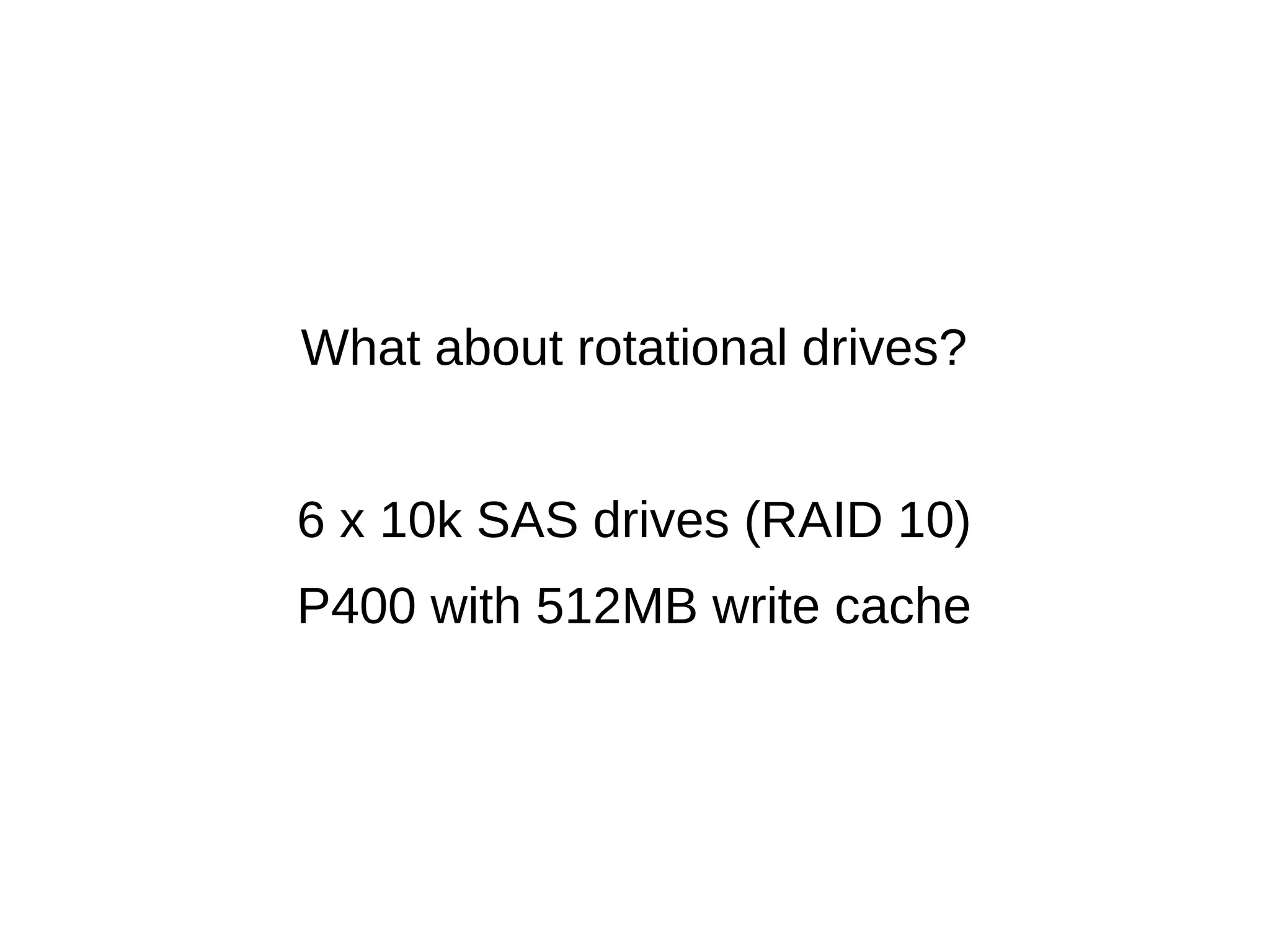
What about rotational drives? 
6 x 10k SAS drives (RAID 10) 
P400 with 512MB write cache
0 5 10 15 20 25 30 
800 
700 
600 
500 
400 
300 
200 
100 
0 
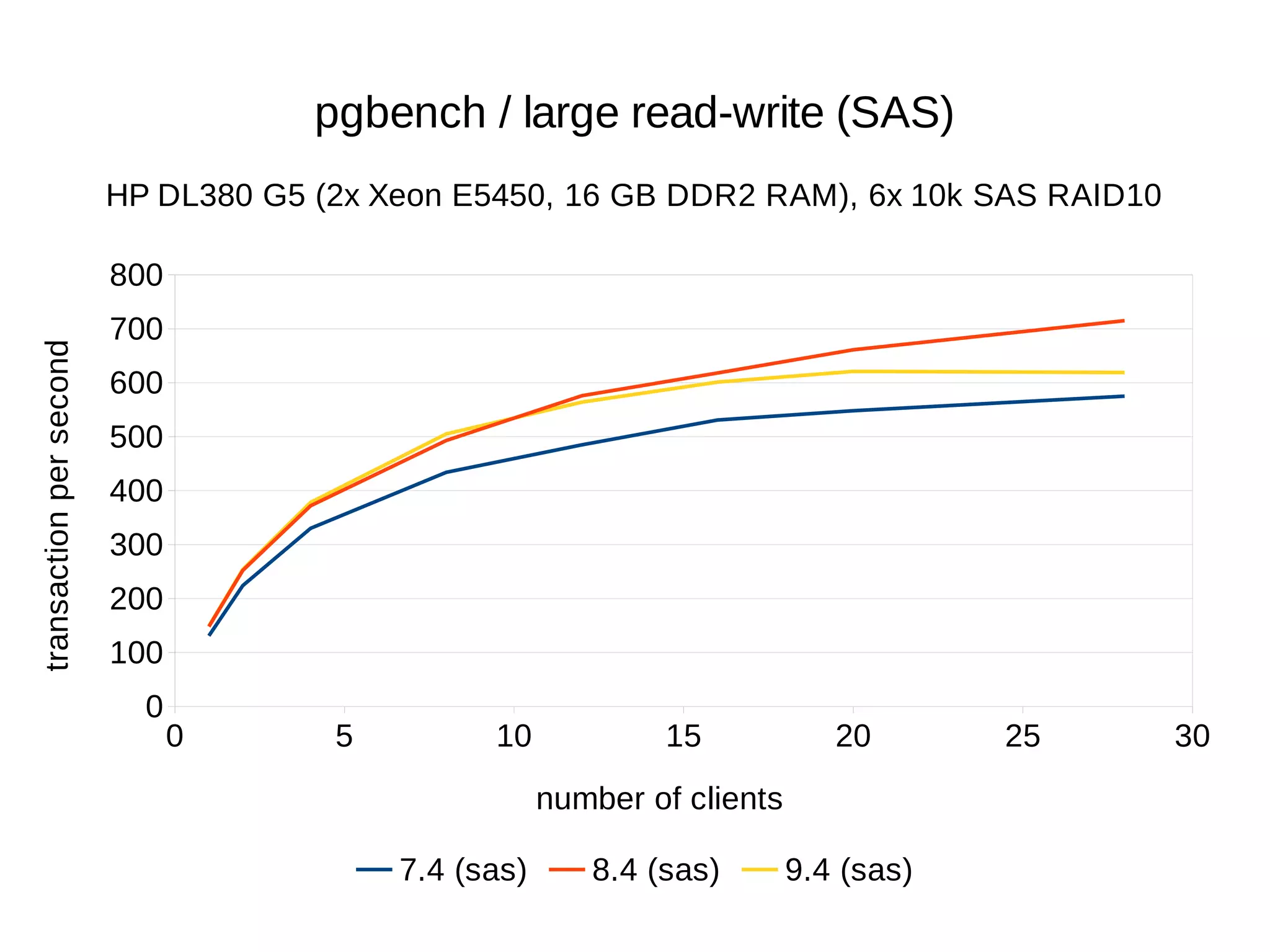
pgbench / large read-write (SAS) 
HP DL380 G5 (2x Xeon E5450, 16 GB DDR2 RAM), 6x 10k SAS RAID10 
number of clients 
7.4 (sas) 8.4 (sas) 9.4 (sas) 
transaction per second
What about a different machine?
Alternative hardware 
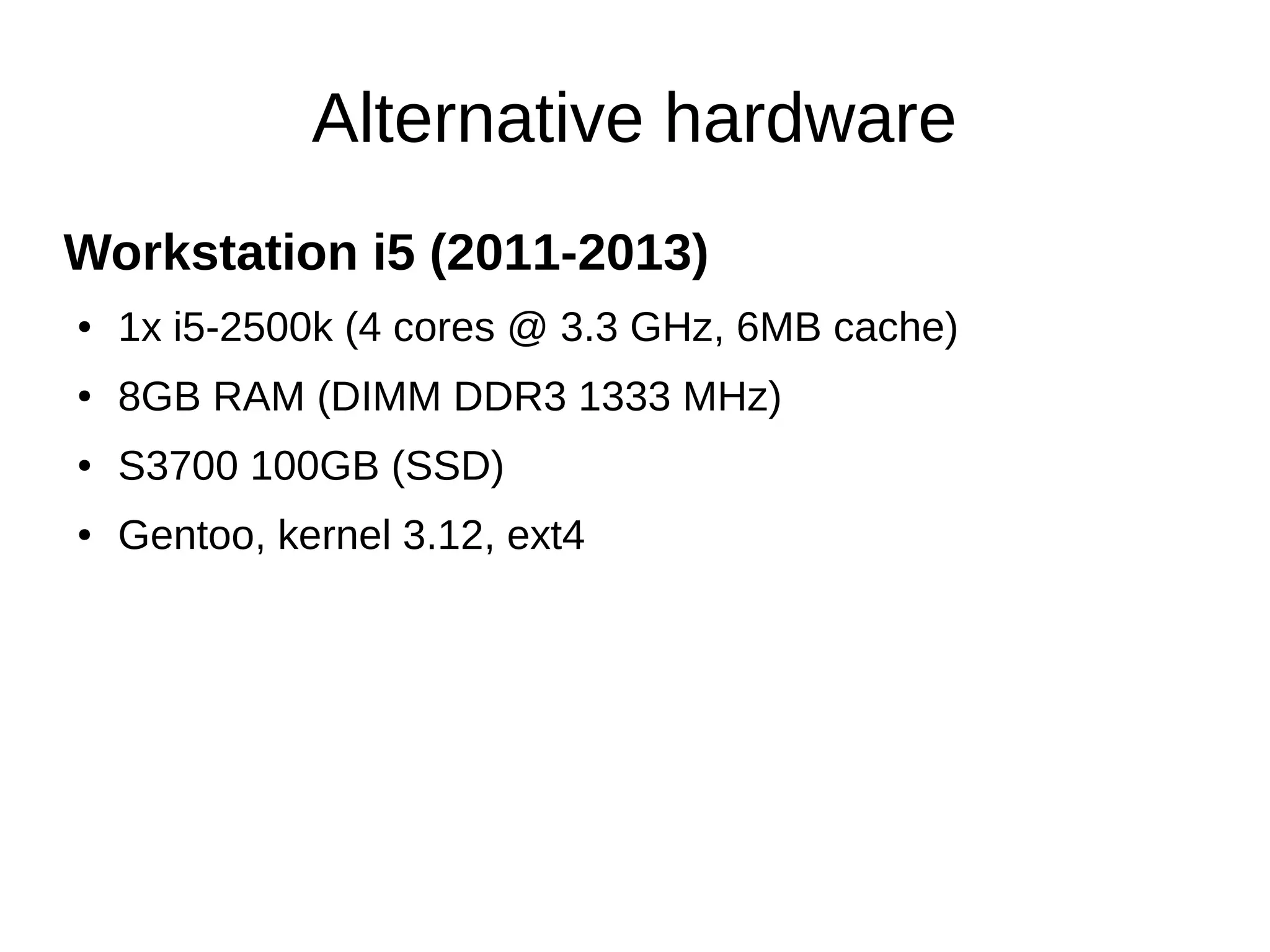
Workstation i5 (2011-2013) 
● 1x i5-2500k (4 cores @ 3.3 GHz, 6MB cache) 
● 8GB RAM (DIMM DDR3 1333 MHz) 
● S3700 100GB (SSD) 
● Gentoo, kernel 3.12, ext4
0 5 10 15 20 25 30 35 
40000 
35000 
30000 
25000 
20000 
15000 
10000 
5000 
0 
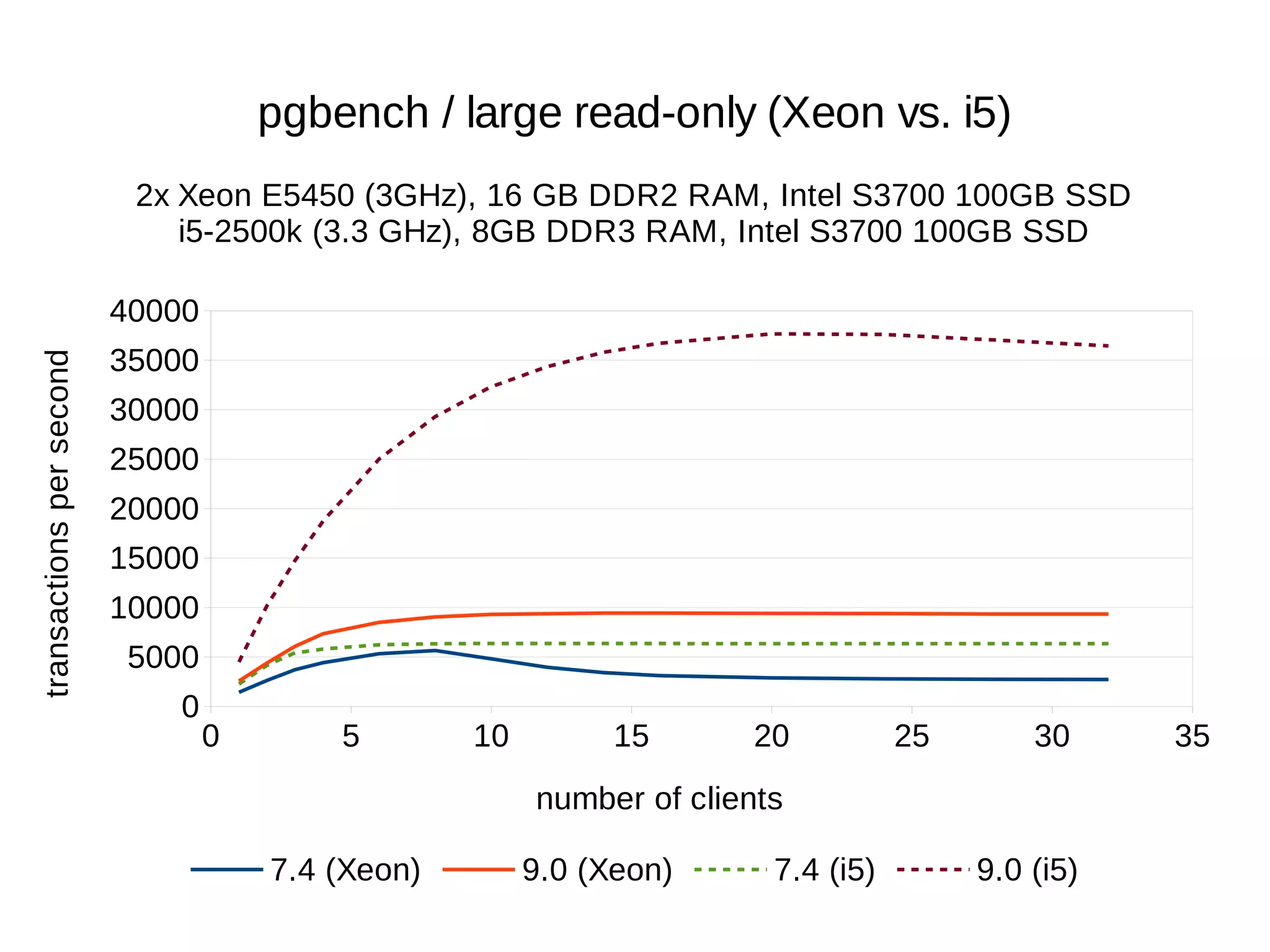
pgbench / large read-only (Xeon vs. i5) 
2x Xeon E5450 (3GHz), 16 GB DDR2 RAM, Intel S3700 100GB SSD 
i5-2500k (3.3 GHz), 8GB DDR3 RAM, Intel S3700 100GB SSD 
number of clients 
7.4 (Xeon) 9.0 (Xeon) 7.4 (i5) 9.0 (i5) 
transactions per second
0 5 10 15 20 25 30 35 
100000 
80000 
60000 
40000 
20000 
0 
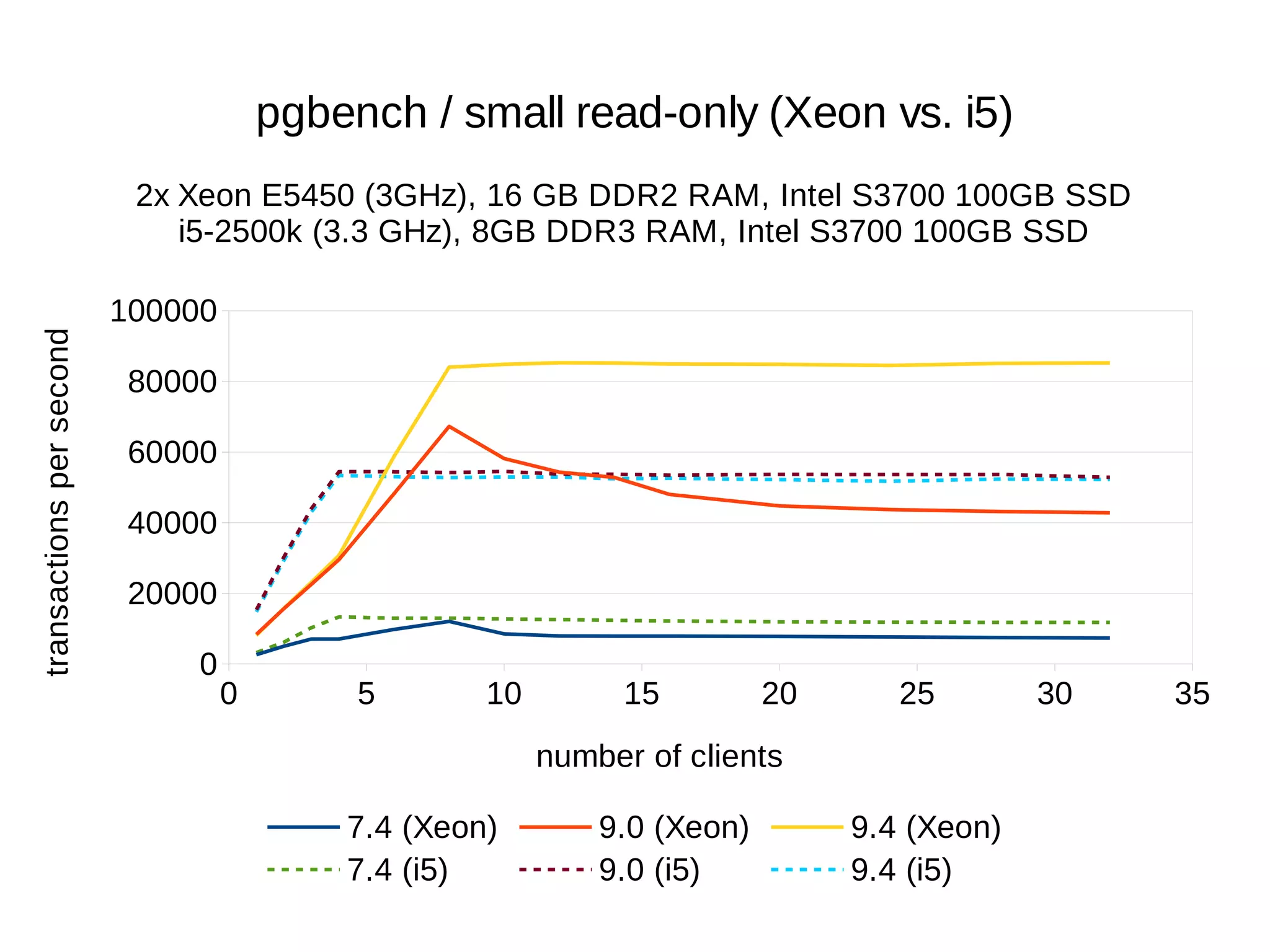
pgbench / small read-only (Xeon vs. i5) 
2x Xeon E5450 (3GHz), 16 GB DDR2 RAM, Intel S3700 100GB SSD 
i5-2500k (3.3 GHz), 8GB DDR3 RAM, Intel S3700 100GB SSD 
number of clients 
7.4 (Xeon) 9.0 (Xeon) 9.4 (Xeon) 
7.4 (i5) 9.0 (i5) 9.4 (i5) 
transactions per second
0 5 10 15 20 25 30 35 
8000 
7000 
6000 
5000 
4000 
3000 
2000 
1000 
0 
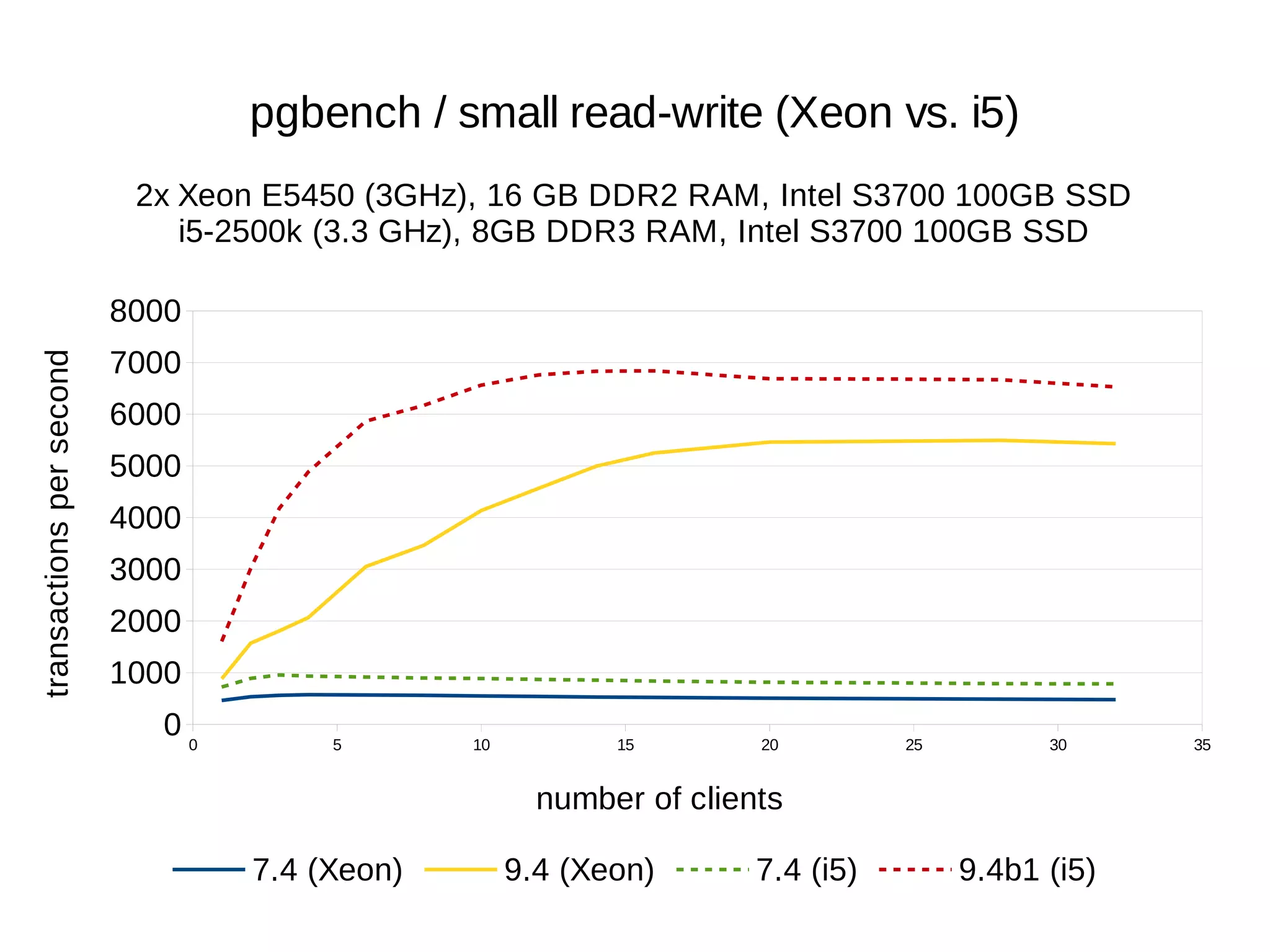
pgbench / small read-write (Xeon vs. i5) 
2x Xeon E5450 (3GHz), 16 GB DDR2 RAM, Intel S3700 100GB SSD 
i5-2500k (3.3 GHz), 8GB DDR3 RAM, Intel S3700 100GB SSD 
number of clients 
7.4 (Xeon) 9.4 (Xeon) 7.4 (i5) 9.4b1 (i5) 
transactions per second
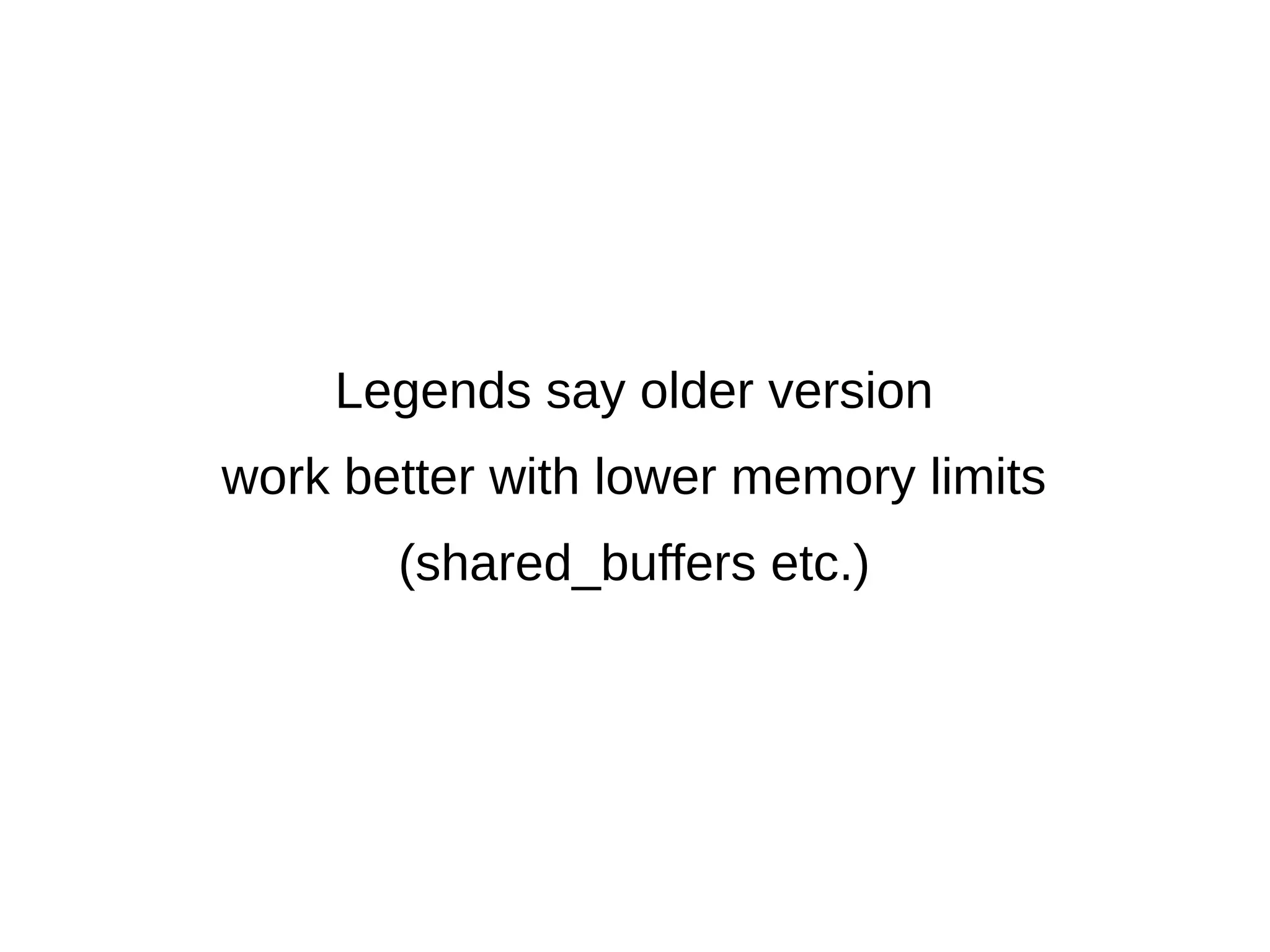
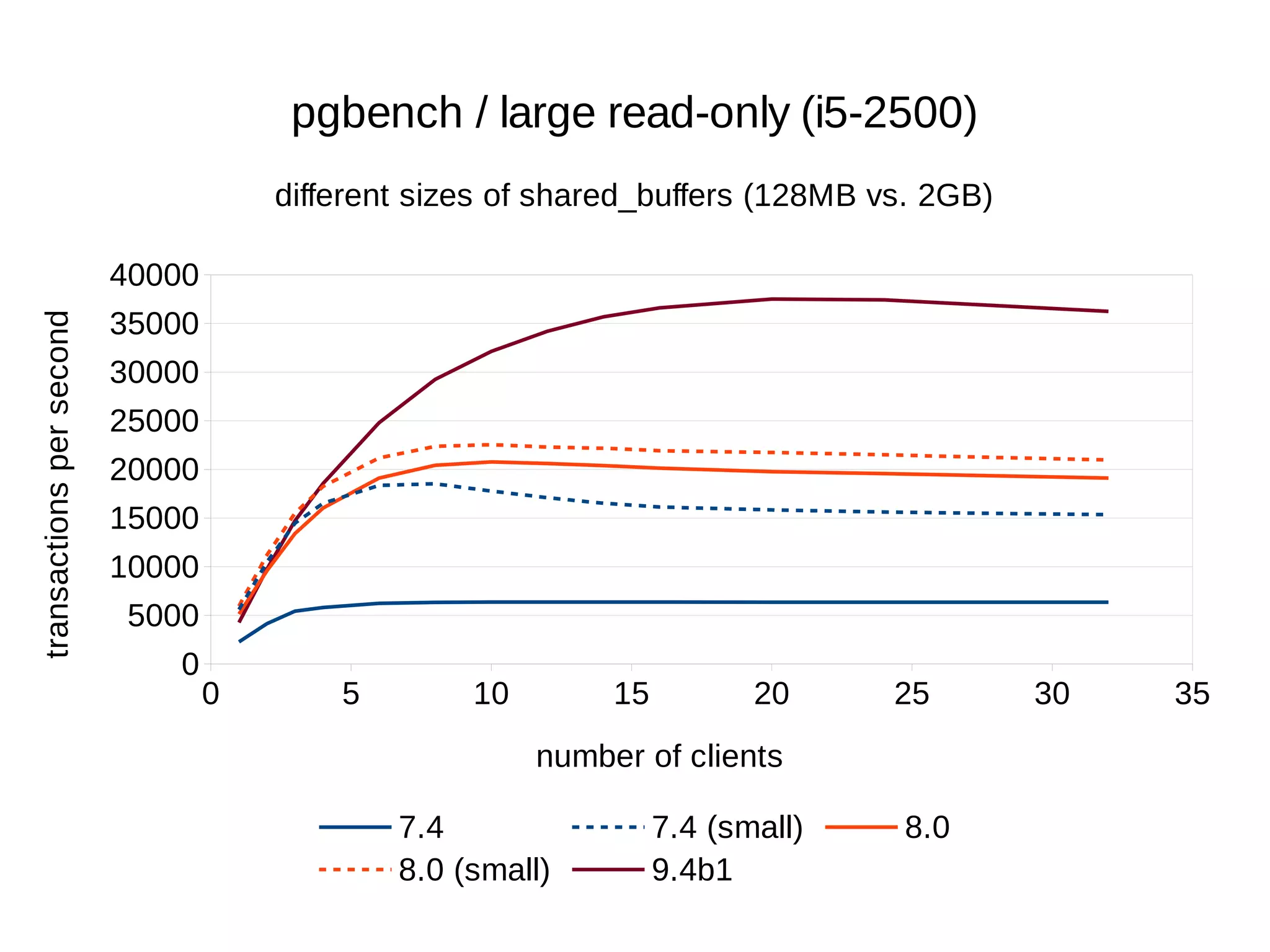
Legends say older version 
work better with lower memory limits 
(shared_buffers etc.)
0 5 10 15 20 25 30 35 
40000 
35000 
30000 
25000 
20000 
15000 
10000 
5000 
0 
pgbench / large read-only (i5-2500) 
different sizes of shared_buffers (128MB vs. 2GB) 
number of clients 
7.4 7.4 (small) 8.0 
8.0 (small) 9.4b1 
transactions per second
pgbench / summary 
● much better 
● improved locking 
– much better scalability to a lot of cores (>= 64) 
● a lot of different optimizations 
– significant improvements even for small client counts 
● lessons learned 
– CPU frequency is very poor measure 
– similarly for number of cores etc.
TPC-DS 
“Decision Support” benchmark 
(aka “Data Warehouse” benchmark)
TPC-DS 
● analytics workloads / warehousing 
– queries processing large data sets (GROUP BY, JOIN) 
– non-uniform distribution (more realistic than TPC-H) 
● 99 query templates defined (TPC-H just 22) 
– some broken (failing generator) 
– some unsupported (e.g. ROLLUP/CUBE) 
– 41 queries >= 7.4 
– 61 queries >= 8.4 (CTE, Window functions) 
– no query rewrites
TPC-DS 
● 1GB and 16GB datasets (raw data) 
– 1GB insufficient for publication, 16GB nonstandard (according to TPC) 
● interesting anyways ... 
– a lot of databases fit into 16GB 
– shows trends (applicable to large DBs) 
● schema 
– pretty much default (standard compliance FTW!) 
– same for all versions (indexes K/join keys, a few more indexes) 
– definitely room for improvements (per version, ...)
8.0 8.1 8.2 8.3 8.4 9.0 9.1 9.2 9.3 9.4 head 
7000 
6000 
5000 
4000 
3000 
2000 
1000 
0 
TPC DS / database size per 1GB raw data 
data indexes 
size [MB]
8.0 8.1 8.2 8.3 8.4 9.0 9.1 9.2 9.3 9.4 head 
1400 
1200 
1000 
800 
600 
400 
200 
0 
TPC DS / load duration (1GB) 
copy indexes vacuum full vacuum freeze analyze 
duration [s]
8.0 8.1 8.2 8.3 8.4 9.0 9.1 9.2 9.3 9.4 head 
1200 
1000 
800 
600 
400 
200 
0 
TPC DS / load duration (1GB) 
copy indexes vacuum freeze analyze 
duration [s]
8.0 8.1 8.2 8.3 8.4 9.0 9.1 9.2 9.3 9.4 
9000 
8000 
7000 
6000 
5000 
4000 
3000 
2000 
1000 
0 
TPC DS / load duration (16 GB) 
LOAD INDEXES VACUUM FREEZE ANALYZE duration [seconds]
8.0 8.1 8.2 8.3 8.4 9.0 9.1 9.2 9.3 9.4 head 
350 
300 
250 
200 
150 
100 
50 
0 
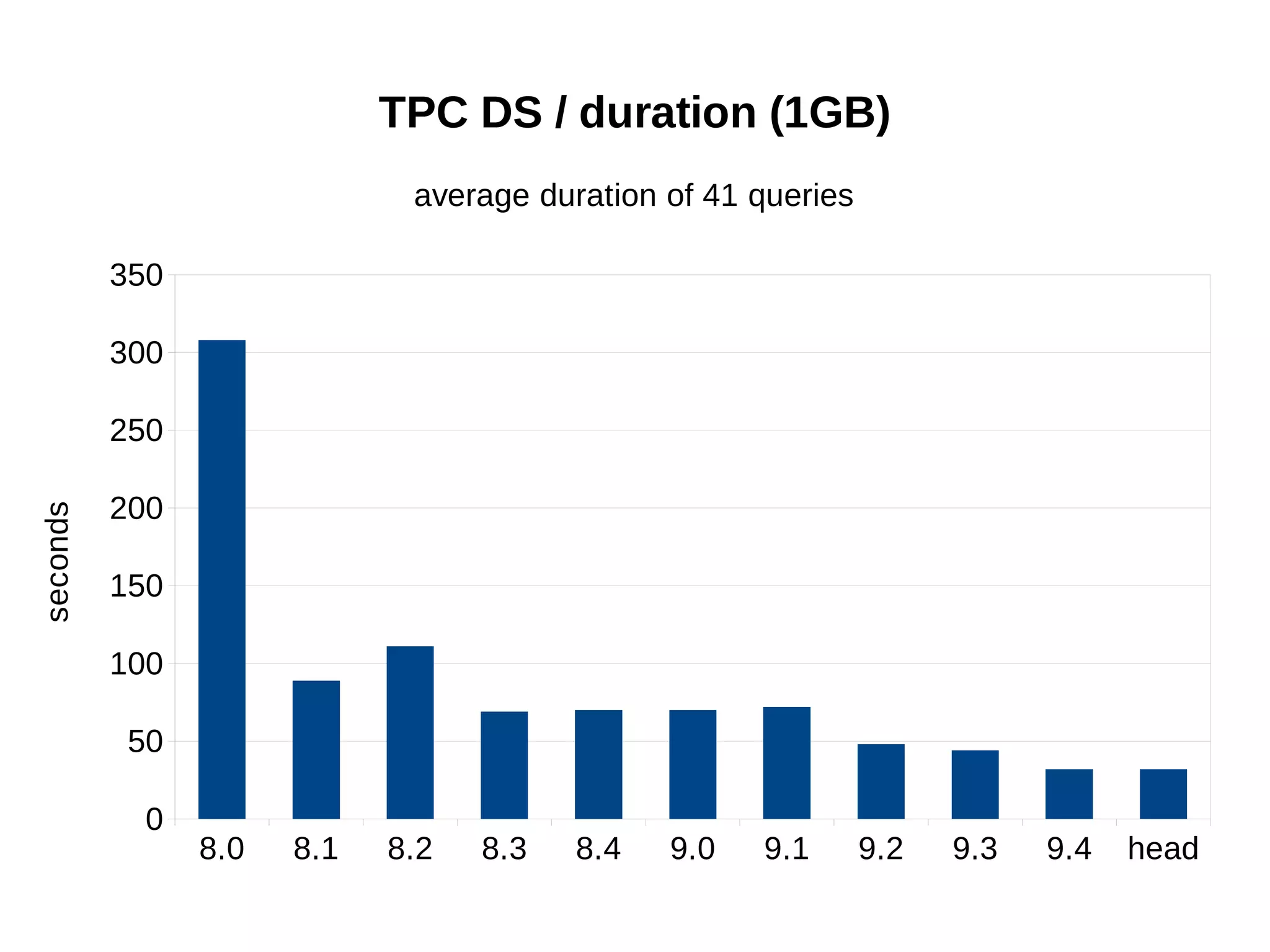
TPC DS / duration (1GB) 
average duration of 41 queries 
seconds
8.0* 8.1 8.2 8.3 8.4 9.0 9.1 9.2 9.3 9.4 
6000 
5000 
4000 
3000 
2000 
1000 
0 
TPC DS / duration (16 GB) 
average duration of 41 queries 
version 
duration [seconds]
TPC-DS / summary 
● data load much faster 
– most of the time spent on indexes (parallelize, RAM) 
– ignoring VACUUM FULL (different implementation 9.0) 
– slightly less space occupied 
● much faster queries 
– in total the speedup is ~6x 
– wider index usage, index only scans
Fulltext Benchmark 
testing GIN and GiST indexes 
through fulltext search
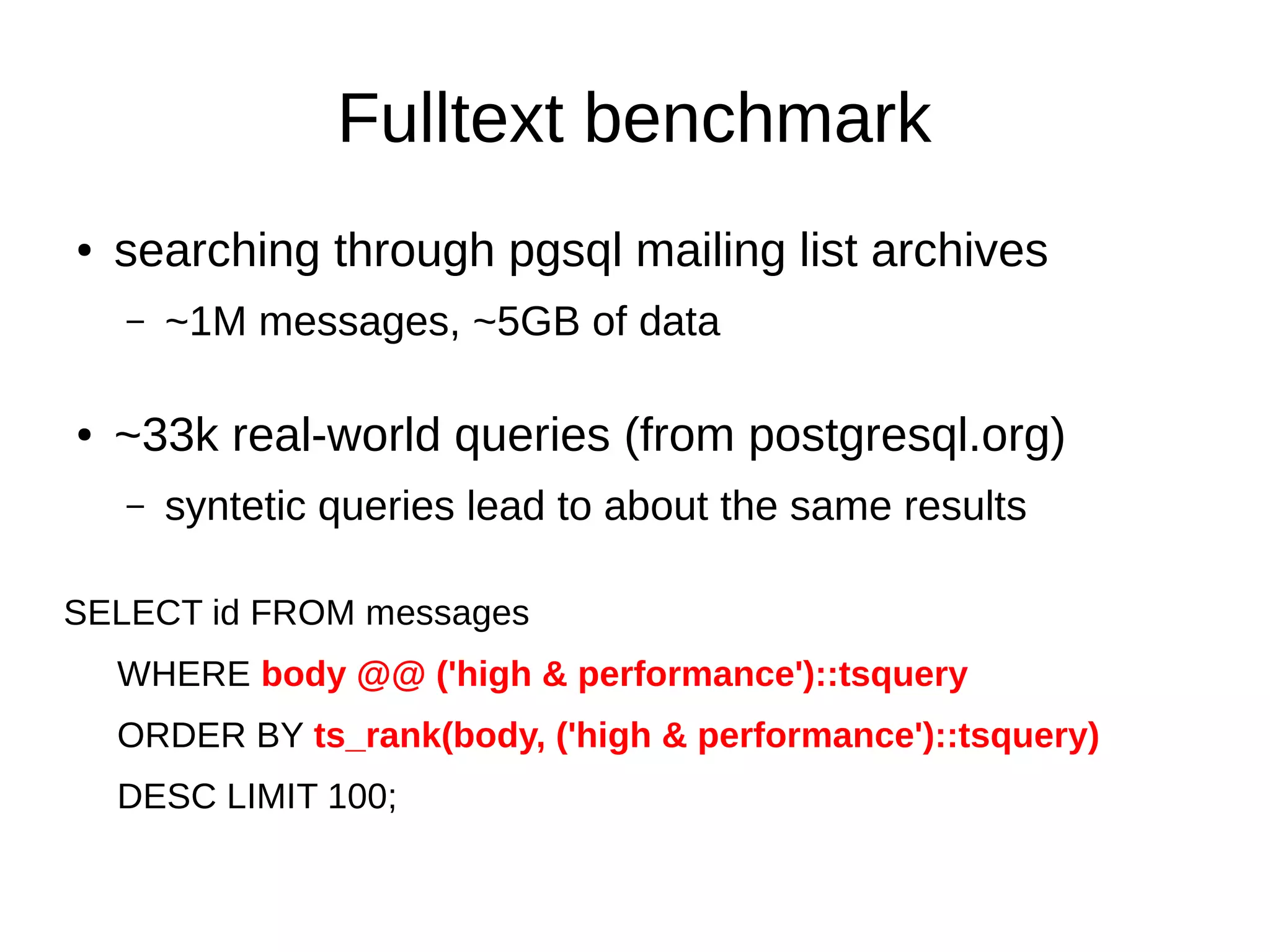
Fulltext benchmark 
● searching through pgsql mailing list archives 
– ~1M messages, ~5GB of data 
● ~33k real-world queries (from postgresql.org) 
– syntetic queries lead to about the same results 
SELECT id FROM messages 
WHERE body @@ ('high & performance')::tsquery 
ORDER BY ts_rank(body, ('high & performance')::tsquery) 
DESC LIMIT 100;
2000 
1800 
1600 
1400 
1200 
1000 
800 
600 
400 
200 
0 
Fulltext benchmark / load 
COPY / with indexes and PL/pgSQL triggers 
COPY VACUUM FREEZE ANALYZE 
duration [sec]
8.0 8.1 8.2 8.3 8.4 9.0 9.1 9.2 9.3 9.4 
6000 
5000 
4000 
3000 
2000 
1000 
0 
Fulltext benchmark / GiST 
33k queries from postgresql.org [TOP 100] 
total runtime [sec]
8.2 8.3 8.4 9.0 9.1 9.2 9.3 9.4 
800 
700 
600 
500 
400 
300 
200 
100 
0 
Fulltext benchmark / GIN 
33k queries from postgresql.org [TOP 100] 
total runtime [sec]
8.0 8.1 8.2 8.3 8.4 9.0 9.1 9.2 9.3 9.4 
6000 
5000 
4000 
3000 
2000 
1000 
0 
Fulltext benchmark - GiST vs. GIN 
33k queries from postgresql.org [TOP 100] 
GiST GIN 
total duration [sec]
9.4 durations, divided by 9.3 durations (e.g. 0.1 means 10x speedup) 
1.8 
1.6 
1.4 
1.2 
1 
0.8 
0.6 
0.4 
0.2 
0 
Fulltext benchmark / 9.3 vs. 9.4 (GIN fastscan) 
0.1 1 10 100 1000 
duration on 9.3 [miliseconds, log scale] 
9.4 duration (relative to 9.3)
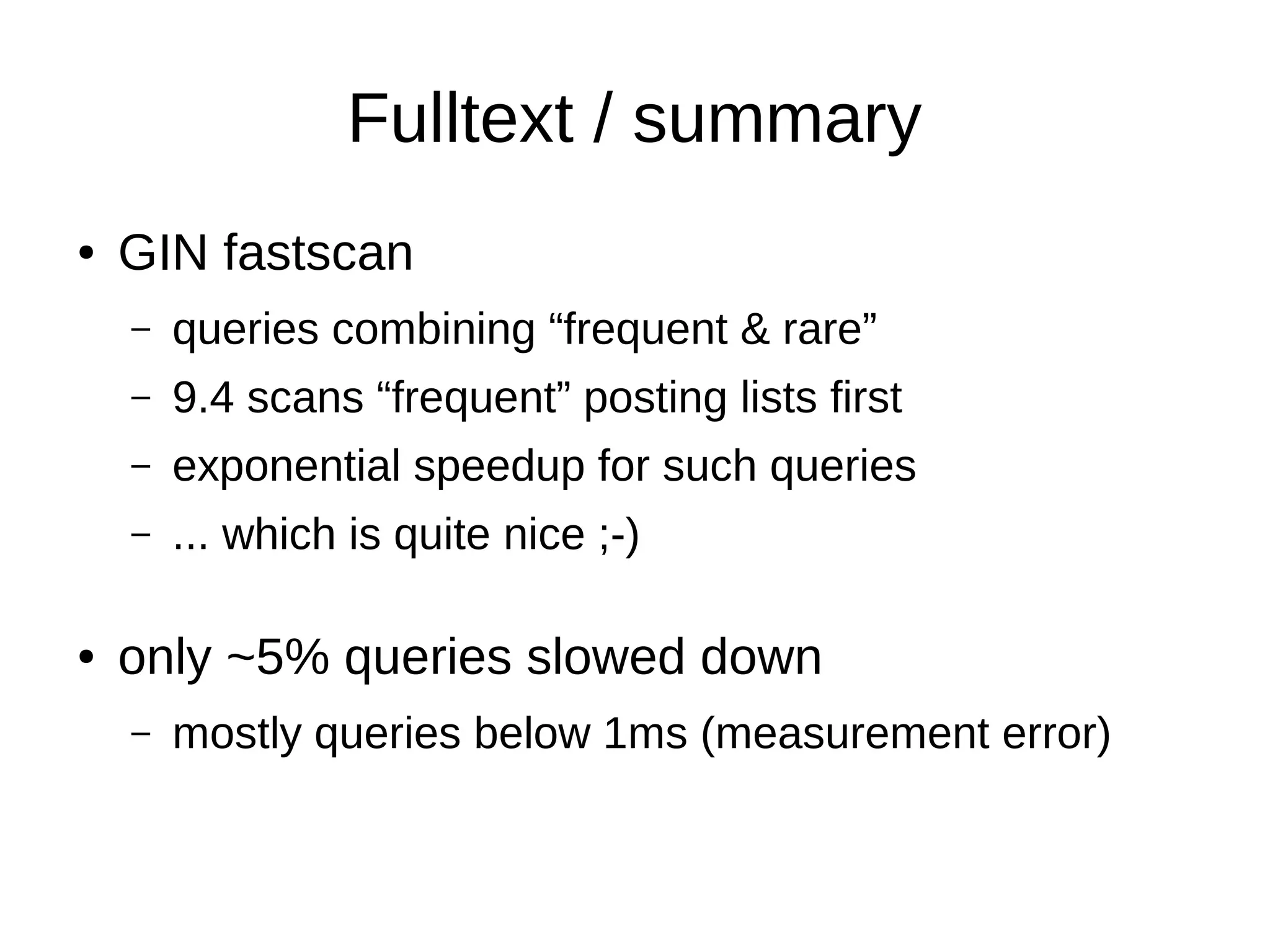
Fulltext / summary 
● GIN fastscan 
– queries combining “frequent & rare” 
– 9.4 scans “frequent” posting lists first 
– exponential speedup for such queries 
– ... which is quite nice ;-) 
● only ~5% queries slowed down 
– mostly queries below 1ms (measurement error)
http://blog.pgaddict.com 
http://planet.postgresql.org 
http://slidesha.re/1CUv3xO

PostgreSQL performance archaeology

  • 1.
    Performance Archaeology TomášVondra, GoodData tomas.vondra@gooddata.com / tomas@pgaddict.com @fuzzycz, http://blog.pgaddict.com Photo by Jason Quinlan, Creative Commons CC-BY-NC-SA https://www.flickr.com/photos/catalhoyuk/9400568431
  • 2.
    How did thePostgreSQL performance evolve over the time? 7.4 released 2003, i.e. ~10 years
  • 3.
    (surprisingly) tricky question ● usually “partial” tests during development – compare two versions / commits – focused on a particular part of the code / feature ● more complex benchmarks compare two versions – difficult to “combine” (different hardware, ...) ● application performance (ultimate benchmark) – apps are subject to (regulard) hardware upgrades – amounts of data grow, applications evolve (new features)
  • 4.
    (somehow) unfair question ● we do develop within context of the current hardware – How much RAM did you use 10 years ago? – Who of you had SSD/NVRAM drives 10 years ago? – How common were machines with 8 cores? ● some differences are consequence of these changes ● a lot of stuff was improved outside PostgreSQL (ext3 -> ext4) Better performance on current hardware is always nice ;-)
  • 5.
    Let's do somebenchmarks!
  • 6.
    short version: We'remuch faster and more scalable.
  • 7.
    If you're scaredof numbers or charts, you should probably leave now.
  • 8.
  • 9.
    Benchmarks (overview) ●pgbench (TPC-B) – “transactional” benchmark – operations work with small row sets (access through PKs, ...) ● TPC-DS (replaces TPC-H) – “warehouse” benchmark – queries chewing large amounts of data (aggregations, joins, ROLLUP/CUBE, ...) ● fulltext benchmark (tsearch2) – primarily about improvements of GIN/GiST indexes – now just fulltext, there are many other uses for GIN/GiST (geo, ...)
  • 10.
    Hardware used HPDL380 G5 (2007-2009) ● 2x Xeon E5450 (each 4 cores @ 3GHz, 12MB cache) ● 16GB RAM (FB-DIMM DDR2 667 MHz), FSB 1333 MHz ● S3700 100GB (SSD) ● 6x10k RAID10 (SAS) @ P400 with 512MB write cache ● Scientific Linux 6.5 / kernel 2.6.32, ext4
  • 11.
  • 12.
    pgbench ● threedataset sizes – small (150 MB) – medium (~50% RAM) – large (~200% RAM) ● two modes – read-only and read-write ● client counts (1, 2, 4, ..., 32) ● 3 runs / 30 minute each (per combination)
  • 13.
    pgbench ● threedataset sizes – small (150 MB) <– locking issues, etc. – medium (~50% RAM) <– CPU bound – large (~200% RAM) <– I/O bound ● two modes – read-only and read-write ● client counts (1, 2, 4, ..., 32) ● 3 runs / 30 minute each (per combination)
  • 14.
    BEGIN; UPDATE accountsSET abalance = abalance + :delta WHERE aid = :aid; SELECT abalance FROM accounts WHERE aid = :aid; UPDATE tellers SET tbalance = tbalance + :delta WHERE tid = :tid; UPDATE branches SET bbalance = bbalance + :delta WHERE bid = :bid; INSERT INTO history (tid, bid, aid, delta, mtime) VALUES (:tid, :bid, :aid, :delta, CURRENT_TIMESTAMP); END;
  • 15.
    0 5 1015 20 25 30 35 12000 10000 8000 6000 4000 2000 0 pgbench / large read-only (on SSD) HP DL380 G5 (2x Xeon E5450, 16 GB DDR2 RAM), Intel S3700 100GB SSD number of clients 7.4 8.0 8.1 head transactions per second
  • 16.
    0 5 1015 20 25 30 35 80000 70000 60000 50000 40000 30000 20000 10000 0 pgbench / medium read-only (SSD) HP DL380 G5 (2x Xeon E5450, 16 GB DDR2 RAM), Intel S3700 100GB SSD number of clients 7.4 8.0 8.1 8.2 8.3 9.0 9.2 transactions per second
  • 17.
    0 5 1015 20 25 30 35 3000 2500 2000 1500 1000 500 0 pgbench / large read-write (SSD) HP DL380 G5 (2x Xeon E5450, 16 GB DDR2 RAM), Intel S3700 100GB SSD number of clients 7.4 8.1 8.3 9.1 9.2 transactions per second
  • 18.
    0 5 1015 20 25 30 35 6000 5000 4000 3000 2000 1000 0 pgbench / small read-write (SSD) HP DL380 G5 (2x Xeon E5450, 16 GB DDR2 RAM), Intel S3700 100GB SSD number of clients 7.4 8.0 8.1 8.2 8.3 8.4 9.0 9.2 transactions per second
  • 19.
    What about rotationaldrives? 6 x 10k SAS drives (RAID 10) P400 with 512MB write cache
  • 20.
    0 5 1015 20 25 30 800 700 600 500 400 300 200 100 0 pgbench / large read-write (SAS) HP DL380 G5 (2x Xeon E5450, 16 GB DDR2 RAM), 6x 10k SAS RAID10 number of clients 7.4 (sas) 8.4 (sas) 9.4 (sas) transaction per second
  • 21.
    What about adifferent machine?
  • 22.
    Alternative hardware Workstationi5 (2011-2013) ● 1x i5-2500k (4 cores @ 3.3 GHz, 6MB cache) ● 8GB RAM (DIMM DDR3 1333 MHz) ● S3700 100GB (SSD) ● Gentoo, kernel 3.12, ext4
  • 23.
    0 5 1015 20 25 30 35 40000 35000 30000 25000 20000 15000 10000 5000 0 pgbench / large read-only (Xeon vs. i5) 2x Xeon E5450 (3GHz), 16 GB DDR2 RAM, Intel S3700 100GB SSD i5-2500k (3.3 GHz), 8GB DDR3 RAM, Intel S3700 100GB SSD number of clients 7.4 (Xeon) 9.0 (Xeon) 7.4 (i5) 9.0 (i5) transactions per second
  • 24.
    0 5 1015 20 25 30 35 100000 80000 60000 40000 20000 0 pgbench / small read-only (Xeon vs. i5) 2x Xeon E5450 (3GHz), 16 GB DDR2 RAM, Intel S3700 100GB SSD i5-2500k (3.3 GHz), 8GB DDR3 RAM, Intel S3700 100GB SSD number of clients 7.4 (Xeon) 9.0 (Xeon) 9.4 (Xeon) 7.4 (i5) 9.0 (i5) 9.4 (i5) transactions per second
  • 25.
    0 5 1015 20 25 30 35 8000 7000 6000 5000 4000 3000 2000 1000 0 pgbench / small read-write (Xeon vs. i5) 2x Xeon E5450 (3GHz), 16 GB DDR2 RAM, Intel S3700 100GB SSD i5-2500k (3.3 GHz), 8GB DDR3 RAM, Intel S3700 100GB SSD number of clients 7.4 (Xeon) 9.4 (Xeon) 7.4 (i5) 9.4b1 (i5) transactions per second
  • 26.
    Legends say olderversion work better with lower memory limits (shared_buffers etc.)
  • 27.
    0 5 1015 20 25 30 35 40000 35000 30000 25000 20000 15000 10000 5000 0 pgbench / large read-only (i5-2500) different sizes of shared_buffers (128MB vs. 2GB) number of clients 7.4 7.4 (small) 8.0 8.0 (small) 9.4b1 transactions per second
  • 28.
    pgbench / summary ● much better ● improved locking – much better scalability to a lot of cores (>= 64) ● a lot of different optimizations – significant improvements even for small client counts ● lessons learned – CPU frequency is very poor measure – similarly for number of cores etc.
  • 29.
    TPC-DS “Decision Support”benchmark (aka “Data Warehouse” benchmark)
  • 30.
    TPC-DS ● analyticsworkloads / warehousing – queries processing large data sets (GROUP BY, JOIN) – non-uniform distribution (more realistic than TPC-H) ● 99 query templates defined (TPC-H just 22) – some broken (failing generator) – some unsupported (e.g. ROLLUP/CUBE) – 41 queries >= 7.4 – 61 queries >= 8.4 (CTE, Window functions) – no query rewrites
  • 31.
    TPC-DS ● 1GBand 16GB datasets (raw data) – 1GB insufficient for publication, 16GB nonstandard (according to TPC) ● interesting anyways ... – a lot of databases fit into 16GB – shows trends (applicable to large DBs) ● schema – pretty much default (standard compliance FTW!) – same for all versions (indexes K/join keys, a few more indexes) – definitely room for improvements (per version, ...)
  • 32.
    8.0 8.1 8.28.3 8.4 9.0 9.1 9.2 9.3 9.4 head 7000 6000 5000 4000 3000 2000 1000 0 TPC DS / database size per 1GB raw data data indexes size [MB]
  • 33.
    8.0 8.1 8.28.3 8.4 9.0 9.1 9.2 9.3 9.4 head 1400 1200 1000 800 600 400 200 0 TPC DS / load duration (1GB) copy indexes vacuum full vacuum freeze analyze duration [s]
  • 34.
    8.0 8.1 8.28.3 8.4 9.0 9.1 9.2 9.3 9.4 head 1200 1000 800 600 400 200 0 TPC DS / load duration (1GB) copy indexes vacuum freeze analyze duration [s]
  • 35.
    8.0 8.1 8.28.3 8.4 9.0 9.1 9.2 9.3 9.4 9000 8000 7000 6000 5000 4000 3000 2000 1000 0 TPC DS / load duration (16 GB) LOAD INDEXES VACUUM FREEZE ANALYZE duration [seconds]
  • 36.
    8.0 8.1 8.28.3 8.4 9.0 9.1 9.2 9.3 9.4 head 350 300 250 200 150 100 50 0 TPC DS / duration (1GB) average duration of 41 queries seconds
  • 37.
    8.0* 8.1 8.28.3 8.4 9.0 9.1 9.2 9.3 9.4 6000 5000 4000 3000 2000 1000 0 TPC DS / duration (16 GB) average duration of 41 queries version duration [seconds]
  • 38.
    TPC-DS / summary ● data load much faster – most of the time spent on indexes (parallelize, RAM) – ignoring VACUUM FULL (different implementation 9.0) – slightly less space occupied ● much faster queries – in total the speedup is ~6x – wider index usage, index only scans
  • 39.
    Fulltext Benchmark testingGIN and GiST indexes through fulltext search
  • 40.
    Fulltext benchmark ●searching through pgsql mailing list archives – ~1M messages, ~5GB of data ● ~33k real-world queries (from postgresql.org) – syntetic queries lead to about the same results SELECT id FROM messages WHERE body @@ ('high & performance')::tsquery ORDER BY ts_rank(body, ('high & performance')::tsquery) DESC LIMIT 100;
  • 41.
    2000 1800 1600 1400 1200 1000 800 600 400 200 0 Fulltext benchmark / load COPY / with indexes and PL/pgSQL triggers COPY VACUUM FREEZE ANALYZE duration [sec]
  • 42.
    8.0 8.1 8.28.3 8.4 9.0 9.1 9.2 9.3 9.4 6000 5000 4000 3000 2000 1000 0 Fulltext benchmark / GiST 33k queries from postgresql.org [TOP 100] total runtime [sec]
  • 43.
    8.2 8.3 8.49.0 9.1 9.2 9.3 9.4 800 700 600 500 400 300 200 100 0 Fulltext benchmark / GIN 33k queries from postgresql.org [TOP 100] total runtime [sec]
  • 44.
    8.0 8.1 8.28.3 8.4 9.0 9.1 9.2 9.3 9.4 6000 5000 4000 3000 2000 1000 0 Fulltext benchmark - GiST vs. GIN 33k queries from postgresql.org [TOP 100] GiST GIN total duration [sec]
  • 45.
    9.4 durations, dividedby 9.3 durations (e.g. 0.1 means 10x speedup) 1.8 1.6 1.4 1.2 1 0.8 0.6 0.4 0.2 0 Fulltext benchmark / 9.3 vs. 9.4 (GIN fastscan) 0.1 1 10 100 1000 duration on 9.3 [miliseconds, log scale] 9.4 duration (relative to 9.3)
  • 46.
    Fulltext / summary ● GIN fastscan – queries combining “frequent & rare” – 9.4 scans “frequent” posting lists first – exponential speedup for such queries – ... which is quite nice ;-) ● only ~5% queries slowed down – mostly queries below 1ms (measurement error)
  • 47.