Version 8.4
Holy Frijole,
That's a lot of features!
                               February 2009
                                San Franciso
          Josh Berkus, PostgreSQL Core Team
8.4: A Few Patches
8.4: A Few Patches
 5 CommitFests
8.4: A Few Patches
    5 CommitFests

9 Months of Development
8.4: A Few Patches
    5 CommitFests

9 Months of Development

Over 1600 GIT Updates
8.4: A Few Patches
         5 CommitFests

    9 Months of Development

     Over 1600 GIT Updates

More Than 2 Dozen Major Features
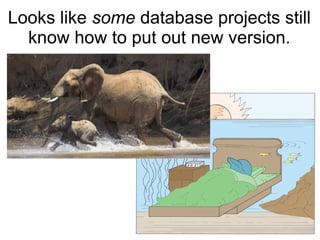
Looks like some database projects still
  know how to put out new version.
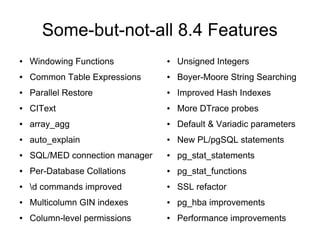
Some-but-not-all 8.4 Features
●   Windowing Functions          ●   Unsigned Integers
●   Common Table Expressions     ●   Boyer-Moore String Searching
●   Parallel Restore             ●   Improved Hash Indexes
●   CIText                       ●   More DTrace probes
●   array_agg                    ●   Default & Variadic parameters
●   auto_explain                 ●   New PL/pgSQL statements
●   SQL/MED connection manager   ●   pg_stat_statements
●   Per-Database Collations      ●   pg_stat_functions
●   d commands improved         ●   SSL refactor
●   Multicolumn GIN indexes      ●   pg_hba improvements
●   Column-level permissions     ●   Performance improvements
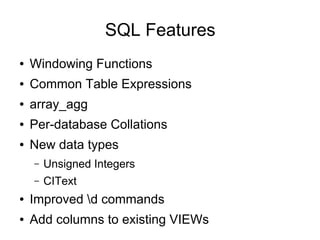
SQL Features
●   Windowing Functions
●   Common Table Expressions
●   array_agg
●   Per-database Collations
●   New data types
    –   Unsigned Integers
    –   CIText
●   Improved d commands
●   Add columns to existing VIEWs
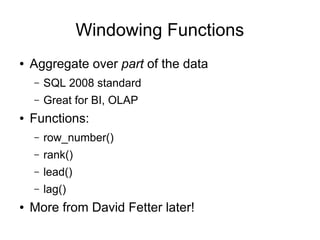
Windowing Functions
●   Aggregate over part of the data
    –   SQL 2008 standard
    –   Great for BI, OLAP
●   Functions:
    –   row_number()
    –   rank()
    –   lead()
    –   lag()
●   More from David Fetter later!
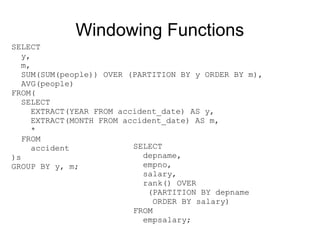
Windowing Functions
SELECT
   y,
   m,
   SUM(SUM(people)) OVER (PARTITION BY y ORDER BY m),
   AVG(people)
FROM(
   SELECT
     EXTRACT(YEAR FROM accident_date) AS y,
     EXTRACT(MONTH FROM accident_date) AS m,
     *
   FROM
     accident             SELECT
)s                          depname,
GROUP BY y, m;              empno,
                            salary,
                            rank() OVER
                             (PARTITION BY depname
                               ORDER BY salary)
                          FROM
                            empsalary;
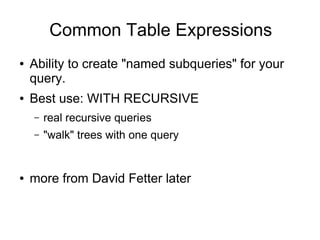
Common Table Expressions
●   Ability to create "named subqueries" for your
    query.
●   Best use: WITH RECURSIVE
    –   real recursive queries
    –   "walk" trees with one query


●   more from David Fetter later
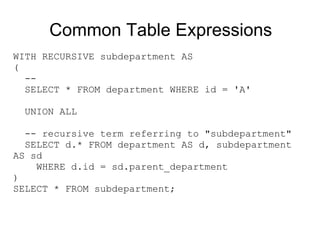
Common Table Expressions
WITH RECURSIVE subdepartment AS
(
  --
  SELECT * FROM department WHERE id = 'A'

  UNION ALL

  -- recursive term referring to "subdepartment"
  SELECT d.* FROM department AS d, subdepartment
AS sd
    WHERE d.id = sd.parent_department
)
SELECT * FROM subdepartment;
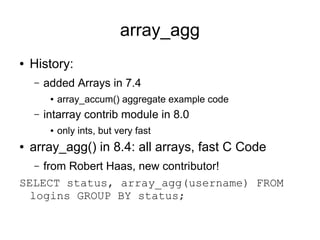
array_agg
●   History:
    –   added Arrays in 7.4
         ●   array_accum() aggregate example code
    –   intarray contrib module in 8.0
         ●   only ints, but very fast
●   array_agg() in 8.4: all arrays, fast C Code
    from Robert Haas, new contributor!
    –

SELECT status, array_agg(username) FROM
  logins GROUP BY status;
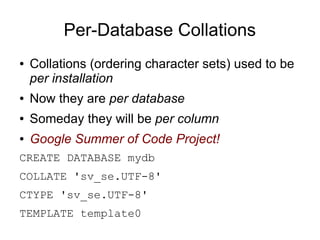
Per-Database Collations
●   Collations (ordering character sets) used to be
    per installation
●   Now they are per database
●   Someday they will be per column
●   Google Summer of Code Project!
CREATE DATABASE mydb
COLLATE 'sv_se.UTF-8'
CTYPE 'sv_se.UTF-8'
TEMPLATE template0
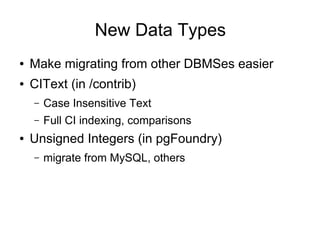
New Data Types
●   Make migrating from other DBMSes easier
●   CIText (in /contrib)
    –   Case Insensitive Text
    –   Full CI indexing, comparisons
●   Unsigned Integers (in pgFoundry)
    –   migrate from MySQL, others
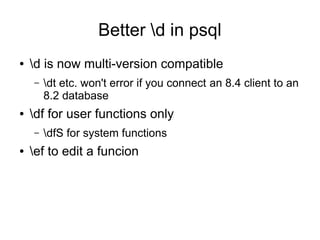
Better d in psql
●   d is now multi-version compatible
    –   dt etc. won't error if you connect an 8.4 client to an
        8.2 database
●   df for user functions only
    –   dfS for system functions
●   ef to edit a funcion
Add columns to VIEWs
●   In the bad old days:
    –   need to add another column to your VIEW?
    –   have to drop it & recreate it
    –   have to drop & recreate all dependancies
    –   enter the World Of Pain
●   In 8.4:
    –   ALTER VIEW lets you add columns
    –   Can't rename or modify though
Performance & Monitoring
●   Parallel Restore
●   Improved Hash Indexes
●   pg_stat_user_functions
●   pg_stat_statements
●   More Dtrace probes
●   auto_explain
●   Other Performance Improvements
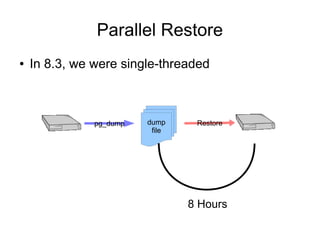
Parallel Restore
●   In 8.3, we were single-threaded


               pg_dump   dump     Restore
                          file


                                 8 Hours
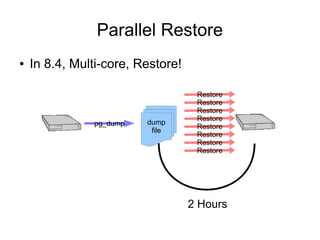
Parallel Restore
●   In 8.4, Multi-core, Restore!

                                    Restore
                                    Restore
                                    Restore
                                    Restore
               pg_dump   dump
                                    Restore
                          file
                                    Restore
                                    Restore
                                    Restore


                                   2 Hours
Improved Hash Indexes
●   Our old hash indexes were slow and useless
●   Improved hash indexes are fast!
    –   use them for ID columns
         ●   or other unique keys
    –   not completely recovery-safe yet though
         ●   don't switch over production DBs until 8.5
●   Google Summer of Code project!
pg_stat_user_functions
●   For each of your functions, see
    –   # of times called
    –   amount of time spent
    –   amount of time spent excluding other functions
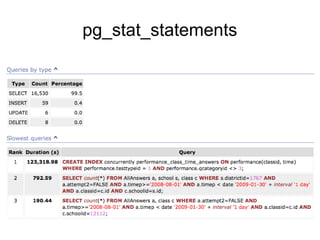
pg_stat_statements
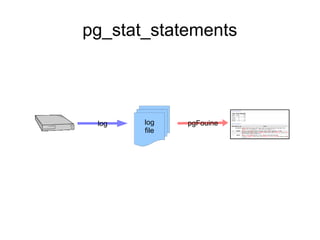
pg_stat_statements


 log   log    pgFouine
       file
pg_stat_statements
postgres=# SELECT * FROM pg_stat_statements ORDER BY total_time DESC
LIMIT 3;
-[ RECORD 1 ]------------------------------------------------------------
userid     | 10
dbid       | 63781
query      | UPDATE branches SET bbalance = bbalance + $1 WHERE bid = $2;
calls      | 3000
total_time | 20.716706
rows       | 3000
-[ RECORD 2 ]------------------------------------------------------------
userid     | 10
dbid       | 63781
query      | UPDATE tellers SET tbalance = tbalance + $1 WHERE tid = $2;
calls      | 3000
total_time | 17.1107649999999
rows       | 3000
-[ RECORD 3 ]------------------------------------------------------------
userid     | 10
dbid       | 63781
query      | UPDATE accounts SET abalance = abalance + $1 WHERE aid = $2;
calls      | 3000
total_time | 0.645601
rows       | 3000
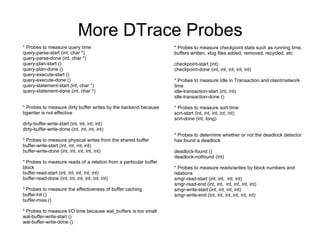
More DTrace Probes
* Probes to measure query time                                     * Probes to measure checkpoint stats such as running time,
query-parse-start (int, char *)                                    buffers written, xlog files added, removed, recycled, etc
query-parse-done (int, char *)
query-plan-start ()                                                checkpoint-start (int)
query-plan-done ()                                                 checkpoint-done (int, int, int, int, int)
query-execute-start ()
query-execute-done ()                                              * Probes to measure Idle in Transaction and client/network
query-statement-start (int, char *)                                time
query-statement-done (int, char *)                                 idle-transaction-start (int, int)
                                                                   idle-transaction-done ()

* Probes to measure dirty buffer writes by the backend because     * Probes to measure sort time
bgwriter is not effective                                          sort-start (int, int, int, int, int)
                                                                   sort-done (int, long)
dirty-buffer-write-start (int, int, int, int)
dirty-buffer-write-done (int, int, int, int)
                                                                   * Probes to determine whether or not the deadlock detector
* Probes to measure physical writes from the shared buffer         has found a deadlock
buffer-write-start (int, int, int, int)
buffer-write-done (int, int, int, int, int)                        deadlock-found ()
                                                                   deadlock-notfound (int)
* Probes to measure reads of a relation from a particular buffer
block                                                              * Probes to measure reads/writes by block numbers and
buffer-read-start (int, int, int, int, int)                        relations
buffer-read-done (int, int, int, int, int, int)                    smgr-read-start (int, int, int, int)
                                                                   smgr-read-end (int, int, int, int, int, int)
* Probes to measure the effectiveness of buffer caching            smgr-write-start (int, int, int, int)
buffer-hit ()                                                      smgr-write-end (int, int, int, int, int, int)
buffer-miss ()

* Probes to measure I/O time because wal_buffers is too small
wal-buffer-write-start ()
wal-buffer-write-done ()
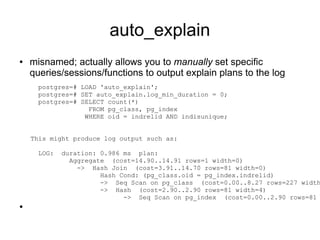
auto_explain
●   misnamed; actually allows you to manually set specific
    queries/sessions/functions to output explain plans to the log
      postgres=# LOAD 'auto_explain';
      postgres=# SET auto_explain.log_min_duration = 0;
      postgres=# SELECT count(*)
                   FROM pg_class, pg_index
                  WHERE oid = indrelid AND indisunique;


    This might produce log output such as:

      LOG:   duration: 0.986 ms plan:
               Aggregate (cost=14.90..14.91 rows=1 width=0)
                 -> Hash Join (cost=3.91..14.70 rows=81 width=0)
                       Hash Cond: (pg_class.oid = pg_index.indrelid)
                       -> Seq Scan on pg_class (cost=0.00..8.27 rows=227 width
                       -> Hash (cost=2.90..2.90 rows=81 width=4)
                             -> Seq Scan on pg_index (cost=0.00..2.90 rows=81
●
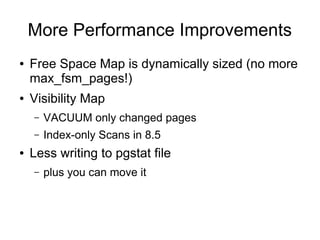
More Performance Improvements
●   Free Space Map is dynamically sized (no more
    max_fsm_pages!)
●   Visibility Map
    –   VACUUM only changed pages
    –   Index-only Scans in 8.5
●   Less writing to pgstat file
    –   plus you can move it
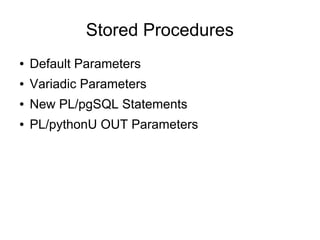
Stored Procedures
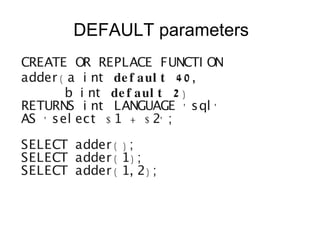
●   Default Parameters
●   Variadic Parameters
●   New PL/pgSQL Statements
●   PL/pythonU OUT Parameters
DEFAULT parameters
CREATE OR REPLACE FUNCTI ON
adder ) a i nt de f a ul t 4 0 ,
       b i nt de f a ul t 2 (
RETURNS i nt LANGUAGE ' sql '
AS ' sel ect $ 1 + $ 2' ;

SELECT adder ) ( ;
SELECT adder ) 1( ;
SELECT adder ) 1, 2( ;
VARIADIC parameters
CREATE OR REPLACE FUNCTION
  adder(VARIADIC v int[])
  RETURNS int AS $$
DECLARE s int; i int;
BEGIN
  s:=0;
  FOR i IN SELECT generate_subscripts(v,1) LOOP
     s := s + i;
  END LOOP;
RETURN s;
END;
$$ LANGUAGE 'plpgsql';

SELECT adder(1);
SELECT adder(1,2,3);
SELECT adder(40,2);
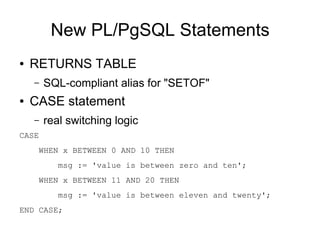
New PL/PgSQL Statements
●   RETURNS TABLE
    –   SQL-compliant alias for "SETOF"
●   CASE statement
    –   real switching logic
CASE
     WHEN x BETWEEN 0 AND 10 THEN
           msg := 'value is between zero and ten';
     WHEN x BETWEEN 11 AND 20 THEN
           msg := 'value is between eleven and twenty';
END CASE;
PL/pythonU OUT Parameters
●   You now can use IN, OUT and INOUT
    parameters with PL/pythonU functions.
●   That's it!
Exotic Features
●   SQL/MED Connection Manager
●   Multi-column GIN Indexes
●   Boyer-Moore String Searching
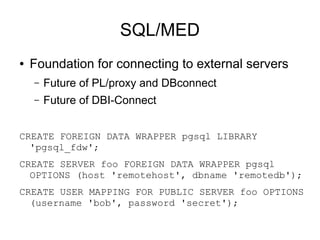
SQL/MED
●   Foundation for connecting to external servers
    –   Future of PL/proxy and DBconnect
    –   Future of DBI-Connect


CREATE FOREIGN DATA WRAPPER pgsql LIBRARY
  'pgsql_fdw';
CREATE SERVER foo FOREIGN DATA WRAPPER pgsql
  OPTIONS (host 'remotehost', dbname 'remotedb');
CREATE USER MAPPING FOR PUBLIC SERVER foo OPTIONS
  (username 'bob', password 'secret');
Multi-Column GIN Indexes
●   Bad Old Days: to do a single Full Text Search
    index over several columns, you had to
    concatenate them.
●   New Goodness: you can now do a proper
    multicolumn index
    –   and it's faster!
Boyer-Moore String Searching


   No, I don't know what it is either.


         But we have it now.
Security
●   Refactored SSL
●   Improved pg_hba.conf
●   Column-level Permissions
●   SE-Postgres
Refactored SSL              by Magnus


●   Proper certificate verification
    –   Choose level, full verification is default
●   Control over all key and certificate files
●   SSL certificate authentication
    –   Trusted root certificate
    –   Map «cn» value of certificate
pg_hba Improvements
●   "crypt" is gone (insecure)
●   «ident sameuser» => «ident»
●   New format for options
    –   name=value for all options
●   usermaps for all external methods
    –   with regexp support
●   Parsed on reload
Column Permissions
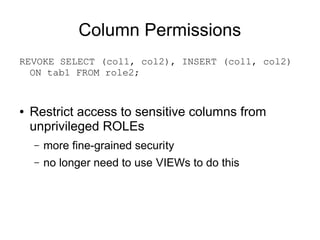
REVOKE SELECT (col1, col2), INSERT (col1, col2)
  ON tab1 FROM role2;


●   Restrict access to sensitive columns from
    unprivileged ROLEs
    –   more fine-grained security
    –   no longer need to use VIEWs to do this
PostgreSQL Needs YOU
Many Patches == Lots of Testing
●   Bug Testing
    –   can you make 8.4 crash?
●   Specification Testing
    –   do the features do what the docs say they do?
●   Performance Testing
    –   is 8.4 really faster? How much?
●   Combinational Testing
    –   what happens when you put several new features
        together?
Many Patches == Lots of Testing
1. Take a copy of your production applications
2. Port them to 8.4
3. Report breakage and issues
4. Play with implementing new features


               Do It Now!
          We're counting on you!
Contact Information
●   Josh Berkus                                       ●    Upcoming events
    –   josh@postgresql.org                                  –   SCALE 7, Los
    –   http://it.toolbox.com/                                   Angeles, Feb. 20
        blogs/database-soup                                  –   pgCon 2009, Ottawa,
                                                                 May 20


                  This talk is copyright 2009 Josh Berkus, and is licensed under the Creative Commons Attribution License

8.4 Upcoming Features

  • 1.
    Version 8.4 Holy Frijole, That'sa lot of features! February 2009 San Franciso Josh Berkus, PostgreSQL Core Team
  • 2.
    8.4: A FewPatches
  • 3.
    8.4: A FewPatches 5 CommitFests
  • 4.
    8.4: A FewPatches 5 CommitFests 9 Months of Development
  • 5.
    8.4: A FewPatches 5 CommitFests 9 Months of Development Over 1600 GIT Updates
  • 6.
    8.4: A FewPatches 5 CommitFests 9 Months of Development Over 1600 GIT Updates More Than 2 Dozen Major Features
  • 7.
    Looks like somedatabase projects still know how to put out new version.
  • 8.
    Some-but-not-all 8.4 Features ● Windowing Functions ● Unsigned Integers ● Common Table Expressions ● Boyer-Moore String Searching ● Parallel Restore ● Improved Hash Indexes ● CIText ● More DTrace probes ● array_agg ● Default & Variadic parameters ● auto_explain ● New PL/pgSQL statements ● SQL/MED connection manager ● pg_stat_statements ● Per-Database Collations ● pg_stat_functions ● d commands improved ● SSL refactor ● Multicolumn GIN indexes ● pg_hba improvements ● Column-level permissions ● Performance improvements
  • 9.
    SQL Features ● Windowing Functions ● Common Table Expressions ● array_agg ● Per-database Collations ● New data types – Unsigned Integers – CIText ● Improved d commands ● Add columns to existing VIEWs
  • 10.
    Windowing Functions ● Aggregate over part of the data – SQL 2008 standard – Great for BI, OLAP ● Functions: – row_number() – rank() – lead() – lag() ● More from David Fetter later!
  • 11.
    Windowing Functions SELECT y, m, SUM(SUM(people)) OVER (PARTITION BY y ORDER BY m), AVG(people) FROM( SELECT EXTRACT(YEAR FROM accident_date) AS y, EXTRACT(MONTH FROM accident_date) AS m, * FROM accident SELECT )s depname, GROUP BY y, m; empno, salary, rank() OVER (PARTITION BY depname ORDER BY salary) FROM empsalary;
  • 12.
    Common Table Expressions ● Ability to create "named subqueries" for your query. ● Best use: WITH RECURSIVE – real recursive queries – "walk" trees with one query ● more from David Fetter later
  • 13.
    Common Table Expressions WITHRECURSIVE subdepartment AS ( -- SELECT * FROM department WHERE id = 'A' UNION ALL -- recursive term referring to "subdepartment" SELECT d.* FROM department AS d, subdepartment AS sd WHERE d.id = sd.parent_department ) SELECT * FROM subdepartment;
  • 14.
    array_agg ● History: – added Arrays in 7.4 ● array_accum() aggregate example code – intarray contrib module in 8.0 ● only ints, but very fast ● array_agg() in 8.4: all arrays, fast C Code from Robert Haas, new contributor! – SELECT status, array_agg(username) FROM logins GROUP BY status;
  • 15.
    Per-Database Collations ● Collations (ordering character sets) used to be per installation ● Now they are per database ● Someday they will be per column ● Google Summer of Code Project! CREATE DATABASE mydb COLLATE 'sv_se.UTF-8' CTYPE 'sv_se.UTF-8' TEMPLATE template0
  • 16.
    New Data Types ● Make migrating from other DBMSes easier ● CIText (in /contrib) – Case Insensitive Text – Full CI indexing, comparisons ● Unsigned Integers (in pgFoundry) – migrate from MySQL, others
  • 17.
    Better d inpsql ● d is now multi-version compatible – dt etc. won't error if you connect an 8.4 client to an 8.2 database ● df for user functions only – dfS for system functions ● ef to edit a funcion
  • 18.
    Add columns toVIEWs ● In the bad old days: – need to add another column to your VIEW? – have to drop it & recreate it – have to drop & recreate all dependancies – enter the World Of Pain ● In 8.4: – ALTER VIEW lets you add columns – Can't rename or modify though
  • 19.
    Performance & Monitoring ● Parallel Restore ● Improved Hash Indexes ● pg_stat_user_functions ● pg_stat_statements ● More Dtrace probes ● auto_explain ● Other Performance Improvements
  • 20.
    Parallel Restore ● In 8.3, we were single-threaded pg_dump dump Restore file 8 Hours
  • 21.
    Parallel Restore ● In 8.4, Multi-core, Restore! Restore Restore Restore Restore pg_dump dump Restore file Restore Restore Restore 2 Hours
  • 22.
    Improved Hash Indexes ● Our old hash indexes were slow and useless ● Improved hash indexes are fast! – use them for ID columns ● or other unique keys – not completely recovery-safe yet though ● don't switch over production DBs until 8.5 ● Google Summer of Code project!
  • 23.
    pg_stat_user_functions ● For each of your functions, see – # of times called – amount of time spent – amount of time spent excluding other functions
  • 24.
  • 25.
    pg_stat_statements log log pgFouine file
  • 26.
    pg_stat_statements postgres=# SELECT *FROM pg_stat_statements ORDER BY total_time DESC LIMIT 3; -[ RECORD 1 ]------------------------------------------------------------ userid | 10 dbid | 63781 query | UPDATE branches SET bbalance = bbalance + $1 WHERE bid = $2; calls | 3000 total_time | 20.716706 rows | 3000 -[ RECORD 2 ]------------------------------------------------------------ userid | 10 dbid | 63781 query | UPDATE tellers SET tbalance = tbalance + $1 WHERE tid = $2; calls | 3000 total_time | 17.1107649999999 rows | 3000 -[ RECORD 3 ]------------------------------------------------------------ userid | 10 dbid | 63781 query | UPDATE accounts SET abalance = abalance + $1 WHERE aid = $2; calls | 3000 total_time | 0.645601 rows | 3000
  • 27.
    More DTrace Probes *Probes to measure query time * Probes to measure checkpoint stats such as running time, query-parse-start (int, char *) buffers written, xlog files added, removed, recycled, etc query-parse-done (int, char *) query-plan-start () checkpoint-start (int) query-plan-done () checkpoint-done (int, int, int, int, int) query-execute-start () query-execute-done () * Probes to measure Idle in Transaction and client/network query-statement-start (int, char *) time query-statement-done (int, char *) idle-transaction-start (int, int) idle-transaction-done () * Probes to measure dirty buffer writes by the backend because * Probes to measure sort time bgwriter is not effective sort-start (int, int, int, int, int) sort-done (int, long) dirty-buffer-write-start (int, int, int, int) dirty-buffer-write-done (int, int, int, int) * Probes to determine whether or not the deadlock detector * Probes to measure physical writes from the shared buffer has found a deadlock buffer-write-start (int, int, int, int) buffer-write-done (int, int, int, int, int) deadlock-found () deadlock-notfound (int) * Probes to measure reads of a relation from a particular buffer block * Probes to measure reads/writes by block numbers and buffer-read-start (int, int, int, int, int) relations buffer-read-done (int, int, int, int, int, int) smgr-read-start (int, int, int, int) smgr-read-end (int, int, int, int, int, int) * Probes to measure the effectiveness of buffer caching smgr-write-start (int, int, int, int) buffer-hit () smgr-write-end (int, int, int, int, int, int) buffer-miss () * Probes to measure I/O time because wal_buffers is too small wal-buffer-write-start () wal-buffer-write-done ()
  • 28.
    auto_explain ● misnamed; actually allows you to manually set specific queries/sessions/functions to output explain plans to the log postgres=# LOAD 'auto_explain'; postgres=# SET auto_explain.log_min_duration = 0; postgres=# SELECT count(*) FROM pg_class, pg_index WHERE oid = indrelid AND indisunique; This might produce log output such as: LOG: duration: 0.986 ms plan: Aggregate (cost=14.90..14.91 rows=1 width=0) -> Hash Join (cost=3.91..14.70 rows=81 width=0) Hash Cond: (pg_class.oid = pg_index.indrelid) -> Seq Scan on pg_class (cost=0.00..8.27 rows=227 width -> Hash (cost=2.90..2.90 rows=81 width=4) -> Seq Scan on pg_index (cost=0.00..2.90 rows=81 ●
  • 29.
    More Performance Improvements ● Free Space Map is dynamically sized (no more max_fsm_pages!) ● Visibility Map – VACUUM only changed pages – Index-only Scans in 8.5 ● Less writing to pgstat file – plus you can move it
  • 30.
    Stored Procedures ● Default Parameters ● Variadic Parameters ● New PL/pgSQL Statements ● PL/pythonU OUT Parameters
  • 31.
    DEFAULT parameters CREATE ORREPLACE FUNCTI ON adder ) a i nt de f a ul t 4 0 , b i nt de f a ul t 2 ( RETURNS i nt LANGUAGE ' sql ' AS ' sel ect $ 1 + $ 2' ; SELECT adder ) ( ; SELECT adder ) 1( ; SELECT adder ) 1, 2( ;
  • 32.
    VARIADIC parameters CREATE ORREPLACE FUNCTION adder(VARIADIC v int[]) RETURNS int AS $$ DECLARE s int; i int; BEGIN s:=0; FOR i IN SELECT generate_subscripts(v,1) LOOP s := s + i; END LOOP; RETURN s; END; $$ LANGUAGE 'plpgsql'; SELECT adder(1); SELECT adder(1,2,3); SELECT adder(40,2);
  • 33.
    New PL/PgSQL Statements ● RETURNS TABLE – SQL-compliant alias for "SETOF" ● CASE statement – real switching logic CASE WHEN x BETWEEN 0 AND 10 THEN msg := 'value is between zero and ten'; WHEN x BETWEEN 11 AND 20 THEN msg := 'value is between eleven and twenty'; END CASE;
  • 34.
    PL/pythonU OUT Parameters ● You now can use IN, OUT and INOUT parameters with PL/pythonU functions. ● That's it!
  • 35.
    Exotic Features ● SQL/MED Connection Manager ● Multi-column GIN Indexes ● Boyer-Moore String Searching
  • 36.
    SQL/MED ● Foundation for connecting to external servers – Future of PL/proxy and DBconnect – Future of DBI-Connect CREATE FOREIGN DATA WRAPPER pgsql LIBRARY 'pgsql_fdw'; CREATE SERVER foo FOREIGN DATA WRAPPER pgsql OPTIONS (host 'remotehost', dbname 'remotedb'); CREATE USER MAPPING FOR PUBLIC SERVER foo OPTIONS (username 'bob', password 'secret');
  • 37.
    Multi-Column GIN Indexes ● Bad Old Days: to do a single Full Text Search index over several columns, you had to concatenate them. ● New Goodness: you can now do a proper multicolumn index – and it's faster!
  • 38.
  • 39.
    Boyer-Moore String Searching No, I don't know what it is either. But we have it now.
  • 40.
    Security ● Refactored SSL ● Improved pg_hba.conf ● Column-level Permissions ● SE-Postgres
  • 41.
    Refactored SSL by Magnus ● Proper certificate verification – Choose level, full verification is default ● Control over all key and certificate files ● SSL certificate authentication – Trusted root certificate – Map «cn» value of certificate
  • 42.
    pg_hba Improvements ● "crypt" is gone (insecure) ● «ident sameuser» => «ident» ● New format for options – name=value for all options ● usermaps for all external methods – with regexp support ● Parsed on reload
  • 43.
    Column Permissions REVOKE SELECT(col1, col2), INSERT (col1, col2) ON tab1 FROM role2; ● Restrict access to sensitive columns from unprivileged ROLEs – more fine-grained security – no longer need to use VIEWs to do this
  • 44.
  • 45.
    Many Patches ==Lots of Testing ● Bug Testing – can you make 8.4 crash? ● Specification Testing – do the features do what the docs say they do? ● Performance Testing – is 8.4 really faster? How much? ● Combinational Testing – what happens when you put several new features together?
  • 46.
    Many Patches ==Lots of Testing 1. Take a copy of your production applications 2. Port them to 8.4 3. Report breakage and issues 4. Play with implementing new features Do It Now! We're counting on you!
  • 47.
    Contact Information ● Josh Berkus ● Upcoming events – josh@postgresql.org – SCALE 7, Los – http://it.toolbox.com/ Angeles, Feb. 20 blogs/database-soup – pgCon 2009, Ottawa, May 20 This talk is copyright 2009 Josh Berkus, and is licensed under the Creative Commons Attribution License