Postgres Performance
for Humans
@craigkerstiens
www.citusdata.com
Shameless plugs
http://www.postgresweekly.com
http://www.craigkerstiens.com
http://www.postgresguide.com
http://www.postgresapp.com
http://www.citusdata.com
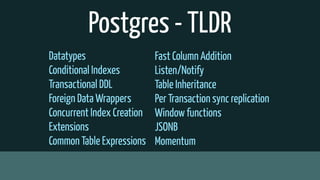
Postgres - TLDR
Postgres - TLDR
Datatypes
Conditional Indexes
Transactional DDL
Foreign Data Wrappers
Concurrent Index Creation
Extensions
Common Table Expressions
Fast Column Addition
Listen/Notify
Table Inheritance
Per Transaction sync replication
Window functions
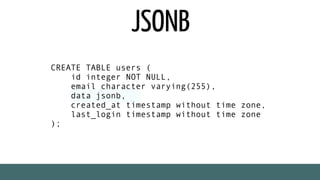
JSONB
Momentum
TLDRinaquote
http://www.craigkerstiens.com/2012/04/30/why-postgres/
“It’s the emacs of databases”
OLTP vs OLAP
OLTP vs OLAP
Web apps
OLTP vs OLAP
BI/Reporting
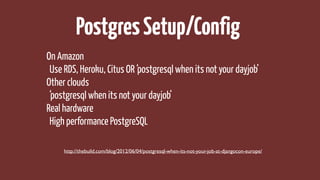
PostgresSetup/Config
On Amazon
Use RDS, Heroku, Citus OR ‘postgresql when its not your dayjob’
Other clouds
‘postgresql when its not your dayjob’
Real hardware
High performance PostgreSQL
http://thebuild.com/blog/2012/06/04/postgresql-when-its-not-your-job-at-djangocon-europe/
Cache rules
everything around me
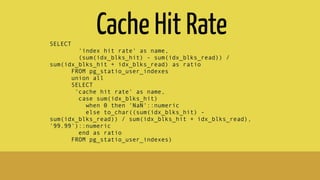
Cache Hit RateSELECT
'index hit rate' as name,
(sum(idx_blks_hit) - sum(idx_blks_read)) /
sum(idx_blks_hit + idx_blks_read) as ratio
FROM pg_statio_user_indexes
union all
SELECT
'cache hit rate' as name,
case sum(idx_blks_hit)
when 0 then 'NaN'::numeric
else to_char((sum(idx_blks_hit) -
sum(idx_blks_read)) / sum(idx_blks_hit + idx_blks_read),
'99.99')::numeric
end as ratio
FROM pg_statio_user_indexes)
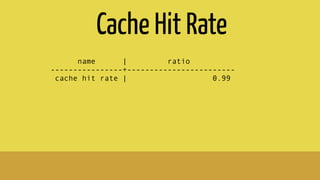
Cache Hit Rate
name | ratio
----------------+------------------------
cache hit rate | 0.99
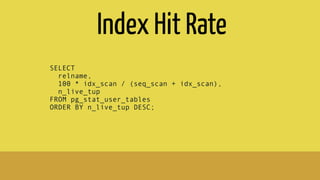
Index Hit Rate
SELECT
relname,
100 * idx_scan / (seq_scan + idx_scan),
n_live_tup
FROM pg_stat_user_tables
ORDER BY n_live_tup DESC;
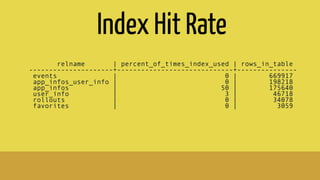
Index Hit Rate
relname | percent_of_times_index_used | rows_in_table
---------------------+-----------------------------+---------------
events | 0 | 669917
app_infos_user_info | 0 | 198218
app_infos | 50 | 175640
user_info | 3 | 46718
rollouts | 0 | 34078
favorites | 0 | 3059
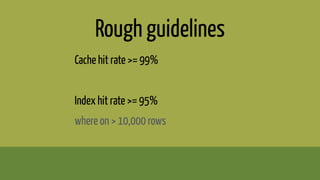
Rough guidelines
Cache hit rate >= 99%
Index hit rate >= 95%
where on > 10,000 rows
Shortcuts
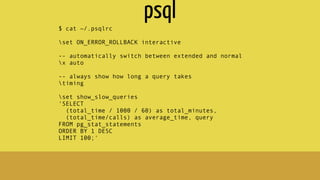
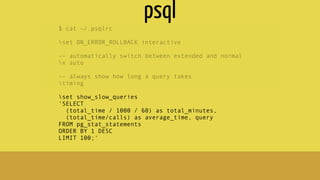
$ cat ~/.psqlrc
set ON_ERROR_ROLLBACK interactive
-- automatically switch between extended and normal
x auto
-- always show how long a query takes
timing
set show_slow_queries
'SELECT
(total_time / 1000 / 60) as total_minutes,
(total_time/calls) as average_time, query
FROM pg_stat_statements
ORDER BY 1 DESC
LIMIT 100;'
psql
$ cat ~/.psqlrc
set ON_ERROR_ROLLBACK interactive
-- automatically switch between extended and normal
x auto
-- always show how long a query takes
timing
set show_slow_queries
'SELECT
(total_time / 1000 / 60) as total_minutes,
(total_time/calls) as average_time, query
FROM pg_stat_statements
ORDER BY 1 DESC
LIMIT 100;'
psql
Understanding
Specific Query
Performance
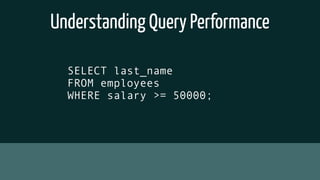
Understanding Query Performance
SELECT last_name
FROM employees
WHERE salary >= 50000;
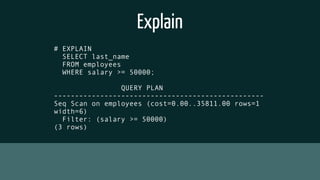
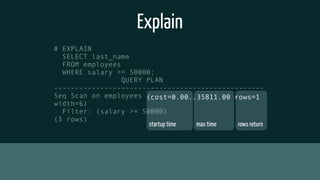
Explain
# EXPLAIN
SELECT last_name
FROM employees
WHERE salary >= 50000;
QUERY PLAN
--------------------------------------------------
Seq Scan on employees (cost=0.00..35811.00 rows=1
width=6)
Filter: (salary >= 50000)
(3 rows)
Explain
# EXPLAIN
SELECT last_name
FROM employees
WHERE salary >= 50000;
QUERY PLAN
--------------------------------------------------
Seq Scan on employees
width=6)
Filter: (salary >= 50000)
(3 rows)
startup time max time rows return
(cost=0.00..35811.00 rows=1
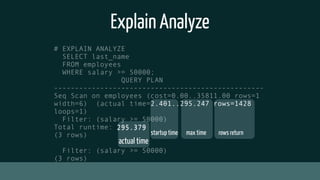
Explain Analyze
# EXPLAIN ANALYZE
SELECT last_name
FROM employees
WHERE salary >= 50000;
QUERY PLAN
--------------------------------------------------
Seq Scan on employees (cost=0.00..35811.00 rows=1
width=6) (actual time=2.401..295.247 rows=1428
loops=1)
Filter: (salary >= 50000)
Total runtime: 295.379
(3 rows)
Filter: (salary >= 50000)
(3 rows)
startup time max time rows return
actual time
2.401..295.247 rows=1428
295.379
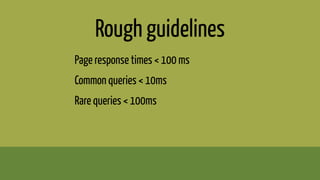
Rough guidelines
Page response times < 100 ms
Common queries < 10ms
Rare queries < 100ms
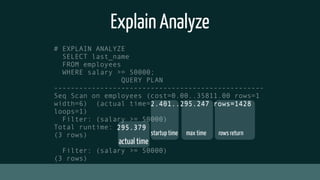
Explain Analyze
# EXPLAIN ANALYZE
SELECT last_name
FROM employees
WHERE salary >= 50000;
QUERY PLAN
--------------------------------------------------
Seq Scan on employees (cost=0.00..35811.00 rows=1
width=6) (actual time=2.401..295.247 rows=1428
loops=1)
Filter: (salary >= 50000)
Total runtime: 295.379
(3 rows)
Filter: (salary >= 50000)
(3 rows)
startup time max time rows return
actual time
2.401..295.247 rows=1428
295.379
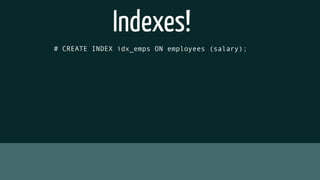
# CREATE INDEX idx_emps ON employees (salary);
Indexes!
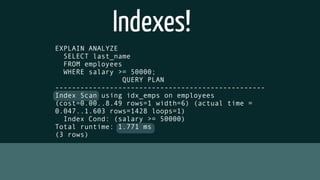
Indexes!
EXPLAIN ANALYZE
SELECT last_name
FROM employees
WHERE salary >= 50000;
QUERY PLAN
--------------------------------------------------
Index Scan using idx_emps on employees
(cost=0.00..8.49 rows=1 width=6) (actual time =
0.047..1.603 rows=1428 loops=1)
Index Cond: (salary >= 50000)
Total runtime: 1.771 ms
(3 rows)
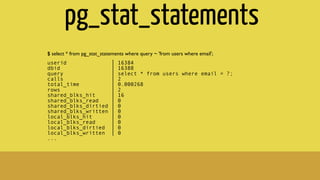
pg_stat_statements
$ select * from pg_stat_statements where query ~ 'from users where email';
userid │ 16384
dbid │ 16388
query │ select * from users where email = ?;
calls │ 2
total_time │ 0.000268
rows │ 2
shared_blks_hit │ 16
shared_blks_read │ 0
shared_blks_dirtied │ 0
shared_blks_written │ 0
local_blks_hit │ 0
local_blks_read │ 0
local_blks_dirtied │ 0
local_blks_written │ 0
...
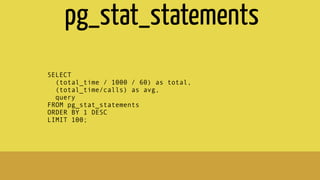
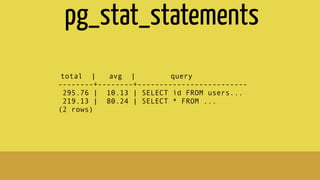
SELECT
(total_time / 1000 / 60) as total,
(total_time/calls) as avg,
query
FROM pg_stat_statements
ORDER BY 1 DESC
LIMIT 100;
pg_stat_statements
total | avg | query
--------+--------+-------------------------
295.76 | 10.13 | SELECT id FROM users...
219.13 | 80.24 | SELECT * FROM ...
(2 rows)
pg_stat_statements
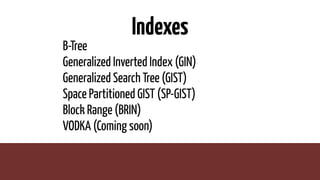
Indexes
Indexes
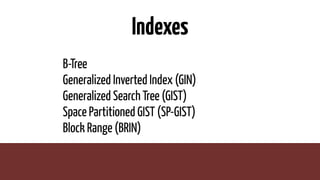
B-Tree
Generalized Inverted Index (GIN)
Generalized Search Tree (GIST)
Space Partitioned GIST (SP-GIST)
Block Range (BRIN)
Indexes
Which do I use?
BTree
This is what you usually want
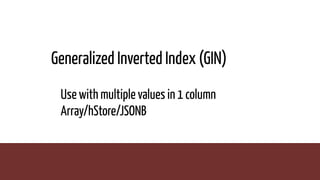
Generalized Inverted Index (GIN)
Use with multiple values in 1 column
Array/hStore/JSONB
Generalized Search Tree (GIST)
Full text search
Shapes
Indexes
B-Tree
Generalized Inverted Index (GIN)
Generalized Search Tree (GIST)
Space Partitioned GIST (SP-GIST)
Block Range (BRIN)
VODKA (Coming soon)
More indexes
Indexes
Conditional
Functional
Concurrent creation
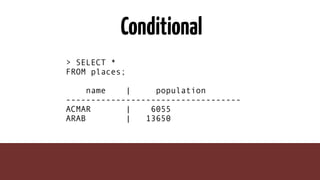
Conditional
> SELECT *
FROM places;
name | population
-----------------------------------
ACMAR | 6055
ARAB | 13650
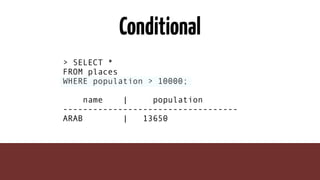
Conditional
> SELECT *
FROM places
WHERE population > 10000;
name | population
-----------------------------------
ARAB | 13650
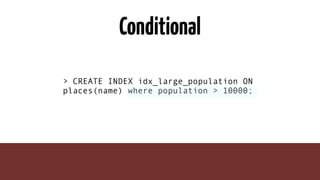
Conditional
> CREATE INDEX idx_large_population ON
places(name) where population > 10000;
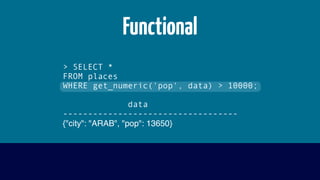
Functional
> SELECT *
FROM places;
data
-----------------------------------
{"city": "ACMAR", "pop": 6055}
{"city": "ARAB", "pop": 13650}
> SELECT *
FROM places
WHERE get_numeric('pop', data) > 10000;
data
-----------------------------------
{"city": "ARAB", "pop": 13650}
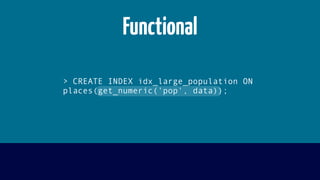
Functional
> CREATE INDEX idx_large_population ON
places(get_numeric('pop', data));
Functional
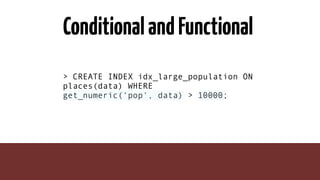
ConditionalandFunctional
> CREATE INDEX idx_large_population ON
places(data) WHERE
get_numeric('pop', data) > 10000;
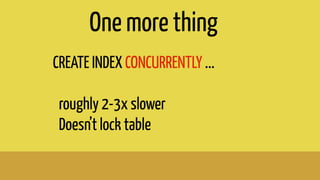
CREATE INDEX CONCURRENTLY ...
roughly 2-3x slower
Doesn’t lock table
One more thing
hstore /
JSON /
JSONB
hstore /
JSON /
JSONB
JSONB
CREATE TABLE users (
id integer NOT NULL,
email character varying(255),
data jsonb,
created_at timestamp without time zone,
last_login timestamp without time zone
);
SELECT
'{"id":1,"email":
“craig.kerstiens@gmail.com",}'::jsonb;
SELECT *
FROM talks
WHERE data->’conference’ = ‘PyOhio’;
JSONB
JSONB
Indexes work
gin
gist
Pooling
Application/Framework layer
Stand alone daemon
Options
pgbouncer
pgpool
PG options
Backups
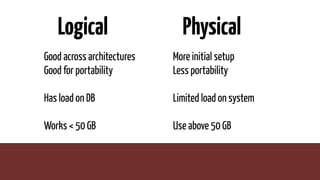
Logical
pg_dump
can be human readable, is portable
Physical
The bytes on disk
Base backup
Logical
Good across architectures
Good for portability
Has load on DB
Works < 50 GB
Physical
More initial setup
Less portability
Limited load on system
Use above 50 GB
Adding Cache
Increase cache
with cash
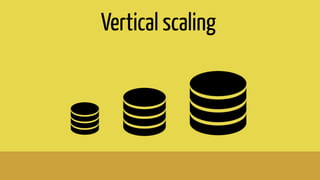
Vertical scaling
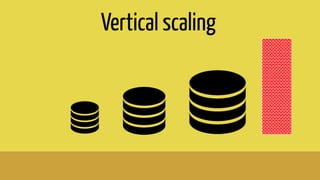
Vertical scaling
Horizontal scaling
Reads to a replica
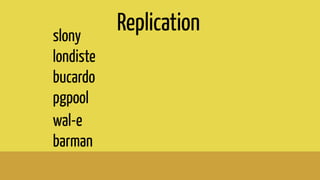
Replicationslony
londiste
bucardo
pgpool
wal-e
barman
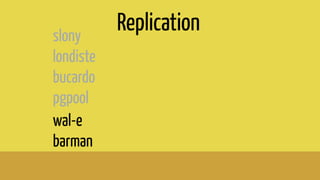
Replicationslony
londiste
bucardo
pgpool
wal-e
barman
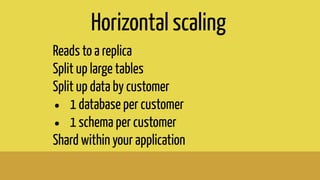
Horizontal scaling
Reads to a replica
Split up large tables
Split up data by customer
• 1 database per customer
• 1 schema per customer
Shard within your application
Horizontal scaling
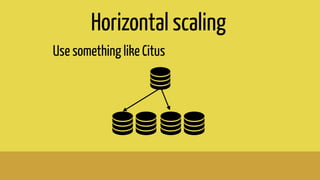
Use something like Citus
Recap
OLAP
Whole other talk
Disk IO is important
Order on disk is helpful (pg-reorg)
MPP solutions on top of Postgres
Recap
OLTP (webapps)
Ensure bulk of data is cache
Optimize overall query load with pg_stat_statements
Efficient use of indexes
When cache sucks, throw more at it
Recap
Thanks!
Questions?
http://www.speakerdeck.com/u/craigkerstiens/
@craigkerstiens
@citusdata

Postgres Performance for Humans