Open Source SQL databases enter millions queries per second era
Alexander Korotkov, Sveta Smirnova
Postgres Professional, Percona
2016
Alexander Korotkov, Sveta Smirnova Open Source SQL databases enter millions queries per second era 1 / 33
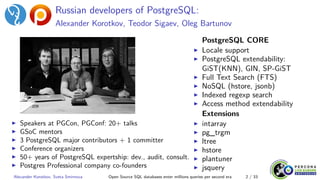
Russian developers of PostgreSQL:
Alexander Korotkov, Teodor Sigaev, Oleg Bartunov
▶ Speakers at PGCon, PGConf: 20+ talks
▶ GSoC mentors
▶ 3 PostgreSQL major contributors + 1 committer
▶ Conference organizers
▶ 50+ years of PostgreSQL expertship: dev., audit, consult.
▶ Postgres Professional company co-founders
PostgreSQL CORE
▶ Locale support
▶ PostgreSQL extendability:
GiST(KNN), GIN, SP-GiST
▶ Full Text Search (FTS)
▶ NoSQL (hstore, jsonb)
▶ Indexed regexp search
▶ Access method extendability
Extensions
▶ intarray
▶ pg_trgm
▶ ltree
▶ hstore
▶ plantuner
▶ jsquery
Alexander Korotkov, Sveta Smirnova Open Source SQL databases enter millions queries per second era 2 / 33
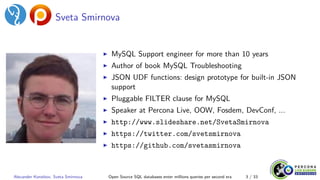
Sveta Smirnova
▶ MySQL Support engineer for more than 10 years
▶ Author of book MySQL Troubleshooting
▶ JSON UDF functions: design prototype for built-in JSON
support
▶ Pluggable FILTER clause for MySQL
▶ Speaker at Percona Live, OOW, Fosdem, DevConf, ...
▶ http://www.slideshare.net/SvetaSmirnova
▶ https://twitter.com/svetsmirnova
▶ https://github.com/svetasmirnova
Alexander Korotkov, Sveta Smirnova Open Source SQL databases enter millions queries per second era 3 / 33
Scalability benchmark
What do we have?
▶ Outstanding scalability improvements in PostgreSQL 9.6 and MySQL 5.7.
▶ Nice benchmarks for MySQL 5.7 made by Dimitri Kravtchuk.
▶ https://goo.gl/aw0sM6
▶ https://goo.gl/xc8cp8
▶ https://goo.gl/7dwkoY
▶ Some benchmarks for PostgreSQL 9.6
▶ https://goo.gl/RNWYxb
▶ https://goo.gl/3WrOAH
▶ Access to 72-cores server for testing.
We want to run
▶ same tests
▶ on the same machine
▶ using the same tool
for both MySQL 5.7 and PostgreSQL 9.6.
Alexander Korotkov, Sveta Smirnova Open Source SQL databases enter millions queries per second era 4 / 33
Try #1: synchronizing tests
▶ For PostgreSQL standard is pgbench
▶ For MySQL SysBench is widely used
▶ It is scriptable
▶ Easy to communicate with MySQL developers via bugs database, email and so on
▶ SysBench has built-in PostgreSQL support.
▶ I converted pgbench tests into Lua
▶ (open-database-bench)
▶ In PostgreSQL world, it’s standard to run small SQL-queries as prepared
statements.
Alexander Korotkov, Sveta Smirnova Open Source SQL databases enter millions queries per second era 5 / 33
sysbench with prepared statements: try 1
▶ Problem: NULL handling is broken in sysbench for PostgreSQL.
FATAL: failed to execute function `event': 3
(last message repeated 7 times)
FATAL: PQexecPrepared() failed: 7 ERROR: invalid input syntax for integer: ""
▶ Fix. Pull request was merged by Alexey Kopytov.
/* Convert SysBench bind structures to PgSQL data */
for (i = 0; i < (unsigned)pgstmt->nparams; i++)
{
- if (stmt->bound_param[i].is_null)
+ if (stmt->bound_param[i].is_null && *(stmt->bound_param[i].is_null))
continue;
switch (stmt->bound_param[i].type) {
Alexander Korotkov, Sveta Smirnova Open Source SQL databases enter millions queries per second era 6 / 33
sysbench with prepared statements: try 2
▶ Problem 2: sysbench can’t load PostgreSQL when using
prepared statements.
93087 korotkov 20 0 9289440 3,718g 2964 S 242,6 0,1 0:32.82 sysbench
93161 korotkov 20 0 32,904g 81612 80208 S 4,0 0,0 0:00.47 postgres
93116 korotkov 20 0 32,904g 80828 79424 S 3,6 0,0 0:00.46 postgres
93118 korotkov 20 0 32,904g 80424 79020 S 3,6 0,0 0:00.47 postgres
93121 korotkov 20 0 32,904g 80720 79312 S 3,6 0,0 0:00.47 postgres
93128 korotkov 20 0 32,904g 77936 76536 S 3,6 0,0 0:00.46 postgres
93130 korotkov 20 0 32,904g 81604 80204 S 3,6 0,0 0:00.47 postgres
93146 korotkov 20 0 32,904g 81112 79704 S 3,6 0,0 0:00.46 postgres
..............................................................................
▶ ...give up with sysbench, let’s use pgbench!
Alexander Korotkov, Sveta Smirnova Open Source SQL databases enter millions queries per second era 7 / 33
pgbench OLTP read-only script
set table_size 10000000
set range_size 100
set id1 random(1, :table_size)
...............................................................
set id10 random(1, :table_size)
set r1l random(1, :table_size)
set r1u :r1l + :range_size
...............................................................
set r4l random(1, :table_size)
set r4u :r4l + :range_size
SELECT c FROM sbtest WHERE id = :id1;
...............................................................
SELECT c FROM sbtest WHERE id = :id10;
SELECT c FROM sbtest WHERE id BETWEEN :r1l AND :r1u;
SELECT SUM(K) FROM sbtest WHERE id BETWEEN :r2l AND :r2u;
SELECT c FROM sbtest WHERE id BETWEEN :r3l AND :r3u ORDER BY c;
SELECT DISTINCT c FROM sbtest WHERE id BETWEEN :r4l AND :r4u;
Alexander Korotkov, Sveta Smirnova Open Source SQL databases enter millions queries per second era 8 / 33
pgbench OLTP read-write script
set table_size 10000000
...............................................................
set u1 random(1, :table_size)
set u2 random(1, :table_size)
set u3 random(1, :table_size)
set u4 random(1, :table_size)
BEGIN;
SELECT c FROM sbtest WHERE id = :id1;
...............................................................
SELECT DISTINCT c FROM sbtest WHERE id BETWEEN :r4l AND :r4u;
UPDATE sbtest SET k = k + 1 WHERE id = :u1;
UPDATE sbtest SET c = sb_rand_str('###########-###########-###########-###########
DELETE FROM sbtest WHERE id = :u3;
INSERT INTO sbtest (id, k, c, pad) VALUES (:u3, :u4, sb_rand_str('###########-####
COMMIT;
I’ve to implement sb_rand_str() in server side C.
Alexander Korotkov, Sveta Smirnova Open Source SQL databases enter millions queries per second era 9 / 33
How to run this?
It’s on the github and reproducible!
$ git clone https://github.com/postgrespro/pg_oltp_bench.git
$ cd pg_oltp_bench
$ make USE_PGXS=1
$ sudo make USE_PGXS=1 install
$ psql DB -f oltp_init.sql
$ psql DB -c "CREATE EXTENSION pg_oltp_bench;"
$ pgbench -c 100 -j 100 -M prepared -f oltp_ro.sql -T 300 -P 1 DB
$ pgbench -c 100 -j 100 -M prepared -f oltp_rw.sql -T 300 -P 1 DB
Alexander Korotkov, Sveta Smirnova Open Source SQL databases enter millions queries per second era 10 / 33
Inequal comparison!
Alexander Korotkov, Sveta Smirnova Open Source SQL databases enter millions queries per second era 11 / 33
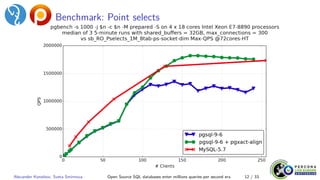
Benchmark: Point selects
Alexander Korotkov, Sveta Smirnova Open Source SQL databases enter millions queries per second era 12 / 33
Benchmark: OLTP RO results
Alexander Korotkov, Sveta Smirnova Open Source SQL databases enter millions queries per second era 13 / 33
Benchmark: OLTP RW results
Alexander Korotkov, Sveta Smirnova Open Source SQL databases enter millions queries per second era 14 / 33
That was close...
Alexander Korotkov, Sveta Smirnova Open Source SQL databases enter millions queries per second era 15 / 33
Pin/UnpinBuffer in lockless manner
Before ”touching”any block of data, backend have to
”pin”correcponding buffer. Pin/UnpinBuffer – very frequent
operation.
Before:
S_LOCK(bufHdr);
bufHdr->pinCount++;
S_UNLOCK(bufHdr);
After:
atomic_increment(buf_hdr->pinCount);
See commit details: https://goo.gl/LLCvR8.
Alexander Korotkov, Sveta Smirnova Open Source SQL databases enter millions queries per second era 16 / 33
Reduce ProcArrayLock contention
▶ Snapshot contains list of running transaction ids. Getting
snapshot requires shared ProcArrayLock.
▶ Transaction commit clears its id from shared memory.
Committing transaction requires exclusive ProcArrayLock.
▶ High TPS leads to high ProcArrayLock contention.
▶ Solution: clear transaction id in group.
See commit details: https://goo.gl/ZxiilI.
Alexander Korotkov, Sveta Smirnova Open Source SQL databases enter millions queries per second era 17 / 33
Reduce CLogControlLock contention
▶ Getting transaction status requires shared CLogControlLock.
Setting transaction status requires exclusive CLogControlLock.
Reading new CLOG page requires exclusive CLogControlLock.
▶ On modern multicore systems, backends frequently get
transaction status. Number of demanded transactions is also
high.
▶ Solution: increase CLOG buffers from 32 to 128. We would
have to read CLOG pages rarely.
See commit details: https://goo.gl/aaPYsJ.
Alexander Korotkov, Sveta Smirnova Open Source SQL databases enter millions queries per second era 18 / 33
What is PostgreSQL bottleneck?
Alexander Korotkov, Sveta Smirnova Open Source SQL databases enter millions queries per second era 19 / 33
What ARE PostgreSQL bottlenecks?
Alexander Korotkov, Sveta Smirnova Open Source SQL databases enter millions queries per second era 20 / 33
What are PostgreSQL bottlenecks?
▶ Buffer manager – slow hash-table, pin, locks etc.
▶ Snapshots – for each new snapshot we have to iterate over each
active transaction. It’s O(n2
) where n – number of active
sessions.
▶ Synchronous protocol.
▶ Slow xid allocation – a lot of locks.
Alexander Korotkov, Sveta Smirnova Open Source SQL databases enter millions queries per second era 21 / 33
PostgreSQL bottlenecks in numbers
▶ SELECT val FROM tab WHERE id IN (:id1, ... :id10)
– 150K per second = 1.5M points per second, no gain.
Bottleneck in locks.
▶ 10 x SELECT 1 in single command – 2.2M queries per second.
Taking snapshots is a bottleneck.
▶ SELECT 1 with CSN patch (cheap snapshots) – 3.9M queries
per second. Protocol is a bottleneck.
▶ SELECT txid_current() – 390K per second. Bottleneck in
locks.
Alexander Korotkov, Sveta Smirnova Open Source SQL databases enter millions queries per second era 22 / 33
How can we improve PostgreSQL?
▶ True in-memory engine without buffer manager.
▶ CSN for faster snapshots.
▶ Asynchronous binary protocol for processing more short queries.
▶ Lockless xid allocation.
Alexander Korotkov, Sveta Smirnova Open Source SQL databases enter millions queries per second era 23 / 33
At the MySQL side
▶ It could be easy for me
▶ Dimitri continuously publishing very detailed test results
▶ I could just ask Alexander to check how PostgreSQL is doing
▶ Original purpose of this investigation
▶ Many use heterogeneous database setups
▶ Some have better experience with one of databases
▶ All solve real-life issues
▶ Speed of writes on master
▶ Maximum performance for read-only slave
▶ Effect of checksums, synchronizations, compression
▶ How to get best results from each database on same hardware?
▶ We have to use same test base
Alexander Korotkov, Sveta Smirnova Open Source SQL databases enter millions queries per second era 24 / 33
Strangeness for read-write
▶ Percona test machine
▶ Processors: physical = 2, cores = 12, virtual = 24, hyperthreading = yes
▶ Memory: 251.9G
▶ Disk speed: about 33K IOPS
▶ Postgres Professional’s test machine
▶ Processors: physical = 4, cores = 72, virtual = 144, hyperthreading = yes
▶ Memory: 3,0T
▶ Disk speed: about 3K IOPS
Alexander Korotkov, Sveta Smirnova Open Source SQL databases enter millions queries per second era 25 / 33
Initial read-write test results
▶ Percona test machine
OLTP test statistics:
transactions: 1000000 (28727.81 per sec.)
read/write requests: 5000000 (143639.05 per sec.)
other operations: 2000000 (57455.62 per sec.)
▶ Postgres Professional’s test machine
transactions: 1000000 (29784.74 per sec.)
read/write requests: 5000000 (148923.71 per sec.)
other operations: 2000000 (59569.49 per sec.)
▶ Almost same
▶ I want to gain performance from all cores!
Alexander Korotkov, Sveta Smirnova Open Source SQL databases enter millions queries per second era 26 / 33
Try #2: Read-only test can be 100% in memory
▶ 700 QPS after initial run
▶ SysBench uses as much CPU as MySQL
PID USER PR NI VIRT RES SHR S %CPU %MEM TIME+ COMMAND
4585 smirnova 20 0 0,157t 0,041t 9596 S 7226 1,4 12:27.16 mysqld
8745 smirnova 20 0 1266212 629148 1824 S 7126 0,0 9:22.78 sysbench
▶ Solution
▶ Run sysbench with option –percentile=0
▶ Run several parallel sysbench processes
▶ Using –num-threads less than 36 improves CPU usage
▶ Still not ideal
▶ Maximum was 1,217,873 QPS for 256 threads
▶ Writing proper benchmarks is challenging
▶ I have to stuck with Dimitri’s results
Alexander Korotkov, Sveta Smirnova Open Source SQL databases enter millions queries per second era 27 / 33
Changes in MySQL which made this happen
▶ InnoDB: transaction list optimization
▶ Version 5.7.2: global transaction list was split into two
▶ Read-write
▶ Read-only
▶ Version 5.7.3: by default transaction not put into any list unless it started with
option READ WRITE
▶ Read only transactions are mutex-free
▶ READ ONLY transactions are not visible in SHOW ENGINE INNODB STATUS
output
▶ More details
▶ WL #6047
Alexander Korotkov, Sveta Smirnova Open Source SQL databases enter millions queries per second era 28 / 33
Changes in MySQL which made this happen
▶ InnoDB: transaction list optimization
▶ InnoDB: Reduce lock_sys_t::mutex contention, WL #6899
▶ InnoDB: fix index->lock contention WL #6326
▶ InnoDB: faster & parallel flushing
▶ Multiple page cleaner threads: WL #6642
▶ Reduced number of pages which needs to be flushed: WL #7047
▶ Improved adaptive flushing: WL #7868
Alexander Korotkov, Sveta Smirnova Open Source SQL databases enter millions queries per second era 28 / 33
Changes in MySQL which made this happen
▶ InnoDB: transaction list optimization
▶ InnoDB: Reduce lock_sys_t::mutex contention, WL #6899
▶ InnoDB: fix index->lock contention WL #6326
▶ InnoDB: faster & parallel flushing
▶ MDL (Meta-Data Lock) scalability
▶ Remove THR_LOCK::mutex for InnoDB: WL #6671
▶ Partitioned LOCK_grant
▶ Number of partitions is constant
▶ Thread ID used to assign partition
▶ WL #8355
▶ Bug #72829
▶ Lock-free MDL lock acquisition for DML: WL #7306, WL #7305
Alexander Korotkov, Sveta Smirnova Open Source SQL databases enter millions queries per second era 28 / 33
Other improvements in MySQL which affect performance
▶ Performance Schema is cheaper than before
▶ I did not notice any difference while was running benchmarks
▶ I did not turn ON any instruments
▶ innodb_checksum_algorithm is crc32 by default
▶ InnoDB Temporary Table Performance
▶ No UNDO and REDO logging
▶ No Insert buffering
▶ No persistence
▶ WL #6469, WL #6470, WL #6915, https://goo.gl/LeIYD4
▶ InnoDB buffer pool dump and reload
▶ More
Alexander Korotkov, Sveta Smirnova Open Source SQL databases enter millions queries per second era 29 / 33
Special Thanks
▶ Freematiq for provided servers.
▶ MySQL Server Team
▶ MySQL InnoDB Team
▶ Dimitri Kravtchuk
▶ Alexey Kopytov
Alexander Korotkov, Sveta Smirnova Open Source SQL databases enter millions queries per second era 30 / 33
Tools used
▶ sysbench
▶ pgbench
▶ pg_oltp_bench
▶ open-database-bench
▶ PGXACT cacheline align patch
Alexander Korotkov, Sveta Smirnova Open Source SQL databases enter millions queries per second era 31 / 33
Rate Our Session!
Alexander Korotkov, Sveta Smirnova Open Source SQL databases enter millions queries per second era 32 / 33
Thank you for attention!
Alexander Korotkov, Sveta Smirnova Open Source SQL databases enter millions queries per second era 33 / 33

Open Source SQL databases enter millions queries per second era

  • 1.
    Open Source SQLdatabases enter millions queries per second era Alexander Korotkov, Sveta Smirnova Postgres Professional, Percona 2016 Alexander Korotkov, Sveta Smirnova Open Source SQL databases enter millions queries per second era 1 / 33
  • 2.
    Russian developers ofPostgreSQL: Alexander Korotkov, Teodor Sigaev, Oleg Bartunov ▶ Speakers at PGCon, PGConf: 20+ talks ▶ GSoC mentors ▶ 3 PostgreSQL major contributors + 1 committer ▶ Conference organizers ▶ 50+ years of PostgreSQL expertship: dev., audit, consult. ▶ Postgres Professional company co-founders PostgreSQL CORE ▶ Locale support ▶ PostgreSQL extendability: GiST(KNN), GIN, SP-GiST ▶ Full Text Search (FTS) ▶ NoSQL (hstore, jsonb) ▶ Indexed regexp search ▶ Access method extendability Extensions ▶ intarray ▶ pg_trgm ▶ ltree ▶ hstore ▶ plantuner ▶ jsquery Alexander Korotkov, Sveta Smirnova Open Source SQL databases enter millions queries per second era 2 / 33
  • 3.
    Sveta Smirnova ▶ MySQLSupport engineer for more than 10 years ▶ Author of book MySQL Troubleshooting ▶ JSON UDF functions: design prototype for built-in JSON support ▶ Pluggable FILTER clause for MySQL ▶ Speaker at Percona Live, OOW, Fosdem, DevConf, ... ▶ http://www.slideshare.net/SvetaSmirnova ▶ https://twitter.com/svetsmirnova ▶ https://github.com/svetasmirnova Alexander Korotkov, Sveta Smirnova Open Source SQL databases enter millions queries per second era 3 / 33
  • 4.
    Scalability benchmark What dowe have? ▶ Outstanding scalability improvements in PostgreSQL 9.6 and MySQL 5.7. ▶ Nice benchmarks for MySQL 5.7 made by Dimitri Kravtchuk. ▶ https://goo.gl/aw0sM6 ▶ https://goo.gl/xc8cp8 ▶ https://goo.gl/7dwkoY ▶ Some benchmarks for PostgreSQL 9.6 ▶ https://goo.gl/RNWYxb ▶ https://goo.gl/3WrOAH ▶ Access to 72-cores server for testing. We want to run ▶ same tests ▶ on the same machine ▶ using the same tool for both MySQL 5.7 and PostgreSQL 9.6. Alexander Korotkov, Sveta Smirnova Open Source SQL databases enter millions queries per second era 4 / 33
  • 5.
    Try #1: synchronizingtests ▶ For PostgreSQL standard is pgbench ▶ For MySQL SysBench is widely used ▶ It is scriptable ▶ Easy to communicate with MySQL developers via bugs database, email and so on ▶ SysBench has built-in PostgreSQL support. ▶ I converted pgbench tests into Lua ▶ (open-database-bench) ▶ In PostgreSQL world, it’s standard to run small SQL-queries as prepared statements. Alexander Korotkov, Sveta Smirnova Open Source SQL databases enter millions queries per second era 5 / 33
  • 6.
    sysbench with preparedstatements: try 1 ▶ Problem: NULL handling is broken in sysbench for PostgreSQL. FATAL: failed to execute function `event': 3 (last message repeated 7 times) FATAL: PQexecPrepared() failed: 7 ERROR: invalid input syntax for integer: "" ▶ Fix. Pull request was merged by Alexey Kopytov. /* Convert SysBench bind structures to PgSQL data */ for (i = 0; i < (unsigned)pgstmt->nparams; i++) { - if (stmt->bound_param[i].is_null) + if (stmt->bound_param[i].is_null && *(stmt->bound_param[i].is_null)) continue; switch (stmt->bound_param[i].type) { Alexander Korotkov, Sveta Smirnova Open Source SQL databases enter millions queries per second era 6 / 33
  • 7.
    sysbench with preparedstatements: try 2 ▶ Problem 2: sysbench can’t load PostgreSQL when using prepared statements. 93087 korotkov 20 0 9289440 3,718g 2964 S 242,6 0,1 0:32.82 sysbench 93161 korotkov 20 0 32,904g 81612 80208 S 4,0 0,0 0:00.47 postgres 93116 korotkov 20 0 32,904g 80828 79424 S 3,6 0,0 0:00.46 postgres 93118 korotkov 20 0 32,904g 80424 79020 S 3,6 0,0 0:00.47 postgres 93121 korotkov 20 0 32,904g 80720 79312 S 3,6 0,0 0:00.47 postgres 93128 korotkov 20 0 32,904g 77936 76536 S 3,6 0,0 0:00.46 postgres 93130 korotkov 20 0 32,904g 81604 80204 S 3,6 0,0 0:00.47 postgres 93146 korotkov 20 0 32,904g 81112 79704 S 3,6 0,0 0:00.46 postgres .............................................................................. ▶ ...give up with sysbench, let’s use pgbench! Alexander Korotkov, Sveta Smirnova Open Source SQL databases enter millions queries per second era 7 / 33
  • 8.
    pgbench OLTP read-onlyscript set table_size 10000000 set range_size 100 set id1 random(1, :table_size) ............................................................... set id10 random(1, :table_size) set r1l random(1, :table_size) set r1u :r1l + :range_size ............................................................... set r4l random(1, :table_size) set r4u :r4l + :range_size SELECT c FROM sbtest WHERE id = :id1; ............................................................... SELECT c FROM sbtest WHERE id = :id10; SELECT c FROM sbtest WHERE id BETWEEN :r1l AND :r1u; SELECT SUM(K) FROM sbtest WHERE id BETWEEN :r2l AND :r2u; SELECT c FROM sbtest WHERE id BETWEEN :r3l AND :r3u ORDER BY c; SELECT DISTINCT c FROM sbtest WHERE id BETWEEN :r4l AND :r4u; Alexander Korotkov, Sveta Smirnova Open Source SQL databases enter millions queries per second era 8 / 33
  • 9.
    pgbench OLTP read-writescript set table_size 10000000 ............................................................... set u1 random(1, :table_size) set u2 random(1, :table_size) set u3 random(1, :table_size) set u4 random(1, :table_size) BEGIN; SELECT c FROM sbtest WHERE id = :id1; ............................................................... SELECT DISTINCT c FROM sbtest WHERE id BETWEEN :r4l AND :r4u; UPDATE sbtest SET k = k + 1 WHERE id = :u1; UPDATE sbtest SET c = sb_rand_str('###########-###########-###########-########### DELETE FROM sbtest WHERE id = :u3; INSERT INTO sbtest (id, k, c, pad) VALUES (:u3, :u4, sb_rand_str('###########-#### COMMIT; I’ve to implement sb_rand_str() in server side C. Alexander Korotkov, Sveta Smirnova Open Source SQL databases enter millions queries per second era 9 / 33
  • 10.
    How to runthis? It’s on the github and reproducible! $ git clone https://github.com/postgrespro/pg_oltp_bench.git $ cd pg_oltp_bench $ make USE_PGXS=1 $ sudo make USE_PGXS=1 install $ psql DB -f oltp_init.sql $ psql DB -c "CREATE EXTENSION pg_oltp_bench;" $ pgbench -c 100 -j 100 -M prepared -f oltp_ro.sql -T 300 -P 1 DB $ pgbench -c 100 -j 100 -M prepared -f oltp_rw.sql -T 300 -P 1 DB Alexander Korotkov, Sveta Smirnova Open Source SQL databases enter millions queries per second era 10 / 33
  • 11.
    Inequal comparison! Alexander Korotkov,Sveta Smirnova Open Source SQL databases enter millions queries per second era 11 / 33
  • 12.
    Benchmark: Point selects AlexanderKorotkov, Sveta Smirnova Open Source SQL databases enter millions queries per second era 12 / 33
  • 13.
    Benchmark: OLTP ROresults Alexander Korotkov, Sveta Smirnova Open Source SQL databases enter millions queries per second era 13 / 33
  • 14.
    Benchmark: OLTP RWresults Alexander Korotkov, Sveta Smirnova Open Source SQL databases enter millions queries per second era 14 / 33
  • 15.
    That was close... AlexanderKorotkov, Sveta Smirnova Open Source SQL databases enter millions queries per second era 15 / 33
  • 16.
    Pin/UnpinBuffer in locklessmanner Before ”touching”any block of data, backend have to ”pin”correcponding buffer. Pin/UnpinBuffer – very frequent operation. Before: S_LOCK(bufHdr); bufHdr->pinCount++; S_UNLOCK(bufHdr); After: atomic_increment(buf_hdr->pinCount); See commit details: https://goo.gl/LLCvR8. Alexander Korotkov, Sveta Smirnova Open Source SQL databases enter millions queries per second era 16 / 33
  • 17.
    Reduce ProcArrayLock contention ▶Snapshot contains list of running transaction ids. Getting snapshot requires shared ProcArrayLock. ▶ Transaction commit clears its id from shared memory. Committing transaction requires exclusive ProcArrayLock. ▶ High TPS leads to high ProcArrayLock contention. ▶ Solution: clear transaction id in group. See commit details: https://goo.gl/ZxiilI. Alexander Korotkov, Sveta Smirnova Open Source SQL databases enter millions queries per second era 17 / 33
  • 18.
    Reduce CLogControlLock contention ▶Getting transaction status requires shared CLogControlLock. Setting transaction status requires exclusive CLogControlLock. Reading new CLOG page requires exclusive CLogControlLock. ▶ On modern multicore systems, backends frequently get transaction status. Number of demanded transactions is also high. ▶ Solution: increase CLOG buffers from 32 to 128. We would have to read CLOG pages rarely. See commit details: https://goo.gl/aaPYsJ. Alexander Korotkov, Sveta Smirnova Open Source SQL databases enter millions queries per second era 18 / 33
  • 19.
    What is PostgreSQLbottleneck? Alexander Korotkov, Sveta Smirnova Open Source SQL databases enter millions queries per second era 19 / 33
  • 20.
    What ARE PostgreSQLbottlenecks? Alexander Korotkov, Sveta Smirnova Open Source SQL databases enter millions queries per second era 20 / 33
  • 21.
    What are PostgreSQLbottlenecks? ▶ Buffer manager – slow hash-table, pin, locks etc. ▶ Snapshots – for each new snapshot we have to iterate over each active transaction. It’s O(n2 ) where n – number of active sessions. ▶ Synchronous protocol. ▶ Slow xid allocation – a lot of locks. Alexander Korotkov, Sveta Smirnova Open Source SQL databases enter millions queries per second era 21 / 33
  • 22.
    PostgreSQL bottlenecks innumbers ▶ SELECT val FROM tab WHERE id IN (:id1, ... :id10) – 150K per second = 1.5M points per second, no gain. Bottleneck in locks. ▶ 10 x SELECT 1 in single command – 2.2M queries per second. Taking snapshots is a bottleneck. ▶ SELECT 1 with CSN patch (cheap snapshots) – 3.9M queries per second. Protocol is a bottleneck. ▶ SELECT txid_current() – 390K per second. Bottleneck in locks. Alexander Korotkov, Sveta Smirnova Open Source SQL databases enter millions queries per second era 22 / 33
  • 23.
    How can weimprove PostgreSQL? ▶ True in-memory engine without buffer manager. ▶ CSN for faster snapshots. ▶ Asynchronous binary protocol for processing more short queries. ▶ Lockless xid allocation. Alexander Korotkov, Sveta Smirnova Open Source SQL databases enter millions queries per second era 23 / 33
  • 24.
    At the MySQLside ▶ It could be easy for me ▶ Dimitri continuously publishing very detailed test results ▶ I could just ask Alexander to check how PostgreSQL is doing ▶ Original purpose of this investigation ▶ Many use heterogeneous database setups ▶ Some have better experience with one of databases ▶ All solve real-life issues ▶ Speed of writes on master ▶ Maximum performance for read-only slave ▶ Effect of checksums, synchronizations, compression ▶ How to get best results from each database on same hardware? ▶ We have to use same test base Alexander Korotkov, Sveta Smirnova Open Source SQL databases enter millions queries per second era 24 / 33
  • 25.
    Strangeness for read-write ▶Percona test machine ▶ Processors: physical = 2, cores = 12, virtual = 24, hyperthreading = yes ▶ Memory: 251.9G ▶ Disk speed: about 33K IOPS ▶ Postgres Professional’s test machine ▶ Processors: physical = 4, cores = 72, virtual = 144, hyperthreading = yes ▶ Memory: 3,0T ▶ Disk speed: about 3K IOPS Alexander Korotkov, Sveta Smirnova Open Source SQL databases enter millions queries per second era 25 / 33
  • 26.
    Initial read-write testresults ▶ Percona test machine OLTP test statistics: transactions: 1000000 (28727.81 per sec.) read/write requests: 5000000 (143639.05 per sec.) other operations: 2000000 (57455.62 per sec.) ▶ Postgres Professional’s test machine transactions: 1000000 (29784.74 per sec.) read/write requests: 5000000 (148923.71 per sec.) other operations: 2000000 (59569.49 per sec.) ▶ Almost same ▶ I want to gain performance from all cores! Alexander Korotkov, Sveta Smirnova Open Source SQL databases enter millions queries per second era 26 / 33
  • 27.
    Try #2: Read-onlytest can be 100% in memory ▶ 700 QPS after initial run ▶ SysBench uses as much CPU as MySQL PID USER PR NI VIRT RES SHR S %CPU %MEM TIME+ COMMAND 4585 smirnova 20 0 0,157t 0,041t 9596 S 7226 1,4 12:27.16 mysqld 8745 smirnova 20 0 1266212 629148 1824 S 7126 0,0 9:22.78 sysbench ▶ Solution ▶ Run sysbench with option –percentile=0 ▶ Run several parallel sysbench processes ▶ Using –num-threads less than 36 improves CPU usage ▶ Still not ideal ▶ Maximum was 1,217,873 QPS for 256 threads ▶ Writing proper benchmarks is challenging ▶ I have to stuck with Dimitri’s results Alexander Korotkov, Sveta Smirnova Open Source SQL databases enter millions queries per second era 27 / 33
  • 28.
    Changes in MySQLwhich made this happen ▶ InnoDB: transaction list optimization ▶ Version 5.7.2: global transaction list was split into two ▶ Read-write ▶ Read-only ▶ Version 5.7.3: by default transaction not put into any list unless it started with option READ WRITE ▶ Read only transactions are mutex-free ▶ READ ONLY transactions are not visible in SHOW ENGINE INNODB STATUS output ▶ More details ▶ WL #6047 Alexander Korotkov, Sveta Smirnova Open Source SQL databases enter millions queries per second era 28 / 33
  • 29.
    Changes in MySQLwhich made this happen ▶ InnoDB: transaction list optimization ▶ InnoDB: Reduce lock_sys_t::mutex contention, WL #6899 ▶ InnoDB: fix index->lock contention WL #6326 ▶ InnoDB: faster & parallel flushing ▶ Multiple page cleaner threads: WL #6642 ▶ Reduced number of pages which needs to be flushed: WL #7047 ▶ Improved adaptive flushing: WL #7868 Alexander Korotkov, Sveta Smirnova Open Source SQL databases enter millions queries per second era 28 / 33
  • 30.
    Changes in MySQLwhich made this happen ▶ InnoDB: transaction list optimization ▶ InnoDB: Reduce lock_sys_t::mutex contention, WL #6899 ▶ InnoDB: fix index->lock contention WL #6326 ▶ InnoDB: faster & parallel flushing ▶ MDL (Meta-Data Lock) scalability ▶ Remove THR_LOCK::mutex for InnoDB: WL #6671 ▶ Partitioned LOCK_grant ▶ Number of partitions is constant ▶ Thread ID used to assign partition ▶ WL #8355 ▶ Bug #72829 ▶ Lock-free MDL lock acquisition for DML: WL #7306, WL #7305 Alexander Korotkov, Sveta Smirnova Open Source SQL databases enter millions queries per second era 28 / 33
  • 31.
    Other improvements inMySQL which affect performance ▶ Performance Schema is cheaper than before ▶ I did not notice any difference while was running benchmarks ▶ I did not turn ON any instruments ▶ innodb_checksum_algorithm is crc32 by default ▶ InnoDB Temporary Table Performance ▶ No UNDO and REDO logging ▶ No Insert buffering ▶ No persistence ▶ WL #6469, WL #6470, WL #6915, https://goo.gl/LeIYD4 ▶ InnoDB buffer pool dump and reload ▶ More Alexander Korotkov, Sveta Smirnova Open Source SQL databases enter millions queries per second era 29 / 33
  • 32.
    Special Thanks ▶ Freematiqfor provided servers. ▶ MySQL Server Team ▶ MySQL InnoDB Team ▶ Dimitri Kravtchuk ▶ Alexey Kopytov Alexander Korotkov, Sveta Smirnova Open Source SQL databases enter millions queries per second era 30 / 33
  • 33.
    Tools used ▶ sysbench ▶pgbench ▶ pg_oltp_bench ▶ open-database-bench ▶ PGXACT cacheline align patch Alexander Korotkov, Sveta Smirnova Open Source SQL databases enter millions queries per second era 31 / 33
  • 34.
    Rate Our Session! AlexanderKorotkov, Sveta Smirnova Open Source SQL databases enter millions queries per second era 32 / 33
  • 35.
    Thank you forattention! Alexander Korotkov, Sveta Smirnova Open Source SQL databases enter millions queries per second era 33 / 33