Performance Management-Appraisals  Workshop Continual organizational  improvement can only come about  with continual individual improvement.
Index Course goals Performance Management What is Performance Appraisal? Performance Appraisal Process. Methods of Performance Appraisal Conclusion.
Course Goals   To assist you in managing employee performance  To enable you to appropriately complete the evaluation portion of a performance management program standards. Why have Performance Appraisals? Overview of The Process - Appraisal Procedure Benefits of Appraisals - Management Role - Employee Role
Communication Skills Required - Questioning - Listening - Language The Appraisal - Appraisal Areas - Preparation - Writing the Appraisal - Do's and Don'ts - Goals - Self Esteem - Structuring the Appraisal
The Appraisal Discussion - Framing - Disagreement - Criticism - Feedback Problems with Appraisals - People - Process - Preparation
ROTATIONAL BRAINSTORMING What is Performance Appraisal? Why is it necessary? What is the key to the effectiveness of PA? Should PA be done or not? If so why?(State at least 3 reasons for either)
DEFINITION What is performance management? An   ongoing  communication process.
Key Definitions we will explore in Performance Performance Standards What are they? Performance Evaluation What is it?
Standards Start with a good job description . ( Why does this job exist??) What is this person to accomplish? What is the person accountable for in the work process? What results are achieved through the functions of THIS job? What are the  KEY  performance expectations of THIS job? Remember:  Standards should reflect what a satisfactory employee can accomplish .
Evaluations Only one aspect of the continuous Performance Management Process!!! Should be linked to the Business Objectives Should measure Results & Competencies  Standards are “Standard” or “Satisfactory” in our process Don’t create a “zero sum game”-- Always strive for Win/Win situations Ratings are not decided upon compared to other performers, but rather to your planned performance for the specific staff person Look at behavior and results
EVALUATE/APPRAISE OBTAIN INPUT FROM RECORDS & DISCUSSIONS WITH REVIEWING OFFICER . RECORD RESULTS, PERFORMANCE, BEHAVIOR RATE FACTORS ON ALL DIMENSIONS OF JOB FOR ENTIRE RATING PERIOD RECORD THE RATINGS DISCUSS WITH REVIEWING OFFICER DISCUSS WITH EMPLOYEE
GUIDELINES FOR CONDUCTING PERFORMANCE EVALUATIONS PREPARE FOR MEETING AND PROVIDE UNINTERRUPTED SESSION SHOW KNOWLEDGE OF AND INTEREST IN EMPLOYEE DISCUSS PERFORMANCE AND PROVIDE SPECIFICS DISCUSS EMPLOYEE DEVELOPMENT CONCLUDE ON POSITIVE
PERFORMANCE APPRAISALS
Definition “ Any system of determining how well an individual employee has performed during a period of time, frequently used as a basis for determining merit increases.” “ OBSERVE   and  EVALUATE   an employee in relation to  PRE-SET   performance standards.”
BRAINSTORMING What objectives would you base  PA upon ?
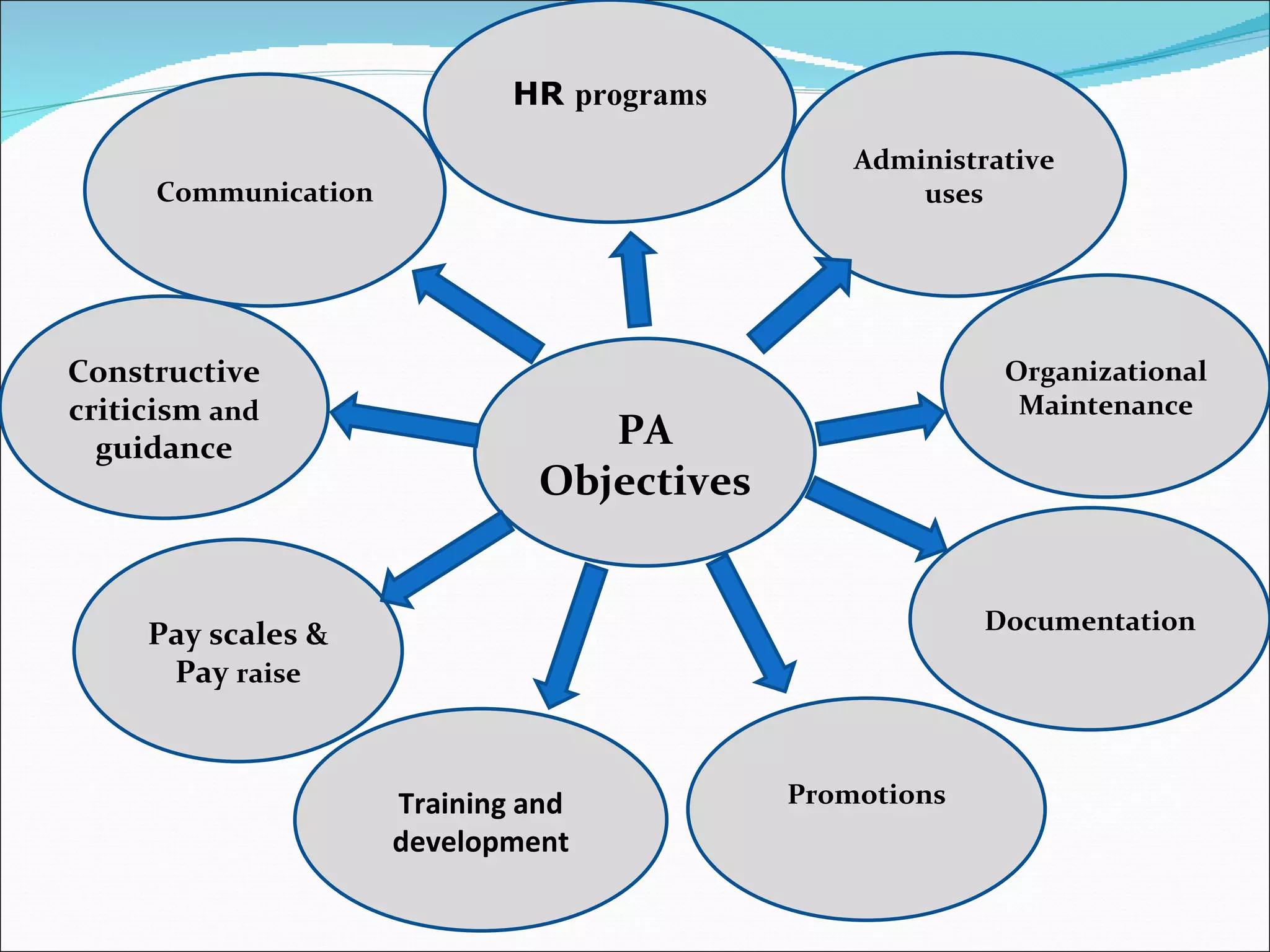
PA Objectives Documentation Organizational Maintenance Promotions Training and development Pay scales & Pay  raise Constructive criticism  and  guidance Administrative uses HR  programs Communication
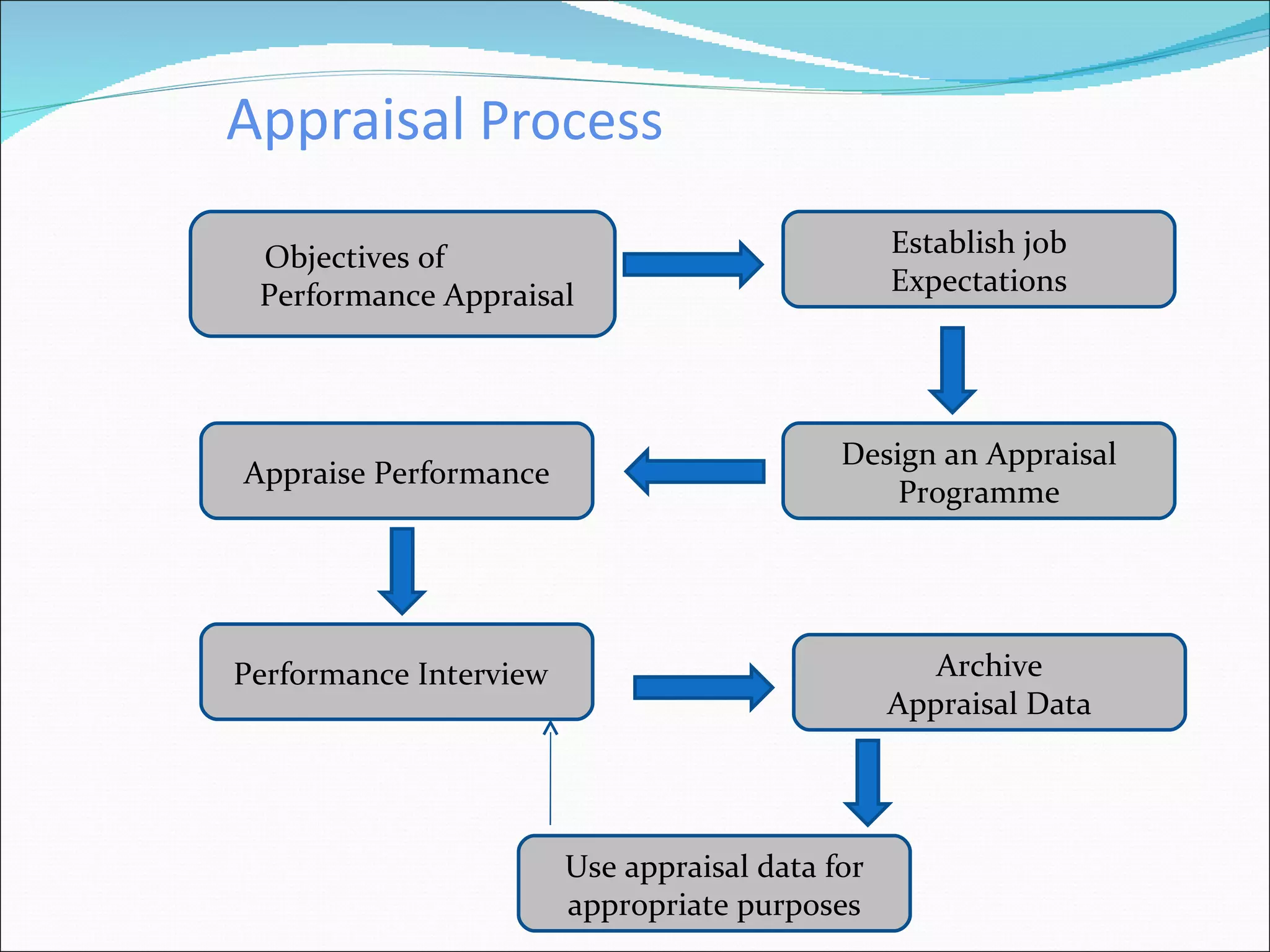
Appraisal  Process Establish job Expectations Design an Appraisal Programme Appraise Performance Performance Interview Objectives of Performance Appraisal Archive Appraisal Data Use appraisal data for appropriate purposes
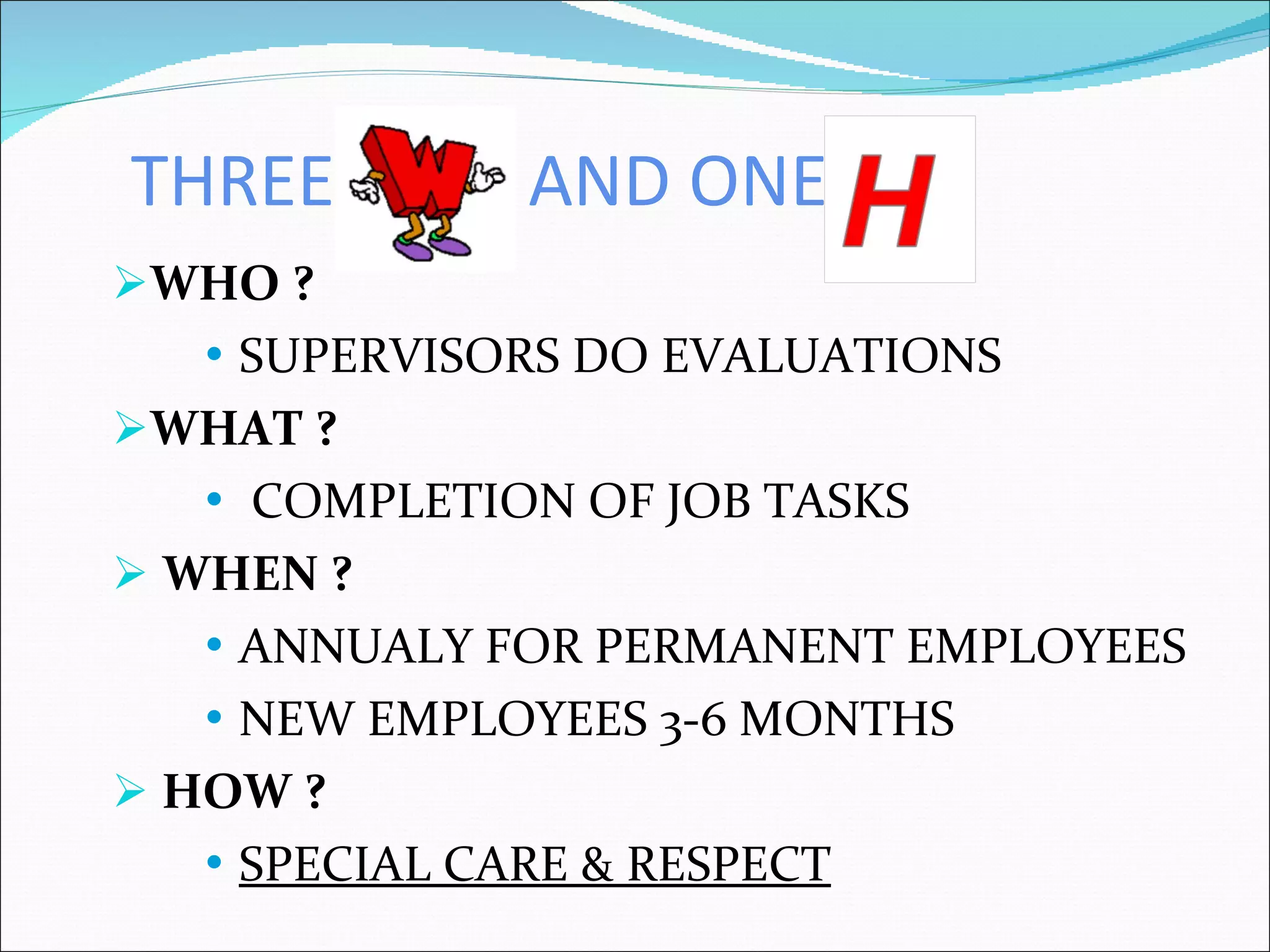
THREE  AND ONE WHO ? SUPERVISORS DO EVALUATIONS WHAT ? COMPLETION OF JOB TASKS WHEN ? ANNUALY FOR PERMANENT EMPLOYEES  NEW EMPLOYEES 3-6 MONTHS HOW ? SPECIAL CARE & RESPECT
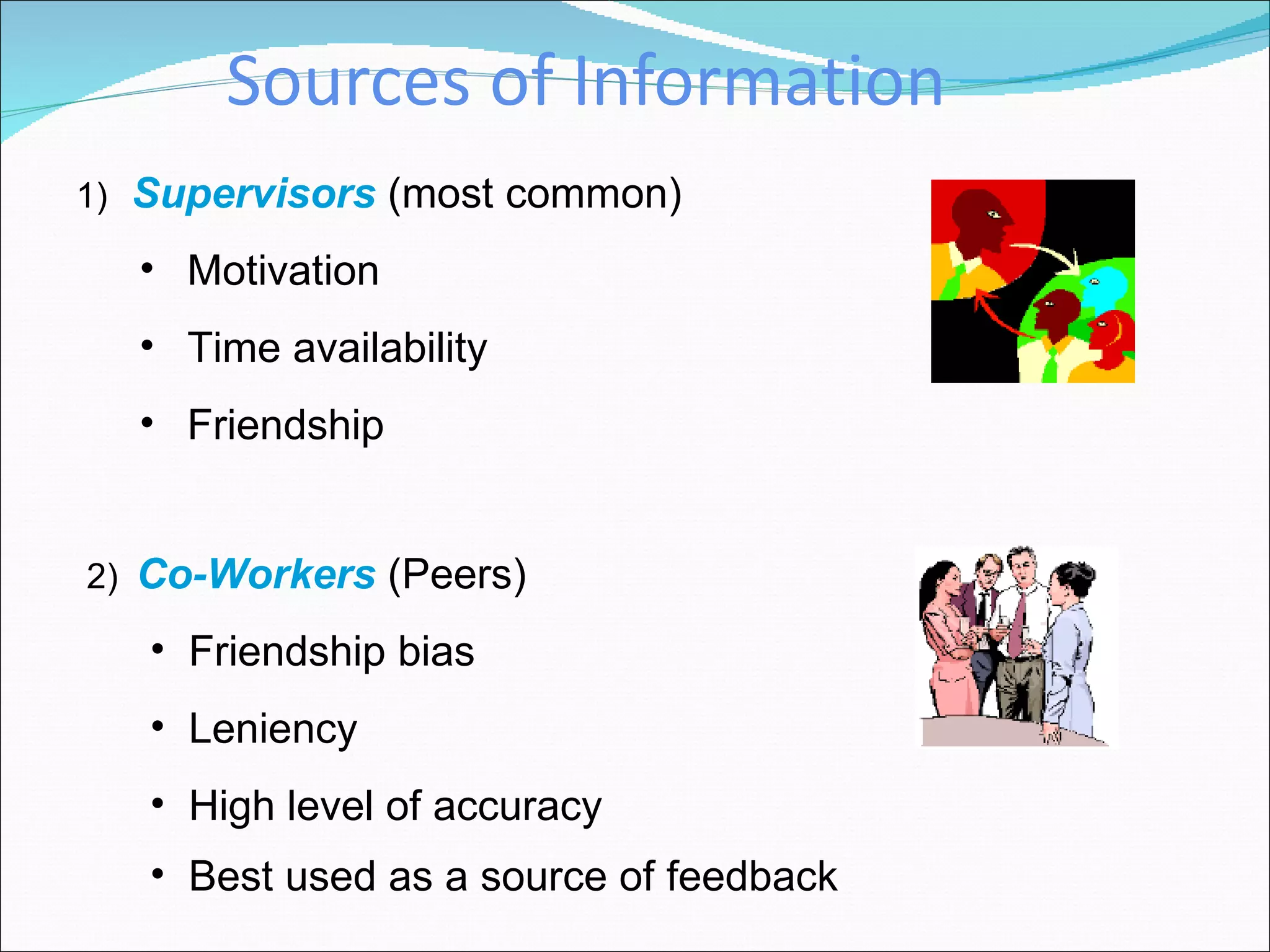
Sources of Information 1)   Supervisors  (most common) Motivation Time availability Friendship  2)   Co-Workers  (Peers) Friendship bias Leniency  High level of accuracy Best used as a source of feedback
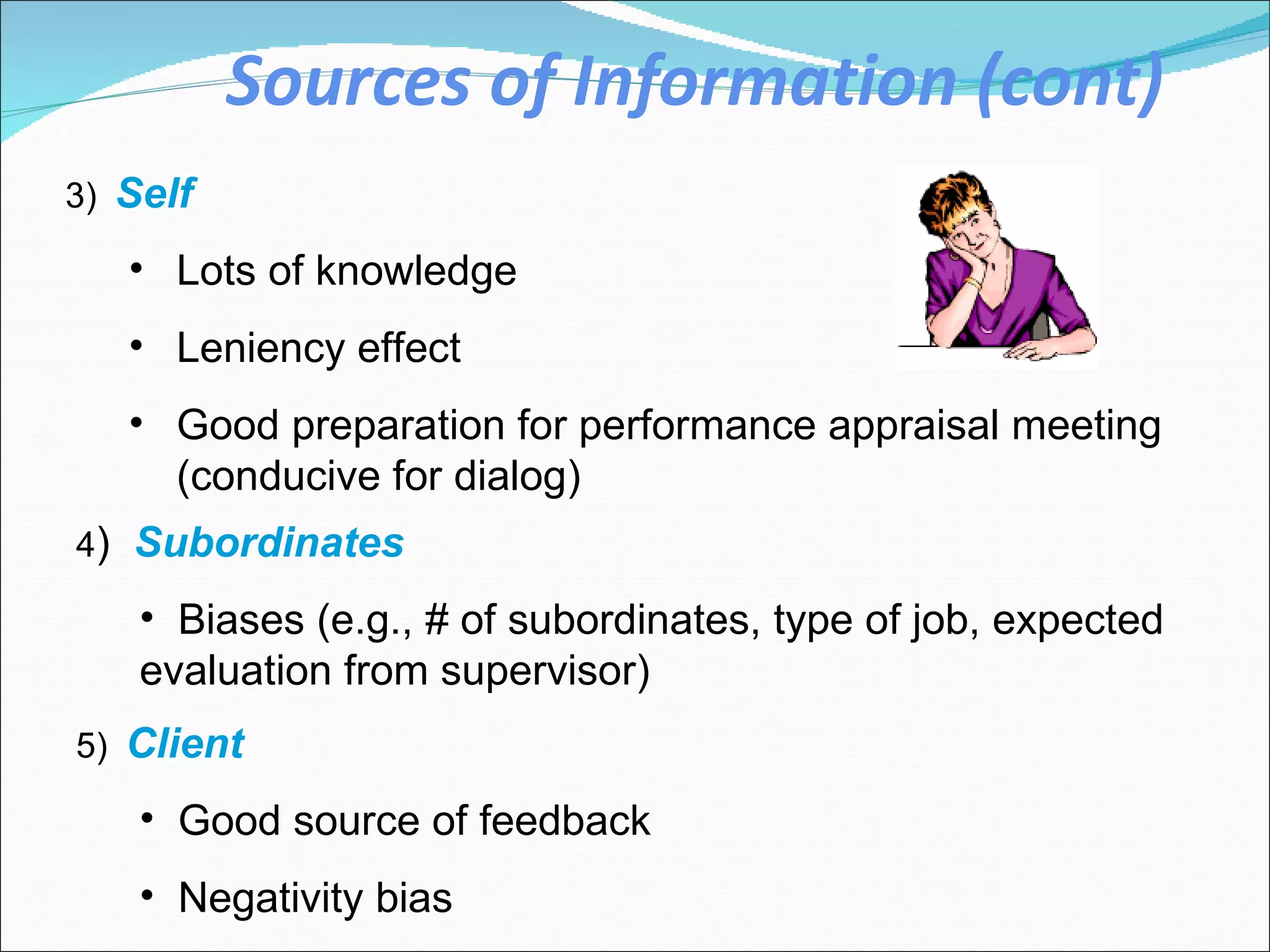
Sources of Information (cont) 3)   Self Lots of knowledge Leniency effect Good preparation for performance appraisal meeting (conducive for dialog)  4 )  Subordinates  Biases (e.g., # of subordinates, type of job, expected evaluation from supervisor)  5)   Client Good source of feedback Negativity bias
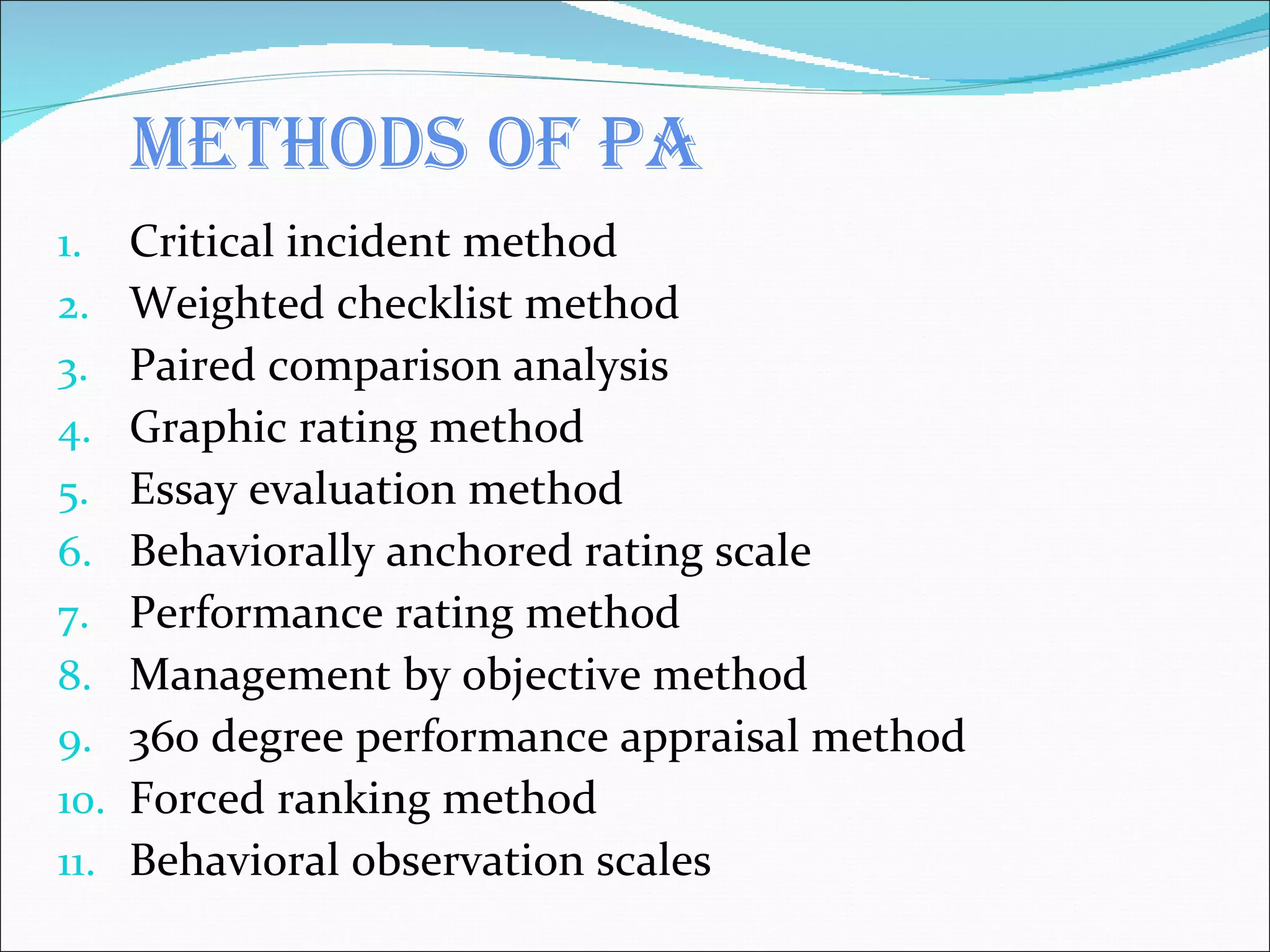
Methods of PA Critical incident method Weighted checklist method Paired comparison analysis Graphic rating method Essay evaluation method Behaviorally anchored rating scale Performance rating method Management by objective method 360 degree performance appraisal method Forced ranking method Behavioral observation scales
 
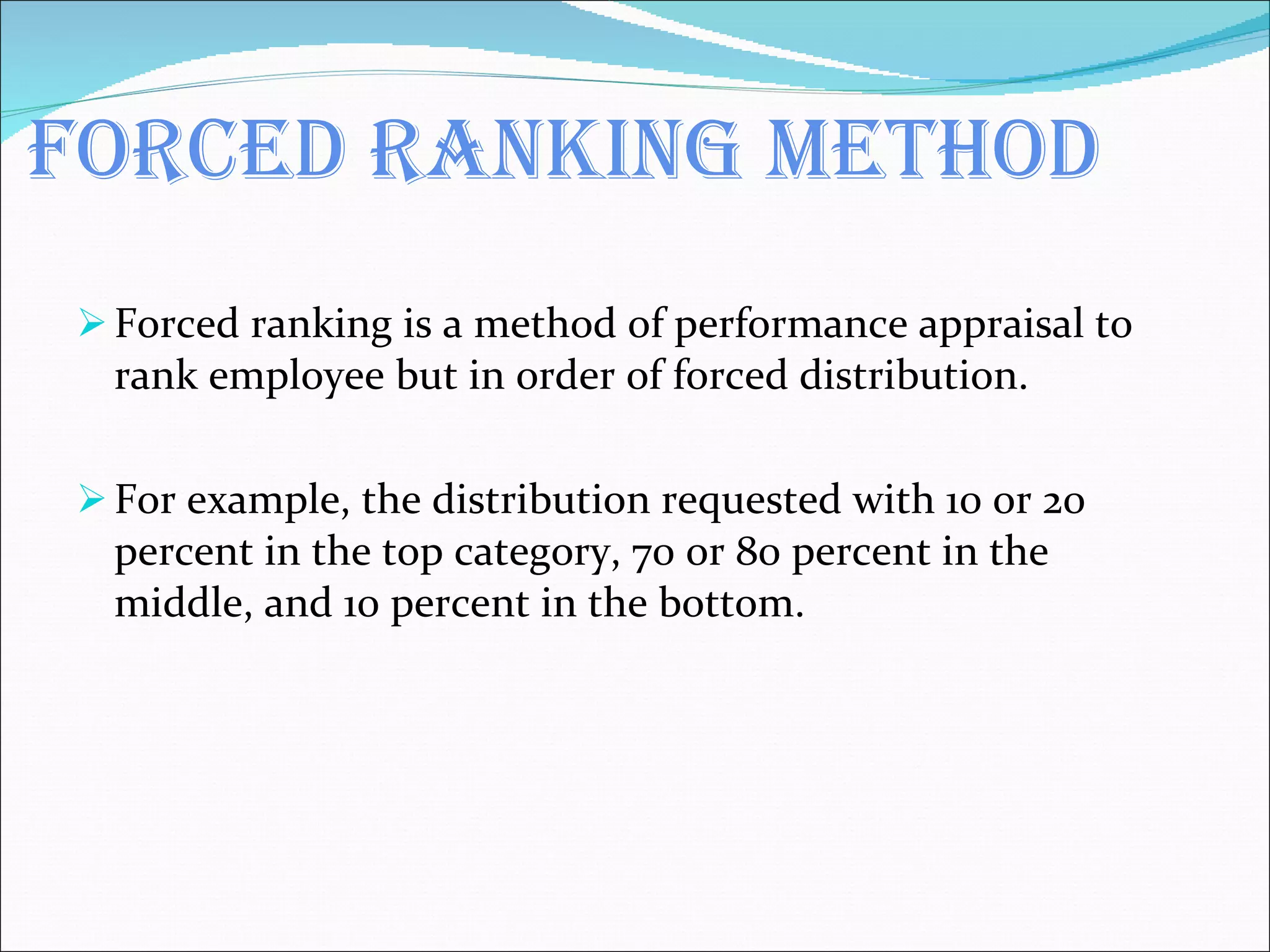
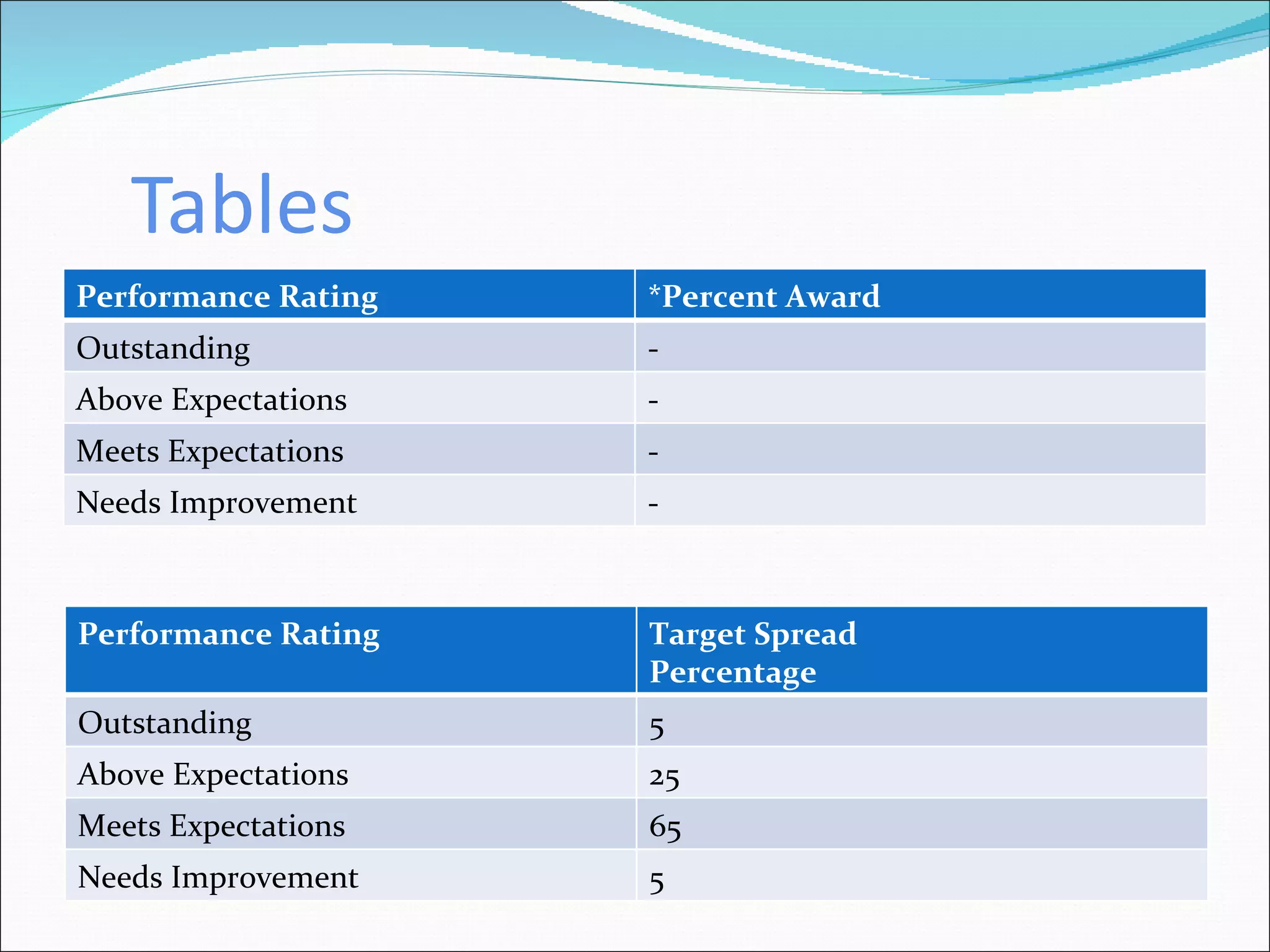
Forced ranking method Forced ranking is a method of performance appraisal to rank employee but in order of forced distribution. For example, the distribution requested with 10 or 20 percent in the top category, 70 or 80 percent in the middle, and 10 percent in the bottom.
Tables Performance Rating *Percent Award Outstanding - Above Expectations - Meets Expectations - Needs Improvement - Performance Rating Target Spread Percentage Outstanding 5 Above Expectations 25 Meets Expectations 65 Needs Improvement 5
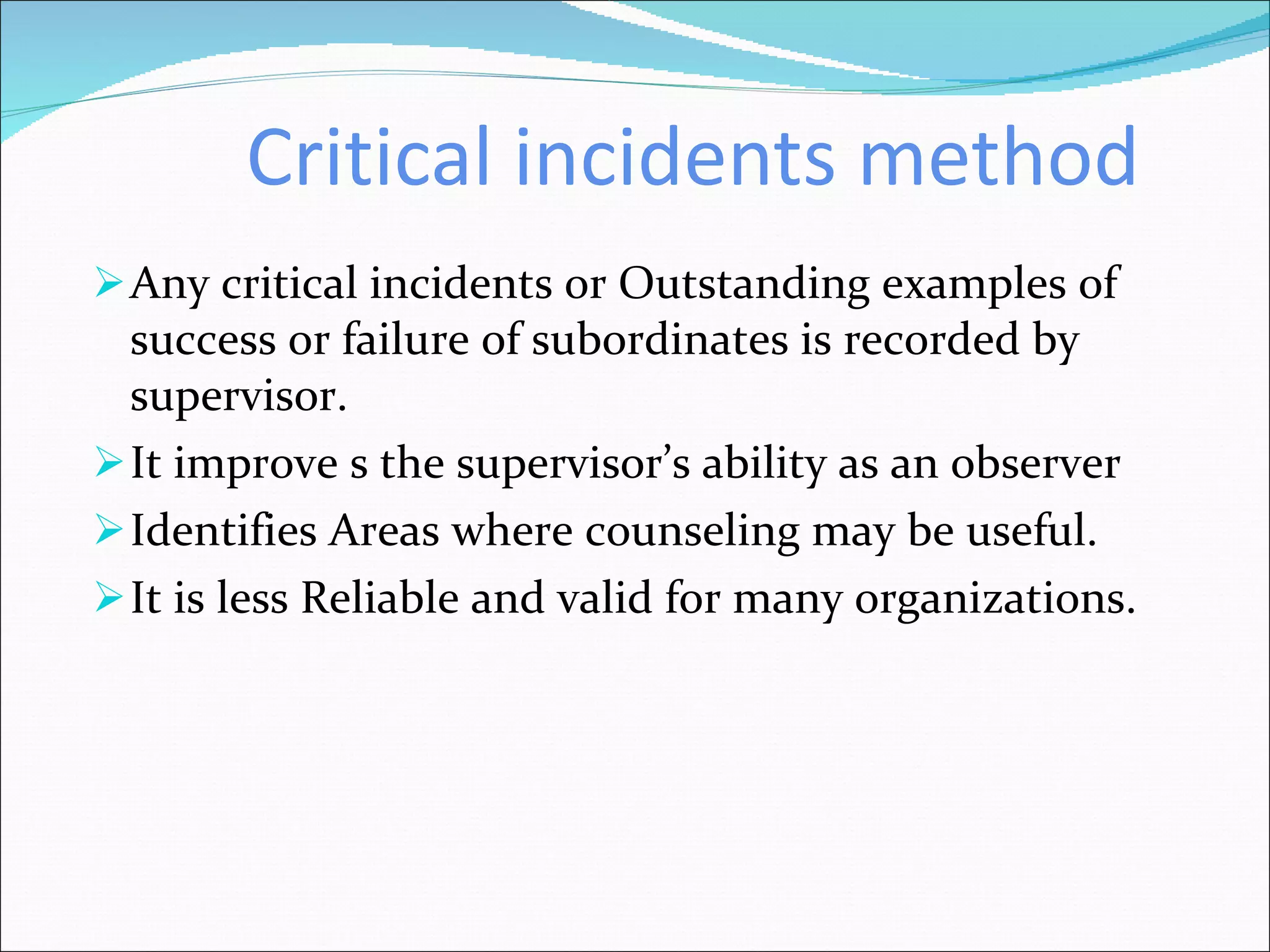
Critical incidents method Any critical incidents or Outstanding examples of success or failure of subordinates is recorded by supervisor. It improve s the supervisor’s ability as an observer Identifies Areas where counseling may be useful.  It is less Reliable and valid for many organizations.
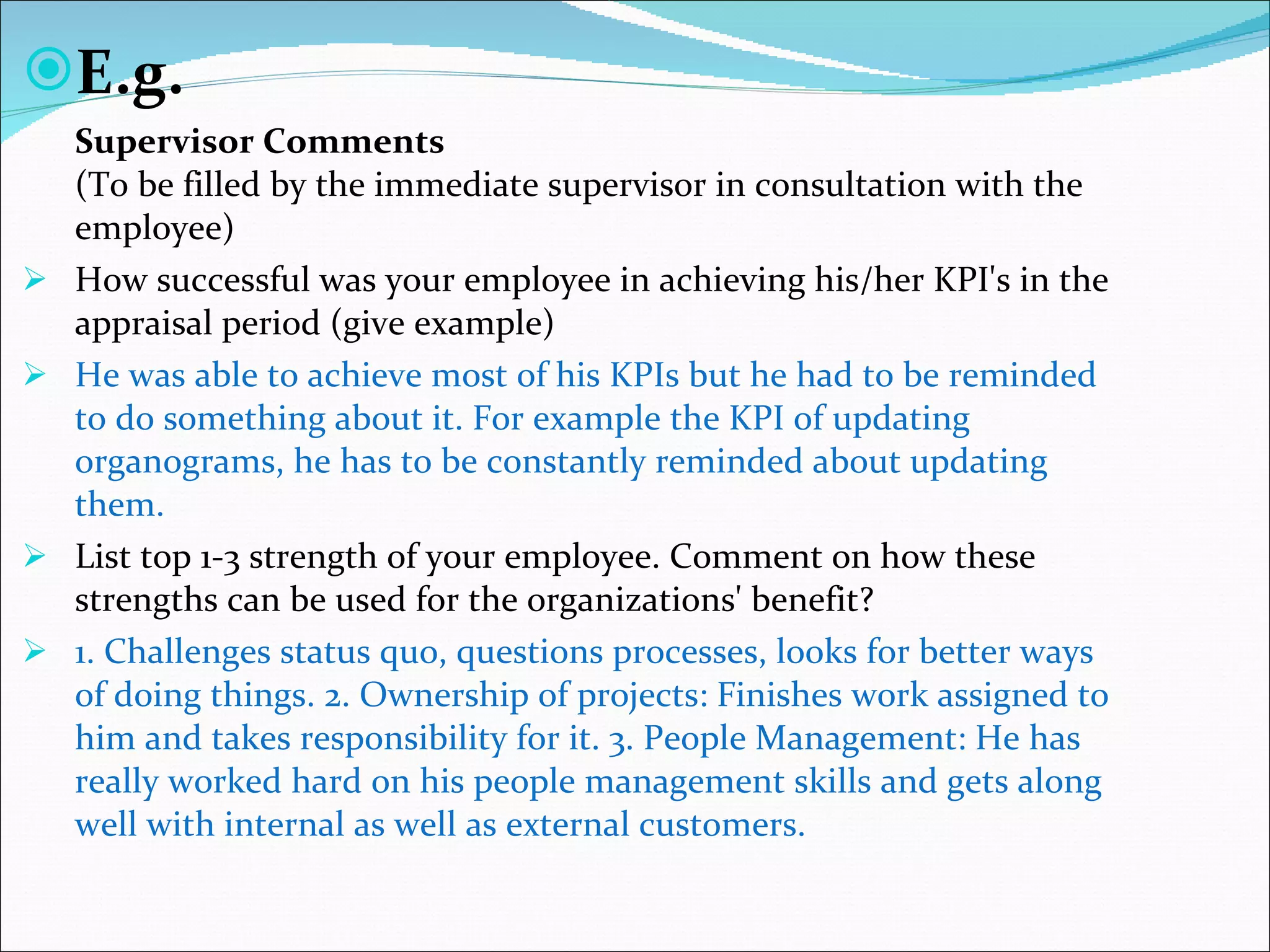
E.g. Supervisor Comments  (To be filled by the immediate supervisor in consultation with the employee)  How successful was your employee in achieving his/her KPI's in the appraisal period (give example)  He was able to achieve most of his KPIs but he had to be reminded to do something about it. For example the KPI of updating organograms, he has to be constantly reminded about updating them.  List top 1-3 strength of your employee. Comment on how these strengths can be used for the organizations' benefit?  1. Challenges status quo, questions processes, looks for better ways of doing things. 2. Ownership of projects: Finishes work assigned to him and takes responsibility for it. 3. People Management: He has really worked hard on his people management skills and gets along well with internal as well as external customers.
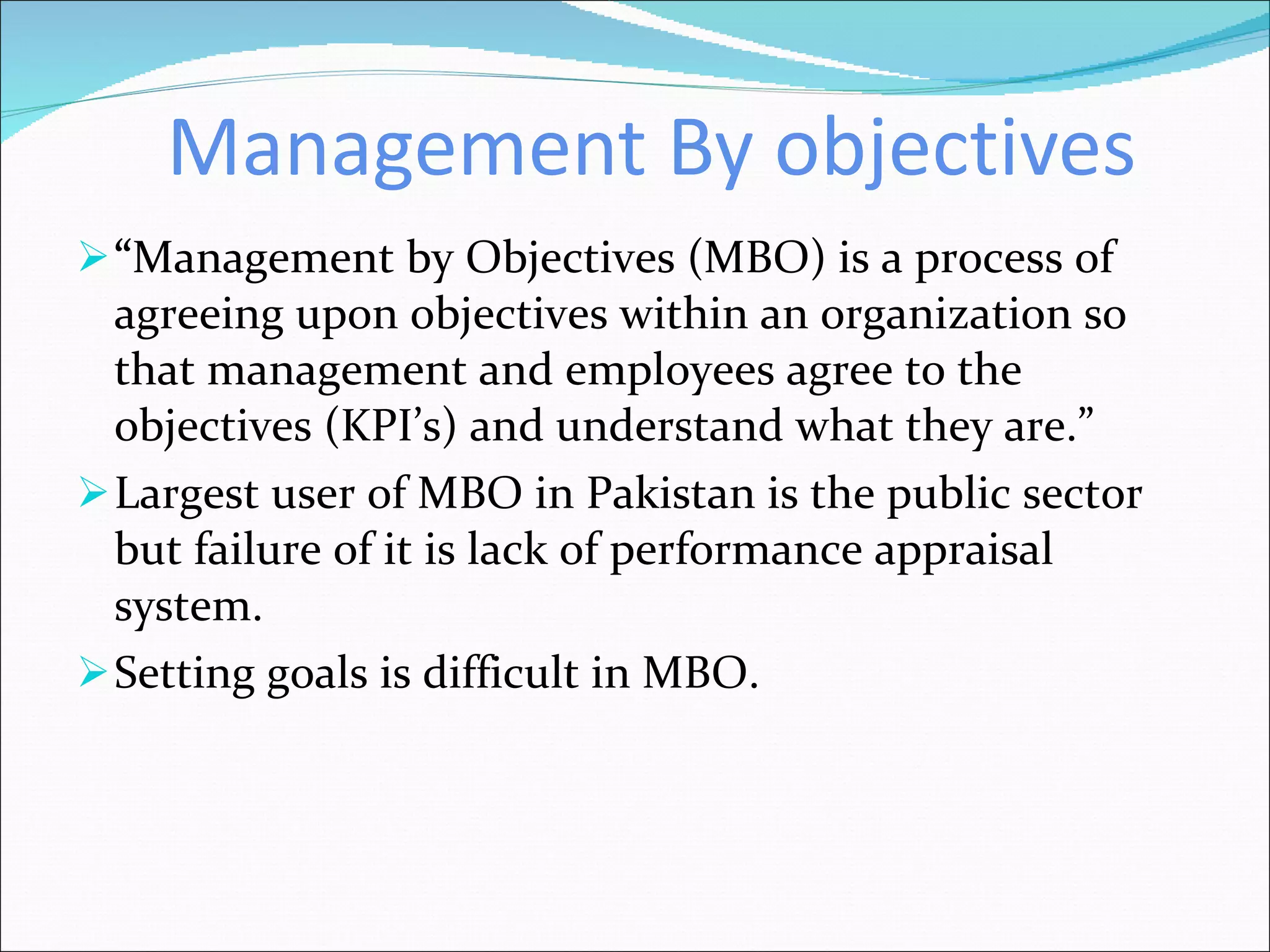
Management By objectives “ Management by Objectives (MBO) is a process of agreeing upon objectives within an organization so that management and employees agree to the objectives (KPI’s) and understand what they are.” Largest user of MBO in Pakistan is the public sector but failure of it is lack of performance appraisal system. Setting goals is difficult in MBO.
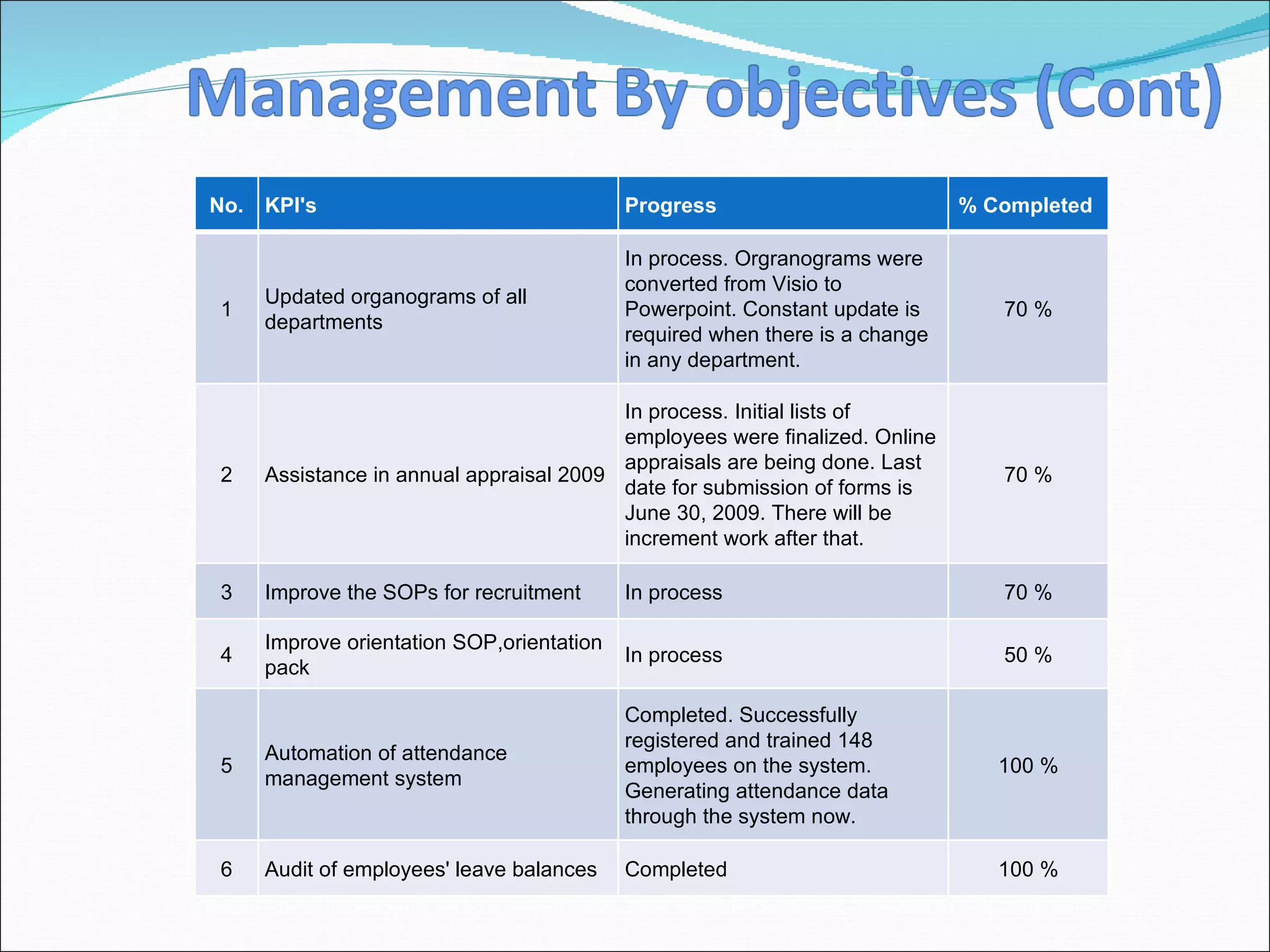
No. KPI's Progress % Completed  1 Updated organograms of all departments In process. Orgranograms were converted from Visio to Powerpoint. Constant update is required when there is a change in any department.  70 % 2 Assistance in annual appraisal 2009 In process. Initial lists of employees were finalized. Online appraisals are being done. Last date for submission of forms is June 30, 2009. There will be increment work after that.  70 % 3 Improve the SOPs for recruitment In process 70 % 4 Improve orientation SOP,orientation pack In process 50 % 5 Automation of attendance management system Completed. Successfully registered and trained 148 employees on the system. Generating attendance data through the system now. 100 % 6 Audit of employees' leave balances Completed 100 %
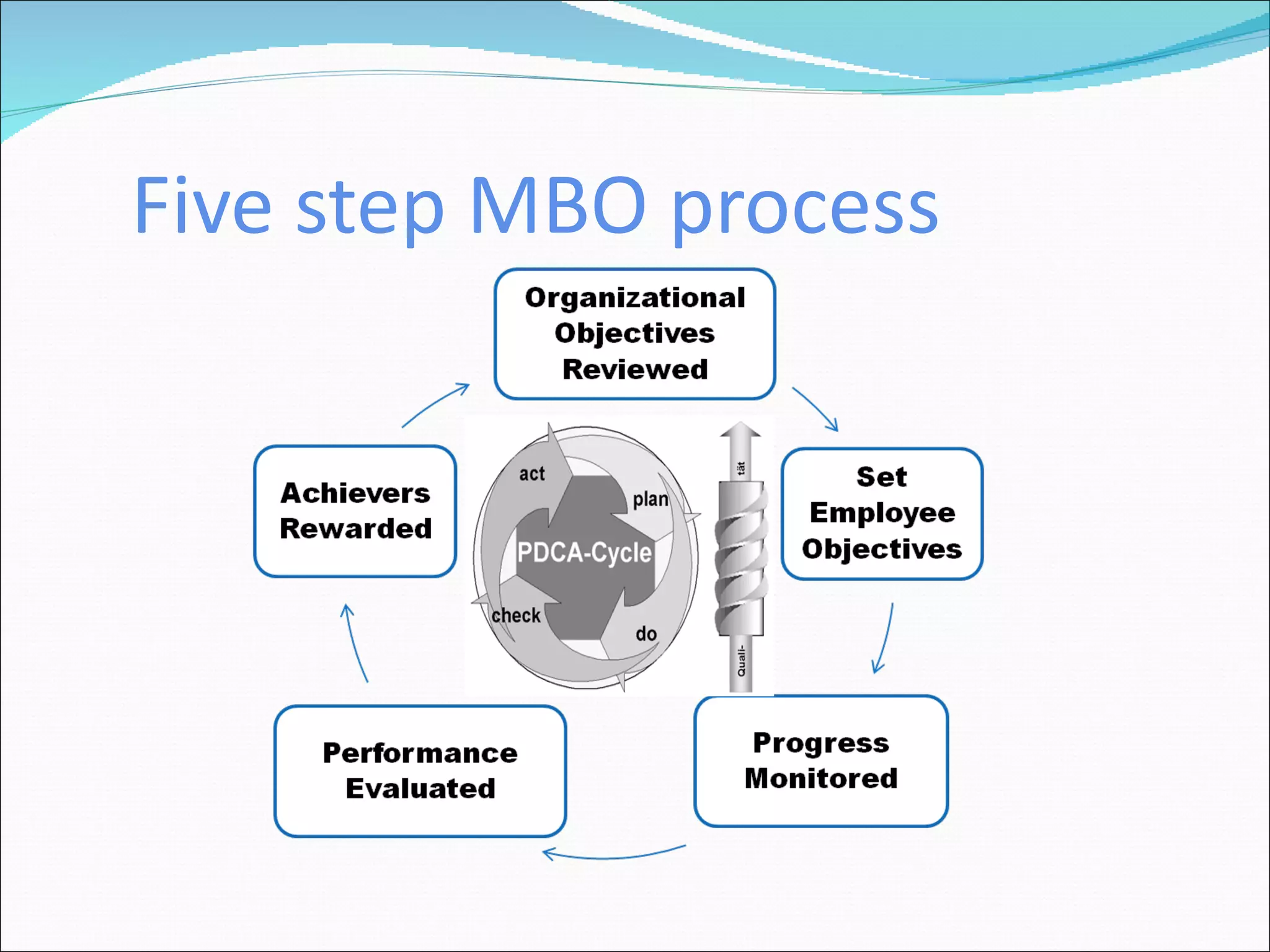
Five step MBO process
DEFINITION A GOAL –DIRECTED  APPROACH  TO PERFORMANCE APPRAISAL IN WHICH WORKERS AND THEIR SUPERVISORS SET GOALS TOGETHER FOR THE UPCOMING  EVALUATION PERIOD
Essay Method Employee is described in a number of broad categories like Overall impression Strengths and weakness The strength of this method is the writing skills and analytical skills of the rater.
ROLE PLAY  (Total Time: 75 min) Groups of four  Each group to write 3-4 objectives (10 min) Preparation for interview as per objectives (10 min)  Role play between Appraiser-Appraisee  (15 min/group) One group to observe the other and then rotate Each group to provide feedback on the other (5 min/group) Highlight strengths and weaknesses in the appraisal process of the other groups Syndicate Discussion (5-7 min)
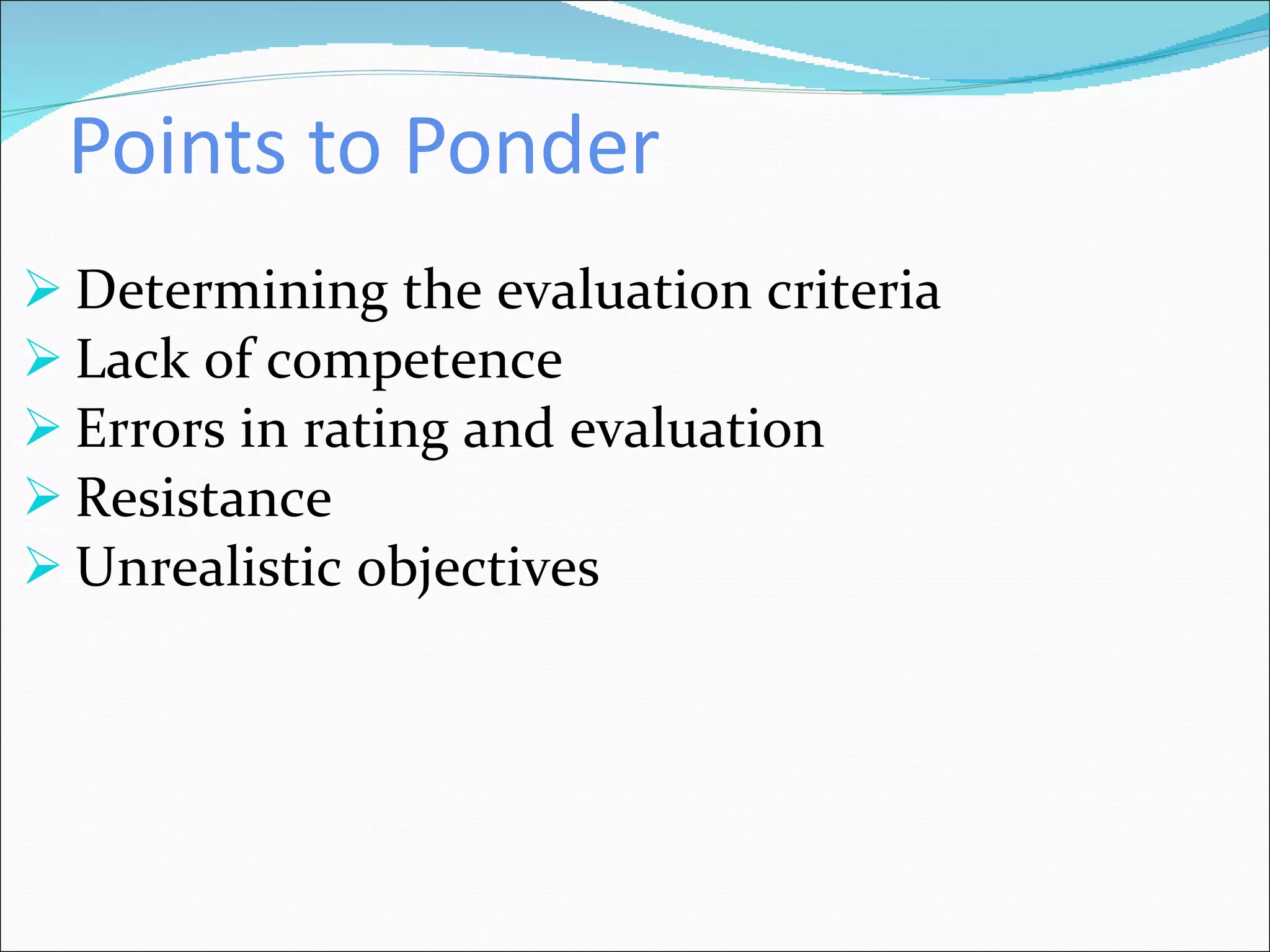
Points to Ponder Determining the evaluation criteria Lack of competence  Errors in rating and evaluation  Resistance  Unrealistic objectives
ERRORS IN PERFORMANCE APPRAISAL, WAYS & MEANS TO REDUCE IT
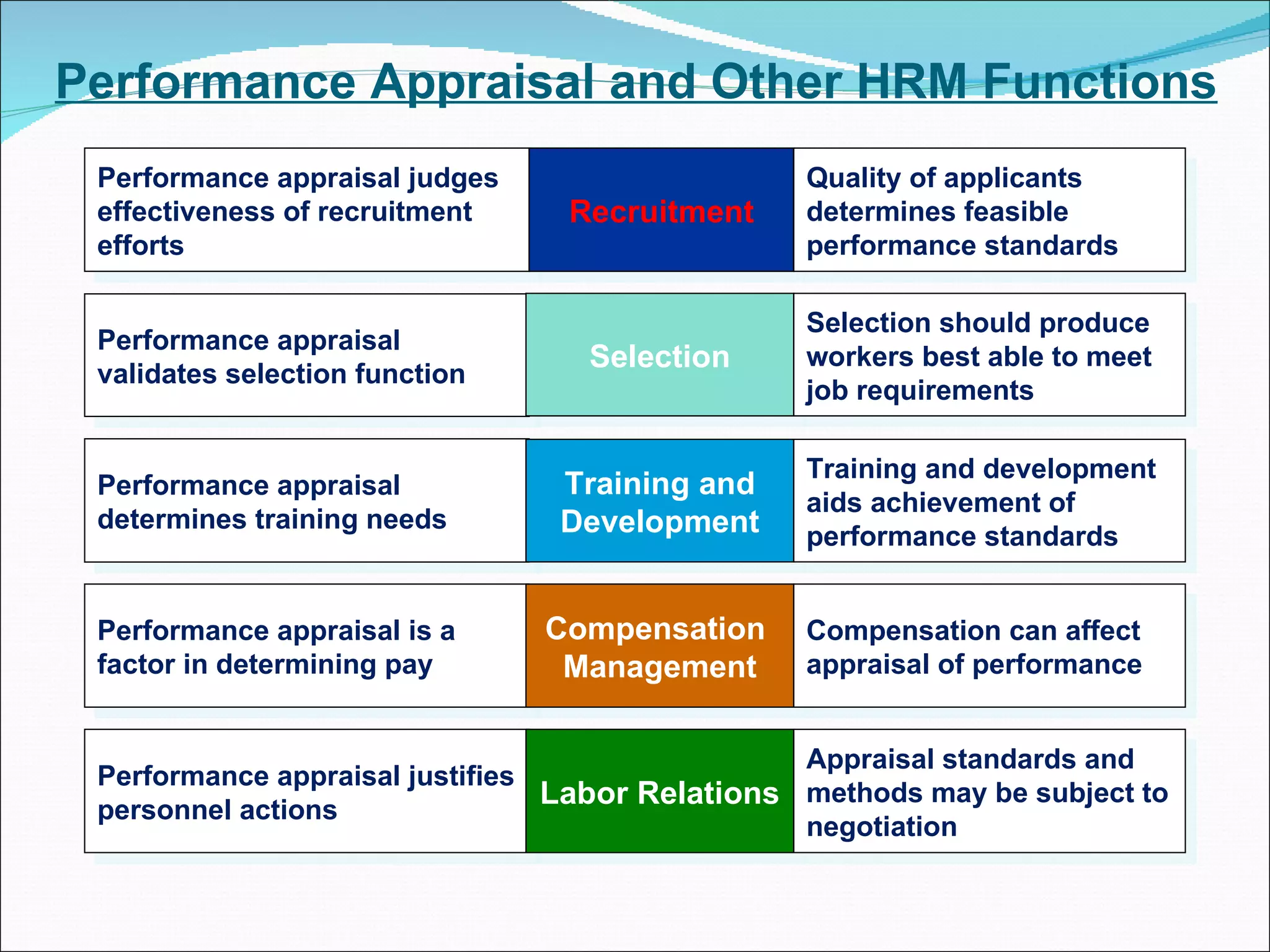
Performance Appraisal and Other HRM Functions Performance appraisal validates selection function Selection Selection should produce workers best able to meet job requirements Performance appraisal determines training needs Training and Development Training and development aids achievement of performance standards Performance appraisal is a factor in determining pay Compensation  Management Compensation can affect appraisal of performance Performance appraisal judges effectiveness of recruitment efforts Recruitment Quality of applicants determines feasible performance standards Performance appraisal justifies personnel actions Labor Relations Appraisal standards and methods may be subject to negotiation
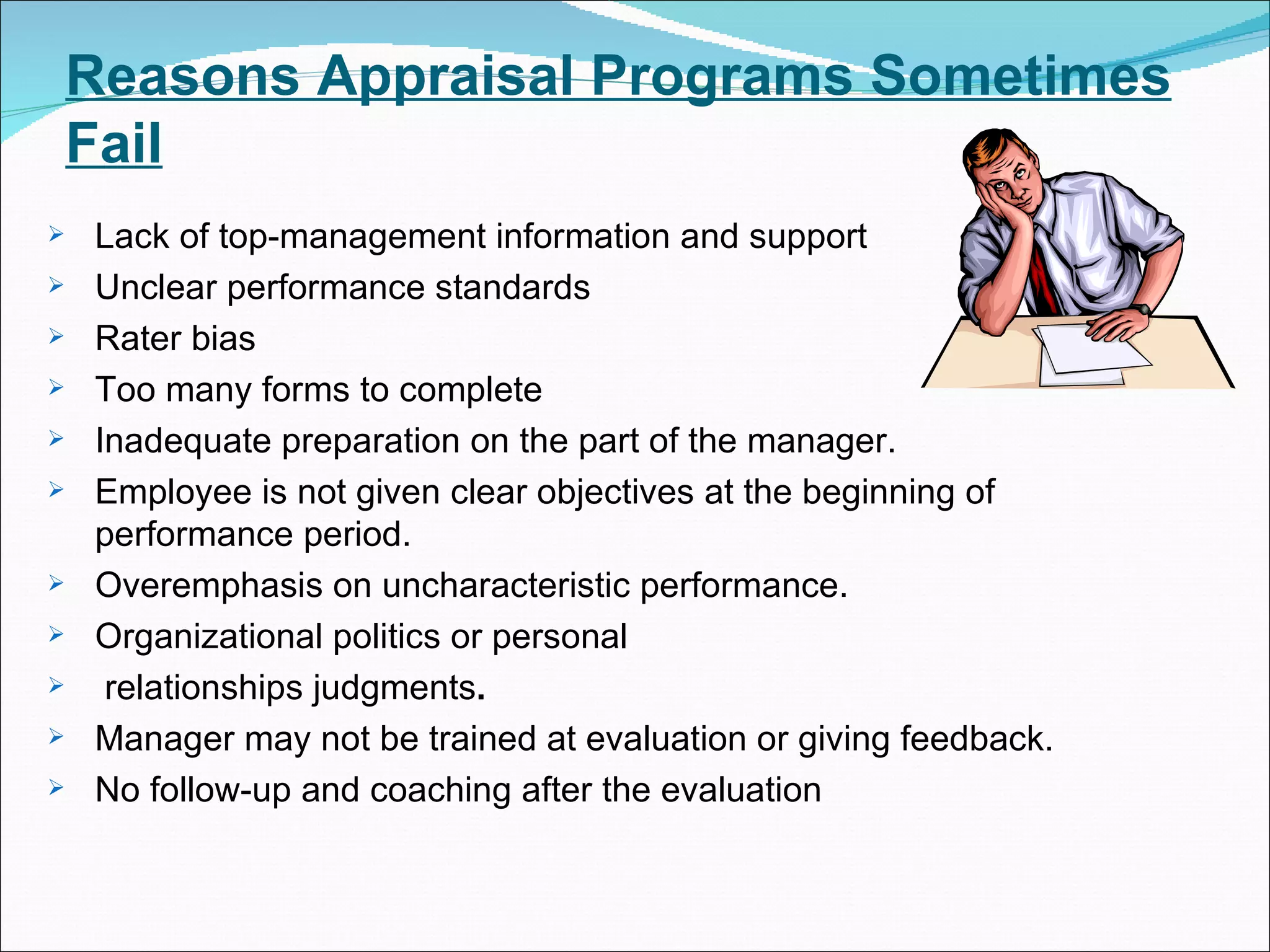
Reasons Appraisal Programs Sometimes Fail Lack of top-management information and support Unclear performance standards Rater bias Too many forms to complete Inadequate preparation on the part of the manager. Employee is not given clear objectives at the beginning of performance period.  Overemphasis on uncharacteristic performance. Organizational politics or personal relationships judgments . Manager may not be trained at evaluation or giving feedback. No follow-up and coaching after the evaluation
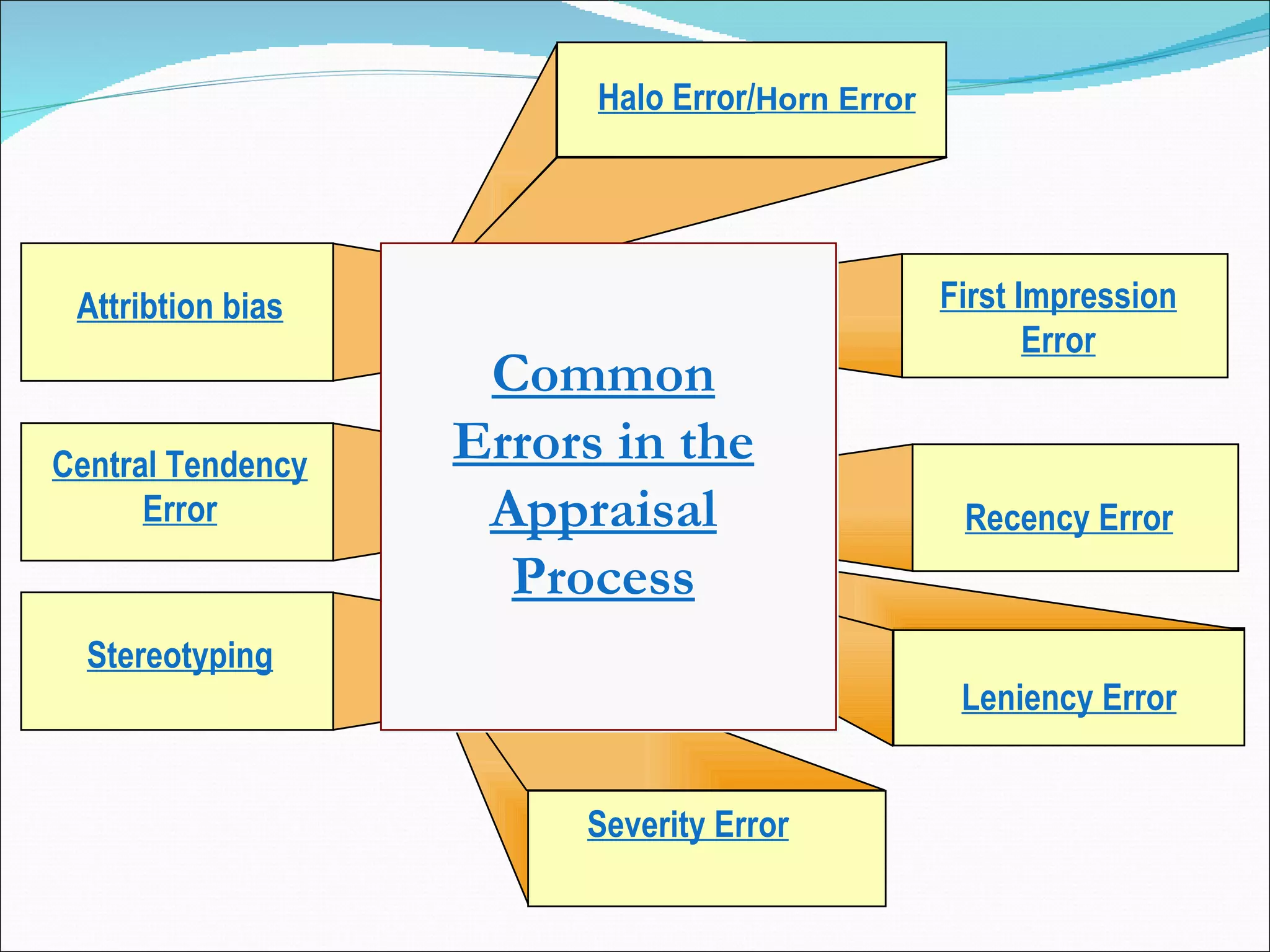
Common Errors in the Appraisal Process Halo Error/ Horn Error First Impression Error Recency Error Leniency Error Severity Error Central Tendency Error Stereotyping Attribtion bias
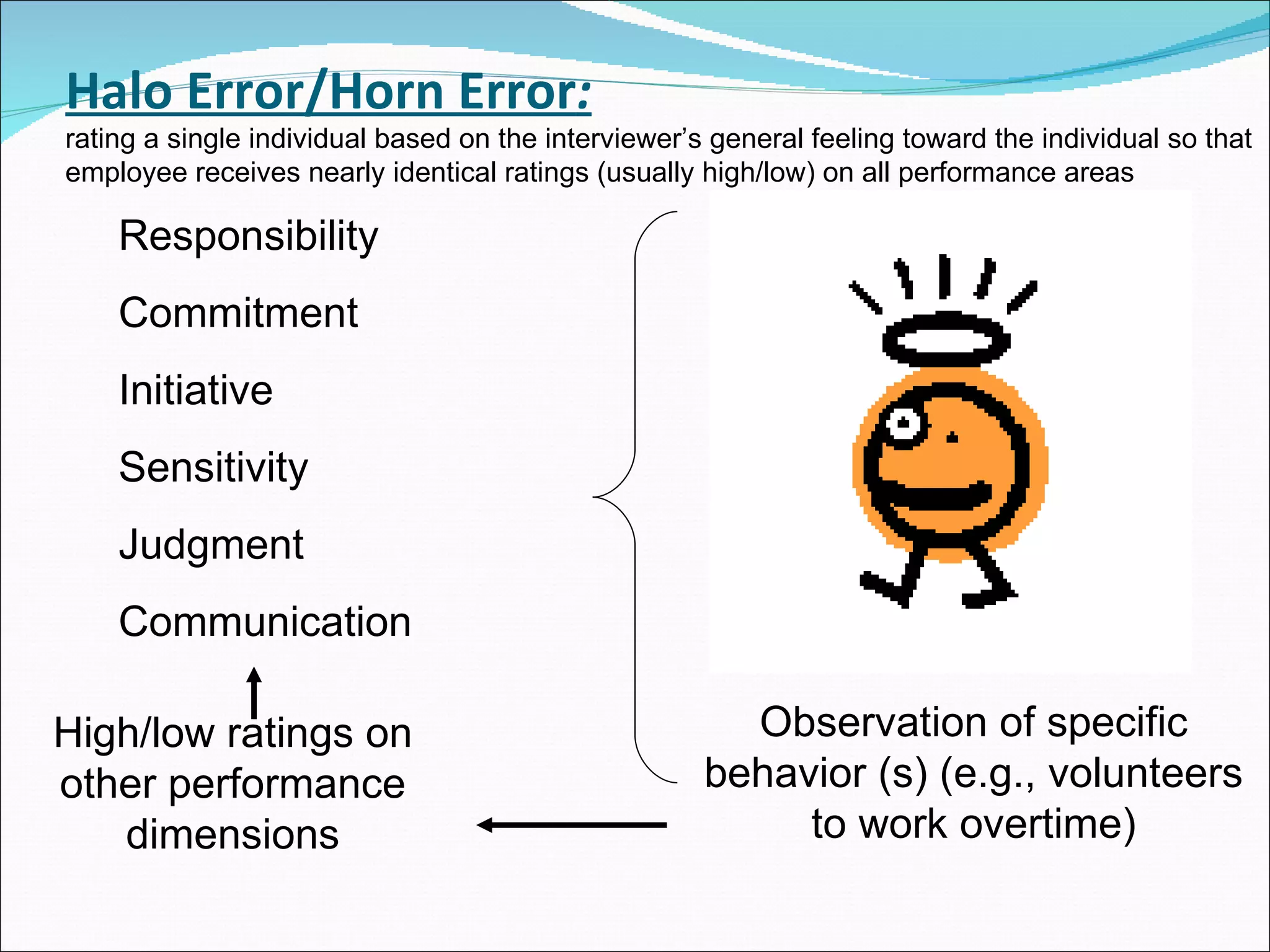
Responsibility Commitment Initiative Sensitivity Judgment Communication Observation of specific behavior (s) (e.g., volunteers to work overtime) Halo Error/Horn Error :   rating a single individual based on the interviewer’s general feeling toward the individual so that employee receives nearly identical ratings (usually high/low) on all performance areas High/low ratings on other performance dimensions
First Impression Error Tendency of a rater to make an initial positive or negative judgment of an employee and allow that first impression to color or distort later information Leniency Error give more positive ratings to employees than they deserve Severity Error   evaluate employees more unfavorably than they deserve Central Tendency Error rating all employees near the mid-point of the performance scale
Recency Error The tendency of minor events that have happened recently to have more influence on the rating than major events of many months ago. Stereotyping The tendency to generalize across groups and ignore individual differences.
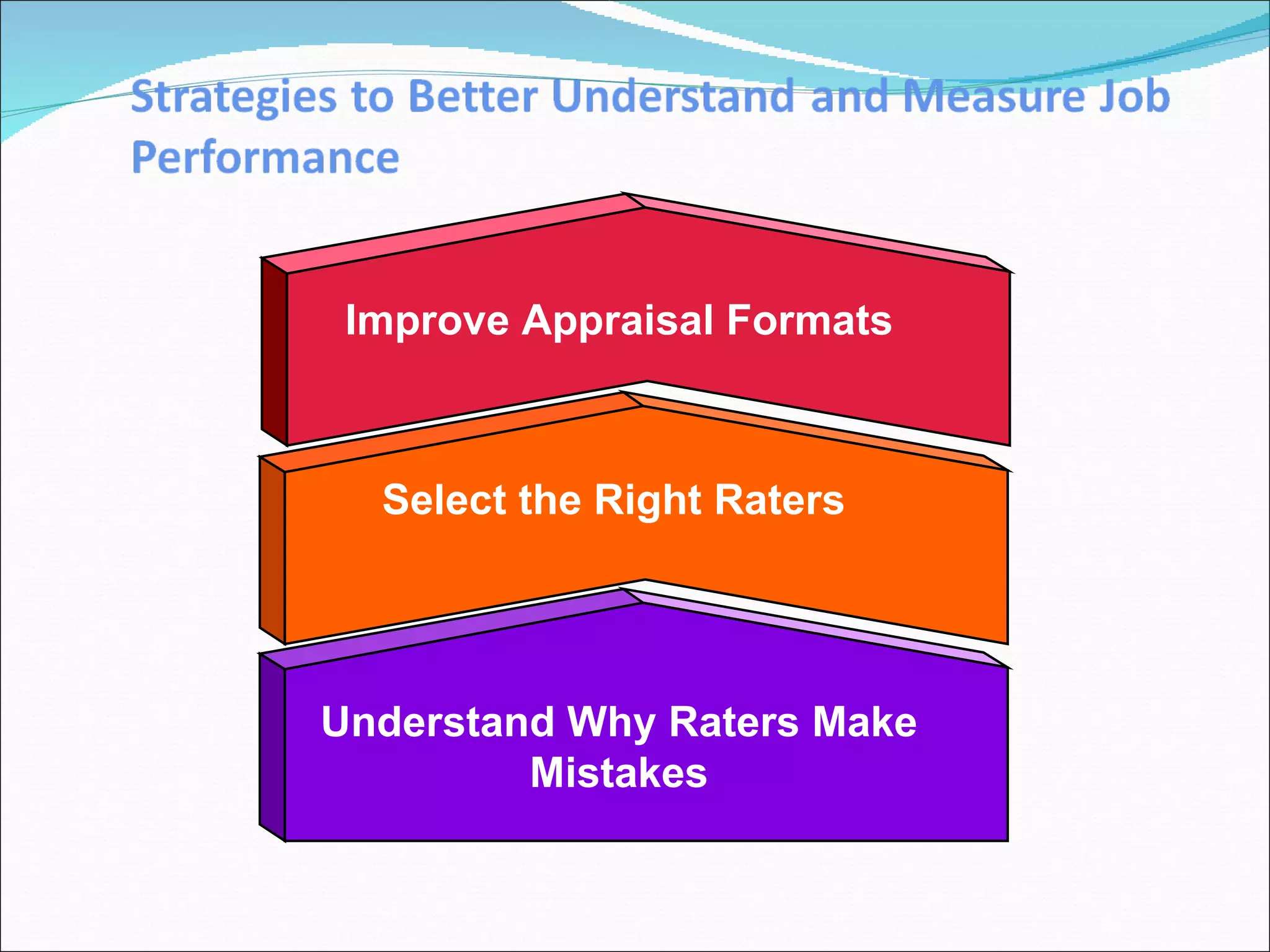
Improve Appraisal Formats Select the Right Raters Understand Why Raters Make Mistakes
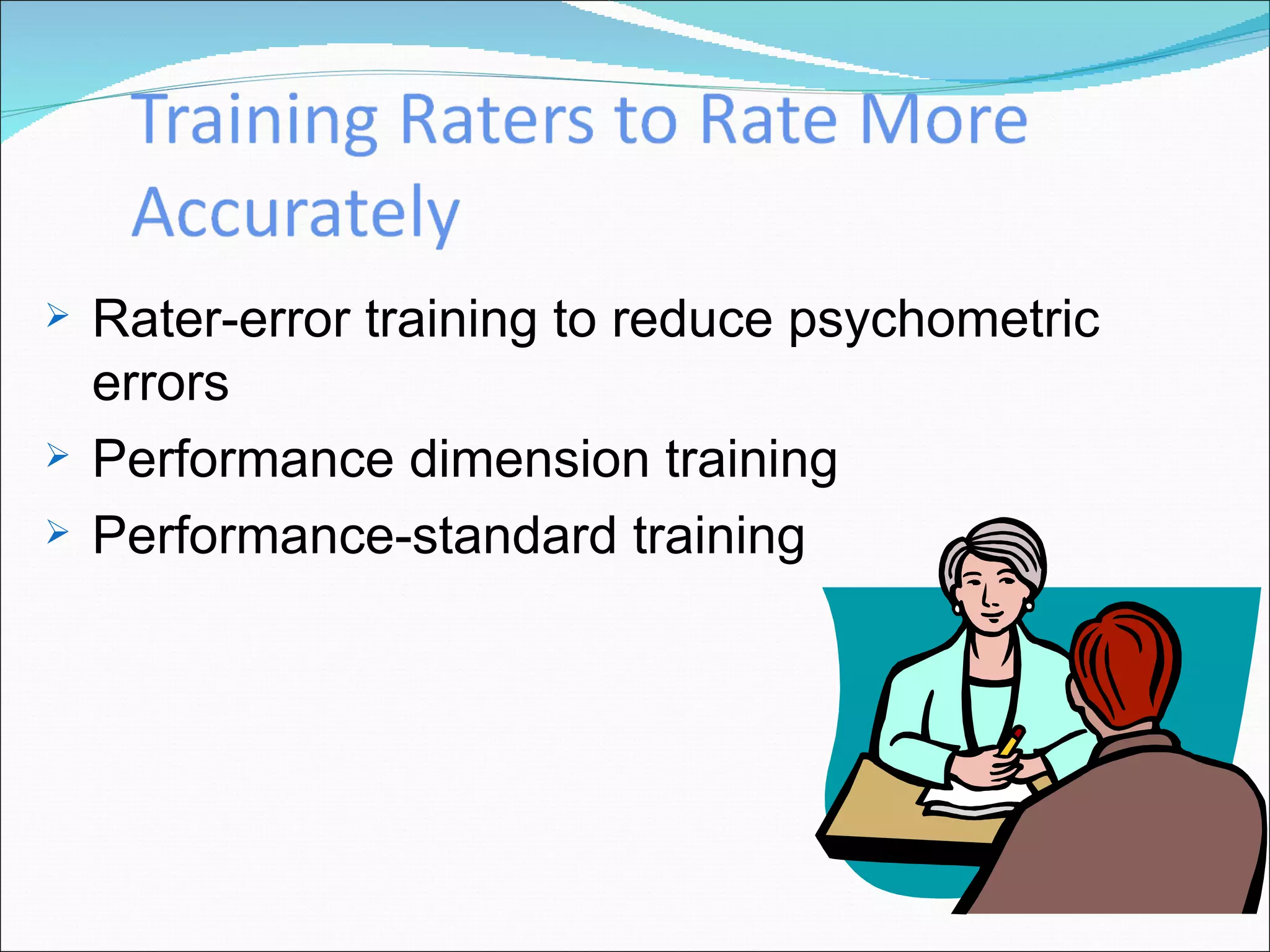
Rater-error training to reduce psychometric errors Performance dimension training Performance-standard training
Ensure that procedures for personnel decisions do not differ as a function of the race, sex, national origin, religion, or age of those affected by such decisions. 2)  Use objective and uncontaminated data whenever they are available. 3)  Provide a formal system of review or appeal to resolve disagreements regarding appraisals. 4)  Use more than one independent evaluator of performance. 5)  Use a formal, standardized system for personnel decisions. 6)  Ensure that evaluators have ample opportunity to observe and rate performance if ratings must be made. 7)  Avoid ratings on traits such as dependability, drive, aptitude, or attitude. 8)  Provide documented performance counseling prior to performances-based termination decisions. Prescriptions for Defensible Appraisal Systems
From a Performance Perspective ( An Exercise ) Jigsaw reading Four groups Read the given extract and jot down at least 8-10 key points (10 min)  Each group to present and share the key points (3 min per group) Syndicate Discussion (10 min)


Performance appraisal final copy

  • 1.
    Performance Management-Appraisals Workshop Continual organizational improvement can only come about with continual individual improvement.
  • 2.
    Index Course goalsPerformance Management What is Performance Appraisal? Performance Appraisal Process. Methods of Performance Appraisal Conclusion.
  • 3.
    Course Goals To assist you in managing employee performance To enable you to appropriately complete the evaluation portion of a performance management program standards. Why have Performance Appraisals? Overview of The Process - Appraisal Procedure Benefits of Appraisals - Management Role - Employee Role
  • 4.
    Communication Skills Required- Questioning - Listening - Language The Appraisal - Appraisal Areas - Preparation - Writing the Appraisal - Do's and Don'ts - Goals - Self Esteem - Structuring the Appraisal
  • 5.
    The Appraisal Discussion- Framing - Disagreement - Criticism - Feedback Problems with Appraisals - People - Process - Preparation
  • 6.
    ROTATIONAL BRAINSTORMING Whatis Performance Appraisal? Why is it necessary? What is the key to the effectiveness of PA? Should PA be done or not? If so why?(State at least 3 reasons for either)
  • 7.
    DEFINITION What isperformance management? An ongoing communication process.
  • 8.
    Key Definitions wewill explore in Performance Performance Standards What are they? Performance Evaluation What is it?
  • 9.
    Standards Start witha good job description . ( Why does this job exist??) What is this person to accomplish? What is the person accountable for in the work process? What results are achieved through the functions of THIS job? What are the KEY performance expectations of THIS job? Remember: Standards should reflect what a satisfactory employee can accomplish .
  • 10.
    Evaluations Only oneaspect of the continuous Performance Management Process!!! Should be linked to the Business Objectives Should measure Results & Competencies Standards are “Standard” or “Satisfactory” in our process Don’t create a “zero sum game”-- Always strive for Win/Win situations Ratings are not decided upon compared to other performers, but rather to your planned performance for the specific staff person Look at behavior and results
  • 11.
    EVALUATE/APPRAISE OBTAIN INPUTFROM RECORDS & DISCUSSIONS WITH REVIEWING OFFICER . RECORD RESULTS, PERFORMANCE, BEHAVIOR RATE FACTORS ON ALL DIMENSIONS OF JOB FOR ENTIRE RATING PERIOD RECORD THE RATINGS DISCUSS WITH REVIEWING OFFICER DISCUSS WITH EMPLOYEE
  • 12.
    GUIDELINES FOR CONDUCTINGPERFORMANCE EVALUATIONS PREPARE FOR MEETING AND PROVIDE UNINTERRUPTED SESSION SHOW KNOWLEDGE OF AND INTEREST IN EMPLOYEE DISCUSS PERFORMANCE AND PROVIDE SPECIFICS DISCUSS EMPLOYEE DEVELOPMENT CONCLUDE ON POSITIVE
  • 13.
  • 14.
    Definition “ Anysystem of determining how well an individual employee has performed during a period of time, frequently used as a basis for determining merit increases.” “ OBSERVE and EVALUATE an employee in relation to PRE-SET performance standards.”
  • 15.
    BRAINSTORMING What objectiveswould you base PA upon ?
  • 16.
    PA Objectives DocumentationOrganizational Maintenance Promotions Training and development Pay scales & Pay raise Constructive criticism and guidance Administrative uses HR programs Communication
  • 17.
    Appraisal ProcessEstablish job Expectations Design an Appraisal Programme Appraise Performance Performance Interview Objectives of Performance Appraisal Archive Appraisal Data Use appraisal data for appropriate purposes
  • 18.
    THREE ANDONE WHO ? SUPERVISORS DO EVALUATIONS WHAT ? COMPLETION OF JOB TASKS WHEN ? ANNUALY FOR PERMANENT EMPLOYEES NEW EMPLOYEES 3-6 MONTHS HOW ? SPECIAL CARE & RESPECT
  • 19.
    Sources of Information1) Supervisors (most common) Motivation Time availability Friendship 2) Co-Workers (Peers) Friendship bias Leniency High level of accuracy Best used as a source of feedback
  • 20.
    Sources of Information(cont) 3) Self Lots of knowledge Leniency effect Good preparation for performance appraisal meeting (conducive for dialog) 4 ) Subordinates Biases (e.g., # of subordinates, type of job, expected evaluation from supervisor) 5) Client Good source of feedback Negativity bias
  • 21.
    Methods of PACritical incident method Weighted checklist method Paired comparison analysis Graphic rating method Essay evaluation method Behaviorally anchored rating scale Performance rating method Management by objective method 360 degree performance appraisal method Forced ranking method Behavioral observation scales
  • 22.
  • 23.
    Forced ranking methodForced ranking is a method of performance appraisal to rank employee but in order of forced distribution. For example, the distribution requested with 10 or 20 percent in the top category, 70 or 80 percent in the middle, and 10 percent in the bottom.
  • 24.
    Tables Performance Rating*Percent Award Outstanding - Above Expectations - Meets Expectations - Needs Improvement - Performance Rating Target Spread Percentage Outstanding 5 Above Expectations 25 Meets Expectations 65 Needs Improvement 5
  • 25.
    Critical incidents methodAny critical incidents or Outstanding examples of success or failure of subordinates is recorded by supervisor. It improve s the supervisor’s ability as an observer Identifies Areas where counseling may be useful. It is less Reliable and valid for many organizations.
  • 26.
    E.g. Supervisor Comments (To be filled by the immediate supervisor in consultation with the employee) How successful was your employee in achieving his/her KPI's in the appraisal period (give example) He was able to achieve most of his KPIs but he had to be reminded to do something about it. For example the KPI of updating organograms, he has to be constantly reminded about updating them. List top 1-3 strength of your employee. Comment on how these strengths can be used for the organizations' benefit? 1. Challenges status quo, questions processes, looks for better ways of doing things. 2. Ownership of projects: Finishes work assigned to him and takes responsibility for it. 3. People Management: He has really worked hard on his people management skills and gets along well with internal as well as external customers.
  • 27.
    Management By objectives“ Management by Objectives (MBO) is a process of agreeing upon objectives within an organization so that management and employees agree to the objectives (KPI’s) and understand what they are.” Largest user of MBO in Pakistan is the public sector but failure of it is lack of performance appraisal system. Setting goals is difficult in MBO.
  • 28.
    No. KPI's Progress% Completed 1 Updated organograms of all departments In process. Orgranograms were converted from Visio to Powerpoint. Constant update is required when there is a change in any department. 70 % 2 Assistance in annual appraisal 2009 In process. Initial lists of employees were finalized. Online appraisals are being done. Last date for submission of forms is June 30, 2009. There will be increment work after that. 70 % 3 Improve the SOPs for recruitment In process 70 % 4 Improve orientation SOP,orientation pack In process 50 % 5 Automation of attendance management system Completed. Successfully registered and trained 148 employees on the system. Generating attendance data through the system now. 100 % 6 Audit of employees' leave balances Completed 100 %
  • 29.
  • 30.
    DEFINITION A GOAL–DIRECTED APPROACH TO PERFORMANCE APPRAISAL IN WHICH WORKERS AND THEIR SUPERVISORS SET GOALS TOGETHER FOR THE UPCOMING EVALUATION PERIOD
  • 31.
    Essay Method Employeeis described in a number of broad categories like Overall impression Strengths and weakness The strength of this method is the writing skills and analytical skills of the rater.
  • 32.
    ROLE PLAY (Total Time: 75 min) Groups of four Each group to write 3-4 objectives (10 min) Preparation for interview as per objectives (10 min) Role play between Appraiser-Appraisee (15 min/group) One group to observe the other and then rotate Each group to provide feedback on the other (5 min/group) Highlight strengths and weaknesses in the appraisal process of the other groups Syndicate Discussion (5-7 min)
  • 33.
    Points to PonderDetermining the evaluation criteria Lack of competence Errors in rating and evaluation Resistance Unrealistic objectives
  • 34.
    ERRORS IN PERFORMANCEAPPRAISAL, WAYS & MEANS TO REDUCE IT
  • 35.
    Performance Appraisal andOther HRM Functions Performance appraisal validates selection function Selection Selection should produce workers best able to meet job requirements Performance appraisal determines training needs Training and Development Training and development aids achievement of performance standards Performance appraisal is a factor in determining pay Compensation Management Compensation can affect appraisal of performance Performance appraisal judges effectiveness of recruitment efforts Recruitment Quality of applicants determines feasible performance standards Performance appraisal justifies personnel actions Labor Relations Appraisal standards and methods may be subject to negotiation
  • 36.
    Reasons Appraisal ProgramsSometimes Fail Lack of top-management information and support Unclear performance standards Rater bias Too many forms to complete Inadequate preparation on the part of the manager. Employee is not given clear objectives at the beginning of performance period. Overemphasis on uncharacteristic performance. Organizational politics or personal relationships judgments . Manager may not be trained at evaluation or giving feedback. No follow-up and coaching after the evaluation
  • 37.
    Common Errors inthe Appraisal Process Halo Error/ Horn Error First Impression Error Recency Error Leniency Error Severity Error Central Tendency Error Stereotyping Attribtion bias
  • 38.
    Responsibility Commitment InitiativeSensitivity Judgment Communication Observation of specific behavior (s) (e.g., volunteers to work overtime) Halo Error/Horn Error : rating a single individual based on the interviewer’s general feeling toward the individual so that employee receives nearly identical ratings (usually high/low) on all performance areas High/low ratings on other performance dimensions
  • 39.
    First Impression ErrorTendency of a rater to make an initial positive or negative judgment of an employee and allow that first impression to color or distort later information Leniency Error give more positive ratings to employees than they deserve Severity Error evaluate employees more unfavorably than they deserve Central Tendency Error rating all employees near the mid-point of the performance scale
  • 40.
    Recency Error Thetendency of minor events that have happened recently to have more influence on the rating than major events of many months ago. Stereotyping The tendency to generalize across groups and ignore individual differences.
  • 41.
    Improve Appraisal FormatsSelect the Right Raters Understand Why Raters Make Mistakes
  • 42.
    Rater-error training toreduce psychometric errors Performance dimension training Performance-standard training
  • 43.
    Ensure that proceduresfor personnel decisions do not differ as a function of the race, sex, national origin, religion, or age of those affected by such decisions. 2) Use objective and uncontaminated data whenever they are available. 3) Provide a formal system of review or appeal to resolve disagreements regarding appraisals. 4) Use more than one independent evaluator of performance. 5) Use a formal, standardized system for personnel decisions. 6) Ensure that evaluators have ample opportunity to observe and rate performance if ratings must be made. 7) Avoid ratings on traits such as dependability, drive, aptitude, or attitude. 8) Provide documented performance counseling prior to performances-based termination decisions. Prescriptions for Defensible Appraisal Systems
  • 44.
    From a PerformancePerspective ( An Exercise ) Jigsaw reading Four groups Read the given extract and jot down at least 8-10 key points (10 min) Each group to present and share the key points (3 min per group) Syndicate Discussion (10 min)
  • 45.
  • 46.

Editor's Notes

  • #2 3 Developed by the Executive Offices, Office of Personnel Services Performance Management Course Guide
  • #4 9 Developed by the Executive Offices, Office of Personnel Services Performance Management Course Guide
  • #9 11 Developed by the Executive Offices, Office of Personnel Services Performance Management Course Guide
  • #43 The branch of psychology that deals with the design, administration, and interpretation of quantitative tests for the measurement of psychological variables such as intelligence, aptitude, and personality traits. Also called psychometry . A “Performance Dimension” is anything an employee must demonstrate in order to be effective in a particular organization, job, and/or level of position. Typically, a Performance Dimensions model includes a number of competencies (such as “technical skills” and “honesty and integrity”), along with specific behaviors that fall within each competency. Performance standards state what behaviors or results are expected for performance to be considered satisfactory. Standards are the criteria against which performance is judged. Standards should be: attainable specific observable meaningful measurable, and stated in terms of quality, quantity, timeliness, or cost. Involve the employee in the development of standards. Be certain the standards describe the conditions that will be met when performance is satisfactory. For example, how well, how much, what speed, etc. is expected. Performance standards are the basis for performance evaluation and should clearly state how you and the employee will recognize when expectations have been met, exceeded, or not met.
  • #45 12 Developed by the Executive Offices, Office of Personnel Services Performance Management Course Guide