Performance appraisal is a method of evaluating the
behavior of employees in the work spot, normally
including both the quantitative and qualitative aspects of
jobperformance.
Performance here refers to the degree of
accomplishment of the tasks that make up an
individual's job. It indicates how well an individual is
fulfillingthejobdemands.
The performance of an employee is compared with the
job standards. The job standards are already fixed by the
management for an effectiveappraisal.
•Performance appraisal refers to all the
formal procedures used in working
organizations to evaluate the personalities
andcontribution ofgroupmembers.
• Todeterminejob competence
• Toselect qualifiedindividualsforpromotionortransfer
• To establish and improve – Communication between
supervisorsandsubordinates– Staffperformance
• To determine – Training and developmental needs of staff –
Salarystandardsandto awardmerit.
• Todiscovertheaspirations andtalents ofstaff
• Tochecktheefficacyofstaff developmentprogrammes
• Toidentifyunsatisfactorystafffordemotionortermination
• Toaidthemanagerin coachingandcounseling
• To provide feedback to enhance staff development and
motivatepersonneltowardsheightsofachievement
• IndividualRewards
• FeedbackforSub-Ordinate
• RecognitionofSuperiorPerformance
• DocumentationofWeakPerformance
• PersonnelDecision-Making
• Toestablishstandardsofjob performance
• To improve organizational development by
identifyingtraininganddevelopmentneeds
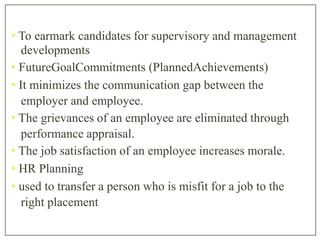
• To earmark candidates for supervisory and management
developments
• FutureGoalCommitments (PlannedAchievements)
• It minimizes the communication gap between the
employer and employee.
• The grievances of an employee are eliminated through
performance appraisal.
• The job satisfaction of an employee increases morale.
• HR Planning
• used to transfer a person who is misfit for a job to the
right placement
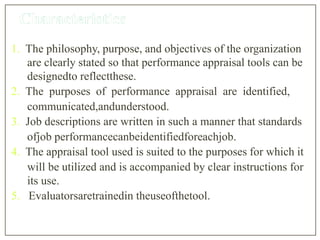
1. The philosophy, purpose, and objectives of the organization
are clearly stated so that performance appraisal tools can be
designedto reflectthese.
2. The purposes of performance appraisal are identified,
communicated,andunderstood.
3. Job descriptions are written in such a manner that standards
ofjob performancecanbeidentifiedforeachjob.
4. The appraisal tool used is suited to the purposes for which it
will be utilized and is accompanied by clear instructions for
its use.
5. Evaluatorsaretrainedin theuseofthetool.
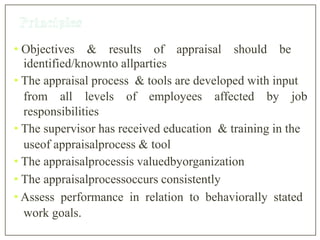
• Objectives & results of appraisal should be
identified/knownto allparties
• The appraisal process & tools are developed with input
from all levels of employees affected by job
responsibilities
• The supervisor has received education & training in the
useof appraisalprocess & tool
• The appraisalprocessis valuedbyorganization
• The appraisalprocessoccurs consistently
• Assess performance in relation to behaviorally stated
work goals.
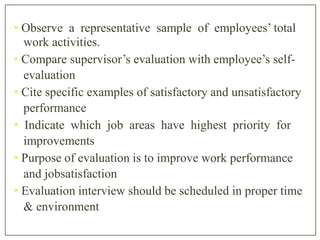
• Observe a representative sample of employees’ total
work activities.
• Compare supervisor’s evaluation with employee’s self-
evaluation
• Cite specific examples of satisfactory and unsatisfactory
performance
• Indicate which job areas have highest priority for
improvements
• Purpose of evaluation is to improve work performance
and jobsatisfaction
• Evaluation interview should be scheduled in proper time
& environment
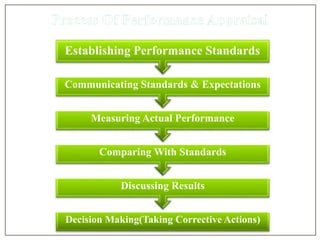
Decision Making(Taking Corrective Actions)
Discussing Results
Comparing With Standards
Measuring Actual Performance
Communicating Standards & Expectations
Establishing Performance Standards

performanceappraisal-200421171425.pptx

  • 2.
    Performance appraisal isa method of evaluating the behavior of employees in the work spot, normally including both the quantitative and qualitative aspects of jobperformance. Performance here refers to the degree of accomplishment of the tasks that make up an individual's job. It indicates how well an individual is fulfillingthejobdemands. The performance of an employee is compared with the job standards. The job standards are already fixed by the management for an effectiveappraisal.
  • 3.
    •Performance appraisal refersto all the formal procedures used in working organizations to evaluate the personalities andcontribution ofgroupmembers.
  • 4.
    • Todeterminejob competence •Toselect qualifiedindividualsforpromotionortransfer • To establish and improve – Communication between supervisorsandsubordinates– Staffperformance • To determine – Training and developmental needs of staff – Salarystandardsandto awardmerit. • Todiscovertheaspirations andtalents ofstaff • Tochecktheefficacyofstaff developmentprogrammes • Toidentifyunsatisfactorystafffordemotionortermination • Toaidthemanagerin coachingandcounseling • To provide feedback to enhance staff development and motivatepersonneltowardsheightsofachievement
  • 5.
    • IndividualRewards • FeedbackforSub-Ordinate •RecognitionofSuperiorPerformance • DocumentationofWeakPerformance • PersonnelDecision-Making • Toestablishstandardsofjob performance • To improve organizational development by identifyingtraininganddevelopmentneeds
  • 6.
    • To earmarkcandidates for supervisory and management developments • FutureGoalCommitments (PlannedAchievements) • It minimizes the communication gap between the employer and employee. • The grievances of an employee are eliminated through performance appraisal. • The job satisfaction of an employee increases morale. • HR Planning • used to transfer a person who is misfit for a job to the right placement
  • 7.
    1. The philosophy,purpose, and objectives of the organization are clearly stated so that performance appraisal tools can be designedto reflectthese. 2. The purposes of performance appraisal are identified, communicated,andunderstood. 3. Job descriptions are written in such a manner that standards ofjob performancecanbeidentifiedforeachjob. 4. The appraisal tool used is suited to the purposes for which it will be utilized and is accompanied by clear instructions for its use. 5. Evaluatorsaretrainedin theuseofthetool.
  • 8.
    • Objectives &results of appraisal should be identified/knownto allparties • The appraisal process & tools are developed with input from all levels of employees affected by job responsibilities • The supervisor has received education & training in the useof appraisalprocess & tool • The appraisalprocessis valuedbyorganization • The appraisalprocessoccurs consistently • Assess performance in relation to behaviorally stated work goals.
  • 9.
    • Observe arepresentative sample of employees’ total work activities. • Compare supervisor’s evaluation with employee’s self- evaluation • Cite specific examples of satisfactory and unsatisfactory performance • Indicate which job areas have highest priority for improvements • Purpose of evaluation is to improve work performance and jobsatisfaction • Evaluation interview should be scheduled in proper time & environment
  • 10.
    Decision Making(Taking CorrectiveActions) Discussing Results Comparing With Standards Measuring Actual Performance Communicating Standards & Expectations Establishing Performance Standards