Introduction
People have
different abilities
andaptitudes,
leading to
variations in
performance.
Differences exist in the
quality and quantity
of the same work
completed by different
individuals.
Performance
Appraisal is a method
to evaluate employee
performance in terms
of quality, quantity,
cost, and time.
3.
Definition
• According toNewstrom “It is the process of
evaluating the performance of employees, sharing that
information with them and searching for ways to
improve their performance’’.
• Performance Appraisal (PA) is a systematic, periodic
evaluation of an employee's job performance and
productivity based on pre-established criteria and
organizational goals.
4.
OBJECTIVES
Reflection and Feedback:Create opportunities
for employee-supervisor discussions on
performance and work environment.
Performance Recognition: Acknowledge and
encourage above-standard performance.
Obstacle Removal: Identify and eliminate
distractions and ineffective behaviors.
Growth Areas: Pinpoint development
opportunities for employees and the
organization.
5.
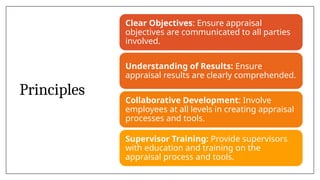
Principles
Clear Objectives: Ensureappraisal
objectives are communicated to all parties
involved.
Understanding of Results: Ensure
appraisal results are clearly comprehended.
Collaborative Development: Involve
employees at all levels in creating appraisal
processes and tools.
Supervisor Training: Provide supervisors
with education and training on the
appraisal process and tools.
6.
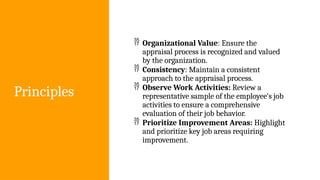
Principles
Organizational Value:Ensure the
appraisal process is recognized and valued
by the organization.
Consistency: Maintain a consistent
approach to the appraisal process.
Observe Work Activities: Review a
representative sample of the employee's job
activities to ensure a comprehensive
evaluation of their job behavior.
Prioritize Improvement Areas: Highlight
and prioritize key job areas requiring
improvement.
7.
Principles
Compare Evaluations:Align the supervisor’s
evaluation with the employee’s self-assessment.
Provide Specific Examples: Use specific instances
of satisfactory and unsatisfactory performance to
substantiate evaluation statements in the
performance appraisal
8.
Purpose
Provide datafor salary adjustments, promotions, transfers, or terminations.
Assess the effectiveness of hiring and employment tests.
Offer constructive feedback to improve work performance.
Reconcile employee aspirations with organizational objectives.
Acknowledge and celebrate employee accomplishments.
9.
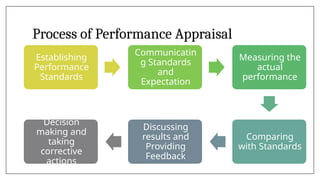
Process of PerformanceAppraisal
Establishing
Performance
Standards
Communicatin
g Standards
and
Expectation
Measuring the
actual
performance
Comparing
with Standards
Discussing
results and
Providing
Feedback
Decision
making and
taking
corrective
actions
10.
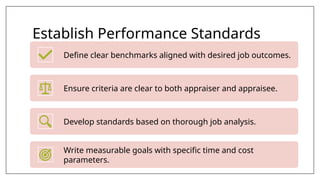
Establish Performance Standards
Defineclear benchmarks aligned with desired job outcomes.
Ensure criteria are clear to both appraiser and appraisee.
Develop standards based on thorough job analysis.
Write measurable goals with specific time and cost
parameters.
11.
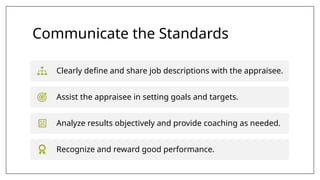
Communicate the Standards
Clearlydefine and share job descriptions with the appraisee.
Assist the appraisee in setting goals and targets.
Analyze results objectively and provide coaching as needed.
Recognize and reward good performance.
12.
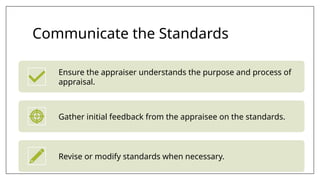
Communicate the Standards
Ensurethe appraiser understands the purpose and process of
appraisal.
Gather initial feedback from the appraisee on the standards.
Revise or modify standards when necessary.
13.
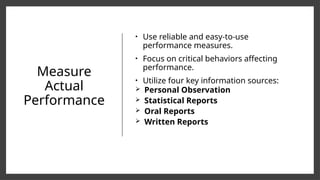
Measure
Actual
Performance
• Use reliableand easy-to-use
performance measures.
• Focus on critical behaviors affecting
performance.
• Utilize four key information sources:
Personal Observation
Statistical Reports
Oral Reports
Written Reports
14.
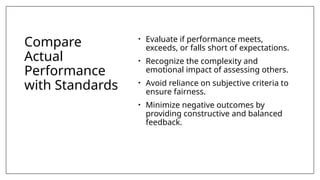
Compare
Actual
Performance
with Standards
• Evaluateif performance meets,
exceeds, or falls short of expectations.
• Recognize the complexity and
emotional impact of assessing others.
• Avoid reliance on subjective criteria to
ensure fairness.
• Minimize negative outcomes by
providing constructive and balanced
feedback.
15.
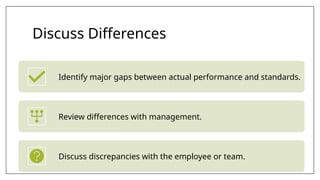
Discuss Differences
Identify majorgaps between actual performance and standards.
Review differences with management.
Discuss discrepancies with the employee or team.
16.
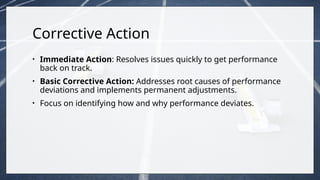
Corrective Action
• ImmediateAction: Resolves issues quickly to get performance
back on track.
• Basic Corrective Action: Addresses root causes of performance
deviations and implements permanent adjustments.
• Focus on identifying how and why performance deviates.
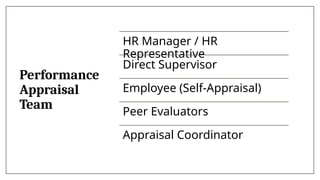
Role of PerformanceAppraisal Team
• HR Manager / HR Representative
• Oversees the entire performance appraisal process, ensuring it aligns with
organizational policies and goals.
• Ensure the process is fair, unbiased, and transparent.
• Collect, analyze, and interpret appraisal data.
• Maintain records of appraisals for future reference and promotions.
19.
Role of DirectSupervisor
• Directly involved in evaluating the employee's
performance, providing feedback, and making
decisions
• Assess the employee's job performance based on
predefined criteria.
• Provide constructive feedback on strengths and
areas for improvement.
• Set performance goals and action plans.
• Discuss career development with employees.
20.
Employee (Self-
Appraisal)
• Conducta self-assessment to reflect on
strengths and areas for improvement.
• Complete a self-appraisal to evaluate
performance.
• Highlight personal achievements,
challenges, and learning experiences.
• Set goals for growth and development.
• Share insights into the work environment
and challenges faced.
21.
Peer Evaluators
• Gatherinsights from colleagues who work
closely with the employee.
• Provide feedback on the employee’s
teamwork and collaboration.
• Highlight strengths and weaknesses
unnoticed by the manager.
• Assess the employee’s interpersonal and
professional skills.
22.
Appraisal Coordinator
• Coordinatethe appraisal process: Ensure timely completion and
consistency
• Gather feedback: Collect appraisal forms and input from relevant
stakeholders.
• Meet deadlines: Ensure appraisals are completed within set timelines.
• Analyze and improve: Track performance trends and recommend process
improvements.
Essay method
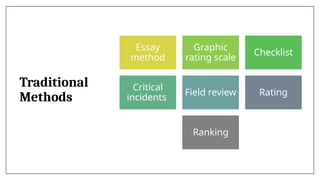
• Theevaluator writes a paragraph or
more about employee
• Highlights the employee's strengths
and potential.
• Focus on performance in relation to
their job description.
• Include relevant personal
characteristics (e.g., teamwork,
motivation for growth).
• Ensure the content reflects their
overall impact and contributions.
26.
Essay method
• Advantages
•In depth analysis of performance
• Identifies training & development
needs & problem areas
• Disadvantages
• Time consuming
• Vary greatly in length and content
• Difficult to combine and compare
27.
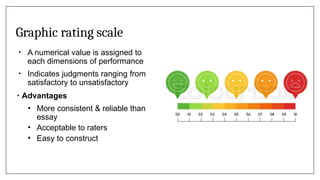
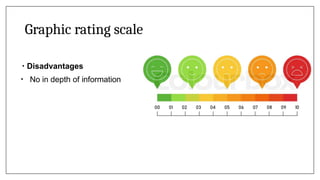
Graphic rating scale
•A numerical value is assigned to
each dimensions of performance
• Indicates judgments ranging from
satisfactory to unsatisfactory
• Advantages
• More consistent & reliable than
essay
• Acceptable to raters
• Easy to construct
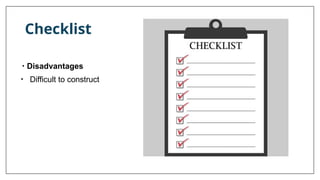
Checklist
• A methodof recording whether a
characteristic is present or
absent
• An action is taken or not
• A simple Yes or No
• Advantages
• Evaluation of large number of
employees
Field review
• Theappraiser visits the field to
assess employee performance.
• Information is gathered through
direct questioning.
• Sources include the employee,
their peers, and their supervisor.
• Focus is on obtaining a
comprehensive view of work
performance.
Rating method
• Therater selects statements that best fit and least fit the individual being
rated.
• Statements are grouped for easier selection.
• Each statement is assigned a weight or score.
• Ratings are calculated based on the weighted scores.
34.
Rating method
•Advantages
• Reducebias since the rater does not know the scoring value for each
statement
• Disadvantages
Costly to develop
35.
Critical incidence method
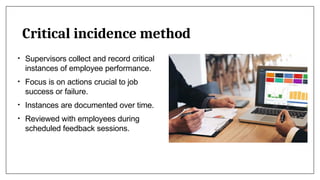
•Supervisors collect and record critical
instances of employee performance.
• Focus is on actions crucial to job
success or failure.
• Instances are documented over time.
• Reviewed with employees during
scheduled feedback sessions.
36.
Critical incidence method
Advantages
•Performance is rated instead of
personality traits.
• Enables supervisors to provide more
effective coaching.
• Facilitates clear communication of
appraisal results to subordinates.
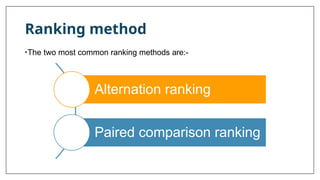
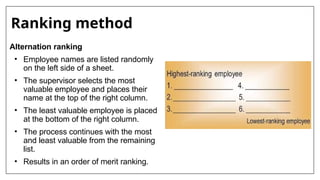
Ranking method
Alternation ranking
•Employee names are listed randomly
on the left side of a sheet.
• The supervisor selects the most
valuable employee and places their
name at the top of the right column.
• The least valuable employee is placed
at the bottom of the right column.
• The process continues with the most
and least valuable from the remaining
list.
• Results in an order of merit ranking.
40.
Ranking method
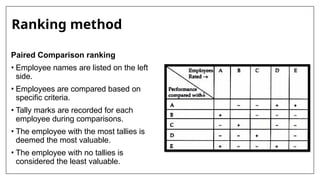
Paired Comparisonranking
• Employee names are listed on the left
side.
• Employees are compared based on
specific criteria.
• Tally marks are recorded for each
employee during comparisons.
• The employee with the most tallies is
deemed the most valuable.
• The employee with no tallies is
considered the least valuable.
41.
Ranking method
Advantages
• Usefulfor decisions on salary administration, promotion, and selection.
• Particularly effective when conducted independently by multiple raters.
• Results from different raters are combined for a comprehensive assessment.
Disadvantages
• Time consuming
42.
Modern Appraisal Methods
•360-degree appraisal method
• 720-degree appraisal Method
• Psychological appraisal
• Management by objectives (MBO)
• Assessment Centre Method
• Behaviorally anchored rating scale bars
• Human Resource appraisal methods
43.
360-degree Feedback
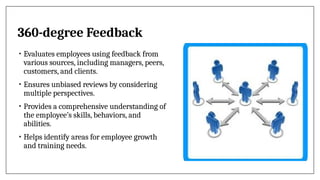
• Evaluatesemployees using feedback from
various sources, including managers, peers,
customers, and clients.
• Ensures unbiased reviews by considering
multiple perspectives.
• Provides a comprehensive understanding of
the employee’s skills, behaviors, and
abilities.
• Helps identify areas for employee growth
and training needs.
44.
360-degree Feedback
Advantages
• Employeesare aware that their performance is monitored by stakeholders.
• Motivates employees to engage in career and self-development.
• Enhances employee engagement and commitment.
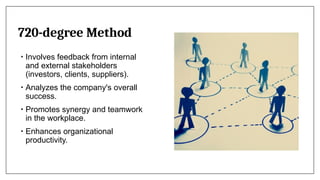
720-degree Method
• Involvesfeedback from internal
and external stakeholders
(investors, clients, suppliers).
• Analyzes the company's overall
success.
• Promotes synergy and teamwork
in the workplace.
• Enhances organizational
productivity.
47.
720-degree Method
Advantages:
• Enablesbetter analysis of performance across multiple elements.
• Provides accurate and constructive feedback.
• Builds a cooperative and high-performing team.
• Encourages transparency in the appraisal process.
Psychological Appraisals
• Analyzesemployees’ performance based on various elements:
Intellectual Traits
Interpersonal Skills
Personality Traits
Cognitive Abilities
Leadership Skills
Emotional Quotient (EQ)
• Uncovers untapped strengths and abilities.
• Emphasizes predicting and enhancing future success.
50.
Psychological Appraisals
Advantages:
• Extractsmeasurable data to
identify employee potential
alongside performance.
• Easy to deploy and provides a
platform for introverted
employees to showcase their
strengths.
Disadvantages:
• The process is slow and
complex.
• Need involvement of
psychologist to conduct
various tests.
51.
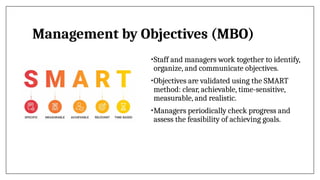
Management by Objectives(MBO)
•Staff and managers work together to identify,
organize, and communicate objectives.
•Objectives are validated using the SMART
method: clear, achievable, time-sensitive,
measurable, and realistic.
•Managers periodically check progress and
assess the feasibility of achieving goals.
52.
Management by Objectives(MBO)
•Employees are reviewed based on results; success leads to rewards (salary
hikes/promotions), while failure leads to further training.
•The performance evaluation process focuses on aiding employee performance in
a constructive, non-punitive manner.
53.
Management by Objectives
Advantages:
•Improves employees’ commitment towards the business
• Increase probability for goal accomplishments
• Make employees future-ready
• It avoids the problem of criticism by employees that are being judged by
unfairly high standards.
• It encourages employees’ participation in setting their own work goals.
54.
Management by Objectives
Disadvantages:
•Less involvement of senior management
• Un-measurable and unclear objectives
• Employee’s goals may not coincide with management.
• Employees may not always want to be involved in their goal setting.
55.
Assessment Centre Method
•Introducedin 1930 and updated to fit modern work culture.
•Employees gain insight into how others perceive them, impacting their
performance.
•Evaluates current performance and predicts future job performance.
•Employees participate in social-simulation activities to assess success
in the role.
56.
Assessment Centre Method
•Primarilyused to evaluate the potential of supervisors and executives.
•Reviewed by senior management, with support from HR and
psychologists.
•Employees engage in exercises, simulations, work groups, and role-
playing crucial to actual job success.
•Reviewers provide feedback on strengths and weaknesses based on
gathered information.
57.
Assessment Centre Method
Advantages:
•Enhance employee’s thought process and boost employee efficiency
• Tailored to fit different business needs and different roles
• Improves an individual’s personality and skills
• Minimum chance for biasedness
58.
Assessment Centre Method
Disadvantages:
•Difficult to carry out!
• Cost and time intensive process
• Discourage poor performers
• Creates unhealthy competition at the workplace
59.
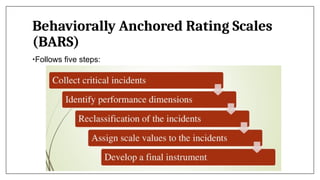
Behaviorally Anchored RatingScales
(BARS)
•Provides both quantitative and qualitative benefits for performance
appraisal.
•Involves statements describing common employee behaviors to
measure performance against predefined standards.
•Offers more equitable appraisals compared to other methods.
Behaviorally Anchored RatingScales
(BARS)
Advantages:
• Clear standards are defined, analyze performance accurately and
enhanced feedback process.
• Focus more on observable and specific behaviors instead of
irrelevant variance rating.
• Eliminate chances of biased reviews and keep the process fair and
transparent!
62.
Behaviorally Anchored RatingScales
(BARS)
Disadvantages:
• Difficult to make decisions regarding promotion and salary
increments
• Time-consuming and demands more from seniors
63.
Human Resource AccountingMethod
• Analyzes employee performance based on the monetary benefits they
contribute to the organization.
• Considers factors such as quality, interpersonal relationships,
overhead costs, and more.
• Links performance to tangible business outcomes, helping assess the
overall impact of employees.
64.
Human Resource AccountingMethod
Advantages:
• Accurately calculates the value employees bring to the company.
Disadvantages:
• This method is money-consuming and need good memory and
strong analytical skills of the reviewer.
65.
ADVANTAGES OF PERFORMANCE
APPRAISAL
•Promotion
• Compensation
• Employees Development
• Selection Validation
• Communication
• Building Trust
• Improving Relationships
• Boosting Morale
66.
DISADVANTAGES OF PERFORMANCE
APPRAISAL
•One Sided Input
• Forms Only Give Quantitative or Qualitative Data
• Once-a-Year Raises
• Halo Effect
• Horn effects
• Central Tendency error
67.
OBSTACLES TO EFFECTIVEPERFORMANCE
• Lack of Top Management Support
• Time-consuming process.
• Lack of understanding of goals and procedures.
• Insufficient appraisal skills.
• Biases and Errors
• Poor Communication
• Inadequate Tools
68.
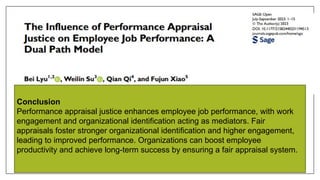
Conclusion
Performance appraisal justiceenhances employee job performance, with work
engagement and organizational identification acting as mediators. Fair
appraisals foster stronger organizational identification and higher engagement,
leading to improved performance. Organizations can boost employee
productivity and achieve long-term success by ensuring a fair appraisal system.
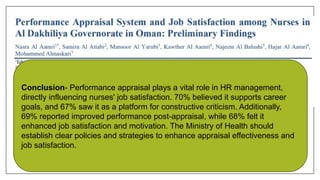
69.
Conclusion- Performance appraisalplays a vital role in HR management,
directly influencing nurses' job satisfaction. 70% believed it supports career
goals, and 67% saw it as a platform for constructive criticism. Additionally,
69% reported improved performance post-appraisal, while 68% felt it
enhanced job satisfaction and motivation. The Ministry of Health should
establish clear policies and strategies to enhance appraisal effectiveness and
job satisfaction.
71.
Conclusion
• Performance appraisalis an established management practice that
assesses employees based on their work rather than personal traits.
Unlike traditional merit rating, which ranks individuals based on
qualities like initiative and dependability, modern appraisal systems
focus on measurable performance. Evaluations can be conducted by
supervisors, peers, subordinates, or through self-assessment.








![Rights_of_women_and_children - new - Copy (2)[1].pptx](https://cdn.slidesharecdn.com/ss_thumbnails/rightsofwomenandchildren-new-copy21-250117115223-ac40d0df-thumbnail.jpg?width=640&height=640&fit=bounds)


