TERMINOLOGIES :-
LEADERSHIP :-
A social relationship in which one individual is more able to
influence others than to be influenced by them.
VALIDITY :-
Measurement of what is to be measured.
ORGANIZATIONS :-
It is a system of cooperative activities of two or more
persons.
PERIODIC APPRAISAL :-
Evaluating the person or the employees periodically.
DEFINITION
performance appraisal is a systematic,
periodic and so far as humanly possible, an
impartial rating of an employee‘s
excellence in matters pertaining to his
present job and to his potentialities for a
better job
Edwin b flippo
OBJECTIVES OF APPRAISAL.
1. To determine the effectiveness of employees
on their present jobs so as to decide their
benefits.
2. To identify the shortcomings of employees
so as to overcome them through systematic
guidance and training.
3. To find out their potential for promotion and
advancement.
PURPOSE
FOR EMPLOYEES :INDIVIDUAL BASED
Criteria for promotion
Performance measurement
Job improvement
Planning for training programs
Tool for motivation
Basis for counselling
Organizational control
Feedback to employees
Periodic review of progress
Self examination
CONTD…
FOR ORGANIZATION : INSTITUTION
BASED
Measurement of organizational objectives
Measurement of work standards
Information generation
Reduce employee grievances
Helps for manpower
CONTD…
SPECIFIC USE
Promotion decisions
Training and development program
Evaluation of supervisors and managers
Compensation decisions
Performance feedback
Personal development
PRINCIPLES OF PERFORMANCE APPRAISAL
1. Single employee is rated by two ratters. Then, the
comparison is made to get accurate rating.
2. Continuous and personal observation of an employee is
essential to make effective performance appraisal.
3. The rating should be done by an immediate superior of
any subordinate in an organization.
4. A separate department may be created for effective
performance appraisal.
5. The rating is conveyed to the concerned employee. It
helps in several ways. The employee can understand the
position where he stands and where he should go.
CONTD…
6. The plus points of an employee should be recognised. At
the same time, the minus points should not be highlighted
too much, but they may be hinted to him.
7. The management should create confidence in the minds
of employees.
8. The standard for each job should be determined by the
management.
9. Separate printed forms should be used for performance
appraisal to each job according to the nature of the job.
CRITERIA FOR PERFORMANCE APPRAISAL
Determine What is to be evaluated
Who are going to be appraised and by
whom
Why to appraise
When to appraise
How to appraise
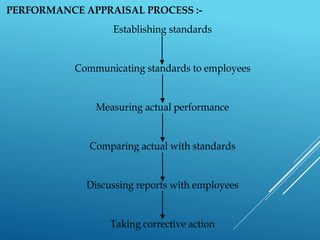
PERFORMANCE APPRAISAL PROCESS :-
Establishing standards
Communicating standards to employees
Measuring actual performance
Comparing actual with standards
Discussing reports with employees
Taking corrective action
OBSTACLES TO PERFORMANCE APPRAISAL
o Lack of support from top management
o Resistance on the part of evaluators because
 Performance appraisal demands too much of
supervisor’s efforts in terms of time, paperwork &
periodic observation of subordinate’s
performance.
 Supervisors lack skills in appraisal technique.
 Performance appraisal is not perceived as being
productive.
o Evaluator biases and rating errors.
o Lack of clear, objective standards of
performance.
o Failure of communicate, purposes and
result of performance appraisal to
employees.
o Lack of suitable appraisal tool.
o Failure to police the appraisal procedure
effectively.
 OBSTACLES TO EFFECTIVE PA
 • Lack of support from the management
 • Evaluate biases and rating errors, which result in unreliable and invalid ratings
 • Lack of clear & objective standards of performance
 • Failure to communicate purposes and result of performance appraisal to employees
 • Lack of suitable appraisal tool
 • Failure to practice the appraisal procedure effectively
 • Resistance on the part of evaluators because;
 – Demands too much of supervisors’ effort in terms of time, paper work & periodic
observation of subordinate’s performance
 – Supervisors are reluctant to play God by judging others
 – Purpose & procedures of performance appraisal is not known
 – Lack skill in appraisal techniques
OVERCOMING THESE OBSTACLES
• Appraisal should be based on standards
• Employee must know the standards in advance
• Employee must know the sources of data gathered
for appraisal
• Employee should have input in to development of
standards
• Appraiser should be someone who has observed
employees work
• Appraiser should be someone who the employ trust
and respects
PROBLEMS IN PERFORMANCE APPRAISAL
Lack of Objectivity
 Halo Error - employee’s extreme competencies in
one area shines over all others. Conversely employee
performs poor in one area and this overshadows
whole area
Leniency/Strictness
Central Tendency –rate everyone as average
 Personal Bias
Recent Behaviour Bias
 Manipulating the Evaluation
 Poor Appraisal Forms
PROBLEMS IN PERFORMANCE APPRAISAL
Lack of Objectivity
 Halo Error - employee’s extreme competencies in
one area shines over all others. Conversely employee
performs poor in one area and this overshadows
whole area
Leniency/Strictness
Central Tendency –rate everyone as average
 Personal Bias
Recent Behaviour Bias
 Manipulating the Evaluation
 Poor Appraisal Forms
 QUALITIES OF GOOD PERFORMANCE APPRAISAL
 OBJECTIVES SHOULD BE CLEAR:
 The objectives of appraisal should be clear and specific. An effective
performance system will always have specific appraisal attributes to match the
employee’s job description.
 DATA SHOULD BE VALID AND RELIABLE:
 An effective performance appraisal system provides data that is consistent,
reliable and valid. It supplies data according the objective that serves the
purpose of performance appraisal and succession planning.
 PERFORMANCE CRITERIA SHOULD BE WELL DEFINED:
 Effective performance appraisal has standard appraisal forms, rules and
appraisal procedures. It will have well defined performance criteria and
standards.
 ECONOMICAL AND LESS TIME CONSUMING:
 Effective performance appraisal systems are designed to be economical and
less time consuming to bring maximum benefits.
 SHOULD INITIATE FOLLOW UP:
 A post appraisal talk should be arranged for employees to get feedback from
their managers. It also helps the organization to learn about the problems and
difficulties the employees might be facing and discover suitable training.
BENEFITS OF PERFORMANCE APPRAISAL
FOR THE ORGANIZATION:
The organization comes to know the true
position of the employees working capacities
and the problems they face while working in
the organization.
This performance appraisal system also acts as
a motivating factor for the employees, which
helps the organization to get better results.
 FOR THE APPRAISE:
 The appraise fells themselves an important part of the
organization, they get a chance to express their views in
front of their superiors; they get a platform to express
their ideas.
 The employee comes to know the truth about:
 To what extent they have achieved their objectives.
 In what respect their work has been most successful.
 Are there any aspects of their work, which they have not
completed?
 Are many other question, which make them assess
rightly?
DISADVANTAGES
1.if not done appropriately; can be a
negative experience
2.very time consuming especially for a
manager
3.subject to rater errors and biases
4.if not done right can be a complete waste
of time
5.can be stressful for all involved
METHODS OF PERFORMANCE APPRAISAL
INDIVIDUAL EVALUATION METHODS
MULTIPLE PERSON EVALUATION
METHOD
OTHER METHODS
INDIVIDUAL EVALUATION METHODS
 CONFIDENTIAL REPORT
Descriptive report
 Prepared by the employee’s immediate supervisor
The report highlights the strengths and weaknesses of
employees
 Prepared in Government organizations
 Does not offer any feedback to the employee
CONFIDENTIAL REPORT
Confidential report is the method of
employee’s performance and taking
actions without giving any feedbacks to the
employees. Confidential report should only
viewed by authorized personnel. Therefore, it
is not send openly but in sealed envelope.
Generally, such method of performance
appraisal is conducted yearly and employees
are appraised on the following traits
Attendance
Team work
Dependability
Leadership
Behaviour with superior, colleagues and junior
workers
Discipline
Integrity and honesty
Quality and quantity of output, etc.
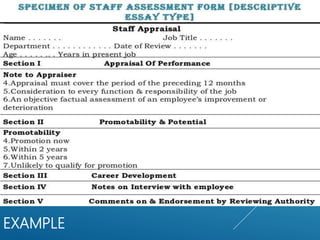
ESSAY APPRAISAL METHOD
The rater is asked to express the strong as well as weak
points of employee’s behavior
The rater considers the employee’s --
Job knowledge and potential
Understanding of company’s programs, policies,
objectives etc
Relation with co-workers and supervisors
Planning, organizing and controlling ability
Attitude and perception
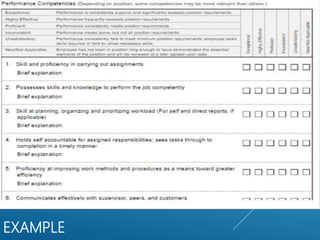
EXAMPLE
LIMITATIONS:
Highly subjective Supervisor may write biased essay
Difficult to find effective writers
 A busy appraiser may write the essay hurriedly
without assessing properly the actual performance of
the worker
If the appraiser takes a long time it becomes
uneconomical from the view point of the firm
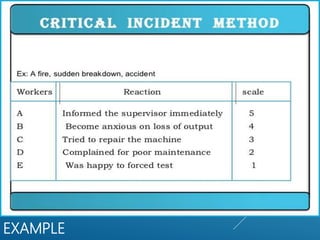
CRITICAL INCIDENT TECHNIQUE
Manager prepares lists of statements of very effective
and ineffective behavior of an employee
These critical incidents represent the outstanding or
poor behavior of the employees
The manager periodically records critical incidents of
employee’s behavior
Example: June 21 - Sales clerk patiently attended to the
customers complaint. He is polite, prompt, enthusiastic
in solving the customers’ problem
EXAMPLE
LIMITATIONS
Limitation of this technique are:
 Negative incidents may be more noticeable than
positive incidents.
 Results in very close supervision which may not
be liked by the employee.
 The recording of incidents is a chore for the
supervisor concerned who may be too busy or
forget to do it.
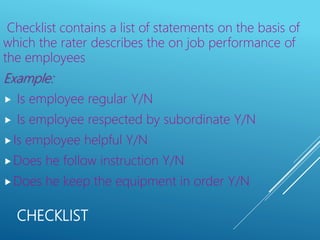
CHECKLIST
Checklist contains a list of statements on the basis of
which the rater describes the on job performance of
the employees
Example:
 Is employee regular Y/N
 Is employee respected by subordinate Y/N
Is employee helpful Y/N
Does he follow instruction Y/N
Does he keep the equipment in order Y/N
EXAMPLE
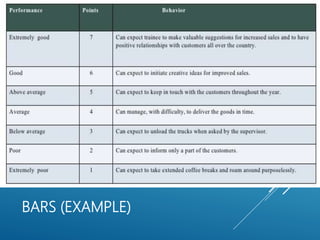
BEHAVIOURALLY ANCHORED RATING SCALE
BARS represent a range of descriptive
statements of behaviour varying from the least
to the most effective
 In this a rater is expected to indicate which
behaviour on each scale best describes an
employee’s performance
BARS (EXAMPLE)
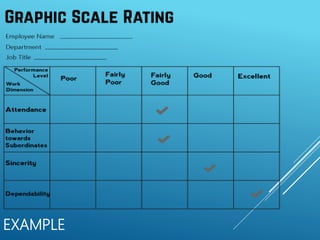
GRAPHIC RATING SCALE
 The rating scale consist of several numerical
scales, each representing a job related
performance criterion such as dependability,
initiative, output, attendance, attitude, co-
operation and the like
EXAMPLE
FORCED CHOICE METHOD
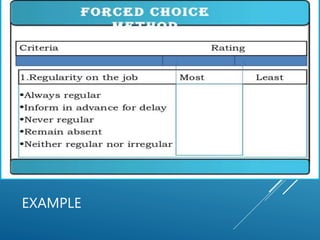
 In the forced choice method the rater is forced
to select statements which are readymade
 The rater is asked to indicate which of the
phrases is the most and least descriptive of a
particular worker
Favorable qualities earn plus credit and
unfavorable ones earn the reverse
EXAMPLE
MANAGEMENT BY OBJECTIVES (MBO)
 First step: MBO emphasizes collectively set goals
that are tangible, verifiable, and measurable
Second step: setting the performance standard for
the subordinates
Third step: the actual level of goal attainment is
compared with the goals agreed upon
Final step: involves establishing new goals and
possibly new strategies for goals not previously
achieved
MULTIPLE PERSON EVALUATION METHODS
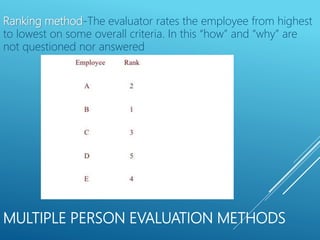
Ranking method-The evaluator rates the employee from highest
to lowest on some overall criteria. In this “how” and “why” are
not questioned nor answered
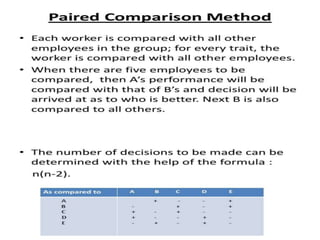
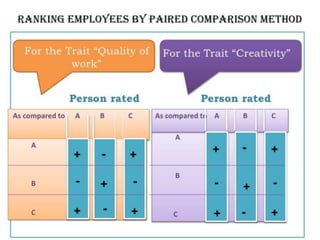
PAIRED COMPARISON METHOD
 For several traits paired comparisons are made,
tabulated and then rank is assigned to each worker
One employee is compared with all other employees
No. of comparisons is calculated by the formula:
N(N-1)/2
 This method is not applicable when the group is
large
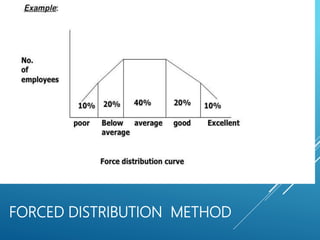
FORCED DISTRIBUTION METHOD
Appraise is forced to evaluate the staff
according to predetermined distribution scale
Usually two criteria are taken for rating and
employee are placed between two extremes
FORCED DISTRIBUTION METHOD
OTHER METHODS
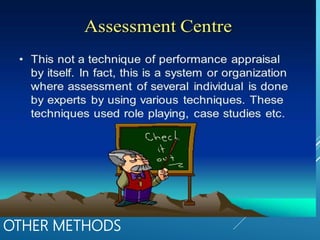
Assessment centre’s
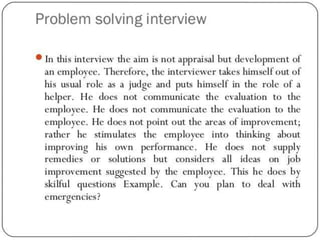
KEY BEHAVIOURS FOR AN APPRAISAL INTERVIEW
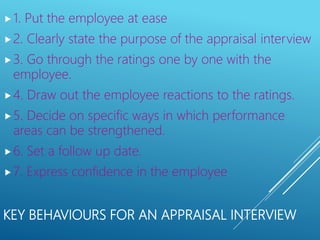
1. Put the employee at ease
2. Clearly state the purpose of the appraisal interview
3. Go through the ratings one by one with the
employee.
4. Draw out the employee reactions to the ratings.
5. Decide on specific ways in which performance
areas can be strengthened.
6. Set a follow up date.
7. Express confidence in the employee
FORMAT
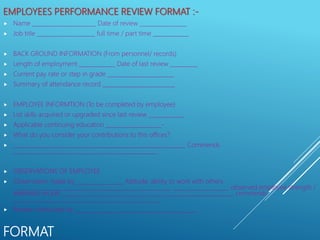
EMPLOYEES PERFORMANCE REVIEW FORMAT :-
 Name _______________________ Date of review _________________
 Job title _____________________ full time / part time _____________
 BACK GROUND INFORMATION (From personnel/ records)
 Length of employment _____________ Date of last review __________
 Current pay rate or step in grade ________________________
 Summary of attendance record __________________________
 EMPLOYEE INFORMTION (To be completed by employee)
 List skills acquired or upgraded since last review _____________
 Applicable continuing education ____________________-
 What do you consider your contributions to this offices?
 ______________________________________________________________ Commends
____________________________________________________
 OBSERVATIONS OF EMPLOYEE
 Observation made by _________________ Attitude, ability to work with others
_________________________________________________________ ____________________ observed employee strength /
weakness on job ______________________________________________________________ commends
_____________________________________________________
 Review conducted by ____________________________________________
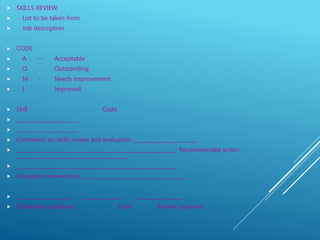
 SKILLS REVIEW
 List to be taken from
 Job description
 CODE
 A – Acceptable
 O - Outstanding
 Ni - Needs improvement
 L - Improved
 Skill Code
 ________________________
 ________________________
 Comments on skills review and evaluation _________________________
 _______________________________________________________________ Recommended action
___________________________________________
 _______________________________________________________________
 Evaluation reviewed by _________________________________________
 _____________________ ________________ __________________
 Employees signature Date Review signature
Performance appraisal

Performance appraisal

  • 2.
    TERMINOLOGIES :- LEADERSHIP :- Asocial relationship in which one individual is more able to influence others than to be influenced by them. VALIDITY :- Measurement of what is to be measured. ORGANIZATIONS :- It is a system of cooperative activities of two or more persons. PERIODIC APPRAISAL :- Evaluating the person or the employees periodically.
  • 3.
    DEFINITION performance appraisal isa systematic, periodic and so far as humanly possible, an impartial rating of an employee‘s excellence in matters pertaining to his present job and to his potentialities for a better job Edwin b flippo
  • 4.
    OBJECTIVES OF APPRAISAL. 1.To determine the effectiveness of employees on their present jobs so as to decide their benefits. 2. To identify the shortcomings of employees so as to overcome them through systematic guidance and training. 3. To find out their potential for promotion and advancement.
  • 7.
    PURPOSE FOR EMPLOYEES :INDIVIDUALBASED Criteria for promotion Performance measurement Job improvement Planning for training programs Tool for motivation Basis for counselling Organizational control Feedback to employees Periodic review of progress Self examination
  • 8.
    CONTD… FOR ORGANIZATION :INSTITUTION BASED Measurement of organizational objectives Measurement of work standards Information generation Reduce employee grievances Helps for manpower
  • 9.
    CONTD… SPECIFIC USE Promotion decisions Trainingand development program Evaluation of supervisors and managers Compensation decisions Performance feedback Personal development
  • 10.
    PRINCIPLES OF PERFORMANCEAPPRAISAL 1. Single employee is rated by two ratters. Then, the comparison is made to get accurate rating. 2. Continuous and personal observation of an employee is essential to make effective performance appraisal. 3. The rating should be done by an immediate superior of any subordinate in an organization. 4. A separate department may be created for effective performance appraisal. 5. The rating is conveyed to the concerned employee. It helps in several ways. The employee can understand the position where he stands and where he should go.
  • 11.
    CONTD… 6. The pluspoints of an employee should be recognised. At the same time, the minus points should not be highlighted too much, but they may be hinted to him. 7. The management should create confidence in the minds of employees. 8. The standard for each job should be determined by the management. 9. Separate printed forms should be used for performance appraisal to each job according to the nature of the job.
  • 12.
    CRITERIA FOR PERFORMANCEAPPRAISAL Determine What is to be evaluated Who are going to be appraised and by whom Why to appraise When to appraise How to appraise
  • 13.
    PERFORMANCE APPRAISAL PROCESS:- Establishing standards Communicating standards to employees Measuring actual performance Comparing actual with standards Discussing reports with employees Taking corrective action
  • 14.
    OBSTACLES TO PERFORMANCEAPPRAISAL o Lack of support from top management o Resistance on the part of evaluators because  Performance appraisal demands too much of supervisor’s efforts in terms of time, paperwork & periodic observation of subordinate’s performance.  Supervisors lack skills in appraisal technique.  Performance appraisal is not perceived as being productive.
  • 15.
    o Evaluator biasesand rating errors. o Lack of clear, objective standards of performance. o Failure of communicate, purposes and result of performance appraisal to employees. o Lack of suitable appraisal tool. o Failure to police the appraisal procedure effectively.
  • 16.
     OBSTACLES TOEFFECTIVE PA  • Lack of support from the management  • Evaluate biases and rating errors, which result in unreliable and invalid ratings  • Lack of clear & objective standards of performance  • Failure to communicate purposes and result of performance appraisal to employees  • Lack of suitable appraisal tool  • Failure to practice the appraisal procedure effectively  • Resistance on the part of evaluators because;  – Demands too much of supervisors’ effort in terms of time, paper work & periodic observation of subordinate’s performance  – Supervisors are reluctant to play God by judging others  – Purpose & procedures of performance appraisal is not known  – Lack skill in appraisal techniques
  • 17.
    OVERCOMING THESE OBSTACLES •Appraisal should be based on standards • Employee must know the standards in advance • Employee must know the sources of data gathered for appraisal • Employee should have input in to development of standards • Appraiser should be someone who has observed employees work • Appraiser should be someone who the employ trust and respects
  • 18.
    PROBLEMS IN PERFORMANCEAPPRAISAL Lack of Objectivity  Halo Error - employee’s extreme competencies in one area shines over all others. Conversely employee performs poor in one area and this overshadows whole area Leniency/Strictness Central Tendency –rate everyone as average  Personal Bias Recent Behaviour Bias  Manipulating the Evaluation  Poor Appraisal Forms
  • 19.
    PROBLEMS IN PERFORMANCEAPPRAISAL Lack of Objectivity  Halo Error - employee’s extreme competencies in one area shines over all others. Conversely employee performs poor in one area and this overshadows whole area Leniency/Strictness Central Tendency –rate everyone as average  Personal Bias Recent Behaviour Bias  Manipulating the Evaluation  Poor Appraisal Forms
  • 20.
     QUALITIES OFGOOD PERFORMANCE APPRAISAL  OBJECTIVES SHOULD BE CLEAR:  The objectives of appraisal should be clear and specific. An effective performance system will always have specific appraisal attributes to match the employee’s job description.  DATA SHOULD BE VALID AND RELIABLE:  An effective performance appraisal system provides data that is consistent, reliable and valid. It supplies data according the objective that serves the purpose of performance appraisal and succession planning.  PERFORMANCE CRITERIA SHOULD BE WELL DEFINED:  Effective performance appraisal has standard appraisal forms, rules and appraisal procedures. It will have well defined performance criteria and standards.  ECONOMICAL AND LESS TIME CONSUMING:  Effective performance appraisal systems are designed to be economical and less time consuming to bring maximum benefits.  SHOULD INITIATE FOLLOW UP:  A post appraisal talk should be arranged for employees to get feedback from their managers. It also helps the organization to learn about the problems and difficulties the employees might be facing and discover suitable training.
  • 21.
    BENEFITS OF PERFORMANCEAPPRAISAL FOR THE ORGANIZATION: The organization comes to know the true position of the employees working capacities and the problems they face while working in the organization. This performance appraisal system also acts as a motivating factor for the employees, which helps the organization to get better results.
  • 22.
     FOR THEAPPRAISE:  The appraise fells themselves an important part of the organization, they get a chance to express their views in front of their superiors; they get a platform to express their ideas.  The employee comes to know the truth about:  To what extent they have achieved their objectives.  In what respect their work has been most successful.  Are there any aspects of their work, which they have not completed?  Are many other question, which make them assess rightly?
  • 23.
    DISADVANTAGES 1.if not doneappropriately; can be a negative experience 2.very time consuming especially for a manager 3.subject to rater errors and biases 4.if not done right can be a complete waste of time 5.can be stressful for all involved
  • 25.
    METHODS OF PERFORMANCEAPPRAISAL INDIVIDUAL EVALUATION METHODS MULTIPLE PERSON EVALUATION METHOD OTHER METHODS
  • 26.
    INDIVIDUAL EVALUATION METHODS CONFIDENTIAL REPORT Descriptive report  Prepared by the employee’s immediate supervisor The report highlights the strengths and weaknesses of employees  Prepared in Government organizations  Does not offer any feedback to the employee
  • 27.
    CONFIDENTIAL REPORT Confidential reportis the method of employee’s performance and taking actions without giving any feedbacks to the employees. Confidential report should only viewed by authorized personnel. Therefore, it is not send openly but in sealed envelope. Generally, such method of performance appraisal is conducted yearly and employees are appraised on the following traits
  • 28.
    Attendance Team work Dependability Leadership Behaviour withsuperior, colleagues and junior workers Discipline Integrity and honesty Quality and quantity of output, etc.
  • 29.
    ESSAY APPRAISAL METHOD Therater is asked to express the strong as well as weak points of employee’s behavior The rater considers the employee’s -- Job knowledge and potential Understanding of company’s programs, policies, objectives etc Relation with co-workers and supervisors Planning, organizing and controlling ability Attitude and perception
  • 30.
  • 31.
    LIMITATIONS: Highly subjective Supervisormay write biased essay Difficult to find effective writers  A busy appraiser may write the essay hurriedly without assessing properly the actual performance of the worker If the appraiser takes a long time it becomes uneconomical from the view point of the firm
  • 32.
    CRITICAL INCIDENT TECHNIQUE Managerprepares lists of statements of very effective and ineffective behavior of an employee These critical incidents represent the outstanding or poor behavior of the employees The manager periodically records critical incidents of employee’s behavior Example: June 21 - Sales clerk patiently attended to the customers complaint. He is polite, prompt, enthusiastic in solving the customers’ problem
  • 33.
  • 34.
    LIMITATIONS Limitation of thistechnique are:  Negative incidents may be more noticeable than positive incidents.  Results in very close supervision which may not be liked by the employee.  The recording of incidents is a chore for the supervisor concerned who may be too busy or forget to do it.
  • 35.
    CHECKLIST Checklist contains alist of statements on the basis of which the rater describes the on job performance of the employees Example:  Is employee regular Y/N  Is employee respected by subordinate Y/N Is employee helpful Y/N Does he follow instruction Y/N Does he keep the equipment in order Y/N
  • 36.
  • 37.
    BEHAVIOURALLY ANCHORED RATINGSCALE BARS represent a range of descriptive statements of behaviour varying from the least to the most effective  In this a rater is expected to indicate which behaviour on each scale best describes an employee’s performance
  • 38.
  • 39.
    GRAPHIC RATING SCALE The rating scale consist of several numerical scales, each representing a job related performance criterion such as dependability, initiative, output, attendance, attitude, co- operation and the like
  • 40.
  • 41.
    FORCED CHOICE METHOD In the forced choice method the rater is forced to select statements which are readymade  The rater is asked to indicate which of the phrases is the most and least descriptive of a particular worker Favorable qualities earn plus credit and unfavorable ones earn the reverse
  • 42.
  • 43.
    MANAGEMENT BY OBJECTIVES(MBO)  First step: MBO emphasizes collectively set goals that are tangible, verifiable, and measurable Second step: setting the performance standard for the subordinates Third step: the actual level of goal attainment is compared with the goals agreed upon Final step: involves establishing new goals and possibly new strategies for goals not previously achieved
  • 44.
    MULTIPLE PERSON EVALUATIONMETHODS Ranking method-The evaluator rates the employee from highest to lowest on some overall criteria. In this “how” and “why” are not questioned nor answered
  • 45.
    PAIRED COMPARISON METHOD For several traits paired comparisons are made, tabulated and then rank is assigned to each worker One employee is compared with all other employees No. of comparisons is calculated by the formula: N(N-1)/2  This method is not applicable when the group is large
  • 48.
    FORCED DISTRIBUTION METHOD Appraiseis forced to evaluate the staff according to predetermined distribution scale Usually two criteria are taken for rating and employee are placed between two extremes
  • 49.
  • 50.
  • 59.
    KEY BEHAVIOURS FORAN APPRAISAL INTERVIEW 1. Put the employee at ease 2. Clearly state the purpose of the appraisal interview 3. Go through the ratings one by one with the employee. 4. Draw out the employee reactions to the ratings. 5. Decide on specific ways in which performance areas can be strengthened. 6. Set a follow up date. 7. Express confidence in the employee
  • 60.
    FORMAT EMPLOYEES PERFORMANCE REVIEWFORMAT :-  Name _______________________ Date of review _________________  Job title _____________________ full time / part time _____________  BACK GROUND INFORMATION (From personnel/ records)  Length of employment _____________ Date of last review __________  Current pay rate or step in grade ________________________  Summary of attendance record __________________________  EMPLOYEE INFORMTION (To be completed by employee)  List skills acquired or upgraded since last review _____________  Applicable continuing education ____________________-  What do you consider your contributions to this offices?  ______________________________________________________________ Commends ____________________________________________________  OBSERVATIONS OF EMPLOYEE  Observation made by _________________ Attitude, ability to work with others _________________________________________________________ ____________________ observed employee strength / weakness on job ______________________________________________________________ commends _____________________________________________________  Review conducted by ____________________________________________
  • 61.
     SKILLS REVIEW List to be taken from  Job description  CODE  A – Acceptable  O - Outstanding  Ni - Needs improvement  L - Improved  Skill Code  ________________________  ________________________  Comments on skills review and evaluation _________________________  _______________________________________________________________ Recommended action ___________________________________________  _______________________________________________________________  Evaluation reviewed by _________________________________________  _____________________ ________________ __________________  Employees signature Date Review signature