


Welcometo presentation
PerformanceAppraisal
Group-3
 DipanwitaDey 120305
 PriyankaHui Chowdhury 120316
 ArnaBanerjee 120324
 Nusrat Jahan 120329
 SumonaHossain 120336
 Niaz Bhuian 120354
10/29/15 2prepared by group 3
Outline
 Performance Appraisal
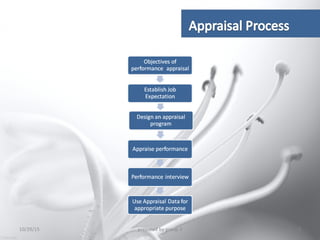
 Objectives of performance appraisal
 Appraisal process
 Rating errors
 Method of appraisal
 Psychological appraisal
 Assessment center
 Method of job evaluation
 Organizational Strategy &Performance Appraisal
 Job evaluation &it’s process
10/29/15 3prepared by group 3
It is assessment of an individual’s
performance in a systematic way &
measurement performance against
factors like job knowledge, quality,
quantity of output , leadership,
abilities, supervision, dependability,
co-operation, judgment, versatility,
health etc.
10/29/15 4prepared by group 3
Performance appraisal
 “It is the systematic evaluation of individual with respect
to his or her performance on the job.”
 “Performance appraisal is a formal, structure system of
measuring an employee and evaluating an employee’s
job related behaviors and outcome.”
10/29/15 5prepared by group 3
 Effect promotions based on competence and
performance.
 Confirmation of the service of probationary employees.
 Assess the training & development needs of employee.
 Decide pay raise .
 Assist, guide employees with constructive criticisms.
 Improve communication skill of employees .
 Determine HR programmers'(selection, training, transfer)
effectiveness.
10/29/15 6prepared by group 3
10/29/15 7prepared by group 3
 Objectives of appraisal
 Assessment of work system that effect
performance
 Identification of system obstacles
 Facilitate development & motivation
 Establish job expectation
 Informing employees about the expectations
 Review major duties
10/29/15 8prepared by group 3
 Design appraisal program
 Following questions needed to be answered
• Whose performance to be assed?
• Who are the raters?
• What problems are encounter?
• How to solve problems?
• What should be evaluated?
• When to evaluate?
• What method of appraisal?
10/29/15 9prepared by group 3
Rating errors
• Leniency or severity
• Central tendency
• Halo error
• Rater effect
• Primary & recency effects
• Perceptual set
• PerformanceDimension order
• Spillover effect
• Statuseffect
10/29/15 10prepared by group 3
Leniency or severity
At the time of rating rater may have following
misconceptions
 May think anyonerated unfavorably isdischarged
 May think derogatory rating will harm relationships
 May rateleniently to win promotions
 May projecting
 Try to gel approval
 Want to set cultureof approval
 May rateunfavorably for showing own worthiness
10/29/15 11prepared by group 3
Central tendency
The attitude shown by the rater to be safe
– Do I know theperson sufficiently well to givefaireassessment?
– What will beimpact on our relationship?
– What will effect relationswith my subordinates?
– What will beitseffect on hisor her relationship within groups,
subordinates?
– Will I beobjectivein view of pressureof peers, superiors&
tradeunions?
– Will I beaccused of being partial?
– How will my bossreview theappraisal ?
10/29/15 12prepared by group 3
Rating errors(cont.)
 Halo effect
 oneaspect of an individual’sperformanceinfluences
theentireperformance
 Ratereffect
 includesfavourisam, stereotyping, and hostility attitude
toward ratee
 Perceptual set
 assessment influenceon previousbeliefs
10/29/15 13prepared by group 3
Rating errors(cont.)
• Performance dimension order
• oneor two dimensionson aperformanceinstrument
follow or closely followed each other
• Spillovereffect
• past performanceappraisal effect current appraisal
unjustifiably
• Status effect
• overrating of employeeshigher-level or jobsheld in
high esteem
10/29/15 14prepared by group 3
Methods of appraisal
 Forced ChoiceMethod
Therater isforced to select statementswhich are
readymade.
 Advantage
 Absenceof personal biasin rating.
 Disadvantage
 Statements may not be properly framed and they may
not beprecisely descriptiveof theratee’straits.
10/29/15 15prepared by group 3
 Critical Incidents Method
Focuson certain critical behavior of an
employeethat makeall thedifferencebetween
effectiveand non-effectiveperformanceof a
job. Such incidentsarerecorded by the
superiorsasand when they occur.
Methods of appraisal
10/29/15 16prepared by group 3
Critical Incidents Method (Cont.)
 Advantage
• Evaluation isbased on actual job behavior.
 Limitation
• negativeincidentsaremorenoticeablethan positive
ones.
• Overly closesupervision may result.
10/29/15 17prepared by group 3
Appraisal by outsider
 Appraisal by someoneoutsidetheassessee’sown
department (Corporateofficeor HR department)
 Advantage
– Primarily used for making promotional decision at the
managerial level.
– Useful when comparableinformation isneeded from employees
in different unitsor locations
10/29/15 18prepared by group 3
Field Review Method
 Disadvantage
 Outsidesunconsciousnessabout an employee’swork
environment may affect employee’sability or
motivation.
 Outsiderscan not observeemployeebehavior over a
period of timeand in variety of situations.
10/29/15 19prepared by group 3
Cost Accounting Method
 Evaluatesperformancefrom themonetary returnsthe
employeeyieldsto hisor her organization.
 A relationship isestablished between thecost included in
keeping theemployeeand thebenefit theorganization
derivesfrom him or her.
 Then theperformanceof theemployeeisevaluated based
on therelationship.
10/29/15 20prepared by group 3
Psychological Appraisal
 Industrial psychology
 Assesspast performance& futurepotentials
 Appraisal processConsistsof –
 Interviews
 Psychological tests
 Evaluate individuals‘ emotional, motivational & work
related behaviors.
 Dependslargely on thequality of psychologists.
10/29/15 21prepared by group 3
Assessment Centre
An assessment center is a central location where managers come
together to have their participation in job related exercises
evaluated by trained observers.
Mainly used for :–
Executivehiring
Observing executives
Evaluating executiveperformanceby self & peer evaluation
10/29/15 22prepared by group 3
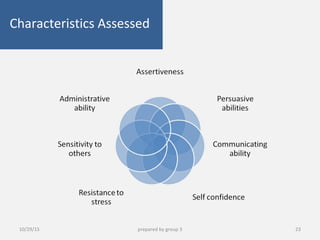
Characteristics Assessed
10/29/15 23prepared by group 3
Problems of Assessment Centers
 Excessivecost
 Slow process
 Influenced by subjectivematters
 Examination taking syndrome
 Unhealthy senseof competition
 Overemphasizing test performance
 Difficulty in conducting tests
10/29/15 24prepared by group 3
Advantages of Assessment centers
 A well conducted assessment center can providesuch
advantages-
 Forecast futureperformance
 Increasereliability, content validity
 High Predictivevalidity
 Clearly definesselection & promotion
10/29/15 25prepared by group 3
10/29/15 26prepared by group 3
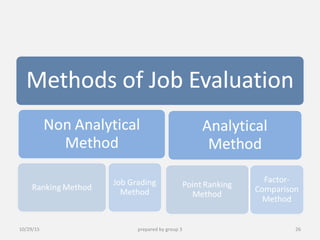
Non Analytical Method
• No useof detailed job factors
• Treat each job asawholein determining itsrelativeranking
• Two methods:
a)Ranking method
b)Job-grading method
10/29/15 27prepared by group 3
Ranking Method
 Job evaluation – on the basis of its title or its content
comparing thejob with others& determining itsplace.
 Advantages: Simple, inexpensiveand expedient method
 Drawbacks: i) Subjectivemethod of evaluation
ii) Hard to measurewholejob
10/29/15 28prepared by group 3
Job Grading Method (cont..)
10/29/15 29prepared by group 3
simpleand inexpressive
Providesatisfactory
result when thenumber
job issmall.
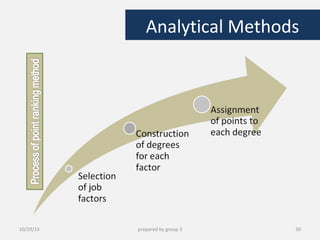
Analytical Methods
10/29/15 30prepared by group 3
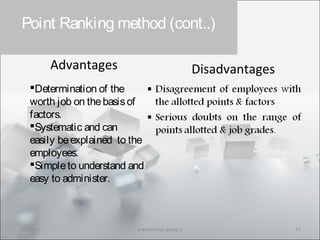
Point Ranking method (cont..)
Advantages Disadvantages
10/29/15 31prepared by group 3
Determination of the
worth job on thebasisof
factors.
Systematic and can
easily beexplained to the
employees.
Simpleto understand and
easy to administer.
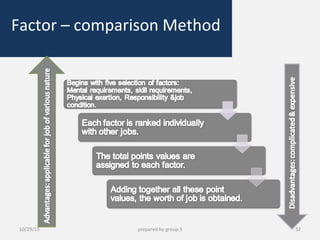
Factor – comparison Method
10/29/15 32prepared by group 3
Wage Survey
 Fourth stepsof job evaluation process.
 For fixing wagerate, wagesurvey isrequired.
 In wagesurvey, thefirst step isto select key jobs.
 Secondly, asampleof firmsin thelabor market must be
chosen.
 Thefinal task isto obtain appropriateinformation, taking
careto ensurethat job comparisonsbeing madearevalid.
10/29/15 33prepared by group 3
Employee classification
 Last phaseof job evaluation process.
 Theprocessof assigning ajob titleto every employee.
 Easy to classify clearly definablejob likecashier in abank.
 But difficult to classify family typejob likesecretarial job.
10/29/15 34prepared by group 3
Organizational Strategy & Performance Appraisal
From thestrategic management point of view,
organizationscan begrouped into 3 categories:
1. Defenders
2. Prospectorsand
3. Analyzers
10/29/15 35prepared by group 3
1. Defenders
 Narrow focuson product market domain
 Improving theefficiency of existing operations
 Identifying training needs
 Morebehavior oriented
1. Prospectors
 Search for different product and market opportunities
 Emphasison skillsidentification
 Identifying staffing needs
10/29/15 36prepared by group 3
3. AnalyzerStrategy
 Two typesof product market domains
 Onedomain isstableand another ischanging
 Emphasison both skill building and skill acquisition
 Examinecurrent performancewith past performance
10/29/15 37prepared by group 3
Job Evaluation
• Theprocessof analyzing and assessing thevariousjobs
• To ascertain job’srelativeworth in organization
• Based on job content
• Jobsareplaced in theorder of their importance
10/29/15 38prepared by group 3
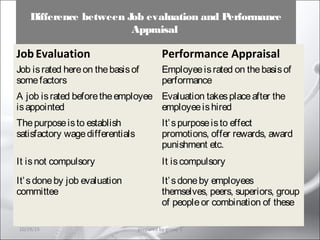
Difference between Job evaluation and Performance
Appraisal
JobEvaluation Performance Appraisal
Job israted hereon thebasisof
somefactors
Employeeisrated on thebasisof
performance
A job israted beforetheemployee
isappointed
Evaluation takesplaceafter the
employeeishired
Thepurposeisto establish
satisfactory wagedifferentials
It’spurposeisto effect
promotions, offer rewards, award
punishment etc.
It isnot compulsory It iscompulsory
It’sdoneby job evaluation
committee
It’sdoneby employees
themselves, peers, superiors, group
of peopleor combination of these
10/29/15 39prepared by group 3
Job Evaluation Process
Job evaluation process program involves answering the following
questions:
 Which jobsareto beevaluated?
 Who should evaluatethejobs?
 What training do theevaluatorsneed?
 How much timeisinvolved?
 What should bethecriteriafor evaluation?
10/29/15 40prepared by group 3
Jobs, to be Evaluated?
 A sampleof benchmark jobsisto beselected
 Thesamplesizedependson thenumber of different jobs
 It’sunlikely to belessthan about 25 percent of thetotal jobs
• Staffing the evaluation Exercise
Job evaluation processisdoneby ----------
 A committeeconsisting headsof variousdepartment
 Representativesof employeeunions
 Specialistsdrawn from National Productivity Council
10/29/15 41prepared by group 3
Training for the Committee
In training session, thefollowing issuesarediscussed:
 What isjob evaluation?
 Why doesthiscompany need job evaluation?
 How will it work?
 How doesit affect promotion policy?
 How will thesystemsbekept up-to-date?Etc.
10/29/15 42prepared by group 3
Questions????
10/29/15 43prepared by group 3

Performance appraisal

  • 1.
  • 2.
    Group-3  DipanwitaDey 120305 PriyankaHui Chowdhury 120316  ArnaBanerjee 120324  Nusrat Jahan 120329  SumonaHossain 120336  Niaz Bhuian 120354 10/29/15 2prepared by group 3
  • 3.
    Outline  Performance Appraisal Objectives of performance appraisal  Appraisal process  Rating errors  Method of appraisal  Psychological appraisal  Assessment center  Method of job evaluation  Organizational Strategy &Performance Appraisal  Job evaluation &it’s process 10/29/15 3prepared by group 3
  • 4.
    It is assessmentof an individual’s performance in a systematic way & measurement performance against factors like job knowledge, quality, quantity of output , leadership, abilities, supervision, dependability, co-operation, judgment, versatility, health etc. 10/29/15 4prepared by group 3
  • 5.
    Performance appraisal  “Itis the systematic evaluation of individual with respect to his or her performance on the job.”  “Performance appraisal is a formal, structure system of measuring an employee and evaluating an employee’s job related behaviors and outcome.” 10/29/15 5prepared by group 3
  • 6.
     Effect promotionsbased on competence and performance.  Confirmation of the service of probationary employees.  Assess the training & development needs of employee.  Decide pay raise .  Assist, guide employees with constructive criticisms.  Improve communication skill of employees .  Determine HR programmers'(selection, training, transfer) effectiveness. 10/29/15 6prepared by group 3
  • 7.
  • 8.
     Objectives ofappraisal  Assessment of work system that effect performance  Identification of system obstacles  Facilitate development & motivation  Establish job expectation  Informing employees about the expectations  Review major duties 10/29/15 8prepared by group 3
  • 9.
     Design appraisalprogram  Following questions needed to be answered • Whose performance to be assed? • Who are the raters? • What problems are encounter? • How to solve problems? • What should be evaluated? • When to evaluate? • What method of appraisal? 10/29/15 9prepared by group 3
  • 10.
    Rating errors • Leniencyor severity • Central tendency • Halo error • Rater effect • Primary & recency effects • Perceptual set • PerformanceDimension order • Spillover effect • Statuseffect 10/29/15 10prepared by group 3
  • 11.
    Leniency or severity Atthe time of rating rater may have following misconceptions  May think anyonerated unfavorably isdischarged  May think derogatory rating will harm relationships  May rateleniently to win promotions  May projecting  Try to gel approval  Want to set cultureof approval  May rateunfavorably for showing own worthiness 10/29/15 11prepared by group 3
  • 12.
    Central tendency The attitudeshown by the rater to be safe – Do I know theperson sufficiently well to givefaireassessment? – What will beimpact on our relationship? – What will effect relationswith my subordinates? – What will beitseffect on hisor her relationship within groups, subordinates? – Will I beobjectivein view of pressureof peers, superiors& tradeunions? – Will I beaccused of being partial? – How will my bossreview theappraisal ? 10/29/15 12prepared by group 3
  • 13.
    Rating errors(cont.)  Haloeffect  oneaspect of an individual’sperformanceinfluences theentireperformance  Ratereffect  includesfavourisam, stereotyping, and hostility attitude toward ratee  Perceptual set  assessment influenceon previousbeliefs 10/29/15 13prepared by group 3
  • 14.
    Rating errors(cont.) • Performancedimension order • oneor two dimensionson aperformanceinstrument follow or closely followed each other • Spillovereffect • past performanceappraisal effect current appraisal unjustifiably • Status effect • overrating of employeeshigher-level or jobsheld in high esteem 10/29/15 14prepared by group 3
  • 15.
    Methods of appraisal Forced ChoiceMethod Therater isforced to select statementswhich are readymade.  Advantage  Absenceof personal biasin rating.  Disadvantage  Statements may not be properly framed and they may not beprecisely descriptiveof theratee’straits. 10/29/15 15prepared by group 3
  • 16.
     Critical IncidentsMethod Focuson certain critical behavior of an employeethat makeall thedifferencebetween effectiveand non-effectiveperformanceof a job. Such incidentsarerecorded by the superiorsasand when they occur. Methods of appraisal 10/29/15 16prepared by group 3
  • 17.
    Critical Incidents Method(Cont.)  Advantage • Evaluation isbased on actual job behavior.  Limitation • negativeincidentsaremorenoticeablethan positive ones. • Overly closesupervision may result. 10/29/15 17prepared by group 3
  • 18.
    Appraisal by outsider Appraisal by someoneoutsidetheassessee’sown department (Corporateofficeor HR department)  Advantage – Primarily used for making promotional decision at the managerial level. – Useful when comparableinformation isneeded from employees in different unitsor locations 10/29/15 18prepared by group 3
  • 19.
    Field Review Method Disadvantage  Outsidesunconsciousnessabout an employee’swork environment may affect employee’sability or motivation.  Outsiderscan not observeemployeebehavior over a period of timeand in variety of situations. 10/29/15 19prepared by group 3
  • 20.
    Cost Accounting Method Evaluatesperformancefrom themonetary returnsthe employeeyieldsto hisor her organization.  A relationship isestablished between thecost included in keeping theemployeeand thebenefit theorganization derivesfrom him or her.  Then theperformanceof theemployeeisevaluated based on therelationship. 10/29/15 20prepared by group 3
  • 21.
    Psychological Appraisal  Industrialpsychology  Assesspast performance& futurepotentials  Appraisal processConsistsof –  Interviews  Psychological tests  Evaluate individuals‘ emotional, motivational & work related behaviors.  Dependslargely on thequality of psychologists. 10/29/15 21prepared by group 3
  • 22.
    Assessment Centre An assessmentcenter is a central location where managers come together to have their participation in job related exercises evaluated by trained observers. Mainly used for :– Executivehiring Observing executives Evaluating executiveperformanceby self & peer evaluation 10/29/15 22prepared by group 3
  • 23.
  • 24.
    Problems of AssessmentCenters  Excessivecost  Slow process  Influenced by subjectivematters  Examination taking syndrome  Unhealthy senseof competition  Overemphasizing test performance  Difficulty in conducting tests 10/29/15 24prepared by group 3
  • 25.
    Advantages of Assessmentcenters  A well conducted assessment center can providesuch advantages-  Forecast futureperformance  Increasereliability, content validity  High Predictivevalidity  Clearly definesselection & promotion 10/29/15 25prepared by group 3
  • 26.
  • 27.
    Non Analytical Method •No useof detailed job factors • Treat each job asawholein determining itsrelativeranking • Two methods: a)Ranking method b)Job-grading method 10/29/15 27prepared by group 3
  • 28.
    Ranking Method  Jobevaluation – on the basis of its title or its content comparing thejob with others& determining itsplace.  Advantages: Simple, inexpensiveand expedient method  Drawbacks: i) Subjectivemethod of evaluation ii) Hard to measurewholejob 10/29/15 28prepared by group 3
  • 29.
    Job Grading Method(cont..) 10/29/15 29prepared by group 3 simpleand inexpressive Providesatisfactory result when thenumber job issmall.
  • 30.
  • 31.
    Point Ranking method(cont..) Advantages Disadvantages 10/29/15 31prepared by group 3 Determination of the worth job on thebasisof factors. Systematic and can easily beexplained to the employees. Simpleto understand and easy to administer.
  • 32.
    Factor – comparisonMethod 10/29/15 32prepared by group 3
  • 33.
    Wage Survey  Fourthstepsof job evaluation process.  For fixing wagerate, wagesurvey isrequired.  In wagesurvey, thefirst step isto select key jobs.  Secondly, asampleof firmsin thelabor market must be chosen.  Thefinal task isto obtain appropriateinformation, taking careto ensurethat job comparisonsbeing madearevalid. 10/29/15 33prepared by group 3
  • 34.
    Employee classification  Lastphaseof job evaluation process.  Theprocessof assigning ajob titleto every employee.  Easy to classify clearly definablejob likecashier in abank.  But difficult to classify family typejob likesecretarial job. 10/29/15 34prepared by group 3
  • 35.
    Organizational Strategy &Performance Appraisal From thestrategic management point of view, organizationscan begrouped into 3 categories: 1. Defenders 2. Prospectorsand 3. Analyzers 10/29/15 35prepared by group 3
  • 36.
    1. Defenders  Narrowfocuson product market domain  Improving theefficiency of existing operations  Identifying training needs  Morebehavior oriented 1. Prospectors  Search for different product and market opportunities  Emphasison skillsidentification  Identifying staffing needs 10/29/15 36prepared by group 3
  • 37.
    3. AnalyzerStrategy  Twotypesof product market domains  Onedomain isstableand another ischanging  Emphasison both skill building and skill acquisition  Examinecurrent performancewith past performance 10/29/15 37prepared by group 3
  • 38.
    Job Evaluation • Theprocessofanalyzing and assessing thevariousjobs • To ascertain job’srelativeworth in organization • Based on job content • Jobsareplaced in theorder of their importance 10/29/15 38prepared by group 3
  • 39.
    Difference between Jobevaluation and Performance Appraisal JobEvaluation Performance Appraisal Job israted hereon thebasisof somefactors Employeeisrated on thebasisof performance A job israted beforetheemployee isappointed Evaluation takesplaceafter the employeeishired Thepurposeisto establish satisfactory wagedifferentials It’spurposeisto effect promotions, offer rewards, award punishment etc. It isnot compulsory It iscompulsory It’sdoneby job evaluation committee It’sdoneby employees themselves, peers, superiors, group of peopleor combination of these 10/29/15 39prepared by group 3
  • 40.
    Job Evaluation Process Jobevaluation process program involves answering the following questions:  Which jobsareto beevaluated?  Who should evaluatethejobs?  What training do theevaluatorsneed?  How much timeisinvolved?  What should bethecriteriafor evaluation? 10/29/15 40prepared by group 3
  • 41.
    Jobs, to beEvaluated?  A sampleof benchmark jobsisto beselected  Thesamplesizedependson thenumber of different jobs  It’sunlikely to belessthan about 25 percent of thetotal jobs • Staffing the evaluation Exercise Job evaluation processisdoneby ----------  A committeeconsisting headsof variousdepartment  Representativesof employeeunions  Specialistsdrawn from National Productivity Council 10/29/15 41prepared by group 3
  • 42.
    Training for theCommittee In training session, thefollowing issuesarediscussed:  What isjob evaluation?  Why doesthiscompany need job evaluation?  How will it work?  How doesit affect promotion policy?  How will thesystemsbekept up-to-date?Etc. 10/29/15 42prepared by group 3
  • 43.