THE PERFORMANCE
APPRAISAL
BY
MOHAMED KHALIL
PERFORMANCE APPRAISAL DEFINITION
• Performance Appraisal is the systematic evaluation of the
performance of employees and to understand the abilities of a
person for further growth and development.
Performance appraisal is generally done in systematic ways which
are as follows:-
• The supervisors measure the pay of employees and compare it
with targets and plans.
• The employers are in position to guide the employees for a better
performance.
OBJECTIVES OF PERFORMANCE APPRAISAL
• To maintain records in order to determine compensation
packages, wage structure, salaries raises, etc.
• To identify the strengths and weaknesses of employees to place
right men on right job.
• To maintain and assess the potential present in a person for
further growth and development.
• To provide a feedback to employees regarding their performance
and related status.
• To provide a feedback to employees regarding their performance
and related status.
• To review and retain the promotional and other training
programmers.
ADVANTAGES OF PERFORMANCE APPRAISAL
• Promotion: Performance Appraisal helps the supervisors to chalk out the promotion
programmers for efficient employees.
• Compensation: Compensation packages which includes bonus, high salary rates, extra
benefits, allowances and pre-requisites are dependent on performance appraisal.
• Employees Development: It helps to analyses strengths and weaknesses of employees so
that new jobs can be designed for efficient employees. It also helps in framing future
training development programmers.
• Selection Validation: understand the validity and importance of the selection procedure
and Future changes in selection methods can be made in this regard.
• Communication: For an organization, effective communication between employees and
employers is very important.
• Motivation: Through evaluating performance of employees, a person’s efficiency can be
determined if the targets are achieved. This very well motivates a person for better job
and helps him to improve his/her performance in the future.
PROCESS OF PERFORMANCE APPRAISAL
1. Establish Performance Standards:
The managers must determine what outputs, accomplishments and skills will
be evaluated, These performance standards should also be clear and
objective to be understood and measured.
2. Communicate Performance Expectations to Employees:
Once the performance standards are established, this need to be
communicated to the respective employees so that they come to know what
is expected of them.
The feedback from the employees on the standards communicated to them
must be obtained.
3. Measure Actual Performance:
In this stage, the actual performance of the employee is measured on the
basis of information available from various sources such as personal
observation, statistical reports, oral reports, and written reports.
4. Compare Actual Performance with Standards:
the actual performance is compared with the predetermined standards.
Such a comparison may reveal the deviation between standard
performance and actual performance and will enable the evaluator to
proceed to the fifth step in the process.
5. Discuss the Appraisal with the Employee:
is to communicate to and discuss with the employees the results of the
appraisal.
A discussion on appraisal enables employees to know their strengths and
weaknesses, the impact may be positive or negative depending upon how
the appraisal is presented and discussed with the employees.
6. Initiate Corrective Action:
the common examples of corrective actions that managers initiate to
COMMON PROBLEMS WITH PERFORMANCE
APPRAISALS
• Objection 1: Once-a-year (or even twice) critiquing (at the annual
appraisal) encourages people to save up and squirrel away both praise
and criticism for months instead of giving it at the appropriate time.
• Objection 2: Managers are cowardly – they know that low marks are
demoralizing so they avoid giving them and hence a paper trail of the
poor performers suggests they are performing well.
• Objection 3: Appraisal confounds different functions: feedback,
coaching, development, pay decisions, legal documentation.
• Objection 4: Appraisal is evaluation by ambush because employees were
encouraged to meet a standard they had not seen, understood or
thought relevant to their job.
• Objection 5: Appraisals are either too inflexible to force real
differentiation between individuals on trivial criteria or else so specific
that no useful comparative data is generated.
• Objection 6: the appraisal system is not organization-wide;
special groups opt out quite unreasonably and unfairly.
• Objection 7: Appraising and giving feedback are skills that needs
to be taught before any system is put in place – ie, the system is
not supported by training.
• Objection 8: The rating scale means the numbers and the words
do not match.
• Objection 9: A cost-benefit analysis of designing, implementing
and maintain a performance management system implies that,
frankly, it isn’t worth it.
• Objection 10: Individual appraisal ruins teamwork and team spirit.
Traditionally appraisal is done on an individual basis: it's the
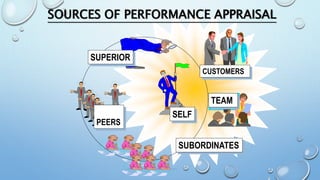
SUPERIOR
CUSTOMERS
SUBORDINATES
PEERS
SELF
SOURCES OF PERFORMANCE APPRAISAL
TEAM
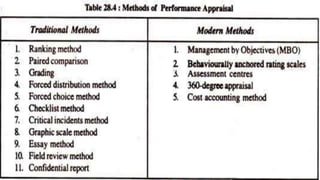
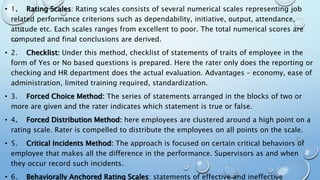
• 1. Rating Scales: Rating scales consists of several numerical scales representing job
related performance criterions such as dependability, initiative, output, attendance,
attitude etc. Each scales ranges from excellent to poor. The total numerical scores are
computed and final conclusions are derived.
• 2. Checklist: Under this method, checklist of statements of traits of employee in the
form of Yes or No based questions is prepared. Here the rater only does the reporting or
checking and HR department does the actual evaluation. Advantages – economy, ease of
administration, limited training required, standardization.
• 3. Forced Choice Method: The series of statements arranged in the blocks of two or
more are given and the rater indicates which statement is true or false.
• 4. Forced Distribution Method: here employees are clustered around a high point on a
rating scale. Rater is compelled to distribute the employees on all points on the scale.
• 5. Critical Incidents Method: The approach is focused on certain critical behaviors of
employee that makes all the difference in the performance. Supervisors as and when
they occur record such incidents.
• 6. Behaviorally Anchored Rating Scales: statements of effective and ineffective
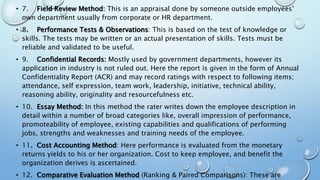
• 7. Field Review Method: This is an appraisal done by someone outside employees’
own department usually from corporate or HR department.
• 8. Performance Tests & Observations: This is based on the test of knowledge or
skills. The tests may be written or an actual presentation of skills. Tests must be
reliable and validated to be useful.
• 9. Confidential Records: Mostly used by government departments, however its
application in industry is not ruled out. Here the report is given in the form of Annual
Confidentiality Report (ACR) and may record ratings with respect to following items;
attendance, self expression, team work, leadership, initiative, technical ability,
reasoning ability, originality and resourcefulness etc.
• 10. Essay Method: In this method the rater writes down the employee description in
detail within a number of broad categories like, overall impression of performance,
promoteability of employee, existing capabilities and qualifications of performing
jobs, strengths and weaknesses and training needs of the employee.
• 11. Cost Accounting Method: Here performance is evaluated from the monetary
returns yields to his or her organization. Cost to keep employee, and benefit the
organization derives is ascertained.
• 12. Comparative Evaluation Method (Ranking & Paired Comparisons): These are
FUTURE ORIENTED METHODS
1. Management By Objectives: It means management by objectives and the performance is rated against the
achievement of objectives stated by the management. MBO process goes as under.
Establish goals and desired outcomes for each subordinate - Setting performance standards - Comparison of actual
goals with goals attained by the employee - Establish new goals and new strategies for goals not achieved in previous
year.
2. Psychological Appraisals: These appraisals are more directed to assess employees potential for future performance
rather than the past one. It is done in the form of in-depth interviews, psychological tests, and discussion with
supervisors and review of other evaluations. It is more focused on employees emotional, intellectual, and
motivational and other personal characteristics affecting his performance.
3. Assessment Centers: This technique was first developed in USA and UK in 1943. An assessment center is a central
location where managers may come together to have their participation in job related exercises evaluated by trained
observers. It is more focused on observation of behaviors across a series of select exercises or work samples.
Assesses are requested to participate in in-basket exercises, work groups, computer simulations, role playing and
other similar activities which require same attributes for successful performance in actual job. The characteristics
assessed in assessment center can be assertiveness, persuasive ability, communicating ability, planning and
organizational ability, self confidence, resistance to stress, energy level, decision making, sensitivity to feelings,
administrative ability, creativity and mental alertness etc
4. 360-Degree Feedback: It is a technique which is systematic collection of performance data on an individual group,
derived from a number of stakeholders like immediate supervisors, team members, customers, peers and self. In
fact anyone who has useful information on how an employee does a job may be one of the appraisers. This
technique is highly useful in terms of broader perspective, greater self-development and multi-source feedback is
useful. 360-degree appraisals are useful to measure inter-personal skills, customer satisfaction and team building
skills. However on the negative side, receiving feedback from multiple sources can be intimidating, threatening etc.
APPRAISING MANAGER PERFORMANCE
• Who can appraising managers?
1- committee of top mangers.
2- counselor.
3- group of vice president.
4- subordinate.
* Management use 7S methods:-
1-System.
2-strategy.
3-structure.
4-Style.
5-stff.
6-skills.
7-shred values.
INDIRECT METHODS OF APPRAISAL”
OBJECTIVE”
• Technical power
• Social power
• Personal power
• Political power
• Financial power
DIRECT METHODS OF APPRAISAL”
SUBJECTIVE”
• Intelligence
• Knowledge
• Persuade people well
• Humanism
• Self-control
• Responsibility
• Creativity
• Innovation
• Information skills
• Coaching
• Polity behavior TACT

The performance appraisal

  • 1.
  • 2.
    PERFORMANCE APPRAISAL DEFINITION •Performance Appraisal is the systematic evaluation of the performance of employees and to understand the abilities of a person for further growth and development. Performance appraisal is generally done in systematic ways which are as follows:- • The supervisors measure the pay of employees and compare it with targets and plans. • The employers are in position to guide the employees for a better performance.
  • 3.
    OBJECTIVES OF PERFORMANCEAPPRAISAL • To maintain records in order to determine compensation packages, wage structure, salaries raises, etc. • To identify the strengths and weaknesses of employees to place right men on right job. • To maintain and assess the potential present in a person for further growth and development. • To provide a feedback to employees regarding their performance and related status. • To provide a feedback to employees regarding their performance and related status. • To review and retain the promotional and other training programmers.
  • 4.
    ADVANTAGES OF PERFORMANCEAPPRAISAL • Promotion: Performance Appraisal helps the supervisors to chalk out the promotion programmers for efficient employees. • Compensation: Compensation packages which includes bonus, high salary rates, extra benefits, allowances and pre-requisites are dependent on performance appraisal. • Employees Development: It helps to analyses strengths and weaknesses of employees so that new jobs can be designed for efficient employees. It also helps in framing future training development programmers. • Selection Validation: understand the validity and importance of the selection procedure and Future changes in selection methods can be made in this regard. • Communication: For an organization, effective communication between employees and employers is very important. • Motivation: Through evaluating performance of employees, a person’s efficiency can be determined if the targets are achieved. This very well motivates a person for better job and helps him to improve his/her performance in the future.
  • 5.
    PROCESS OF PERFORMANCEAPPRAISAL 1. Establish Performance Standards: The managers must determine what outputs, accomplishments and skills will be evaluated, These performance standards should also be clear and objective to be understood and measured. 2. Communicate Performance Expectations to Employees: Once the performance standards are established, this need to be communicated to the respective employees so that they come to know what is expected of them. The feedback from the employees on the standards communicated to them must be obtained. 3. Measure Actual Performance: In this stage, the actual performance of the employee is measured on the basis of information available from various sources such as personal observation, statistical reports, oral reports, and written reports.
  • 6.
    4. Compare ActualPerformance with Standards: the actual performance is compared with the predetermined standards. Such a comparison may reveal the deviation between standard performance and actual performance and will enable the evaluator to proceed to the fifth step in the process. 5. Discuss the Appraisal with the Employee: is to communicate to and discuss with the employees the results of the appraisal. A discussion on appraisal enables employees to know their strengths and weaknesses, the impact may be positive or negative depending upon how the appraisal is presented and discussed with the employees. 6. Initiate Corrective Action: the common examples of corrective actions that managers initiate to
  • 7.
    COMMON PROBLEMS WITHPERFORMANCE APPRAISALS • Objection 1: Once-a-year (or even twice) critiquing (at the annual appraisal) encourages people to save up and squirrel away both praise and criticism for months instead of giving it at the appropriate time. • Objection 2: Managers are cowardly – they know that low marks are demoralizing so they avoid giving them and hence a paper trail of the poor performers suggests they are performing well. • Objection 3: Appraisal confounds different functions: feedback, coaching, development, pay decisions, legal documentation. • Objection 4: Appraisal is evaluation by ambush because employees were encouraged to meet a standard they had not seen, understood or thought relevant to their job. • Objection 5: Appraisals are either too inflexible to force real differentiation between individuals on trivial criteria or else so specific that no useful comparative data is generated.
  • 8.
    • Objection 6:the appraisal system is not organization-wide; special groups opt out quite unreasonably and unfairly. • Objection 7: Appraising and giving feedback are skills that needs to be taught before any system is put in place – ie, the system is not supported by training. • Objection 8: The rating scale means the numbers and the words do not match. • Objection 9: A cost-benefit analysis of designing, implementing and maintain a performance management system implies that, frankly, it isn’t worth it. • Objection 10: Individual appraisal ruins teamwork and team spirit. Traditionally appraisal is done on an individual basis: it's the
  • 9.
  • 11.
    • 1. RatingScales: Rating scales consists of several numerical scales representing job related performance criterions such as dependability, initiative, output, attendance, attitude etc. Each scales ranges from excellent to poor. The total numerical scores are computed and final conclusions are derived. • 2. Checklist: Under this method, checklist of statements of traits of employee in the form of Yes or No based questions is prepared. Here the rater only does the reporting or checking and HR department does the actual evaluation. Advantages – economy, ease of administration, limited training required, standardization. • 3. Forced Choice Method: The series of statements arranged in the blocks of two or more are given and the rater indicates which statement is true or false. • 4. Forced Distribution Method: here employees are clustered around a high point on a rating scale. Rater is compelled to distribute the employees on all points on the scale. • 5. Critical Incidents Method: The approach is focused on certain critical behaviors of employee that makes all the difference in the performance. Supervisors as and when they occur record such incidents. • 6. Behaviorally Anchored Rating Scales: statements of effective and ineffective
  • 12.
    • 7. FieldReview Method: This is an appraisal done by someone outside employees’ own department usually from corporate or HR department. • 8. Performance Tests & Observations: This is based on the test of knowledge or skills. The tests may be written or an actual presentation of skills. Tests must be reliable and validated to be useful. • 9. Confidential Records: Mostly used by government departments, however its application in industry is not ruled out. Here the report is given in the form of Annual Confidentiality Report (ACR) and may record ratings with respect to following items; attendance, self expression, team work, leadership, initiative, technical ability, reasoning ability, originality and resourcefulness etc. • 10. Essay Method: In this method the rater writes down the employee description in detail within a number of broad categories like, overall impression of performance, promoteability of employee, existing capabilities and qualifications of performing jobs, strengths and weaknesses and training needs of the employee. • 11. Cost Accounting Method: Here performance is evaluated from the monetary returns yields to his or her organization. Cost to keep employee, and benefit the organization derives is ascertained. • 12. Comparative Evaluation Method (Ranking & Paired Comparisons): These are
  • 13.
    FUTURE ORIENTED METHODS 1.Management By Objectives: It means management by objectives and the performance is rated against the achievement of objectives stated by the management. MBO process goes as under. Establish goals and desired outcomes for each subordinate - Setting performance standards - Comparison of actual goals with goals attained by the employee - Establish new goals and new strategies for goals not achieved in previous year. 2. Psychological Appraisals: These appraisals are more directed to assess employees potential for future performance rather than the past one. It is done in the form of in-depth interviews, psychological tests, and discussion with supervisors and review of other evaluations. It is more focused on employees emotional, intellectual, and motivational and other personal characteristics affecting his performance. 3. Assessment Centers: This technique was first developed in USA and UK in 1943. An assessment center is a central location where managers may come together to have their participation in job related exercises evaluated by trained observers. It is more focused on observation of behaviors across a series of select exercises or work samples. Assesses are requested to participate in in-basket exercises, work groups, computer simulations, role playing and other similar activities which require same attributes for successful performance in actual job. The characteristics assessed in assessment center can be assertiveness, persuasive ability, communicating ability, planning and organizational ability, self confidence, resistance to stress, energy level, decision making, sensitivity to feelings, administrative ability, creativity and mental alertness etc 4. 360-Degree Feedback: It is a technique which is systematic collection of performance data on an individual group, derived from a number of stakeholders like immediate supervisors, team members, customers, peers and self. In fact anyone who has useful information on how an employee does a job may be one of the appraisers. This technique is highly useful in terms of broader perspective, greater self-development and multi-source feedback is useful. 360-degree appraisals are useful to measure inter-personal skills, customer satisfaction and team building skills. However on the negative side, receiving feedback from multiple sources can be intimidating, threatening etc.
  • 14.
    APPRAISING MANAGER PERFORMANCE •Who can appraising managers? 1- committee of top mangers. 2- counselor. 3- group of vice president. 4- subordinate. * Management use 7S methods:- 1-System. 2-strategy. 3-structure. 4-Style. 5-stff. 6-skills. 7-shred values.
  • 15.
    INDIRECT METHODS OFAPPRAISAL” OBJECTIVE” • Technical power • Social power • Personal power • Political power • Financial power
  • 16.
    DIRECT METHODS OFAPPRAISAL” SUBJECTIVE” • Intelligence • Knowledge • Persuade people well • Humanism • Self-control • Responsibility • Creativity • Innovation • Information skills • Coaching • Polity behavior TACT